
Life, 1913-07-10 · page 25 of 44
Life — July 10, 1913 — page 25: what you’re looking at
What you’re looking at
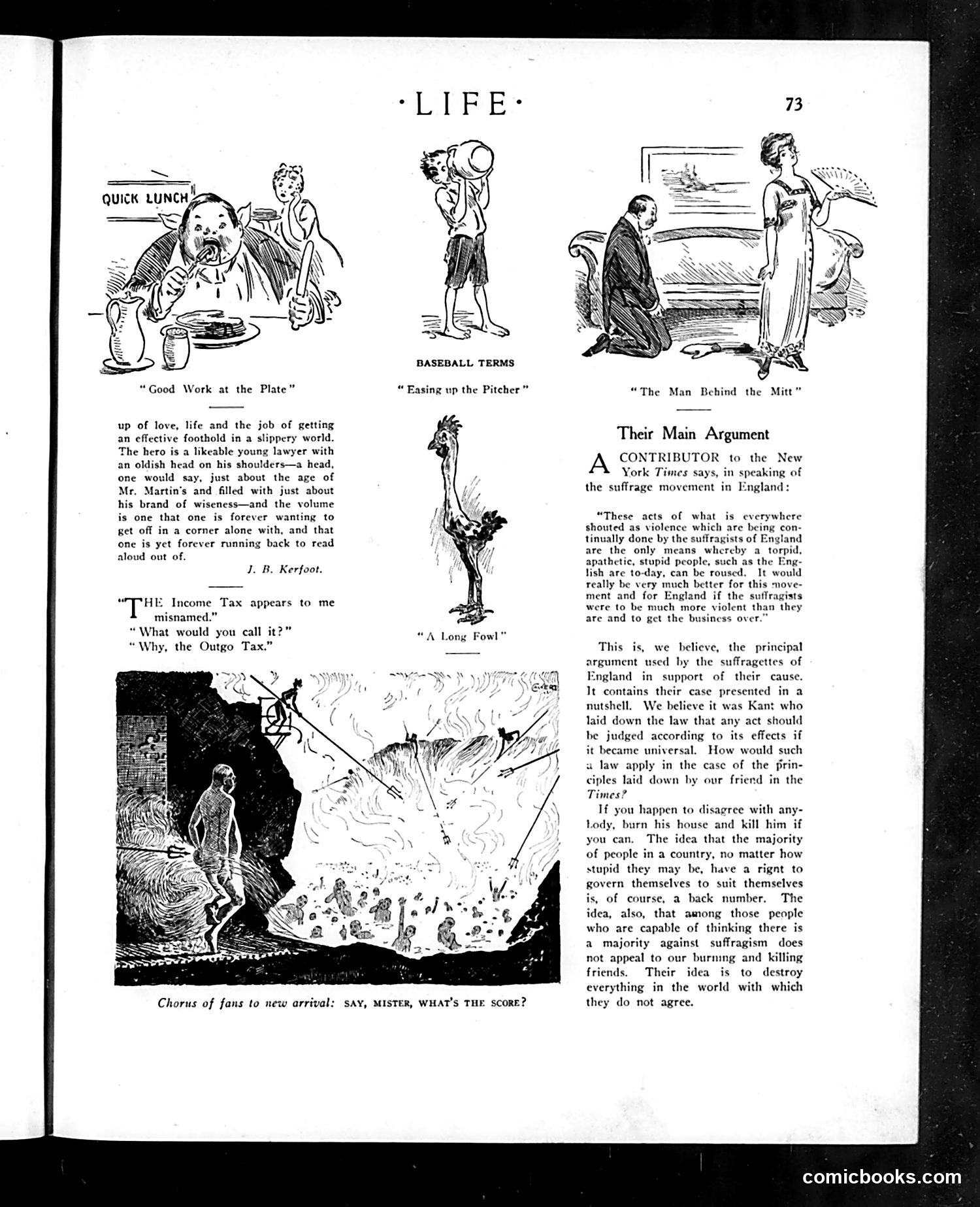
This page combines baseball-themed cartoons with serious political commentary on the British suffrage movement. The three top cartoons use baseball terminology as double entendre ("Good Work at the Plate," "Easing up the Pitcher," "The Man Behind the Mitt"). The main article critiques a *New York Times* contributor's argument defending suffragette violence in England. That contributor claimed violent acts were necessary to "rouse" the apathetic British public into supporting women's voting rights. Life's editorial response is scathing: it applies the contributor's logic universally—if violence is justified whenever you want change, then anyone could burn houses and kill opponents they disagree with. The piece argues this destroys the principle that majorities have the right to self-governance, and that this extremism undermines the suffragists' own cause. The satire targets both the suffragettes' violent tactics and the intellectuals defending them as justified means to an end.
📄 Transcribed text from this page (OCR, searchable)
Machine-transcribed from the original scan — historical spelling and the odd misread are preserved.
“Good Work at the Plate” up of love, life and the job of getting an effective foothold in a slippery world. The hero is a likeable young lawyer with an oldish head on his shoulders—a head, one would say, just about the age of Mr. Martin's and filled with just about his brand of wiseness—and the volume is one that one is forever wanting to get off in a corner alone with, and that one is yet forever running back to read aloud out of. J. B. Kerfoot. HE Income Tax appears to me misnamed.” “What would you call it?” “Why, the Outgo Tax.” Chorus of fans to new arrival: BASEBALL TERMS “ Easing up the Pitcher” A Long SAY, MISTER, WHAT'S THE SCORE? “The Man Behind the Mitt” Their Main Argument CONTRIBUTOR to the New York Times says, in speaking of the suffrage movement in England: “These acts of what is everywhere shouted as violence which are being con- tinually done by the suffragists of England are the only means whereby a torpid, apathetic, stupid people, such as the Eng- lish are to-day, can be roused. It would really be very much better for thi ment and for England were to be much more violent than they are and to get the business over.” This is, we believe, the principal argument used by the suffragettes of England in support of their cause. It contains their case presented in a nutshell. We believe it was Kant who laid down the law that any act should be judged according to its effects if it became universal. How would such u law apply in the case of the prin- ciples laid down by our friend in the Times? If you happen to disagree with any- Lody, burn his house and kill him if you can. The idea that the majority of people in a country, no matter how stupid they may be, have a rignt to govern themselves to suit themselves is, of course, a back number. The idea, also, that among those people who are capable of thinking there is a majority against suffragism does not appeal to our burming and killing friends. Their idea is to destroy everything in the world with which they do not agree. comicbooks.com