
Life, 1913-07-10 · page 24 of 44
Life — July 10, 1913 — page 24: what you’re looking at
What you’re looking at
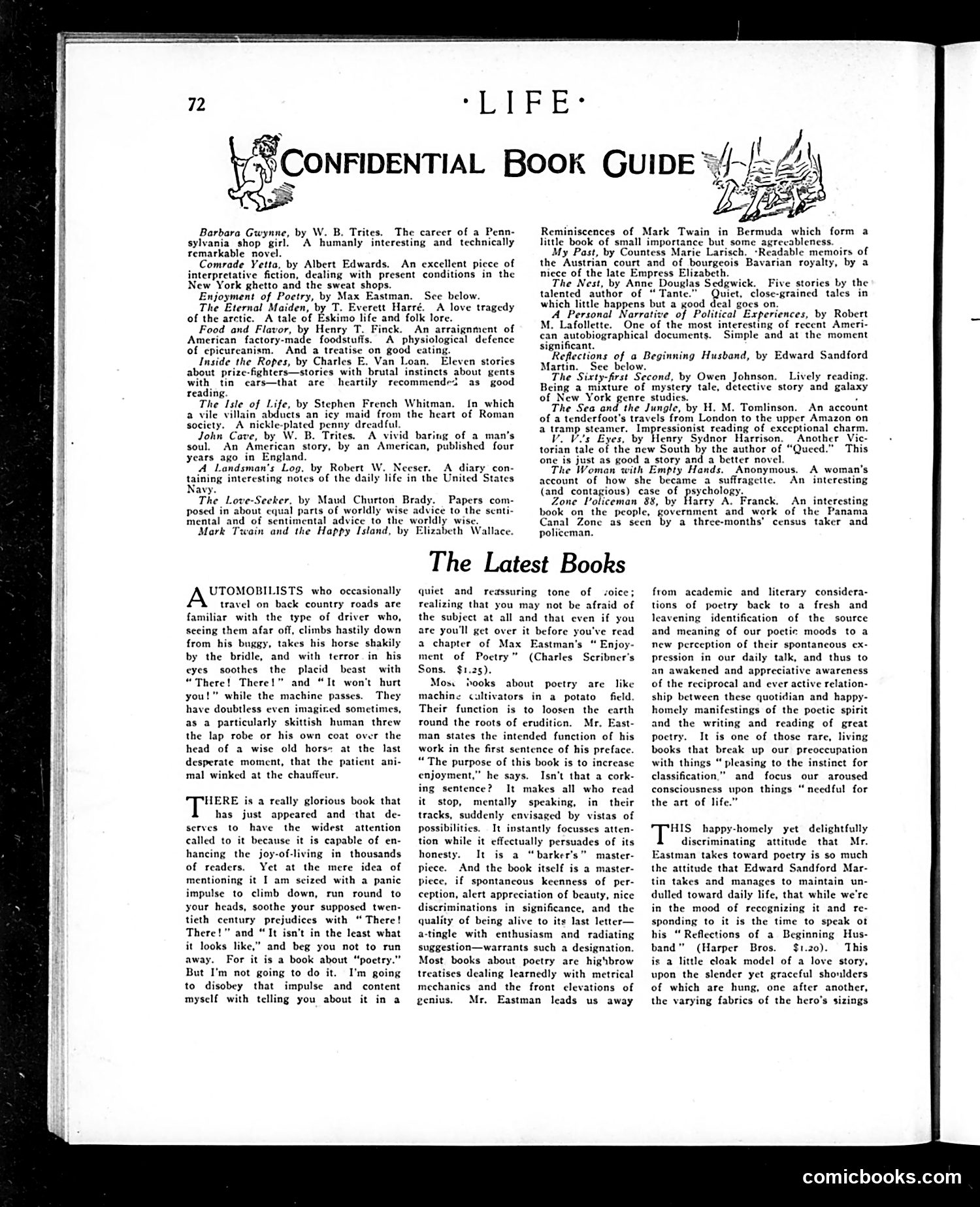
This is a book review section titled "Confidential Book Guide" from *Life* magazine, not a political cartoon page. It catalogs contemporary novels and non-fiction, offering brief critical assessments. Notable entries reveal early 1900s progressive concerns: "Comrade Yetta" addresses sweat shop conditions; Robert La Follette's autobiography on "Political Experiences" reflects interest in reform politics; and "The Woman with Empty Hands" describes how a woman became a suffragette—noted as "contagious" psychology, suggesting contemporary anxiety about women's activism. The lower section discusses Max Eastman's "Enjoyment of Poetry," debating whether poetry should be intellectually highbrow or accessible to ordinary readers. The automobile anecdote illustrates rural tension between old and new technology—horses panicking at cars. The page reflects Progressive Era literary culture: socially conscious fiction, political memoir, and debates about modernization versus tradition.
📄 Transcribed text from this page (OCR, searchable)
Machine-transcribed from the original scan — historical spelling and the odd misread are preserved.
“hes CONFIDENTIAL BOOK GUIDE *- Barbara Gwynne, by W. B. Trites. The career of a Penn- sylvania shop girl. A humanly interesting and technically remarkable novel. Comrade Yetta, by Albert Edwards. An excellent picce of interpretative fiction, dealing with present conditions in the New York ghetto and the sweat shops. Enjoyment of Poetry, by Max Eastman. Sce below. The Eternal Maiden, by T. Everett Harré. A love tragedy of the arctic. A tale of Eskimo life and folk lore. Food and Flavor, by Henry T, Finck. An arraignment of American factory-made foodstufis. A physiological defence of cpicurcanism. And a treatise on good cating. Inside the Ropes, by Charles E. Van Loan. Eleven stories about prize-fighters—stories with brutal instincts about gents with tin cars—that are heartily recommende? as good reading. The Isle of Life, by Stephen French Whitman, in which a vile villain abducts an icy maid from the heart of Roman society. A nickle-plated penny dreadful. John Cave, by W. B. Trites. A vivid baring of a man’s soul. An American story, by an American, published four years ago in England. A Landsman's Log. by Robert W. Neeser. A diary_con- taining interesting notes of the daily life in the United States Navy. The Love-Seeker, by Maud Churton Brady. Papers com- posed in about equal parts of worldly wise advice to the senti- mental and of sentimental advice to the worldly wise. Mark Twain and the Happy Island, by Elizabeth Wallace. Ves Reminiscences of Mark Twain in Bermuda which form a little book of small importance but some agrecableness. My Past, by Countess Marie Larisch. ‘Readable memoirs of the Austrian court and of bourgeois Bavarian royalty, by a niece of the late Empress Elizabeth. The Nest, by Anne Douglas Sedgwick. Five stories by the talented author of “Tante.” Quiet, close-grained tales in which little happens but a good deal goes o1 A Personal Narrative of Political Experiences, by Robert M. Lafollette. One of the most interesting of recent Ameri- can autobiographical documents. Simple and at the moment significant. Reflections of a Beginning Husband, by Edward Sandford Martin. See below. The Sixty-first Second, by Owen Johnson. Lively reading. Being a mixture of mystery tale, detective story and galaxy of New York genre studies. : The Sea and the Jungle, by H. M. Tomlinson. An account of a tenderfoot's travels from London to the upper Amazon on a tramp steamer. Impressionist reading of exceptional charm. V. V's Eyes, by Henry Sydnor Harrison, Another Vic- torian tale of the new South by the author of “Queed.” This one is just as good a story and a better novel. The Woman with Empty Hands. Anonymous. A woman's account of how she became a suffragette. An interesting (and contagious) case of poychology, Zone Policeman 88, by Harry Franck. An interesting book on the people, government and work of the Panama Canal Zone as seen by a three-months’ census taker and policeman. UTOMOBILISTS who occasionally travel on back country roads are familiar with the type of driver who, seeing them afar off, climbs hastily down from his buggy, takes his horse shakily by the bridle, and with terror in his eyes soothes the placid beast with “There! There!” and “It won't hurt you!" while the machine passes. They have doubtless even imagined sometimes, as a particularly skittish human threw the lap robe or his own coat over the head of a wise old hors: at the last desperate moment, that the patient ani- mal winked at the chauffeur. HERE is a really glorious book that has just appeared and that de- serves to have the widest attention called to it because it is capable of en- hancing the joy-of-living in thousands of readers. Yet at the mere idea of mentioning it I am seized with a panic impulse to climb down, run round to your heads, soothe your supposed twen- tieth century prejudices with “ There! There!" and “It isn’t in the least what it looks like,” and beg you not to run away. For it is a book about “poetry.” But I'm not going to do it. I'm going to disobey that impulse and content myself with telling you about it in a The Latest Books quiet and reassuring tone of coice; realizing that you may not be afraid of the subject at all and that even if you are you'll get over it before you've read a chapter of Max itman's “ Enjoy- ment of Poetry” (Charles Scribner's Sons. $1.25). Mos. books about poctry machine cultivators in a potato field. Their function is to loosen the earth round the roots of erudition. Mr, East- man states the intended function of his work in the first sentence of his preface. “ The purpose of this book is to increase enjoyment,” he says. Isn't that a cork- ing sentence? It makes all who read it stop, mentally speaking, in their tracks, suddenly envisaged by vistas of possibilities. It instantly focusses atten- tion while it effectually persuades of its honesty. It is a “barker’s” master- piece. And the book itself is a master- piece, if spontaneous keenness of per- ception, alert appreciation of beauty, nice discriminations in significance, and the quality of being alive to its last letter— a-tingle with enthusiasm and radiating suggestion—warrants such a designation. Most books about poetry are highbrow treatises dealing learnedly with metrical mechanics and the front elevations of genius. Mr. Eastman leads us away are like from academic and literary considera- tions of poetry back to a fresh and leavening identification of the source and meaning of our poetic moods to a new perception of their spontancous ex- pression in our daily talk, and thus to an awakened and appreciative awareness of the reciprocal and ever active relation- ship between these quotidian and happy- homely manifestings of the poctic spirit and the writing and reading of great poctry. It is one of those rare, living books that break up our preoccupation with things “ pleasing to the instinct for classification.” and focus our aroused consciousness upon things “needful for the art of life.” HIS happy-homely yet delightfully discriminating attitude that Mr. stman takes toward poetry is so much the attitude that Edward Sandford Mar- tin takes and manages to maintain un- dulled toward daily life, that while we're in the mood of recognizing it and re- sponding to it is the time to speak ot his “Reflections of a Beginning Hus- band” (Harper Bros. $1.20). This is a little cloak model of a love story, upon the slender yet graceful shoulders of which are hung, one after another, the varying fabrics of the hero's sizings comicbooks.com