
Life, 1913-07-10 · page 20 of 44
Life — July 10, 1913 — page 20: what you’re looking at
What you’re looking at
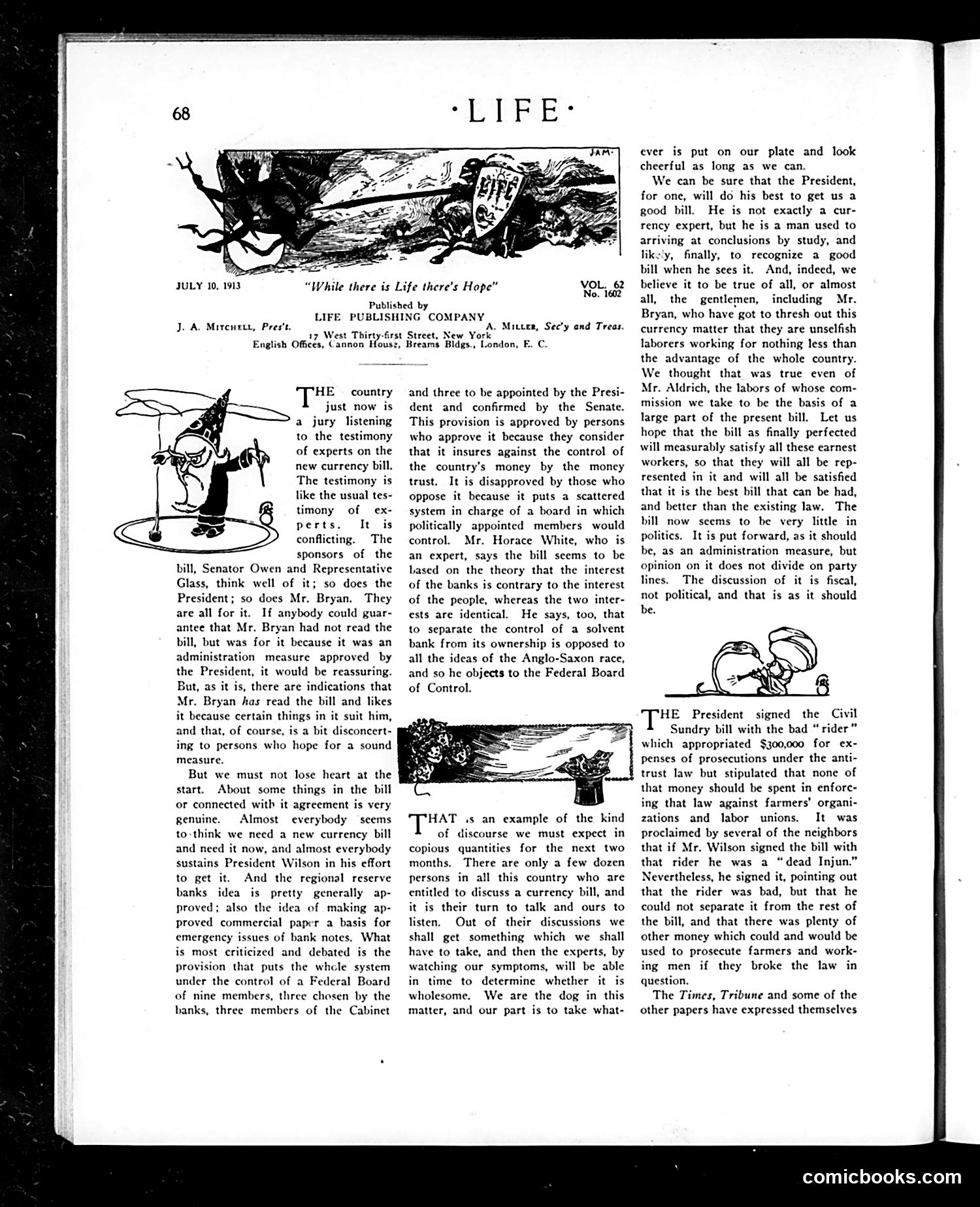
This editorial discusses the Federal Reserve Act then under debate in Congress. The page contains **no prominent cartoon**, but rather political commentary on currency reform. **The Context:** President Wilson is pushing a new currency bill through Congress with support from Senator Owen, Representative Glass, and Secretary of State William Jennings Bryan. The article notes that while experts disagree sharply about the bill's merits, the public must simply accept whatever legislation emerges—comparing citizens to a dog that must "take what" is given. **Key Debate:** The central controversy concerns a Federal Board controlling the banking system. Critics like economist Horace White object to this centralized control, arguing it separates bank ownership from control and reflects distrust of banks themselves. **The Satire:** The author gently mocks Bryan's sudden support for an administration measure, suggesting it's oddly convenient that he approves legislation he supposedly read and studied independently. The overall tone is resigned: the public is merely an audience to expert testimony, expected to accept the outcome without complaint.
📄 Transcribed text from this page (OCR, searchable)
Machine-transcribed from the original scan — historical spelling and the odd misread are preserved.
ever is put on our plate and look cheerful as long as we can. We can be sure that the President, for one, will do his best to get us a good bill. He is not exactly a cur- rency expert, but he is a man used to arriving at conclusions by study, and likely, finally, to recognize a good bill when he sees it. And, indeed, we 62 believe it to be true of all, or almost No. 162 yy JULY 10, 1913 “While there is Life there’s Hope” Published by LIFE PUBLISHING 17 West Thirty English Offices, Cannon Hous the gentlemen, including Mr. Bryan, who have got to thresh out this currency matter that they are unselfish laborers working for nothing less than the advantage of the whole country. COMPANY A st Street, New York Breams Bldgs., London, E. C. J. A. Mircnrtt, Pres’t. Mutter, Sec’y and Treas. HE country just now is a jury listening to the testimony of experts on the new currency bill. The testimony is like the usual tes- timony of ex- perts. It is conflicting. The sponsors of the bill, Senator Owen and Representative Glass, think well of it; so does the President; so does Mr. Bryan. They are all for it. If anybody could guar- antee that Mr. Bryan had not read the bill, but was for it because it was an administration measure approved by the President, it would be reassuring. But, as it is, there are indications that Mr. Bryan has read the bill and likes it because certain things in it suit him, and that, of course, is a bit disconcert- ing to persons who hope for a sound measure. But we must not lose heart at the start. About some things in the bill or connected with it agreement is very genuine. Almost everybody seems to-think we need a new currency bill and need it now, and almost everybody sustains President Wilson in his effort to get it. And the regional reserve banks idea is pretty generally ap- proved; also the idea of making ap- proved commercial paper a basis for emergency issues of bank notes. What is most criticized and debated is the provision that puts the whole system under the control of a Federal Board of nine members, three chosen by the banks, three members of the Cabinet and three to be appointed by the Presi- dent and confirmed by the Senate. This provision is approved by persons who approve it because they consider that it insures against the control of the country’s money by the moncy trust. It is disapproved by those who oppose it because it puts a scattered system in charge of a board in which politically appointed members would control. Mr. Horace White, who is an expert, says the bill seems to be based on the theory that the interest of the banks is contrary to the interest of the people, whereas the two inter- ests are identical. He says, too, that to separate the control of a solvent bank from its ownership is opposed to all the ideas of the Anglo-Saxon race, and so he objects to the Federal Board of Control. HAT .s an example of the kind of discourse we must expect in copious quantities for the next two months. There are only a few dozen persons in all this country who are entitled to discuss a currency bill, and it is their turn to talk and ours to listen. Out of their discussions we shall get something which we shall have to take, and then the experts, by watching our symptoms, will be able in time to determine whether it is wholesome. We are the dog in this matter, and our part is to take what- We thought that was true even of Mr. Aldrich, the labors of whose com- mission we take to be the basis of a large part of the present bill. Let us hope that the bill as finally perfected will measurably satisfy all these earnest workers, so that they will all be rep- resented in it and will all be satisfied that it is the best bill that can be had, and better than the existing law. The bill now seems to be very little in politics. It is put forward, as it should be, as an administration measure, but opinion on it does not divide on party lines. The discussion of it is fiscal, not political, and that is as it should be. HE President signed the Civil Sundry bill with the bad “ rider” which appropriated $300,000 for ex- penses of prosecutions under the anti- trust law but stipulated that none of that money should be spent in enfore- ing that law against farmers’ organi- zations and labor unions. It was proclaimed by several of the neighbors that if Mr. Wilson signed the bill with that rider he was a “dead Injun.” Nevertheless, he signed it, pointing out that the rider was bad, but that he could not separate it from the rest of the bill, and that there was plenty of other money which could and would be used to prosecute farmers and work- ing men if they broke the law in question. The Times, Tribune and some of the other papers have expressed themselves comicbooks.com