
Life, 1913-07-10 · page 37 of 44
Life — July 10, 1913 — page 37: what you’re looking at
What you’re looking at
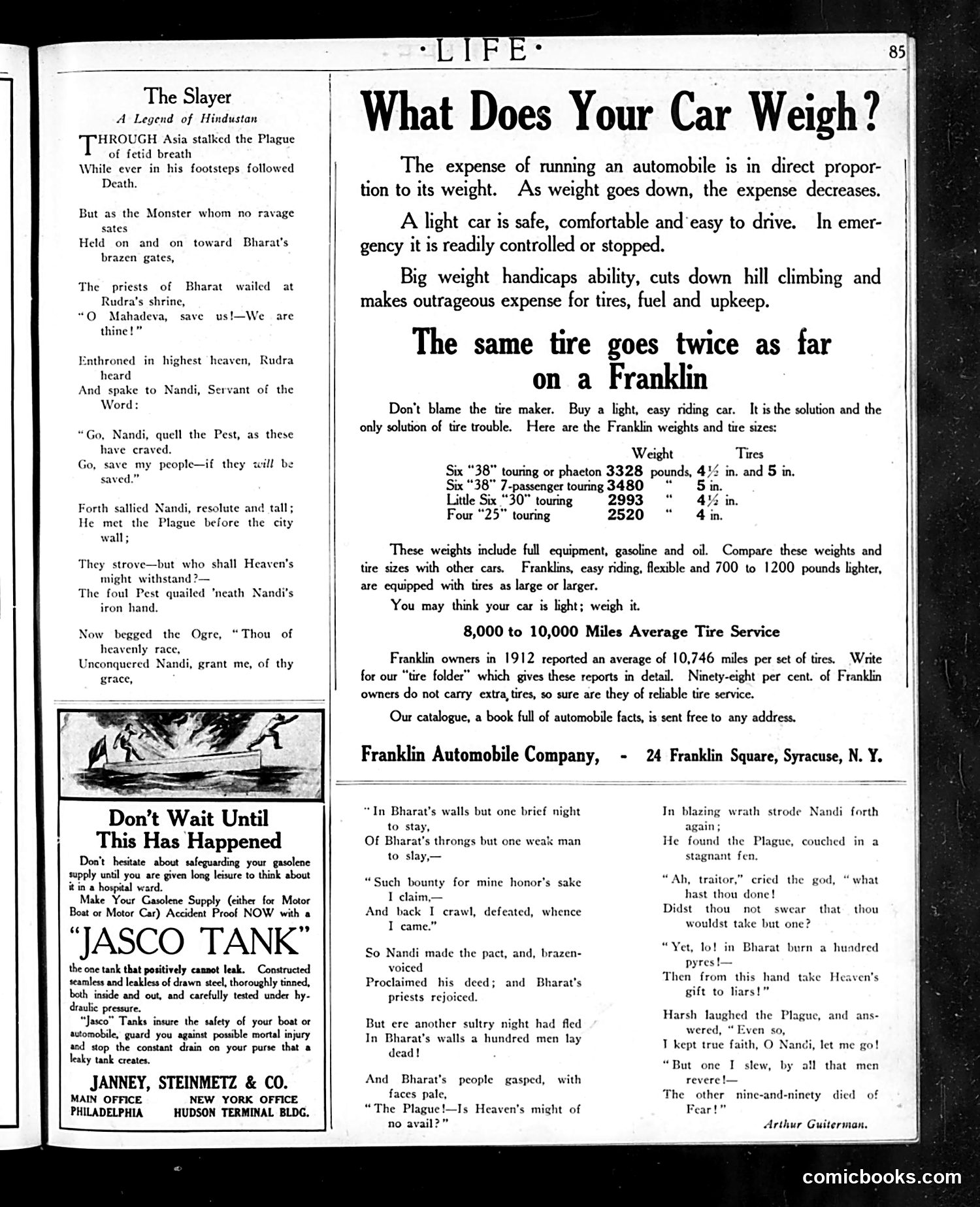
This page mixes literary content with automobile advertising, representing early 20th-century magazine design. **Left side:** "The Slayer: A Legend of Hindustan" is a narrative poem about the Hindu god Nandi defeating the Plague that threatens India. The story uses Hindu mythology metaphorically—the Plague breaches a pact by killing far more than agreed, forcing Nandi to confront it again. This appears to reference real plague outbreaks affecting India during this period, framing divine intervention in classical terms for American readers. **Right side:** Two advertisements—the Jasco Tank (gasoline safety) and Franklin Automobile Company (promoting lightweight cars). The Franklin ad argues that lighter vehicles cost less to operate, citing tire longevity data from 1912 owners. This reflects early automotive competition focused on efficiency rather than power. The juxtaposition is typical of Life's format: serious literature alongside commercial messaging.
📄 Transcribed text from this page (OCR, searchable)
Machine-transcribed from the original scan — historical spelling and the odd misread are preserved.
The Slayer A Legend of Hindustan HROUGH Asia stalked the Plague of fetid breath While ever in his footsteps followed Death. But as the Monster whom no ravage sates Held on and on toward Bharat’s brazen gates, The priests of Bharat wailed at Rudra’s shrine, “O Mahadeva, save us!—We are thine!” Enthroned in highest heaven, Rudra heard And spake to Nandi, Servant of the Word: “Go, Nandi, quell the Pest, as these have craved. Go, save my people—if they will be saved.” Forth sallied Nandi, resolute and tall; He met the Plague before the city wall; They strove—but who shall Heaven's might withstand ?— The foul Pest quailed ‘neath Nandi’s iron hand. Now begged the Ogre, “Thou of heavenly race, Unconquered Nandi, grant me, of thy grace, a Don’t Wait Until This Has Happened Don't hesitate about safeguarding your gasolene supply until you are given long leisure to think about it in a hospital ward. Make Your Gasolene Supply (either for Motor Boat or Motor Car) Accident Proof NOW with a “JASCO TANK" the one tank that positively cannot leak. Constructed seamless and leakless of drawn steel, thoroughly tinned, both inside and out, and carefully tested under hy- draulic pressure. “Jasco” Tanks insure the safety of your boat or automobile, guard you against possible mortal injury and stop the constant drain on your purse that a leaky tank creates. JANNEY, STEINMETZ & CO. MAIN OFFICE NEW YORK OFFICE PHILADELPHIA © HUDSON TERMINAL BLDG. What Does Your Car Weigh? The expense of running an automobile is in direct propor- tion to its weight. As weight goes down, the expense decreases. A light car is safe, comfortable and’easy to drive. In emer- gency it is readily controlled or stopped. Big weight handicaps ability, cuts down hill climbing and makes outrageous expense for tires, fuel and upkeep. The same tire goes twice as far on a Franklin Don’t blame the tire maker. Buy a light, easy riding car. It is the solution and the only solution of tire trouble. Here are the Franklin weights and tire sizes: Weight Tires Six “38” touring or phaeton 3328 pounds, 414 in. and 5 in. Six “38” 7-passenger tourng3480 “ Sin Little Six “30” touring 2993 Four “25” touring 2520 These weights include full equipment, gasoline and oil. Compare these weights and tire sizes with other cars. Franklins, easy riding, flexible and 700 to 1200 pounds lighter, are equipped with tires as large or larger. You may think your car is light; weigh it. 8,000 to 10,000 Miles Average Tire Service Franklin owners in 1912 reported an average of 10,746 miles per set of tires. Write for our “tire folder” which gives these reports in detail. Ninety-eight per cent. of Franklin owners do not carry extra, tires, so sure are they of reliable tire service. Our catalogue, a book full of automobile facts, is sent free to any address. Franklin Automobile Company, - 24 Franklin Square, Syracuse, N. Y. “In Bharat’s walls but one brief night to stay, Of Bharat’s throngs but one weak man to slay,— “Such bounty for mine honor's sake 1 claim,— And back I crawl, defeated, whence I came.” So Nandi made the pact, and, brazen- voiced Proclaimed his deed; and Bharat’s priests rejoiced. But ere another sultry night had fled In Bharat’s walls a hundred men lay dead! And Bharat’s people gasped, with faces pale, “The Plague!—Is Heaven's might of no avail?” In blazing wrath strode Nandi forth again; He found the Plague, couched in a stagnant fen, “Ah, traitor,” cried the god, “what hast thou done! Didst thou not swear that thou wouldst take but one? “Yet, lo! in Bharat burn a hundred pyres !— Then from this hand take Heaven's gift to liars!" Harsh laughed the Plague, and ans- wered, “Even so, T kept true faith, O Nandi, let me go! “But one I slew, by all that men revere !— The other ninc-and-ninety died of Fear!” Arthur Guiterman, comicbooks.com