
A complete issue · 52 pages · 1913
Life — June 5, 1913
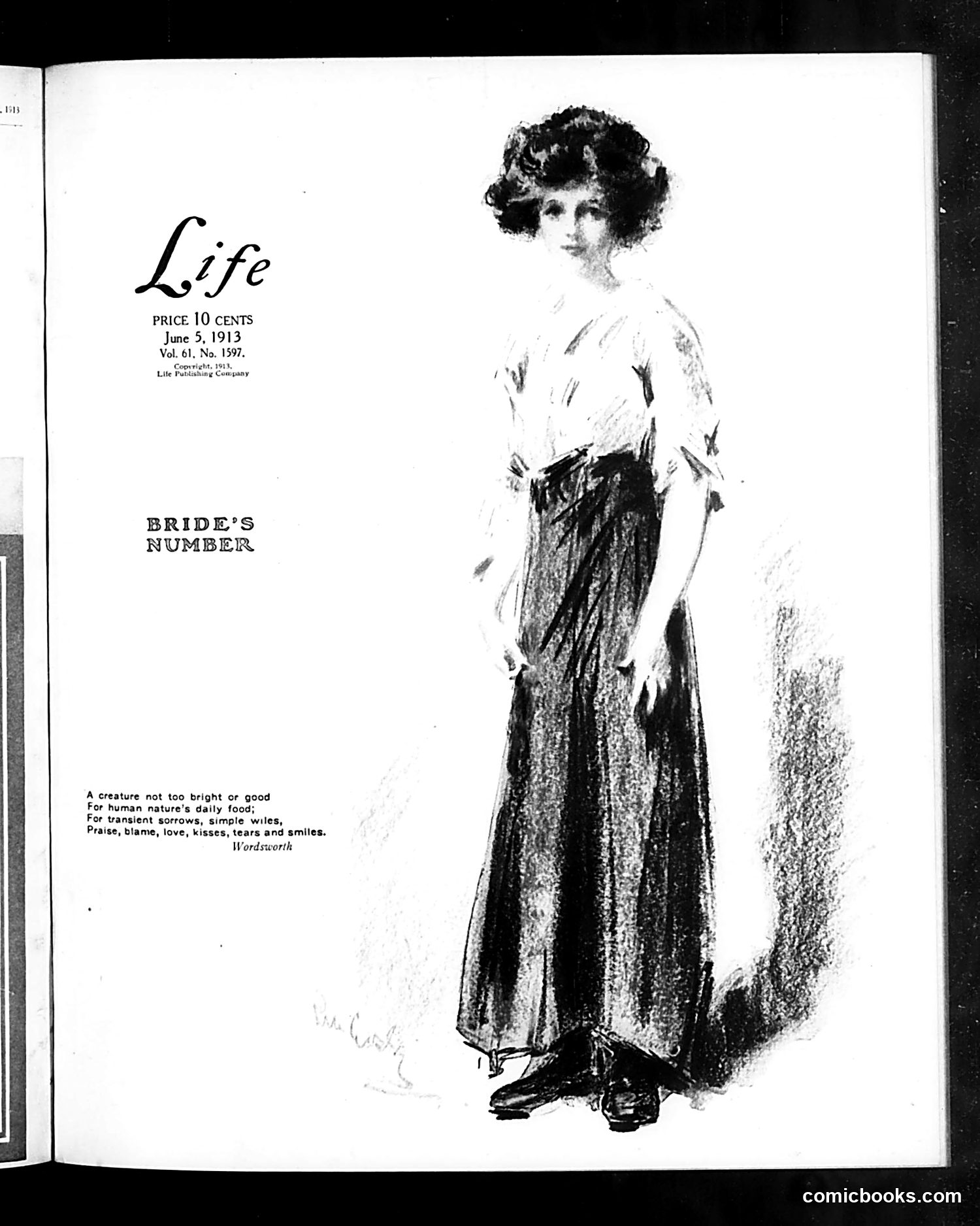
This is the cover of *Life* magazine's "Bride's Number" from June 5, 1913. It features an elegant illustration of a woman in bridal attire—a white blouse and long dark skirt with train—depicted in the refined drawing style typical of early 20th-century fashion illustration. The Wordsworth quote below ("A creature not too bright or good / For human nature's daily food...") appears ironic: it presents an unflattering view of womanhood while the cover celebrates bridal beauty. This juxtaposition likely satirizes the gap between romantic idealization of brides and realistic expectations of marriage—a common theme in *Life*'s social commentary. The issue capitalizes on wedding season readership while gently mocking both marital sentiments and feminine idealization.
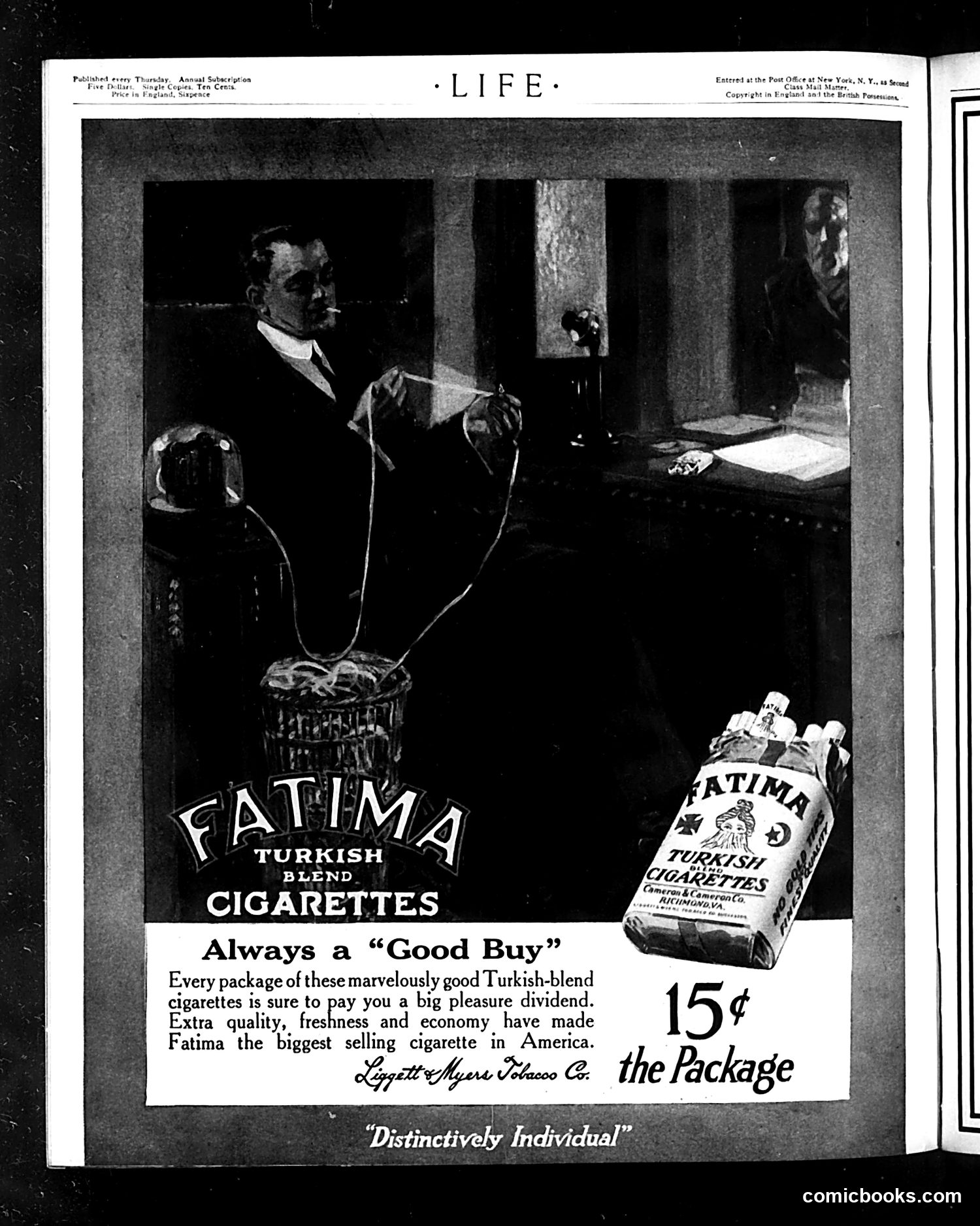
This page is primarily a **cigarette advertisement**, not satire or political commentary. It depicts a man in formal attire using what appears to be an early telephone or electrical device with two headset-like components emerging from a basket of cigarettes. The ad claims Fatima Turkish-blend cigarettes are "Always a 'Good Buy'" at 15¢ per package, emphasizing "extra quality, freshness and economy" while asserting it's "the biggest selling cigarette in America." The tagline "Distinctly Individual" appears below. The scene's purpose is unclear—it may represent some kind of technical or scientific endorsement, though without additional context, the specific meaning of the imagery remains ambiguous. This reflects early-20th-century advertising style promoting consumer products.
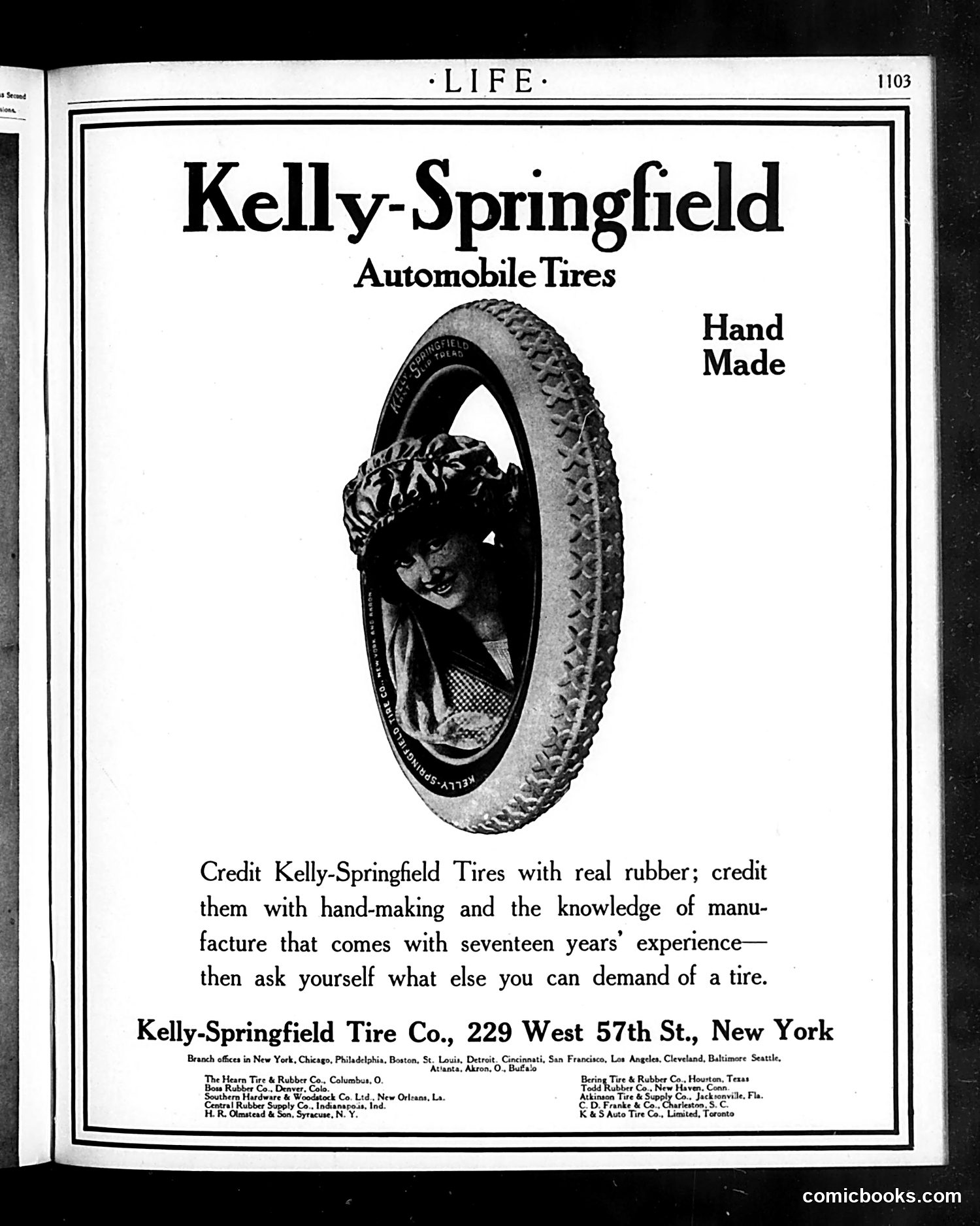
This is a **straightforward product advertisement**, not satire or political commentary. The ad promotes Kelly-Springfield brand automobile tires, emphasizing they are "Hand Made" and contain "real rubber." The central image shows a tire with a woman's face and upper body visible through its center, likely meant as an appealing visual device. The advertising copy appeals to quality and experience, claiming seventeen years of manufacturing knowledge. The company lists branch offices across major American cities (New York, Chicago, Denver, etc.). This represents typical early-20th-century tire advertising, when rubber tires were still relatively new automotive technology and hand-manufacturing was a selling point suggesting quality craftsmanship rather than mass production.
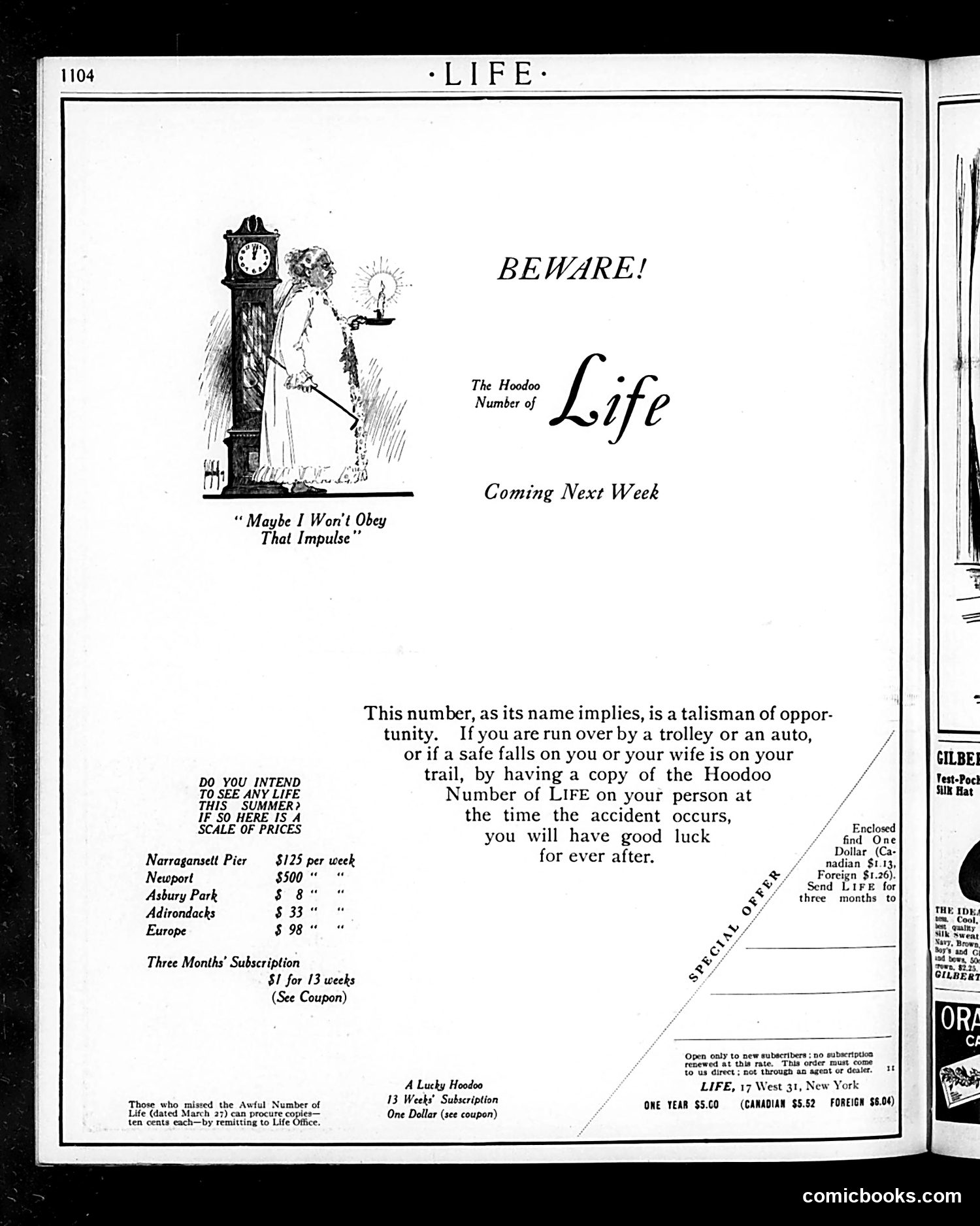
This is a humorous advertisement for an upcoming special issue of *Life* magazine. The central image shows a skeletal figure (representing bad luck or death) holding a candle next to a grandfather clock, with the caption "Maybe I Won't Obey That Impulse." The "Hoodoo Number" plays on superstition—referring to the issue as a talisman against accidents. The accompanying text humorously suggests readers carry a copy for protection: if struck by a trolley, auto accident, or other mishap, possessing this magazine will guarantee "good luck for ever after." This satirizes both contemporary anxieties about modern transportation dangers and the public's susceptibility to superstitious beliefs. The skeletal figure and dark imagery make the joke about mortality darkly comic while advertising the upcoming special issue.
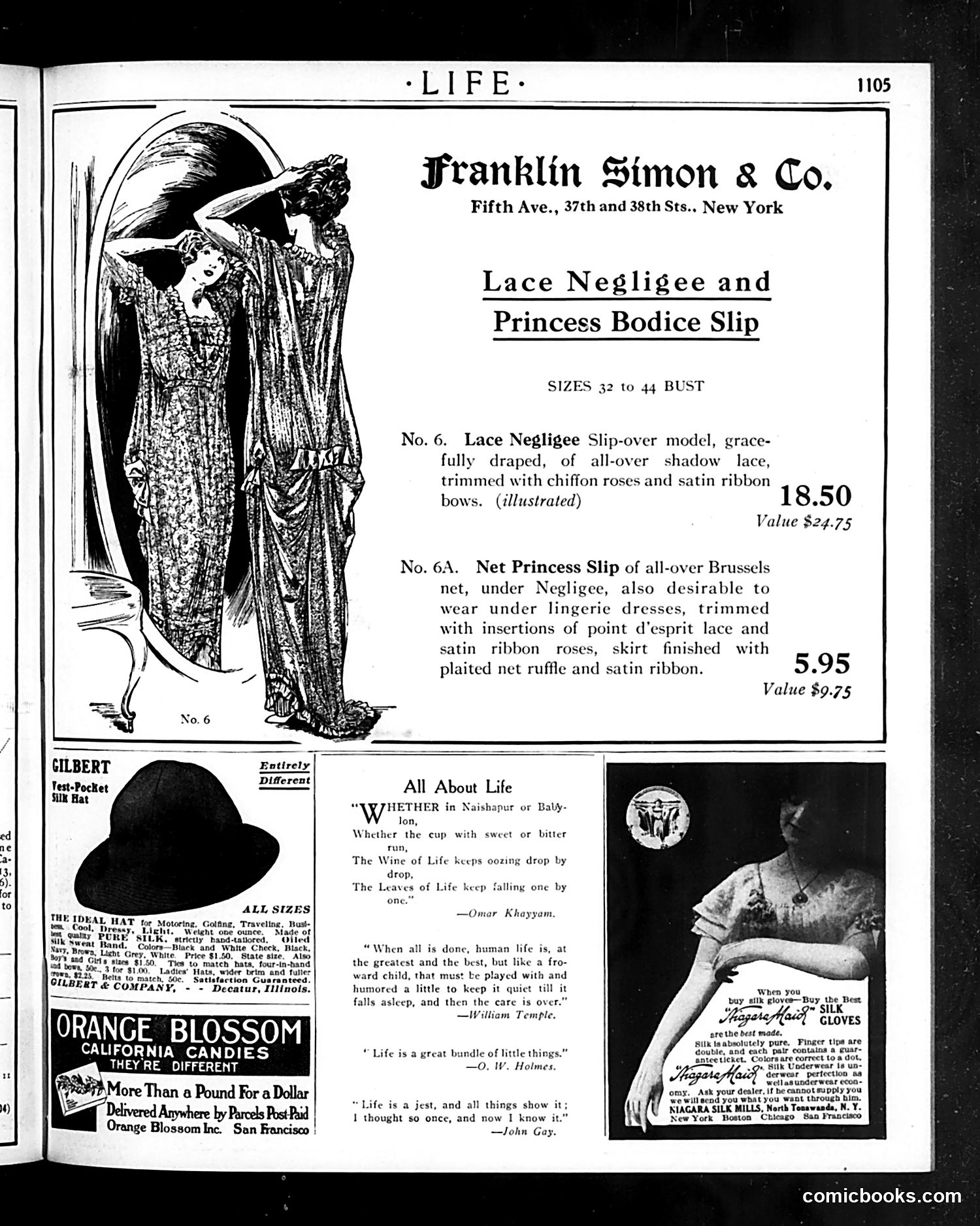
This page is primarily **advertising**, not satire or political commentary. It contains: 1. **Franklin Simon & Co. advertisement** (top): Features a large illustration of a woman modeling elegant lace negligees and slips, priced at $18.50 and $5.95 respectively. This is straightforward fashion advertising for women's undergarments. 2. **"All About Life" section** (center-right): Contains quotations about life from various sources (Omar Khayyam, William Temple, O.W. Holmes, John Gay)—philosophical musings rather than satire. 3. **Supporting advertisements**: Gilbert hat company, Orange Blossom candies, and Niagara Silk Mills gloves. The page reflects early 20th-century consumer culture and women's fashion marketing. There is no discernible political cartoon or satirical content present.
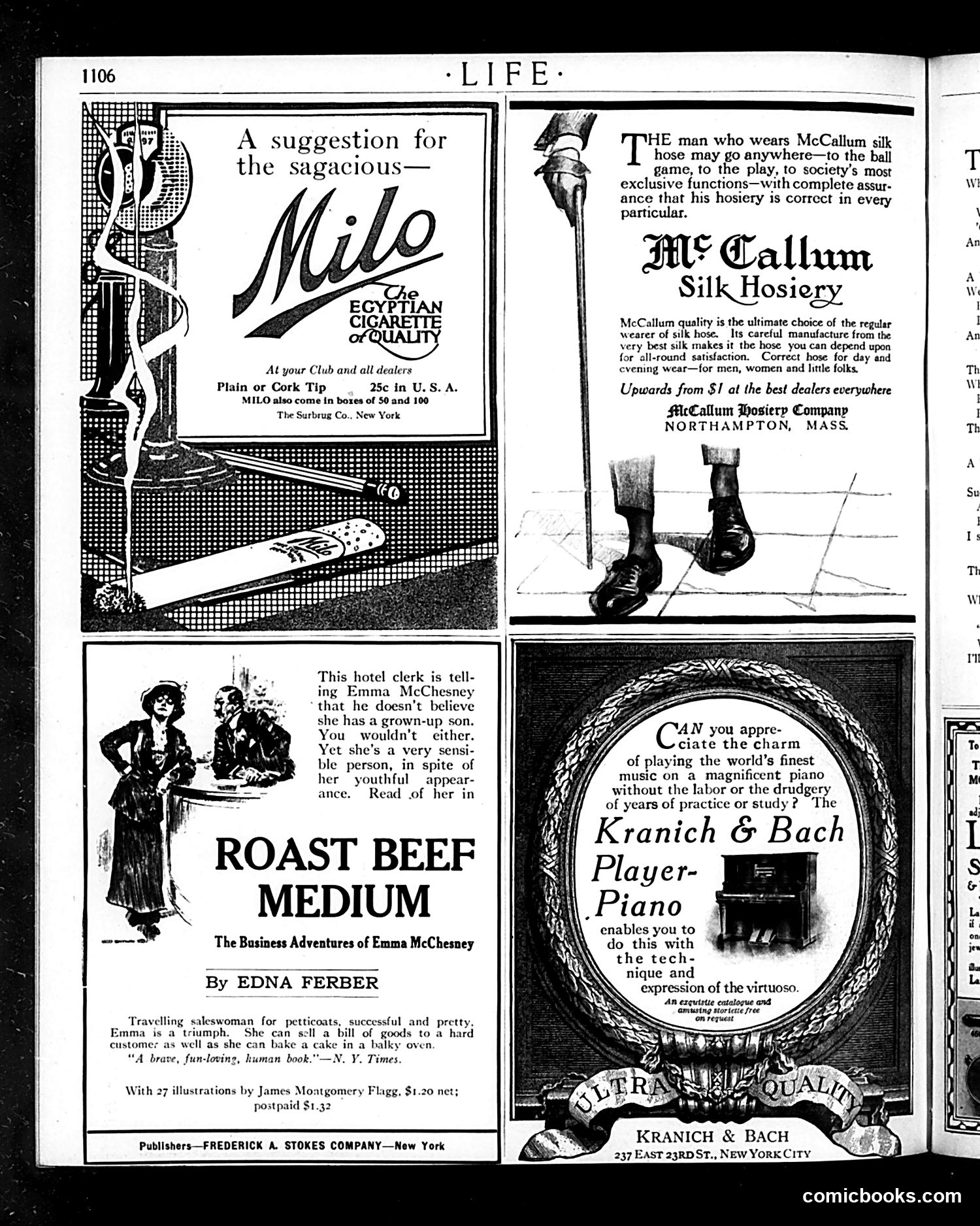
This page is primarily **advertising**, not satire or editorial content. It contains four ads: 1. **Milo cigarettes** - Egyptian cigarettes marketed as quality products, sold at clubs and dealers 2. **McCallum Silk Hosiery** - Silk socks/stockings for men, women, and children, emphasizing correctness for formal occasions 3. **"Roast Beef Medium"** - A serialized story by Edna Ferber about Emma McChesney, a traveling saleswoman. The text notes she's successful, pretty, and resourceful despite being underestimated 4. **Kranich & Bach Player-Piano** - A self-playing piano marketed as enabling musical appreciation without years of practice The McChesney story appears to be the magazine's main feature content. No political satire is present on this page.
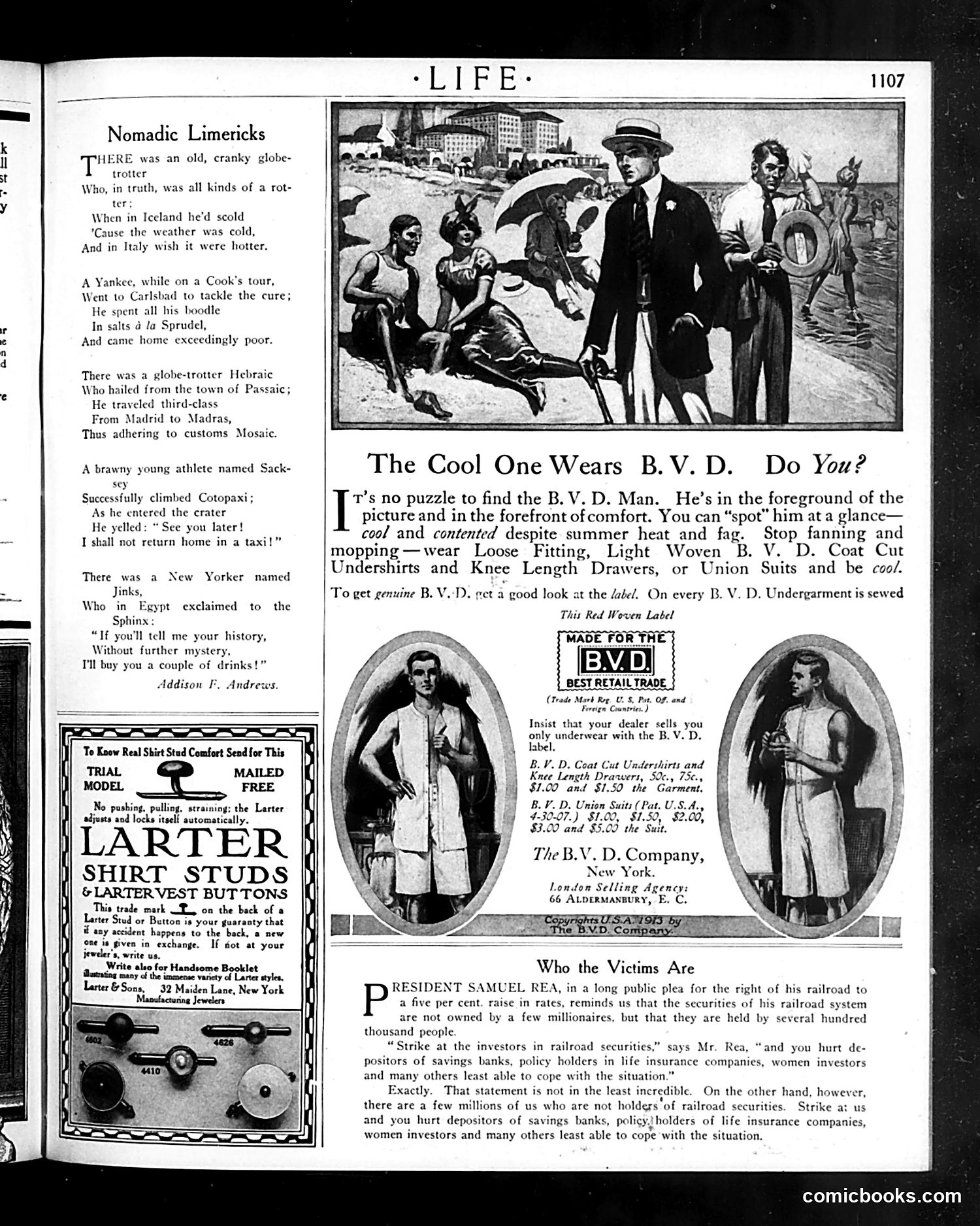
This page is primarily **advertising and light humor** rather than political satire. The left side contains **"Nomadic Limericks"**—humorous five-line poems about travelers and wanderers (a Yankee, a globe-trotter, an athlete, a New Yorker), presented as gentle social commentary on American types. The main illustration advertises **B.V.D. brand underwear**, showing a well-dressed man in summer clothing. The advertisement's humor lies in the play on "cool" (both temperature and demeanor)—suggesting B.V.D. underwear makes one appear sophisticated and composed despite summer heat. The bottom section, "Who the Victims Are," discusses railroad strike impacts on investors and ordinary people holding railroad securities and life insurance policies. Overall, this is a **typical early 20th-century magazine page** mixing light verse, product advertising, and economic commentary rather than sharp political satire.
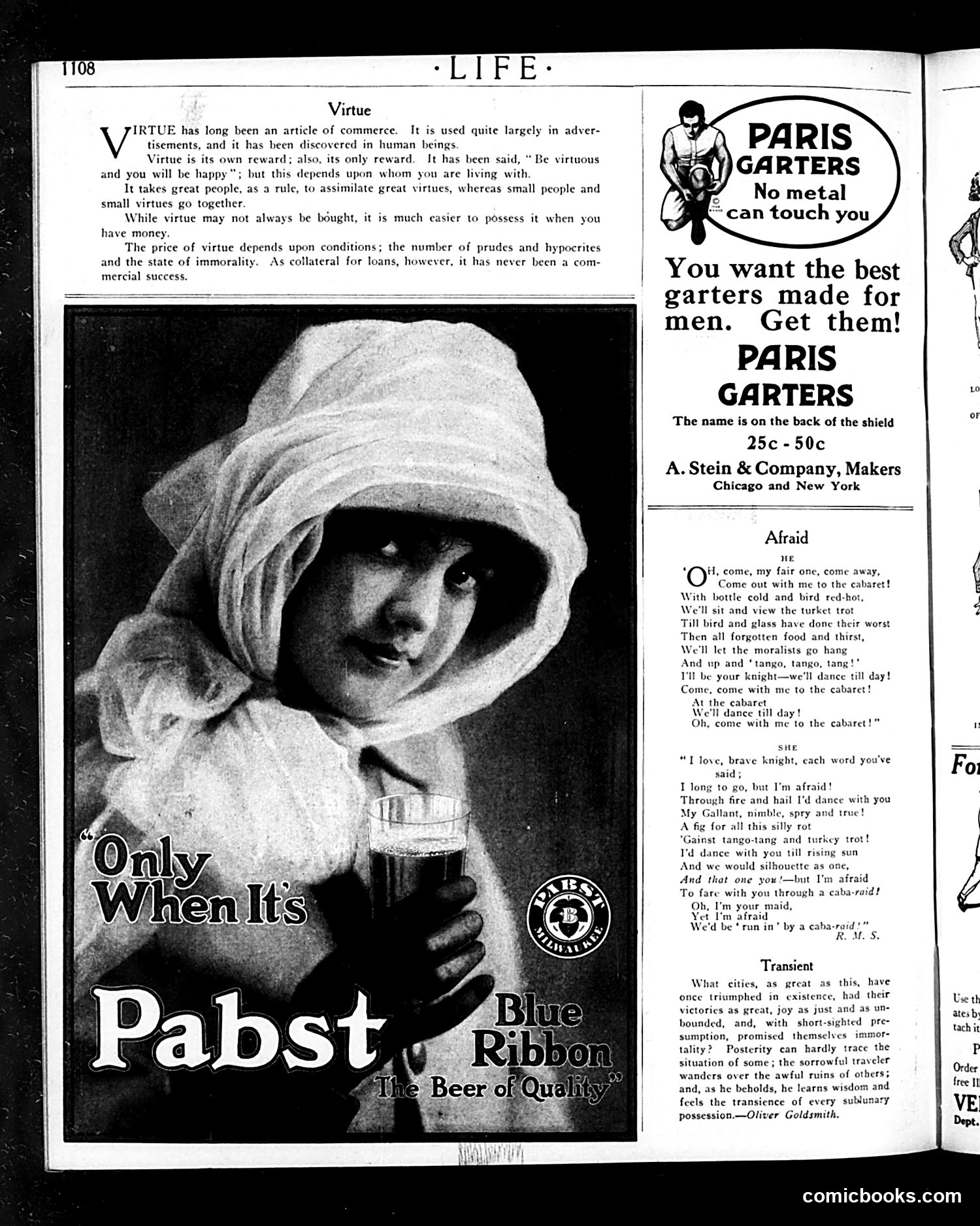
This page contains **advertisements and poetry rather than political cartoons**. The main advertisement features **Pabst Blue Ribbon beer**, showing a woman in a large, fashionable hat holding a glass with the slogan "Only When It's Pabst." This represents early 20th-century beer marketing emphasizing quality and lifestyle. A secondary ad promotes **Paris Garters** (men's sock supporters), claiming superiority through "no metal" construction—addressing practical concerns for the era. The text includes a brief essay on "Virtue" discussing its commercial and personal value, followed by a poem titled "Afraid" about romantic hesitation at a cabaret, and another piece called "Transient" on urban transience and mortality. This reflects Life magazine's mix of satirical commentary, advertising, and literary content typical of the period.
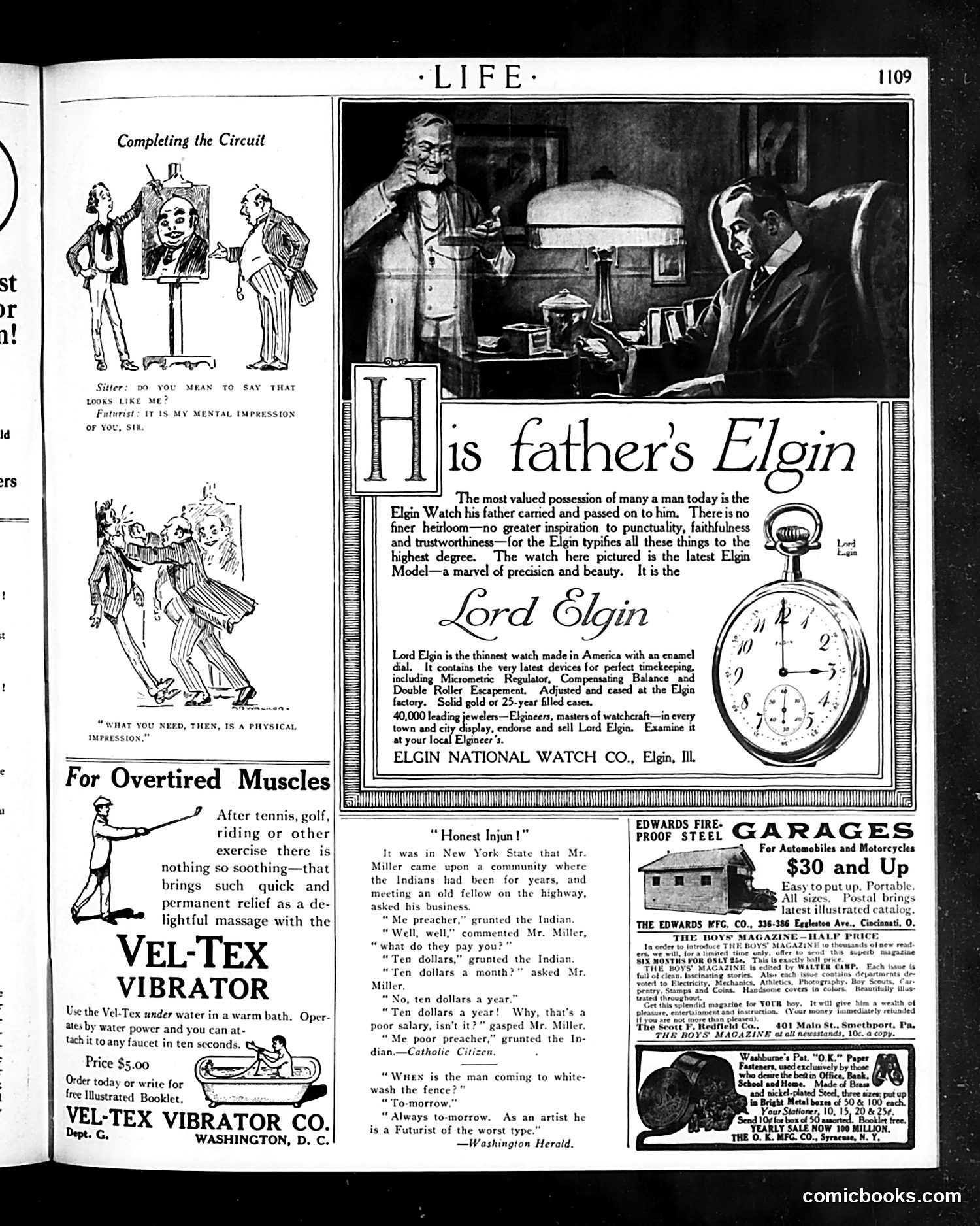
This page is primarily **advertising** with two satirical cartoons on the left margin. **Top cartoon ("Completing the Circuit"):** Shows a man at a mirror where a "Mental Impression" device creates his reflection. The joke: the man asks if the apparatus makes him "look like me"—satirizing pseudoscientific contraptions claiming to manipulate appearance or psychology. This reflects early 20th-century skepticism toward dubious scientific gadgets. **Bottom cartoon ("For Overtired Muscles"):** Advertises the Vel-Tex Vibrator, a massage device. The cartoon shows a woman using it in a bathtub—typical period marketing of vibrators as legitimate therapeutic devices for muscle fatigue. The main content features **Lord Elgin watches** (premium timepieces), Edwards Fireproof Steel Garages, and other consumer goods typical of *Life* magazine's advertising model.
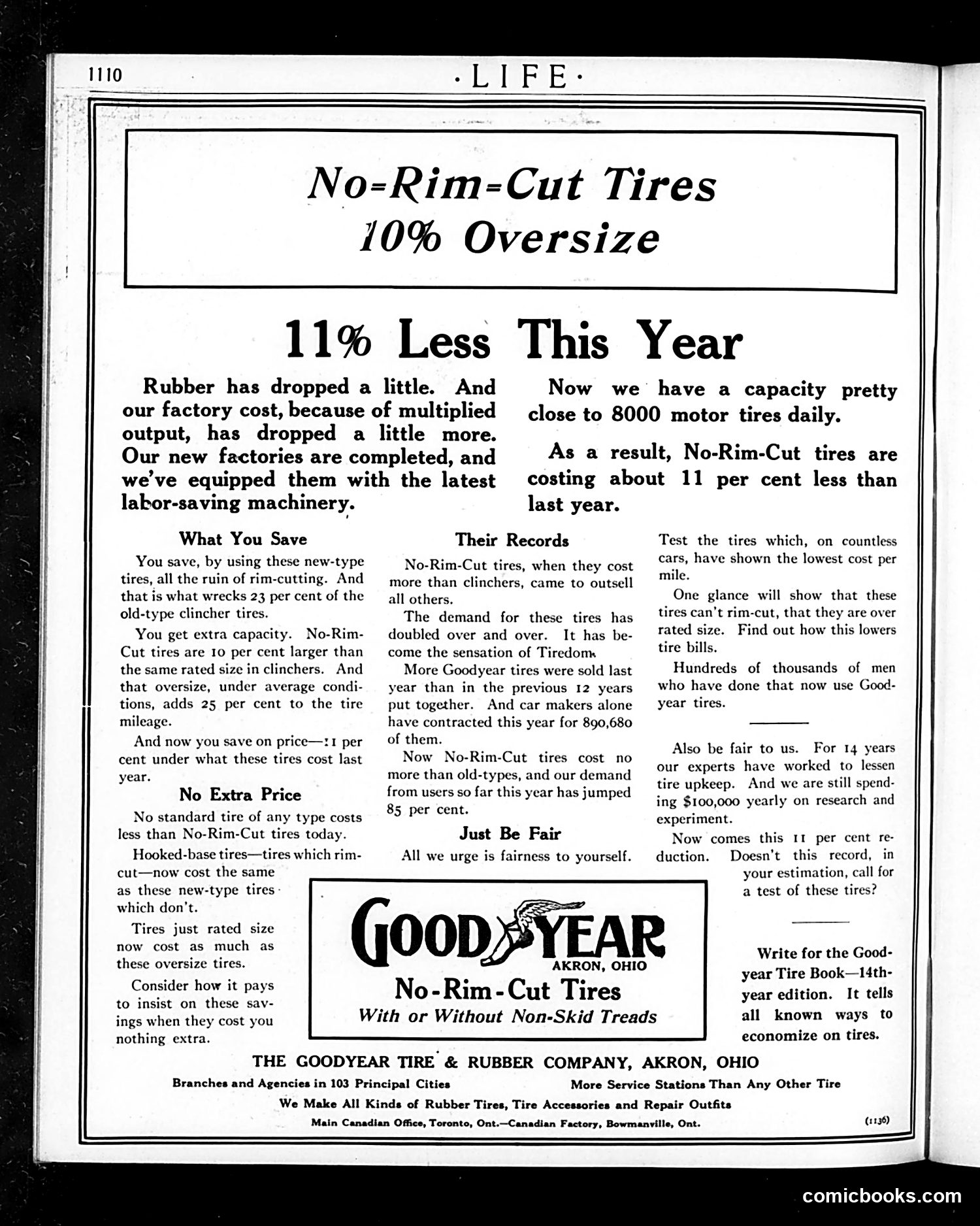
This page is primarily a **Goodyear Tire advertisement**, not satire or political commentary. It announces a new tire product called "No-Rim-Cut Tires" priced 11% less than the previous year. The ad emphasizes that rubber prices dropped, factory costs decreased, and new machinery increased production capacity to 5,000 tires daily. These efficiencies allow Goodyear to pass savings to consumers—11% price reduction with no quality compromise. The tires are 10% oversized compared to standard sizes, last 25% longer than older clinchers, and eliminate rim-cutting problems. Goodyear boasts that more of their tires were sold over 12 years than competitors combined, and claims 800,680 units contracted by car manufacturers. There is no apparent satire here—it's straightforward commercial advertising typical of Life magazine's paid content.
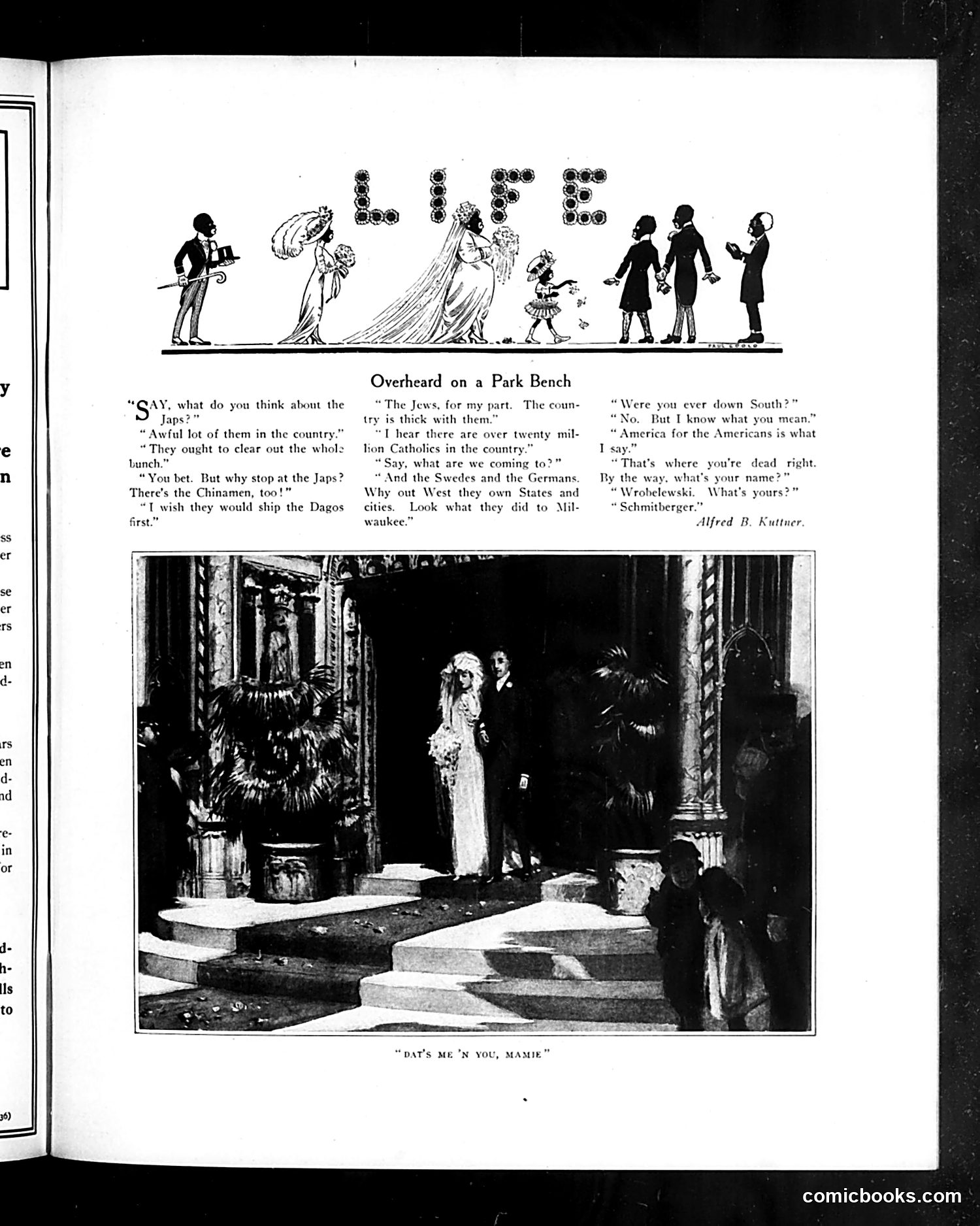
**Top Cartoon ("LIFE")**: An illustrated sequence depicting a wedding, satirizing marriage as a life progression from courtship through domestic life. The title "LIFE" uses the couple and children as letters, making the visual pun explicit. **Middle Section ("Overheard on a Park Bench")**: A dialogue joke expressing xenophobic attitudes common to the 1910s-20s era. The speaker advocates clearing out "Japs," mentions "Chinamen," and discusses various immigrant groups (Jews, Catholics, Swedes, Germans). The punchline reveals the speaker is himself an immigrant ("Schmeltberger"), creating ironic hypocrisy—he holds prejudiced views while being the type of foreigner he criticizes. **Bottom Image ("'Day's Me 'N' You, Mamie'")**: Appears to be a dramatic film or theater scene in an ornate interior with a bride and wedding party. The page satirizes both marriage and nativist prejudice.
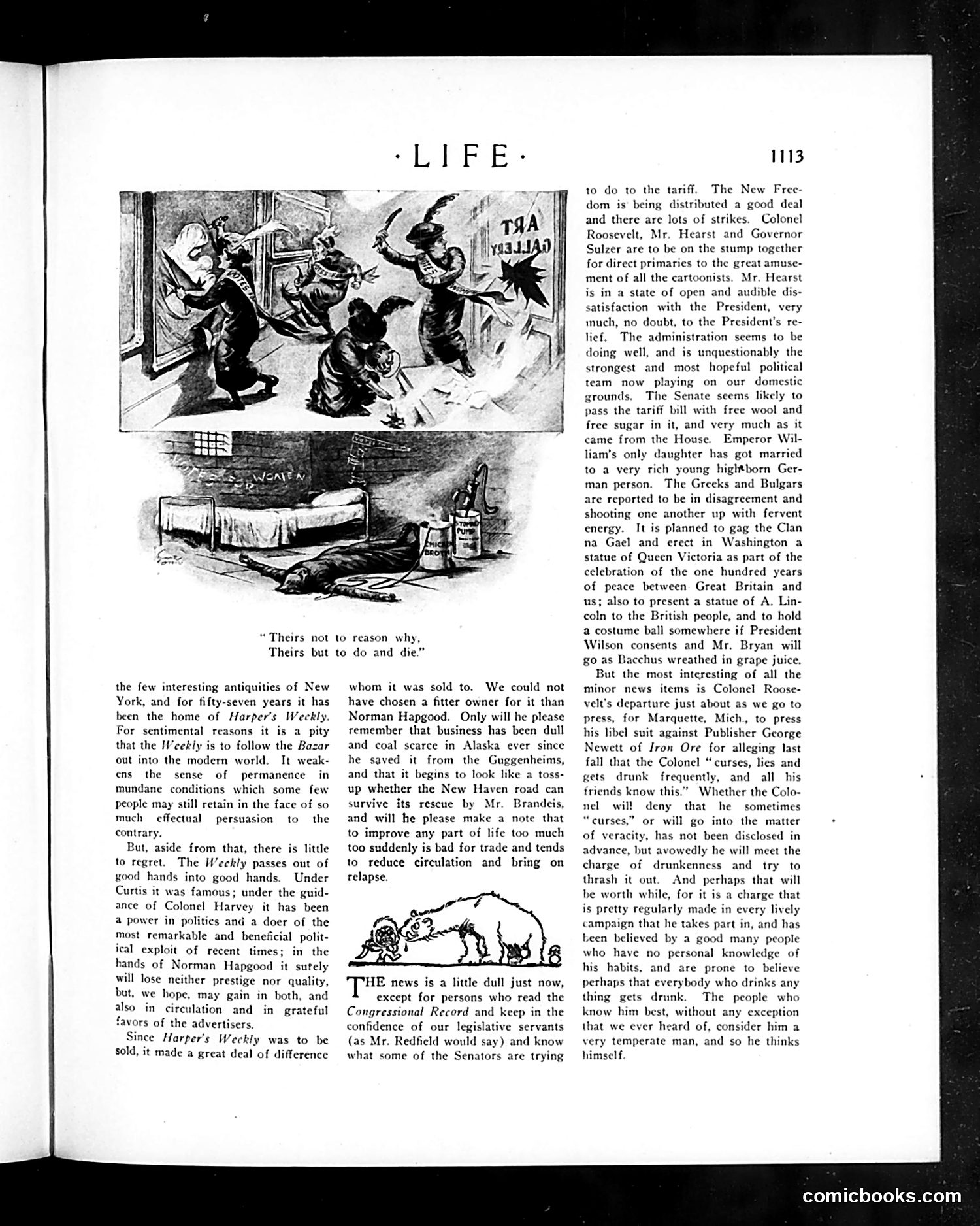
The top cartoon depicts figures being thrown out of a building labeled "TARIFF" - likely representing political opposition to a tariff bill. The chaotic scene with flying bodies suggests violent disagreement or defeat in legislative battle. The bottom illustration shows a pig, accompanying text discussing dull news and the Congressional Record. The surrounding article discusses Roosevelt administration policies, tariff legislation, and various political appointments. It references Senator debates about "free wool and free sugar," Governor Sulzer, and Colonel Roosevelt's satisfaction with the President. The overall page satirizes contemporary political turmoil—specifically legislative conflict over tariff policy and the Roosevelt administration's political maneuvering. Without the specific date visible, the exact historical moment remains unclear, though the content suggests early 20th-century American politics.
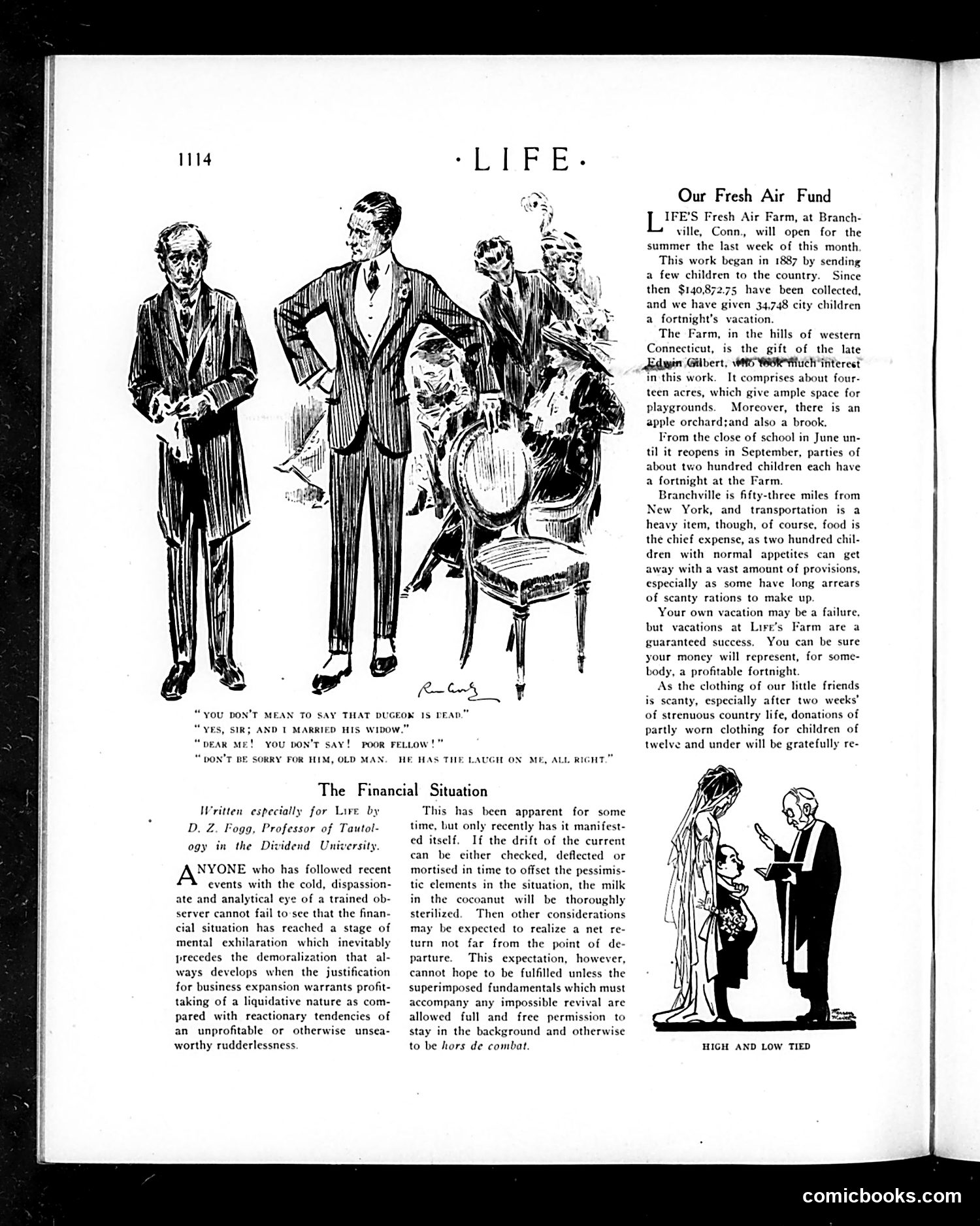
The main cartoon depicts a social scene with well-dressed men and women in what appears to be a humorous domestic situation. The caption reads: "YOU DON'T MEAN TO SAY THAT DUGGIE IS DEAD" / "YES, SIR; AND I MARRIED HIS WIDOW" / "DEAR ME! YOU DON'T SAY! POOR FELLOW!" / "DON'T BE SORRY FOR HIM, OLD MAN. HE HAS THE LAUGH ON ME, ALL RIGHT." This is a joke about remarriage and inheritance—the humor lies in the ironic reversal where the deceased "Duggie" apparently benefits from his own death through some financial or property arrangement, hence having "the laugh" on those still living. It's typical period satire about marriage, money, and social maneuvering among the wealthy. The smaller illustration titled "HIGH AND LOW TIED" appears to show a class contrast, though its specific meaning is unclear from the image alone.
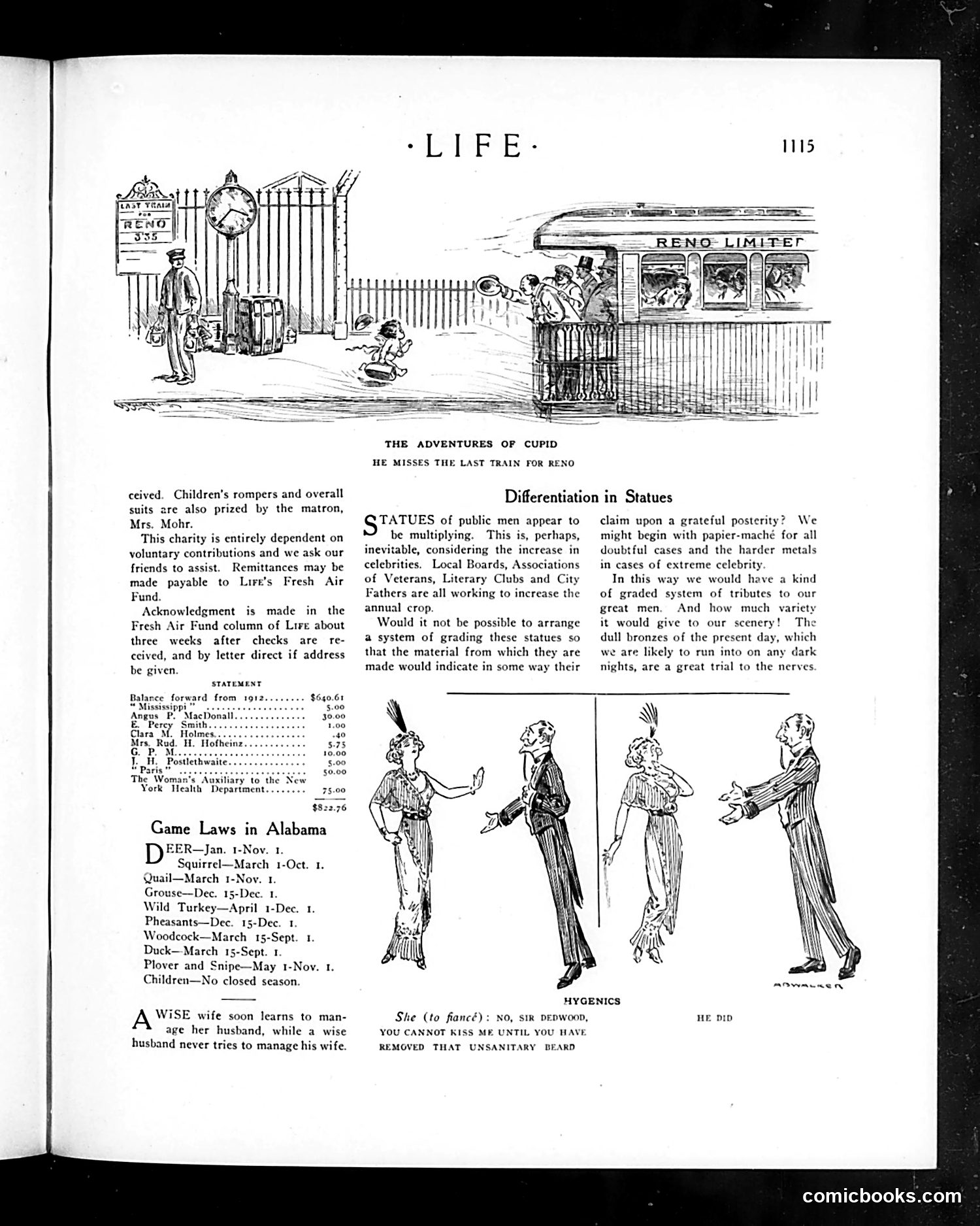
This page contains three distinct satirical pieces: **"The Adventures of Cupid" cartoon** (top): A visual joke about the "Reno Limited" train. Reno, Nevada was famous as a divorce destination in the early 20th century due to lenient residency laws. The cartoon shows Cupid missing this train—suggesting a romantic relationship has failed and divorce is imminent. **"Differentiation in Statues" article**: Social satire proposing a hierarchical system for public monuments based on material quality (papier-mâché for minor figures, bronze for celebrated ones). The joke critiques the proliferation of statues being erected to increasingly obscure public figures, while humorously noting that dark bronze statues are a literal hazard ("a great trial to the nerves"). **"Hygenics" cartoon** (bottom): A humor piece playing on early 20th-century hygiene concerns. A woman refuses to kiss her fiancé until he removes his beard, citing it as "unsanitary"—reflecting contemporary anxieties about germs and cleanliness. The punchline shows he complied.
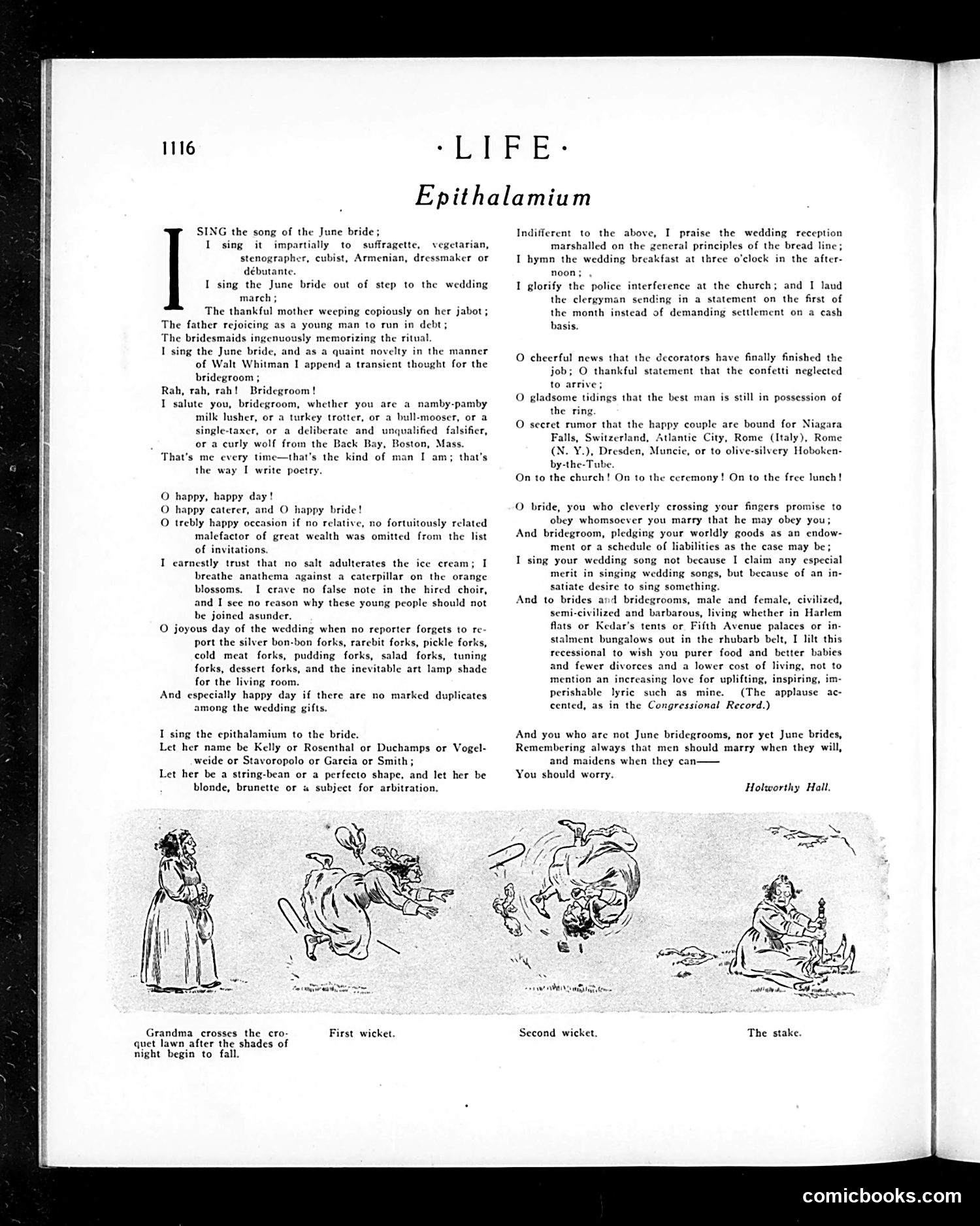
This page presents Holworthy Hall's irreverent poem mocking June weddings and their attendant absurdities. The satire targets multiple contemporary social types—suffragettes, vegetarians, cubists—while ridiculing wedding conventions: the weeping mother, the debt-ridden father, hired choirs, excessive silverware, and mandatory gift duplicates. The poem's humor lies in its mock-serious tone celebrating obvious problems: police interference at church, missing confetti, and the bride's false obedience vow. Hall satirizes the wedding-industrial complex itself—the caterers, decorators, and endless etiquette—while offering sardonic "joyous" observations about marriages ending in divorce. The four sketch cartoons below depict croquet scenes, likely illustrating genteel leisure activities associated with wedding festivities. The overall effect is sophisticated ridicule of upper-class wedding pretension.
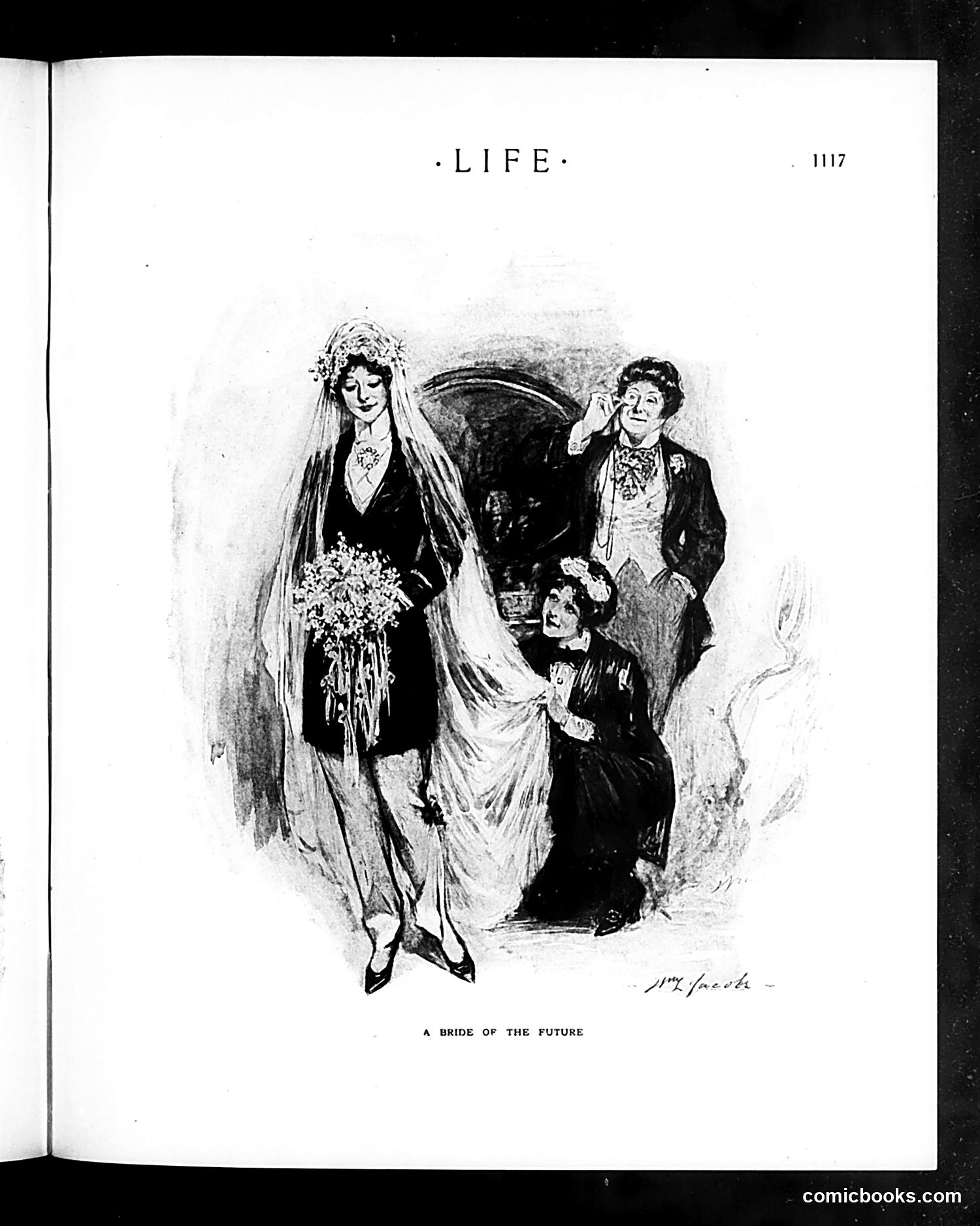
This satirical illustration from *Life* magazine depicts a futuristic wedding scene. A bride in modern dress (notably short skirt and veil) stands prominently, accompanied by what appears to be attendants or family members in dark clothing. The satire likely comments on changing women's roles and fashion in the early 20th century. The bride's notably abbreviated skirt—scandalous by contemporary standards—suggests anxieties about women's increasing independence and the loosening of Victorian dress codes. The title "A Bride of the Future" implies this represents emerging social attitudes toward women's liberation, suffrage, and changing gender norms. The illustration appears designed to both mock progressive changes and poke fun at conservative fears about modern womanhood.
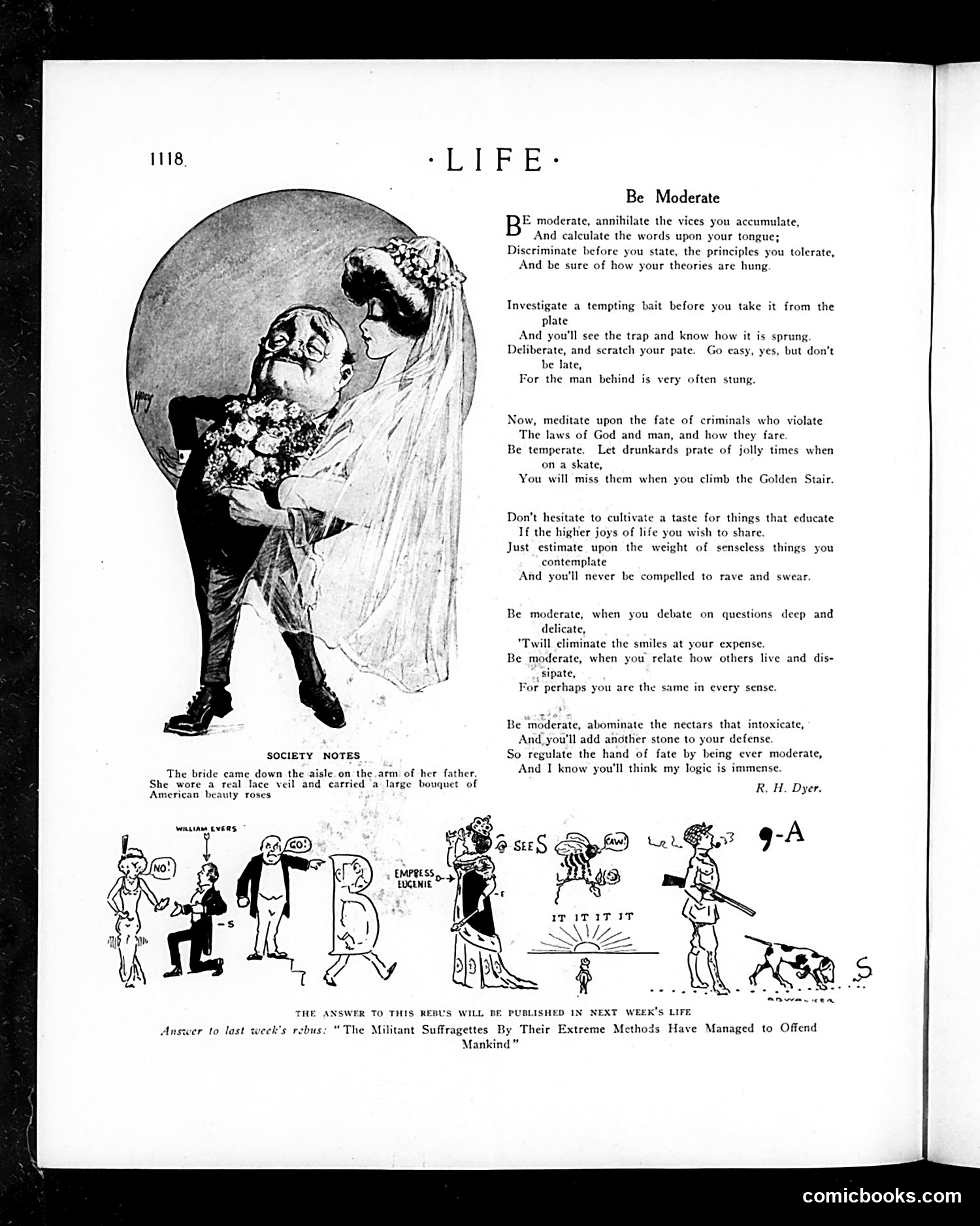
This page features a moralizing poem titled "Be Moderate" by R.H. Dyer, accompanied by a satirical illustration of a groom struggling with an enormous bridal bouquet of American beauty roses—the bride herself barely visible behind the flowers. The joke contrasts the poem's earnest advice about temperance and moderation with the visual gag: the groom is literally overwhelmed by excess (the massive bouquet), ironically illustrating what happens when one *fails* to be moderate. The "Society Notes" caption adds light satire about wedding conventions. Below appears a rebus puzzle (visual wordplay). The answer to the *previous* week's puzzle is noted: "The Militant Suffragettes By Their Extreme Methods Have Managed to Offend Mankind"—indicating this magazine took satirical jabs at the women's suffrage movement, viewing their tactics as immoderate and counterproductive. The page blends domestic humor with period political commentary, typical of Life's early 20th-century approach.
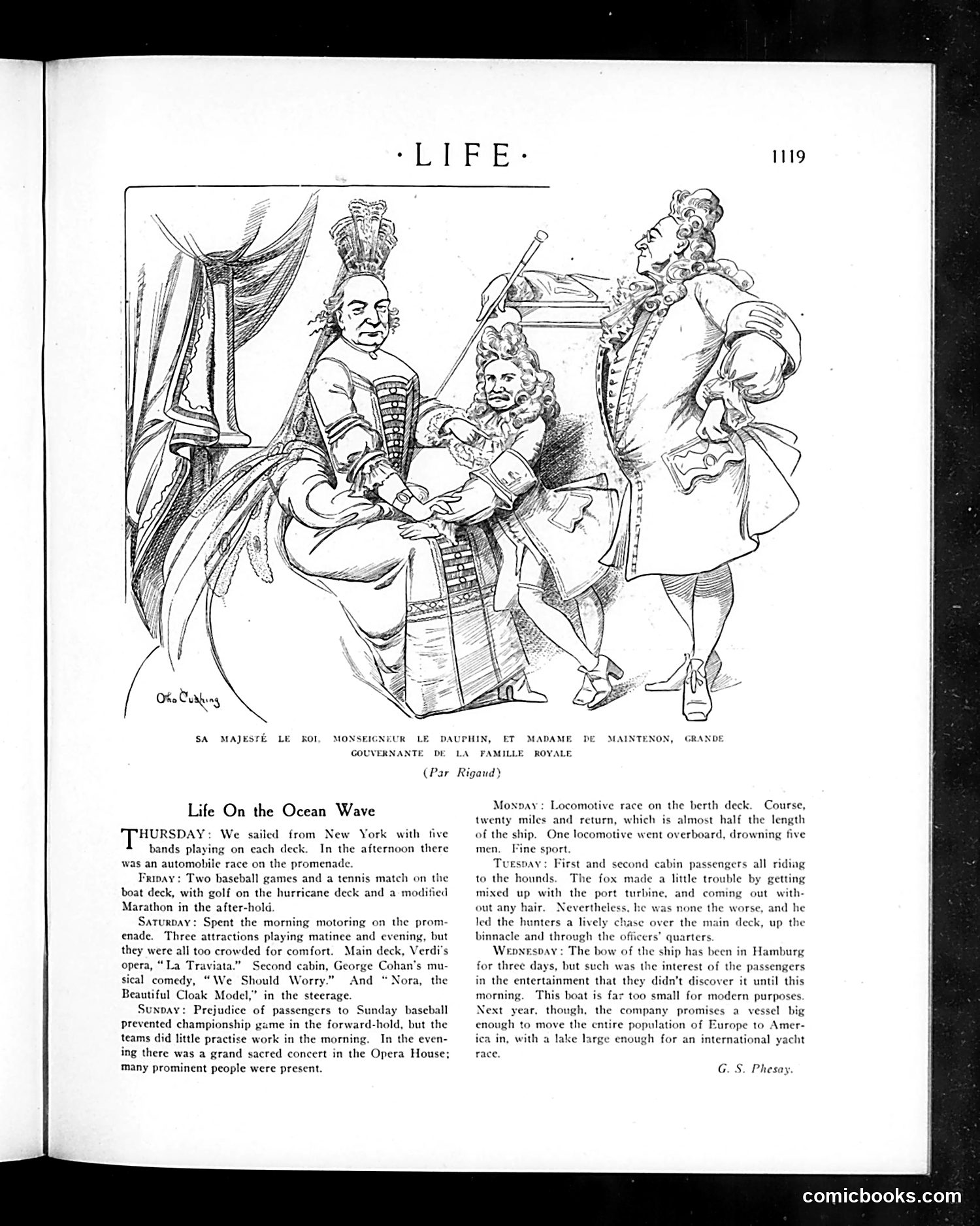
This page satirizes the excess and absurdity of luxury ocean liner travel in the early 20th century. The cartoon at top (by Rigaud, captioned in French referencing French royalty) establishes a tone of aristocratic pretension. The accompanying text parodies a ship's daily log, escalating weekly activities to ridiculous extremes: automobile races on decks, baseball in cargo holds, fox hunts across the ship, and a locomotive race that kills five men—all treated as routine entertainment. The final paragraph's proposal for a future ship large enough to transport Europe's entire population to America, complete with a lake for yacht races, is absurdist hyperbole mocking both maritime engineering ambitions and wealthy travelers' endless demand for novelty. The satire targets the nouveau-riche mentality of gilded-age passengers treating ocean liners as floating pleasure palaces, where entertainment and spectacle matter more than the ship's actual function or safety.
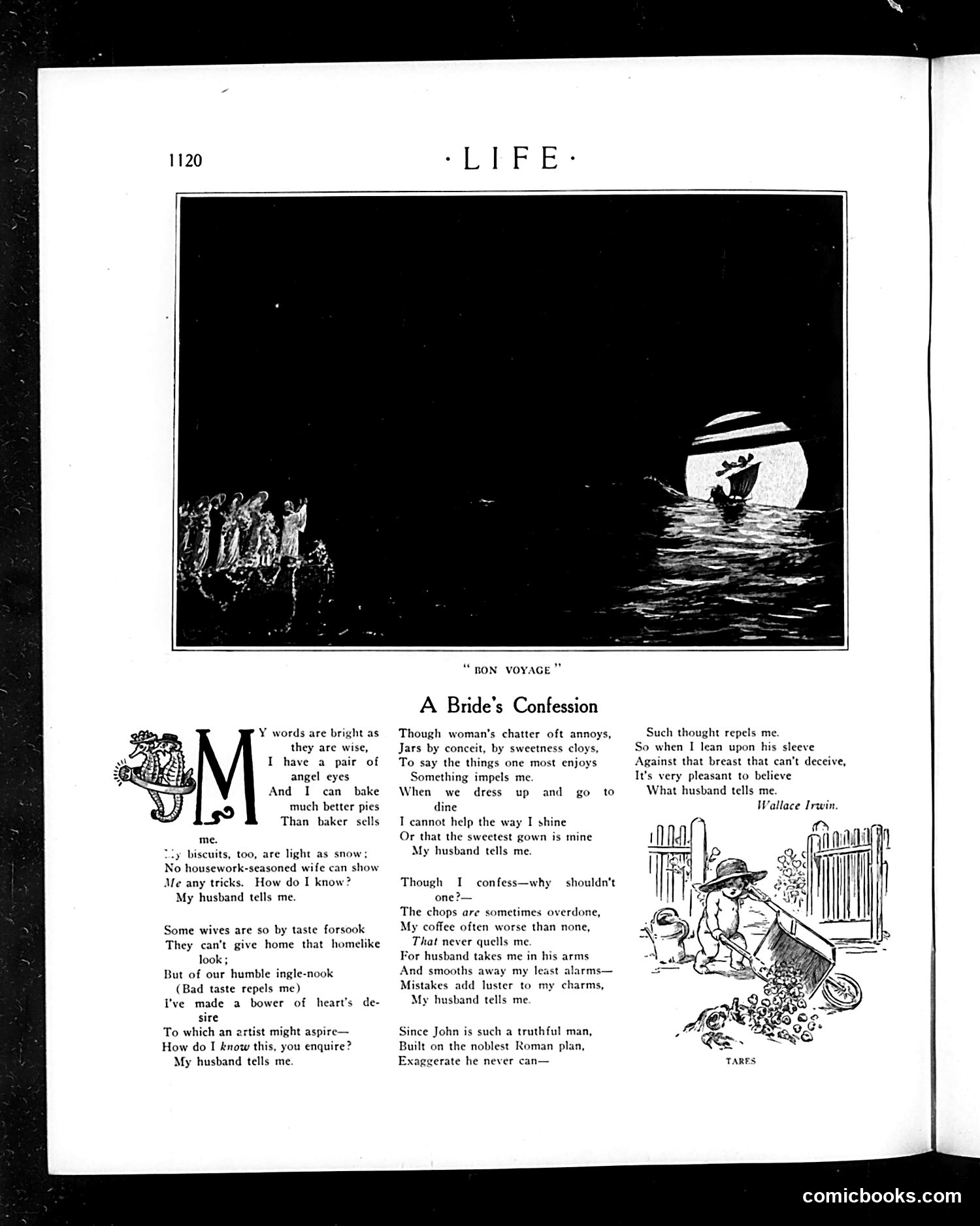
This poem satirizes newlywed wives and male vanity through ironic self-awareness. The bride confesses that she constantly repeats "my husband tells me" when praising herself—her baking, housekeeping, beauty, and charm. The satire works on two levels: she's either gullibly accepting her husband's flattery as objective truth, or she's using his supposed compliments as socially acceptable cover for shameless self-promotion (since a woman couldn't openly boast in this era). The illustration shows a couple on their honeymoon ("Bon Voyage"), reinforcing newlywed naïveté. The poem mocks both husbands who flatter their wives and wives who cite that flattery as evidence of their actual merit. It's gentle domestic satire typical of early-20th-century *Life* magazine—poking fun at marriage dynamics and gender expectations rather than political targets.
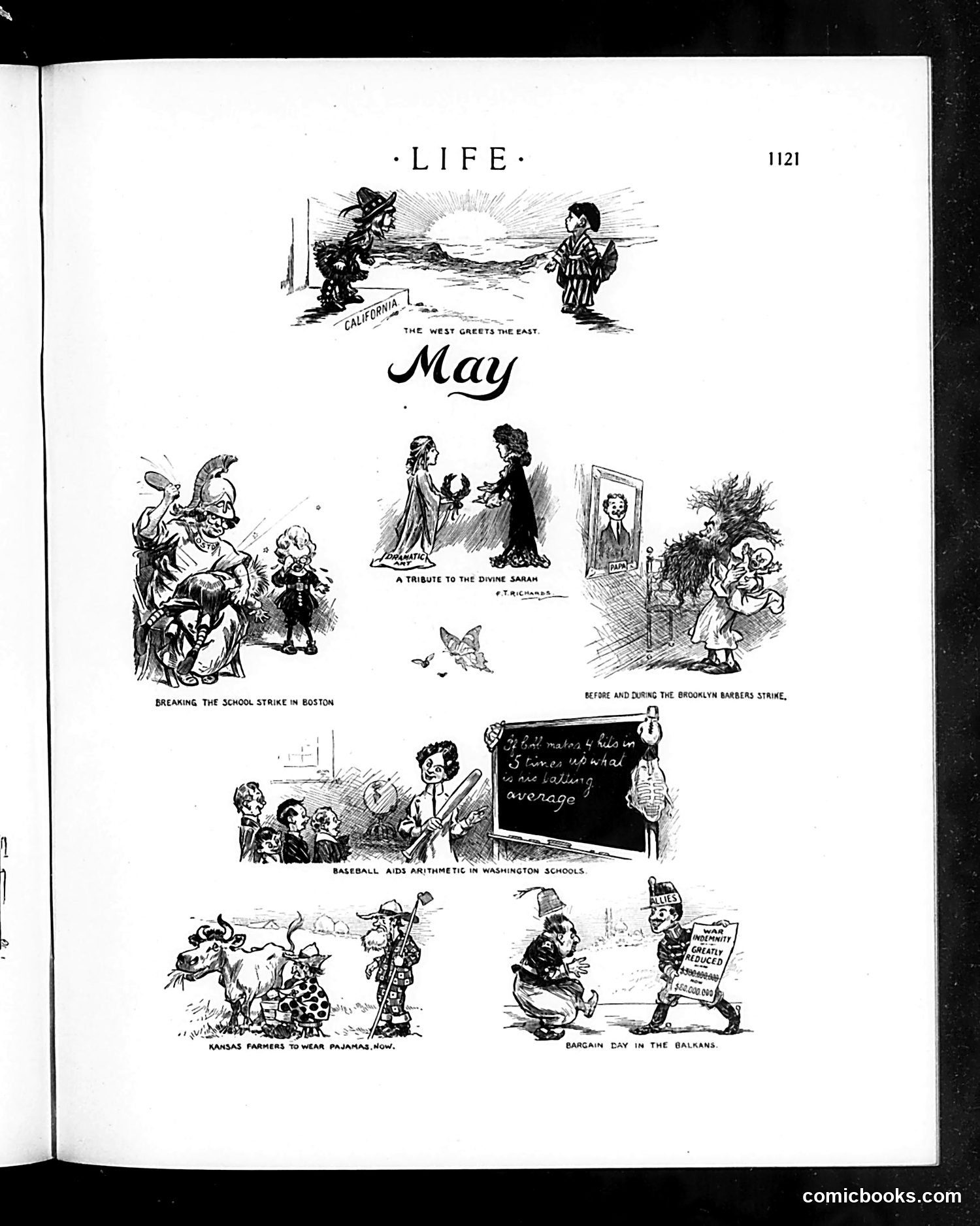
This page presents six satirical cartoons commenting on contemporary American issues: 1. **"The West Greets the East"**: California and the East Coast shake hands, likely referencing regional tensions or reconciliation. 2. **Boston School Strike**: Depicts disruption to education during labor unrest. 3. **Divine Sarah Tribute**: References Sarah Bernhardt, the famous French actress. 4. **Brooklyn Barbers Strike**: Shows labor conflict in the barber trade. 5. **Baseball in Washington Schools**: Satirizes arithmetic education using baseball statistics. 6. **Kansas Farmers/Pajamas**: Rural workers depicted in nightwear, likely mocking farmer economic hardship or lifestyle. 7. **Balkans Bargain Day**: References European post-WWI economic struggles and reduced prices/values. The cartoons collectively satirize American labor strikes, regional divisions, and post-war economic instability of 1921.
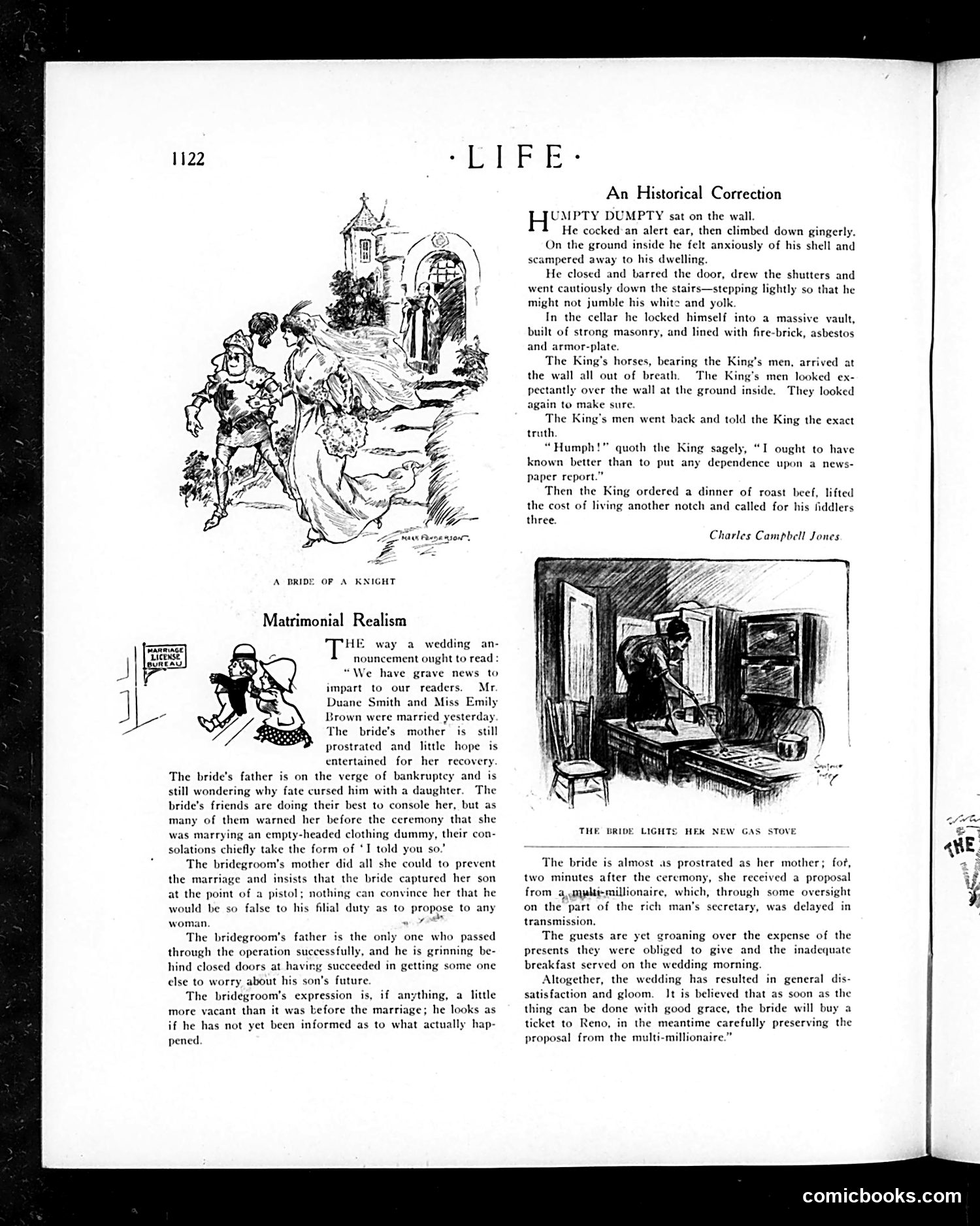
This page contains two satirical pieces mocking early 20th-century social conventions. **"Matrimonial Realism"** inverts typical wedding announcements by describing marriage as a disaster for everyone involved—the bride's mother is "prostrated," her father facing bankruptcy, the groom's mother convinced her son was "captured" at gunpoint, and the groom himself appears vacant and unaware of what happened. The satire targets the emotional and financial toll weddings inflict on families and the often-loveless nature of marriages, where women are portrayed as empty-headed and men as reluctant participants. **"An Historical Correction"** reimagines Humpty Dumpty as a cautious survivor who escapes the wall, locks himself in a vault, and proves the king's men wrong. The punchline mocks newspaper unreliability—the King learns the true story but dismisses it as "newspaper report," then casually raises the cost of living. This satirizes both media credibility and political indifference to economic hardship.
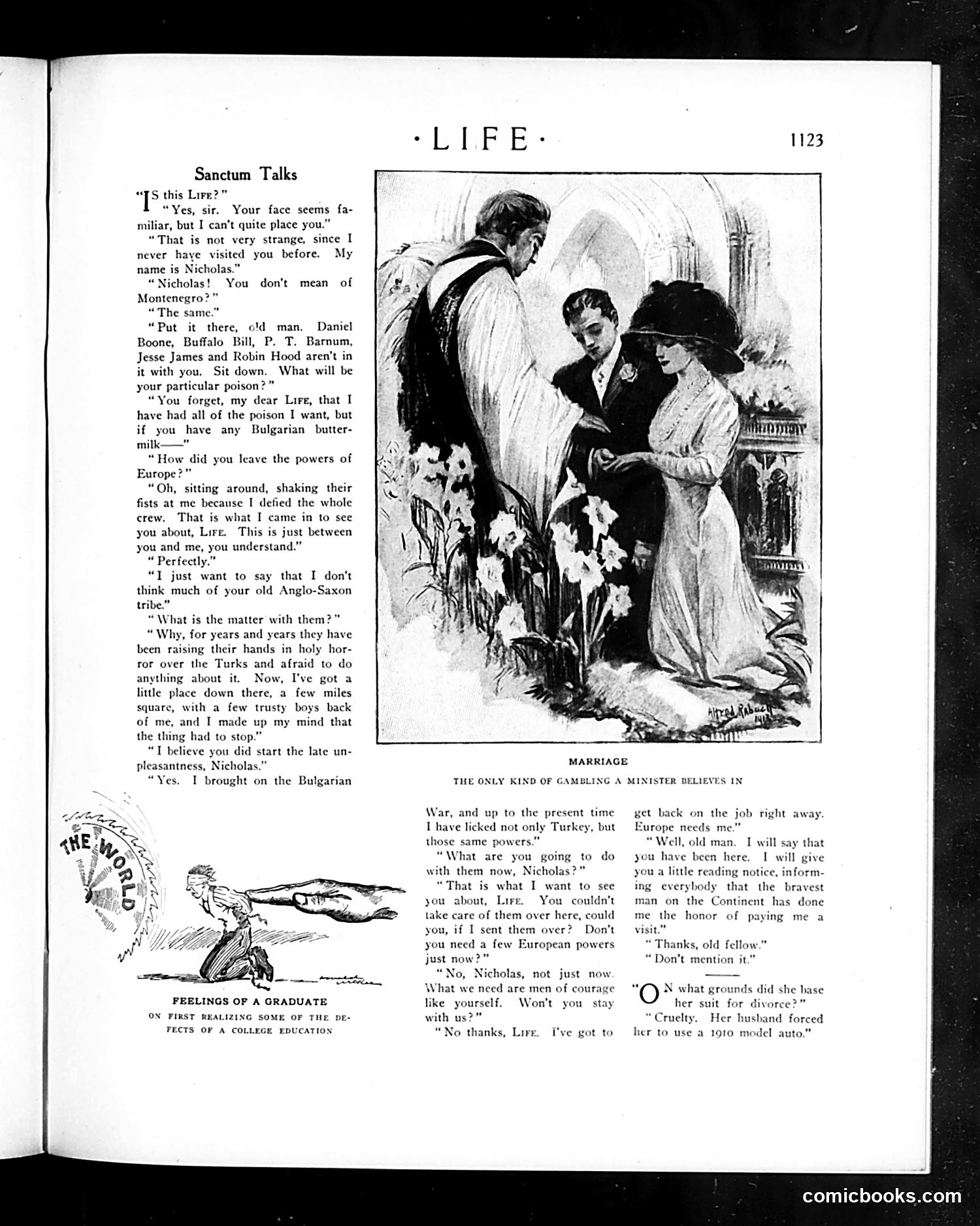
This page contains two satirical pieces from *Life* magazine (circa 1912-1913, based on the "1910 model auto" reference). **"Sanctum Talks"** features Nicholas, the ruler of Montenegro, visiting *Life*'s editor. The satire mocks Nicholas's role in the Balkan Wars—he claims credit for defeating Turkey and the European powers who opposed him. The joke is that this small Balkan ruler is bragging about defying major European nations, yet *Life*'s editor treats him as a celebrity (comparing him to American legends like Buffalo Bill). Nicholas's complaint about Anglo-Saxon hypocrisy—wringing their hands over Turkish atrocities without acting—reflects real contemporary debates about Western intervention in the Balkans. **The lower cartoons** are brief satirical sketches: one about college graduates' disillusionment, and another joke equating the risk of a 1910 automobile with gambling—a contemporary reference to early cars' danger and unreliability. The satire targets both Balkan politics and American attitudes toward international affairs.
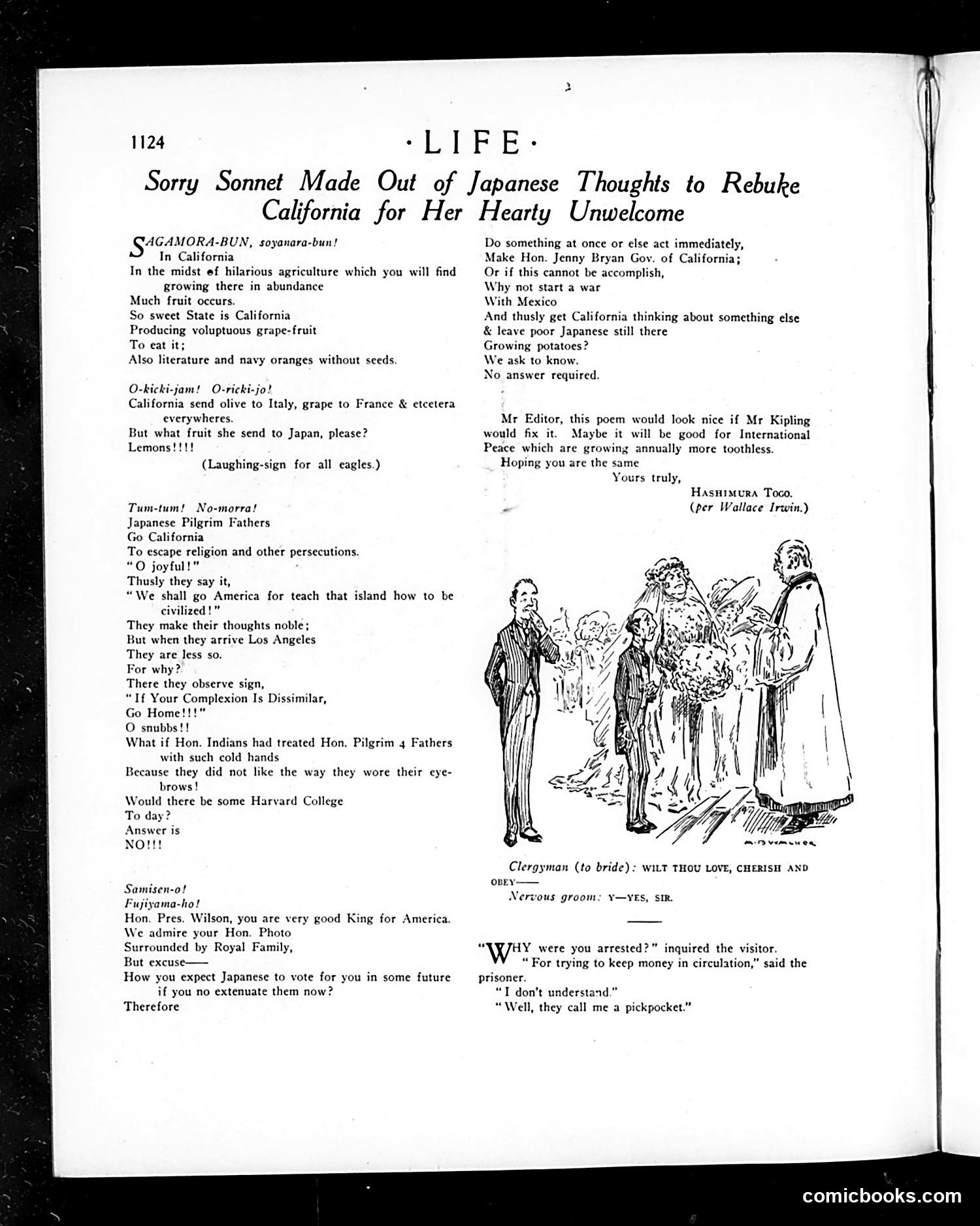
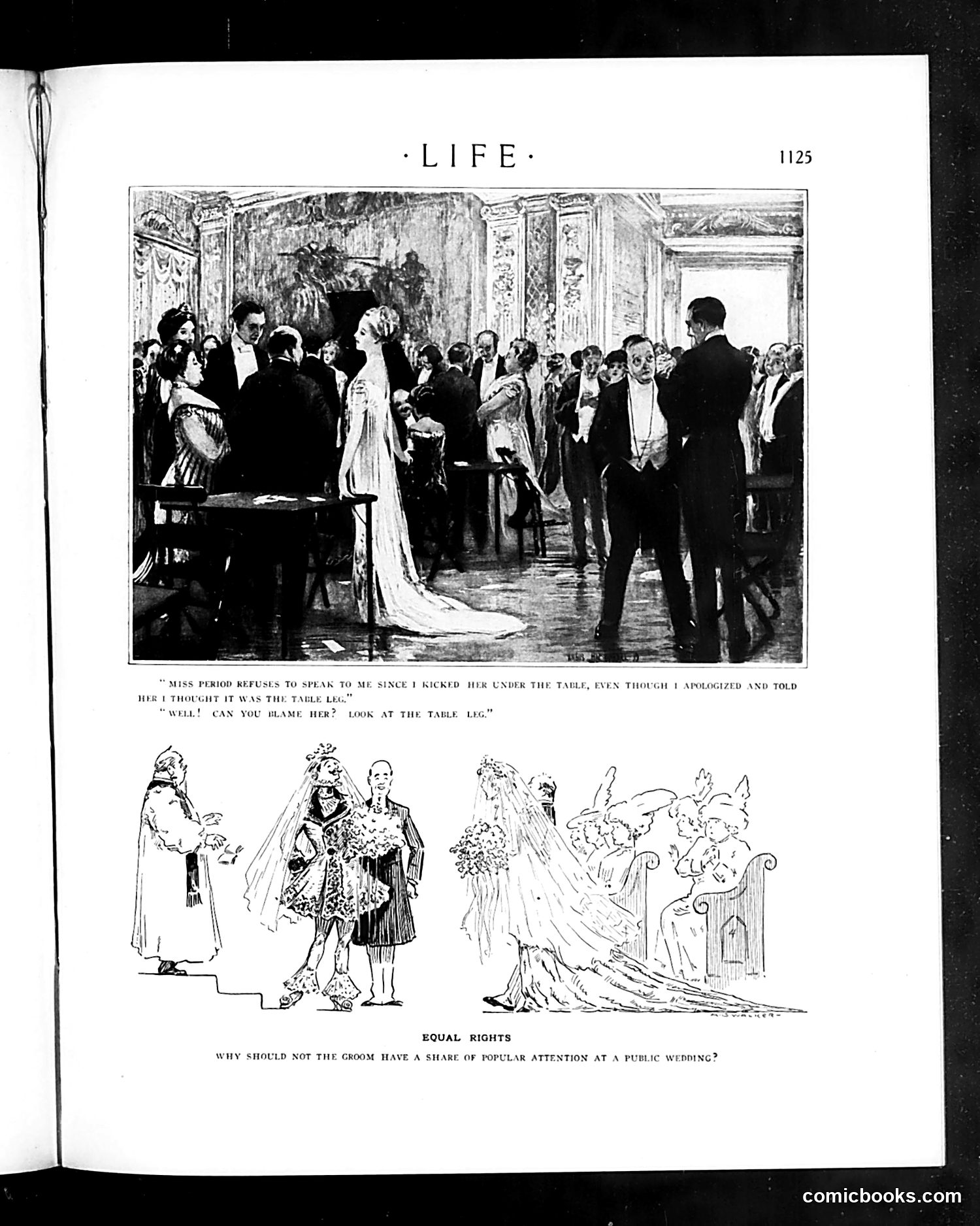
This page satirizes gender inequality at weddings through two related jokes. The top dialogue depicts a man at a formal reception claiming he kicked "Miss Period" under the table, mistaking her leg for furniture—a crude excuse implying women are overlooked or treated as objects in social settings. The bottom cartoon, titled "Equal Rights," directly addresses the satire's point: it questions why grooms receive minimal attention at public weddings compared to brides. The sketches show brides in elaborate wedding dresses commanding focus while grooms stand marginal. The caption sarcastically asks why grooms shouldn't share "popular attention." This appears to be early 20th-century social commentary on traditional wedding customs that center entirely on the bride, humorously arguing for male inclusion—likely a tongue-in-cheek critique of how women dominated these social occasions.
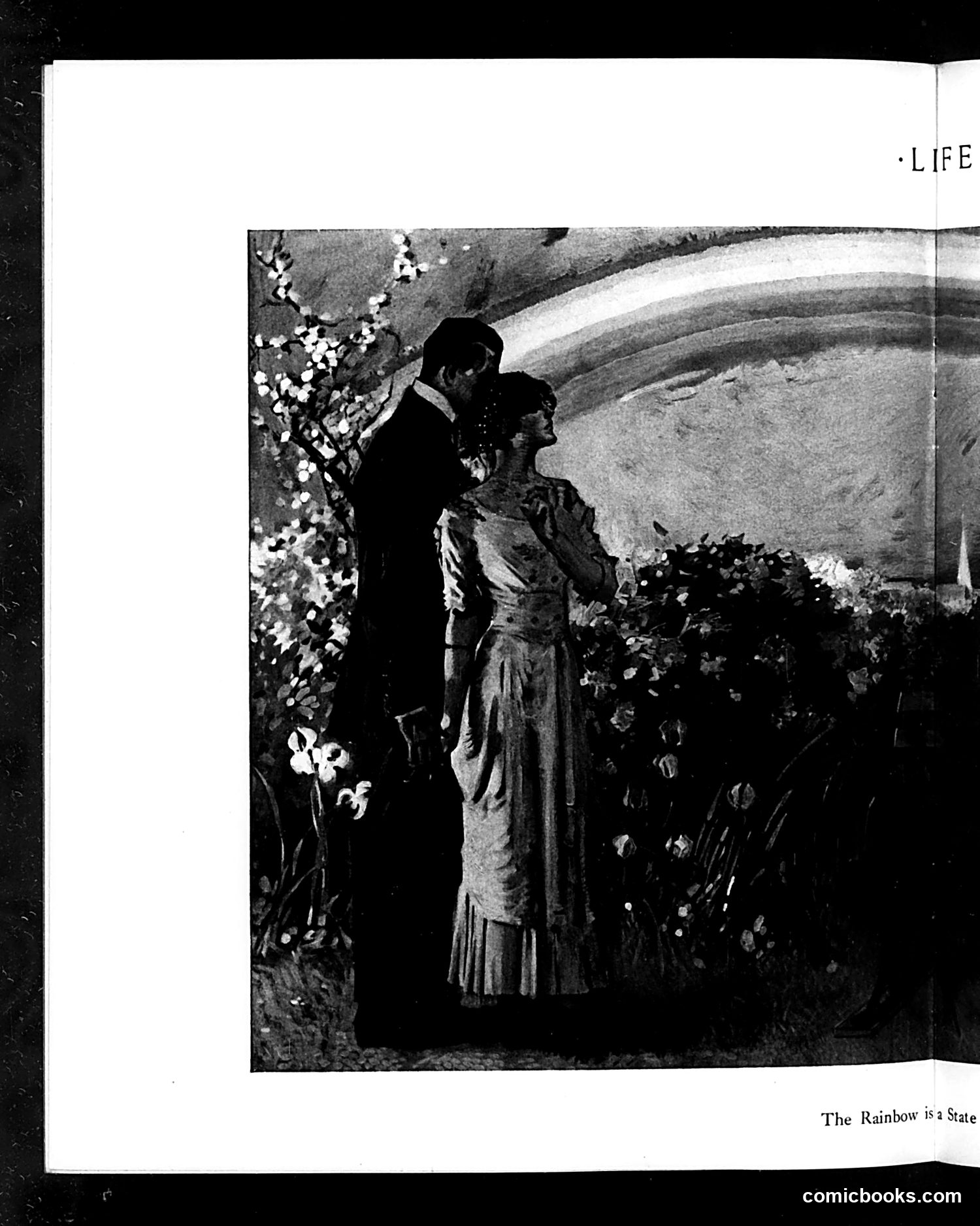
This page from *Life* magazine shows a romantic scene with two figures in period dress standing among flowers, with a rainbow visible in the background. The caption reads "The Rainbow is a State" (though the OCR is largely corrupted). The image appears to be a sentimental or romantic illustration rather than political satire. Without clearer context or date information, it's difficult to identify the specific figures or determine what social commentary—if any—is intended. The romantic setting and rainbow imagery suggest themes of idealism or hope, but the precise satirical point remains unclear from this page alone. This may be an illustration accompanying a story or poem rather than a standalone cartoon.
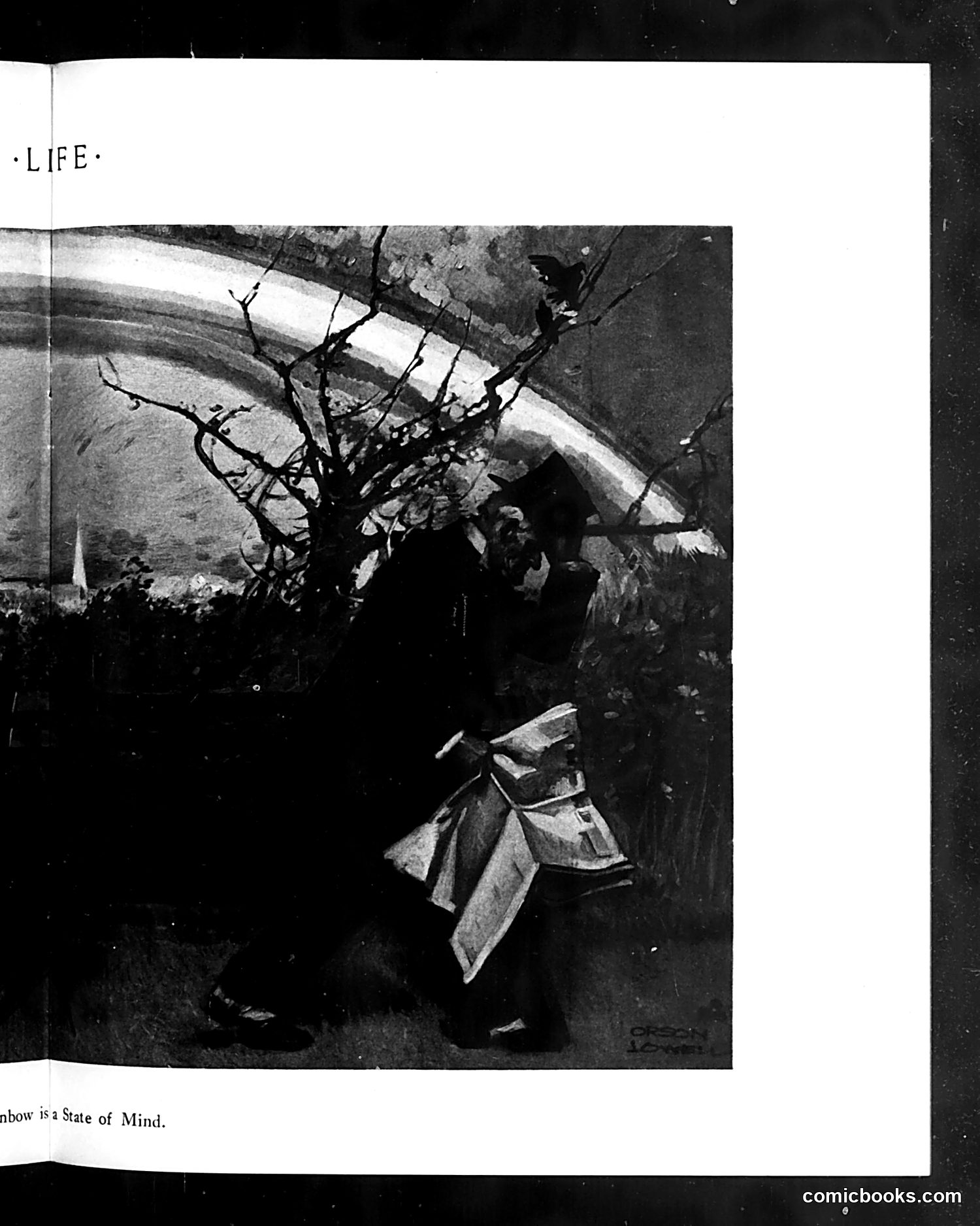
This appears to be a satirical illustration from *Life* magazine showing a dark, somewhat grotesque scene. The visible text fragment "...nbow is a State of Mind" suggests this may be part of a larger cartoon commentary, though the complete context is unclear from this page alone. The image depicts shadowy figures gathered around a gnarled, bare tree with what appears to be fabric or clothing below it. The stark black-and-white photography creates an unsettling mood. Without the full caption or surrounding text, the specific political or social target of the satire cannot be definitively determined. The "state of mind" reference suggests commentary on ideology or perception, but the precise subject remains ambiguous from this fragment alone.
This article satirizes the trend of established American novelists adapting their work for cinema. Owen Johnson, a respected author of the *Century* magazine and writer of "Stover at Yale," has begun writing directly for motion pictures rather than traditional publishing. The piece mocks the cultural moment with gentle irony: literary purists once scorned cinema as lowbrow entertainment, yet now prestigious authors like Johnson are "moving with the movies" to reach broader audiences. The author questions why established literary figures like E. Phillips Oppenheim and Robert W. Chambers should monopolize novel-writing when cinema could use their talent. The article reviews Johnson's film adaptation "The Sixty-first Second" (involving a stolen ruby, Wall Street panic, and high society), finding it entertaining though somewhat confusing. It also discusses Stephen French Whitman's novel "The Isle of Life," noting how American authors increasingly cater to popular entertainment rather than literary tradition—a shift the writer frames as inevitable rather than lamentable.
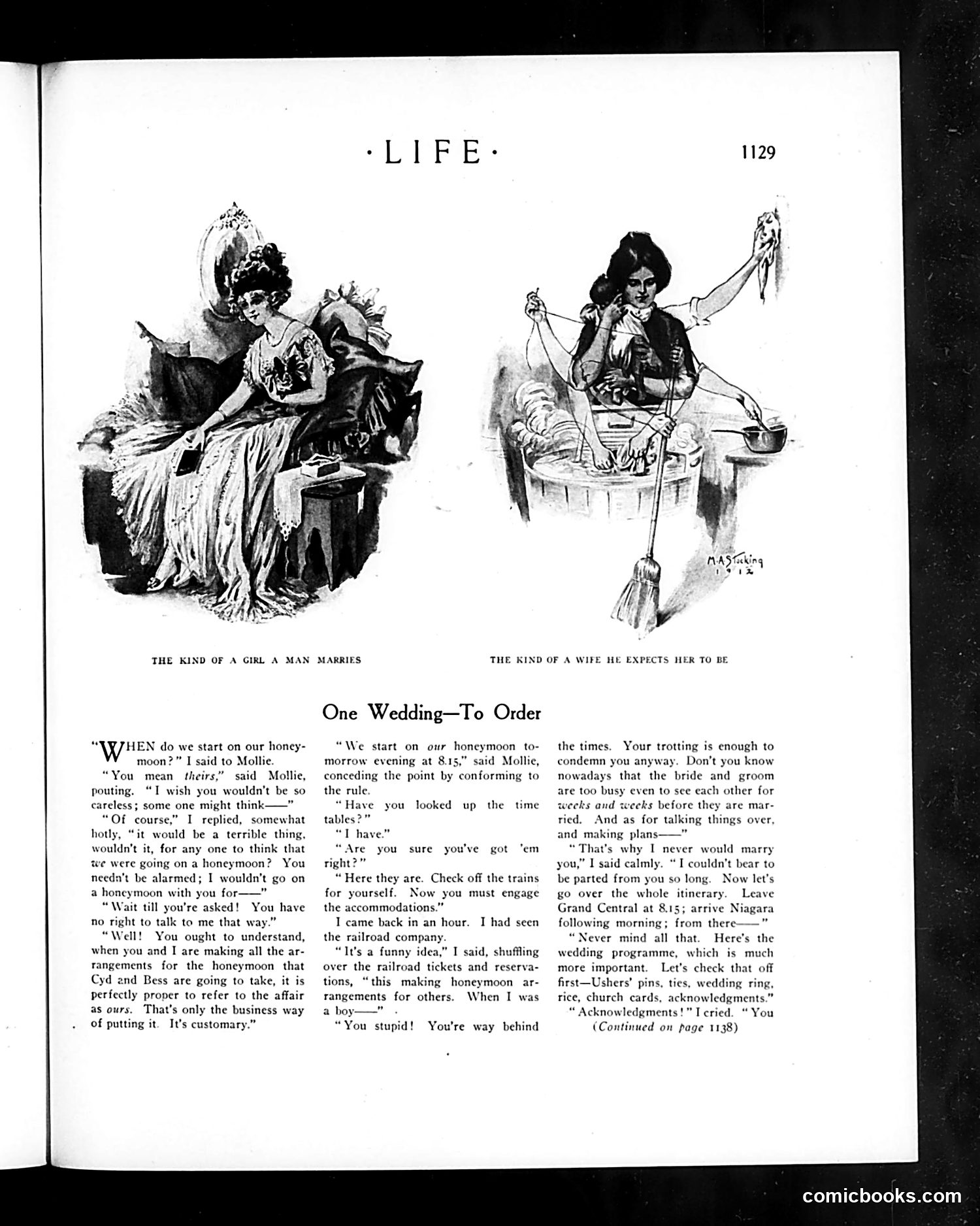
This satirical piece mocks early 20th-century wedding culture and gender dynamics. Two illustrations contrast "the kind of girl a man marries" (demure, decorative) with "the kind of wife he expects her to be" (practical, commanding). The accompanying dialogue humorously depicts a couple planning another couple's honeymoon. The satire targets how modern engaged couples have become so consumed with wedding logistics and social conventions that they've lost romance entirely—they're too busy arranging flowers, acknowledgment cards, and ushers' pins to actually enjoy each other or their own honeymoon. The husband's exasperation ("I never would marry you") and the wife's bossy corrections reveal how marriage, by this era, has become a business transaction focused on proper social appearances rather than intimacy or companionship. The joke undercuts both romantic notions of marriage and the contemporary obsession with perfect wedding details.
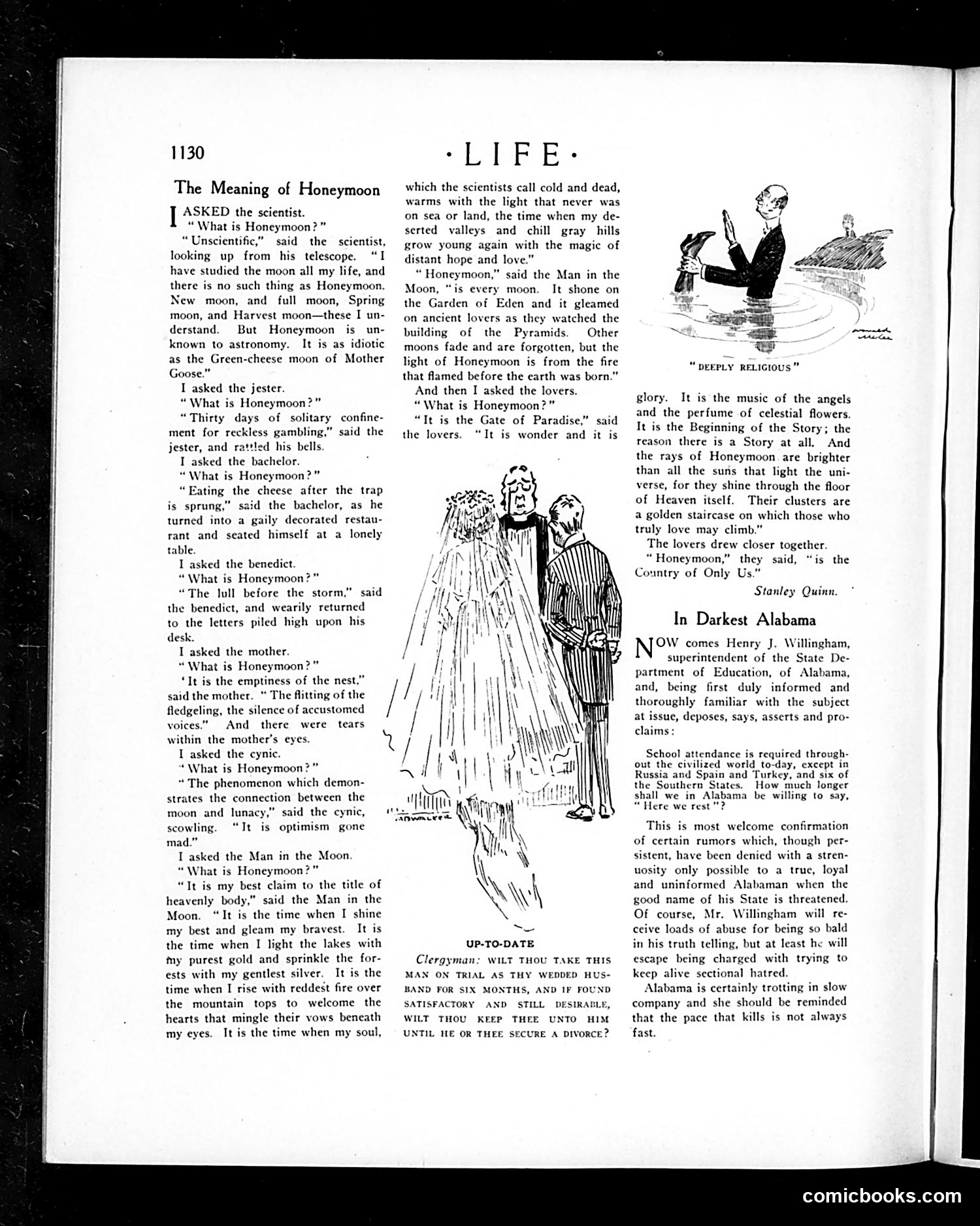
This page contains two satirical pieces typical of early 20th-century American humor. **"The Meaning of Honeymoon"** is a whimsical essay asking various character types—scientist, jester, bachelor, married man (benedict), mother, cynic, and the Man in the Moon—to define honeymoon. Each answer reflects their worldview: the scientist denies it exists astronomically; the bachelor treats marriage as a trap; the married man calls it "the lull before the storm"; the mother laments her empty nest. The Man in the Moon offers the most romantic vision, elevating honeymoon to cosmic significance. The piece satirizes how differently people perceive marriage based on their life stage and temperament. **"Up-to-Date"** cartoon mocks modern divorce culture by depicting a clergyman offering a trial marriage contract—six months with an option to divorce if "unsatisfactory." The caption "Deeply Religious" is ironic, suggesting organized religion has accommodated itself to casual attitudes toward marriage vows. **"In Darkest Alabama"** begins a critical piece about Alabama's failure to require school attendance, comparing the state unfavorably to even Russia, Spain, and Turkey.
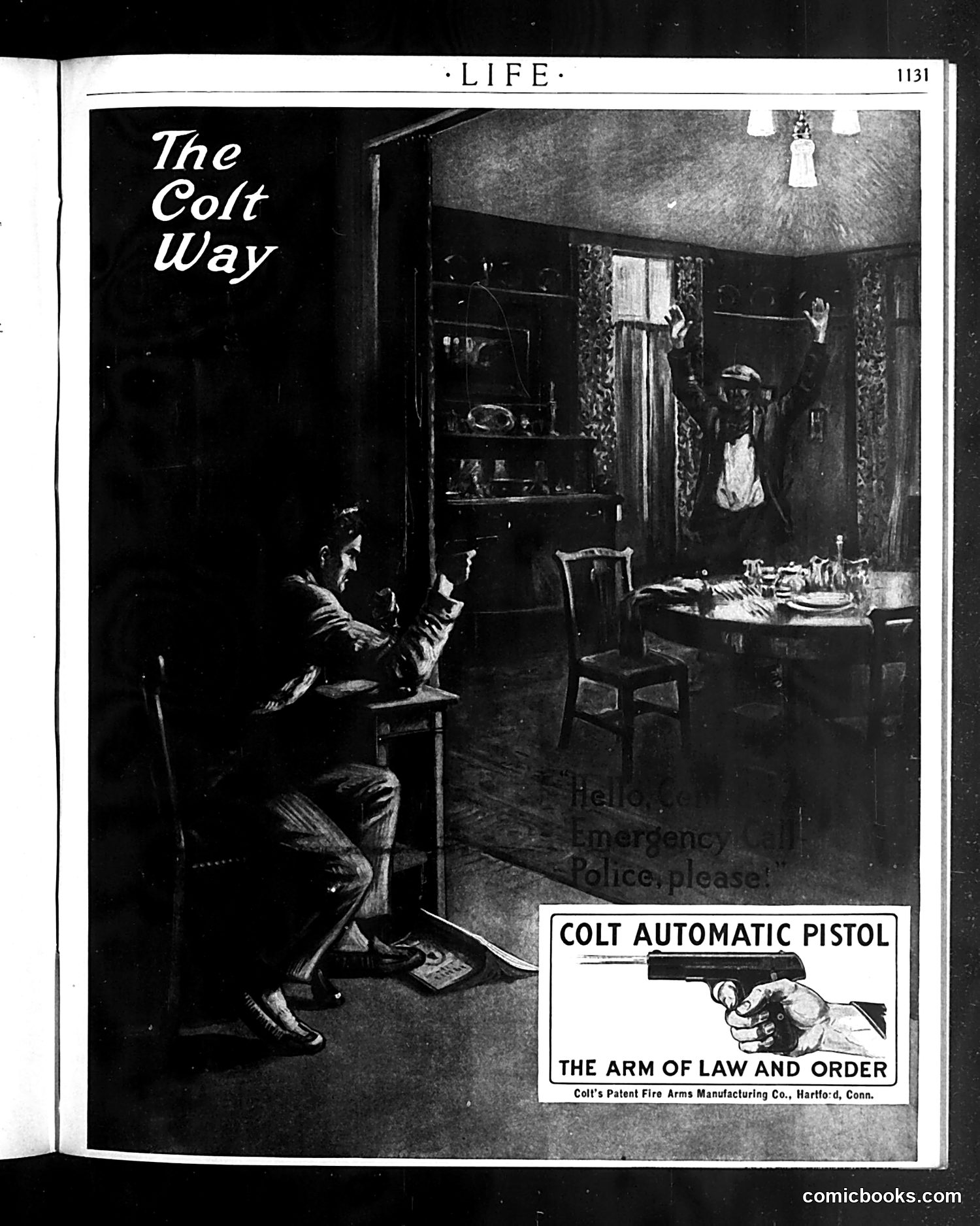
This is a Colt Automatic Pistol advertisement disguised as a satirical scene. The image shows a domestic emergency: a man sits nervously by a telephone while a woman stands in the background calling for police, with the caption "Hello...Emergency...Police, please!" The advertisement's tagline—"The Arm of Law and Order"—suggests that Colt pistols represent personal security and protection. The scenario implies that owning this firearm provides self-defense capability when law enforcement cannot immediately respond. This reflects early 20th-century marketing that positioned handguns as essential household safety tools for respectable citizens. The domestic setting and apparent crisis normalize firearm ownership as practical home protection rather than weaponry.
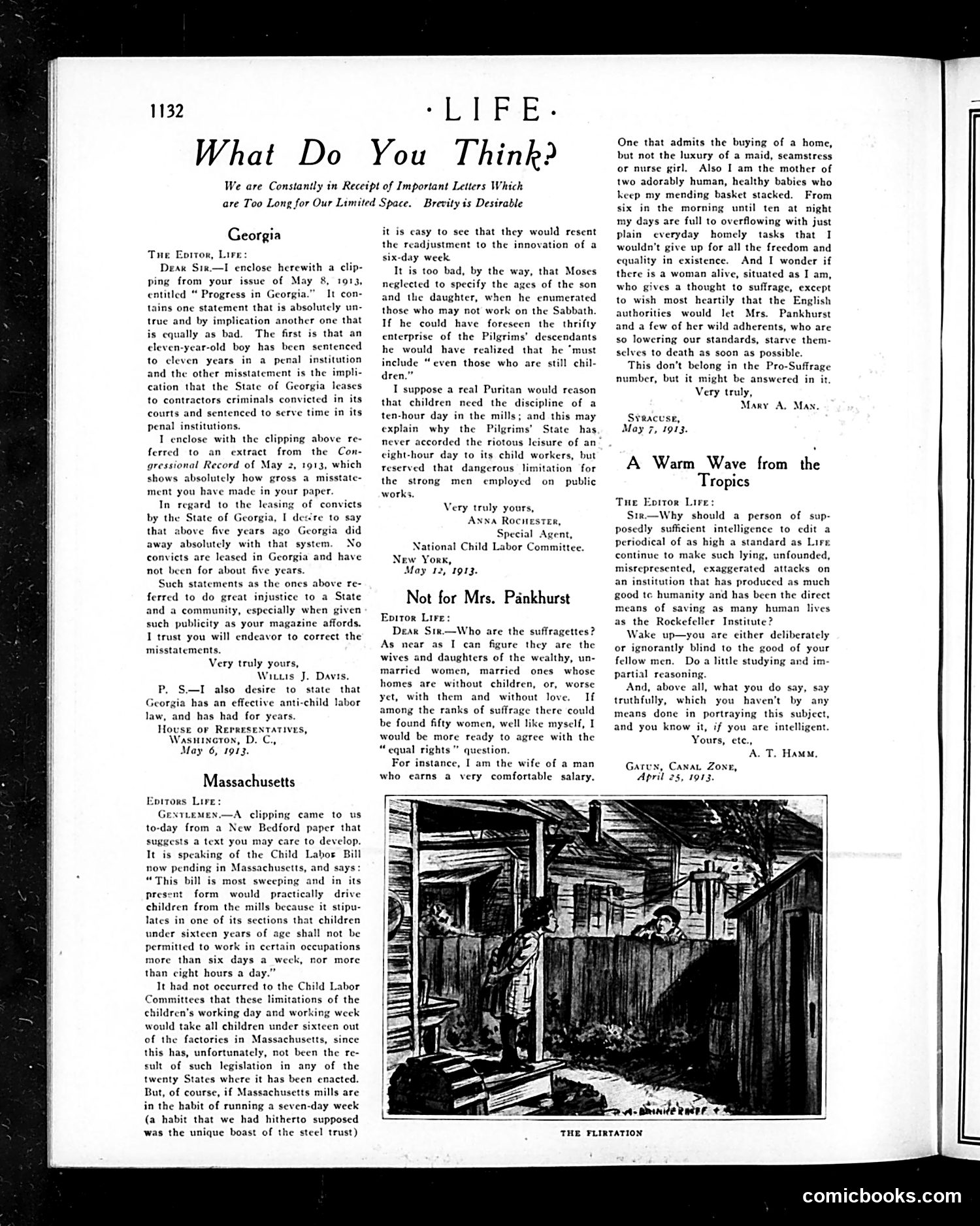
This is a "letters to the editor" section from *Life* magazine (May 1913), featuring reader responses to recent articles. The page contains no cartoon—instead, it showcases satirical editorial commentary embedded within reader letters. The Georgia letter disputes *Life*'s reporting on child labor convictions, claiming the magazine misrepresented facts about a young offender and the state's convict-leasing system. The Massachusetts letter sarcastically mocks mill owners' resistance to child labor restrictions. It notes that limiting children to six days and eight hours weekly supposedly would "drive children from the mills"—implying mills *require* seven-day operation. The writer invokes Biblical and Puritan references to highlight the hypocrisy: if religion mandates rest, why do "thrifty" New England manufacturers deny children what they grant adult workers? The partially-visible "Not for Mrs. Pankhurst" letter references the British suffragette leader, apparently critiquing who participates in the women's suffrage movement.
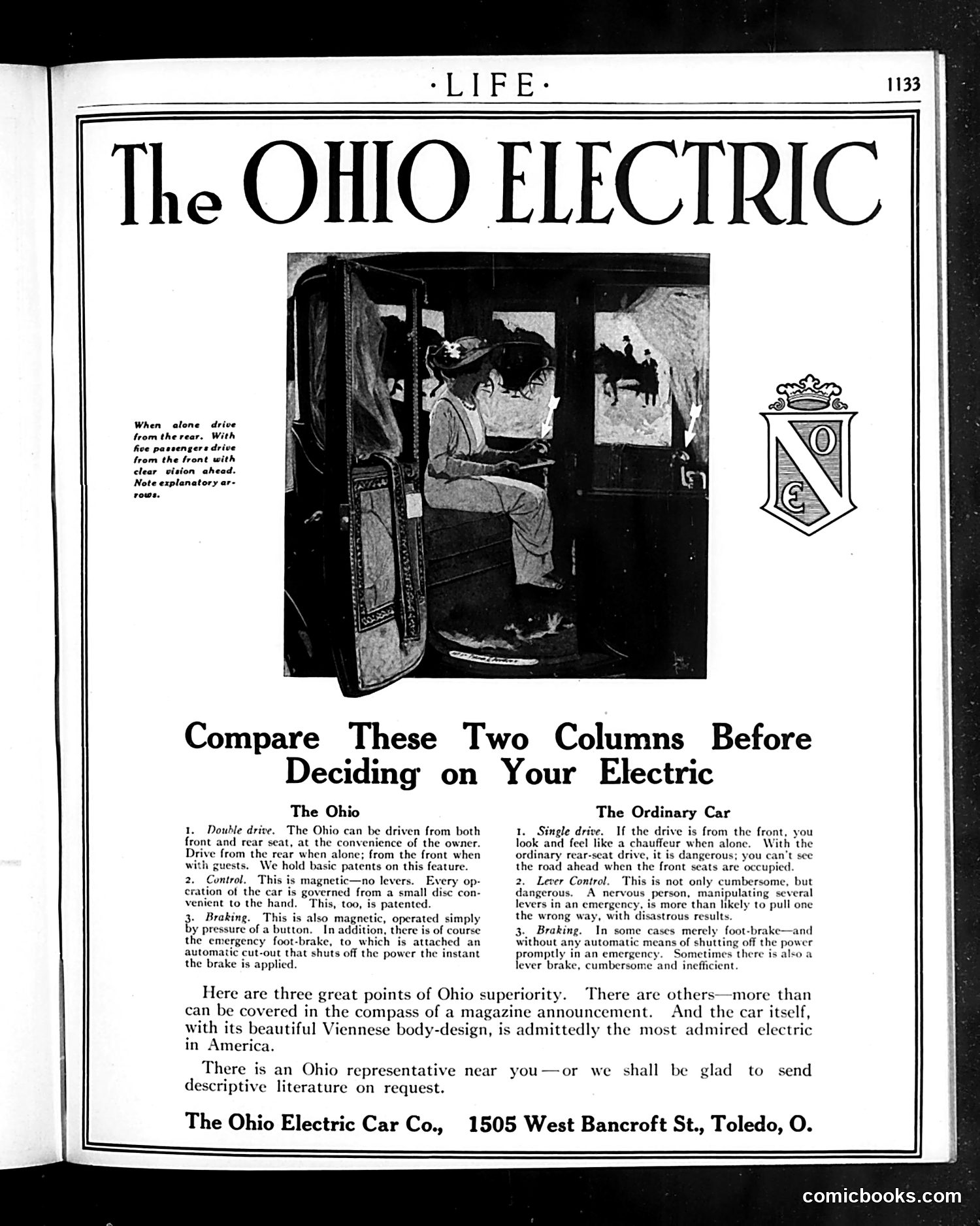
This is **not a cartoon or satire**—it's a straightforward product advertisement for electric automobiles, circa early 1900s. The page compares the Ohio Electric Car to "ordinary" (gasoline) cars through a side-by-side feature comparison. Key selling points include: - **Dual controls** (drive from front or rear seat) - **Magnetic control system** (no mechanical levers) - **Button-operated braking** with automatic power cutoff The photograph shows a woman driver alone in the vehicle, highlighting the car's appeal to women—a significant market for electric vehicles before gasoline cars dominated. The advertisement emphasizes safety, ease of operation, and comfort. It also touts the "beautiful Viennese body-design," suggesting European styling as a luxury feature. The Ohio Electric Car Company operated from Toledo, Ohio, and positioned their product as technologically and aesthetically superior to gas-powered alternatives.
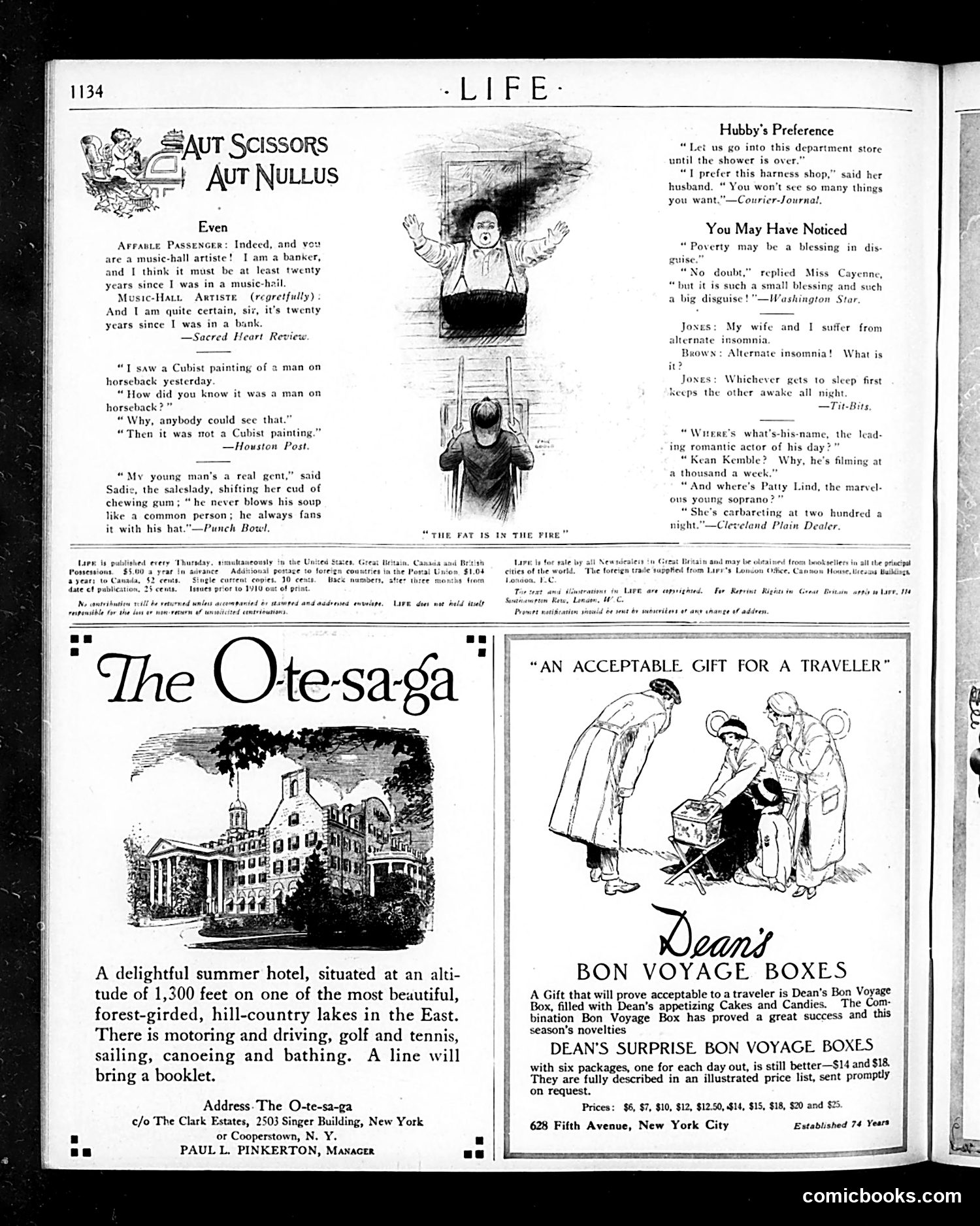
This page mixes humorous short jokes with advertisements. The central cartoon—titled "The Fat Is in the Fire"—shows two figures in distress, likely illustrating the idiom about trouble erupting. The surrounding jokes satirize early 20th-century social absurdities: a banker and musician haven't visited each other's professions in twenty years; someone identifies a Cubist painting by recognizing a man on horseback, defeating the modernist art movement's purpose; a salesman's wife causes shopping frustration by wanting everything she sees; and spouses suffer "alternate insomnia" by keeping each other awake. One joke mocks the era's celebrity culture—famous actors earning lavish sums ($1,000/week) while accomplished singers earn comparatively little ($200/night). The advertisements below promote The Ote-sa-ga resort hotel and Dean's Bon Voyage luxury gift boxes—period luxury goods for wealthy travelers. This juxtaposition of satirizing consumerism while advertising to consumers is characteristic of Life's approach.
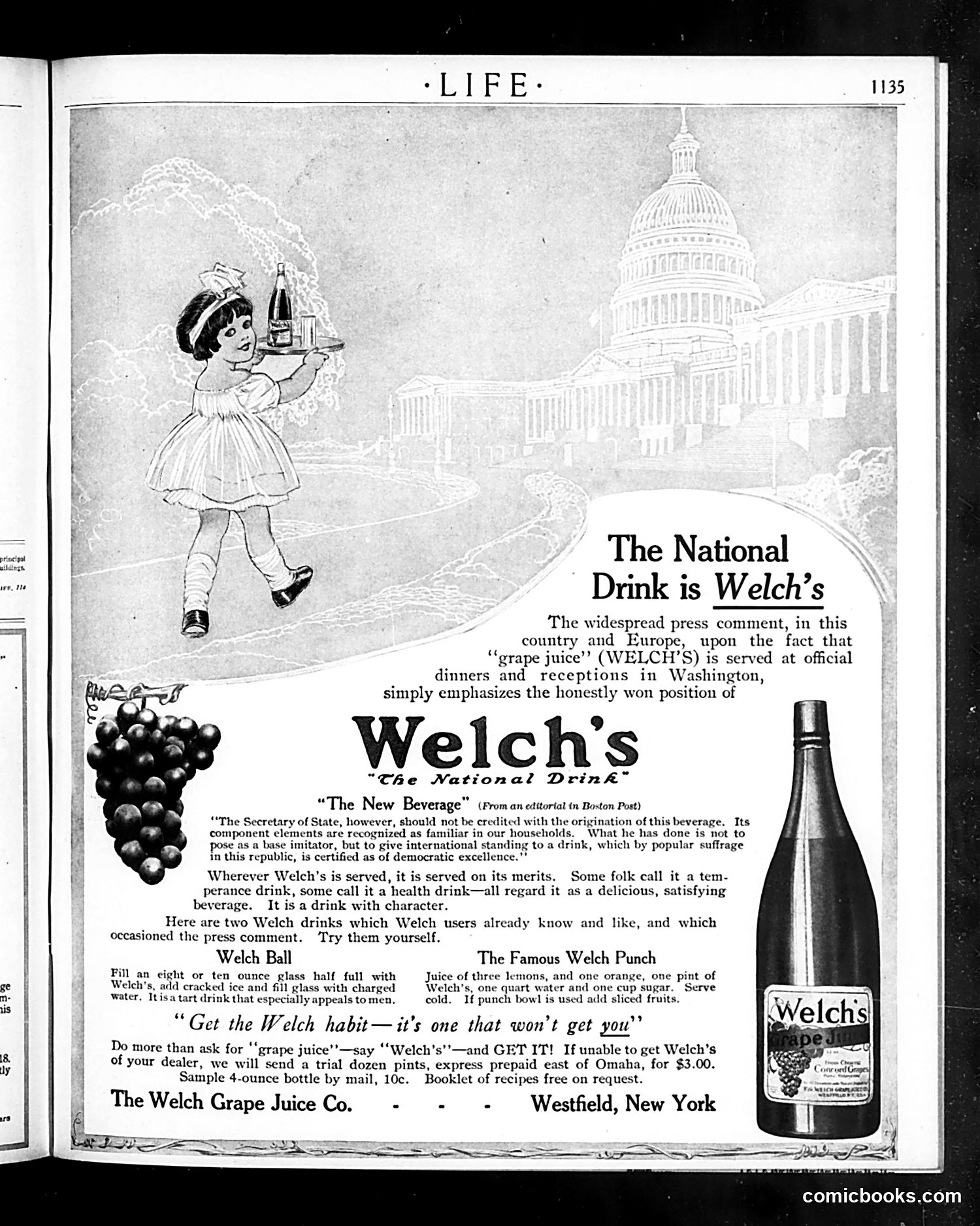
This is primarily a **commercial advertisement**, not political satire. However, it exploits a genuine historical moment: Welch's grape juice was served at official Washington dinners and receptions, likely during Prohibition era discussions or temperance advocacy. The cartoon's image of a young girl holding Welch's bottles before the Capitol building symbolically positions the drink as patriotic and wholesome—"The National Drink." The ad quotes a Boston Post editorial claiming the Secretary of State gave the beverage "international standing" by serving it at official functions. The satire here is subtle: Welch's was **non-alcoholic**, so serving it at formal state dinners represented either temperance values or a pointed statement about American sobriety. The ad emphasizes this obliquely by calling it a "temperance drink" while stressing its patriotic legitimacy. The two recipe variations (Welch Ball, Welch Punch) suggest it's sophisticated enough for formal entertaining—a claim likely amusing to period readers familiar with grape juice's humble origins.
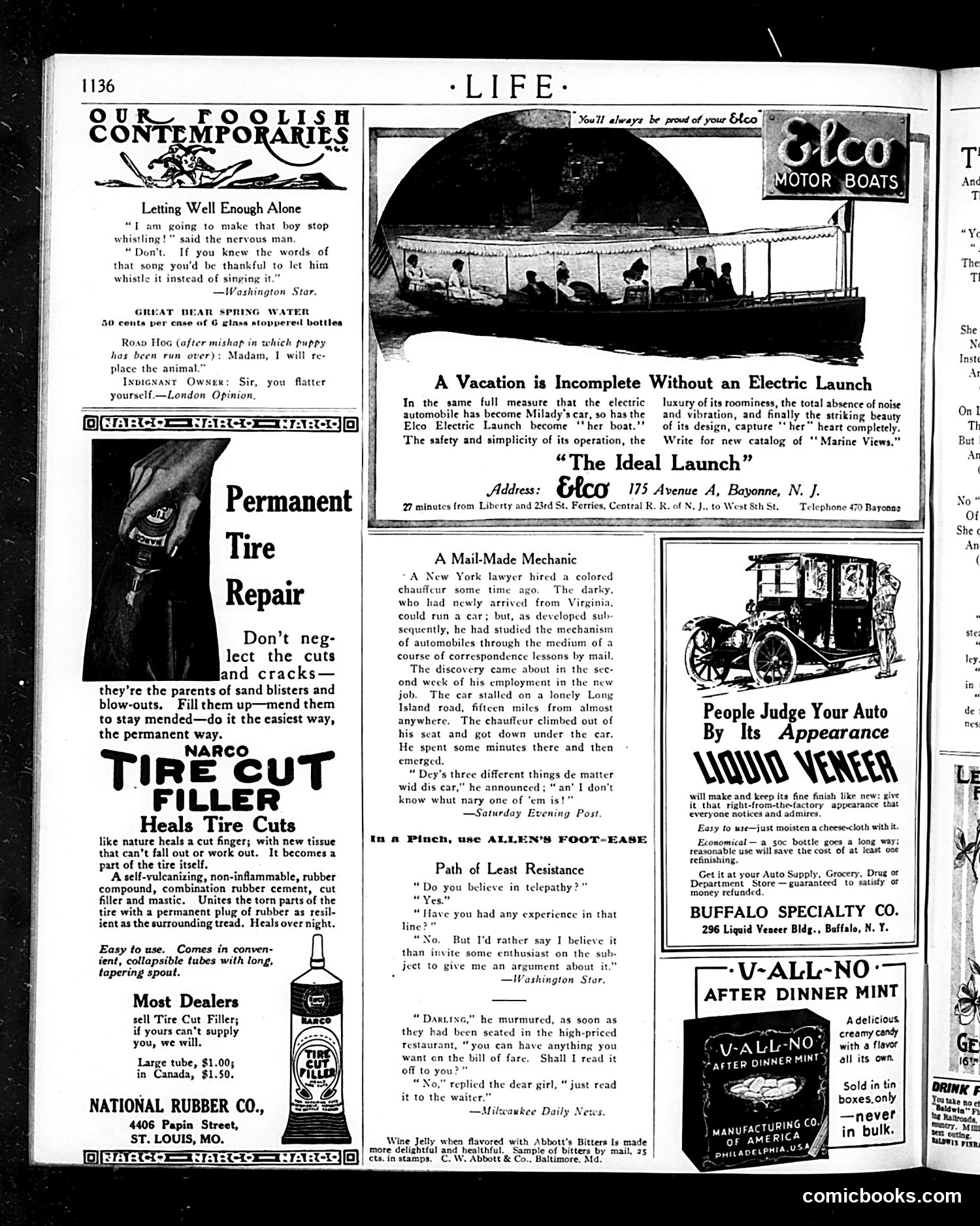
This page is primarily **advertisements and short humorous anecdotes** rather than political cartoons. The content includes: **Humorous Shorts** ("Our Foolish Contemporaries"): Brief jokes mocking everyday social situations—a nervous man wanting to stop a boy's whistling, a road hog offering to "replace" a run-over puppy (implying the dog is replaceable property), and a lawyer's newly hired chauffeur who admits he doesn't understand his mail-order auto mechanic training. **Advertisements**: The dominant content—tire repair filler, electric motorboats ("her boat"), automobile polish, foot powder, and after-dinner mints. These ads target 1920s affluent consumers concerned with leisure, automobiles, and personal grooming. **Social Context**: The humor relies on class anxiety (mail-order education failures), racial stereotypes (the "colored chauffeur" dialect), and emerging consumer culture around automobiles and leisure activities. The page reflects early 20th-century American middle/upper-class preoccupations and attitudes rather than political satire.
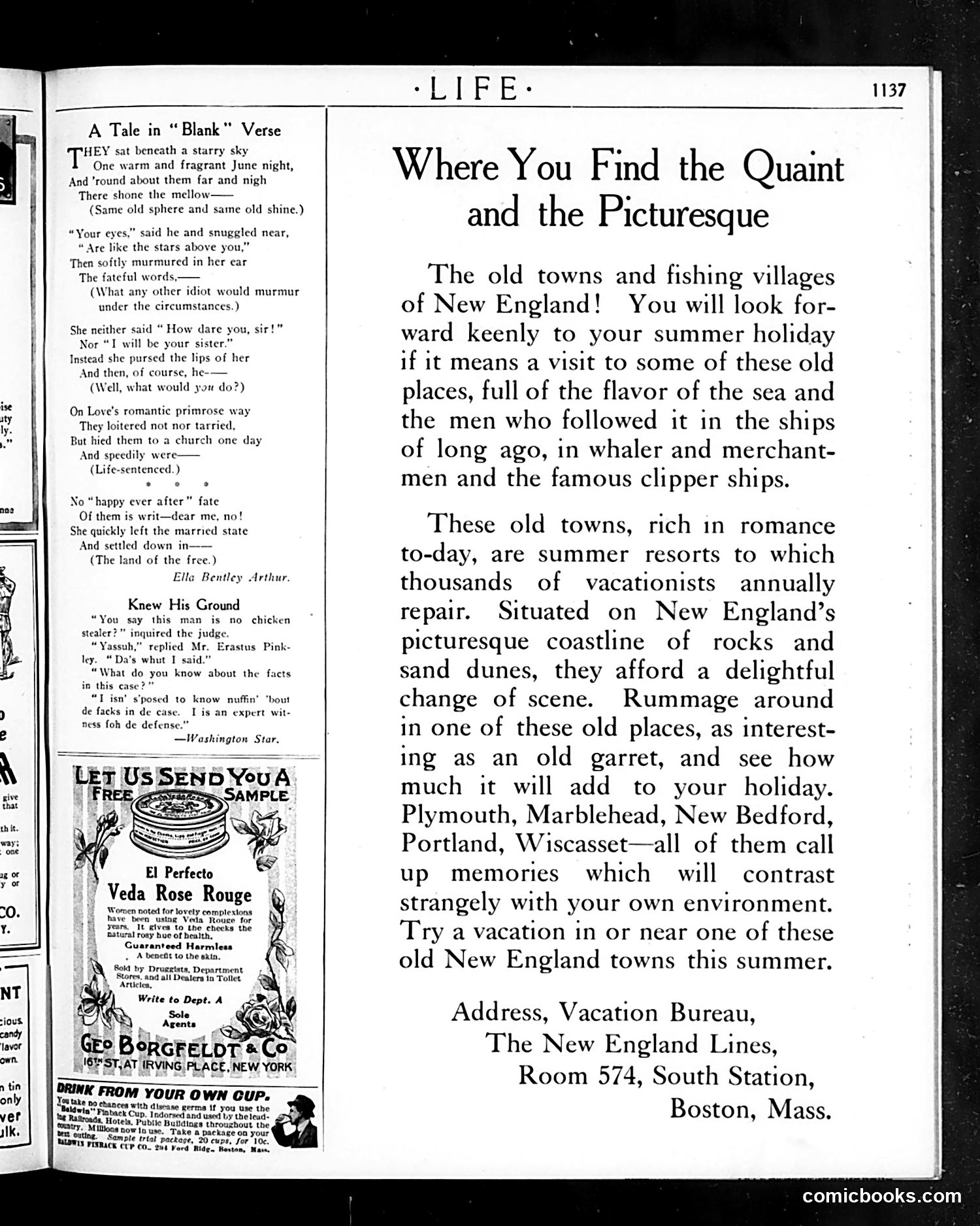
This page contains three distinct elements: **Left column poetry ("A Tale in 'Blank' Verse"):** A satirical poem by Ella Bentley Arthur mocking romantic clichés and hasty marriage. The joke is in the parenthetical asides that deflate the sentiment—when a man compliments a woman's eyes as "like the stars," the aside notes "What any other idiot would murmur." The poem's payoff: the couple quickly divorces ("settled down in (The land of the free)"), suggesting marriage is prison and divorce is liberation. This reflects 1920s anxieties about changing divorce rates. **"Knew His Ground" joke:** A courtroom anecdote mocking an "expert witness" who admits knowing nothing about the facts—he's merely a professional defense witness willing to testify regardless of evidence. Social satire on courtroom hypocrisy. **Right side and bottom:** Advertisements (cosmetics, sanitary cups) and a travel promotion for New England towns, capitalizing on nostalgia for maritime history and "quaint" vacation destinations. The page is primarily satirical humor and advertising, typical of Life magazine's mixed editorial-commercial format.
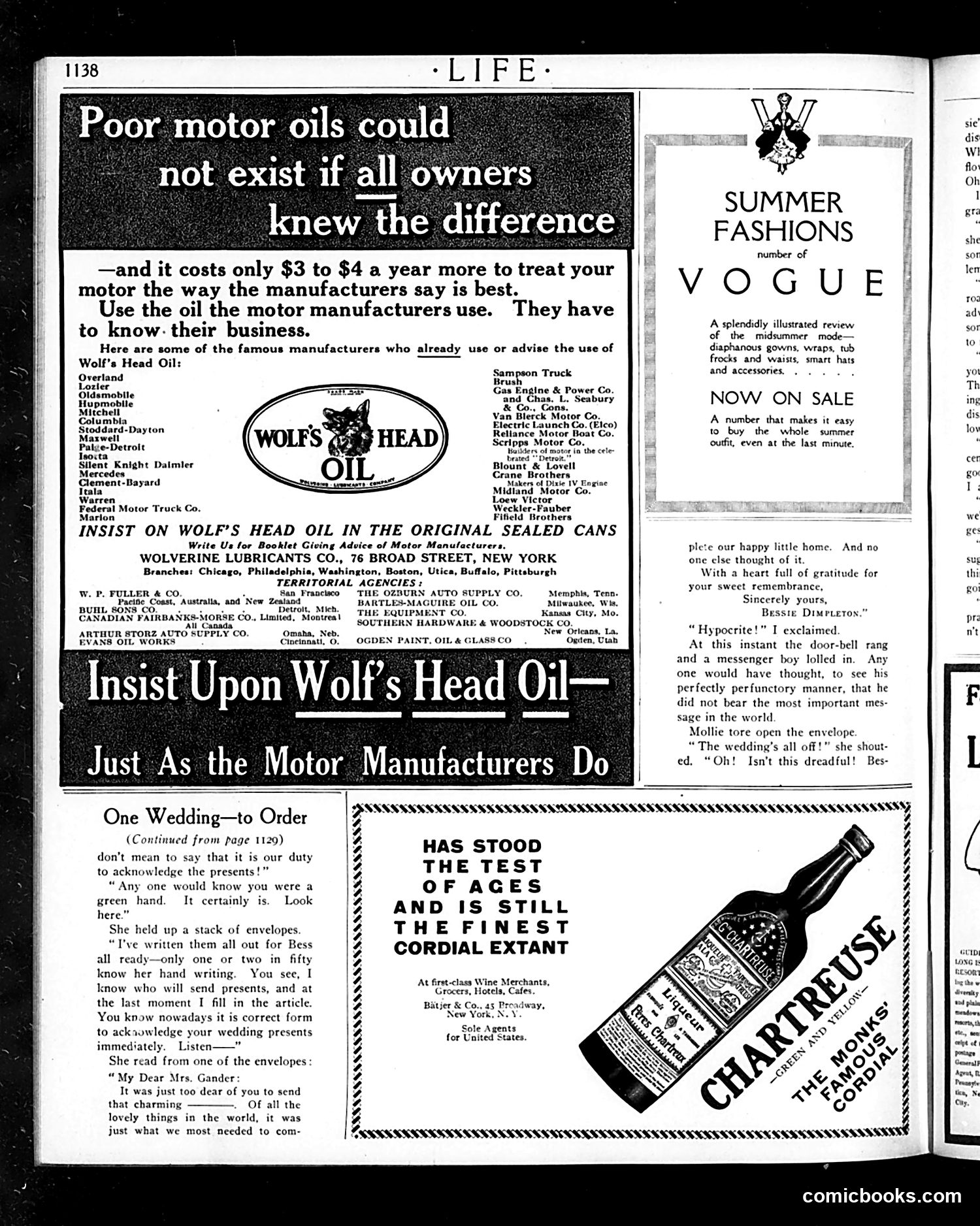
This page contains primarily **advertisements** rather than political cartoons or satire. The dominant content is a **Wolf's Head Motor Oil advertisement** that lists major automobile manufacturers (Overland, Oldsmobile, Maxwell, etc.) endorsing the product. The pitch argues that using quality oil costs only $3-4 yearly more but protects engines properly—manufacturers know best, so use what they use. Below sits an advertisement for **Chartreuse liqueur**, claiming it has "stood the test of ages" and remains "the finest cordial extant." The page also includes a serialized fiction piece titled "One Wedding—to Order" about etiquette surrounding wedding gifts, and an advertisement for **Vogue's Summer Fashions** issue. There is **no political satire or cartoon commentary** visible. This appears to be a standard magazine page from the early automotive era, emphasizing product endorsements by prestigious manufacturers—a common advertising strategy of the period.
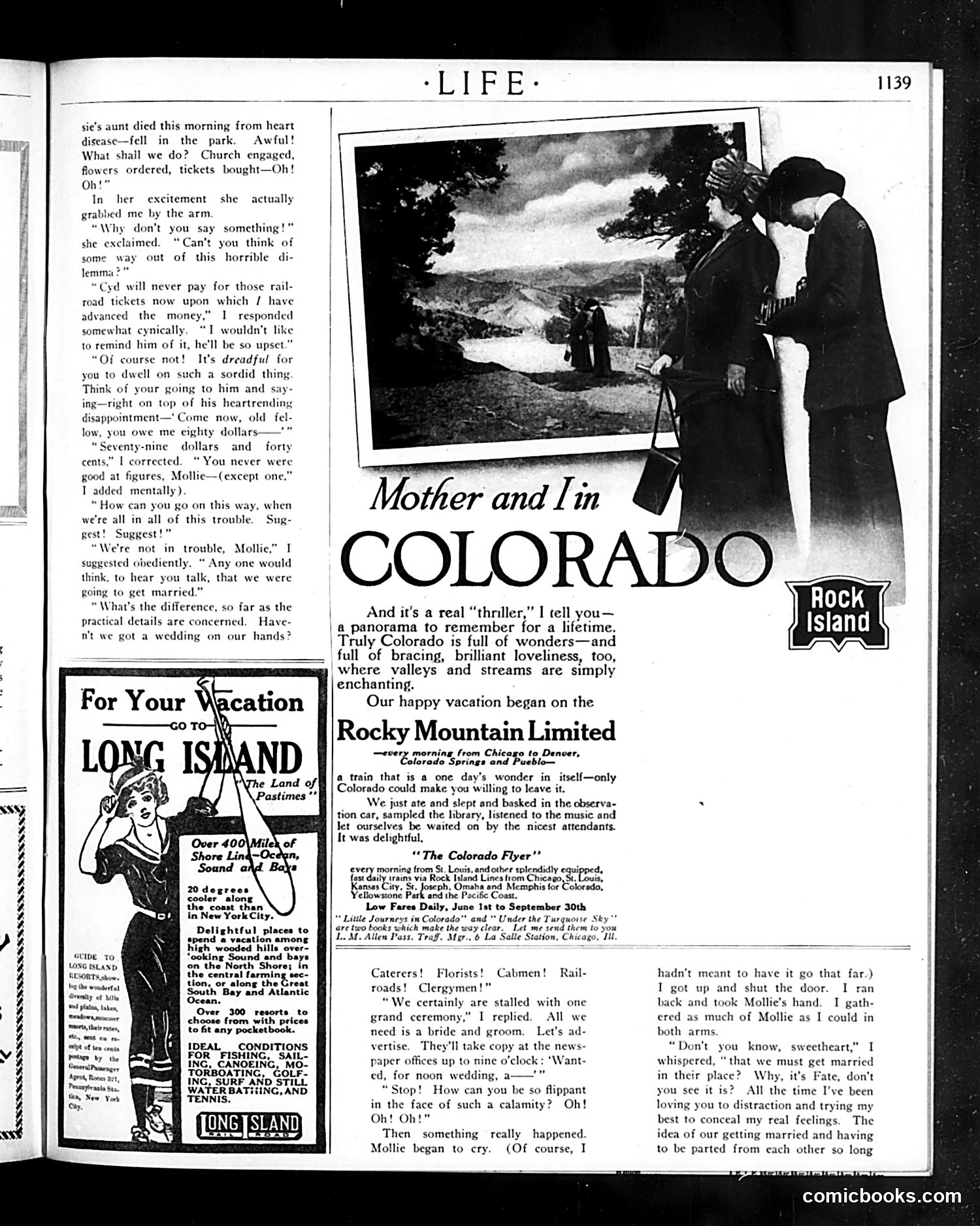
This page contains two distinct elements: a humorous domestic narrative and period travel advertising. **The Main Story**: A comedic dialogue between an engaged couple confronting a wedding crisis. The narrator's aunt has died suddenly, forcing cancellation of their church ceremony, flowers, and tickets—yet the narrator callously fixates on the "$79.40" his fiancée Mollie owes him for railroad tickets he'd advanced. The satire targets masculine emotional obtuseness: while Mollie grieves and panics about the wedding logistics, her fiancé makes crass financial jokes and flippant marriage advertisements ("Wanted, for noon wedding, a—"). Only when Mollie cries does he embrace her emotionally, revealing his genuine feelings beneath shallow practicality. **The Advertising**: A Long Island resort ad and a Rock Island Line railroad promotion for Colorado vacations, featuring photos of scenic mountain landscapes and testimonials about train travel amenities. The joke's social commentary: even amid emotional crisis, American men prioritized financial transactions over feelings—a critique of materialist gender dynamics in the 1920s.
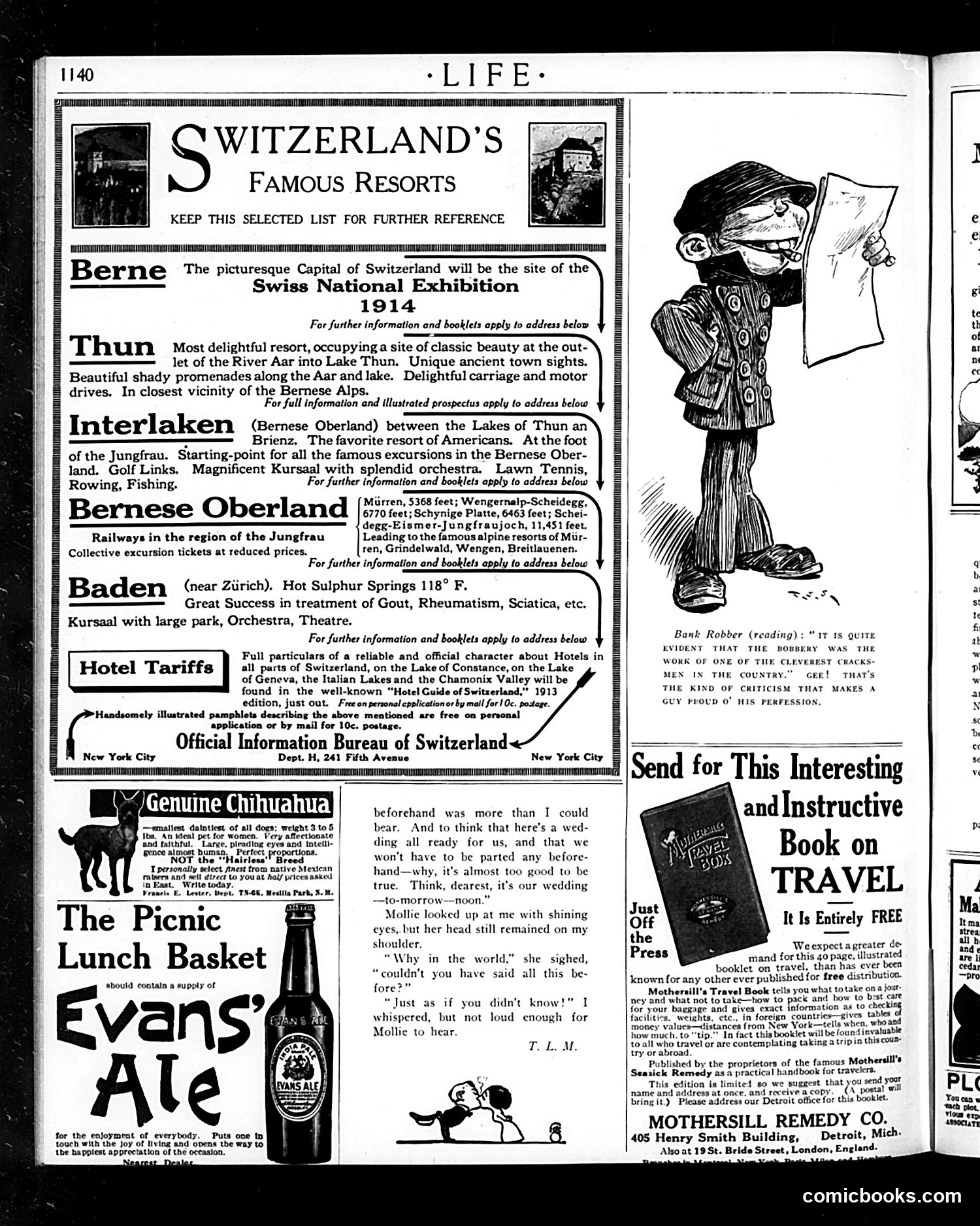
This page is primarily **Swiss tourism advertising** for the 1914 Swiss National Exhibition, with one small satirical cartoon embedded. The cartoon shows a "Bank Robber (reading)" examining a document. The caption reads: "It is quite evident that the robbery was the work of one of the cleverest criminals in the country. Gee! That's the kind of deduction that makes a guy proud of his profession." **The joke**: A criminal is reading a police report about a robbery and smugly praising the investigator's "clever deduction"—when the deduction is so obvious it's worthless. The satire targets **incompetent detective work**: the investigator states the obvious (a "clever criminal" committed a clever crime) and presents it as profound analysis. The robber's pride in being called "one of the cleverest" while reading such vapid reasoning mocks both criminal vanity and police incompetence. This is gentle, timeless humor about bureaucratic foolishness rather than topical political satire.
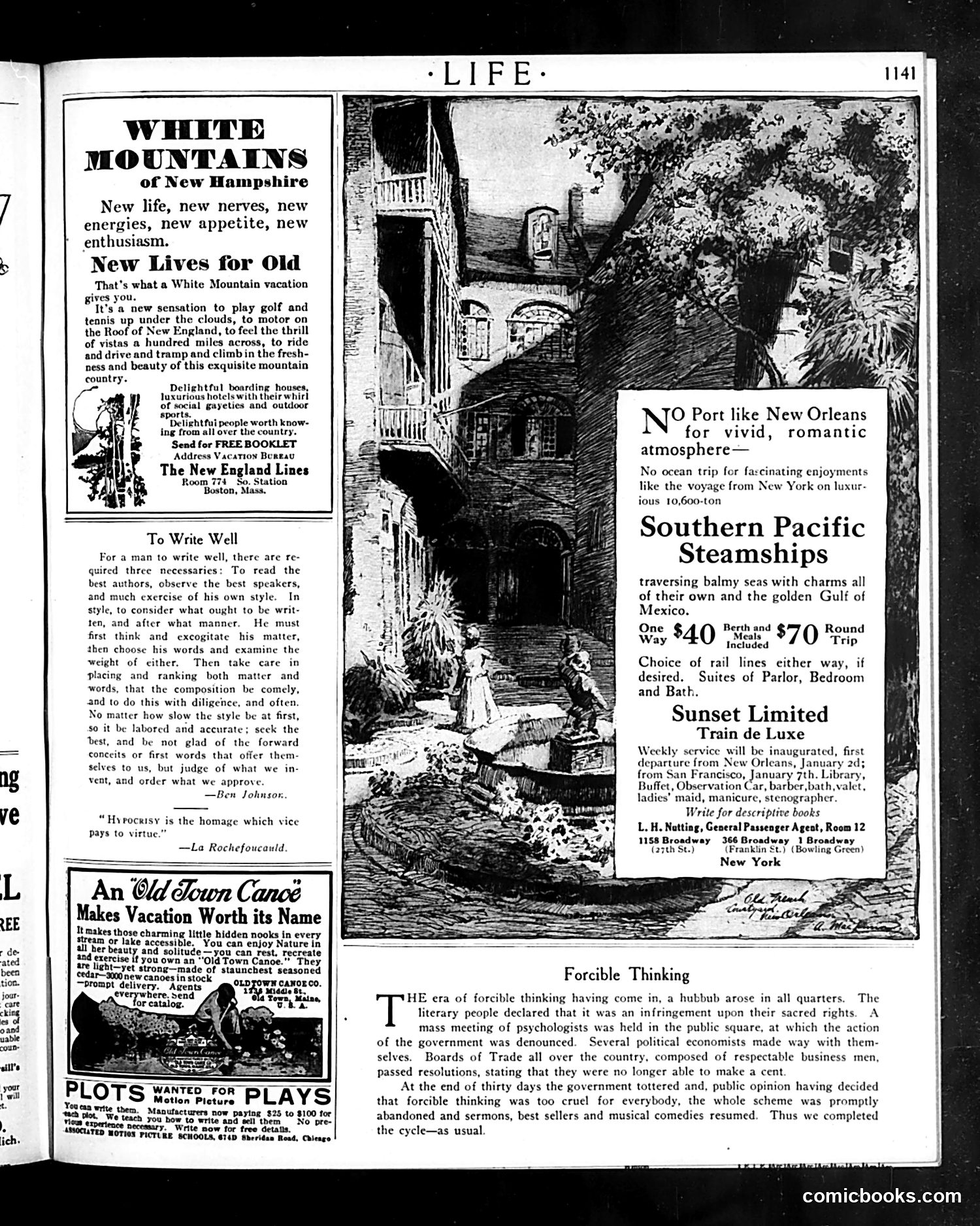
This page is primarily **advertisements and lifestyle content** rather than political satire. The main editorial piece is titled "Forcible Thinking"—a brief satirical commentary on government attempts to mandate intellectual rigor. The satire mocks the backlash when authorities try to impose "forcible thinking" on society. According to the text, literary figures, psychologists, economists, and business leaders all violently opposed this policy, claiming it infringed their rights and harmed commerce. After thirty days of public outcry, the government abandoned the scheme. The joke appears to be **anti-intellectual mockery**: suggesting that when forced to think rigorously, various self-interested groups (artists, academics, businessmen) revolt, preferring comfort to challenge. It critiques how easily public opinion—mobilized by those resisting accountability—can overturn policy. The surrounding advertisements for vacations, canoes, and steamships reflect the magazine's commercial content typical of early 20th-century *Life*.
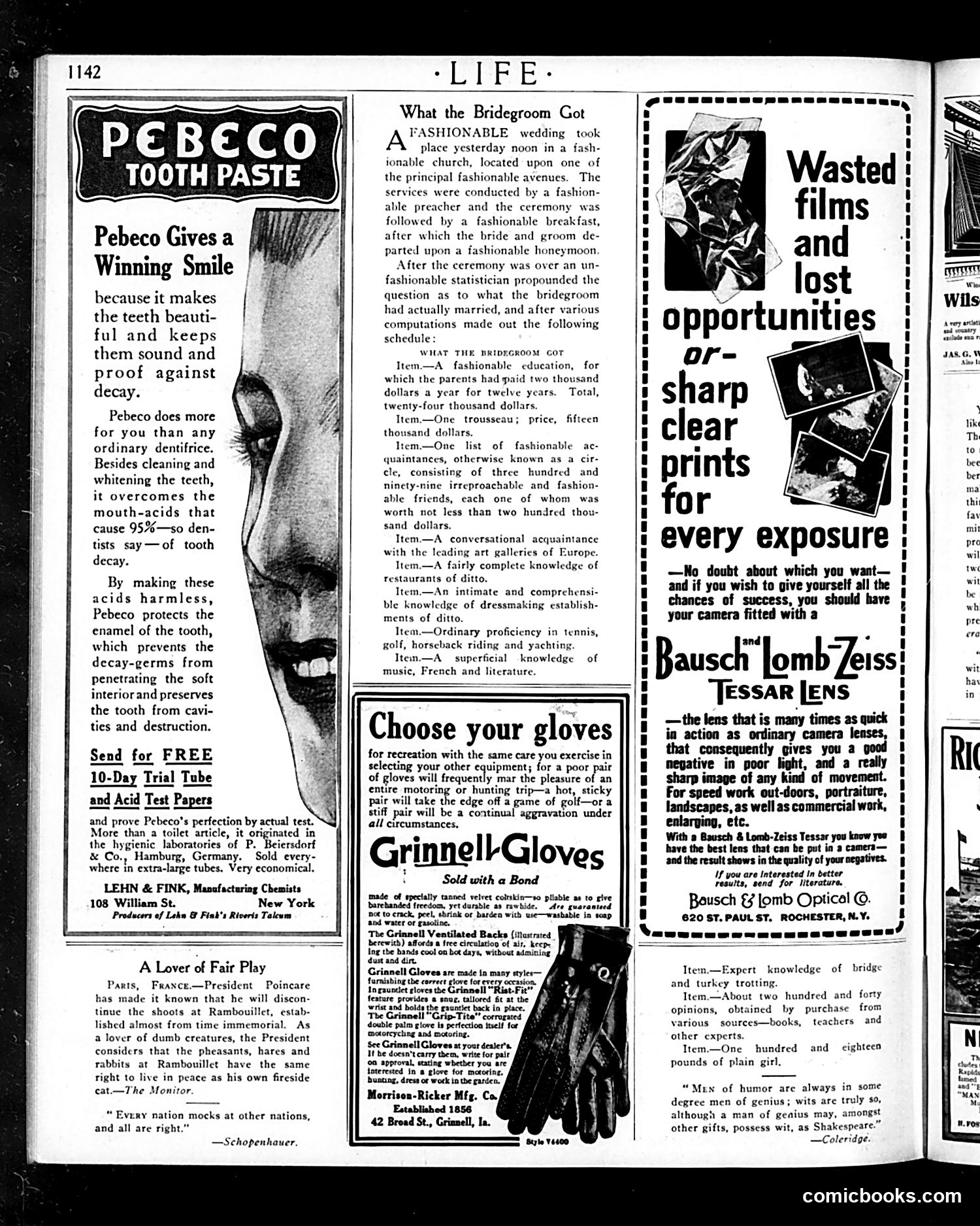
This page is primarily **advertising**, not political satire. However, it contains one notable satirical article: ## "What the Bridegroom Got" This is a humorous social commentary on wealthy marriages, presented as a mock inventory. An "unfashionable statistician" tallies what a groom actually acquires by marrying into high society: $24,000 in fashionable education, a $15,000 trousseau, 399 wealthy acquaintances, knowledge of European art galleries and restaurants, dress-making establishments, and superficial accomplishments in sports and culture. **The satire's point**: It ridicules the emptiness of "fashionable" society—the bride's value is reduced to expensive superficialities and social connections rather than character or intellect. The recurring word "fashionable" emphasizes how hollow and repetitive upper-class pretension is. The remaining content consists of period advertisements for Pebeco toothpaste, Grinnell gloves, Bausch & Lomb camera lenses, and a brief anecdote about French President Poincaré's compassion toward game animals.
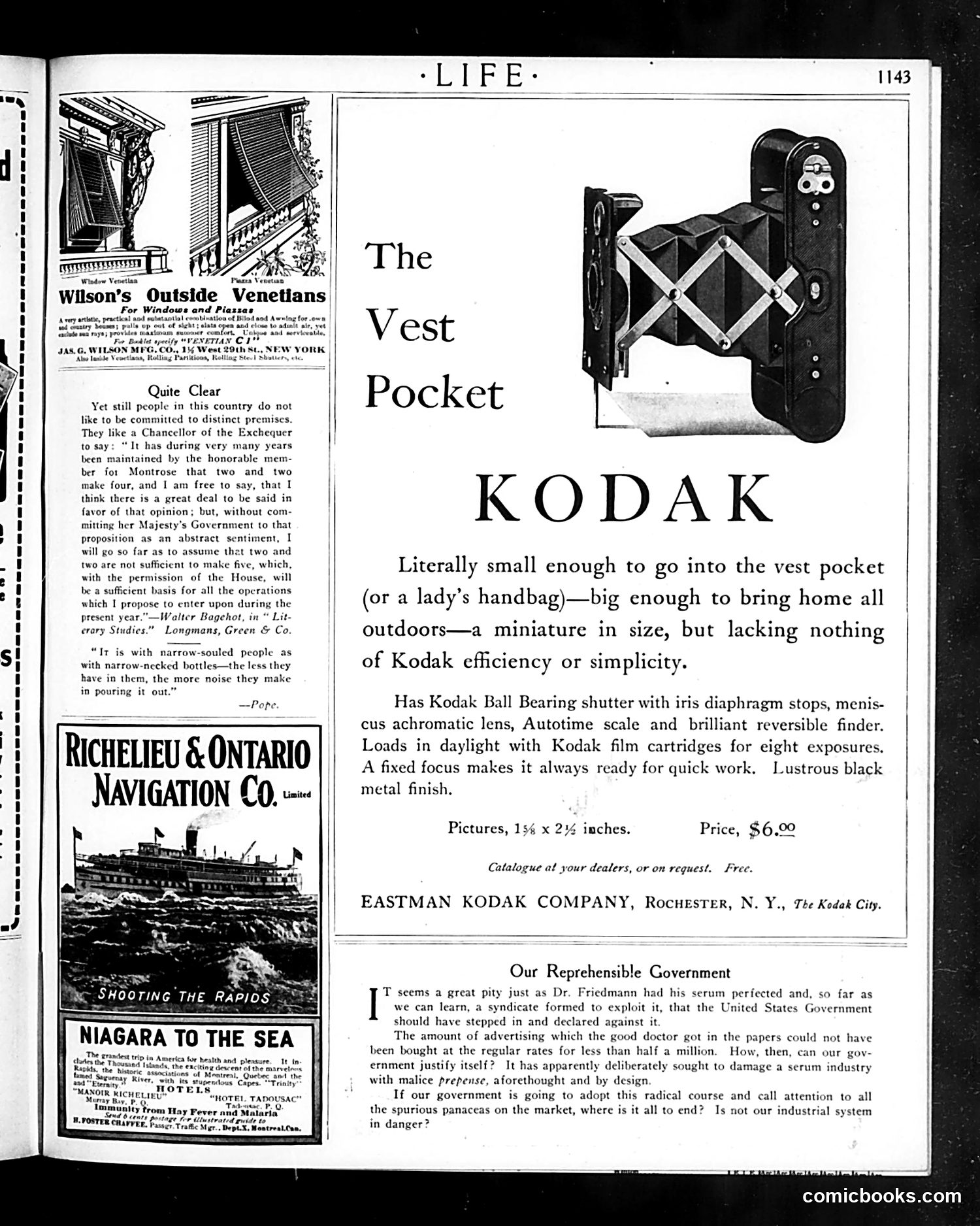
This page is primarily **advertising and editorial content**, not political cartooning. The left side contains ads for Wilson's venetian blinds, Richelieu & Ontario Navigation Company (river cruises), and various quotes about British parliamentary hedging and human nature. The main content is a **Kodak Vest Pocket camera advertisement** — a new portable camera small enough for a vest pocket or handbag, priced at $6.00. Below is an editorial titled "Our Reprehensible Government" criticizing U.S. government intervention against Dr. Friedmann's serum (a tuberculosis treatment). The writer sarcastically argues the government wrongly attacked a medical product that generated free newspaper advertising worth half a million dollars, and sarcastically asks whether the government will now regulate all "spurious panaceas." **The satire**: The piece mocks what it sees as hypocritical government overreach—condemning authorities for damaging legitimate business through "malice prepense" while protecting industrial profits over public health scrutiny.
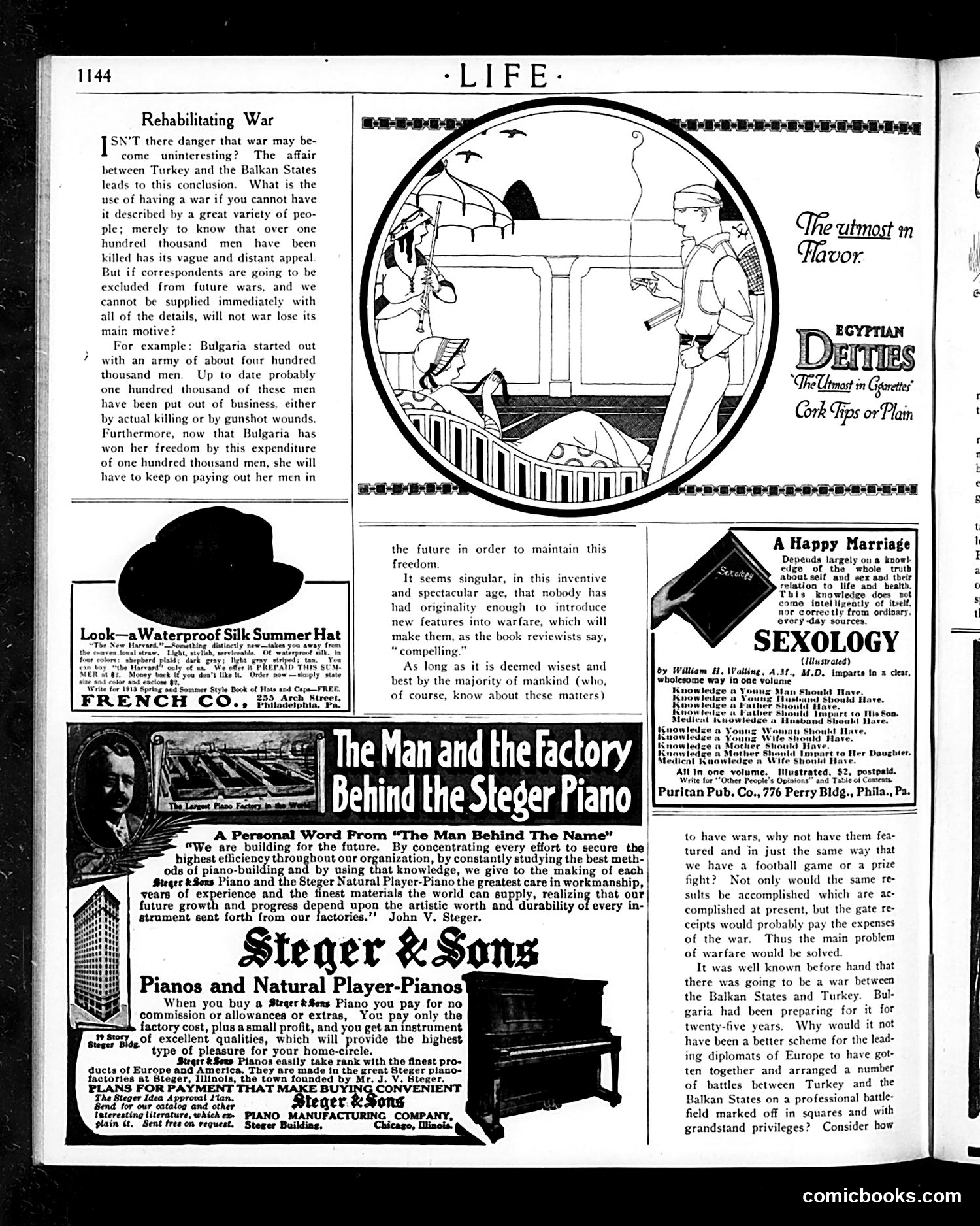
This page's main article mocks the Balkan Wars (likely 1912-1913) through ironic commentary. The author argues war becomes "uninteresting" when journalists are excluded from coverage, since the public's fascination depends on detailed reporting rather than actual outcomes. The satire suggests that if wars were treated like entertainment spectacles—"featured...just the same way that we have a football game or a prize fight"—gate receipts could fund the conflict itself. This inverts typical war justifications by exposing how modern warfare had become, for civilian audiences, primarily a *news commodity* rather than a serious geopolitical matter. The piece critiques both the sensationalism of war reporting and society's appetite for war-as-entertainment. Bulgaria's loss of 100,000 soldiers is presented as economically pointless—they must "keep on paying" to maintain freedom won at such cost. The surrounding advertisements (pianos, hats, marriage guides) contrast sharply with this dark satire about human casualties.
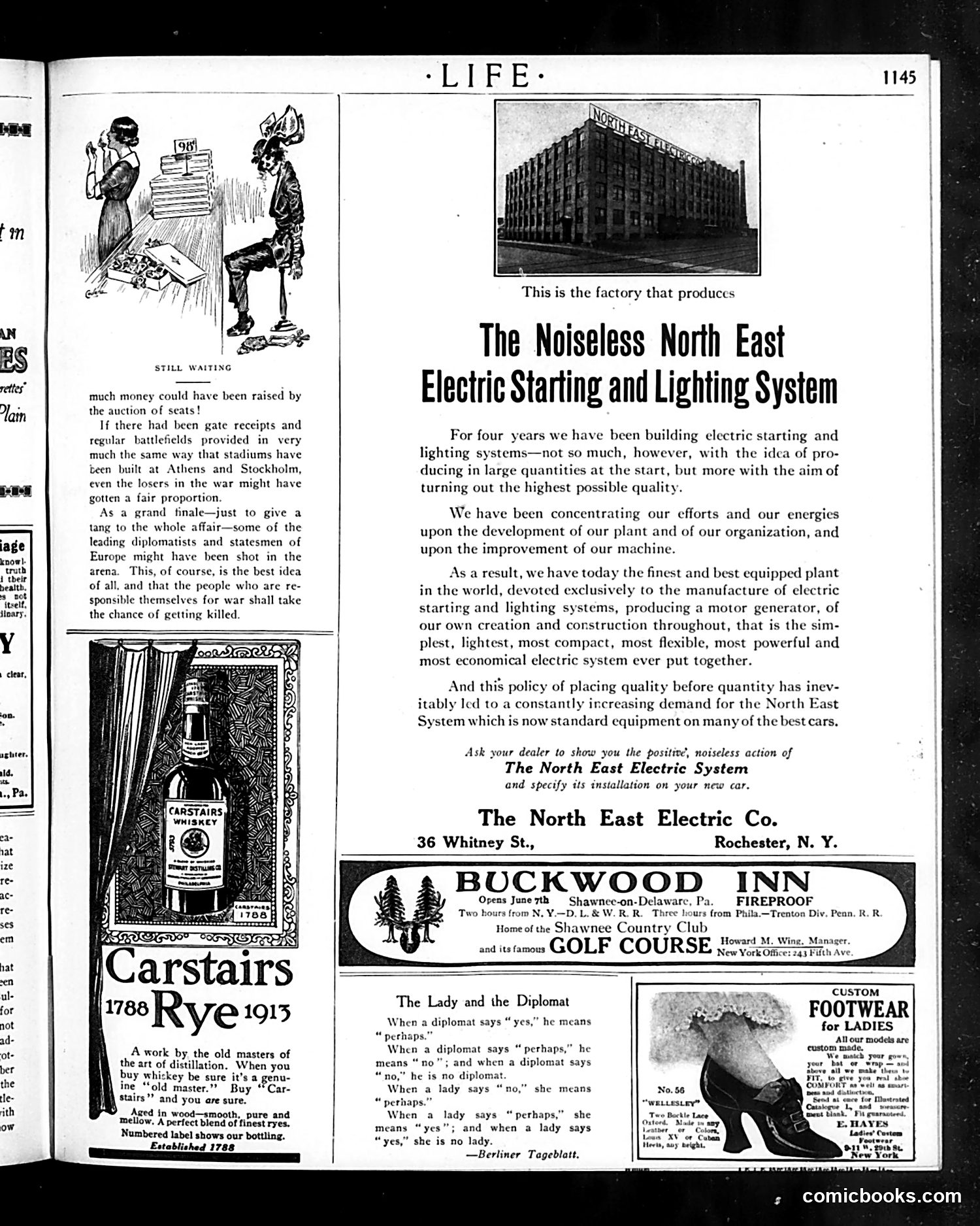
The left cartoon depicts two figures amid scattered papers and bureaucratic chaos, titled "Still Waiting." Based on the accompanying text, this satirizes post-World War I peace negotiations and reparations disputes. The figures appear to represent nations or diplomats awaiting settlement of war debts and territorial claims. The text's accompanying commentary is darkly satirical: it proposes converting war into a spectator sport with "regular battlefields" and stadium seating, suggesting diplomats and statesmen responsible for war should themselves face combat—a biting critique of political leaders sending others to die while remaining safe. The cartoon thus mocks the prolonged, frustrating diplomatic process following WWI, where nations squabbled over compensation while ordinary people suffered the war's aftermath. "Still waiting" captures the public's exasperation with slow governmental action on reconstruction and justice.
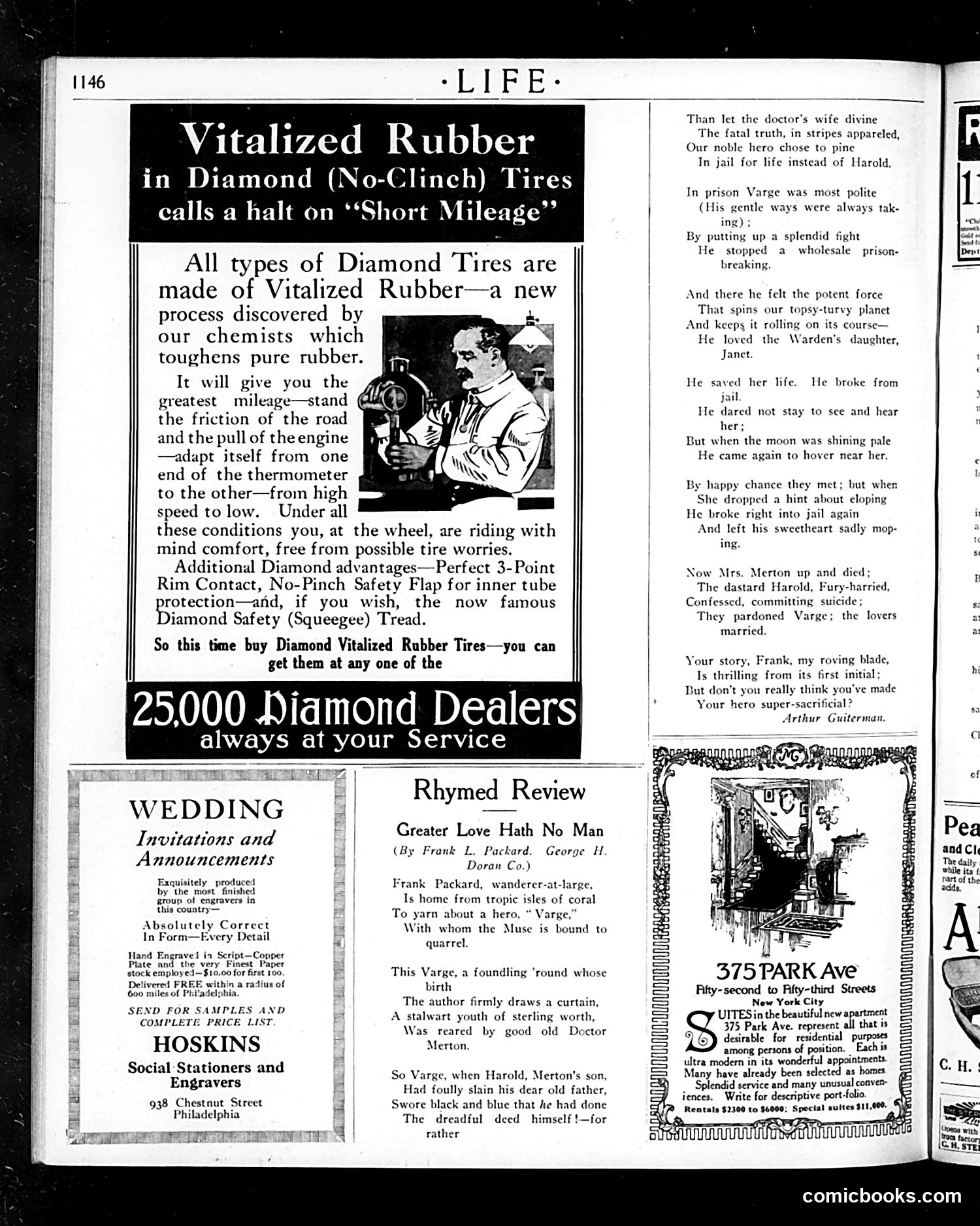
This page is primarily **advertising and literary content**, not political satire. The dominant advertisement promotes **Diamond Vitalized Rubber Tires**, claiming a new chemical process provides superior mileage and durability. The illustration shows a chemist or engineer examining tire materials—a straightforward product pitch aimed at early automobile owners concerned about tire reliability and "short mileage" problems. Below is a **"Rhymed Review"** by Arthur Guiterman critiquing a serialized story called *Greater Love Hath No Man* (by Frank L. Packard and George H. Doran Co.). The poem summarizes the melodramatic plot: a foundling named Varge falsely imprisons himself to protect an innocent man, falls in love with the warden's daughter, breaks out, then returns to jail—all while the guilty party confesses. Guiterman's gentle mockery questions whether the hero is genuinely noble or merely "super-sacrificial" (overly self-sacrificing to the point of absurdity). The page also includes wedding stationery advertising and apartment rental listings—standard magazine filler of the era.
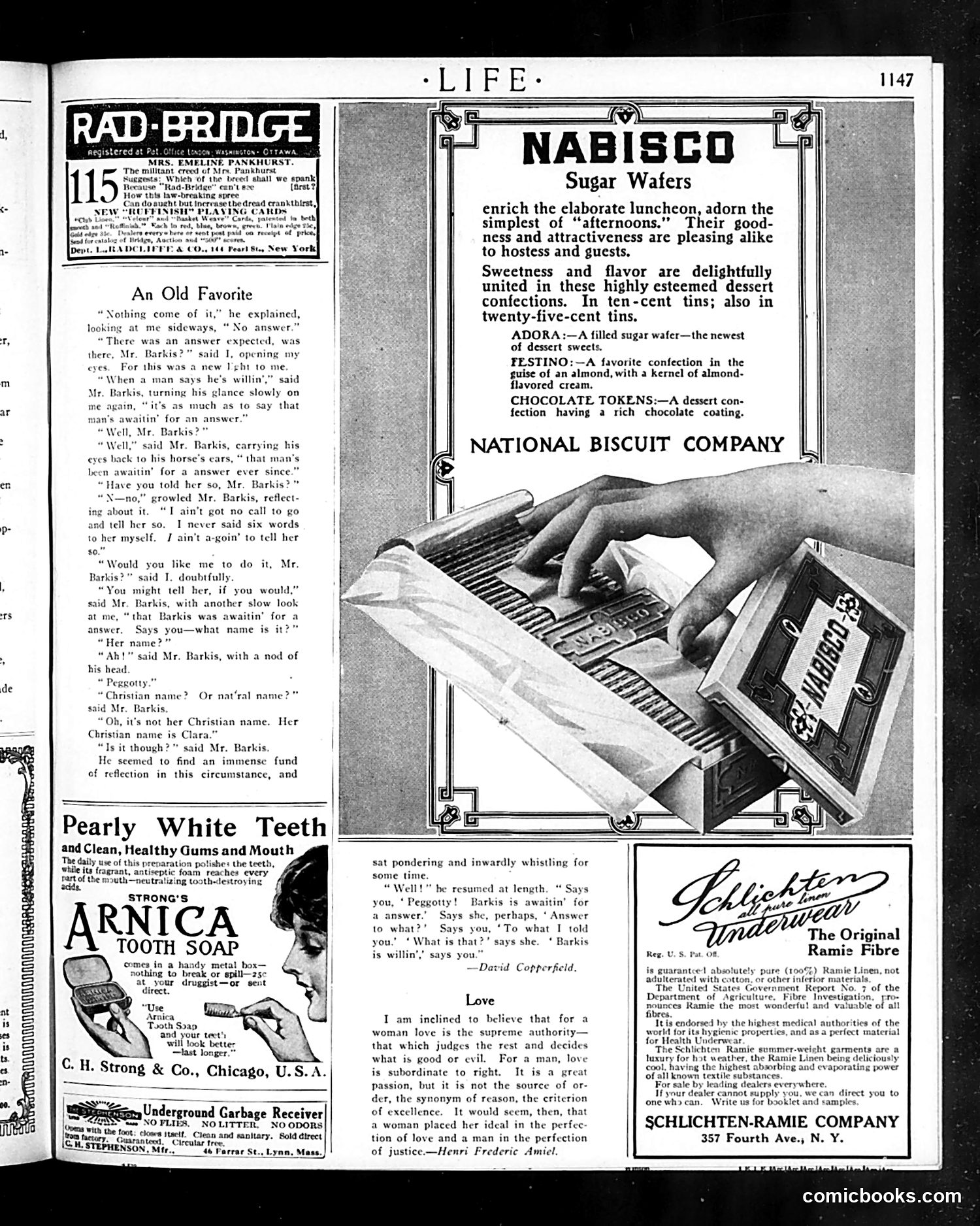
This page is primarily **advertising** with minimal editorial content. The main items are: **Advertisements:** - **Nabisco Sugar Wafers** (top right): Promotes fancy dessert confections for upscale social occasions like luncheons and "afternoons" - **Arnica Tooth Soap**: Promises dental health and clean gums - **Schlichten-Ramie Company**: Markets ramie fiber underwear as superior material - **Underground Garbage Receiver**: A utilitarian sanitation product **Editorial Content:** The left column contains an excerpt from **Charles Dickens's *David Copperfield*** featuring the character Mr. Barkis, famous for the phrase "Barkis is willin'"—a proposal of marriage delivered indirectly through the narrator. **Below:** A brief philosophical passage attributed to Henri Frederic Amiel on the nature of love and gender roles. The page reflects early 20th-century concerns: refinement and social status (fancy desserts), health consciousness (dental care), and evolving gender expectations, though the Dickens excerpt suggests nostalgia for Victorian literature.
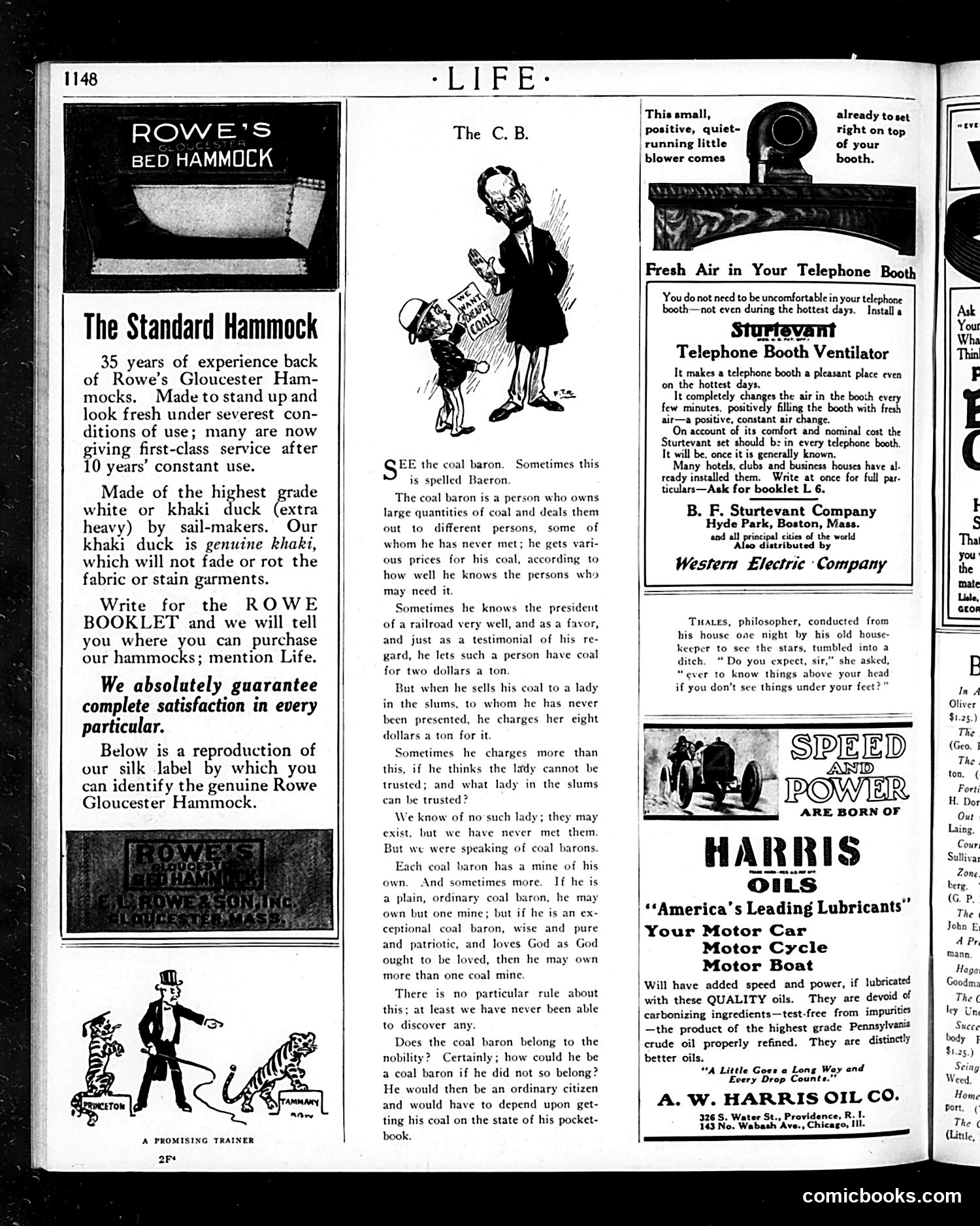
This page's central feature is a satirical article about "the coal baron," illustrated with a cartoon depicting a well-dressed man in a top hat towering over a poor woman and child. The satire exposes economic exploitation during the early 20th century. The "coal baron" was a wealthy industrialist who controlled coal mines and distribution. Life's critique highlights the price-gouging these barons practiced: they charged railroad presidents (whom they knew) $2 per ton, but charged poor women in slums $8 per ton or more for the same product. The piece sarcastically questions whether poor women can be "trusted" to pay inflated prices, implying they couldn't afford honest rates. This reflects genuine Progressive-era anger at monopolistic practices and wealth inequality. Coal was essential for heating homes, making price manipulation particularly exploitative of the poor. The cartoon visually conveys the power imbalance between the wealthy baron and vulnerable customers dependent on his coal for survival.
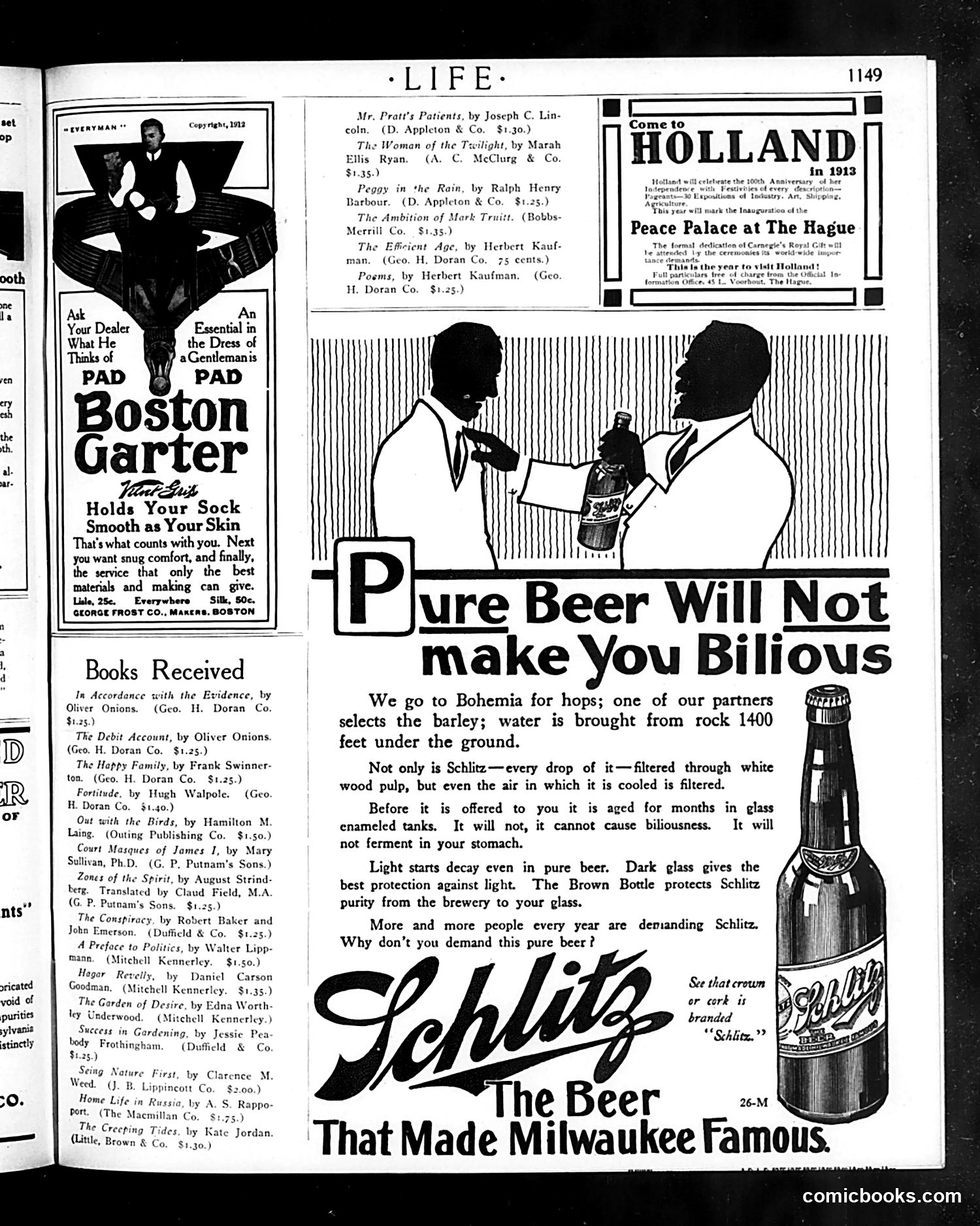
This page is primarily **advertising**, not satirical content. The dominant feature is a large Schlitz beer advertisement occupying roughly half the page. **The Advertisement's Argument:** The ad's headline "Pure Beer Will Not make You Bilious" addresses a genuine contemporary health concern—beer was widely blamed for causing digestive upset and nausea. Schlitz responds by emphasizing their purification process: filtered water from deep underground, filtered air during cooling, and aged storage in glass-enameled tanks to prevent fermentation in the stomach. **Historical Context:** This reflects early 20th-century anxieties about food and beverage safety before modern food regulations. The ad also shows two men in what appears to be a commercial transaction, typical of period advertising imagery. The page's other content consists of book reviews and a Boston Garter sock advertisement—standard magazine filler material of the era. There is no political satire present on this particular page.
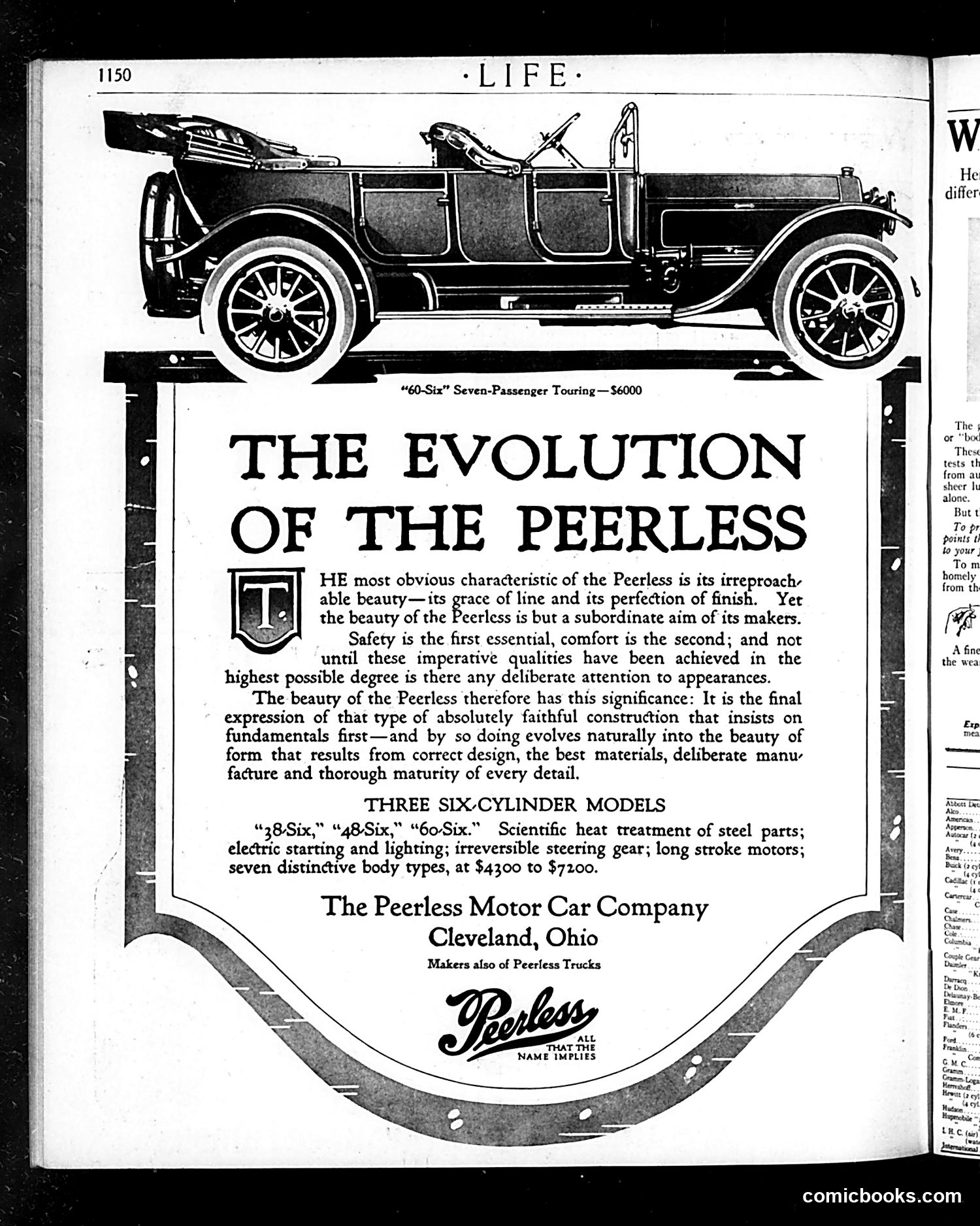
This is **not a cartoon or satire page**—it's a full-page advertisement for the Peerless Motor Car Company of Cleveland, Ohio, published in *Life* magazine. The ad showcases the "60-Six" seven-passenger touring car ($6,000) and promotes three six-cylinder models ranging from $4,300 to $7,200. The advertisement's argument is straightforward marketing, not satire: it claims Peerless vehicles prioritize safety and comfort as "fundamentals first," with beauty naturally following from quality construction rather than superficial styling. The only potential irony for a modern reader is that *Life*'s editorial content was satirical, yet *Life* carried substantial automobile advertising—a common tension in early 20th-century magazines balancing humor with revenue. However, the ad itself presents no political commentary or jokes; it's earnest commercial copy typical of the automotive industry during this era.
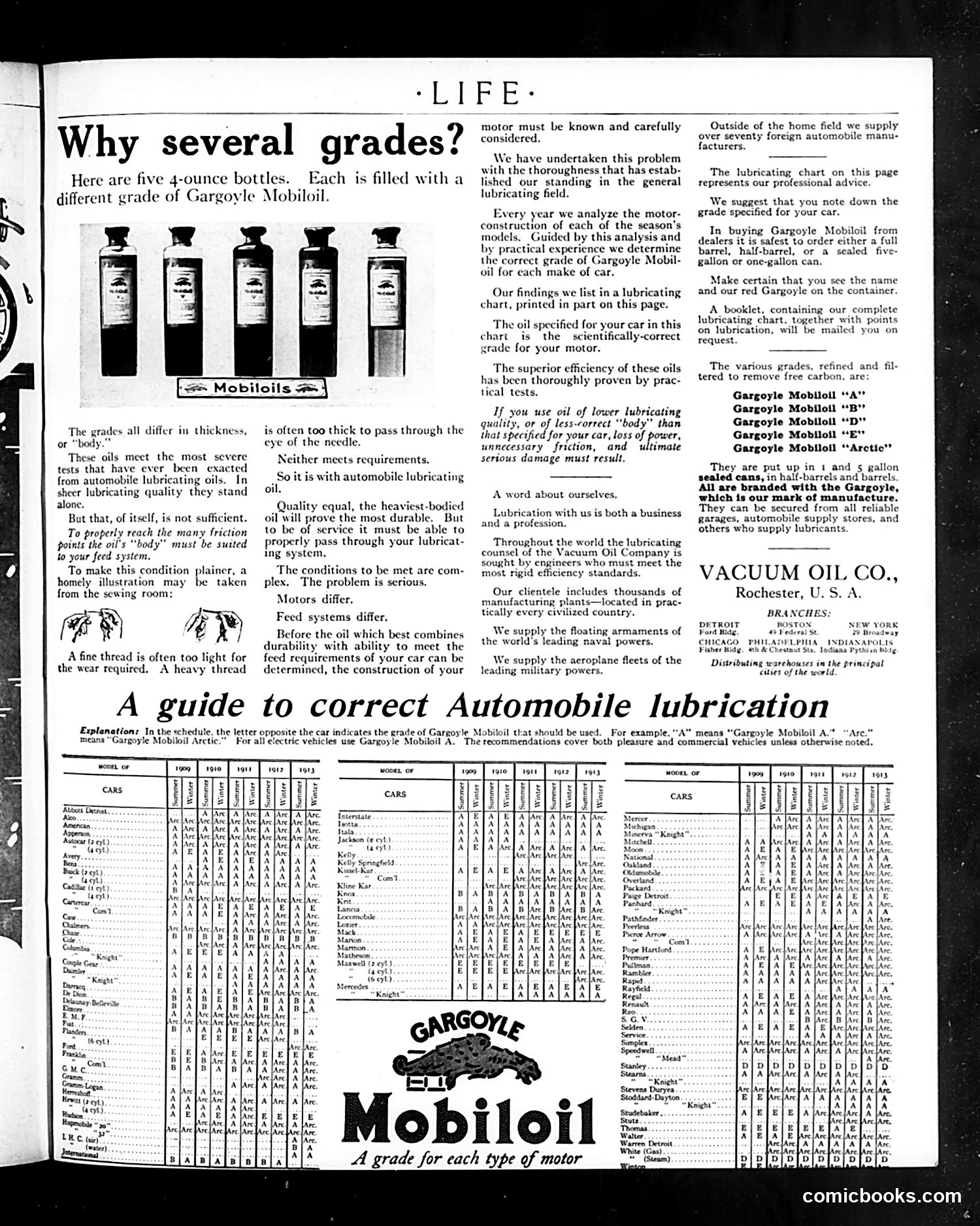
This is a **full-page advertisement**, not satire or political commentary. It promotes Gargoyle Mobiloil motor oil, made by the Vacuum Oil Company of Rochester, New York. The page explains why the company sells five different oil grades. The key argument uses a **sewing analogy**: just as thread must be the right thickness to pass through a needle's eye, motor oil must have the correct viscosity ("body") for each car's specific feed system. Too thin and it won't lubricate; too thick and it won't flow properly. The advertisement includes: - Five sample bottles showing viscosity differences - Technical justification for multiple grades - A detailed lubrication chart (visible but not fully legible) recommending specific grades for different car makes and years - Claims about the company's expertise supplying naval and military forces worldwide This reflects early 20th-century automotive marketing: as motor designs proliferated, standardized oil recommendations became a competitive selling point and professional service differentiator.
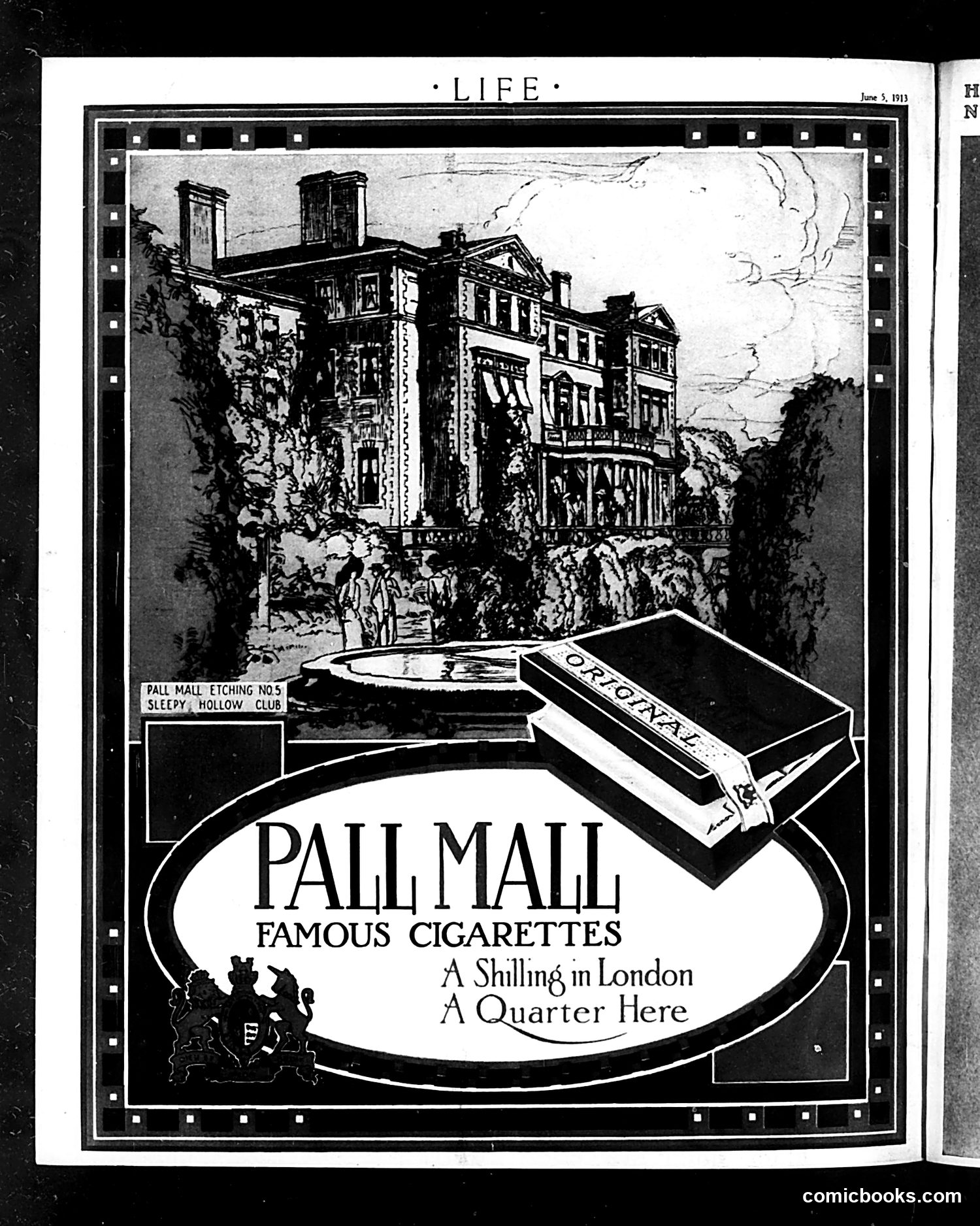
This is a **cigarette advertisement**, not a political cartoon. It advertises Pall Mall Famous Cigarettes, emphasizing their affordability: "A Shilling in London / A Quarter Here" (comparing British and American pricing). The advertisement features an etching labeled "Pall Mall Etching No. 5: Sleepy Hollow Club"—a romanticized illustration of a grand mansion surrounded by grounds with figures in period dress. The image evokes literary prestige and leisured sophistication, likely referencing Washington Irving's "The Legend of Sleepy Hollow" to associate the cigarette brand with American cultural heritage and genteel appeal. A cigarette package is prominently displayed in the foreground, serving as the focal point for the brand pitch. This was typical LIFE magazine advertising from the 1910s era.