
Life, 1913-06-05 · page 13 of 52
Life — June 5, 1913 — page 13: what you’re looking at
What you’re looking at
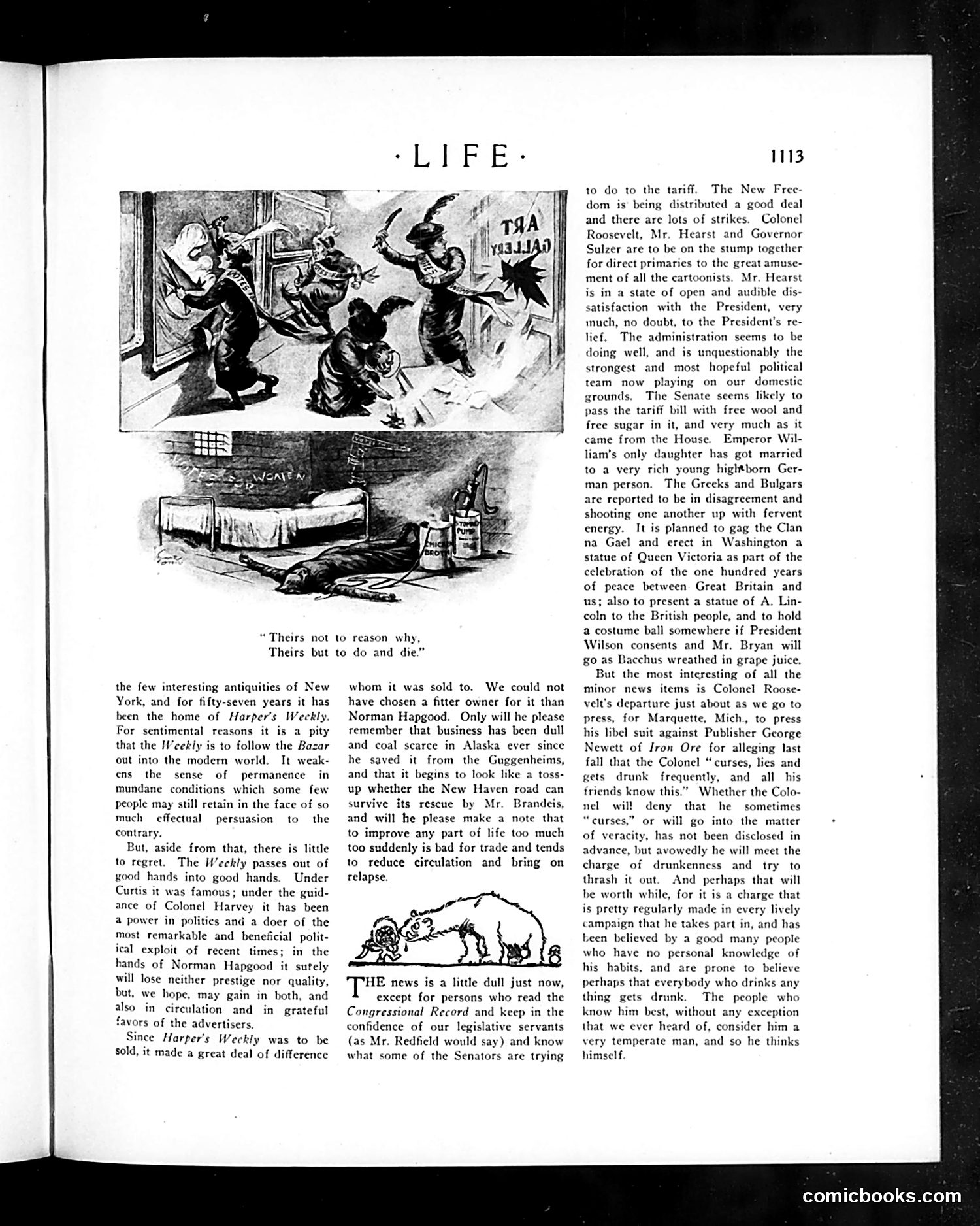
The top cartoon depicts figures being thrown out of a building labeled "TARIFF" - likely representing political opposition to a tariff bill. The chaotic scene with flying bodies suggests violent disagreement or defeat in legislative battle. The bottom illustration shows a pig, accompanying text discussing dull news and the Congressional Record. The surrounding article discusses Roosevelt administration policies, tariff legislation, and various political appointments. It references Senator debates about "free wool and free sugar," Governor Sulzer, and Colonel Roosevelt's satisfaction with the President. The overall page satirizes contemporary political turmoil—specifically legislative conflict over tariff policy and the Roosevelt administration's political maneuvering. Without the specific date visible, the exact historical moment remains unclear, though the content suggests early 20th-century American politics.
📄 Transcribed text from this page (OCR, searchable)
Machine-transcribed from the original scan — historical spelling and the odd misread are preserved.
“ Theirs not to ri on why Theirs but to do and di the few interesting antiquities of New York, and for fifty-seven years it has been the home of Harper's Wecekl. For sentimental reasons it is a pity that the eekly is to follow the Bazar out into the modern world. It weak- ens the sense of permanence in mundane conditions which some few people may still retain in the face of so much effectual persuasion to the contrary. But, aside from that, there is little to regret. The Weekly passes out of good hands into good hands. Under Curtis it was famous; under the guid- ance of Colonel Harvey it has been @ power in politics and a doer of the most remarkable and beneficial polit- ical exploit of recent times; in the hands of Norman Hapgood it sutely will lose neither prestige nor quality, but, we hope, may gain in both, and also in circulation and in grateful favors of the advertisers. Since Harper's Weekly was to be sold, it made a great deal of difference whom it was sold to. We could not have chosen a fitter owner for it than Norman Hapgood. Only will he please remember that business has been dull and coal scarce in Alaska ever since he saved it from the Guggenheims, and that it begins to look like a toss- up whether the New Haven road can survive its rescue by Mr. Brandeis, and will he please make a note that to improve any part of life too much too suddenly is bad for trade and tends to reduce circulation and bring on relapse. TH news is a little dull just now, except for persons who read the Congressional Record and keep in the confidence of our legislative servants (as Mr. Redfield would say) and know what some of the Senators are trying 1113 to do to the tariff. The New Free- dom is being distributed a good deal and there are lots of strikes. Colonel Roosevelt, Mr. Hearst and Governor Sulzer are to be on the stump together for direct primaries to the great amuse- ment of all the cartoonists. Mr. Hearst is in a state of open and audible dis- satisfaction with the President, very much, no doubt, to the President's re- lief. The administration seems to be doing well, and is unquestionably the strongest and most hopeful political team now playing on our domestic grounds, The Senate seems likely to pass the tariff bill with free wool and free sugar in it, and very much as it came from the House. Emperor Wil- m’s only daughter has got married to a very rich young hightborn Ger- man person. The Greeks and Bulgars are reported to be in disagreement and shooting one another up with fervent energy. It is planned to gag the Clan na Gael and erect in Washington a statue of Queen Victoria as part of the celebration of the one hundred years of peace between Great Britain and us; also to present a statue of A. Lin- coln to the British people, and to hold a costume ball somewhere if President Wilson consents and Mr. Bryan will go as Bacchus wreathed in grape juice. But the most interesting of all the minor news items is Colonel Roose- velt’s departure just about as we go to press, for Marquette, Mich., to press his libel suit against Publisher George Newett of Jron Ore for alleging last fall that the Colonel “curses, lies and gets drunk frequently, and all his friends know thi: Whether the Colo- nel will deny that he sometimes “curses,” or will go into the matter of veracity, has not been disclosed in advance, but avowedly he will meet the charge of drunkenness and try to thrash it out. And perhaps that will be worth while, for it is a charge that is pretty regularly made in every lively campaign that he takes part in, and has been believed by a good many people who have no personal knowledge of his habits, and are prone to believe perhaps that everybody who drinks any thing gets drunk. The people who know him best, without any exception that we ever heard of, consider him a very temperate man, and so he thinks himself. comicbooks.com