
Life, 1913-06-05 · page 16 of 52
Life — June 5, 1913 — page 16: what you’re looking at
What you’re looking at
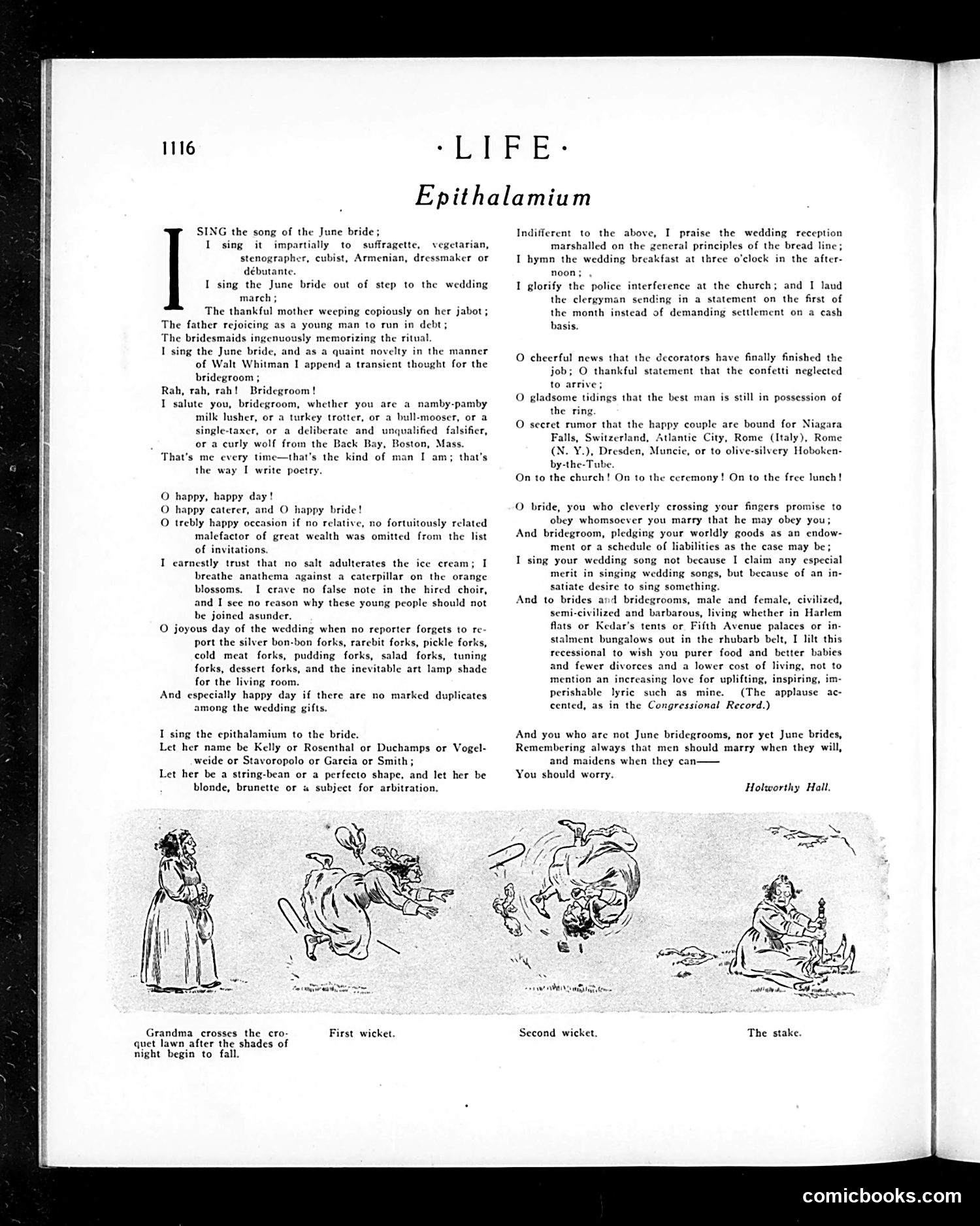
This page presents Holworthy Hall's irreverent poem mocking June weddings and their attendant absurdities. The satire targets multiple contemporary social types—suffragettes, vegetarians, cubists—while ridiculing wedding conventions: the weeping mother, the debt-ridden father, hired choirs, excessive silverware, and mandatory gift duplicates. The poem's humor lies in its mock-serious tone celebrating obvious problems: police interference at church, missing confetti, and the bride's false obedience vow. Hall satirizes the wedding-industrial complex itself—the caterers, decorators, and endless etiquette—while offering sardonic "joyous" observations about marriages ending in divorce. The four sketch cartoons below depict croquet scenes, likely illustrating genteel leisure activities associated with wedding festivities. The overall effect is sophisticated ridicule of upper-class wedding pretension.
📄 Transcribed text from this page (OCR, searchable)
Machine-transcribed from the original scan — historical spelling and the odd misread are preserved.
LIT FE* Epithalamium NG the song of the June bride; sing it impartially to suffragette, vegetarian, stenographer, cubist, Armenian, dressmaker or débutante. I sing the June bride out of step to the wedding march; The thankful mother weeping copiously on her jabot; The father rejoicing as a young man to run in debt; The bridesmaids ingenuously memorizing the ritual. I sing the June bride, and as a quaint novelty in the manner of Walt Whitman I append a transient thought for the bridegroom ; Rah, rah, rah! Bridegroom! I salute you, bridegroom, whether you are a namby-pamby milk lusher, of a turkey trotter, or a bull-mooser, or a single-taxcr, or a deliberate and unqualified falsifier, or a curly wolf from the Back Bay, Boston, Mass. That's me every time—that’s the kind of man I am; that's the way I write poetry. O happy, happy day! O happy caterer, O trebly happy occasion if no relative, no fortuitously related malefactor of great wealth was omitted from the list of invitations. I earnestly trust that no salt adulterates the ice cream; I breathe anathema against a caterpillar on the orange blossoms. I crave no false note in the hired choir, and I sce no reason why these young people should not be joined asunder. © joyous day of the wedding when no reporter forgets to re port the silver bon-bon forks, rarebit forks, pickle forks, cold meat forks, pudding forks, salad forks, tuning forks, dessert forks, and the inevitable art lamp shade for the living room. And especially happy day if there are no marked duplicates among the wedding gifts. I sing the epithalamium to the bride. Let her name be Kelly or Rosenthal or Duchamps or Vogel- weide or Stavoropolo or Garcia or Smit Let her be a string-bean or a perfecto shape, and let her be blonde, brunette or « subject for arbitration. Grandma crosses the cro- First wicket. quet lawn after the shades of night begin to fall. Indifferent to the above, I praise the wedding reception marshalled on the general principles of the bread line; I hymn the wedding breakfast at three o'clock in the afte noon; I glorify the police interference at the church; and I laud the clergyman sending in a statement on the first of the month instead of demanding settlement on a cash basis. O cheerful news that the decorators have finally finished the job; O thankful statement that the confetti neglected to arrive; O gladsome tidings that the best man is the ring. O sceret rumor that the happy couple are bound for Niagara Falls, Switzerland, Atlantic City, Rome (Italy), Rome (N. Y.), Dresden, Muncie, or to olive-silvery Hoboken- by-the-Tube On to the church! On to the ceremony! On to the free lunch! ill in possession of © bride, you who cleverly crossing your fingers promise to obey whomsocver you marry that he may obey you; And bridegroom, pledging your worldly goods as an endow- ment or a schedule of liabilities as the case may be; I sing your wedding song not because I claim any especial merit in singing wedding songs, but because of an in- satiate desire to sing something. And to brides and bridegrooms, male and female, civilized, semi-civilized and barbarous, living whether in Harlem flats or Kedar’s tents or Fifth Avenue palaces or in- stalment bungalows out in the rhubarb belt, I lilt this recessional to wish you purer food and better babies and fewer divorces and a lower cost of living, not to mention an increasing love for uplifting, inspiring, im- perishable lyric such as mine. (The applause ac- cented, as in the Congressional Record.) And you who are not June bridegrooms, nor yet June brides, Remembering always that men should marry when they will, and maidens when they can— You should worry. Holworthy Hall. Second wicket. The stake. comicbooks.com