
Life, 1913-06-05 · page 28 of 52
Life — June 5, 1913 — page 28: what you’re looking at
What you’re looking at
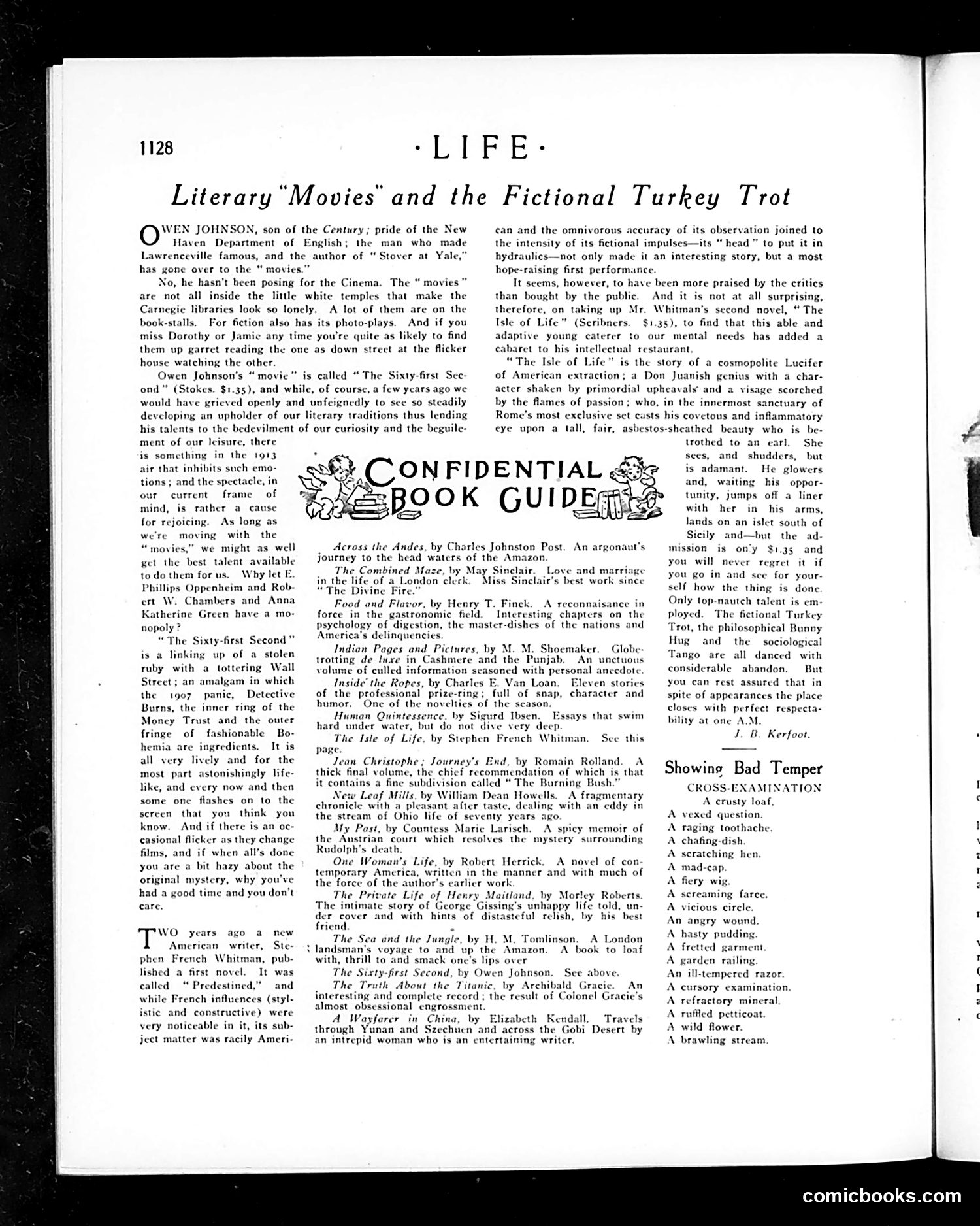
This article satirizes the trend of established American novelists adapting their work for cinema. Owen Johnson, a respected author of the *Century* magazine and writer of "Stover at Yale," has begun writing directly for motion pictures rather than traditional publishing. The piece mocks the cultural moment with gentle irony: literary purists once scorned cinema as lowbrow entertainment, yet now prestigious authors like Johnson are "moving with the movies" to reach broader audiences. The author questions why established literary figures like E. Phillips Oppenheim and Robert W. Chambers should monopolize novel-writing when cinema could use their talent. The article reviews Johnson's film adaptation "The Sixty-first Second" (involving a stolen ruby, Wall Street panic, and high society), finding it entertaining though somewhat confusing. It also discusses Stephen French Whitman's novel "The Isle of Life," noting how American authors increasingly cater to popular entertainment rather than literary tradition—a shift the writer frames as inevitable rather than lamentable.
📄 Transcribed text from this page (OCR, searchable)
Machine-transcribed from the original scan — historical spelling and the odd misread are preserved.
1128 WE Haven Department of Lawrenceville famous, and the author of “ Stover at Y has gone over to the “ movies.” hope: No, he hasn't been posing are not all inside the little white temples that make the ¥ JOHNSON, son of the Century; pride of the New “Pe * Literary “Movies and the Fictional Turkey Trot English; the man who made for the Cinema. The “ movies” than bought by the public. can and the omnivorous accuracy of its observation joined to the intensity of its fictional impulses—its He,’ hydraulics—not only made it an interesting story, but a most ising first performance. It seems, however, to have been more praised by the critics And it is not at all surprising, head to put it in Carnegie libraries look so lonely. A lot of them are on the therefore, on taking up Mr. Whitman’s second novel, “ The book-stalls. For fiction also has its photo-plays. And if you Isle of Life” (Scribners. $1.35), to find that this able and miss Dorothy or Jamic any time you're quite as likely to find adaptive young caterer to our mental needs has added a them up garret reading the one as down street at the flicker cabaret to his house watching the other. Owen Johnson's “ his talents to the bedevilment ment of our Icisure, there is something in the 1913 air that inhibits such emo- tions; and the spectacle, in our current frame of mind, is rather a cause for rejoicing. As long as we're moving with the * movies,” we might as well get the best talent available todo them for us. Why let E. Phillips Oppenheim and Rob- ert W. Chambers and Anna Katherine Green have a mo- nopoly ? “The Sixty-first Second” is a linking up of a stolen ruby with a tottering Wall Street; an amalgam in which the 1907 panic, Detective Burns, the inner ring of the Money Trust and the outer fringe of fashionable Bo- hemia are ingredients. It is all very lively and for the most part astonishingly life- like, and every now and then some one flashes on to the screen that you think you know. And if there is an oc- casional flicker as they change films, and if when all's done you are a bit hazy about the original mystery, why you've had a good time and you don't care. WO years ago a new American writer, Ste- phen French Whitman, pub- lished a first novel. It was called“ Predestined,” and while French influences (styl- istic and constructive) were very noticeable in it, its sub- ject matter was racily Ameri- movie” ond” (Stokes. $1.35), and while, of course, a few years ago we would have grieved openly and unfeignedly to see so ste developing an upholder of our literary traditions thus lending is called “ The Sixty-first Sec Rome's most exclusi of our curiosity and the beguile- CONFIDENTIAL & EyVeSBOOK GUIDE Across the Andes, by Charles Johnston Post. An argonaut’s journey to the head waters of the Amazon. The Combined Maze, by May Sinclair. Love and marriage in the life of a London clerk. Miss Sinclair's best work since “The Divine Fire.” Food and Flavor, by Henry T. Finck. A reconnaisance in force in the gastronomic ficld, ‘Interesting chapters on the psychology of digestion, the master-dishes of the nations and America’s delinquencies. Indian Pages and_ Pictures, by M. M. Shoemaker. Globe trotting de luxe in Cashmere and the Punjab. An unctuous volume of culled information seasoned with personal anecdote Inside’ the Ropes, by Charles E. Van Loan. Eleven stories of the professional prize-ring ; full of snap, character and humor. One of the novelties of the season. Human Quintessence. by Sigurd Ibsen. Essays that swim hard under water, but do not dive very deep. The Isle of Life, by Stephen French Whitman. Sce this page Jean Christophe; Journey's End, by Romain Rolland. A thick final volume, the chief recommendation of which is that it contains a fine subdivision called “ The Burning Bush.” New Leaf Mills, by William Dean Howells. A fragmentary chronicle with a pleasant after taste, dealing with an eddy in the stream of Ohio life of seventy years ago My Past, by Countess Maric Larisch. A spicy memoir of the Austrian court which resolves the mystery surrounding Rudolph’s death One Woman's Life, by Robert Herrick. A novel of con temporary America, written in the manner and with much of the force of the author's earlicr work The Private L y Maitland, by Morley Roberts. The intimate story of George Gissing’s unhappy life told, un- der cover and with hints of distasteful relish, by his’ best friend. 5 The Sea and the Jungle, by H. M. Tomlinson, A London Slandsman’s voyage to and up the Amazon. A book to loaf with, thrill to and smack one’s lips over The Sixty-first Second, by Owen Johnson. See The Truth About the Titanic, by Archibald interesting and complete record; the result of Colonel Gracie’s almost obsessional engrossment A Wayfarer in China, by Elizabeth Kendall. Travels through Yunan and Szechuicn and across the Gobi Desert by an intrepid woman who is an entertaining writer. tellectual restaurant, *The Isle of Life” is the story of a cosmopolite Lucifer of American extraction; a Don Juani acter shaken by primordial upheavals dily by the flames of passion; who, in the innermost sanctuary of ¢ set custs his covetous and inflammatory eye upon a tall, fair, asbestos-sheathed beauty who is be- h genius with a char- and a visa scorched trothed to an earl, She sees, and shudders, but is adamant. He glowers and, waiting his oppor- tunity, jumps off a liner with her in his arms, lands on an islet south of Sicily and—but the ad- mission is on'y $1.35 and you will never regret it if you go in and sce for your- self how the thing is done. Only top-nauteh talent is em- ployed. The fictional Turkey Trot, the philosophical Bunny Hug and the sociological Tango are all danced with considerable abandon. But you can rest assured that in spite of appearances the place closes with perfect respecta- bility at one A.M. J.B. K Showine Bad Temper CROSS-EXAMINATION A crusty loaf, A vexed question. A raging toothache A chafing-dish. A scratching hen. A A rfoot. mad- fiery wig A screaming farce. A vicious circle. An angry wound A hasty pudding. A fretted garment A garden railing. An ill-tempered razor. A cursory examination A refractory mineral. A ruffled petticoat. A wild flower. \ brawling stream ap. comicbooks.com \ 1 ¢ J «