
Life, 1913-06-05 · page 32 of 52
Life — June 5, 1913 — page 32: what you’re looking at
What you’re looking at
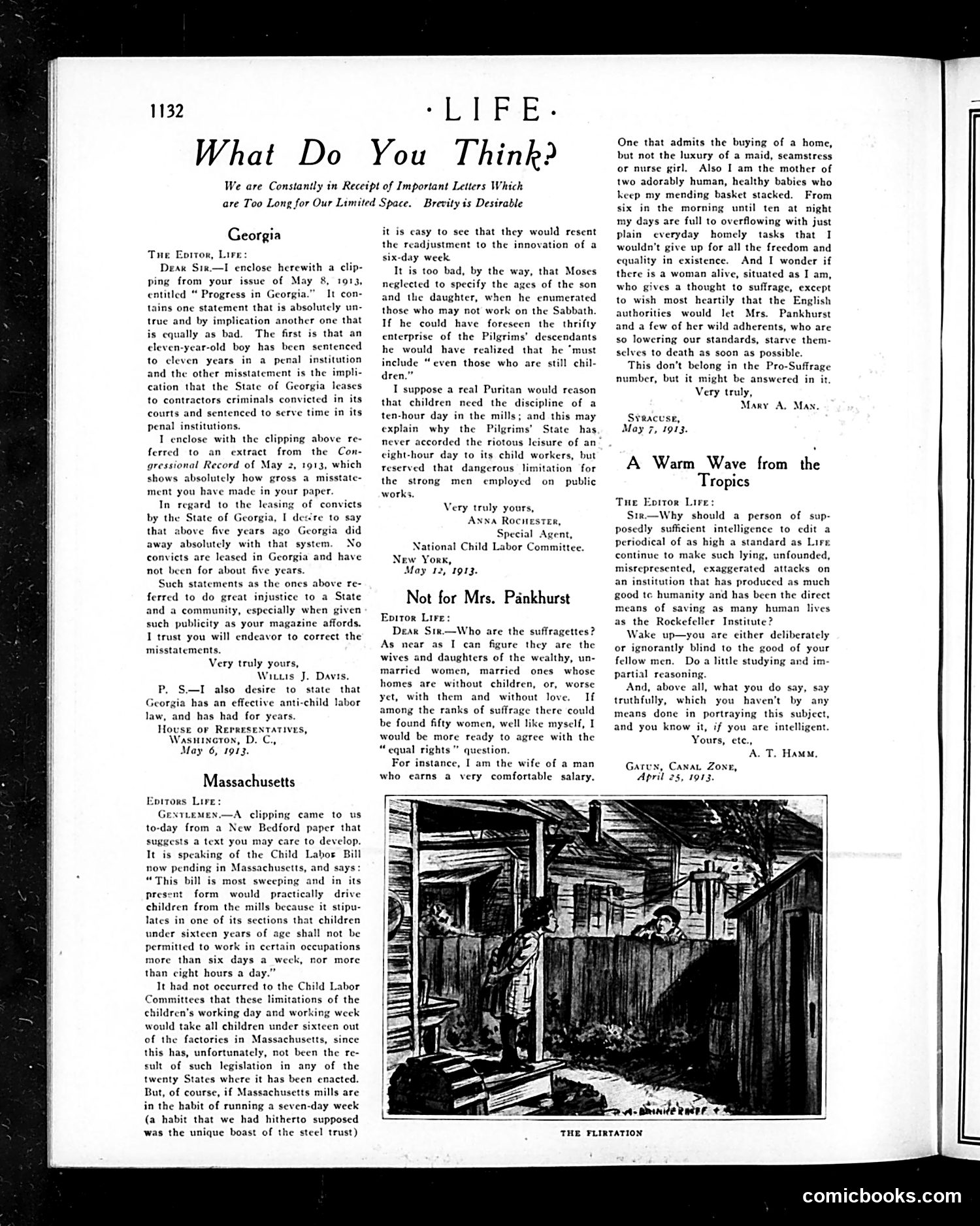
This is a "letters to the editor" section from *Life* magazine (May 1913), featuring reader responses to recent articles. The page contains no cartoon—instead, it showcases satirical editorial commentary embedded within reader letters. The Georgia letter disputes *Life*'s reporting on child labor convictions, claiming the magazine misrepresented facts about a young offender and the state's convict-leasing system. The Massachusetts letter sarcastically mocks mill owners' resistance to child labor restrictions. It notes that limiting children to six days and eight hours weekly supposedly would "drive children from the mills"—implying mills *require* seven-day operation. The writer invokes Biblical and Puritan references to highlight the hypocrisy: if religion mandates rest, why do "thrifty" New England manufacturers deny children what they grant adult workers? The partially-visible "Not for Mrs. Pankhurst" letter references the British suffragette leader, apparently critiquing who participates in the women's suffrage movement.
📄 Transcribed text from this page (OCR, searchable)
Machine-transcribed from the original scan — historical spelling and the odd misread are preserved.
1132 el LPHE: What Do You Think? We are Constantly in Receipt of Important Letters Which are Too Long for Our Limited Space. Georgia Tne Eprror, Lire: Deak Sin—t enclose herewith a clip- ping from your issue of May 8 1913, entitled “ Progress in Georgia.” It con- tains one statement that is absolutely un- true and by implication another one that is equally as bad. The first is that an cleven-year-old boy has been sentenced to cleven years in a penal institution and the other misstatement is the impli- cation that the State of Georgia leases to contractors criminals convicted in its courts and sentenced to serve time in its penal institutions. I enclose with the clipping above re- ferred to an extract from the Con- gressional Record of May 2, 1913, which shows absolutely how gross a misstate- ment you have made in your paper. In regard to the leasing of convicts by the State of Georgia, I desire to say that above five years ago Georgia did away absolutely with that system. No convicts are leased in Georgia and have not been for about five years. Such statements as the oncs above re- ferred to do great injustice to a State and a community, especially when given such publicity as your magazine affords. I trust you will endeavor to correct the misstatements. Very truly yours, Wits J. Davis. P, S—I also desire to state that Georgia has an effective anti-child labor law, and has had for years. House or Rerresentatives Wasuinetox, D.C, May 6, 1913. Massachusetts Eptrors L Gextemex.—A clipping came to us to-day from a New Bedford paper that suggests a text you may care to develop. It is speaking of the Child Labor Bill now pending in Massachusetts, and says: “This bill is most sweeping and in its present form would practically drive children from the mills because it stipu- lates in one of its sections that children under sixteen years of age shall not be permitted to work in certain occupations more than six days a week, nor more than cight hours a day. It had not occurred to the Child Labor Committees that these limitations of the children’s working day and working week would take all children under sixteen out of the factorics in Massachusetts, since this has, unfortunately, not been the re- sult of such legislation in any of the twenty States where it has been enacted. But, of course, if Massachusetts mills are in the habit of running a seven-day week (a habit that we had hitherto supposed was the unique boast of the steel trust) Brevity is Desirable it is casy to see that they would resent the readjustment to the innovation of a six-day week It is too bad, by the way, that Moses neglected to specify the ages of the son and the daughter, when he enumerated those who may not work on the Sabbath. If he could have foreseen the thrifty enterprise of the Pilgrims’ descendants he would have realized that he ‘must include “even those who are still chil- dren.” I suppose a real Puritan would reason that children need the discipline of a ten-hour day in the mills; and this may explain why the Pilgrims’ State has never accorded the riotous Icisure of an cight-hour day to its child workers, but reserved that dangerous limitation for the strong men employed on public works. Very truly yours, Anna Rochester, Special Agent, National Child Labor Committee. w York, May 12,'1913. Not for Mrs. Pankhurst Eprtor Lir Dear Stk—Who are the suffragettes? As near as I can figure they are the wives and daughters of the wealthy, un- married women, married ones whose homes are without children, or, worse yet, with them and without love. If among the ranks of suffrage there could be found fifty women, well like myself, I would be more ready to agree with the “equal rights” question. For instance, I am the wife of a man who earns a very comfortable salary. One that admits the buying of a home, but not the luxury of a maid, seamstress or nurse girl, Also I am the mother of two adorably human, healthy babics who keep my mending basket stacked. From six in the morning until ten at night my days are full to overflowing with just plain everyday homely tasks that I wouldn't give up for all the freedom and equality in existence. And I wonder if there is a woman alive, situated as I am, who gives a thought to suffrage, except to wish most heartily that the English authorities would let Mrs. Pankhurst and a few of her wild adherents, who are so lowering our standards, starve them- selves to death as soon as possible. This don't belong in the Pro-Suffrage number, but it might be answered in it Very truly, Mary A, May. Syracuse, May 7, 1913. A Warm Wave from the Tropics Tue Evitor Lire: Six—Why should a person of sup- posedly sufficient intelligence to edit a periodical of as high a standard as Lire continue to make such lying, unfounded, misrepresented, exaggerated attacks on an institution that has produced as much good tc humanity and has been the direct means of saving as many human lives as the Rockefeller Institute? Wake up—you are either deliberately or ignorantly blind to the good of your fellow men. Do a little studying ard im- partial reasoning. And, above all, what you do say, say truthfully, which you haven't by” any means done in portraying this subject, and you know it, if you are intelligent. Yours, ete., A. T. Hana, THE FLIRTATION comicbooks.com