
Life, 1913-06-05 · page 8 of 52
Life — June 5, 1913 — page 8: what you’re looking at
What you’re looking at
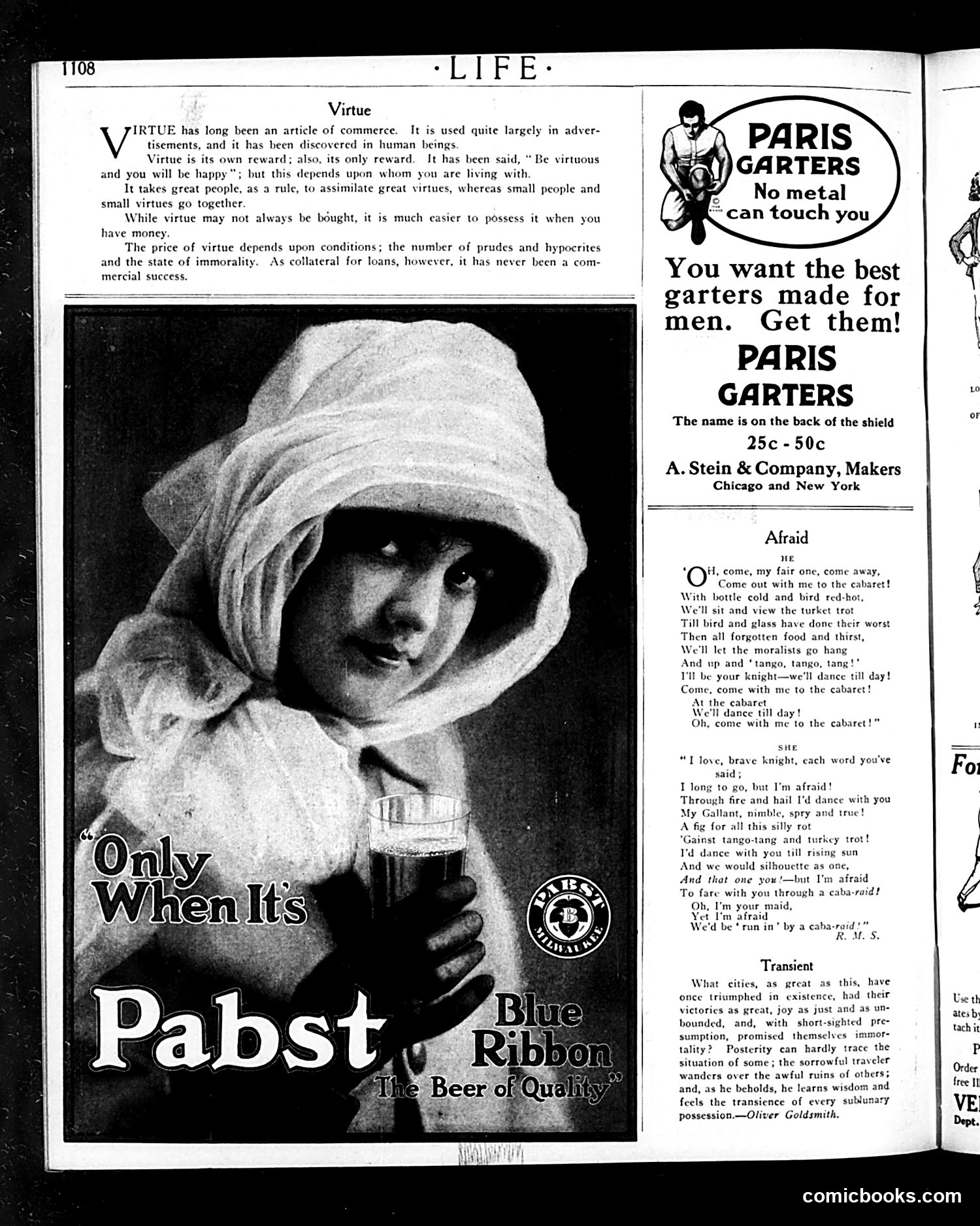
This page contains **advertisements and poetry rather than political cartoons**. The main advertisement features **Pabst Blue Ribbon beer**, showing a woman in a large, fashionable hat holding a glass with the slogan "Only When It's Pabst." This represents early 20th-century beer marketing emphasizing quality and lifestyle. A secondary ad promotes **Paris Garters** (men's sock supporters), claiming superiority through "no metal" construction—addressing practical concerns for the era. The text includes a brief essay on "Virtue" discussing its commercial and personal value, followed by a poem titled "Afraid" about romantic hesitation at a cabaret, and another piece called "Transient" on urban transience and mortality. This reflects Life magazine's mix of satirical commentary, advertising, and literary content typical of the period.
📄 Transcribed text from this page (OCR, searchable)
Machine-transcribed from the original scan — historical spelling and the odd misread are preserved.
“LIFE: Virtue IRTUE has long been an article of commerce. It is used quite largely in adver- V tisements, and it has been discovered in human beings Virtue is its own reward; also, its only reward. It has been said, “ Be virtuous and you will be happy h. small people and but this depends upon whom you are living w It takes great people, as a rule, to assimilate great virtues, where: small virtues go together. While virtue may not always be bought, it is much easier to possess it when you have money. The price of virtue depends upon conditions; the number of prudes and hypocrites and the state of immorality. mercial success. As collateral for loans, however, it has never been a com- f PARIS 74) GARTERS 7y7 No metal * can touch you You want the best garters made for men. Get them! PARIS The name is on the back of the shield " 25c -50c A. Stein & Company, Makers Chicago and New York Afraid ne ‘O*. come, my fair one, come away, Come out with me to the cabaret! With bottle cold and bird red-hot, We'll sit and view the turket trot Till bird and glass have donc their worst Then all forgotten food and thirst, We'll let the moralists go hang And up and ‘tango, tango, tang!” T'll be your knight—we'll dance till day! Come, come with me to the cabaret! At the cabaret We'll dance till day! Oh, come with me to the cabaret!” sie “T love, brave knight, each word you've said; I long to go, but I'm afraid! Through fire and hail I'd dance with you My Gallant, nimble, spry xe! A fig for all this silly rot ks ¢ inst tango-tang and turkey tr I'd dance with you till rising sun And we would silhouette as one, And that one you!—but I'm afraid To fare with you through a caba-raid? Oh, I’m your maid, Yet I'm afraid We'd be ‘run in” by a caba-raid!” — RLM. S. Transient What cities, as g as this, have once triumphed in existence, had their Use tt victorics as great, joy as just and as un- ttesb bounded, and, with short-sighted pre~ eke sumption, promised themselves immor- tality? Posterity can hardly trace the P situation of some; the sorrowful traveler Os wanders over the awful ruins of others; fi sad and, as he beholds, he learns wisdom and ree II feels the transience of every subl possession.—Oliver Goldsmith. comicbooks.com