
Life, 1913-06-05 · page 30 of 52
Life — June 5, 1913 — page 30: what you’re looking at
What you’re looking at
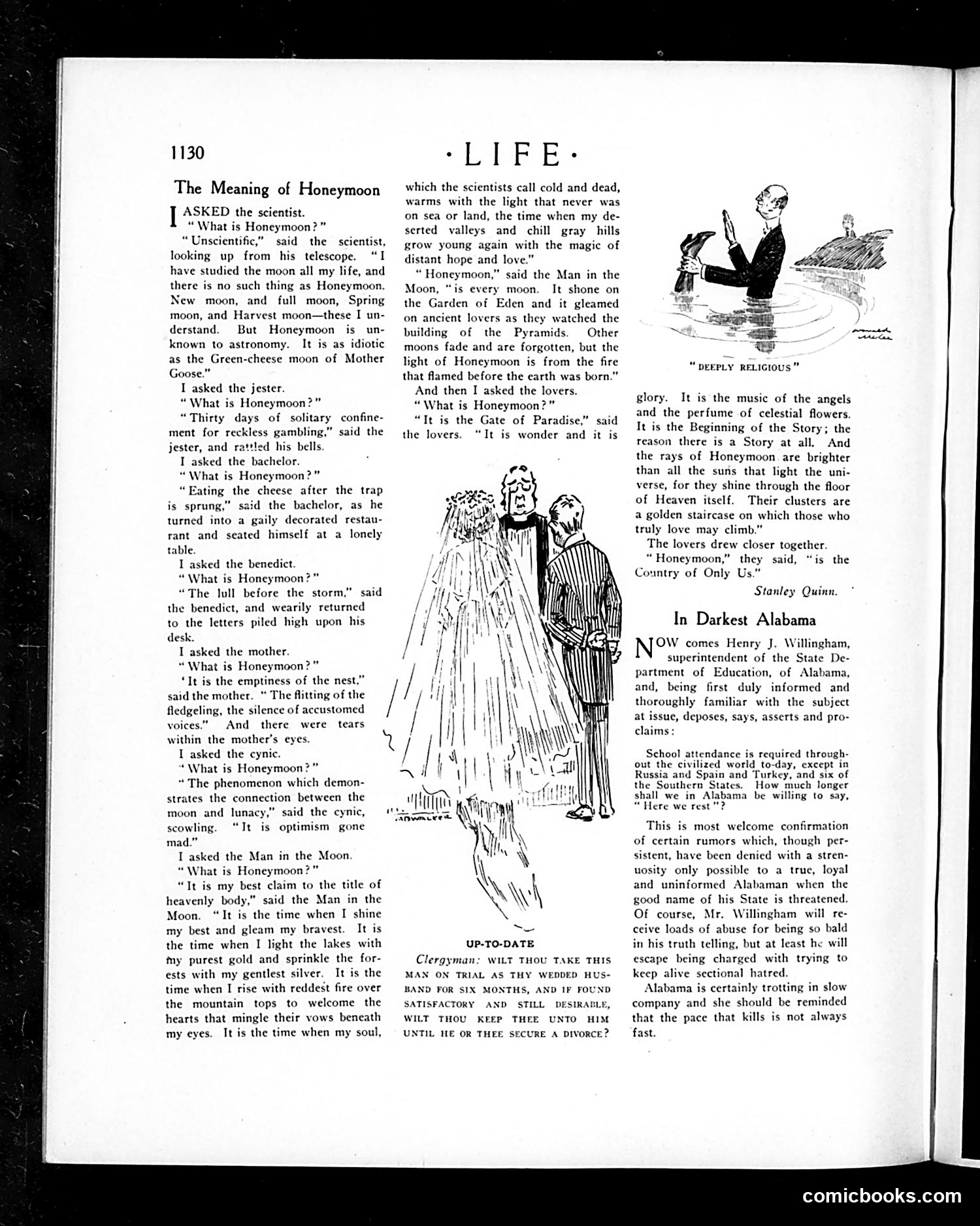
This page contains two satirical pieces typical of early 20th-century American humor. **"The Meaning of Honeymoon"** is a whimsical essay asking various character types—scientist, jester, bachelor, married man (benedict), mother, cynic, and the Man in the Moon—to define honeymoon. Each answer reflects their worldview: the scientist denies it exists astronomically; the bachelor treats marriage as a trap; the married man calls it "the lull before the storm"; the mother laments her empty nest. The Man in the Moon offers the most romantic vision, elevating honeymoon to cosmic significance. The piece satirizes how differently people perceive marriage based on their life stage and temperament. **"Up-to-Date"** cartoon mocks modern divorce culture by depicting a clergyman offering a trial marriage contract—six months with an option to divorce if "unsatisfactory." The caption "Deeply Religious" is ironic, suggesting organized religion has accommodated itself to casual attitudes toward marriage vows. **"In Darkest Alabama"** begins a critical piece about Alabama's failure to require school attendance, comparing the state unfavorably to even Russia, Spain, and Turkey.
📄 Transcribed text from this page (OCR, searchable)
Machine-transcribed from the original scan — historical spelling and the odd misread are preserved.
1130 The Meaning of Honeymoon ASKED the scientist. “What is Honeymoon?” “Unscientific,” said the scientist, looking up from his telescope. “I have studied the moon all my life, and there is no such thing as Honeymoon. New moon, and full moon, Spring moon, and Harvest moon—these I un- derstand. But Honeymoon is un- known to astronomy. It is as idiotic as the Green-cheese moon of Mother Goose.” I asked the jester. “What is Honeymoon?” “Thirty days of solitary confine- ment for reckless gambling,” said the jester, and rattled his bells. I asked the bachelor. “What is Honeymoon?” Eating the cheese after the trap is sprung,” said the bachelor, as he turned into a gaily decorated restau- rant and seated himself at a lonely table. lL asked the benedict. “What is Honeymoon?” “The lull before the storm,” said the benedict, and wearily returned to the letters piled high upon his desk. I asked the mother. “What is Honeymoon?” ‘It is the emptiness of the nest,” said the mother. “ The flitting of the fledgeling, the silence of accustomed voices.” And there were tears within the mother’s eyes. I asked the cynic. “What is Honeymoon?” “The phenomenon which demon- strates the connection between the moon and lunacy,” said the cynic, “Tt is optimism gone scowling. mad.” I asked the Man in the Moon. “What is Honeymoon?” “It is my best claim to the title of heavenly body,” said the Man in the Moon. “It is the time when I shine my best and gleam my bravest. It is the time when I light the lakes with my purest gold and sprinkle the for- ests with my gentlest silver. It is the time when I rise with reddest fire over the mountain tops to welcome the hearts that mingle their vows beneath my eyes. It is the time when my soul, “EEE which the scientists call cold and dead, warms with the light that never was on sea or land, the time when my de- serted valleys and chill gray hills grow young again with the magic of distant hope and lov “Honeymoon,” said the Man in the Moon, “is every moon. It shone on the Garden of Eden and it gleamed on ancient lovers as they watched the building of the Pyramids. Other moons fade and are forgotten, but the light of Honeymoon is from the fire that flamed before the earth was born.” And then I asked the lovers. “What is Honeymoon?” “Tt is the Gate of Paradise,” said the lovers. “It is wonder and it is ‘| : Fire ‘ : ey Yih UP-TO-DATE Clergyman: wit THOU TAKE THIS MAN ON TRIAL AS THY WEDDED HUS- BAND FOR SIX MONTHS, AND IF FOUND SATISFACTORY AND STILL DESIRADLE, WILT THOU KEEP THEE UNTO HIM UNTIL HE OR THEE SECURE A DIVORCE? lft Anwmcet “DEEPLY RELIGIOUS” glory. It is the music of the angels and the perfume of celestial flowers. It is the Beginning of the Story; the reason there is a Story at all. And the rays of Honeymoon are brighter than all the suns that light the uni- verse, for they shine through the floor of Heaven itself. Their clusters are a golden staircase on which those who truly love may climb.” The lovers drew closer together. “Honeymoon,” they said, “is the Country of Only Us.” Stanley Quinn. In Darkest Alabama OW comes Henry J. Willingham, superintendent of the State De- partment of Education, of Alabama, and, being first duly informed and thoroughly familiar with the subject at issue, deposes, says, asserts and pro- claims : School attendance is required through- out the civilized world to-day, except in Russia and Spain and Turkey, and six of the Southern States. How much longer shall we in ama be willing to say, “Here we ri rt This is most welcome confirmation of certain rumors which, though per- sistent, have been denied with a stren- uosity only possible to a true, loyal and uninformed Alabaman when the good name of his State is threatened. Of course, Mr. Willingham will re- ceive loads of abuse for being so bald in his truth telling, but at least he will escape being charged with trying to keep alive sectional hatred. Alabama is certainly trotting in slow company and she should be reminded that the pace that kills is not always fast. comicbooks.com