
A complete issue · 52 pages · 1913
Life — May 15, 1913
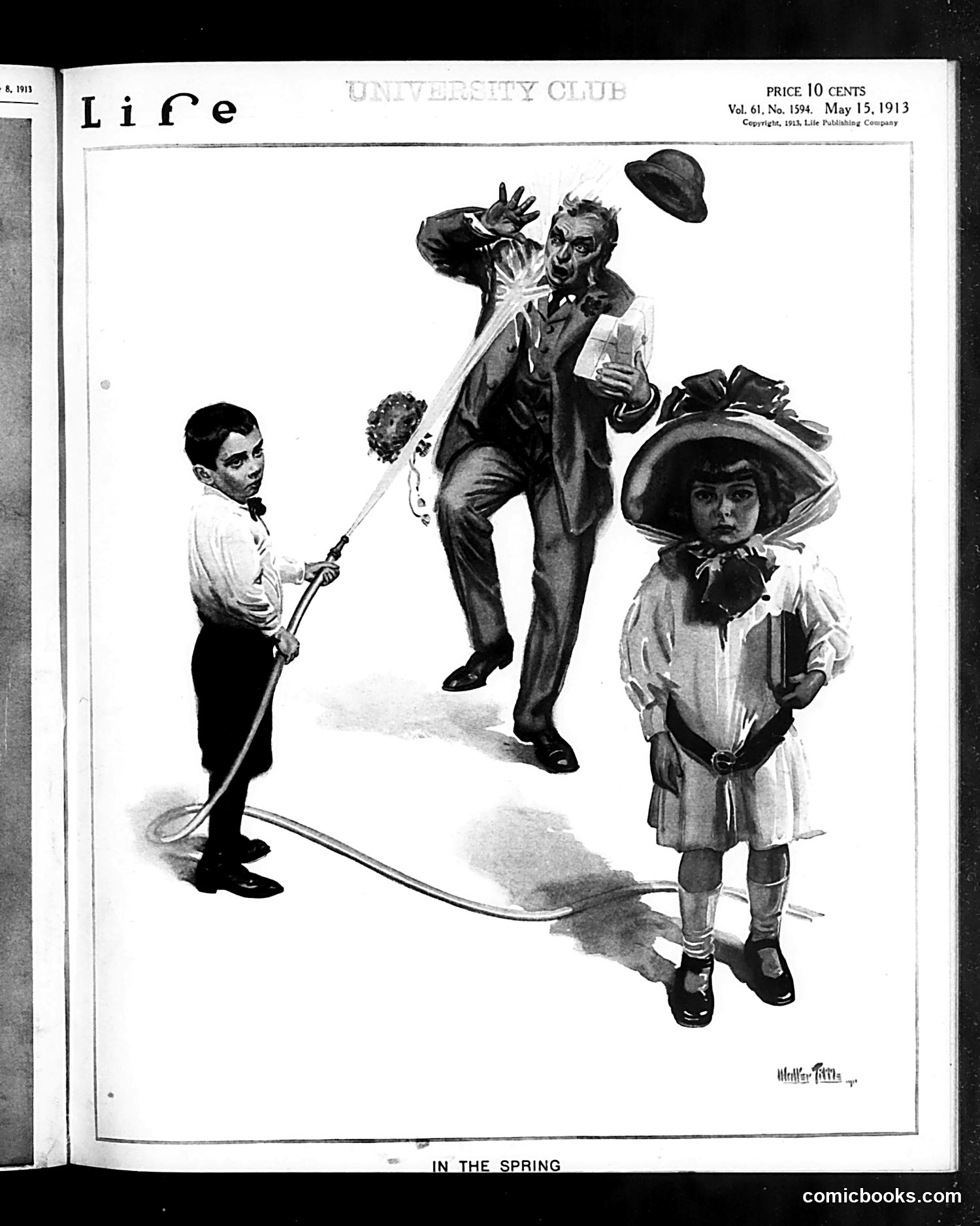
This cartoon illustrates a common springtime theme: young people engaged in outdoor activities and courtship. The illustration shows three figures—a boy with a butterfly net on the left, an exuberant man in the center appearing to jump or dance with joy, and a young girl on the right holding a rope. The title "In the Spring" suggests the season's association with renewal, youth, romance, and playfulness. The man's animated pose and the children's activities represent spring's traditional cultural meaning: a time of rejuvenation and lighthearted outdoor pursuits. The cartoon likely appeals to nostalgic or idealized notions of springtime leisure and youthful energy that would have resonated with Life's early 20th-century readership.
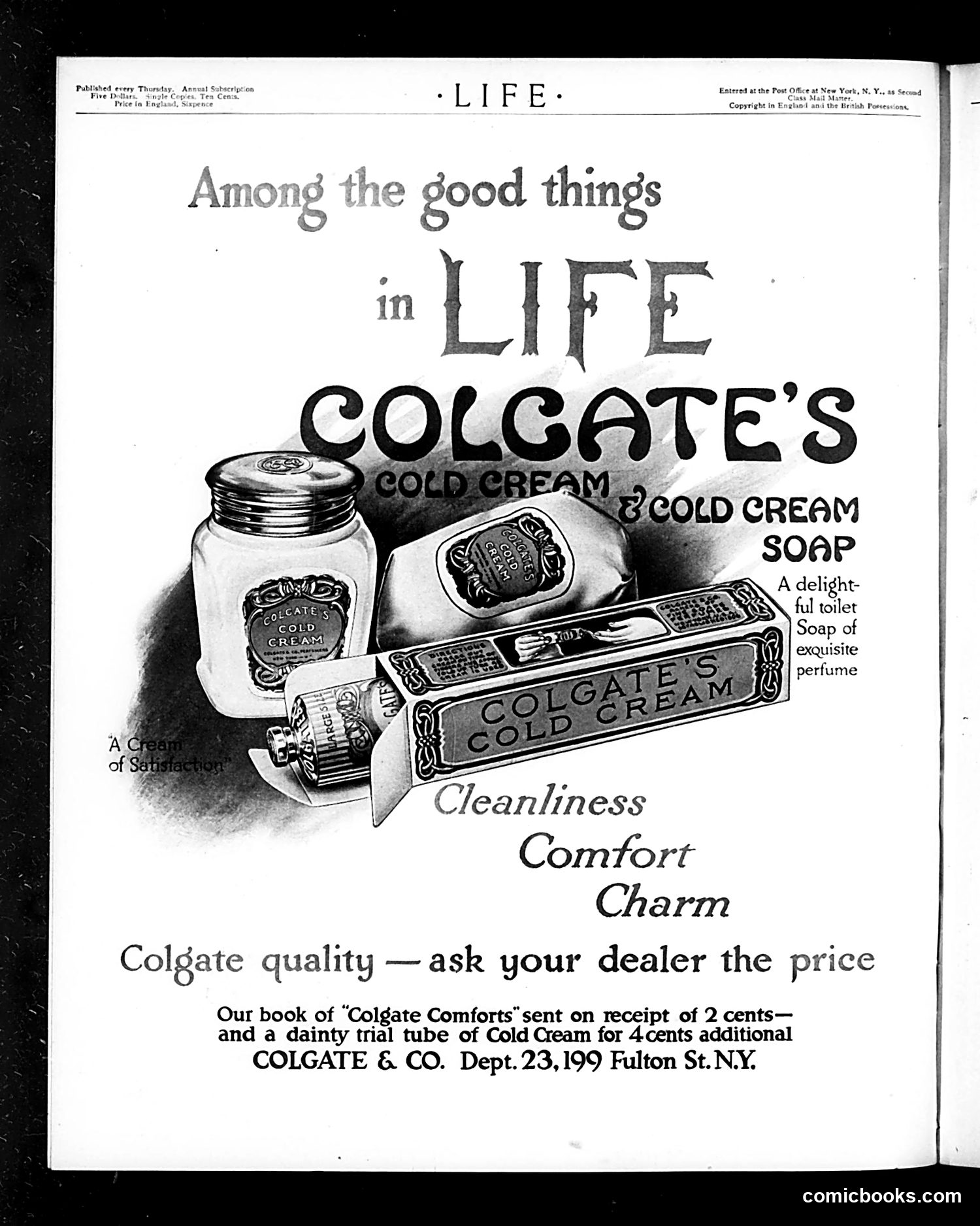
This page is **not a cartoon or satirical content** — it's a straightforward **advertisement for Colgate's Cold Cream and Cold Cream Soap**, published in *Life* magazine. The ad features product illustrations (a jar of cold cream, a soap bar, and a tube) arranged with decorative typography. The marketing copy emphasizes three desirable qualities: "Cleanliness, Comfort, Charm." The only notable element for modern readers is the pricing: customers could obtain a book called "Colgate Comforts" for 2 cents, plus a trial tube of cold cream for 4 cents additional — reflecting early 20th-century consumer economics and direct-mail marketing practices. This represents *Life*'s revenue model: satirical editorial content supported by commercial advertising.
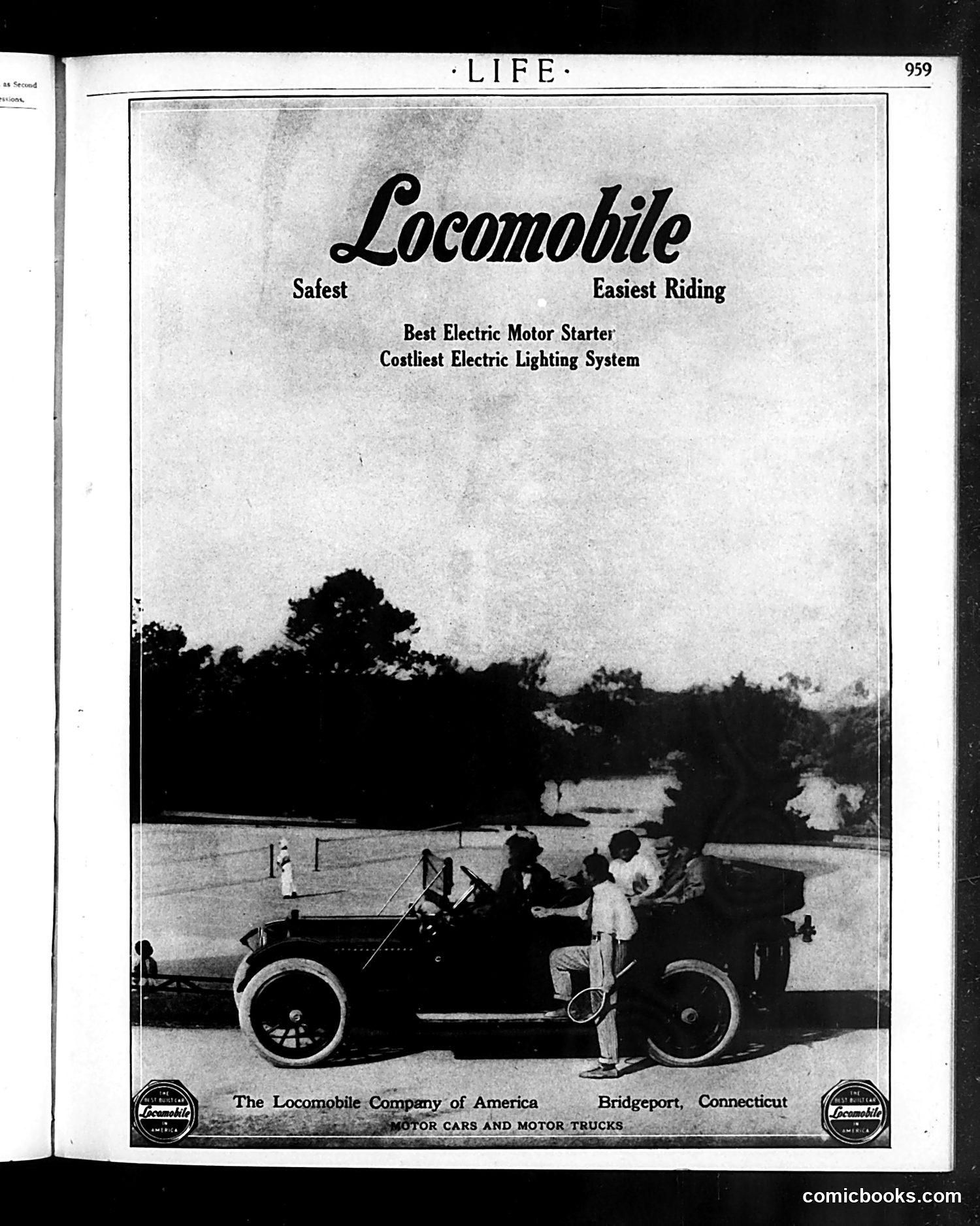
This is **not a cartoon or satire**—it's a straightforward automobile advertisement for the Locomotile, published in *Life* magazine (page 959). The ad features a photograph of an early 1900s motorcar with several well-dressed passengers beside a scenic waterside location. The marketing emphasizes three selling points: "Safest," "Easiest Riding," and highlights the "Best Electric Motor Starter" and "Costliest Electric Lighting System." The Locomobile Company of America, based in Bridgeport, Connecticut, positioned this vehicle as a premium, technologically advanced automobile. The affluent passengers and picturesque setting were typical advertising strategies to associate the product with leisure, status, and modernity during the early automotive era.
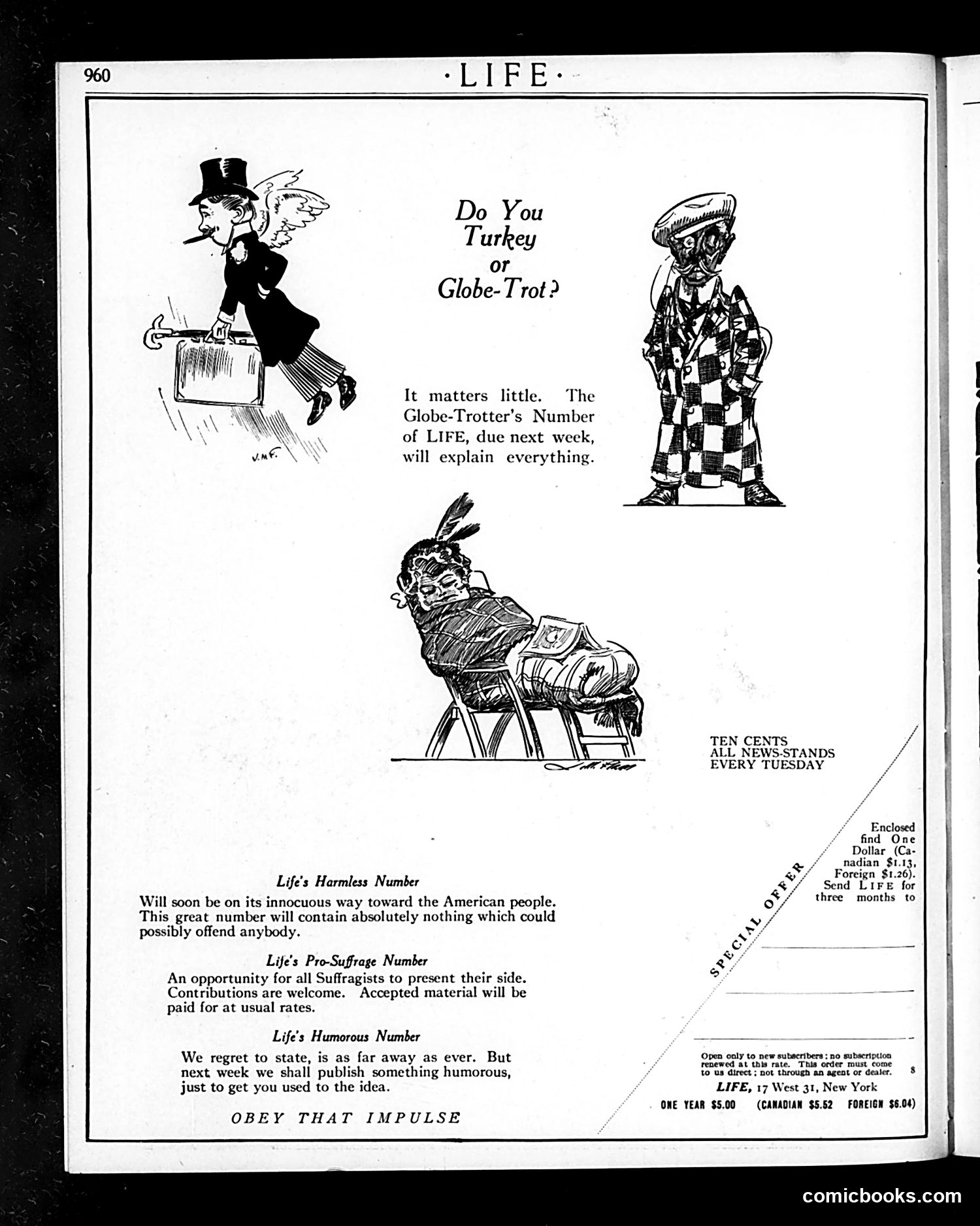
This page announces upcoming content through three satirical cartoon figures. The top left shows a winged figure with a suitcase—likely representing a traveling correspondent or reporter. The central text poses "Do You Turkey or Globe-Trot?"—a playful question about whether readers prefer staying home or traveling internationally. The right figure appears to be a globe-trotter character in patterned clothing. The bottom figure shows someone bundled in furs on a chair. The "Life's Harmless Number," "Pro-Suffrage Number," and "Humorous Number" sections announce special upcoming issues. The suffrage reference indicates this is from the women's voting rights era (pre-1920). The page essentially teases readers with promises of diverse, entertaining upcoming content across travel, politics, and humor.
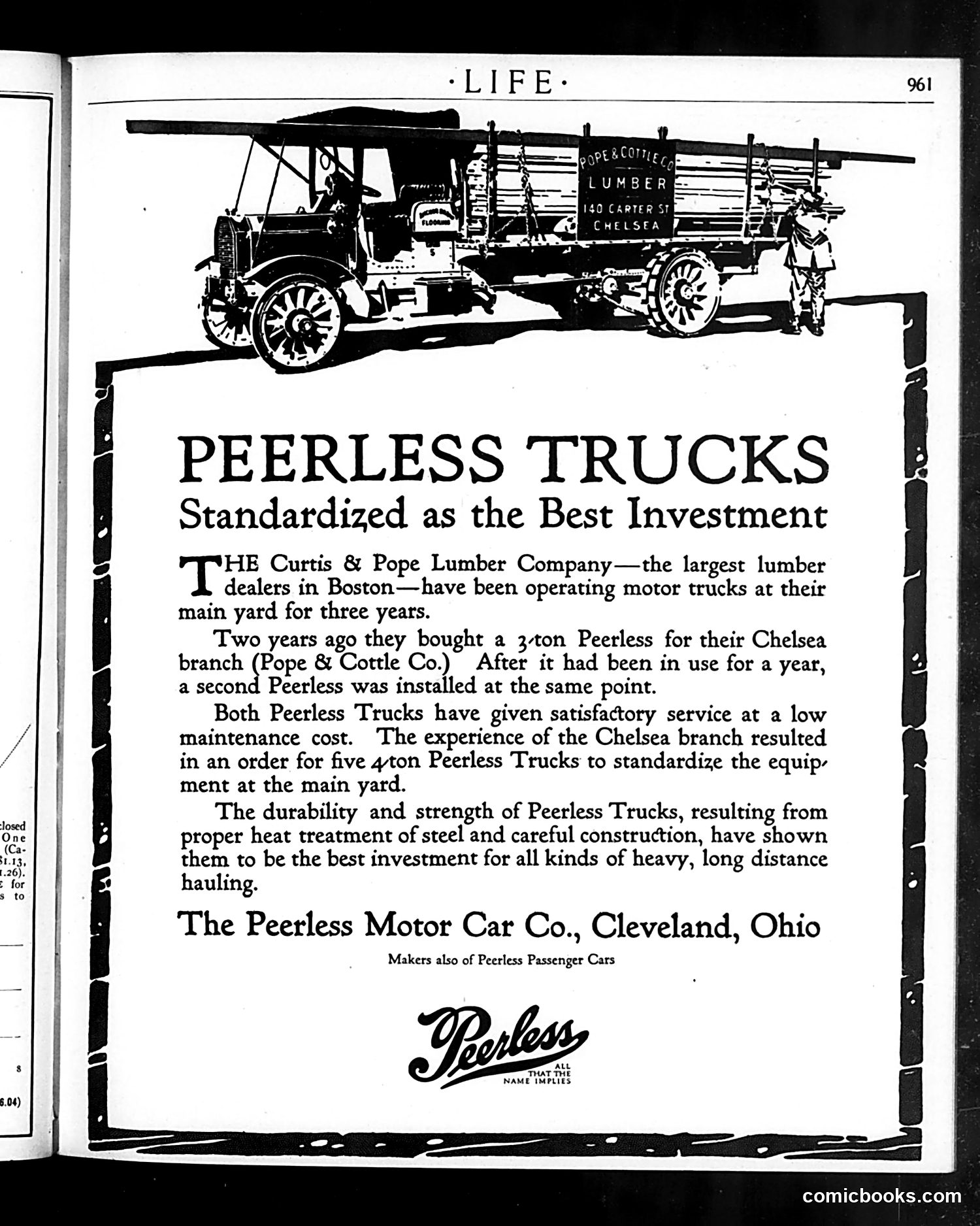
This page is primarily **advertising**, not satire or political commentary. It features a vintage advertisement for **Peerless Trucks**, manufactured by the Peerless Motor Car Company in Cleveland, Ohio. The ad includes an illustration of an early motorized delivery truck with wooden slat sides, bearing signage for "Pope & Cottle Co., Lumber, 140 Carter St, Chelsea." The advertisement functions as a **testimonial**, describing how the Curtis & Pope Lumber Company—Boston's largest lumber dealer—successfully operated Peerless trucks over several years. The ad emphasizes the vehicles' durability, low maintenance costs, and strength as reliable investments for heavy hauling. This represents typical early 20th-century commercial advertising, promoting industrial trucks to business owners rather than containing any satirical or political content.
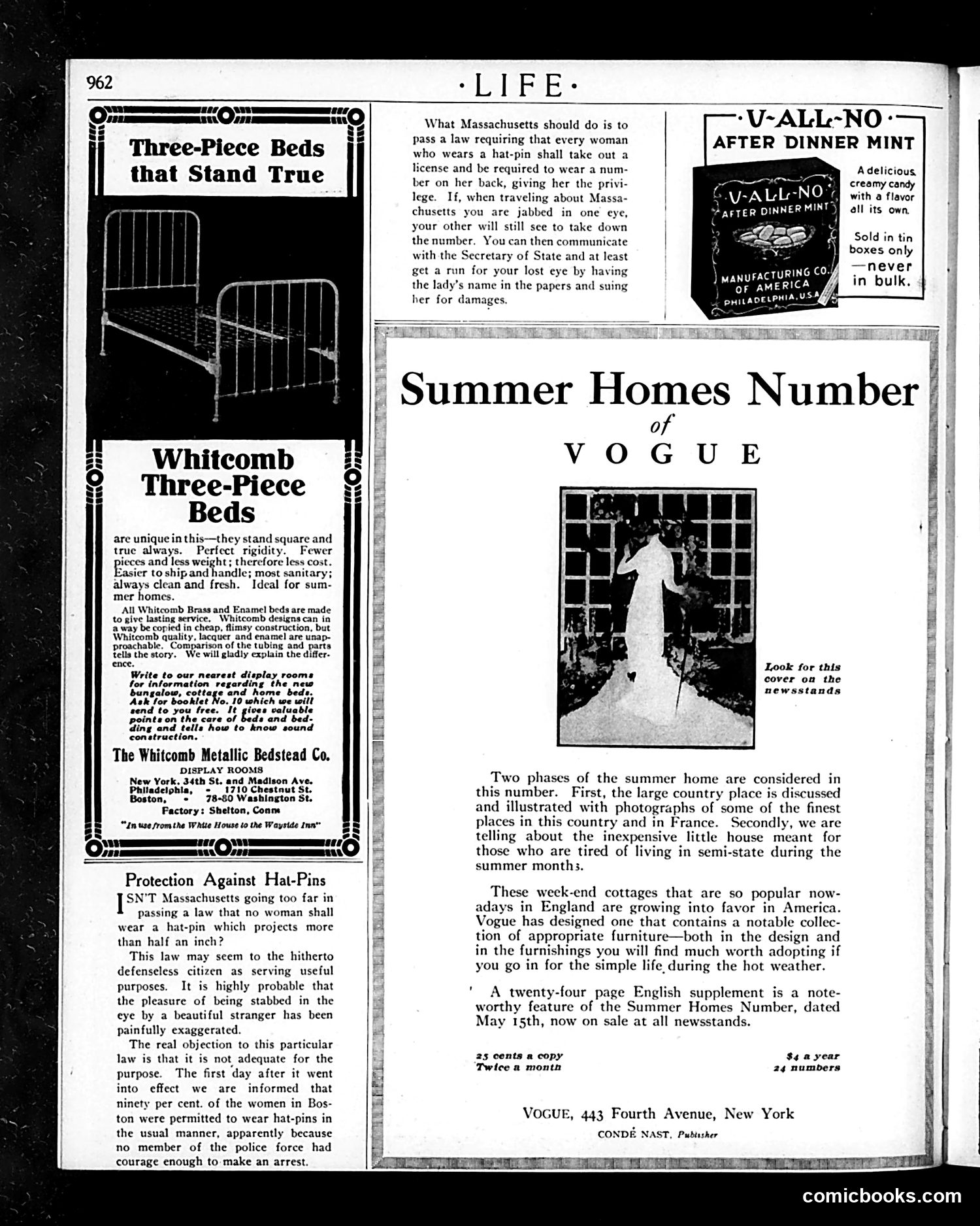
This page is primarily **advertising and editorial content**, not political satire. The left column advertises Whitcomb Three-Piece Beds, emphasizing their durability and affordability for summer homes. The main article announces Vogue's "Summer Homes Number," featuring country house design and furnishings. The accompanying photograph shows an elegantly dressed woman in what appears to be a sunroom or conservatory. Below that, a brief editorial piece titled "Protection Against Hat-Pins" sarcastically discusses a proposed Massachusetts law requiring women wearing hat-pins to license them. The author dismisses the law as absurd, noting that after it passed, 90% of Boston women wore hat-pins anyway—suggesting police lacked enforcement courage. This is social commentary on a genuine (if unusual) historical concern about hat-pins as potential weapons.
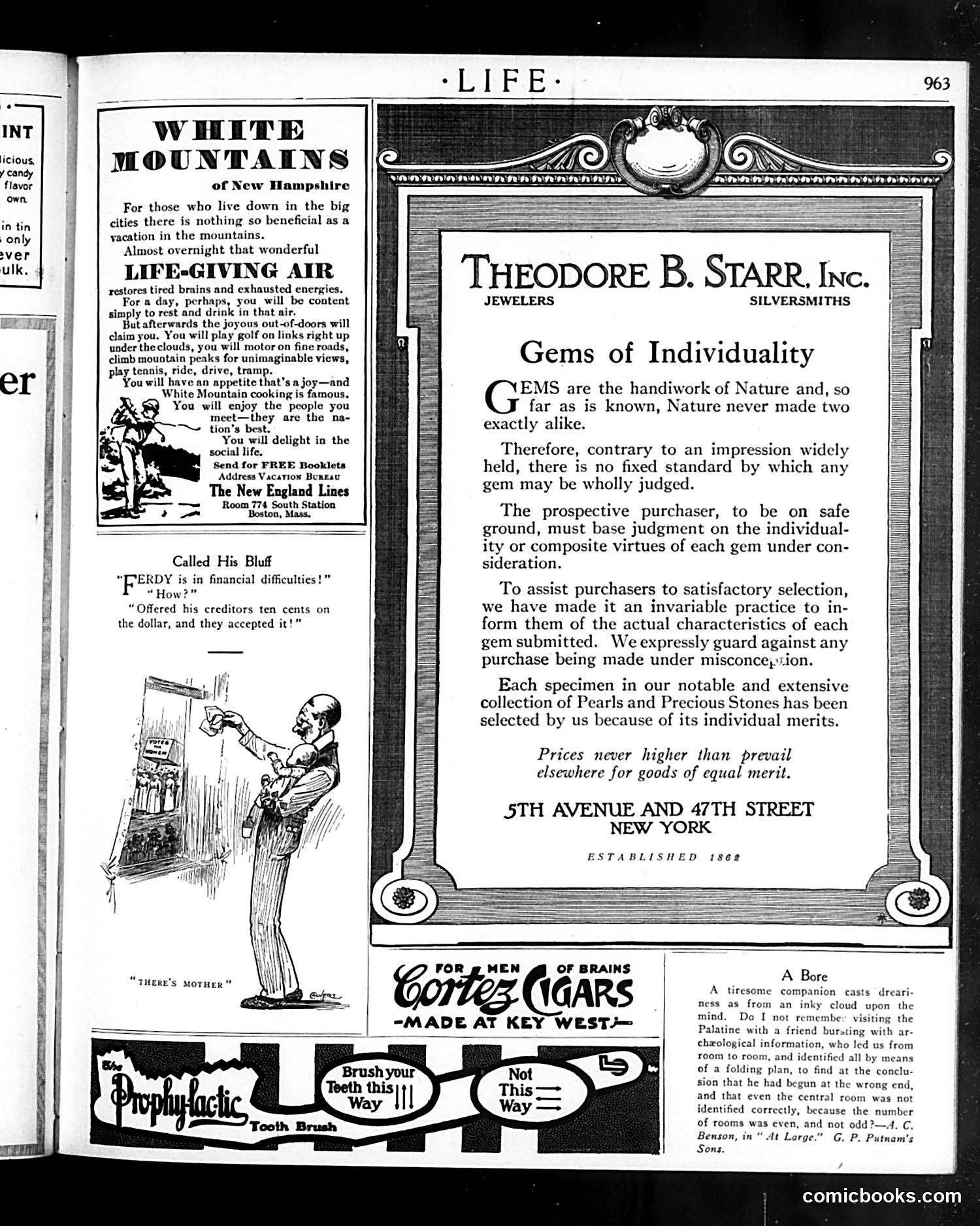
This page is primarily **advertising content** rather than political satire. The main advertisements are: 1. **White Mountains of New Hampshire** — a tourism ad promoting vacation and rest 2. **Theodore B. Starr, Inc.** — a jewelry/silversmith business advertising gems and pearls 3. **Cortez Cigars** — promoting cigars "made at Key West" 4. **Prophylactic Tooth Brush** — a dental hygiene product There are two small **comic vignettes**: "Called His Bluff" (about financial deception) and "There's Mother" (depicting a domestic scene). These appear to be humorous filler rather than political commentary. The page reflects **early 20th-century consumer culture** and advertising strategies, showing how *Life* magazine monetized its pages through paid advertisements mixed with entertainment content. The satirical magazine relied heavily on commercial revenue alongside its editorial humor.
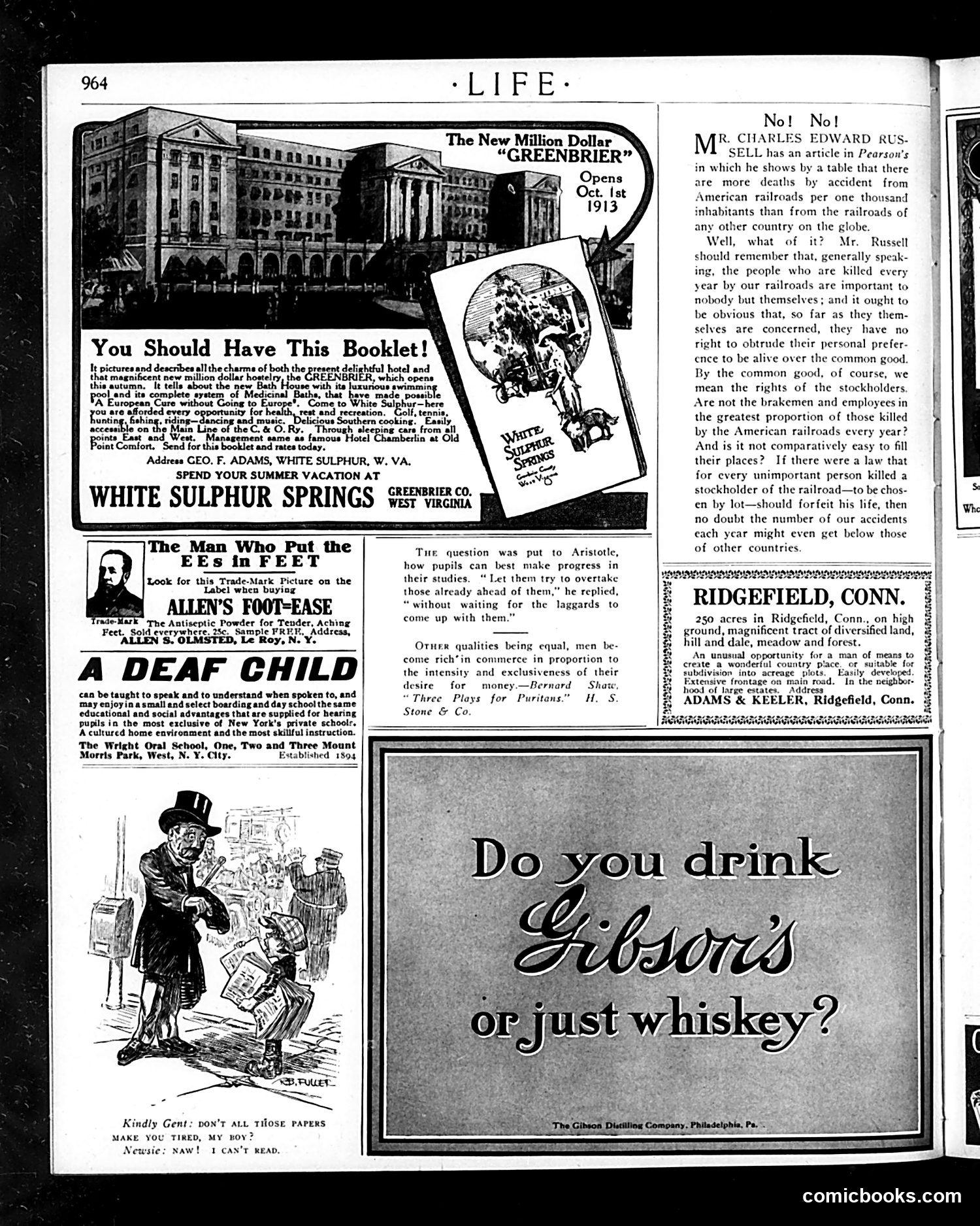
This Life magazine page (964) is primarily **advertising and editorial content** rather than political satire. The main cartoon shows a man in a top hat distributing newspapers to children on a street. The caption reads: "Kindly Gent: DON'T ALL THOSE PAPERS MAKE YOU TIRED, MY BOY? Newsie: NAW! I CAN'T READ." **The joke:** A street newspaper vendor (newsie) claims he isn't tired by the papers because he's illiterate—he can't read them anyway. This satirizes urban poverty and child labor, implying poor children sold newspapers without actually understanding their content. It's social commentary on early 1900s working conditions for impoverished youth. The page also advertises a deaf school, a hotel, railroad safety (responding to Charles Russell's article about railroad deaths), and Gibson whiskey.
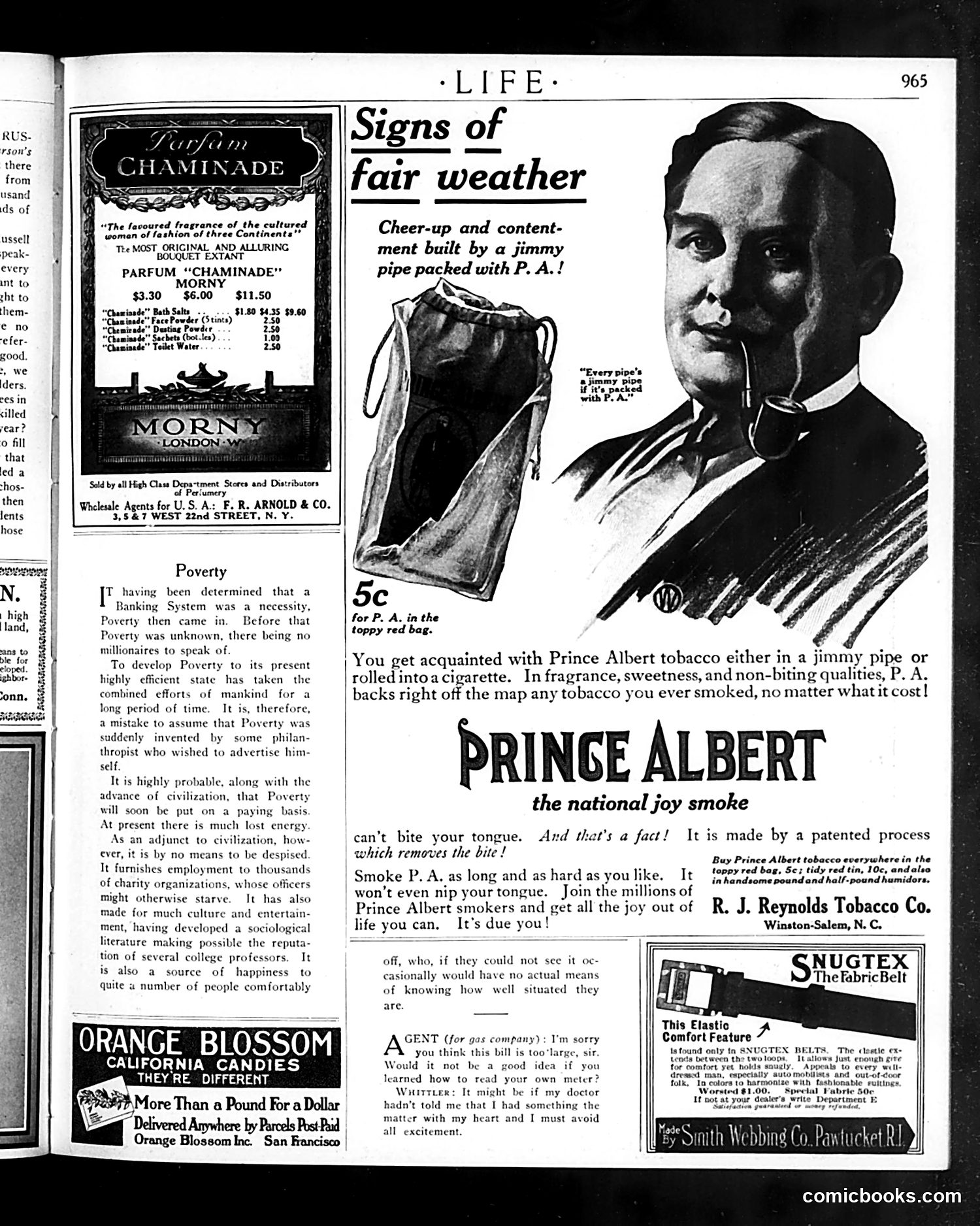
This page is primarily **advertising**, not satirical content. The dominant feature is a Prince Albert tobacco advertisement occupying the right half of the page, featuring a man's portrait and promoting the product as "the national joy smoke" that "can't bite your tongue" and "won't even nip your lip." Other advertisements include: - **Parfum Chaminade** perfume (top left) - **Orange Blossom California Candies** (bottom left) - **Snugtex fabric belt** (bottom right) There is minimal editorial content—a brief article about "Poverty" appears on the left side, discussing economic systems, but contains no satire or political cartoon. This is essentially a commercial magazine page from the early 20th century showcasing consumer goods.
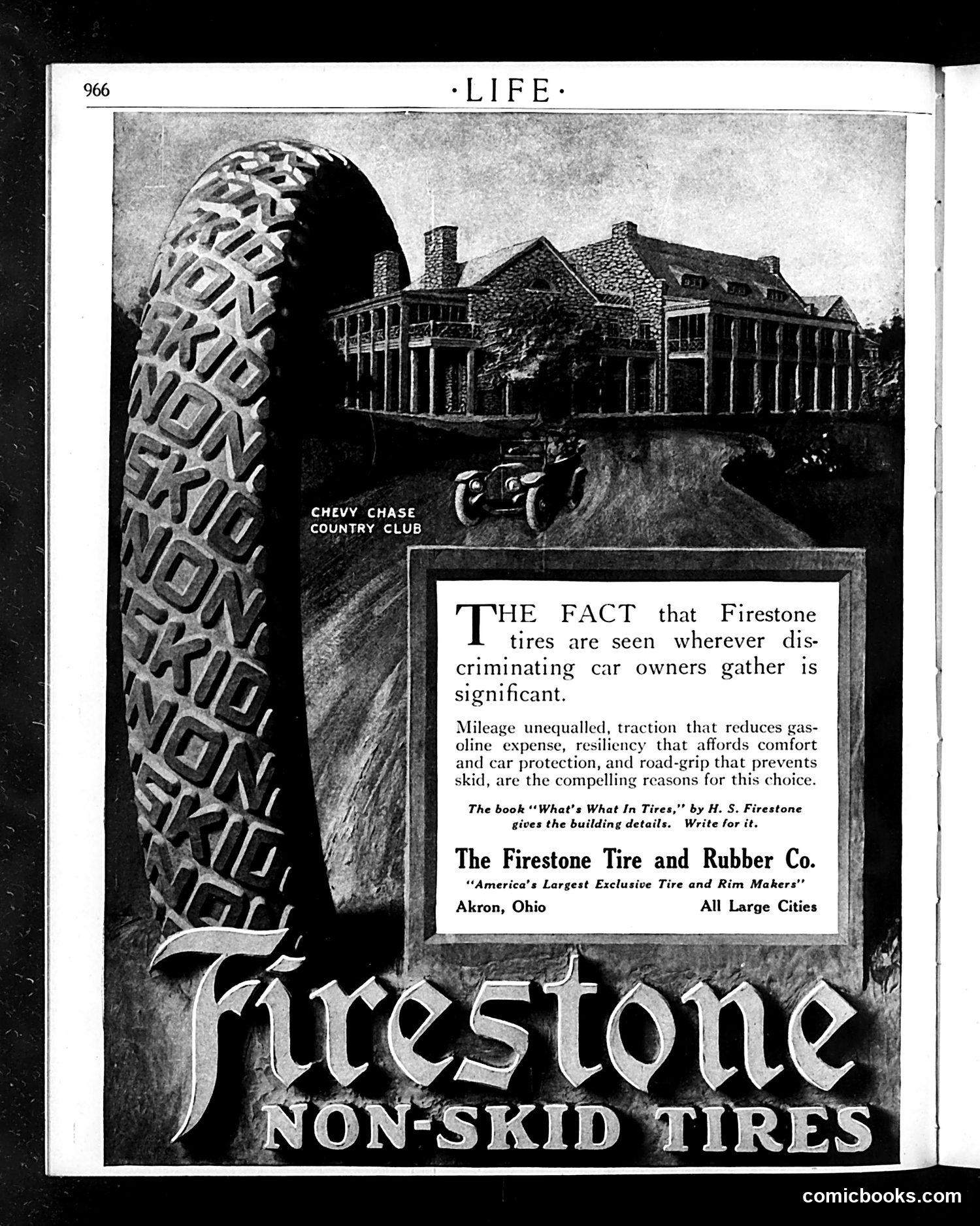
This is a **Firestone Tire advertisement**, not satirical content. The page shows a large close-up of a Firestone tire tread on the left, with an inset photograph of the Chevy Chase Country Club building on the right—featuring what appears to be a vintage race car on the grounds. The ad's pitch emphasizes that discriminating car owners choose Firestone tires for mileage, traction, resilience, and road-grip. It references a book called "What's What in Tires" as proof of Firestone's superiority. The Chevy Chase Country Club image functions as a status symbol, suggesting that wealthy, discerning individuals at prestigious clubs use Firestone products. This appeals to aspirational consumers by associating the brand with affluence and good taste.
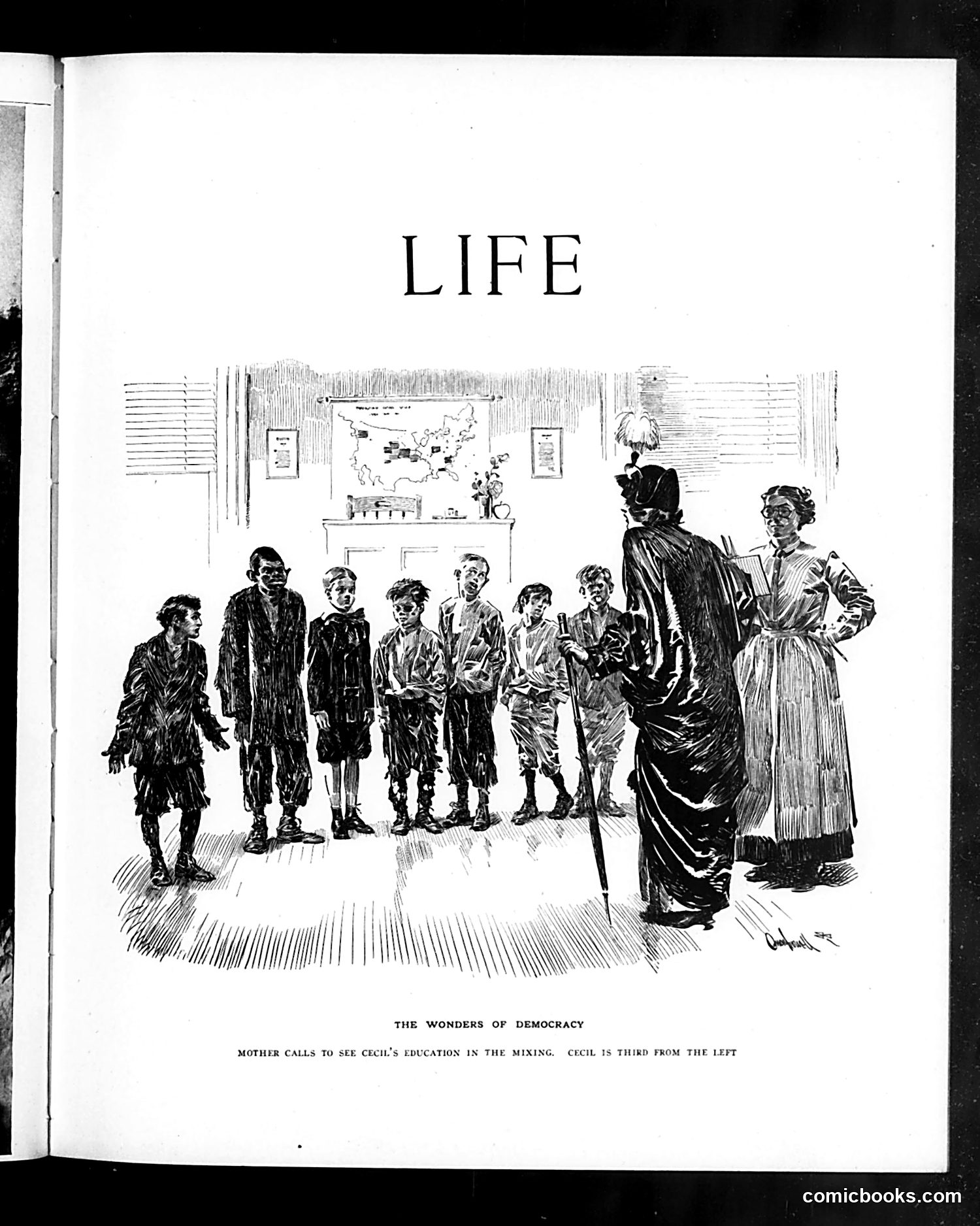
This is a title page for *Life* magazine featuring a satirical illustration titled "The Wonders of Democracy." The caption explains: "Mother calls to see Cecil's education in the mixing. Cecil is third from the left." The cartoon depicts a schoolroom scene where a well-dressed woman (the mother) observes a group of children from diverse socioeconomic backgrounds—ranging from ragged street children to better-dressed students. The implied satire critiques the American educational system's claim to democratic equality. By showing children of vastly different circumstances "mixed" together in one classroom, the artist suggests irony about whether such mixing truly provides equal education or opportunity. The term "wonders of democracy" appears sarcastic, questioning whether public education genuinely serves its democratic ideals when vast class differences persist.
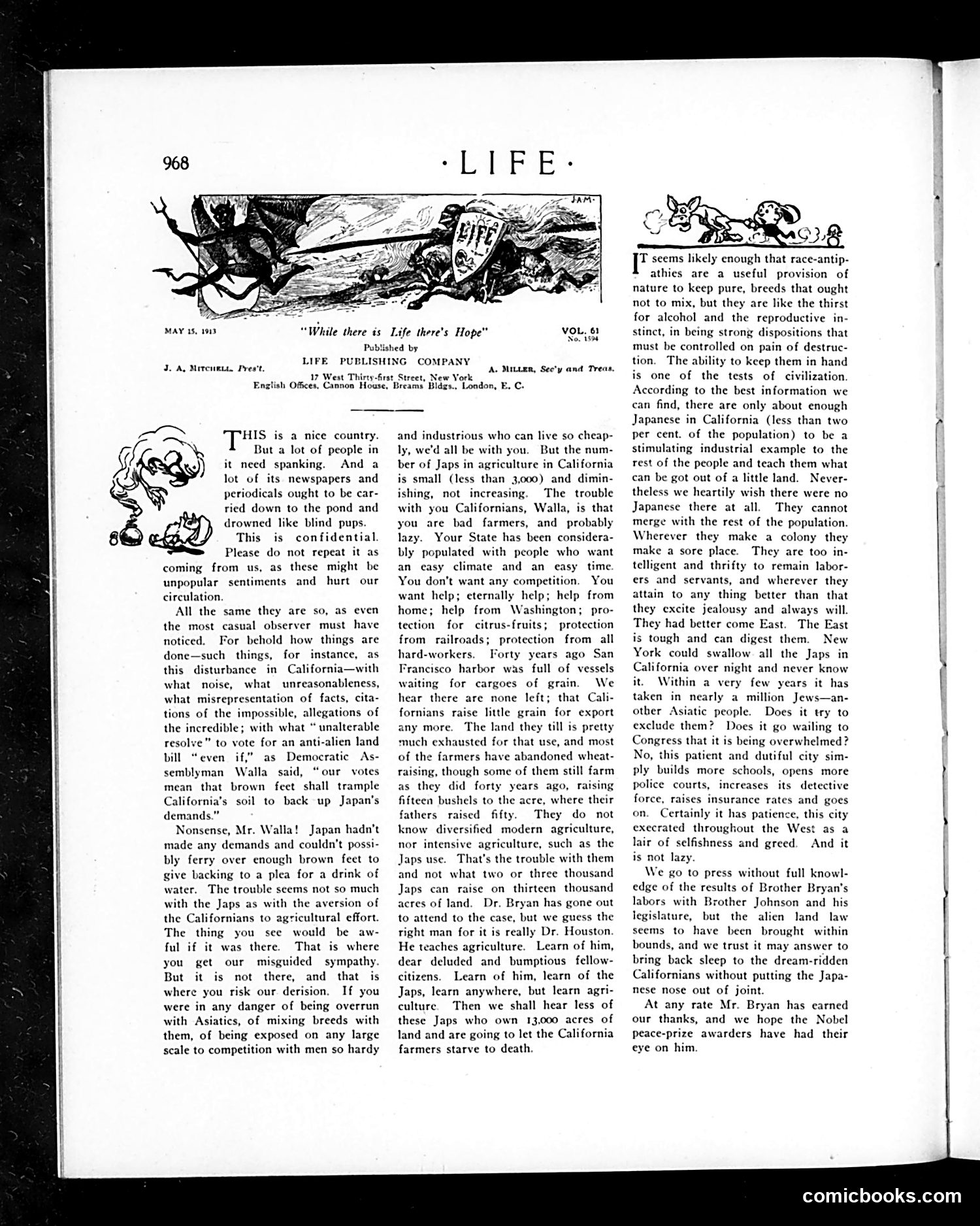
**The cartoon** at top left depicts what appears to be a violent confrontation, with the caption "While there is Life there's Hope." **The article's focus** is anti-Japanese sentiment in California. The unnamed author argues against Japanese immigration, claiming Japanese cannot assimilate and should be excluded. The piece expresses anxiety about Japanese farmers owning 13,000 acres of California land and advocates for their displacement—literally stating "we are going to let the California farmers starve to death" rather than allow Japanese economic competition. **The satire's target**: This appears to be either sincere xenophobic advocacy or satirical exposure of California's racist attitudes toward Asian immigrants. The extreme rhetoric ("starve to death") and the magazine's satirical reputation suggest possible ironic critique, though the text reads as straightforward anti-Japanese propaganda typical of the era's discriminatory policies.
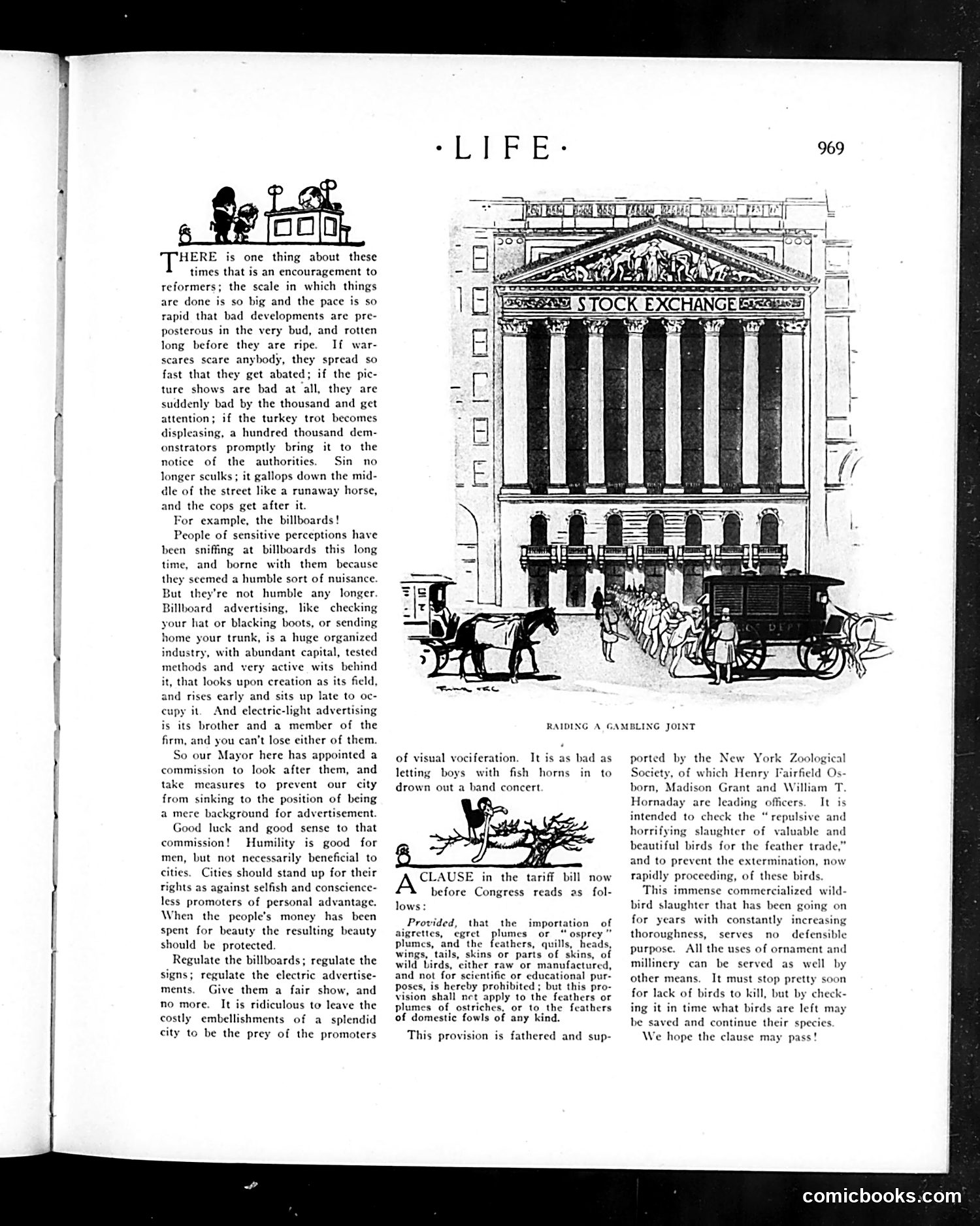
This page contains two distinct pieces of social commentary: **Left column:** A satirical essay criticizing reformers who move too quickly on various issues. The author argues that while well-intentioned, reformers often create chaos by implementing changes before society is ready, using examples like scarecrows startling people or turkeys causing disruption. The piece concludes that billboard advertising and other industries—despite criticism—are actually well-organized enterprises worthy of respect. **Right side:** An illustration labeled "RAIDING A GAMBLING JOINT" shows a Stock Exchange building being raided. Below it, a essay discusses a tariff bill clause protecting birds from slaughter for the feather trade, which was apparently a contemporary concern. The piece advocates for the clause's passage to prevent bird extinction for fashion purposes. Both pieces reflect Progressive-era debates about regulation and reform.
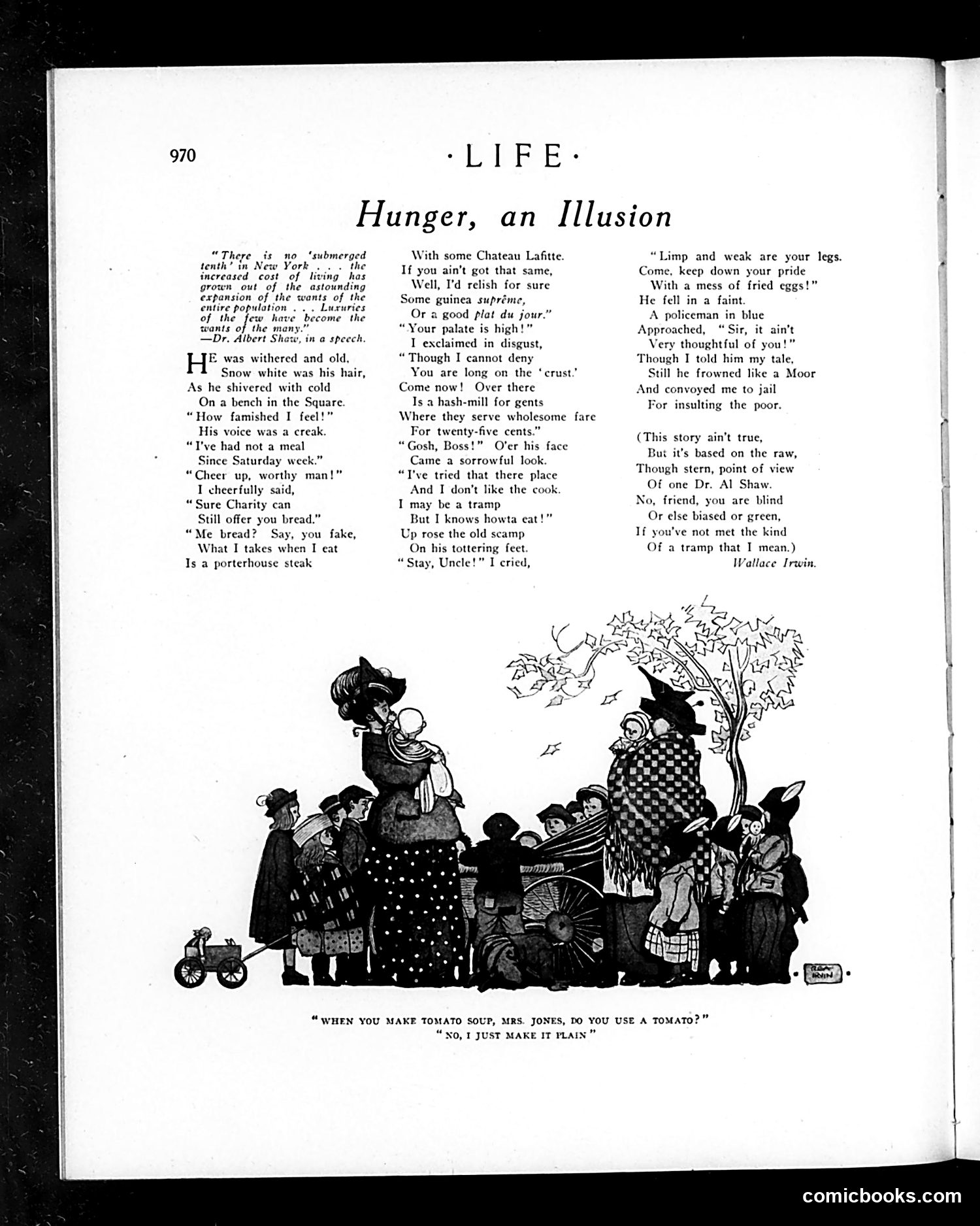
This satirical poem by Wallace Irwin critiques wealthy people's dismissal of poverty. The opening quote from Dr. Albert Shaw frames the theme: the rich claim hunger among the poor is merely psychological, not real. The poem's narrative follows a starving man encountering well-fed people offering empty platitudes instead of food—a Chateau Lafitte wine suggestion, fried eggs, a hash-mill. Each rejection of genuine need reinforces the satire: the affluent convince themselves the poor aren't *actually* hungry, merely lacking "pride" or proper attitude. The illustration shows a wealthy woman distributing charity while poor children gather beneath, visually embodying the disconnect between wealthy benevolence and genuine destitution. The bottom caption—about tomato soup—emphasizes how the poor make do with minimal ingredients, undercutting the poem's central irony.
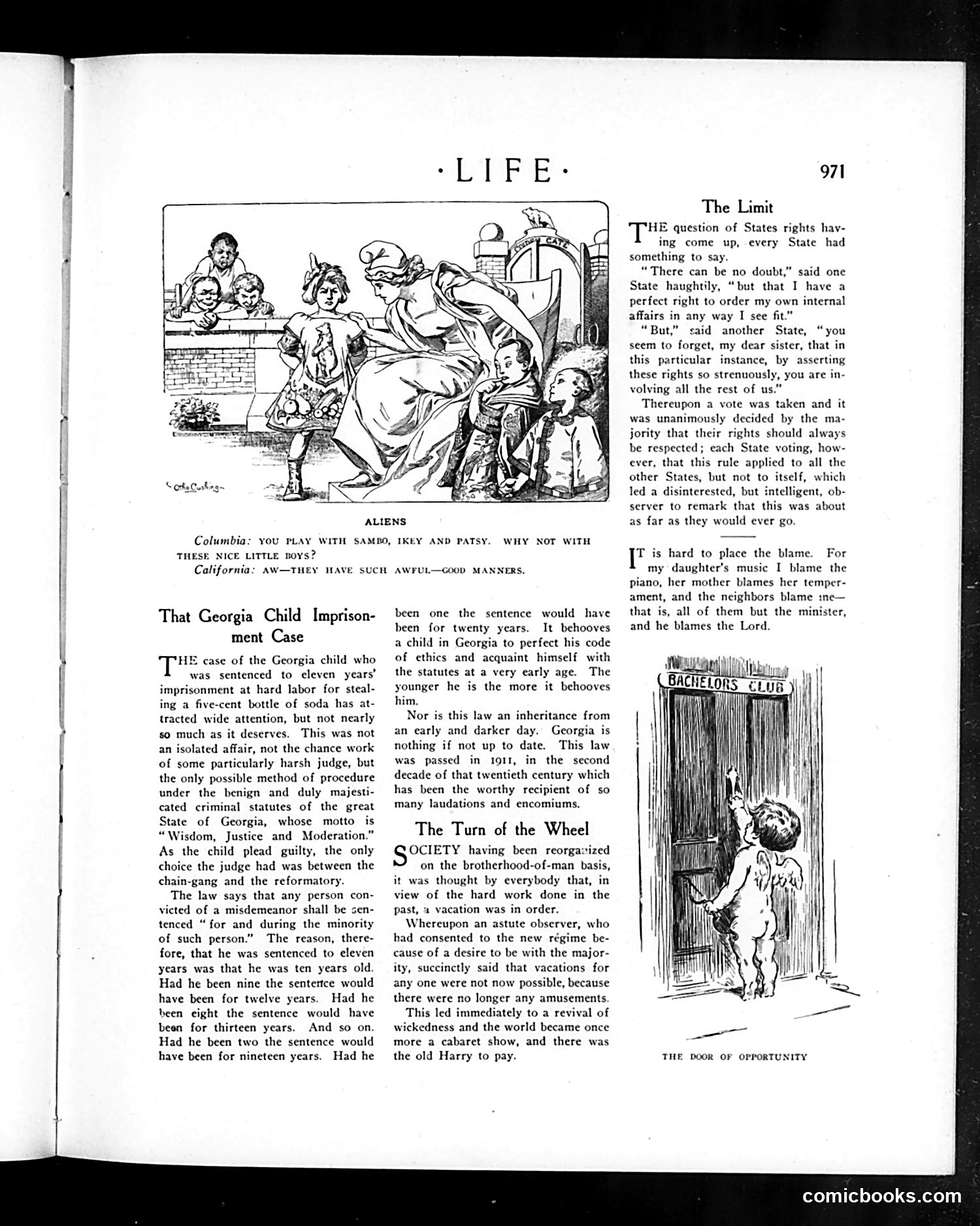
This page contains three satirical pieces attacking American inconsistency and unjust laws. **"Aliens" cartoon** (top): Columbia (representing the U.S.) refuses to let California's children play with "Sambo, Ikey and Patsy"—ethnic stereotypes—claiming they have "awful good manners." The satire mocks American racism: we exclude immigrants while praising civility. **"Georgia Child Imprisonment Case"**: The article criticizes Georgia's 1911 law sentencing a 10-year-old to 11 years hard labor for stealing a soda bottle. The satire exposes the law's absurd logic: sentencing duration equals remaining minority years, meaning younger children receive longer sentences. This demonstrates Georgia's claimed "Wisdom, Justice and Moderation" is hollow. **"The Limit"**: Satirizes states' rights hypocrisy—each state demands autonomy for itself while denying it to others, accomplishing nothing. **"The Turn of the Wheel"**: Mocks post-reform society discovering that eliminating vice requires eliminating all amusement, making utopian ideals impractical.
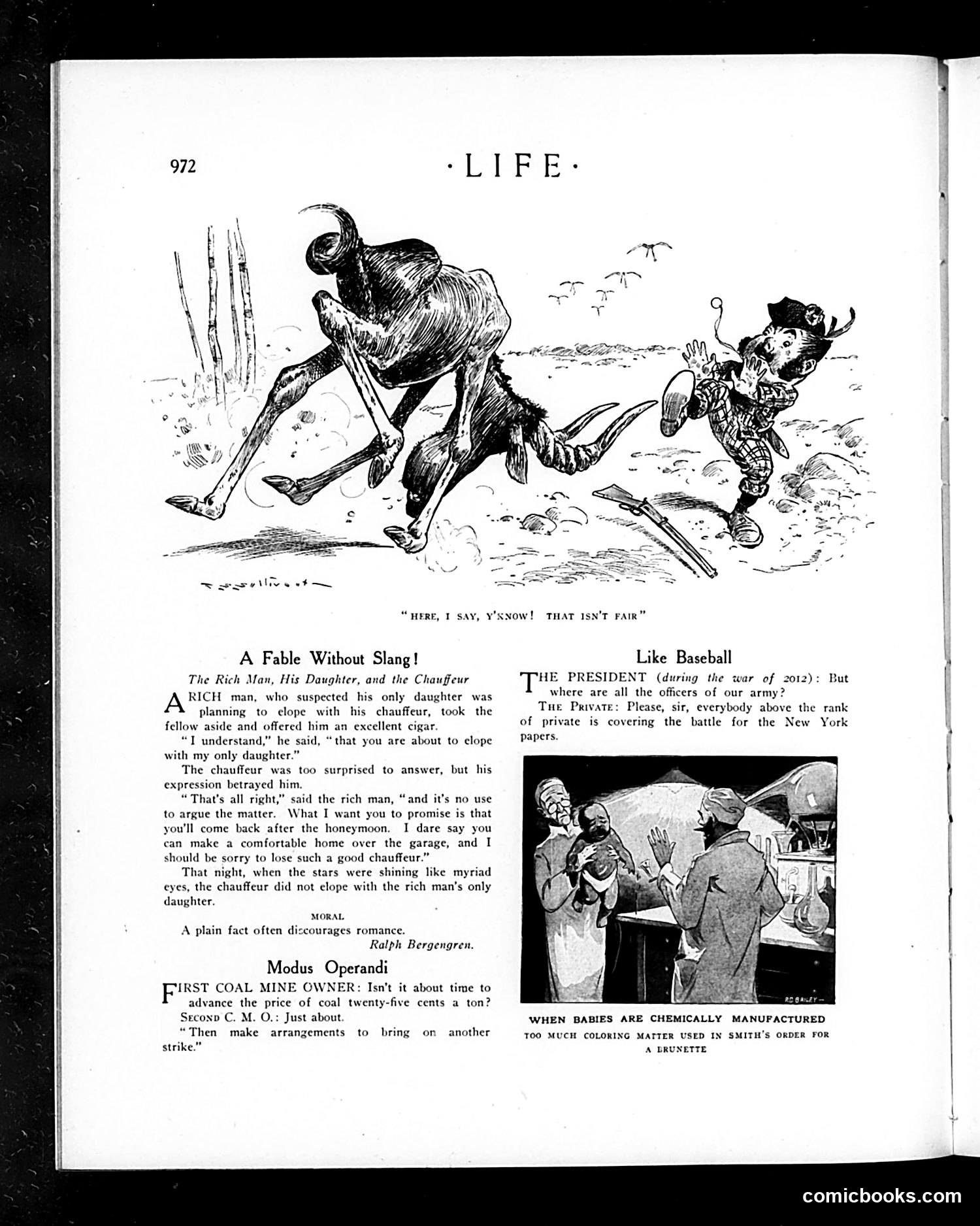
This page contains three separate satirical pieces: 1. **"A Fable Without Slang"**: A morality tale about class and romance. A wealthy man discovers his chauffeur plans to elope with his daughter. Rather than forbidding it, he pragmatically offers the chauffeur cigars and promises of comfortable housing—removing the forbidden-fruit allure. The chauffeur doesn't elope. The moral: practical reality kills romantic fantasy. 2. **"Modus Operandi"**: A cynical joke about coal mine owners deliberately staging strikes to justify raising prices—depicting industrial labor disputes as manufactured theater for profit. 3. **"Like Baseball"**: A satirical commentary (appearing to reference WWI-era concerns about 1912) where all military officers above private rank are covering the war for newspapers rather than fighting it. The joke: military leadership is absent because journalists have taken over. 4. **Image caption**: Appears to mock overly colorful appearance in manufactured goods or babies, though the context is unclear. All reflect early 20th-century anxieties about class, labor, media, and modernization.
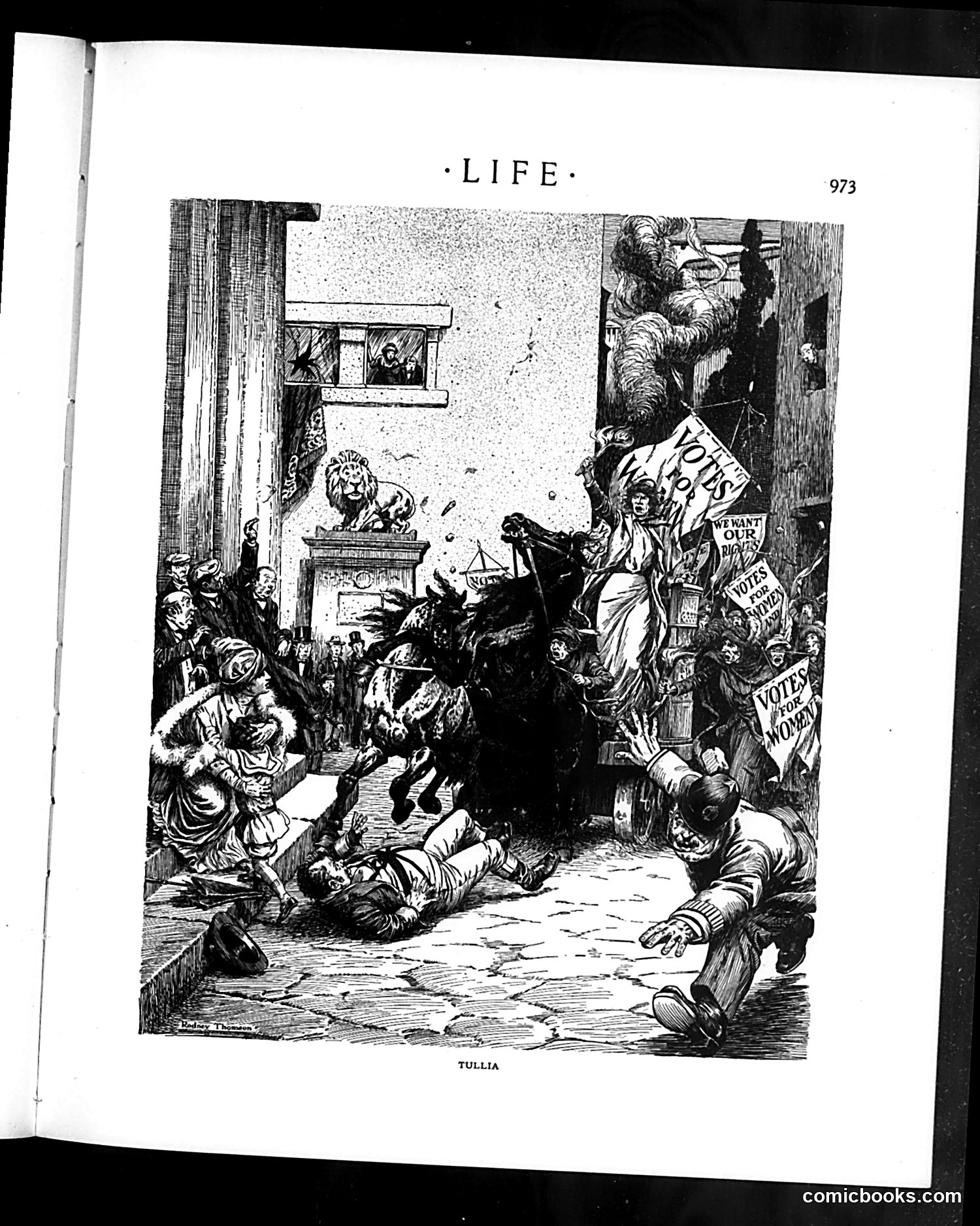
This engraving depicts civil unrest, likely referencing the ancient Roman figure Tullia (daughter of Servius Tullius), though the modern setting—with gas lamps and period dress—suggests a 19th-century political context. The scene shows a mounted figure trampling fallen bodies while crowds wave protest signs reading "VOTES FOR WOMEN" and "WE WANT OUR VOTES." The cartoon appears to satirize violent suppression of women's suffrage activism. The classical reference to Tullia—who in legend drove her chariot over her father's corpse—parallels the brutal treatment of suffragettes. The scattered bodies and chaos represent the consequences of denying women voting rights through force rather than democratic process. This likely appeared during the heated suffrage debate period.
This page from *Life* magazine presents three satirical dialogues mocking prominent early-20th-century figures: **With Secretary of State William Jennings Bryan**: Ridicules Bryan's well-known prohibition stance and moral rigidity. The joke: Bryan served non-alcoholic beverages at a diplomatic dinner, which the interviewer claims makes him uncomfortable—suggesting Bryan's rigid idealism creates awkward situations even for himself. **With King Ferdinand of Bulgaria**: Mocks European power politics. Ferdinand admits Bulgaria spent twenty years fighting Turkish rule, then immediately will fight its former allies. The satire targets the cynical reality that post-war alliances are unstable and self-interested, despite nationalist rhetoric. **With a Medical Visitor**: Criticizes physicians for dismissing patients' legitimate health concerns as minor complaints, suggesting medical arrogance toward the poor. The overarching theme: exposing hypocrisy and self-deception among the powerful—whether moral crusaders, monarchs, or elites—through the device of candid "talks" with Lire (the magazine's persona).
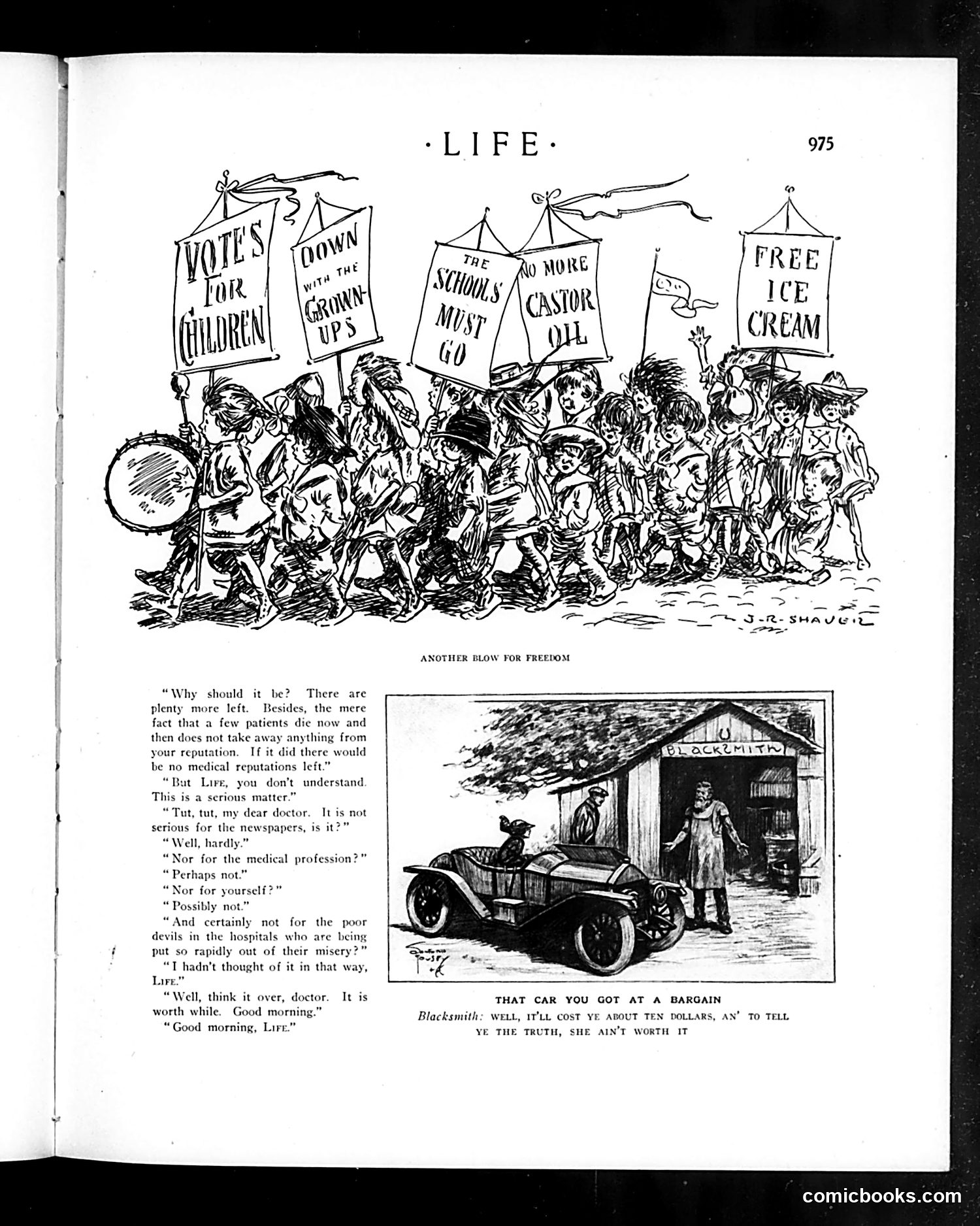
**Top Cartoon ("Another Blow for Freedom"):** A large crowd of children marches with protest signs demanding "Votes for Children," "Down with Growing Up," "Schools Must Go," "No More Castor Oil," and "Free Ice Cream." This satirizes reform movements of the era by absurdly applying their rhetoric to children's complaints, mocking progressive activism as childish complaining. **Dialogue Scene:** A character named "Life" (the magazine's personified voice) confronts a doctor who casually accepts patient deaths as routine. Life sarcastically questions whether deaths harm newspapers, the medical profession, the doctor himself, or hospital patients—exposing the doctor's indifference. This critiques medical negligence and callous professionalism, likely reflecting contemporary concerns about hospital mortality rates. **Bottom Cartoon:** A blacksmith tells a customer their bargain car costs ten dollars to repair and "ain't worth it"—mocking cheap, unreliable automobiles and buyer's remorse among early motorists. All three pieces use humor to critique social attitudes: childish activism, medical negligence, and consumer gullibility.
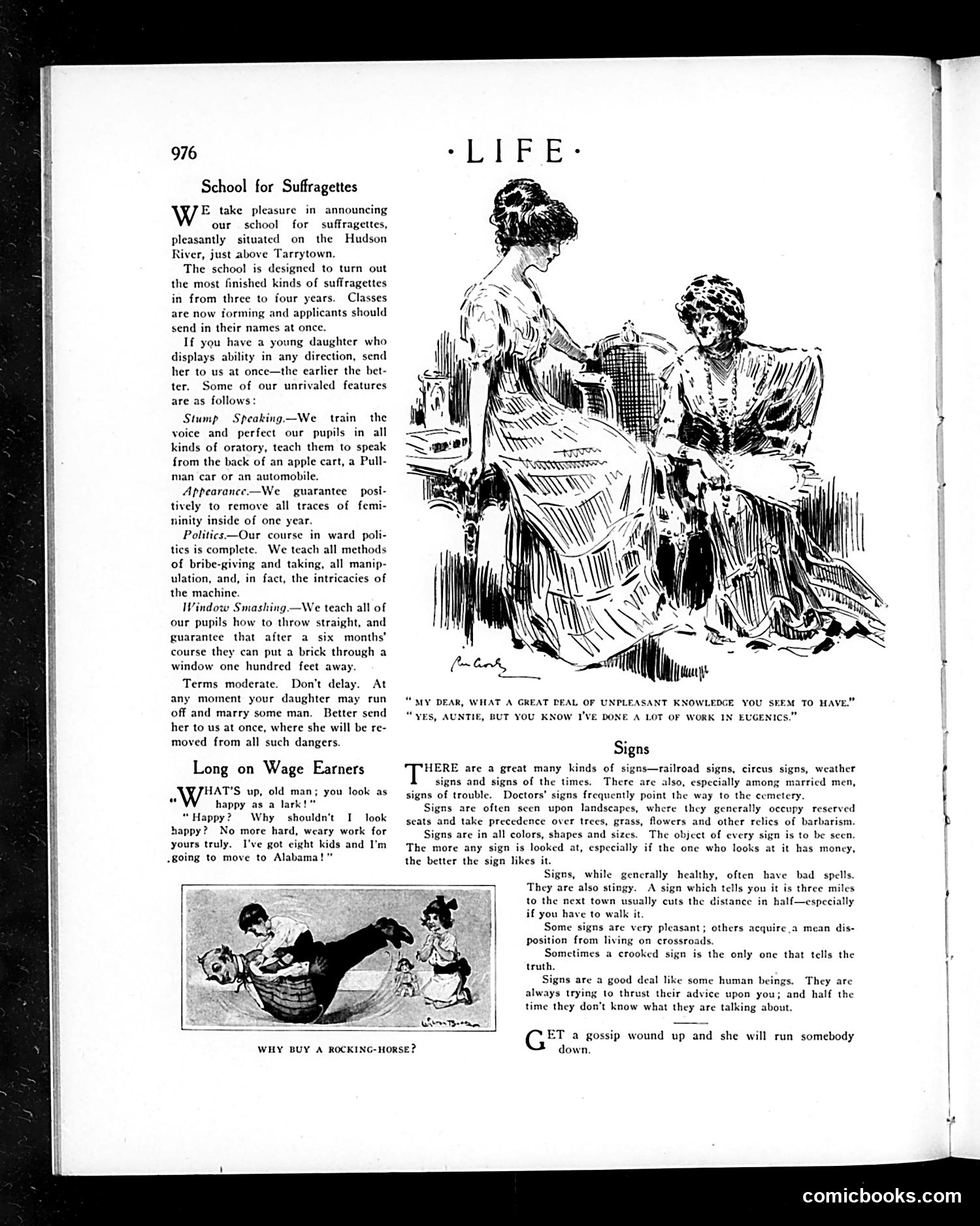
This page contains three satirical pieces mocking early 1900s social issues: **"School for Suffragettes"** (top): A biting parody advertisement attacking women's suffrage activists. It mockingly promises to train young women in "stump speaking," remove their "femininity," teach political corruption and bribery, and instruct them in "window smashing"—referencing actual property damage by militant British suffragettes. The satire suggests suffragists are unfeminine, corrupt, and violent, reflecting anti-suffrage propaganda common before women gained voting rights. **"Long on Wage Earners"** (middle): A cartoon joke about a poor man with eight children planning to move to Alabama to escape work, paired with text about a woman trained in "eugenics"—the pseudoscientific movement advocating selective breeding. This reflects contemporary anxieties about poverty, large families, and eugenics pseudoscience. **"Signs"** (bottom): Humorous observations about roadside signs, comparing them to human behavior—unreliable, self-serving, and often dishonest. The page satirizes progressive-era social movements and attitudes toward working-class life.
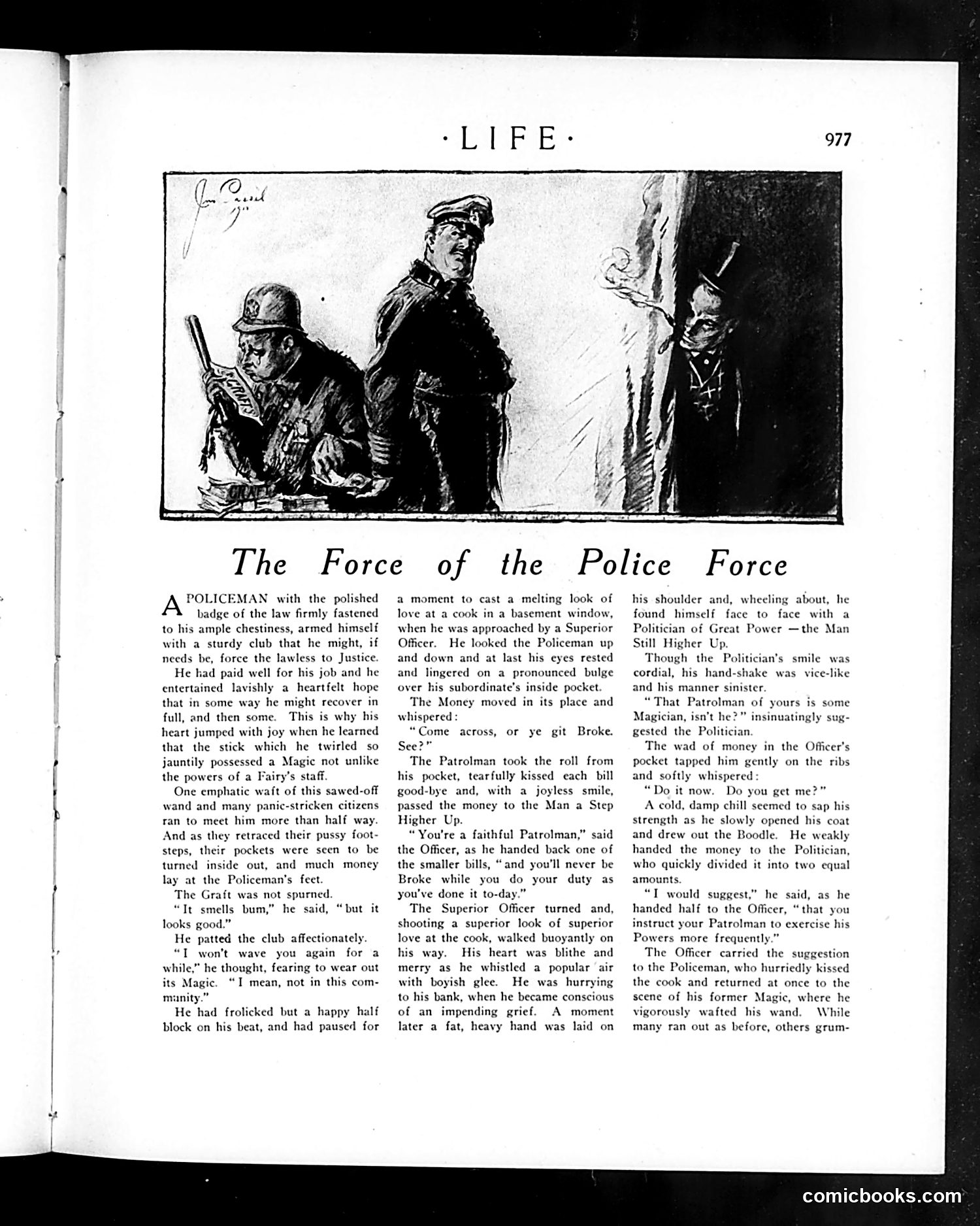
This satirical story exposes police corruption through a chain of bribery. A patrolman uses his club to intimidate citizens into surrendering money—framed as "magic." A superior officer extorts half the proceeds from the patrolman. A politician then extracts half from the officer. Each level profits by instructing subordinates to intensify shakedowns. The satire targets systemic graft in early 20th-century urban police forces, where officers treated their positions as income sources rather than public service. The "magic wand" symbolizes abuse of authority. The hierarchical structure—patrolman, officer, politician—illustrates how corruption cascades upward, with each tier exploiting those below while serving superiors. The story critiques both individual dishonesty and institutional complicity in racketeering disguised as law enforcement.
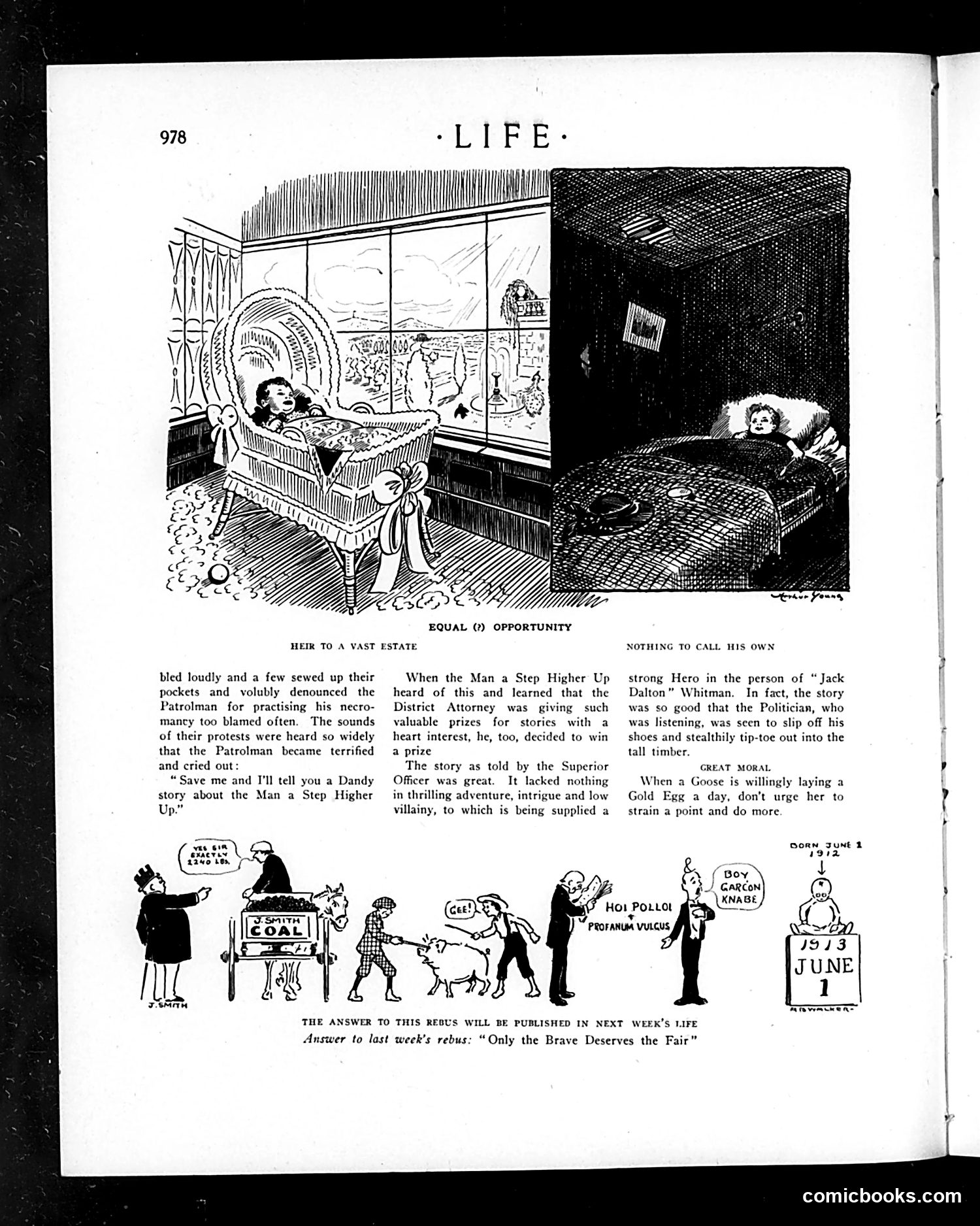
This page from *Life* magazine (dated June 1, 1912) presents a satirical story about inequality and social hypocrisy. **The Top Cartoon:** "Equal(?) Opportunity" contrasts two scenarios—one child gazes from a luxurious nursery at an estate ("Heir to a Vast Estate"), while another lies in a sparse, dark room with almost nothing ("Nothing to Call His Own"). The question mark in the title mocks the concept of equal opportunity in America. **The Story:** A Patrolman uses "necromancy" (magic) to force criminals to confess. When a District Attorney announces prize money for stories with "heart interest," even the Patrolman tries to win—though a Politician hearing the tale steals away rather than face scrutiny. The satire targets how authority figures (police, lawyers, politicians) pursue self-interest over justice. **The Bottom Section:** A rebus puzzle and moral about not overextending resources ("When a Goose is willingly laying a Gold Egg a day, don't urge her to strain a point"). The overall message critiques American class disparity and official corruption during the Progressive Era.
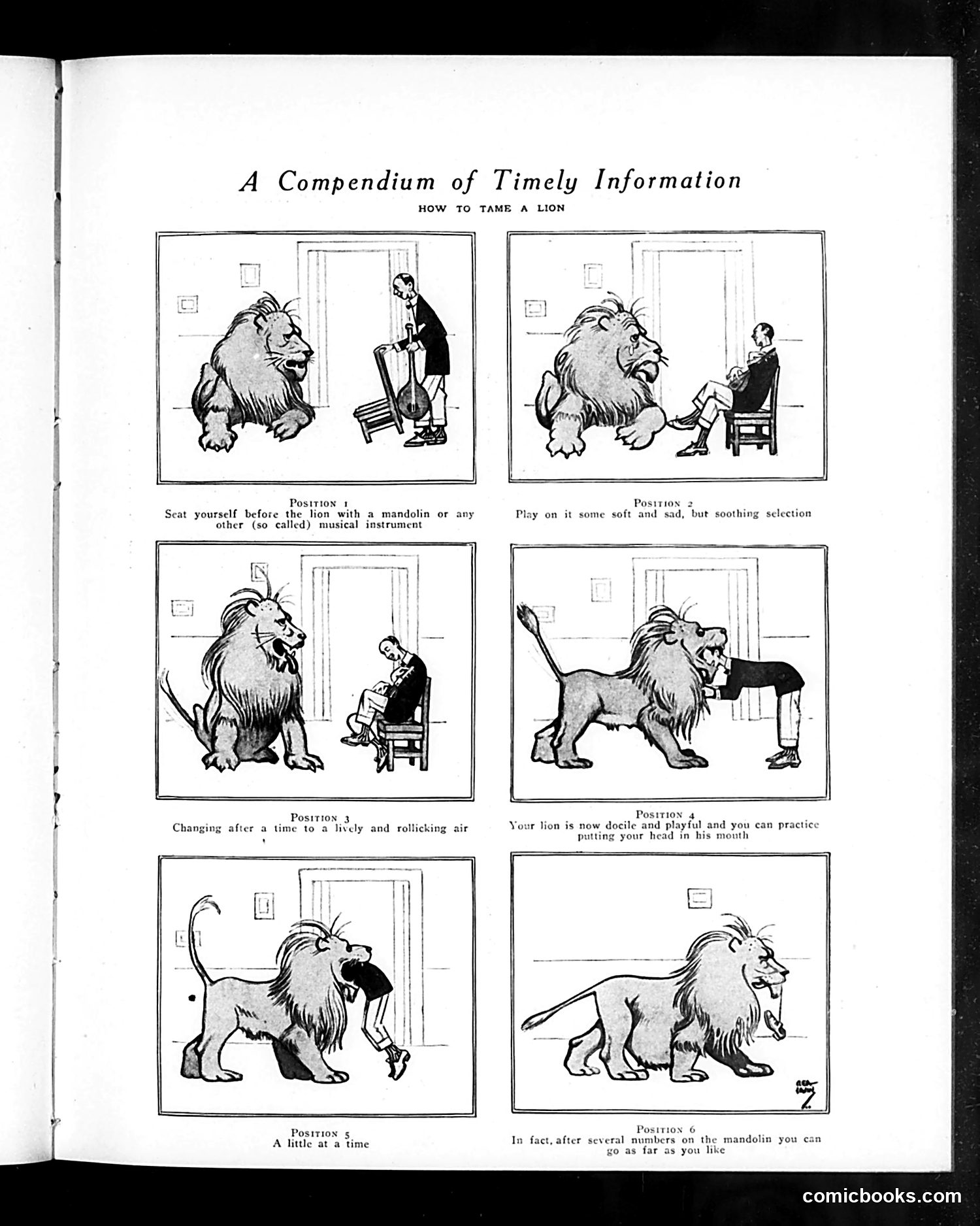
This is a humorous instructional guide presented as satirical "timely information." The cartoon uses a literal lion as the subject, but the satire likely targets **human behavior or social dynamics** of the era—specifically, the idea that one can manipulate or "tame" difficult people (or situations) through charm, music, and incremental appeasement. The progression is absurd: a man plays increasingly lively music to a lion, eventually becoming comfortable enough to place his head in the animal's mouth. The final position notes you can "go as far as you like"—suggesting the dangerous folly of assuming passive submission will last indefinitely. **The point**: This mocks naive optimism about controlling inherently dangerous forces through entertainment or flattery. Without knowing the specific historical context, it appears to satirize either **political appeasement strategies** or **romantic/social manipulation**, warning that such approaches inevitably lead to disaster.
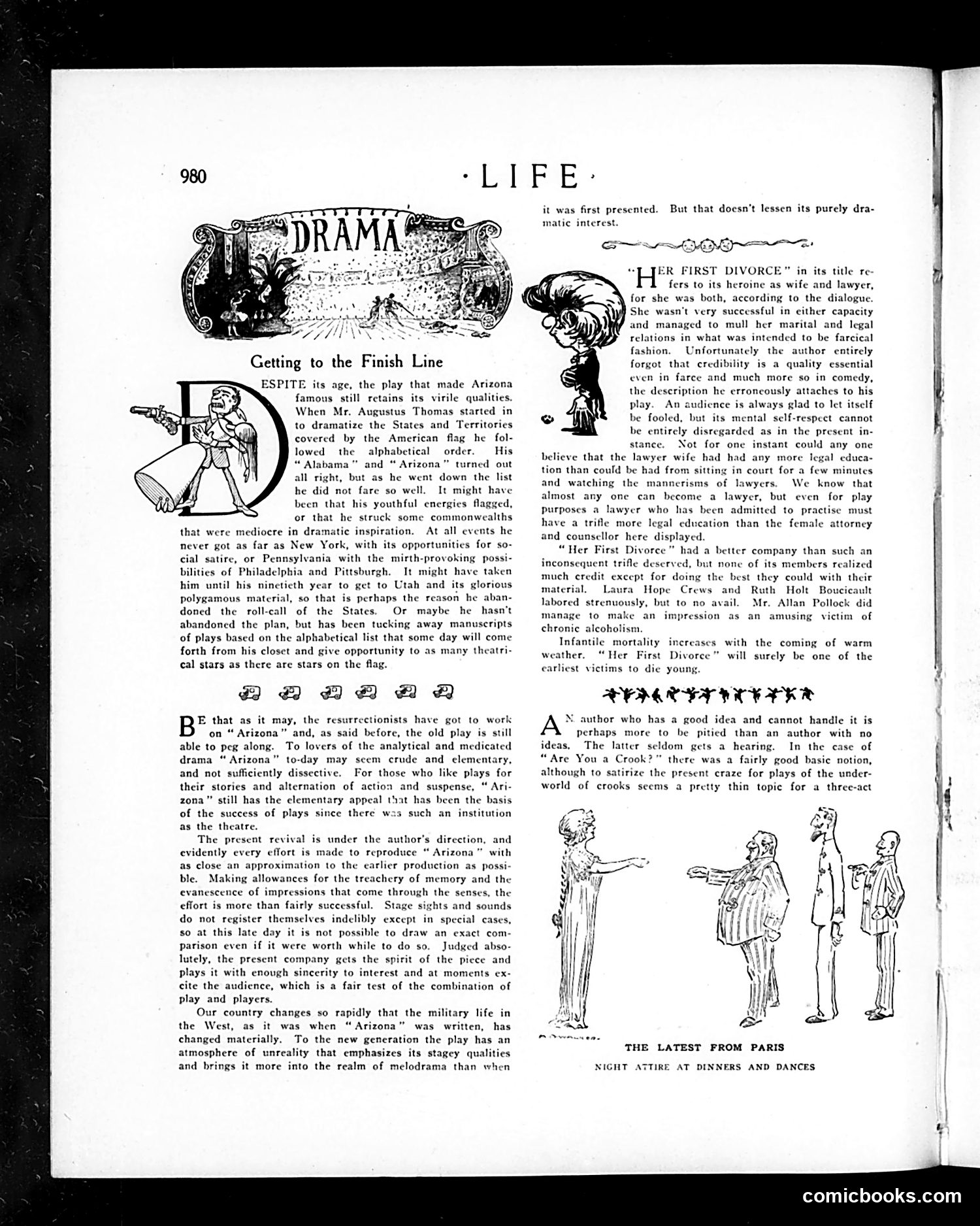
This page reviews theatrical productions, primarily Augustus Thomas's play "Arizona." The left column discusses a revival of this older Western drama, noting that Thomas originally planned to dramatize all U.S. states alphabetically but abandoned the project after "Arizona." The reviewer explains the play feels outdated—its Wild West military setting now seems quaint rather than realistic to modern audiences, pushing it toward melodrama. The right column critiques "Her First Divorce," a farce about a woman serving as both wife and lawyer. The reviewer argues the play fails because audiences cannot suspend disbelief: the female lawyer character lacks any plausible legal knowledge, having only observed courtroom procedures briefly. The satire targets poorly constructed comedy that ignores basic credibility, even in farcical entertainment—audiences accept theatrical conventions, but not complete absurdity presented as realistic. The small illustrations appear to show theatrical costume or character sketches related to these productions.
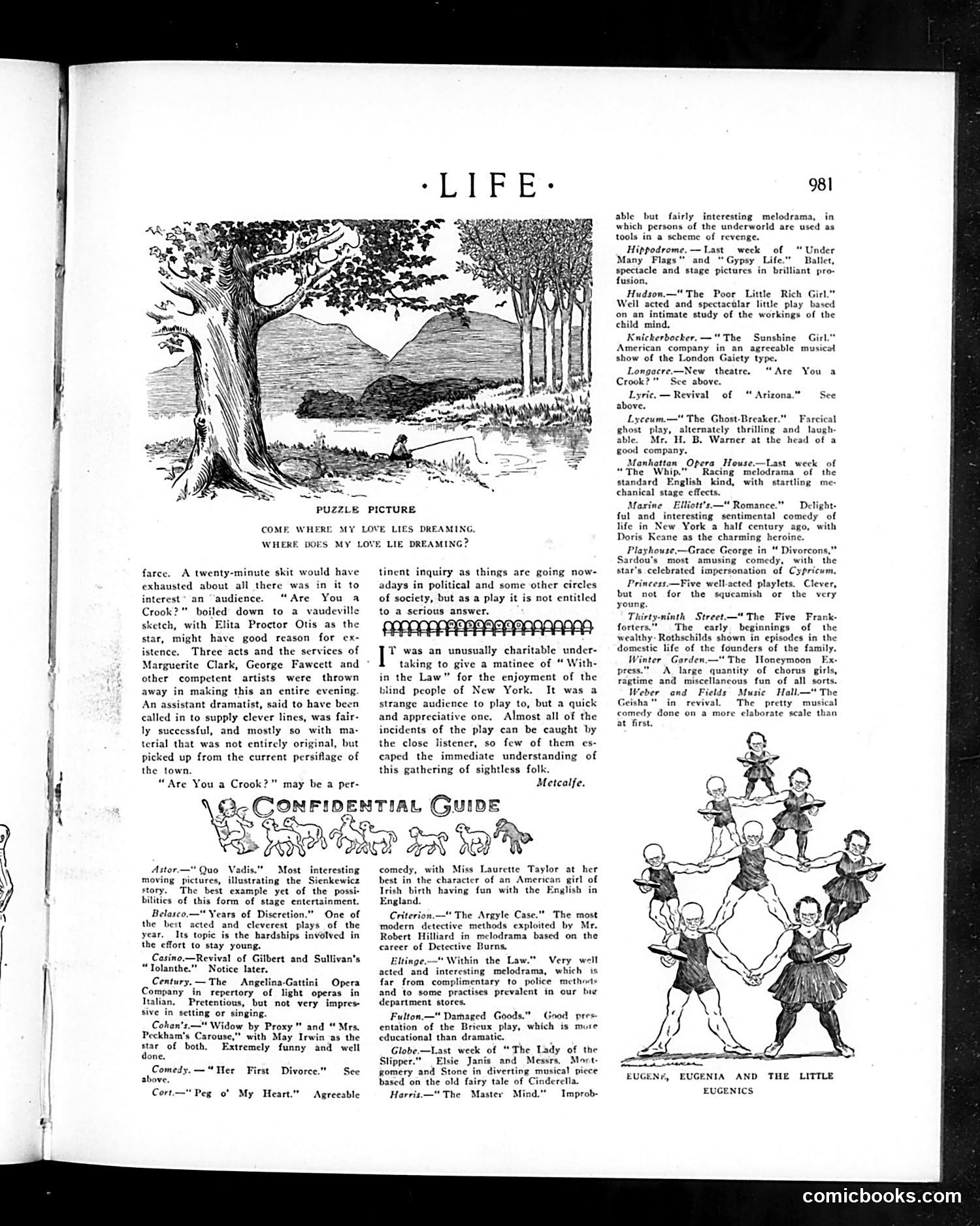
This page is primarily a theater review column from Life magazine, not a political cartoon. The featured image is a decorative "Puzzle Picture" with the caption "Come Where My Love Lie Dreaming? Where Does My Love Lie Dreaming?" — which appears to be a visual riddle rather than satire. The bulk of the page contains critical reviews of Broadway productions, assessing shows like "Quo Vadis," "Are You a Crook?," and various musicals and melodramas. The reviewer (identified as "Metcalfe" in one section) offers straightforward theatrical criticism, occasionally noting social relevance—such as commenting that "Within the Law" presents critiques of police methods and department store practices. There is one small illustration on the right showing children in a circle, labeled "EUGENE, EUGENIA AND THE LITTLE EUGENICS," which references the contemporary eugenics movement, though without visible satirical commentary in the visible text. The page functions as entertainment journalism rather than political satire.
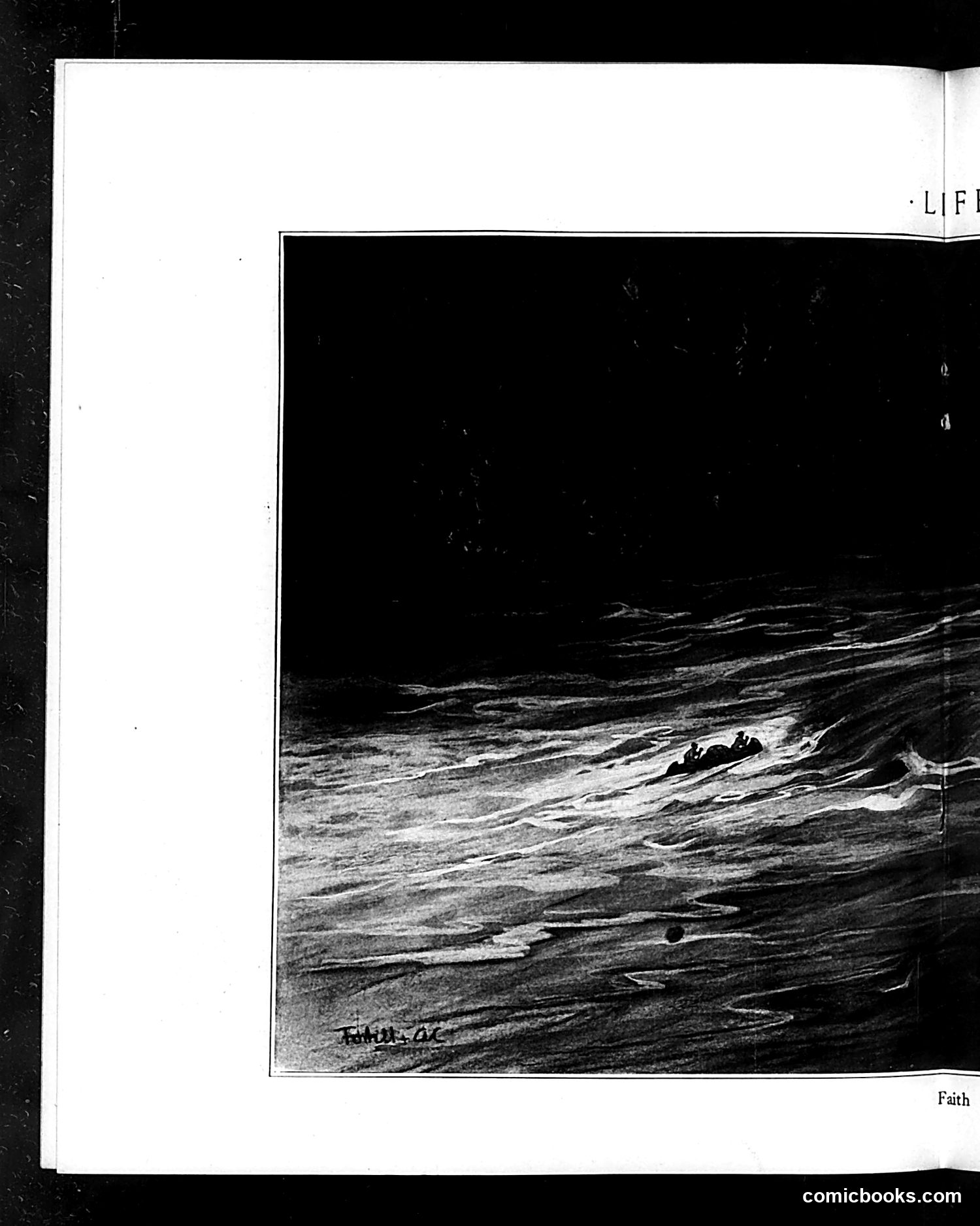
This appears to be a page from Life magazine featuring a black and white photograph or illustration labeled "Faith" at the bottom right. The image shows a stark, desolate lunar or mountainous landscape with what appears to be a small human figure or group of figures in the distance against dark cliffs or mountains. The single word "Faith" as a caption suggests this is commentary on human perseverance or belief in the face of overwhelming, barren circumstances. Without additional visible text or context on this page, the precise satirical point remains unclear, though the juxtaposition of tiny human presence against an enormous, inhospitable landscape likely conveys themes about hope, determination, or spiritual conviction in difficult times.
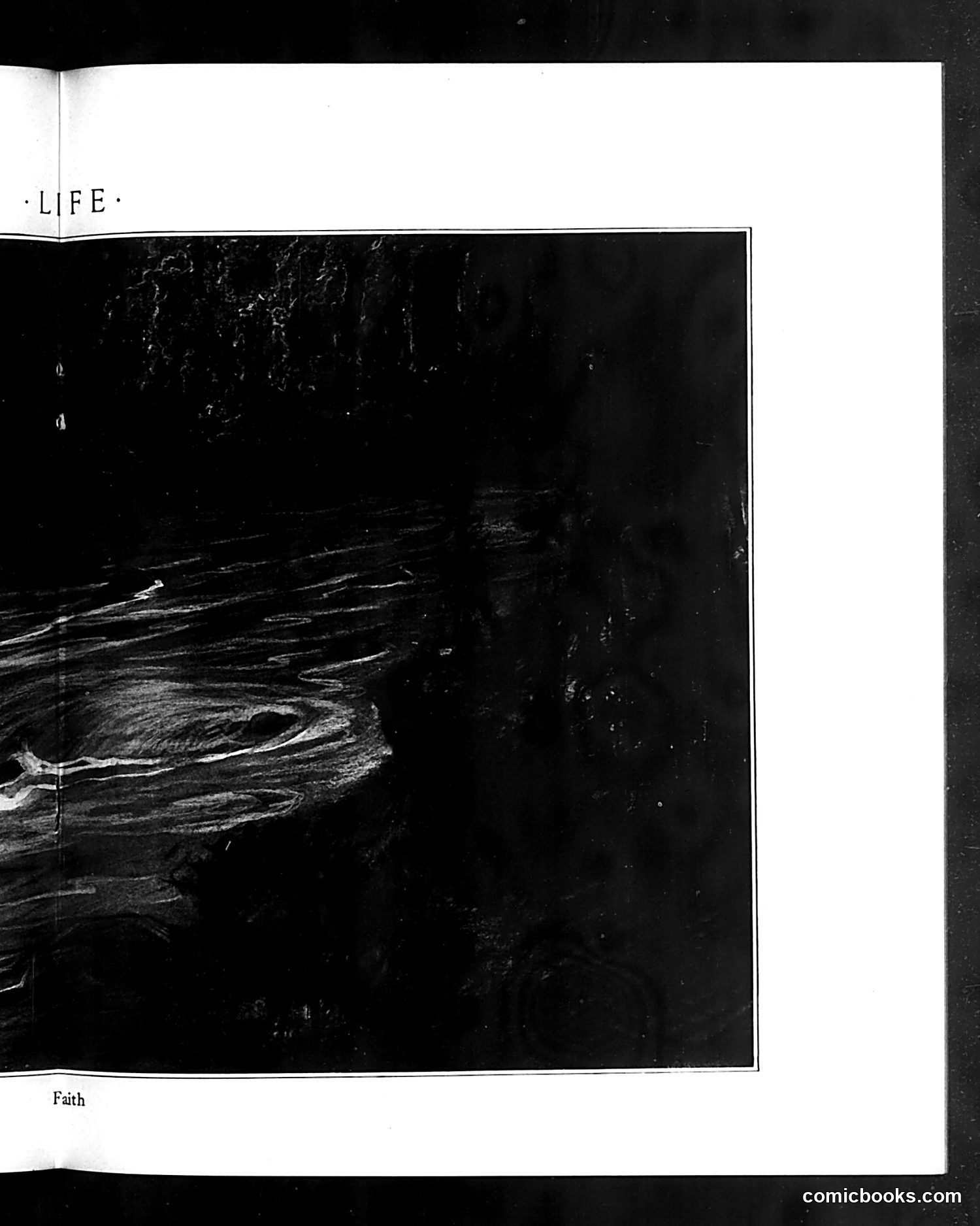
This appears to be a title or section page from *Life* magazine labeled "LIFE" at the top and "Faith" at the bottom. The image itself is a dark, atmospheric black-and-white photograph or illustration showing what appears to be a natural landscape—possibly a forest, canyon, or rocky terrain with flowing water or geological formations. Without additional visible text or clear satirical imagery, the specific political or social commentary is unclear. The pairing of "Faith" with this naturalistic scene suggests a thematic connection between spirituality and nature, but the exact point of satire or commentary cannot be definitively determined from the visible content alone.
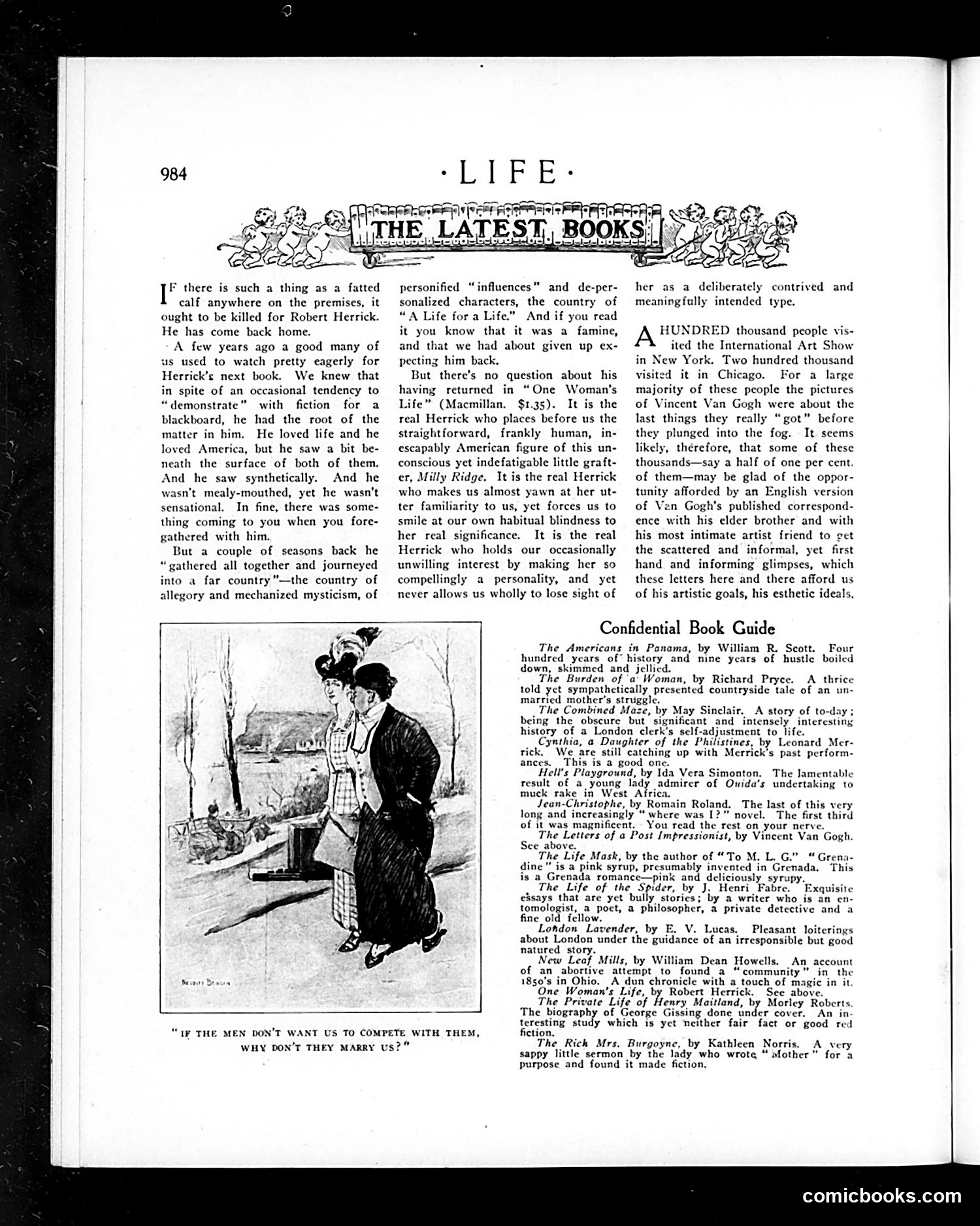
This page reviews Robert Herrick's novel *One Woman's Life*, celebrating his return to realistic fiction after a disappointing allegorical period. The critic praises Herrick's protagonist, Milly Ridge—described as an "unconscious yet indefatigable little grafter"—as authentically American and compellingly drawn despite her familiarity. The accompanying illustration depicts a woman at a mirror, likely representing Milly Ridge or typifying the female character type Herrick portrays. The caption "IF THE MEN DON'T WANT US TO COMPETE WITH THEM, WHY DON'T THEY MARRY US?" addresses gender economics—suggesting women's labor and independence are conditional on marriage, a contemporary feminist concern of the 1910s-1920s era. The "Confidential Book Guide" briefly reviews current publications, including Van Gogh's letters, noting their appeal to Art Show visitors seeking deeper understanding of modernist artistic goals.
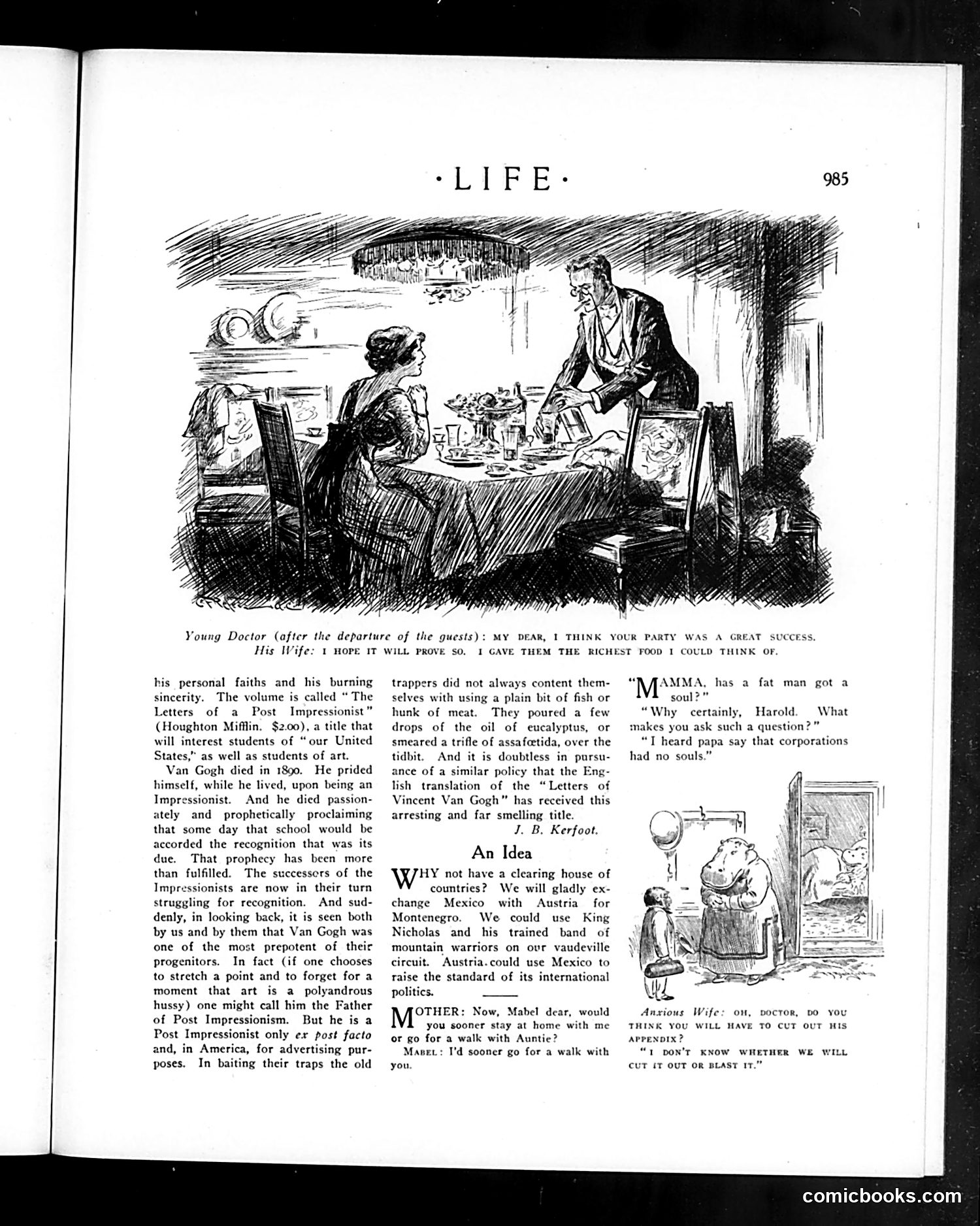
This page contains multiple unrelated satirical pieces typical of Life magazine's format: **Top cartoon**: A young doctor's wife claims her dinner party's success stems from serving "the richest food"—satirizing shallow social climbing and the assumption that expensive meals guarantee entertaining guests. **Middle section**: An article about Van Gogh's published letters criticizes how publishers sensationalize art history for commercial purposes, comparing the "arresting" title to a trapper's bait. **"An Idea"**: Satirizes American attitudes toward other nations by proposing absurdly swapping Mexico and Austria, suggesting Americans view countries as interchangeable commodities rather than sovereign entities. **Bottom dialogues**: Quick satirical exchanges mocking domestic life (a child's logic about souls and corporations) and medical uncertainty (a doctor joking about "blasting" rather than surgically removing an appendix). The page reflects early 20th-century American satirical humor targeting materialism, artistic pretension, and domestic relationships.
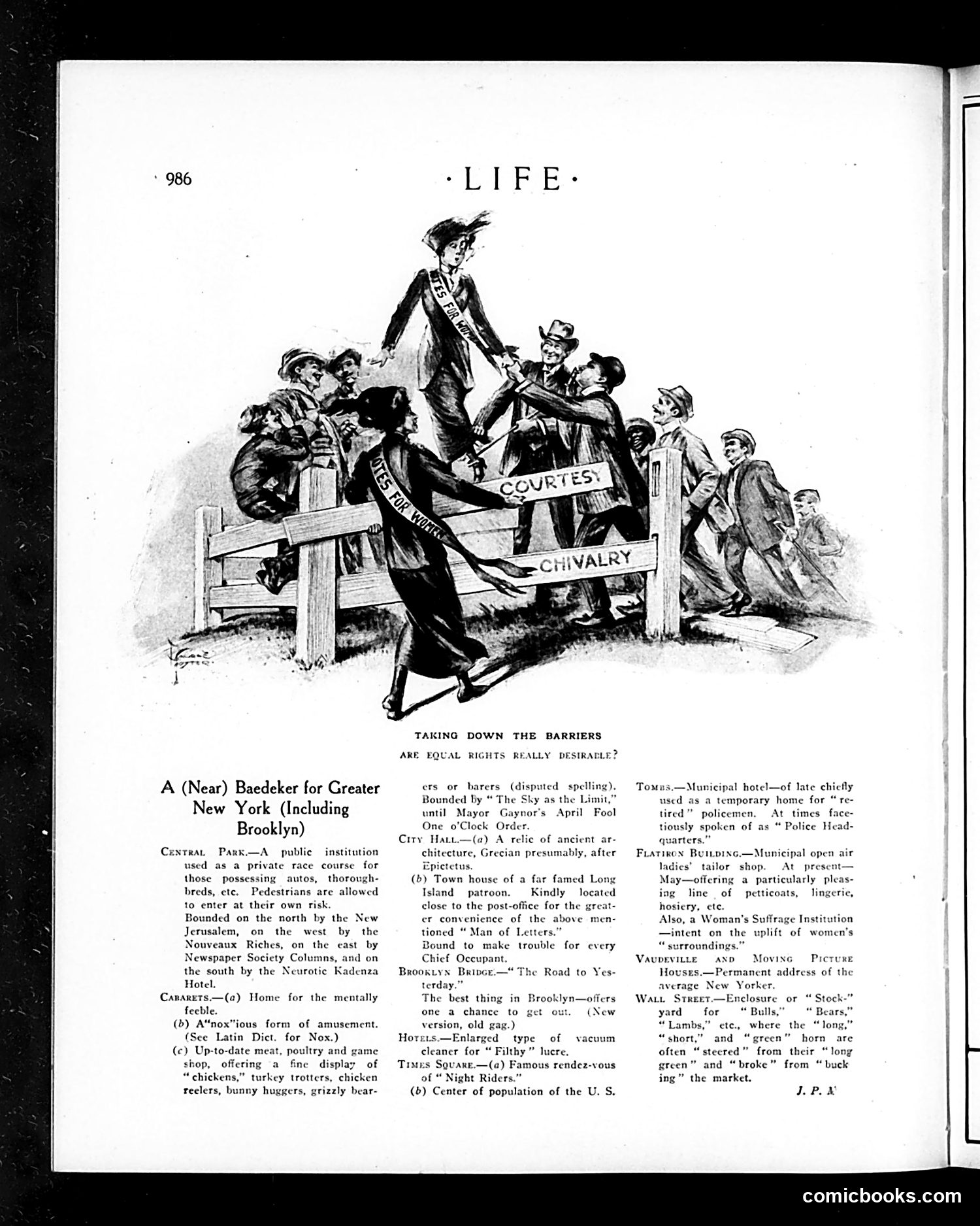
This Life magazine page satirizes New York City institutions and social customs through mock dictionary entries—a format mocking the earnest travel guides (Baedekers) popular at the time. The main cartoon depicts a woman labeled "Equal Rights" jumping over barriers labeled "Courtesy" and "Chivalry" while men below try to stop her. The caption asks sarcastically: "ARE EQUAL RIGHTS REALLY DESIRABLE?" This reflects early 1900s anti-suffrage sentiment—mocking women's rights advocates by suggesting that equality would mean women abandoning traditional feminine privileges like male deference. The dictionary entries below mock wealthy New Yorkers (Central Park as a private auto-racing course), immigrants ("Nouveaux Riches"), and working-class areas (Brooklyn). References to "Night Riders" and police corruption suggest contemporary urban vice. The overall tone is cynical upper-class satire of both social climbers and reform movements, typical of Life magazine's demographic.
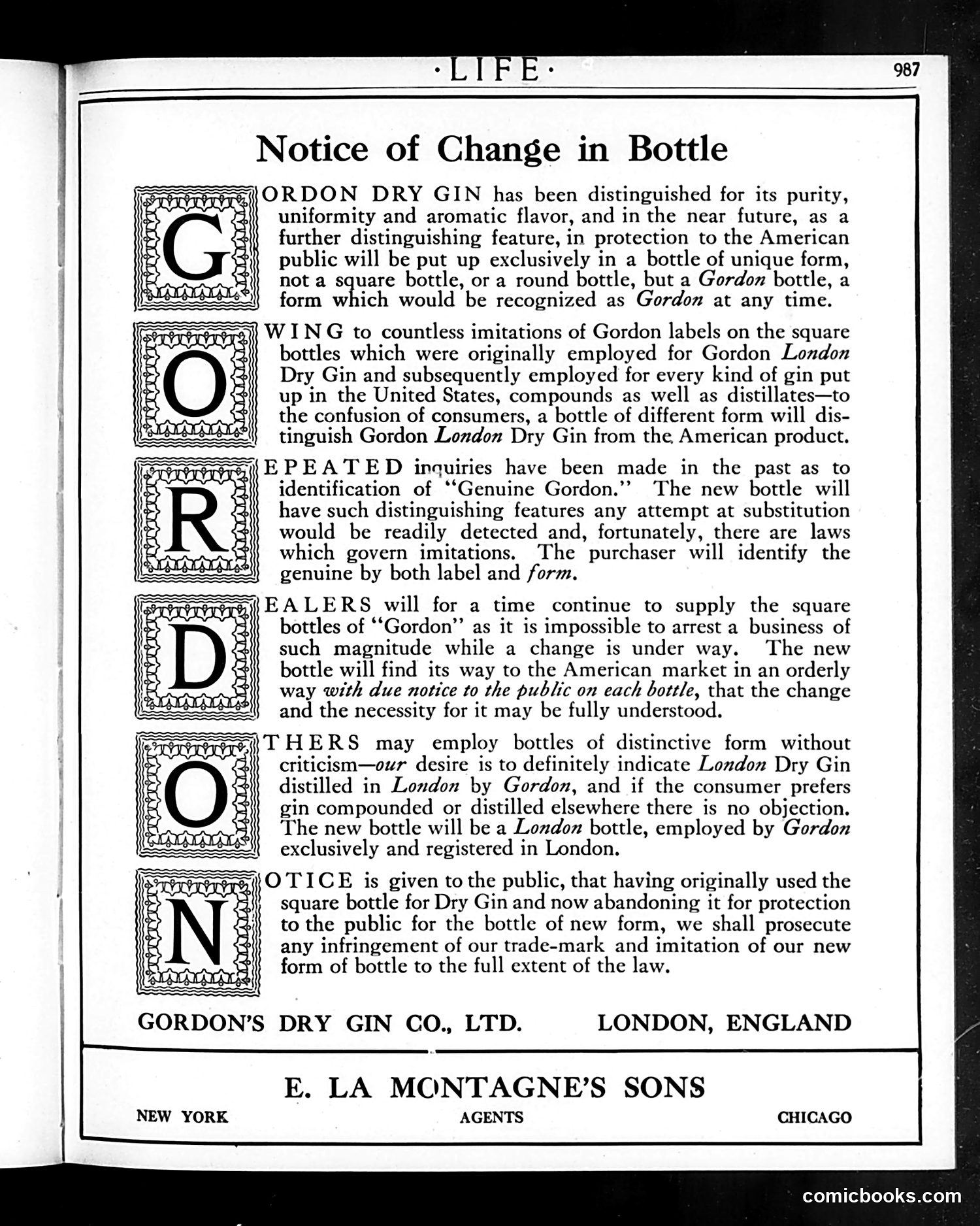
This is **not a cartoon but a corporate advertisement** disguised as a public notice. Gordon's Dry Gin announces it will abandon its traditional square bottle for a new distinctive "Gordon bottle" design to combat counterfeit products flooding the American market. The satirical framing—presented as an acrostic spelling "GORDON" with ornamental capital letters—converts a business decision into mock-official language. The satire lies in the pompous tone: Gordon's presents trademark protection as a public service ("protection to the American public"), when it's actually commercial self-interest. The repeated claims about prosecuting imitators and the defensive explanations about continuing square-bottle distribution reveal anxiety about market counterfeits and brand dilution during the Prohibition era or early post-Prohibition period when spirits distribution was chaotic. The acrostic structure itself is the visual joke—dressing up a straightforward business notice in elaborate period typography to amuse *Life*'s sophisticated readers.
This page contains the "What Do You Think?" letters column—reader correspondence on current issues. The visible letters address three topics: **"It Echoes in Germany"**: A correspondent protests Georgia's harsh sentencing of a ten-year-old child (Ollie Taylor) to eleven years imprisonment for stealing soda water, questioning whether judges should be recalled. **"A Challenge"**: A reader accuses *Life* of dishonest journalism for sarcastically claiming the Rockefeller Institute had discovered "274 sure cures" for cancer and tuberculosis. The writer demands *Life* prove the Institute ever announced actual cures, exposing what he sees as anti-vivisection propaganda. **"From Malay"**: A correspondent challenges *Life's* logical consistency, arguing their anti-tariff and anti-vivisection positions inadvertently support women's suffrage. The page demonstrates *Life's* role as a forum for public debate on progressive-era controversies: criminal justice reform, animal research ethics, and women's rights.
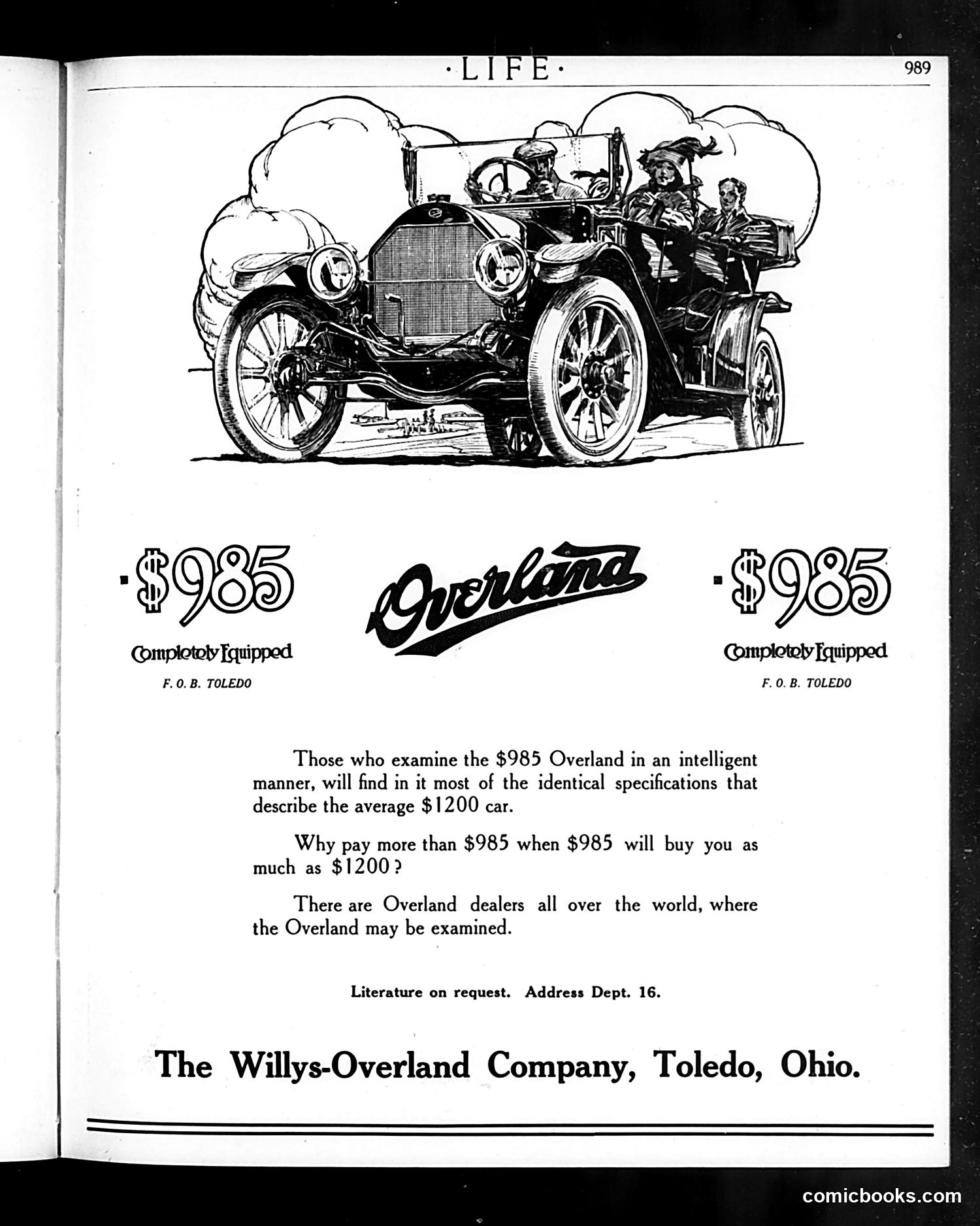
The Willys-Overland Company advertises their $985 car model, emphasizing value. The sketch shows an early 1900s touring car loaded with passengers and luggage, conveying practicality and capacity. The advertising pitch compares the Overland favorably to average $1200 cars, arguing consumers get equivalent specifications for less money—a direct value proposition. The slogan "Why pay more than $985 when $985 will buy you as much as $1200?" is a straightforward economic argument. This appears in *Life* magazine's advertisement section (page 989), not as editorial content. There is no political cartoon or satire here—just commercial messaging typical of early automotive marketing, emphasizing affordability and availability through dealers worldwide.
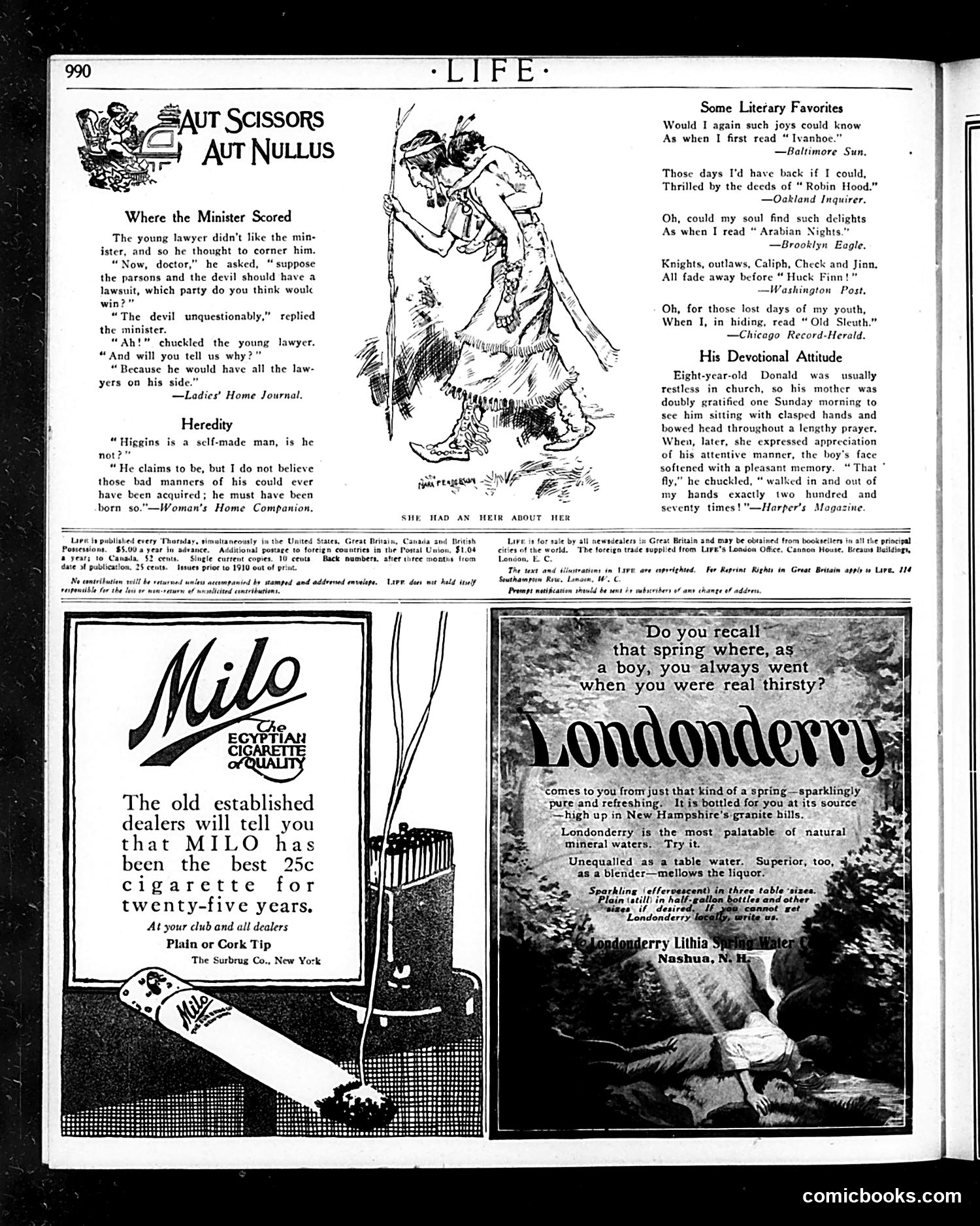
This page contains several short humorous anecdotes typical of early 20th-century American humor magazines: **"Where the Minister Scored"**: A young lawyer tries to trap a minister in debate by asking whether parsons or the devil would win a lawsuit. The minister's clever response—that the devil would win "because he would have all the lawyers on his side"—satirizes lawyers as morally corrupt and willing to argue any case for payment. **"Heredity"**: A brief joke suggesting that a self-made man's bad manners must be inherited rather than self-created, mocking the concept of the "self-made man." **"His Devotional Attitude"**: A boy appears devout during church prayers, but reveals he was actually counting a fly walking across his hands 270 times—satirizing children's inability to maintain genuine piety. The page also includes advertisements for Milo cigarettes and Londonderry mineral water, plus literary nostalgia quotes from readers.
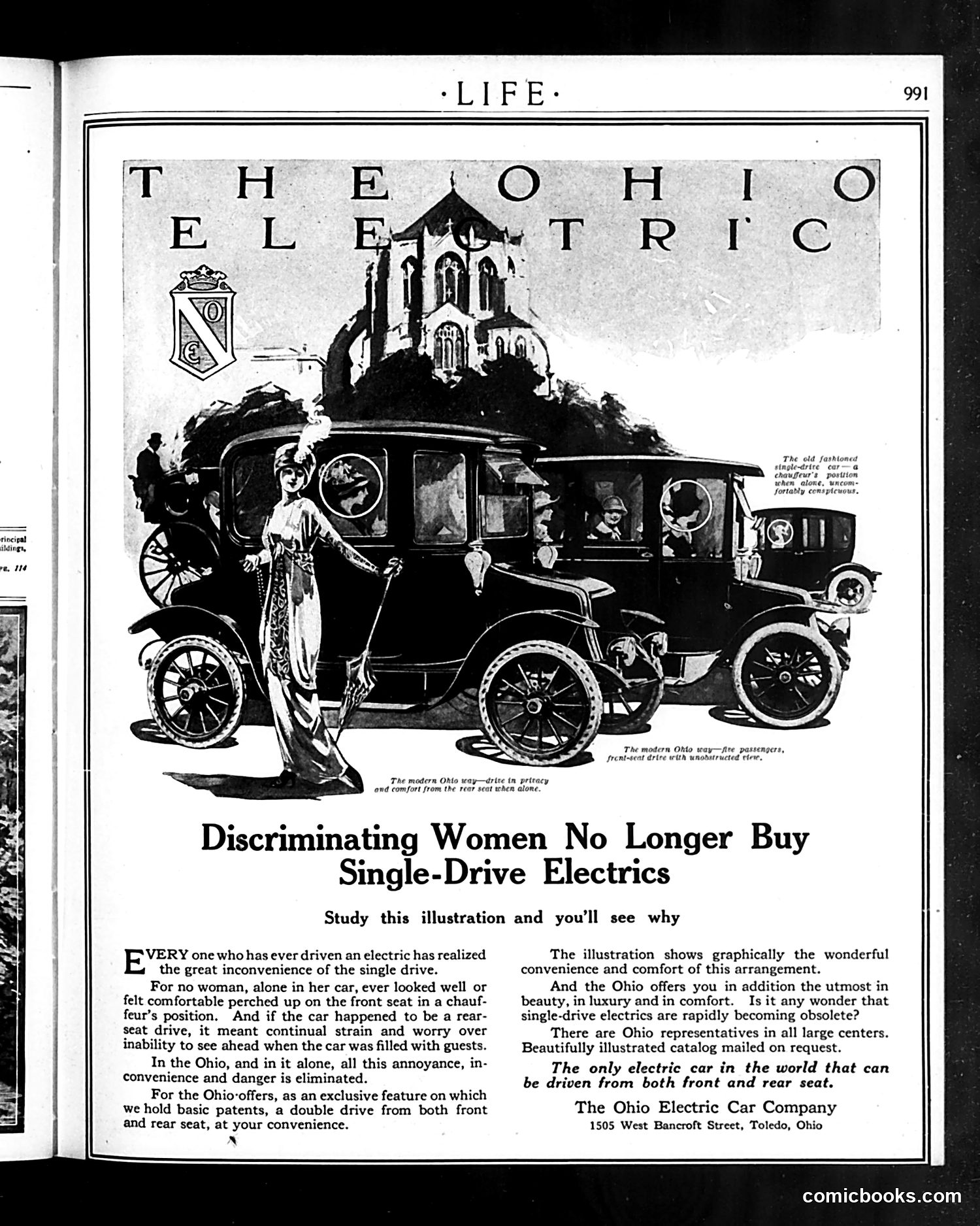
This is primarily an **advertisement**, not satire—though it employs gendered marketing rhetoric typical of early 1900s automobile advertising. The ad promotes the Ohio Electric Car's unique "dual drive" feature (operable from both front and rear seats), marketed specifically to women drivers. The central illustration contrasts three scenarios: a woman awkwardly positioned as a chauffeur in a traditional single-drive car versus the comfort of driving from the rear seat in an Ohio vehicle. The pitch exploits social anxieties: women alone in cars appeared "conspicuous" and uncomfortable in the chauffeur's position (traditionally masculine), while rear-seat driving in crowded vehicles created safety and visibility problems. The Ohio's solution supposedly eliminated these embarrassments. The claim that "discriminating women" reject single-drive electrics reflects period advertising's assumption that women buyers were concerned with propriety, comfort, and appearance rather than mechanical performance. Electric cars were marketed to women partly because they required no hand-cranking or gear-shifting—deemed too physically demanding for ladies.
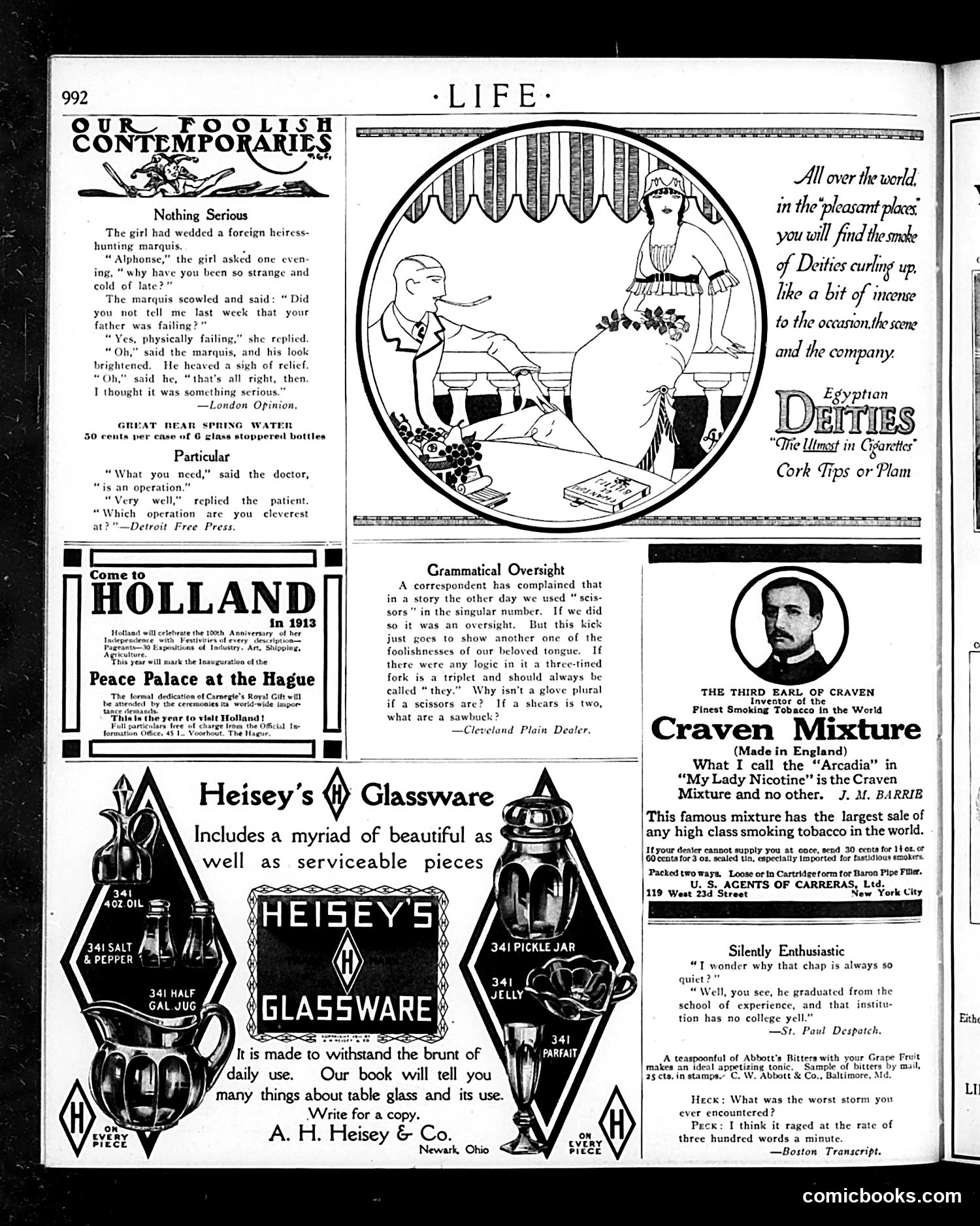
This page contains two brief humorous anecdotes and several advertisements typical of an early 1900s American satirical magazine. **"Nothing Serious"** satirizes fortune-hunting European aristocrats. A marquis marries an American heiress for her wealth, then grows cold toward her. When she mentions her father is "failing," the marquis brightens—relieved the father is merely dying rather than losing his fortune. The joke mocks the mercenary motives of titled European men seeking American wealth. **"Grammatical Oversight"** critiques English language illogic. The writer defends using "scissors" singularly by pointing out similar grammatical absurdities: "fork" should be plural (like scissors), "glove" should be singular (opposite of scissors), and "shears" presents parallel confusion. It's wordplay highlighting the tongue's inconsistent rules. The remaining content consists of period advertisements for Egyptian Deities cigarettes, Heisey's glassware, Craven Mixture tobacco, and Abbott's Bitters—typical commercial placements funding the magazine.
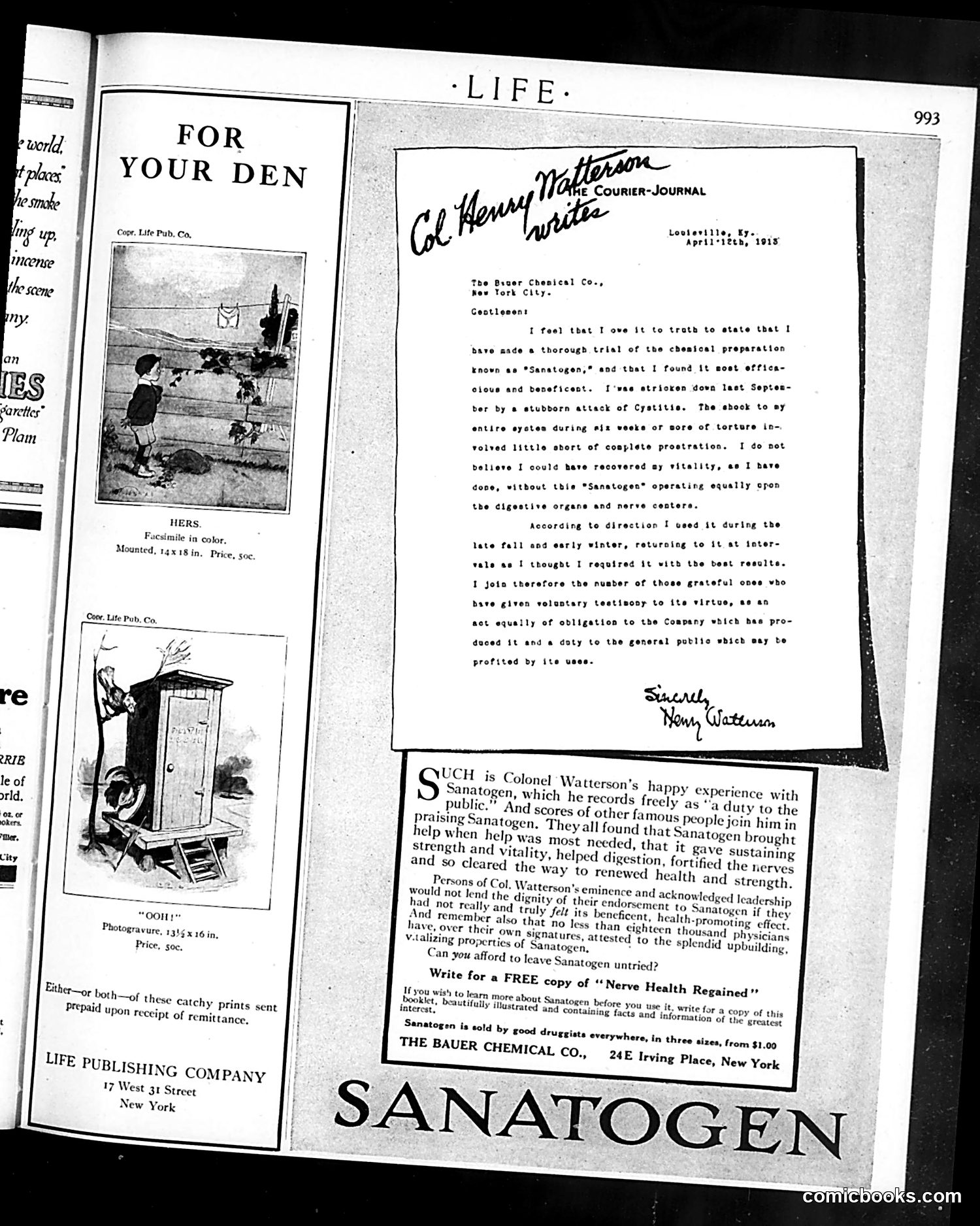
This page is primarily **advertising content**, not satire or editorial cartoons. The left side shows two decorative prints available for purchase from Life Publishing Company—titled "For Your Den"—featuring period illustrations suitable for home display. The dominant content is a **testimonial advertisement for Sanatogen**, a patent medicine/tonic. Colonel Henry Watterson, a prominent newspaper editor (Louisville Courier-Journal), endorses the product in a letter dated April 1915. He claims Sanatogen cured his cystitis and restored his health and vitality. The ad leverages Watterson's prestigious reputation to market the product, citing his "duty to the public" to share his experience. It emphasizes that other "famous people" also endorse Sanatogen and urges readers: "Can you afford to leave Sanatogen untried?" This reflects early 20th-century advertising practices where celebrity endorsements and medical claims were largely unregulated. Modern readers should note that Sanatogen's actual medicinal value is historically questionable.
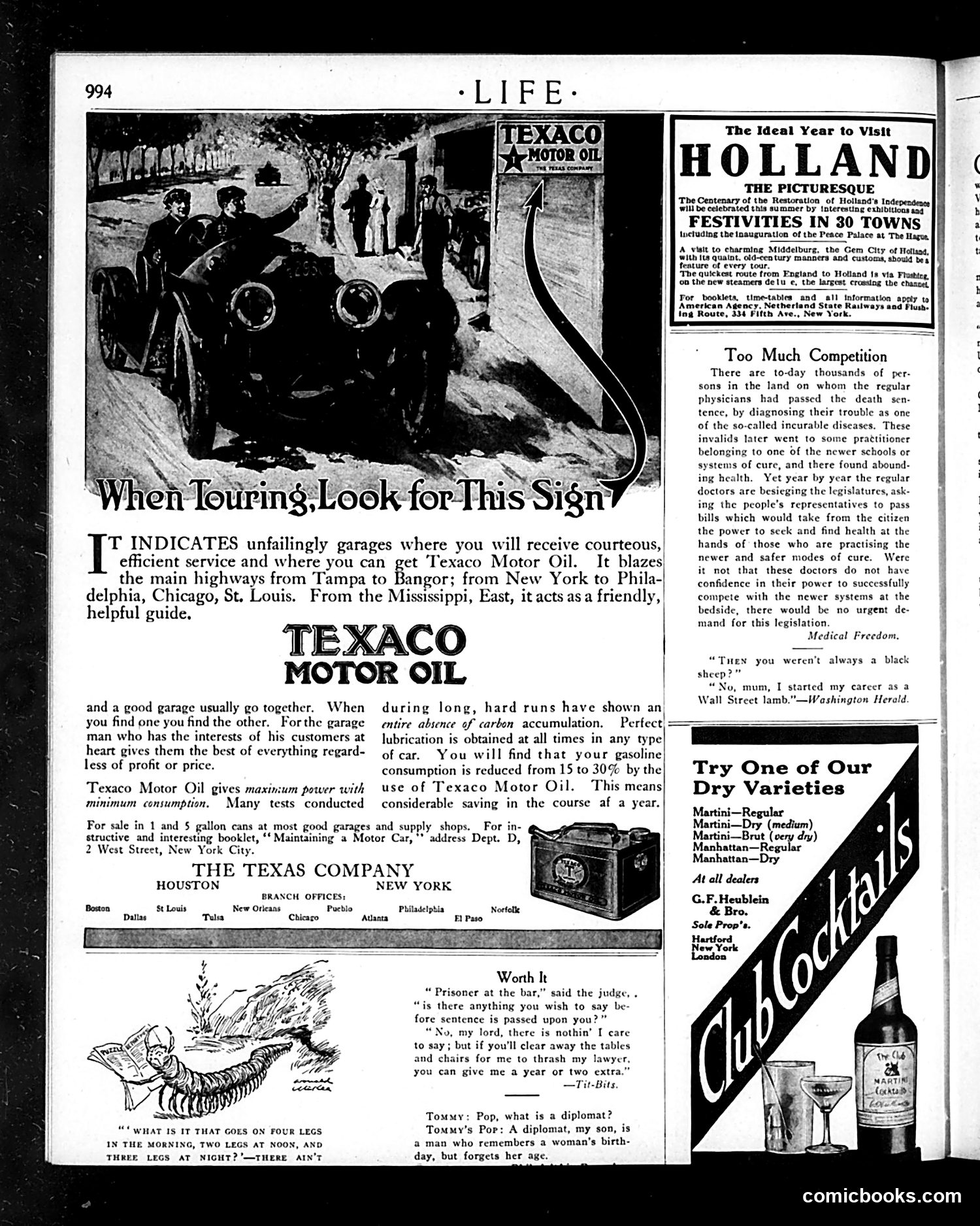
This page is primarily **advertising-driven**, with the Texaco Motor Oil ad dominating the left side. The ad uses the Texaco star sign as a roadside guide for motorists seeking reliable garages across America. The right side contains miscellaneous content: a Holland tourism advertisement, and a brief editorial titled "Too Much Competition" **criticizing medical regulation**. The piece argues that regular physicians, lacking confidence in newer alternative medical systems, are lobbying legislators to restrict citizens' access to these practitioners. It's a **free-market argument against medical licensing restrictions**—a debate relevant to early 20th-century America when alternative medicine competed openly with allopathic medicine. Below are brief comic anecdotes and jokes (a prisoner offering to thrash his lawyer, a diplomat joke about memory). These are filler humor typical of Life's satirical format. The page reflects 1920s concerns: automotive expansion, medical freedom debates, and light social satire.
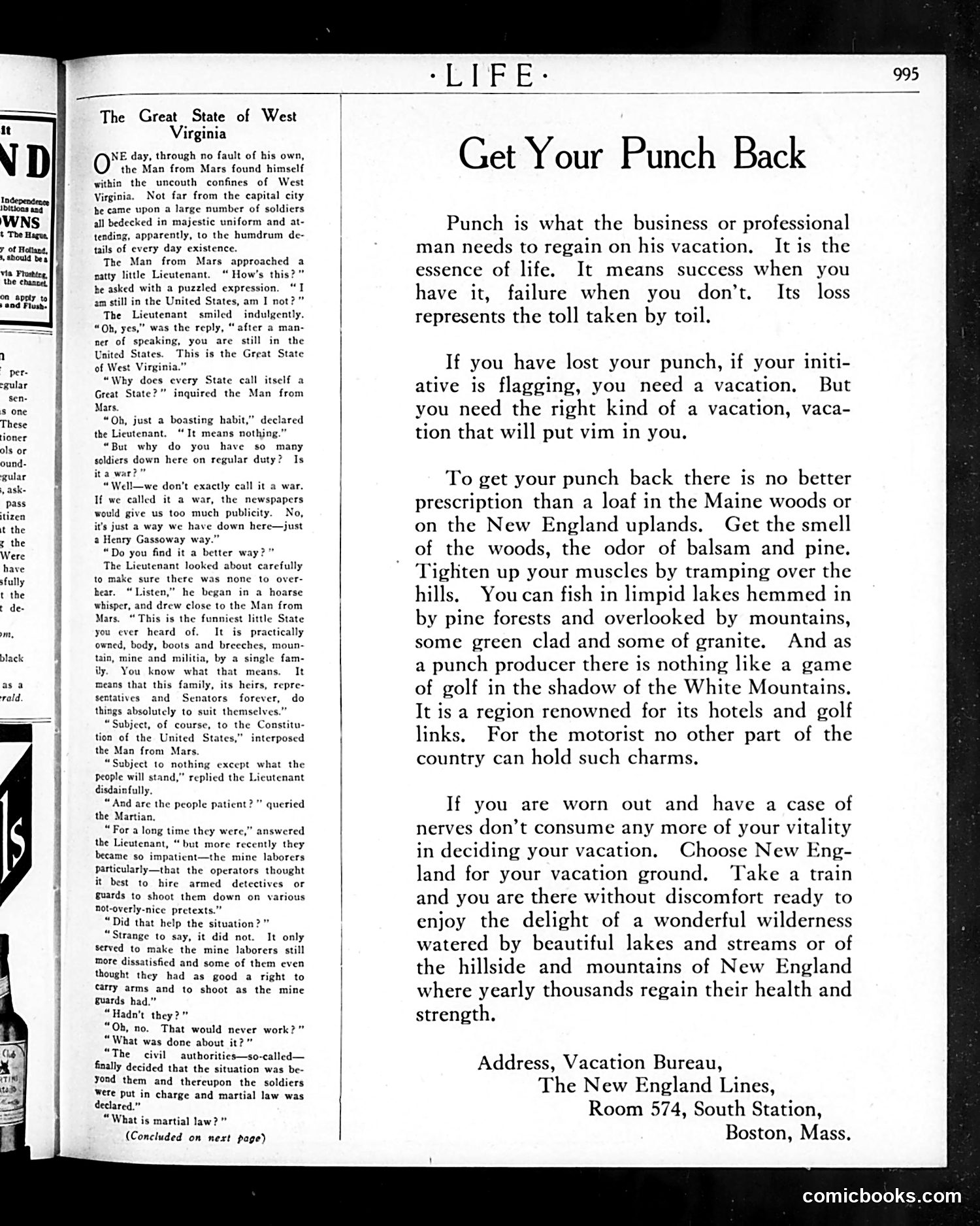
**The Fiction: "The Great State of West Virginia"** This satirical dialogue features a "Man from Mars" discovering West Virginia is effectively controlled by a single family (likely the Gassaways, referenced by name). The story critiques how one oligarchic family dominates the state's politics, military, and resources—"owned, body, boots and breeches"—despite constitutional constraints. The satire exposes labor violence: armed mine guards shoot striking workers, prompting authorities to declare martial law rather than address underlying injustices. The Martian's naive questions highlight the absurdity: workers' justified armed self-defense is deemed illegitimate while hired company violence receives state sanction. **The Advertisement: "Get Your Punch Back"** A vacation advertisement promoting New England (Maine, White Mountains) as a restorative retreat for exhausted businessmen. **Historical Context**: This appears to reference actual West Virginia labor conflicts, particularly coal mine strikes and violent company/state responses during the early 20th century (such as the Battle of Blair Mountain era).
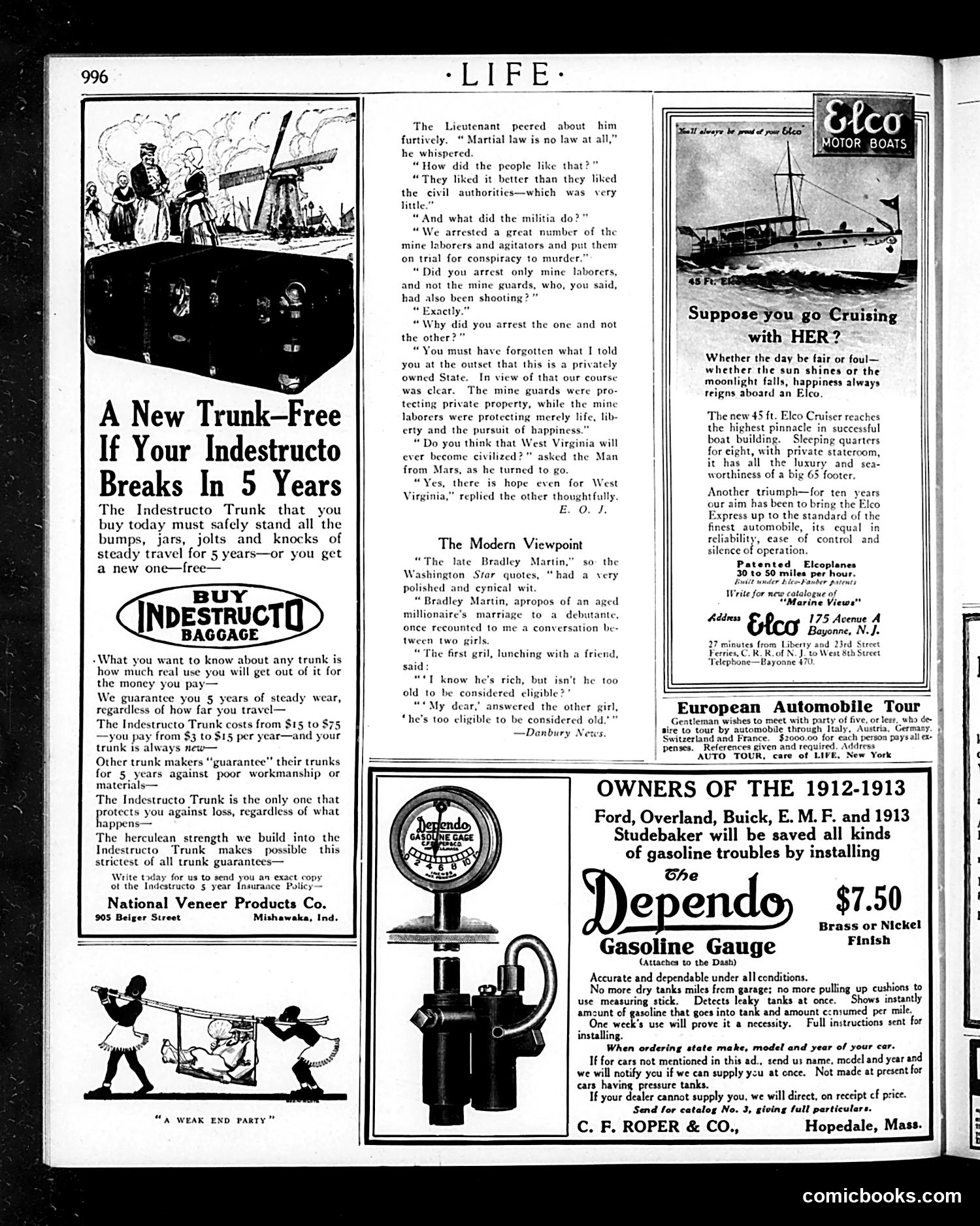
This page contains a dialogue satirizing labor disputes and martial law, likely referencing the violent coal mining conflicts in West Virginia (appears to be early 1910s based on the date context). A Lieutenant discusses arresting "mine laborers and agitators" for conspiracy while NOT arresting mine guards who "had also been shooting." When questioned about this selective justice, he explains the mine guards were "protecting private property" while laborers only protected "life, liberty and the pursuit of happiness"—a pointed ironic reference to the Declaration of Independence. The satire's point: authorities justified harsh treatment of workers (not property-owners) by framing property rights as superior to human welfare. The dialogue exposes how "martial law" was weaponized against labor organizers rather than applied equally. The remainder is advertising (trunks, boats, automobiles, gauges)—typical of Life magazine's mixed editorial/commercial content.
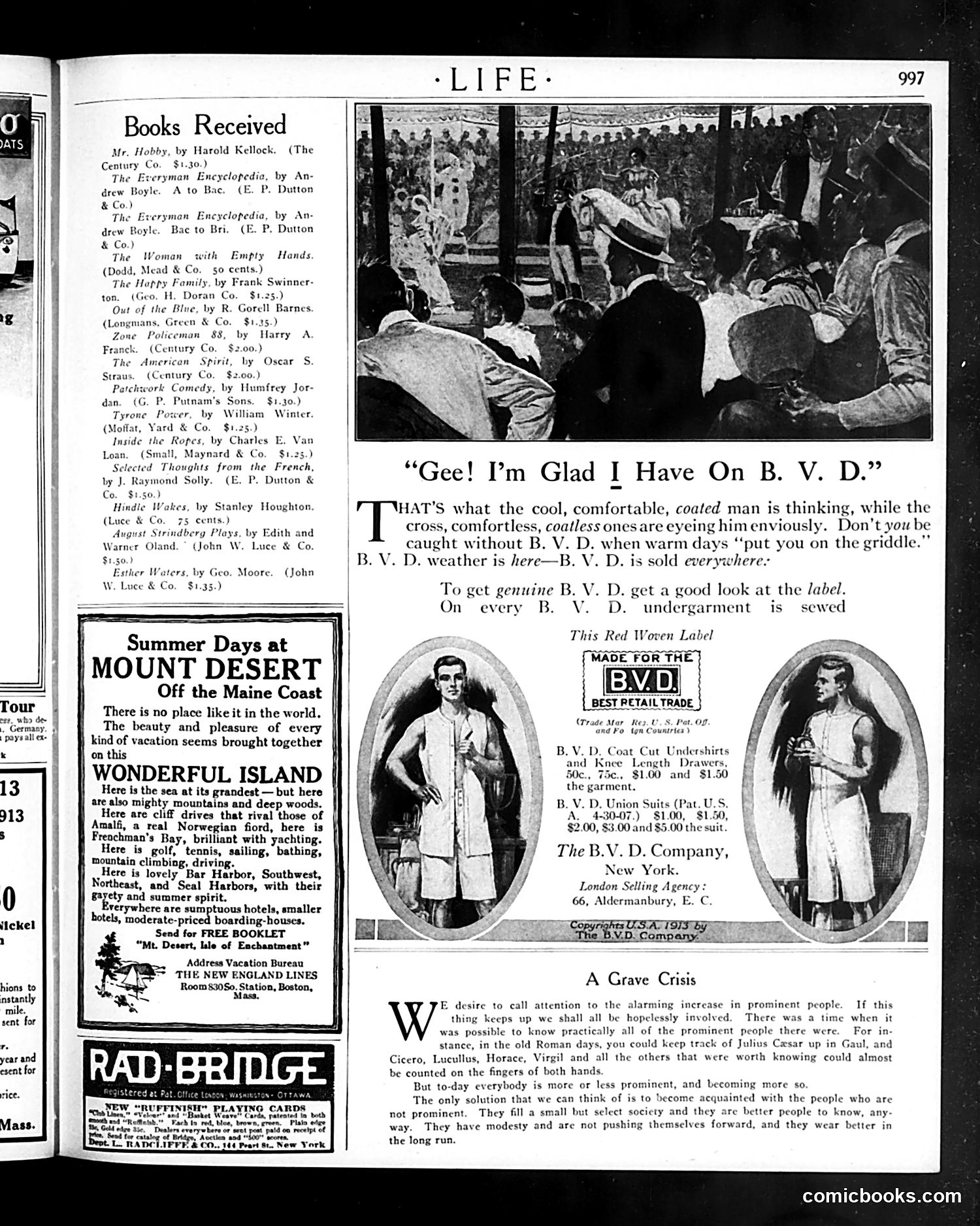
This page is primarily **advertising and book reviews**, not political satire. The main content includes: **Books Received**: A straightforward listing of newly published titles with publishers and prices. **Advertisements**: - Mount Desert Island vacation promotion - B.V.D. undergarment advertisement featuring two men, contrasting a comfortable "coated" man with "cross, comfortless, coatless ones" in warm weather - Playing cards advertisement **"A Grave Crisis"** (bottom article): A humorous essay lamenting that too many people have become "prominent." The author nostalgically contrasts ancient Rome—when one could track Julius Caesar, Cicero, and Virgil—with modern times when "everybody is more or less prominent." The piece is satirical social commentary on celebrity culture and fame proliferation, not political in nature. The photograph at top appears to show a large crowd or gathering, but its specific context is unclear without additional caption information.
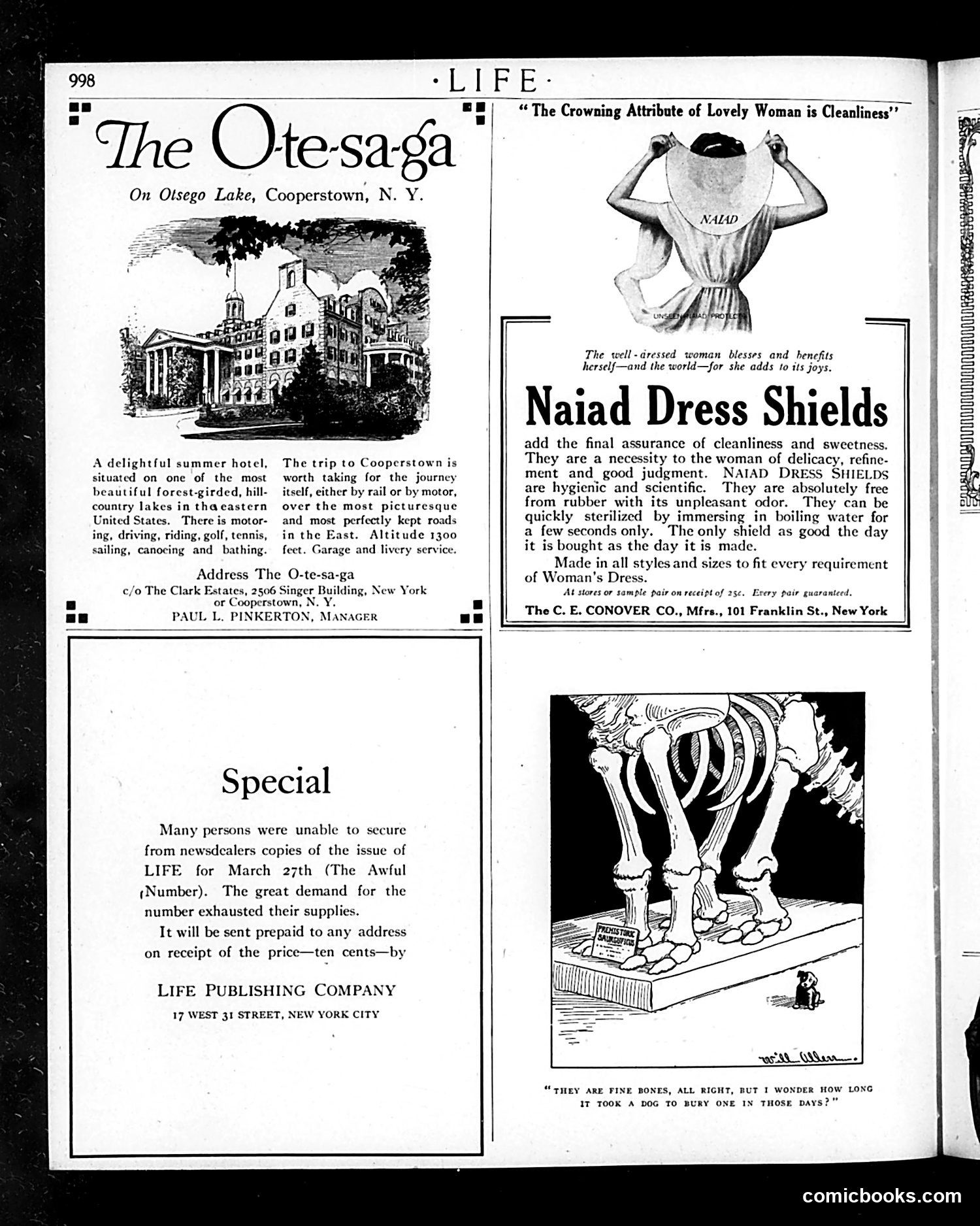
This page contains hotel and product advertisements alongside one cartoon. The cartoon depicts a cow skeleton being examined, with a small dog nearby. The caption jokes: "They are fine bones, all right, but I wonder how long it took a dog to bury one in those days?" The humor relies on absurdist logic—the speaker treats the cow skeleton as if it were a dog bone that had been buried and is now being excavated. It plays on the size disparity between actual dog bones and a massive cow skeleton, suggesting an implausibly large dog from prehistoric times. This is typical of Life magazine's lighthearted, nonsensical humor style. The page also features ads for the Ote-sa-ga resort hotel in upstate New York and Naiad Dress Shields (underarm protective garments for women's clothing), reflecting period concerns about cleanliness and bodily propriety.
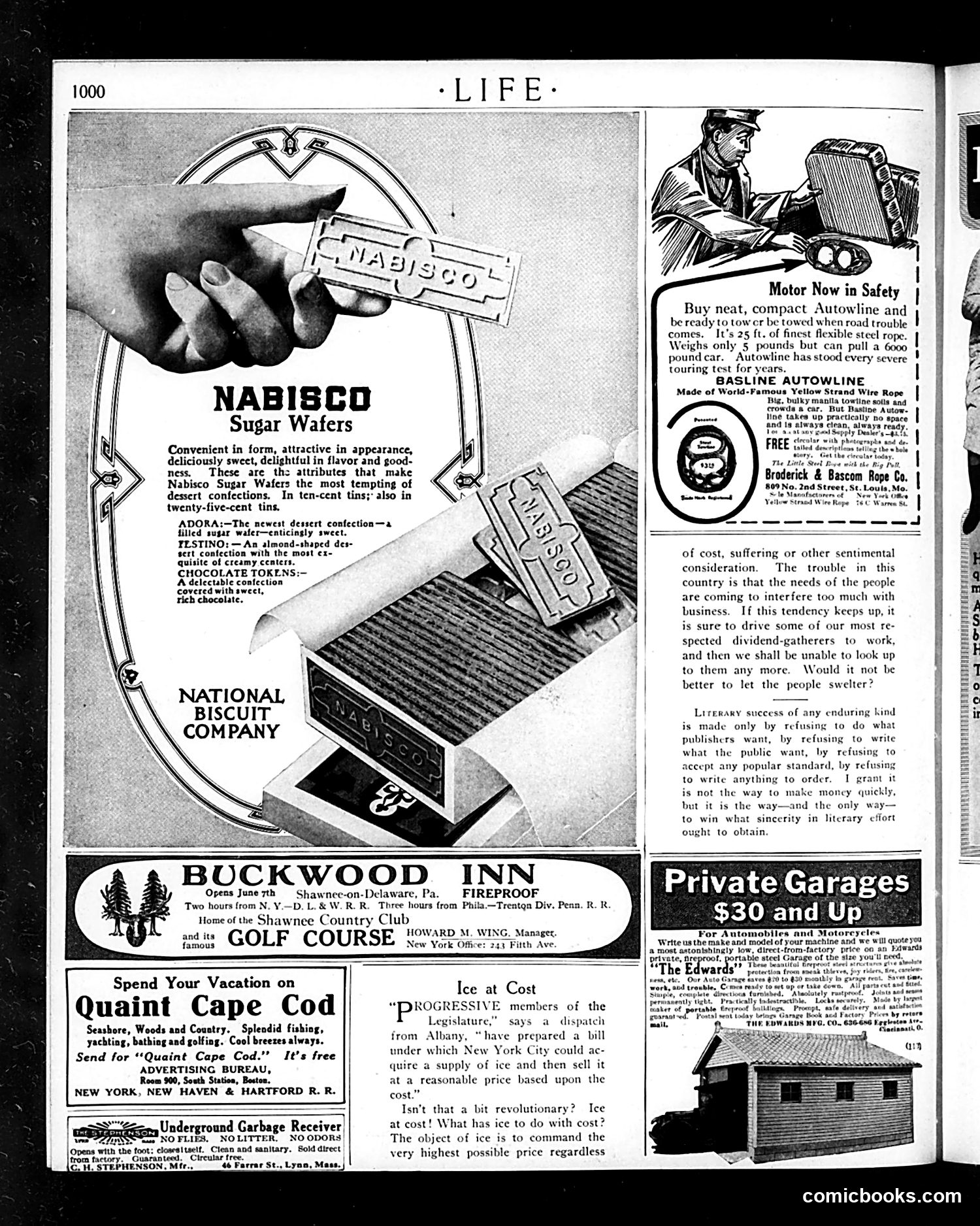
This is primarily an **advertising page** from Life magazine, with one notable **political satire** piece embedded among the ads. The main satirical content appears in the "Ice at Cost" column (bottom right). It mocks "Progressive" New York legislators who proposed selling city-supplied ice at cost-based prices. The satire argues this is "revolutionary" and complains that ice's purpose is to command the highest possible price—not serve the public efficiently. This represents **anti-Progressive ideology**: the piece defends profit-maximization and suggests helping ordinary people conflicts with business interests and the wealthy "dividend-gatherers" who deserve deference. The surrounding advertisements (Nabisco wafers, Autowline rope, vacation resorts, garages) are typical period marketing, though the "Private Garages $30 and Up" ad reflects early automotive culture. The page reflects early 20th-century class tensions between Progressive reform efforts and conservative business defenders.
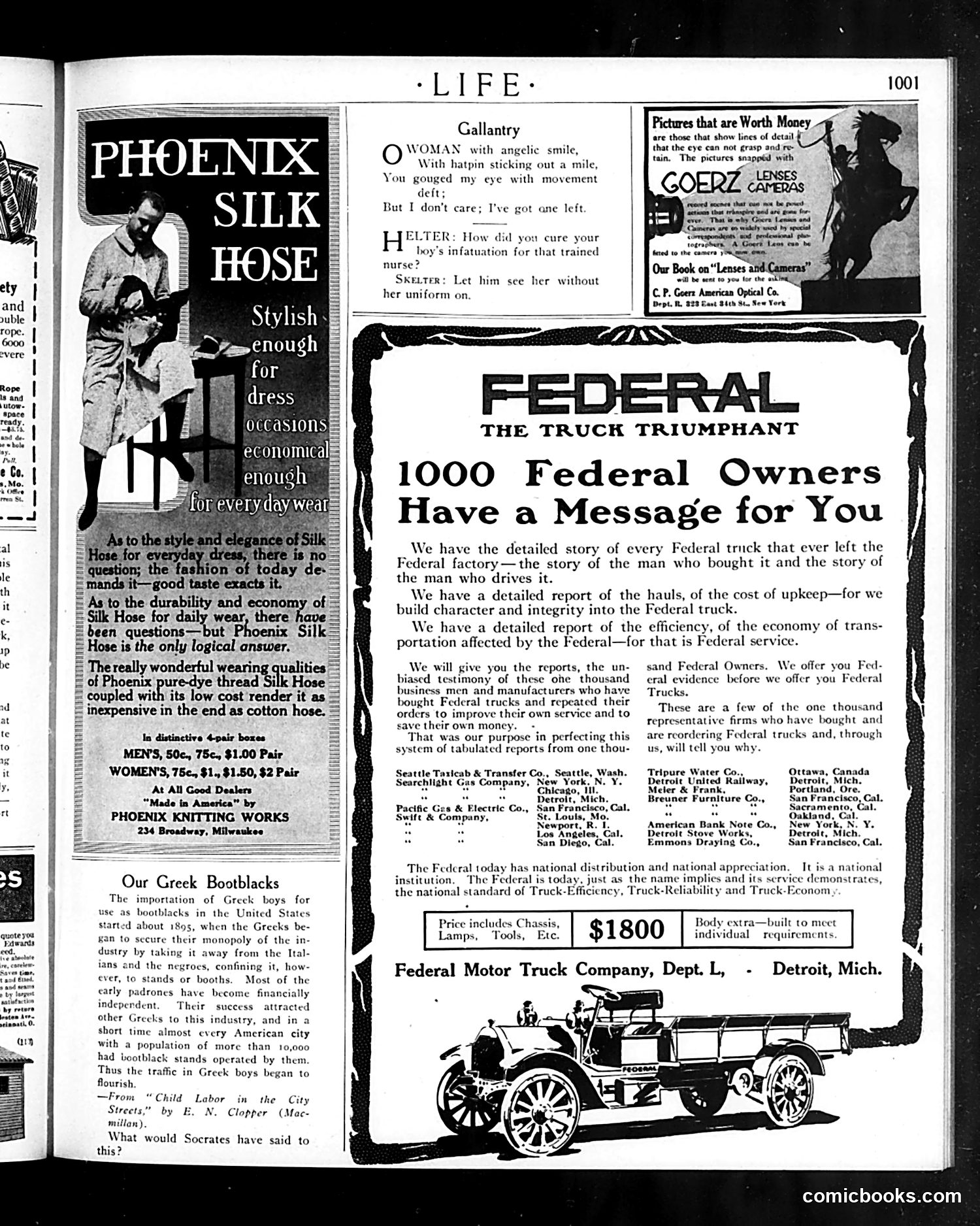
This page is primarily **advertising**, not satire. It contains three distinct elements: 1. **Phoenix Silk Hose ad** (left): A straightforward product advertisement emphasizing that silk hosiery is stylish enough for formal occasions yet economical for daily wear. 2. **"Our Greek Bootblacks" section**: A brief historical note explaining that Greek immigrants monopolized shoe-shining in America starting around 1895, displacing Italian and Black workers. It references child labor exploitation in this industry. The rhetorical question "What would Socrates have said?" is a mild, ironic jab at importing Greek boys for menial labor. 3. **Federal Motor Truck ad** (center/right): The dominant feature—a corporate testimonial claiming 1,000 satisfied truck owners endorse Federal vehicles. It lists actual company names as proof of reliability and efficiency. The "Gallantry" and "Helter-Skelter" jokes are unrelated comic snippets about courtship and infidelity. **No political satire is present.** This is a standard 1910s-era magazine page mixing editorial content with commercial advertisements.
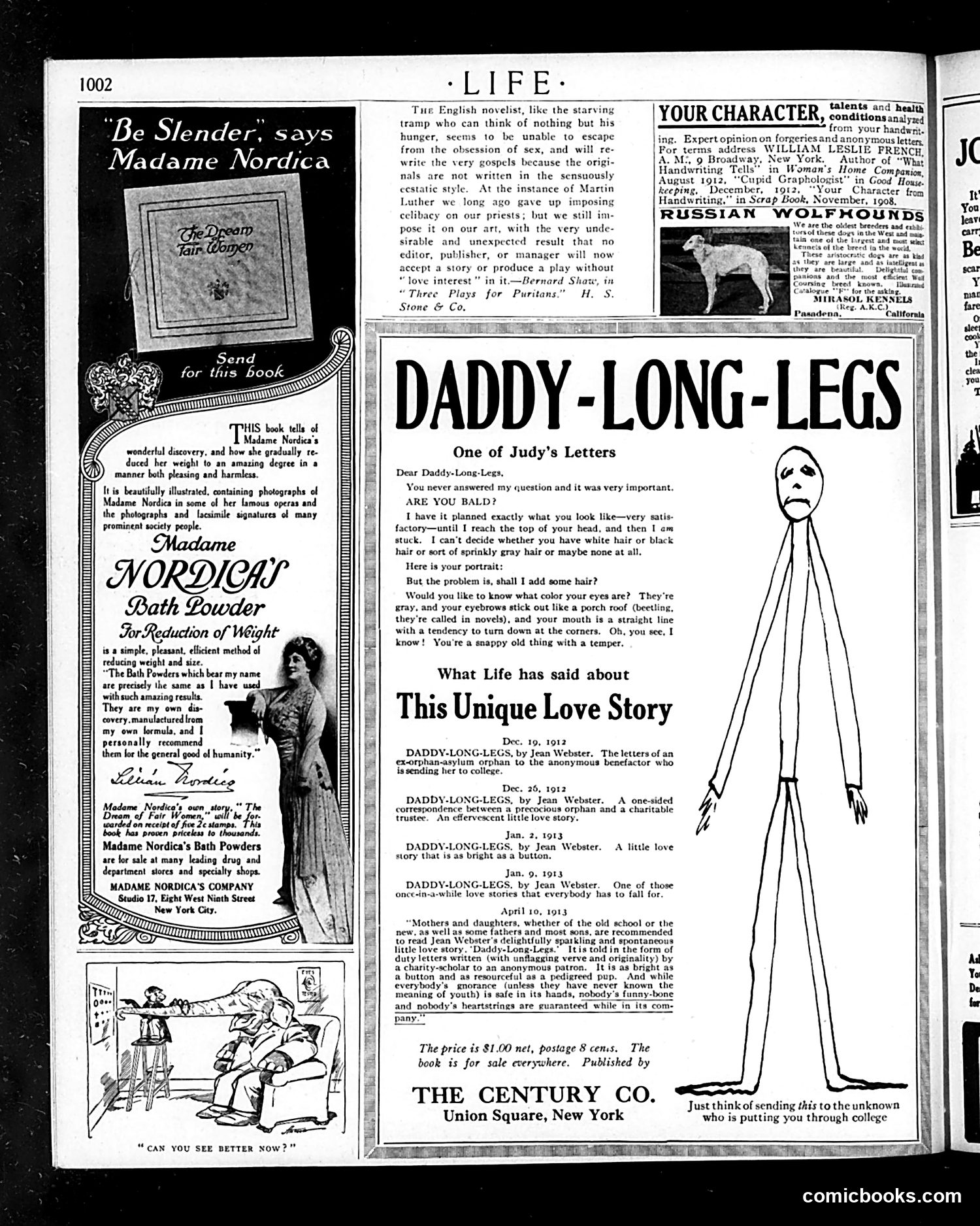
This page combines advertisements with content promoting Jean Webster's serialized novel *Daddy-Long-Legs*. The main cartoon depicts an extremely elongated stick-figure man—literally illustrating the title's metaphor—captioned as an unknown benefactor who anonymously funds a young woman's college education. The central feature is a letter from "Judy" to her mysterious patron, playfully describing his physical appearance while admitting gaps in her knowledge (particularly whether he's bald). The humor derives from the one-sided correspondence format: she imagines his appearance while he remains genuinely unknown to her. *Life* magazine's repeated endorsements (dated Dec. 1912-April 1913) emphasize the story's appeal across demographics—from "mothers and daughters" to "fathers and most sons." The novel romanticizes a Cinderella-like narrative where a poor orphan is elevated through a wealthy stranger's patronage, a sentimental plot that resonated with early 20th-century audiences. The surrounding ads for weight-reduction powders and handwriting analysis reflect period preoccupations with self-improvement and character assessment.
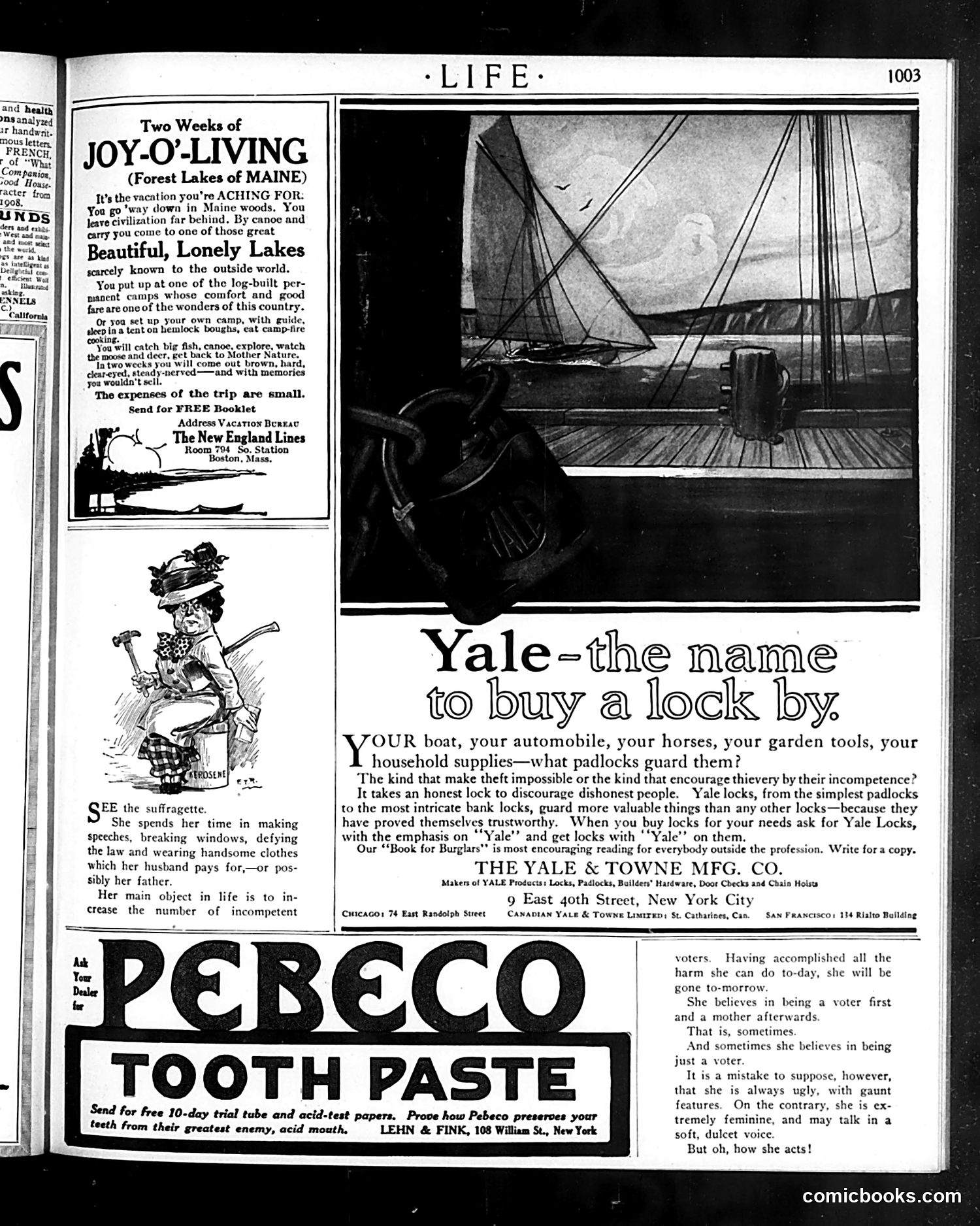
This page contains three distinct elements: vacation advertising, a product ad, and **political satire about the suffragette movement**. The cartoon (lower left) depicts "the suffragette" as a caricatured female figure. The accompanying text mocks women's suffrage activists with classic anti-feminist rhetoric of the era: she breaks windows, defies law, wears fine clothes her husband pays for, and her "main object in life is to increase the number of incompetent voters." The longer editorial passage (right column) continues this attack, sarcastically noting she wants voting rights before motherhood, yet "how she acts!" The tone suggests suffragettes were seen by Life's editors as destructive, hypocritical, and unfit for civic participation. **Context for modern readers:** This reflects pre-1920 opposition to women's suffrage. The "window-breaking" likely references British suffragettes' direct-action tactics. Life magazine adopted a satirical but genuinely hostile stance toward voting rights for women—a mainstream position before the 19th Amendment's passage in 1920.
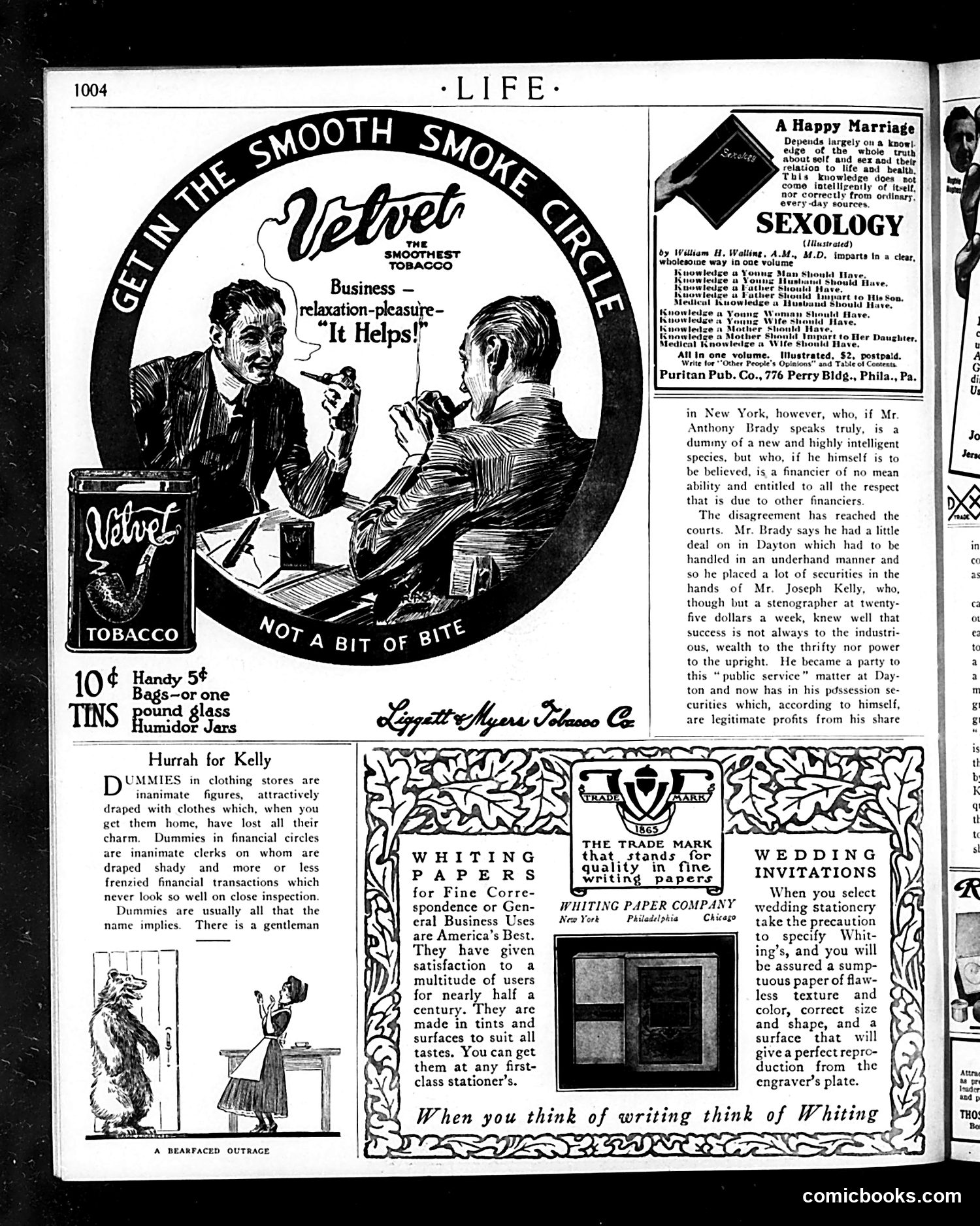
This page combines satirical commentary with period advertising. The main cartoon, "A Bearfaced Outrage," critiques financial corruption through the metaphor of "dummies"—both retail mannequins and corrupt businessmen. The text references a real dispute: Mr. Anthony Brady claims Joseph Kelly, nominally a $25/week stenographer, is merely a "dummy" fronting shady financial dealings in Dayton. Kelly disputes this, claiming legitimate business acumen. The satire suggests Kelly is an inanimate tool used to obscure fraudulent transactions, with the irony that such schemes "never look so well on close inspection." The Velvet tobacco ad dominates the left side, promoting relaxation for business stress. The page also advertises "Sexology," a medical guide book—typical early-20th-century self-help publishing—and wedding stationery, representing mainstream commercial content alongside the satire.
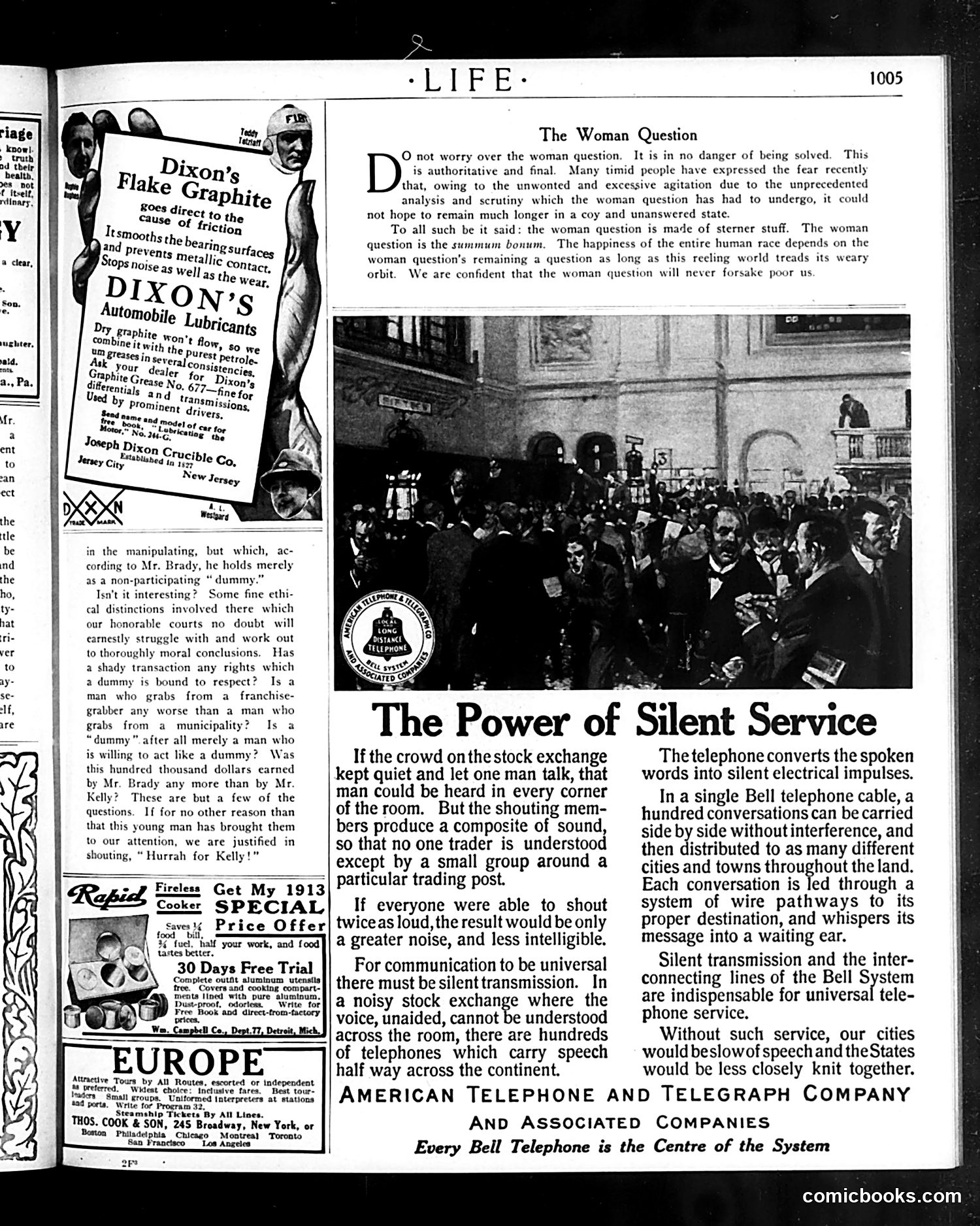
This page contains satirical editorial commentary and period advertisements rather than traditional cartoons. **"The Woman Question"** essay mocks anti-suffrage arguments through ironic praise. It claims the "woman question" is safely permanent—that women will never gain equality because the question itself is too valuable to society. The satire suggests that those opposing women's rights use circular logic: they argue women's issues should remain perpetually unresolved rather than settled through reform. **Context**: This appears from the early 1910s, during intense suffrage activism. Life magazine was known for satirizing social conservatives and political hypocrites. By pretending to celebrate women's permanent powerlessness, the author ridicules those who genuinely held such views. The advertisements (Dixon's Graphite, Rápid Cooker, Europe tours) are typical period commercial content, unrelated to the editorial message. The photograph showing a crowded stock exchange introduces the **Bell Telephone advertisement**, which uses visual contrast—silent communication versus noisy chaos—to promote telephone technology's efficiency.
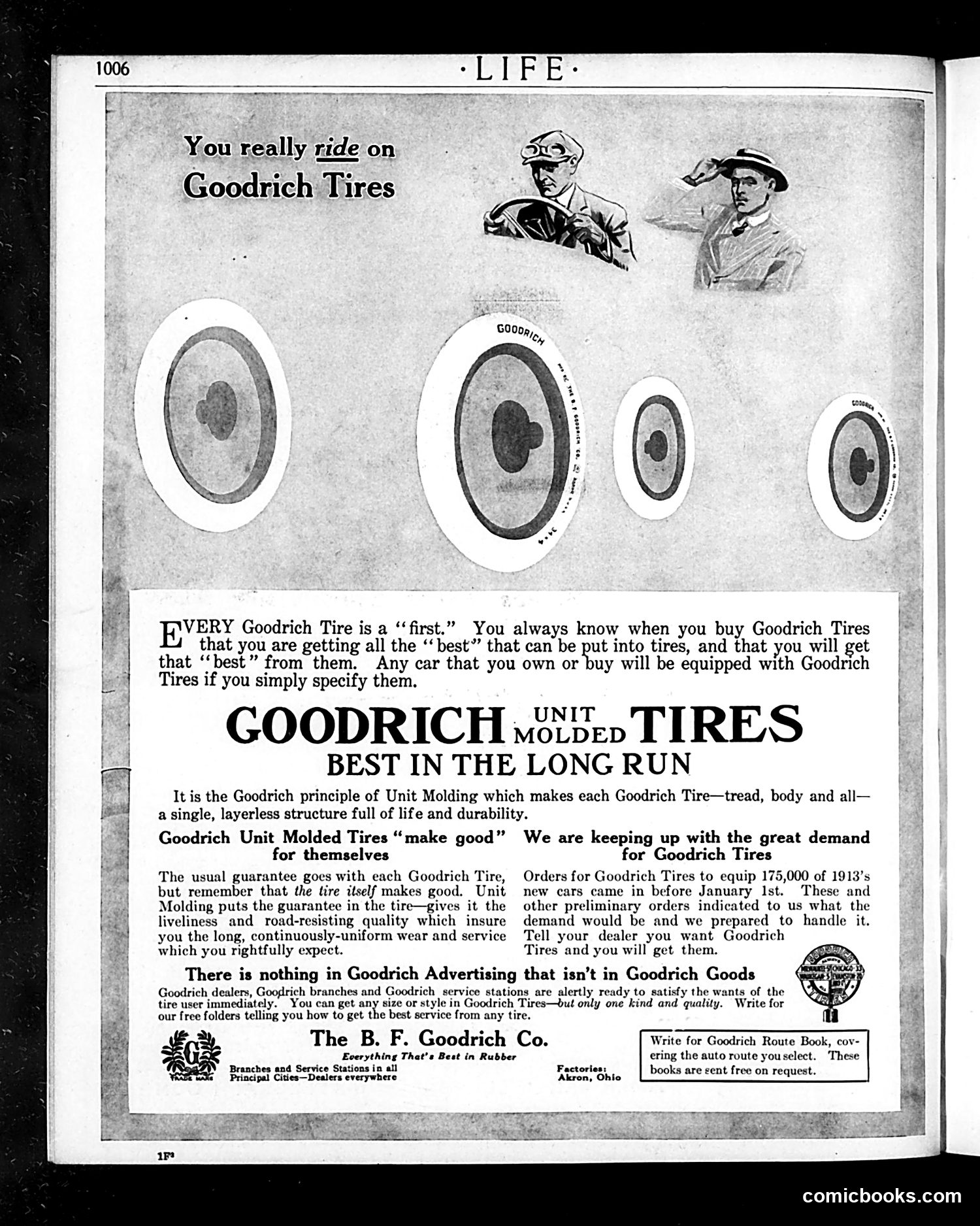
This page is primarily a **tire advertisement**, not satire or political commentary. The B.F. Goodrich Company promotes their "Unit Molded Tires" through the slogan "You really ride on Goodrich Tires." The two illustrated figures at top appear to be **working-class men**—possibly a mechanic and a motorist—establishing credibility through relatable personas rather than celebrity endorsement. The central image displays four tire cross-sections of varying sizes. The ad emphasizes manufacturing quality ("the tire itself makes good") and claims high demand: 175,000 new cars were pre-ordered with Goodrich tires as of January 1913. The copy stresses durability and service availability through Goodrich's dealer network. This represents early **automotive advertising strategy**: building consumer confidence through technical explanation and testimonial-style endorsement rather than purely emotional appeals. The page reflects the nascent American auto industry circa 1913.
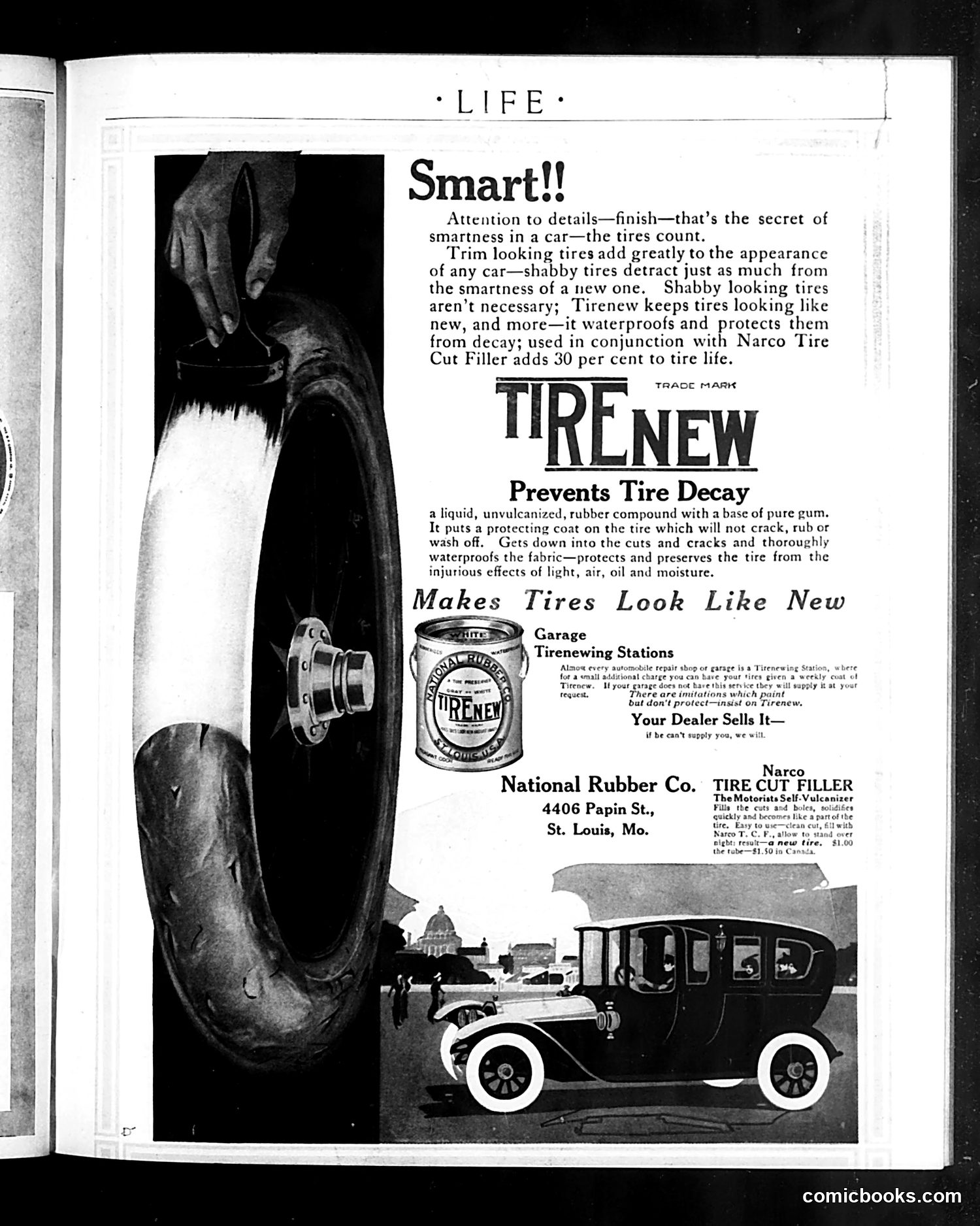
This is primarily a **product advertisement**, not satire or political commentary. The page promotes Tirenew and Narco Tire Cut Filler—tire maintenance products from the National Rubber Company (St. Louis, Missouri). The "Smart!!" headline uses a common early 20th-century advertising appeal: suggesting that car owners who maintain trim, presentable tires demonstrate good taste and attention to detail. The large photograph on the left shows a deteriorated tire beside a well-maintained one, visually contrasting shabby versus smart appearance. The ad targets owners concerned with vehicle appearance and tire longevity, emphasizing that Tirenew's protective coating waterproofs and extends tire life by 30%. It mentions "imitations" exist but warns they only paint over problems without genuine protection—a competitive marketing claim common in patent-medicine-era advertising. This reflects an era when tire maintenance and appearance directly signaled vehicle owner status and competence.
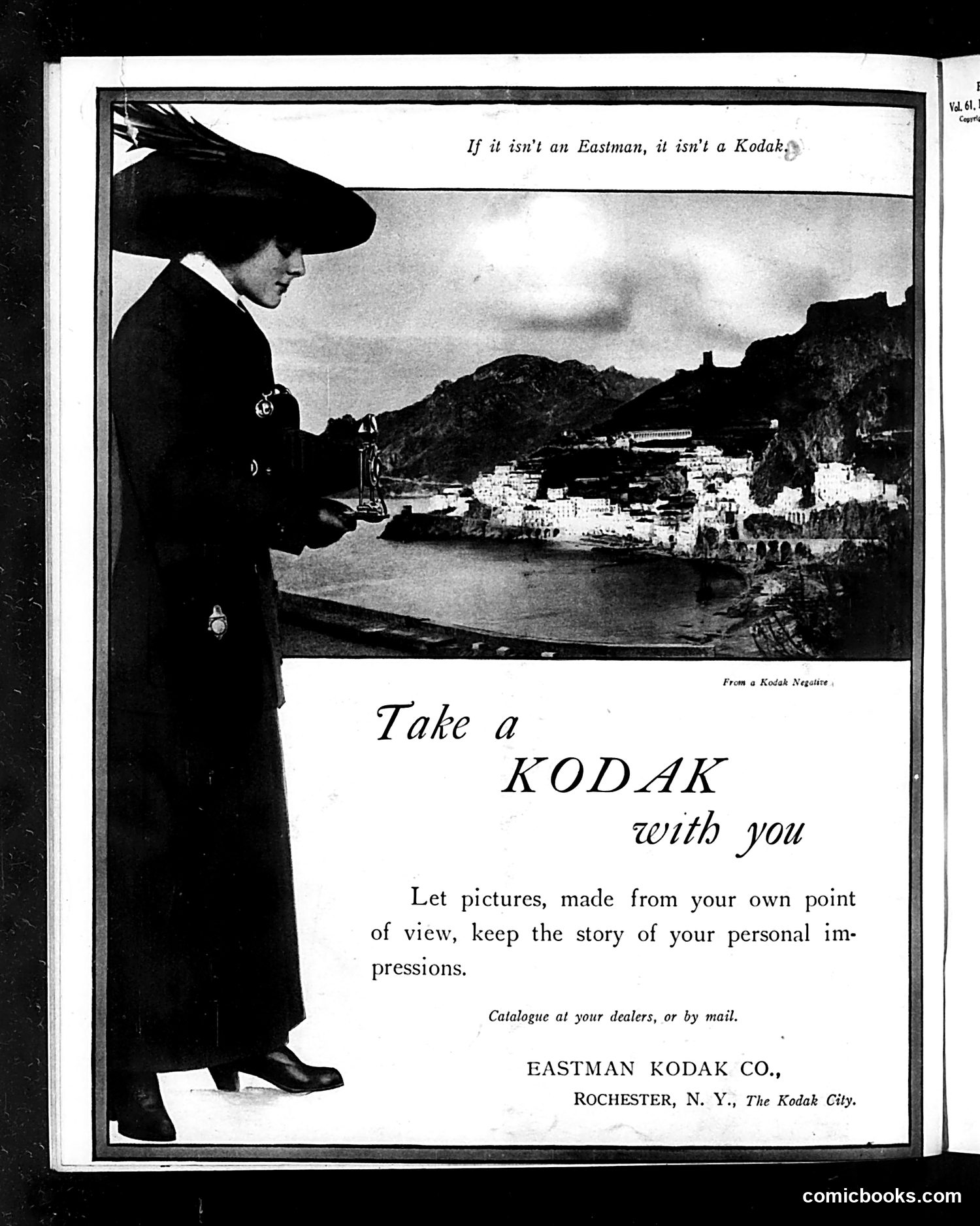
This is a Kodak camera advertisement, not political satire. It features a woman in early 20th-century dress holding a camera, photographing a scenic coastal town (appearing to be Mediterranean or European). The ad's messaging emphasizes personal perspective and memory-keeping—"pictures, made from your own point of view, keep the story of your personal impressions." The tagline "If it isn't an Eastman, it isn't a Kodak" reinforces brand identity and quality. The advertisement targets amateur photographers, positioning cameras as tools for documenting personal travel experiences. This reflects the era's marketing of photography as an accessible leisure activity for middle-class consumers.