
Life, 1913-05-15 · page 24 of 52
Life — May 15, 1913 — page 24: what you’re looking at
What you’re looking at
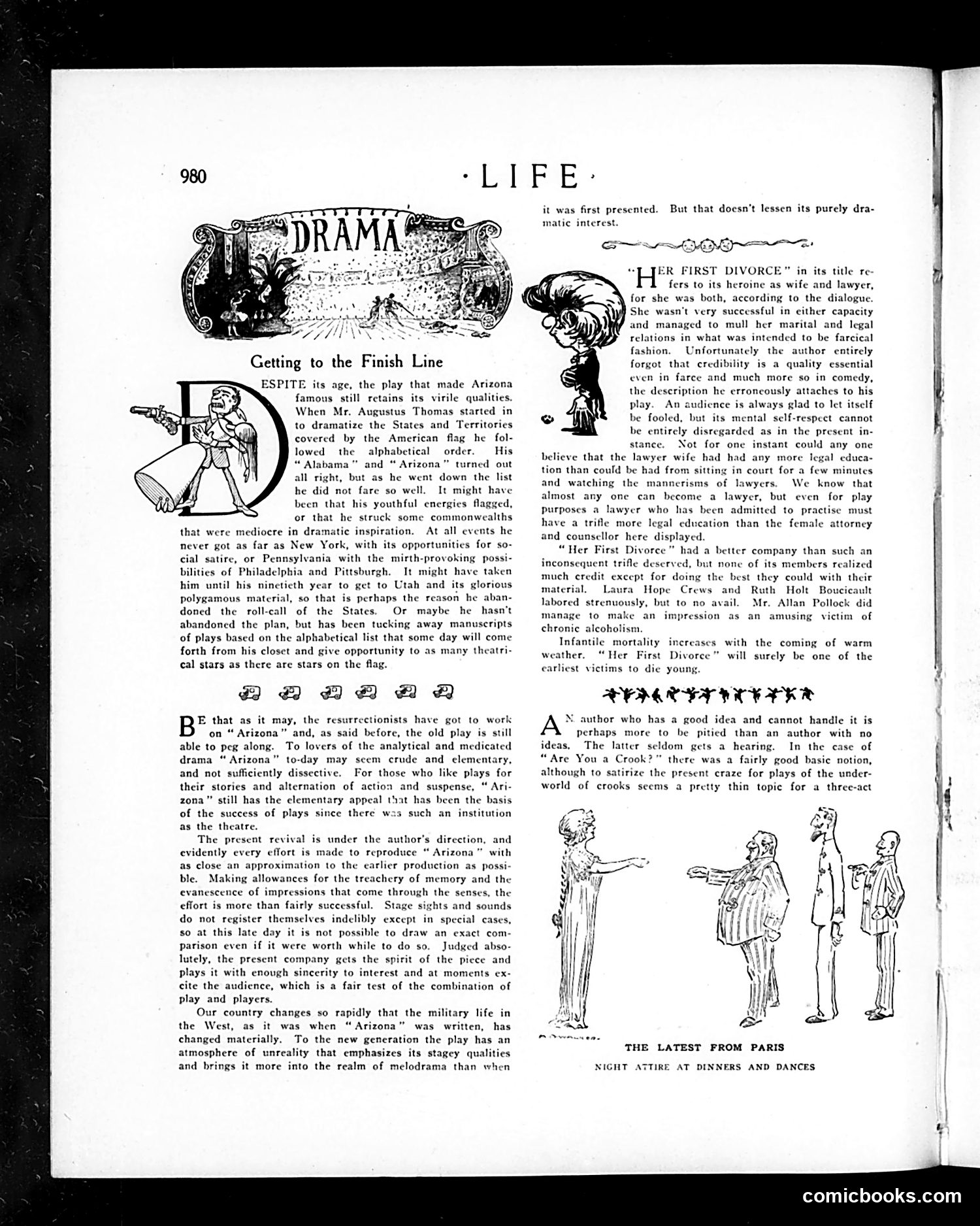
This page reviews theatrical productions, primarily Augustus Thomas's play "Arizona." The left column discusses a revival of this older Western drama, noting that Thomas originally planned to dramatize all U.S. states alphabetically but abandoned the project after "Arizona." The reviewer explains the play feels outdated—its Wild West military setting now seems quaint rather than realistic to modern audiences, pushing it toward melodrama. The right column critiques "Her First Divorce," a farce about a woman serving as both wife and lawyer. The reviewer argues the play fails because audiences cannot suspend disbelief: the female lawyer character lacks any plausible legal knowledge, having only observed courtroom procedures briefly. The satire targets poorly constructed comedy that ignores basic credibility, even in farcical entertainment—audiences accept theatrical conventions, but not complete absurdity presented as realistic. The small illustrations appear to show theatrical costume or character sketches related to these productions.
📄 Transcribed text from this page (OCR, searchable)
Machine-transcribed from the original scan — historical spelling and the odd misread are preserved.
Getting to the Finish Line ESPITE its age, the play that made Arizona famous still retains its virile qualities. When Mr, Augustus Thomas started in to dramatize the States and Territories covered by the American fiag he fol- lowed the alphabetical order. His “ Alabama” and “ Arizona” turned out all right, but as he went down the list he did not fare so well. It might have been that his youthful energies flagged, or that he struck some commonwealth that were mediocre in dramatic inspiration. At all events he never got as far as New York, with its opportunities for so- cial satire, or Pennsylvania with the mirth-provoking possi- bilities of Philadelphia and Pittsburgh. It might have taken him until his ninetieth year to get to Utah and its glorious polygamous material, so that is perhaps the reason he aban- doned the roll-call of the States. Or maybe he hasn't abandoned the plan, but has been tucking away manuscripts of plays based on the alphabetical list that some day will come forth from his closet and give opportunity to as many theatri- cal stars as there are stars on the flag. AA AA AA E that as it may, the resurrcctionists have got to work on “Arizona” and, as said before, the old play is still able to peg along. To lovers of the analytical and medicated drama “Arizona” to-day may seem crude and elementary, and not sufficiently dissective, For those who like plays for their stories and alternation of action and suspense, “ Ari- zona” still has the elementary appeal that has been the basis of the success of plays since there was such an institution as the theatre. The present revival is under the author's direction, and evidently every effort is made to reproduce “ Arizona” with as close an approximation to the earlier production as possi- ble. Making allowances for the treachery of memory and the evanescence of impressions that come through the senses, the effort is more than fairly successful. Stage sights and sounds do not register themselves indelibly execpt in special cases, so at this late day it is not possible to draw an exact com- parison even if it were worth while to do so. Judged abso- lutely, the present company gets the spirit of the piece and plays it with enough sincerity to interest and at moments ex- cite the audience, which is a fair test of the combination of play and players. Our country changes so rapidly that the military life in the West, as it was when “Arizona” was written, has changed materially. To the new generation the play has an atmosphere of unreality that emphasizes its stagey qualities and brings it more into the realm of melodrama than when HLalBAB « it was first presented. But that docsn't lessen its purely dra- matic interest. omar et ‘H FIRST DIVORCE” in its title re fers to its heroine as wife and lawyer, for she was both, according to the dialogue. She wasn't very successful in either capacity and managed to mull her marital and legal relations in what was intended to be farcical fashion. Unfortunately the author entirely forgot that credibility is a quality essential even in farce and much more so in comedy, the description he erroneously attaches to play. An audience is always glad to let itself be fooled, but its mental self-respect cannot be entirely disregarded as in the present in- stance. Not for one instant could any one believe that the lawyer wife had had any more legal educa- tion than could be had from sitting in court for a few minutes and watching the mannerisms of lawyers. We know that almost any one can become a lawyer, but even for play purposes a lawyer who has been admitted to prac! have a trifle more legal education than the female attorney and counsellor here displayed. “Her First Divorce” had a better company than such an inconscquent trifle deserved, but none of its members realized much credit except for doing the best they could with their material. Laura Hope Crews and Ruth Holt Boucicault labored strenuously, but to no avail. Mr. Allan Pollock did manage to make an impression must an amusing victim of chronic alcoholism. Infantile mortality increases with the coming of warm weather. “Her First Divorce” will surely be one of the earliest victims to die young. PEARY PCE EKR A author who has a good idea and cannot handle it is perhaps more to be pitied than an author with no ideas, The latter seldom gets a hearing. In the case of “Are You a Crook?” there was a fairly good basic notion, although to satirize the present craze for plays of the under- world of crooks seems a pretty thin topic for a three-act THE LATEST FROM PARIS NIGHT TTIRE AT DIN S$ AND DANCES a comicbooks.com