
Life, 1913-05-15 · page 25 of 52
Life — May 15, 1913 — page 25: what you’re looking at
What you’re looking at
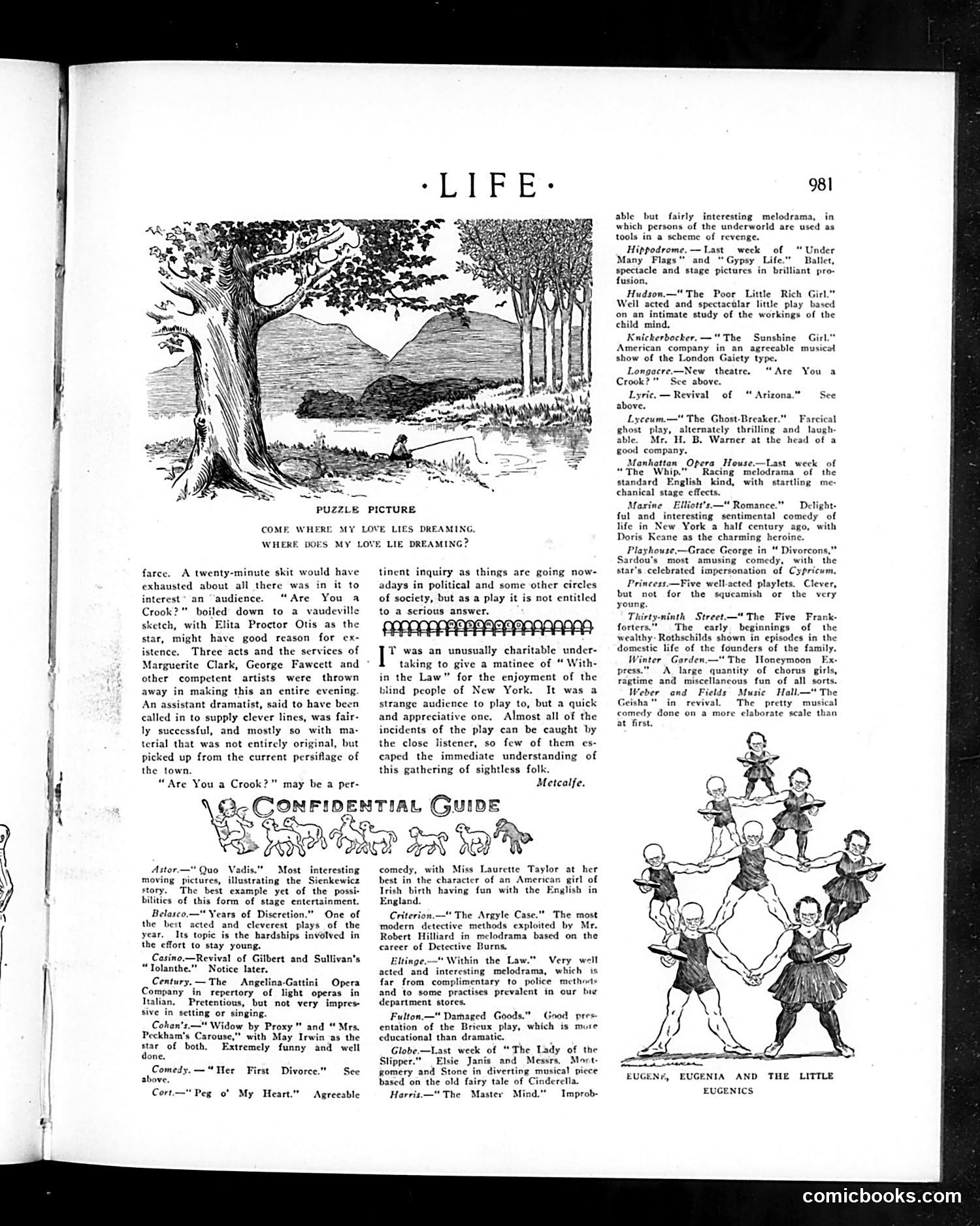
This page is primarily a theater review column from Life magazine, not a political cartoon. The featured image is a decorative "Puzzle Picture" with the caption "Come Where My Love Lie Dreaming? Where Does My Love Lie Dreaming?" — which appears to be a visual riddle rather than satire. The bulk of the page contains critical reviews of Broadway productions, assessing shows like "Quo Vadis," "Are You a Crook?," and various musicals and melodramas. The reviewer (identified as "Metcalfe" in one section) offers straightforward theatrical criticism, occasionally noting social relevance—such as commenting that "Within the Law" presents critiques of police methods and department store practices. There is one small illustration on the right showing children in a circle, labeled "EUGENE, EUGENIA AND THE LITTLE EUGENICS," which references the contemporary eugenics movement, though without visible satirical commentary in the visible text. The page functions as entertainment journalism rather than political satire.
📄 Transcribed text from this page (OCR, searchable)
Machine-transcribed from the original scan — historical spelling and the odd misread are preserved.
COME WHERE MY LOVE WHERE DOES MY LO! farce. A twenty-minute skit would have exhausted about all there was in it to interest’ an audience. “Are You a Crook?" boiled down to a vaudeville sketch, with Elita Proctor Otis as the star, might have good reason for ex- istence. Three acts and the services of Marguerite Clark, George Fawcett and other competent artists were thrown away in making this an entire evening. An assistant dramatist, said to have been called in to supply clever lines, was fair- ly successful, and mostly so with ma- terial that was not entirely original, but picked up from the current persiflage of the town, “Are You a Crook?” may be a per- Astor.—" Quo Vadi Most interesti moving pictures, illustrating the Sienkewicz story. The best example yet of the possi- bilities of this form of stage entertainment. Belasco.—"" Years of Discretion.” One of the best acted and cleverest plays of the year. Its topic is the hardships invotved in the effort to stay young. 4, Casino—Revival of Gilbert and Sullivan's Tolanthe.” Notice later. Century. —The Angelina-Gattini Opera Company in repertory of light operas in Italian, Pretentious, but not very impres- sive in setting or singing. Cohan's.—"* Widow by Proxy" and “ Mrs. Peckham's Carouse,” with May Irwin as the sar of both. Extremely funny and well Jone. Comedy. —“Wer First Divorce." See above, Cort.—"" Peg of My Heart.” Agreeable PUZZLE PICTURE uu LIE DREAMING? tinent inquiry as things are going now- adays in political and some other circles of society, but as a play it is not entitled to a serious answer. T was an unusually charitable under- taking to give a matinee of “ With- in the Law” for the enjoyment of the blind people of New York. It was a strange audience to play to, but a quick and appreciative one, Almost all of the incidents of the play can be caught by the close listener, so few of them es- caped the immediate understanding of this gathering of sightless folk. Metcalfe. - CONFIDENTIAL GUIDE comedy, with Miss Laurette Taylor at her best in ‘the character of an American girl of Irish birth having fun with the English in England. Criterion.—"* The Argyle Case.” The most modern detective methods exploited by Mr. Robert Hilliard in melodrama based on the career of Detective Burns. Eltinge.—" Within the Law." Very well acted and interesting melodrama, which is far from complimentary to police methods and to some practises prevalent in our bie department stores. Fulton.—" Damaged Goods.” Good pres entation of the Bricux play, which is more educational than dramatic. Globe.—Last week of “The Lady of the Slipper.” Elsie Janis and Messrs, Mart: gomery and Stone in diverting musical piece based on the old fairy tale of Cinderella. Horris.—" The Master Mind.”” Improb- 981 able but fairly interesting melodrama, which persons of the underworld are used tools in a scheme of revenge. Hippodrome. —Last week of “Under Many Flags” and “Gypsy Life.” Ballet, spectacle and stage pictures in brilliant pro: fusion, Hudson.—" The Poor Little Rich Girl.” Well acted and spectacalar little play based on an intimate study of the workings of the child mind. Knickerbocker. —“ The Sunshine Girl.” American company in an agreeable musical show of the London Gaiety type. New theatre, “Are You a ¢ above. $ Longaer Crook?” Lyric. — Revival of above. Lyceum. —" The Ghost-Breaker.” Farci ghost play, alternately thrilling and laugh: able. Mr. H. B. Warner at the head of a good company, Manhattan Opera House.—Last weck of “The Whip.” Racing melodrama of the standard English kind, with startling me- chanical stage effects. Marine Eltiott's.—" Romance.” Delights ful and interesting sentimental comedy of life in New York a half century ago, with Doris Keane as the charming heroine. Playhouse.—Grace George in “ Divorcons,” Sardou's most amusing comedy, with the star's celebrated impersonation of Cypricum, Princess.—Five well-acted playlets. Clever, but not for the squeamish or the very young. Thirty-ninth Street—" The Five Frank: forters." The early, beginnings of the wealthy: Rothschilds shown in episodes in the domestic life of the founders of the family. Winter Garden.—" The Honeymoon Ex- press.” A large quantity of chorus girls, ragtime and miscellaneous fun of all sorts. Weber and Fields Music Hall." The Geisha" in revival. The pretty musical comedy done on a more elaborate scale th at first. " Arizona.” See IA AND THE LITTLE EUGENICS comicbooks.com