
Life, 1913-05-15 · page 15 of 52
Life — May 15, 1913 — page 15: what you’re looking at
What you’re looking at
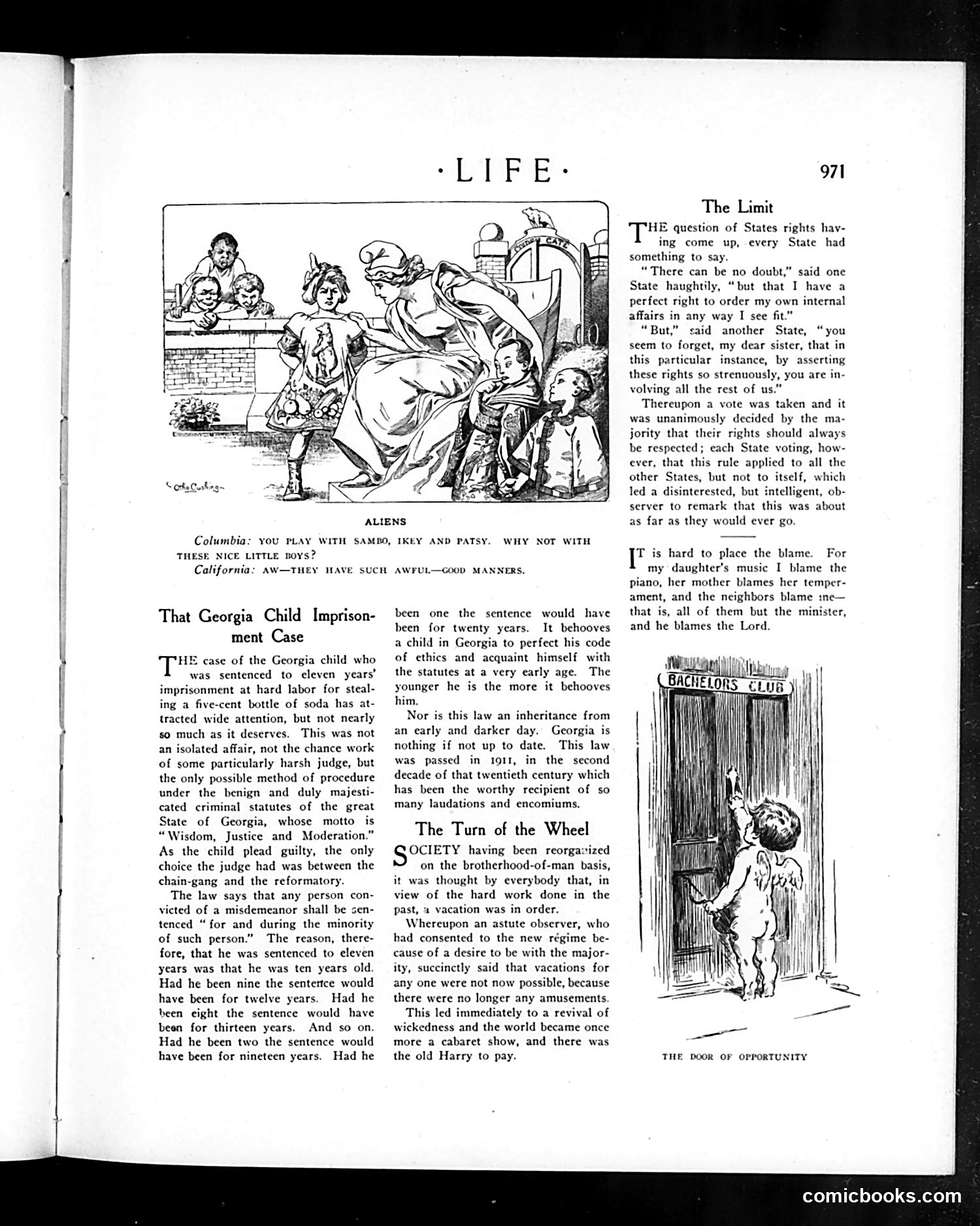
This page contains three satirical pieces attacking American inconsistency and unjust laws. **"Aliens" cartoon** (top): Columbia (representing the U.S.) refuses to let California's children play with "Sambo, Ikey and Patsy"—ethnic stereotypes—claiming they have "awful good manners." The satire mocks American racism: we exclude immigrants while praising civility. **"Georgia Child Imprisonment Case"**: The article criticizes Georgia's 1911 law sentencing a 10-year-old to 11 years hard labor for stealing a soda bottle. The satire exposes the law's absurd logic: sentencing duration equals remaining minority years, meaning younger children receive longer sentences. This demonstrates Georgia's claimed "Wisdom, Justice and Moderation" is hollow. **"The Limit"**: Satirizes states' rights hypocrisy—each state demands autonomy for itself while denying it to others, accomplishing nothing. **"The Turn of the Wheel"**: Mocks post-reform society discovering that eliminating vice requires eliminating all amusement, making utopian ideals impractical.
📄 Transcribed text from this page (OCR, searchable)
Machine-transcribed from the original scan — historical spelling and the odd misread are preserved.
SotaCusbing~ ALIENS Columbia: you PLAY WITH SAMBO, IKEY AND PATSY. THESE NICE LITTLE Boys? WHY NOT WITH California: AW—THEY WAVE SUCH AWFUL—COOD MANNERS. That Georgia Child Imprison- ment Case Te case of the Georgia child who was sentenced to eleven years’ imprisonment at hard labor for steal- ing a five-cent bottle of soda has at- tracted wide attention, but not nearly so much as it deserves. This was not an isolated affair, not the chance work of some particularly harsh judge, but the only possible method of procedure under the benign and duly majesti- cated criminal statutes of the great State of Georgia, whose motto is “Wisdom, Justice and Moderation.” As the child plead guilty, the only choice the judge had was between the chain-gang and the reformatory. The law says that any person con- victed of a misdemeanor shall be sen- tenced “for and during the minority of such person.” The reason, there- fore, that he was sentenced to eleven years was that he was ten years old. Had he been nine the sentertce would have been for twelve years. Had he been eight the sentence would have been for thirteen years. And so on. Had he been two the sentence would have been for nineteen years. Had he been one the sentence would have been for twenty years. It behooves a child in Georgia to perfect his code of ethics and acquaint himself with the statutes at a very early age. The younger he is the more it behooves him. Nor is this law an inheritance from an early and darker day. Georgia is nothing if not up to date. This law was passed in 1911, in the second decade of that twentieth century which has been the worthy recipient of so many laudations and encomiums. The Turn of the Wheel OCIETY having been reorgazized on the brotherhood-of-man basis, it was thought by everybody that, in view of the hard work done in the past, 4 vacation was in order. Whereupon an astute observer, who had consented to the new régime be- cause of a desire to be with the major- ity, succinctly said that vacations for any one were not now possible, because there were no longer any amusements. This led immediately to a revival of wickedness and the world became once more a cabaret show, and there was the old Harry to pay. 971 The Limit HE question of States rights hav- ing come up, every State had something to say. “There can be no doubt,” said one State haughtily, “but that I have a perfect right to order my own internal affairs in any way I see fit.” “But,” said another State, “you seem to forget, my dear sister, that in this particular instance, by asserting these rights so strenuously, you are in- volving all the rest of us.” Thereupon a vote was taken and it was unanimously decided by the ma- jority that their rights should always be respected; each State voting, how- ever, that this rule applied to all the other States, but not to itself, which led a disinterested, but intelligent, ob- server to remark that this was about as far as they would ever go. Cc is hard to place the blame. For my daughter’s music I blame the piano, her mother blames her temper- ament, and the neighbors blame :ne— that is, all of them but the minister, and he blames the Lord. Ny iby “CLUB THE DOOR OF OPPORTUNITY comicbooks.com