
Life, 1913-05-15 · page 28 of 52
Life — May 15, 1913 — page 28: what you’re looking at
What you’re looking at
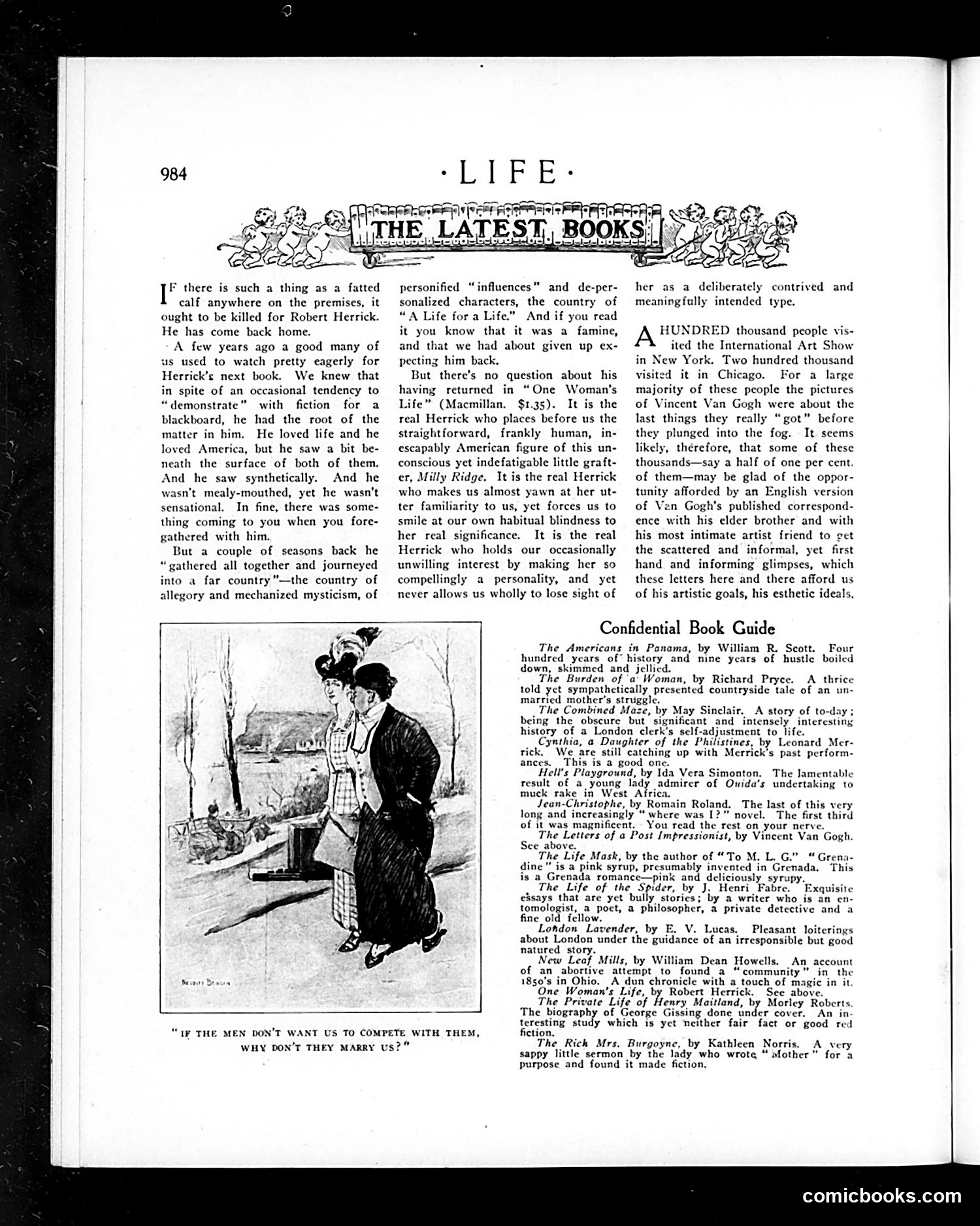
This page reviews Robert Herrick's novel *One Woman's Life*, celebrating his return to realistic fiction after a disappointing allegorical period. The critic praises Herrick's protagonist, Milly Ridge—described as an "unconscious yet indefatigable little grafter"—as authentically American and compellingly drawn despite her familiarity. The accompanying illustration depicts a woman at a mirror, likely representing Milly Ridge or typifying the female character type Herrick portrays. The caption "IF THE MEN DON'T WANT US TO COMPETE WITH THEM, WHY DON'T THEY MARRY US?" addresses gender economics—suggesting women's labor and independence are conditional on marriage, a contemporary feminist concern of the 1910s-1920s era. The "Confidential Book Guide" briefly reviews current publications, including Van Gogh's letters, noting their appeal to Art Show visitors seeking deeper understanding of modernist artistic goals.
📄 Transcribed text from this page (OCR, searchable)
Machine-transcribed from the original scan — historical spelling and the odd misread are preserved.
Ik there is such a thing as a fatted calf anywhere on the premises, it ought to be killed for Robert Herrick. He has come back home, A few years ago a good many of us used to watch pretty eagerly for Herrick’s next book. We knew that in spite of an occasional tendency to “demonstrate” with fiction for a blackboard, he had the root of the matter in him. He loved life and he loved America, but he saw a bit be- neath the surface of both of them, And he saw synthetically. And he wasn’t mealy-mouthed, yet he wasn’t sensational. In fine, there was some- thing coming to you when you fore- gathered with him. But a couple of seasons back he “gathered all together and journeyed into a far country”—the country of allegory and mechanized mysticism, of personified “influences” and de-per- sonalized characters, the country of A Life for a Life.” And if you read it you know that it was a famine, and that we had about given up ex- pecting him back, But there’s no question about his having returned in “One Woman's Life” (Macmillan. $1.35). It is the real Herrick who places before us the straightforward, frankly human, in- escapably American figure of this un- conscious yet indefatigable little graft- er, Milly Ridge. It is the real Herrick who makes us almost yawn at her ut- ter familiarity to us, yet forces us to smile at our own habitual blindness to her real significance. It is the real Herrick who holds our occasionally unwilling interest by making her so compellingly a personality, and yet never allows us wholly to lose sight of her as a deliberately contrived and meaningfully intended type. AX HUNDRED) thousand people vis- ited the International Art Show in New York. Two hundred thousand visited it in Chicago. For a large majority of these people the pictures of Vincent Van Gogh were about the last things they really “got” before they plunged into the fog. It seems likely, thérefore, that some of these thousands—say a half of one per cent. of them—may be glad of the oppor- tunity afforded by an English version of Gogh's published correspond- ence with his elder brother and with his most intimate artist friend to get the scattered and informal, yet first hand and informing glimpses, which these letters here and there afford us of his artistic goals, his esthetic ideals, Confidential Book Guide The Americans in Panama, by William R. Scott. Four hundred years of history and nine ycars of hustle boiled down, skimmed and jellied. The Burden of a’ Woman, by Richard Pryce. A thrice told yet sympathetically presented countryside tale of an un- married mother’s struggle. The Combined Maze, by May Sincl. A story of to-day; being the obscure but significant and intensely interesting history of a London clerk's sclf-adjustment to Cynthia, @ Daughter of the Philistines, by Leonard Mer- rick. We are still catching up with Merrick’s past perform- ances, This is a good one. Hell's Playground, by Ida Vera Simonton. The Jamentable result of a young lady admirer of Ouida’s undertaking to muck rake in West Africa. Jean-Christophe, by Romain Roland. The last of this very long and increasingly “ where was 1?" novel. The first third of it was magnificent. You read the rest on your nerve. The Letters of a Post Impressionist, by Vincent Van Gogh. See above. . The Life Mask, by the author of “To M, L.G.” “Gre dine” is a pink syrup, presumably invented in Grenada, This is a Grenada romance—pink and deliciously syrupy, The Life of the Spider, by J. Henri Fabre. Exqui eSsays that are yet bully stories; by a writer who is an en- tomologist, a poet, a philosopher, a private detective and a fine old fellow. London Lavender, by E. V. Lucas, Pleasant loiterings about London under the guidance of an irresponsible but good natured story. New Leaf Mills, by William Dean Howells. An account of an abortive attempt to found a “community” in’ the 1850's in Ohio. A dun chronicle with a touch of magic in it One Woman's Life, by Robert Herrick. See above. The Private Life of Henry Maitland, by Morley Roberts. -— The Bowephy of George Gissing done under cover, An in teresting, study which is yet neither fair fact or good red ction. The Rich Mrs. Burgoyne, by Kathleen Norris. sappy little sermon by the lady who wrote “ purpose and found it made fiction. “Ip THE MEN DON'T WANT To COMPETE WITH THEM, WHY DON’T THEY MARRY US?” A very Mother" for a comicbooks.com