
Life, 1913-05-15 · page 12 of 52
Life — May 15, 1913 — page 12: what you’re looking at
What you’re looking at
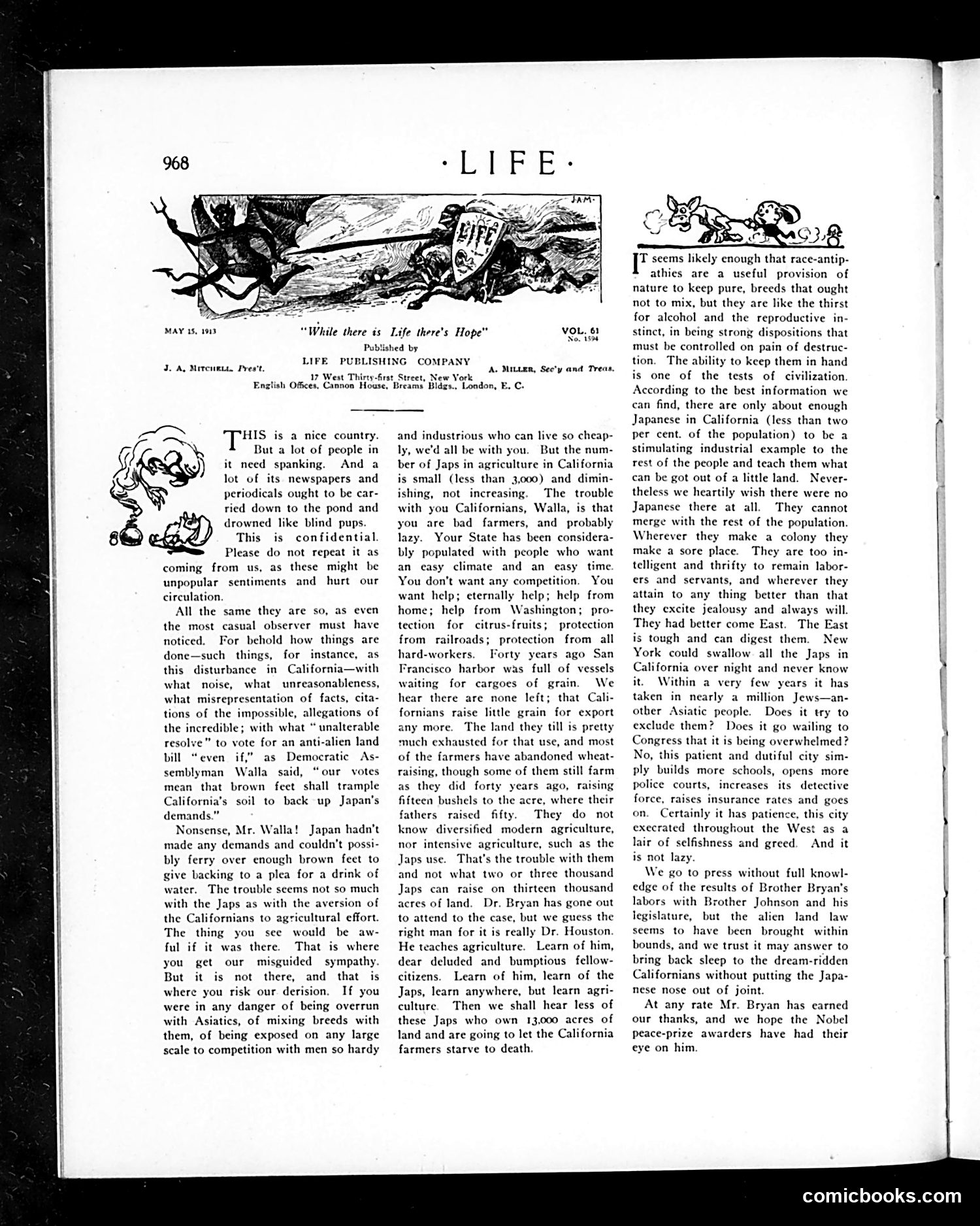
**The cartoon** at top left depicts what appears to be a violent confrontation, with the caption "While there is Life there's Hope." **The article's focus** is anti-Japanese sentiment in California. The unnamed author argues against Japanese immigration, claiming Japanese cannot assimilate and should be excluded. The piece expresses anxiety about Japanese farmers owning 13,000 acres of California land and advocates for their displacement—literally stating "we are going to let the California farmers starve to death" rather than allow Japanese economic competition. **The satire's target**: This appears to be either sincere xenophobic advocacy or satirical exposure of California's racist attitudes toward Asian immigrants. The extreme rhetoric ("starve to death") and the magazine's satirical reputation suggest possible ironic critique, though the text reads as straightforward anti-Japanese propaganda typical of the era's discriminatory policies.
📄 Transcribed text from this page (OCR, searchable)
Machine-transcribed from the original scan — historical spelling and the odd misread are preserved.
MAY 15, 1913 “While there is Life there's Hope" VOL. 61 Now i994 Published by LIFE 17 West Thirty J. A, Mercunts. Pres't, PUBLISHING COMPANY A. Mitte, Sec'y and Tre Street, New York English Offices, Cannon House, Breams Bldgs., London, E. C. HIS is a nice country. But a lot of people in it need spanking. And a lot of its newspapers and periodicals ought to be car- ried down to the pond and drowned like blind pups. This is confidential. Please do not repeat it as coming from us, as these might be unpopular sentiments and hurt our circulation. All the same they are so, as even the most casual observer must have noticed. For behold how things are done—such things, for instance, as this disturbance in California—with what noise, what unreasonableness, what misrepresentation of facts, cita- tions of the impossible, allegations of the incredible; with what “ unalterable solve” to vote for an anti-alien land bill “even if,” as Democratic As- semblyman Walla said, “our votes mean that brown feet shall trample California’s soil to back up Japan's demands.” Nonsense, Mr. Walla! Japan hadn't made any demands and couldn't possi- bly ferry over enough brown feet to give backing to a plea for a drink of water. The trouble seems not so much with the Japs as with the aversion of the Californians to agricultural effort. The thing you see would be aw- ful if it was there. That is where you get our misguided sympathy. But it is not there, and that is where you risk our derision. If you were in any danger of being overrun with Asiatics, of mixing breeds with them, of being exposed on any large scale to competition with men so hardy and industrious who can live so cheap- ly, we'd all be with you. But the num- ber of Japs in agriculture in California is small (less than 3,000) and dimin- ishing, not increasing. The trouble with you Californians, Walla, is that you are bad farmers, and probably lazy. Your State has been considera- bly populated with people who want an easy climate and an easy time. You don’t want any competition. You want help; eternally help; help from home; help from Washington; pro- tection for citrus-fruits; protection from railroads; protection from all hard-workers. Forty years ago San Francisco harbor was full of vessels waiting for cargoes of grain. We hear there are none left; that Cali- fornians raise little grain for export any more. The land they till is pretty much exhausted for that use, and most of the farmers have abandoned wheat- raising, though some of them still farm as they did forty years ago, raising fifteen bushels to the acre, where their fathers raised fifty. They do not know diversified modern agriculture, nor intensive agriculture, such as the Japs use. That's the trouble with them and not what two or three thousand Japs can raise on thirteen thousand acres of land. Dr. Bryan has gone out to attend to the case, but we guess the right man for it is really Dr. Houston. He teaches agriculture. Learn of him, dear deluded and bumptious fellow- citizens. Learn of him, learn of the Japs, learn anywhere, but learn agri- culture. Then we shall hear less of these Japs who own 13,000 acres of land and are going to let the California farmers starve to death. T seems likely enough that race-antip- athies are a useful provision of nature to keep pure, breeds that ought not to mix, but they are like the thirst for alcohol and the reproductive in- stinct, in being strong dispositions that must be controlled on pain of destruc- tion. The ability to keep them in hand is one of the tests of civilization. According to the best information we can find, there are only about enough Japanese in California (less than two per cent. of the population) to be a stimulating industrial example to the rest of the people and teach them what can be got out of a little land. Never- theless we heartily wish there were no Japanese there at all. They cannot merge with the rest of the population. Wherever they make a colony they make a sore place. They are too in- telligent and thrifty to remain labor- ers and servants, and wherever they attain to any thing better than that they excite jealousy and always will. They had better come East. The East is tough and can digest them. New York could swallow all the Japs in California over night and never know it. Within a very few years it has taken in nearly a million Jews—an- other Asiatic people. Does it try to exclude them? Does it go wailing to Congress that it is being overwhelmed? No, this patient and dutiful city sim- ply builds more schools, opens more police courts, increases its detective force, raises insurance rates and goes on. Certainly it has patience, this city execrated throughout the West as a lair of selfishness and greed. And it is not lazy. We go to press without full knowl- edge of the results of Brother Bryan's labors with Brother Johnson and his legislature, but the alien land law seems to have been brought within bounds, and we trust it may answer to bring back sleep to the dream-ridden Californians without putting the Japa- nese nose out of joint. At any rate Mr. Bryan has earned our thanks, and we hope the Nobel peace-prize awarders have had their eye on him. comicbooks.com