
Life, 1913-05-15 · page 29 of 52
Life — May 15, 1913 — page 29: what you’re looking at
What you’re looking at
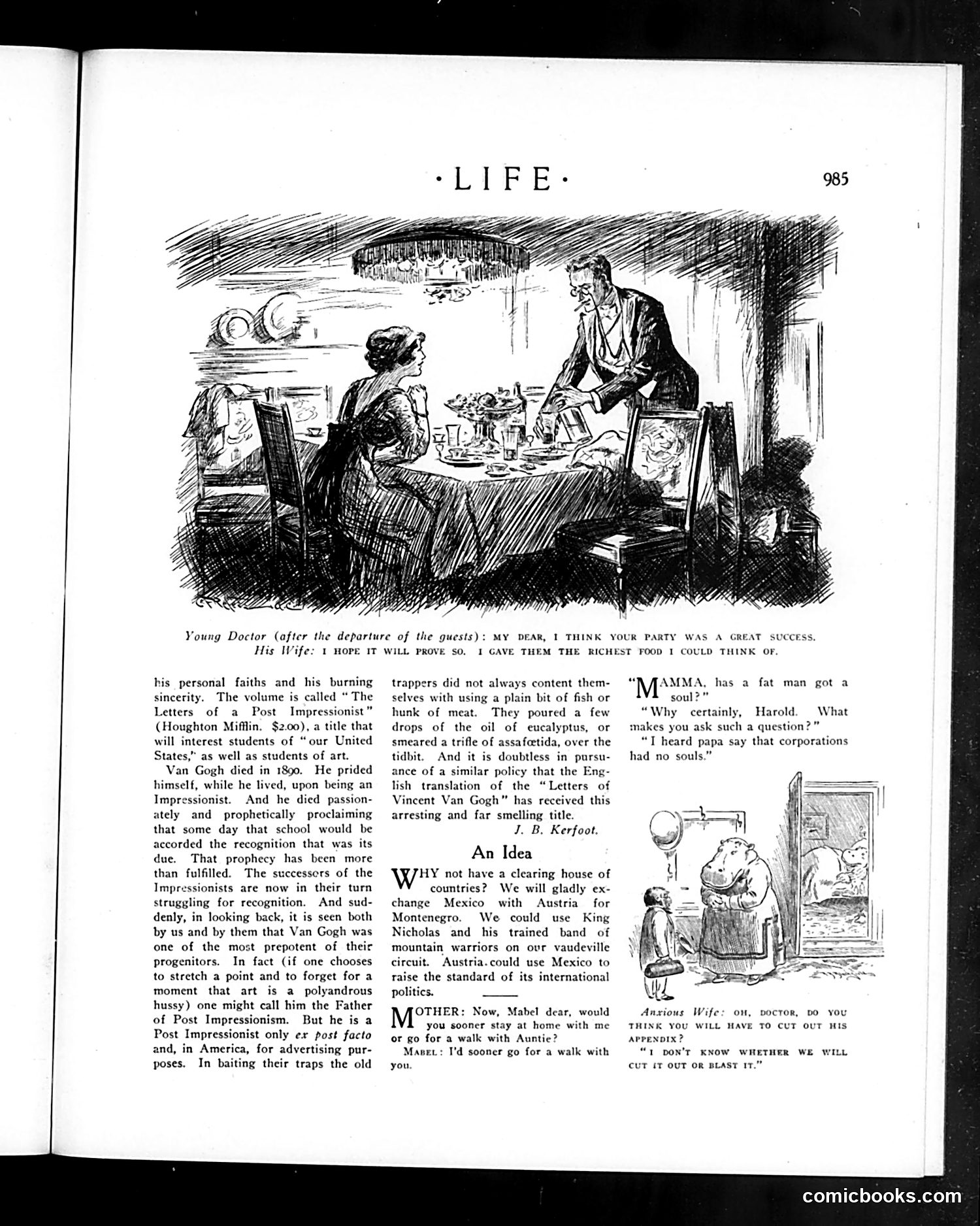
This page contains multiple unrelated satirical pieces typical of Life magazine's format: **Top cartoon**: A young doctor's wife claims her dinner party's success stems from serving "the richest food"—satirizing shallow social climbing and the assumption that expensive meals guarantee entertaining guests. **Middle section**: An article about Van Gogh's published letters criticizes how publishers sensationalize art history for commercial purposes, comparing the "arresting" title to a trapper's bait. **"An Idea"**: Satirizes American attitudes toward other nations by proposing absurdly swapping Mexico and Austria, suggesting Americans view countries as interchangeable commodities rather than sovereign entities. **Bottom dialogues**: Quick satirical exchanges mocking domestic life (a child's logic about souls and corporations) and medical uncertainty (a doctor joking about "blasting" rather than surgically removing an appendix). The page reflects early 20th-century American satirical humor targeting materialism, artistic pretension, and domestic relationships.
📄 Transcribed text from this page (OCR, searchable)
Machine-transcribed from the original scan — historical spelling and the odd misread are preserved.
Young Doctor (after the departure of the guests): MY DEAR, 1 THINK YOUR PARTY WAS A GREAT SUCCESS. His Wife: 1 More IT WILL PROVE SO, 1 GAVE THEM THE RICHEST FOOD I COULD THINK OF. his personal faiths and his burning sincerity. The volume is called “ The Letters of a Post Impressionist” (Houghton Mifflin. $2.00), a title that will interest students of “our United States,” as well as students of art. Van Gogh died in 1890. He prided himself, while he lived, upon being an Impressionist. And he died passion- ately and prophetically proclaiming that some day that school would be accorded the recognition that was its due. That prophecy has been more than fulfilled. The successers of the Impressionists are now in their turn struggling for recognition. And sud- denly, in looking back, it is seen both by us and by them that Van Gogh was one of the most prepotent of their progenitors. In fact (if one chooses to stretch a point and to forget for a moment that art is a polyandrous hussy) one might call him the Father of Post Impressionism. But he is a Post Impressionist only ex post facto and, in America, for advertising pur- poses. In baiting their traps the old trappers did not always content them- selves with using a plain bit of fish or hunk of meat. They poured a few drops of the oil of eucalyptus, or smeared a trifle of assafeetida, over the tidbit. And it is doubtless in pursu- ance of a similar policy that the Eng- lish translation of the “Letters of Vincent Van Gogh” has received this arresting and far smelling title. J. B, Kerfoot. An Idea HY not have a clearing house of countries? We will gladly ex- change Mexico with Austria for Montenegro. We could use King Nicholas and his trained band of mountain warriors on ovr vaudeville circuit. Austria.could use Mexico to raise the standard of its international politics. OTHER: Now, Mabel dear, would you sooner stay at home with me or go for a walk with Auntie? Manet: I'd sooner go for a walk with you “NA AMMA, has a fat man got a soul?” “Why certainly, Harold. © What makes you ask such a question?” “T heard papa say that corporations had no souls,” Anxious Wife: on, po you THINK YOU WILL HAVE TO CUT OUT HIS APPENDIX ? “1 DON’T KNOW WHETHER WE WILL CUT (T OUT OR BLAST IT.” DOCTOR, comicbooks.com