
Life, 1913-05-15 · page 13 of 52
Life — May 15, 1913 — page 13: what you’re looking at
What you’re looking at
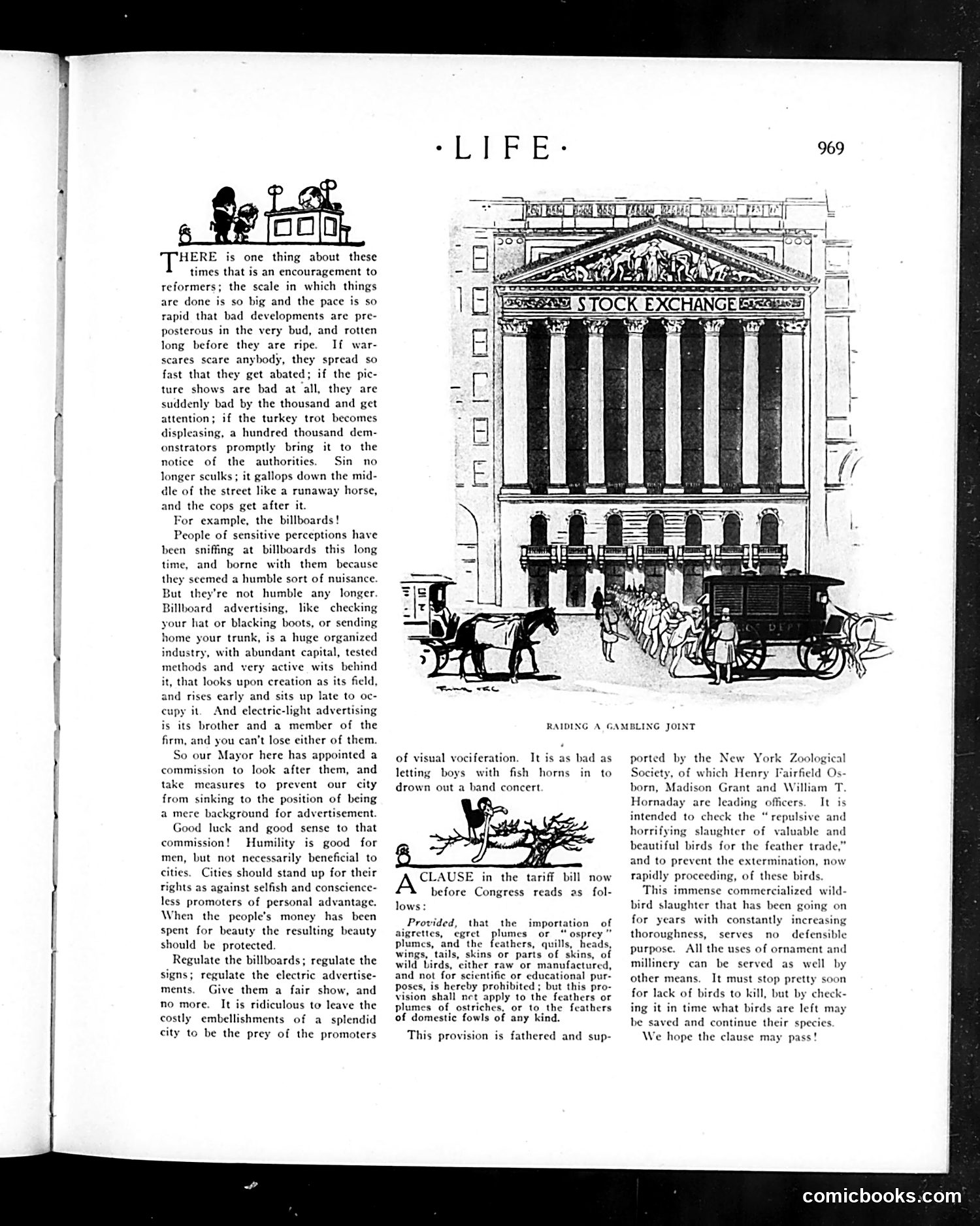
This page contains two distinct pieces of social commentary: **Left column:** A satirical essay criticizing reformers who move too quickly on various issues. The author argues that while well-intentioned, reformers often create chaos by implementing changes before society is ready, using examples like scarecrows startling people or turkeys causing disruption. The piece concludes that billboard advertising and other industries—despite criticism—are actually well-organized enterprises worthy of respect. **Right side:** An illustration labeled "RAIDING A GAMBLING JOINT" shows a Stock Exchange building being raided. Below it, a essay discusses a tariff bill clause protecting birds from slaughter for the feather trade, which was apparently a contemporary concern. The piece advocates for the clause's passage to prevent bird extinction for fashion purposes. Both pieces reflect Progressive-era debates about regulation and reform.
📄 Transcribed text from this page (OCR, searchable)
Machine-transcribed from the original scan — historical spelling and the odd misread are preserved.
> HERE is one thing about these times that is an encouragement to reformers; the scale in which things are done is so big and the pace is so rapid that bad developments are pre- posterous in the very bud, and rotten long before they are ripe. If war- scares scare anybody, they spread so fast that they get abated; if the pic- ture shows are bad at all, they are suddenly bad by the thousand and get attention; if the turkey trot becomes displeasing, a hundred thousand dem- onstrators promptly bring it to the notice of the authorities. Sin no longer sculks; it gallops down the mid- dle of the street like a runaway horse, and the cops get after it. For example, the billboards! People of sensitive perceptions have been sniffing at billboards this long time, and borne with them because they seemed a humble sort of nuisance. But they're not humble any longer. Billboard advertising, like checking your hat or blacking boots, or sending home your trunk, is a huge organized industry, with abundant capital, tested methods and very active wits behind it, that looks upon creation as its field, and rises early and sits up late to oc- cupy it. And electric-light advertising is its brother and a member of the firm, and you can’t lose either of them. So our Mayor here has appointed a commission to look after them, and take measures to prevent our city from sinking to the position of being a mere background for advertisement. Good luck and good sense to that commission! Humility is good for men, but not necessarily beneficial to cities. Cities should stand up for their rights as against selfish and conscience- less promoters of personal advantage. When the people's money has been spent for beauty the resulting beauty should be protected. Regulate the billboards; regulate the signs; regulate the electric advertise- ments. Give them a fair show, and no more. It is ridiculous to leave the costly embellishments of a splendid city to be the prey of the promoters RAIDING A GAMBLING JOINT of visual vociferation. It is as bad as letting boys with fish horns in to drown out a band concert CLAUSE in the tariff bill now before Congress reads as fol- lows: Provided, that the importation of aigrettes, egret plumes or “osprey” plumes, and the feathers, quills, heads, wings, ‘tails, skins or paris of skins, of wild birds, ‘cither raw or manufactured, and not for scientific or educational pur- poses, is hereby prohibited ; but this pro- vision shall net apply to the feathers oF plumes of ostriches, or to the feathers of domestic fowls of any kind. This provision is fathered and sup- New York Zoological Society, of which Henry Fairfield Os- born, Madison Grant and William T. Hornaday are leading officers. It is intended to check the “repulsive and horrifying slaughter of valuable and beautiful birds for the feather trad and to prevent the extermination, now rapidly proceeding, of these birds. This immense commercialized wild- bird slaughter that has been going on for years with constantly increasing thoroughness, serves no defensible purpose. All the uses of ornament and millinery can be served as well by other means. It must stop pretty soon for lack of birds to kill, but by check- ing it in time what birds are left may be saved and continue their species We hope the clause may pass! ported by the comicbooks:com