
A complete issue · 44 pages · 1913
Life — March 13, 1913
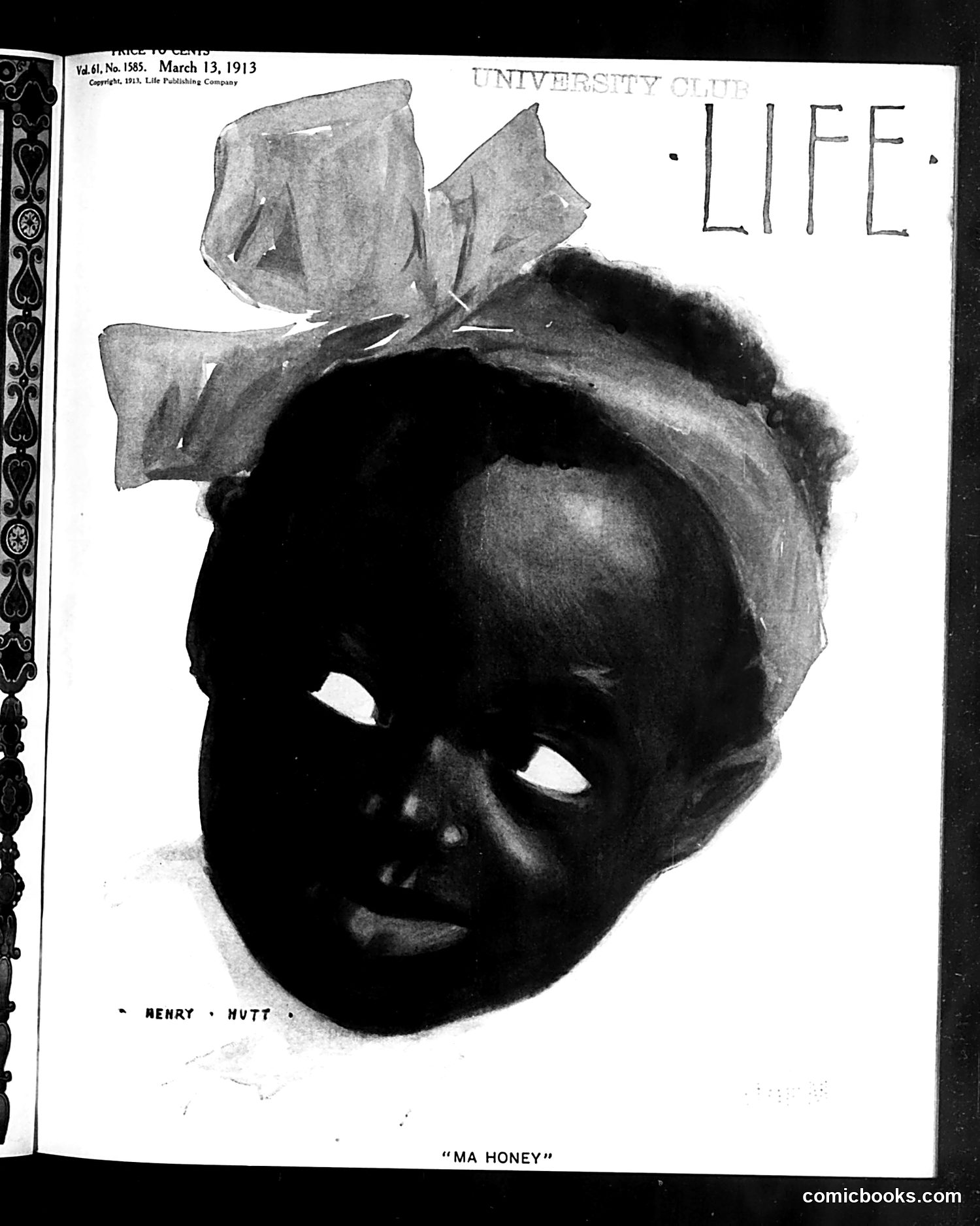
This is a caricature by Henry Hutt titled "Ma Honey." The image shows a dark silhouetted face with exaggerated features and white eye-holes, topped with a light-colored bonnet or head covering with a large bow. The style suggests a minstrel or blackface character—a deeply offensive stereotypical theatrical tradition common in early 20th-century American entertainment. Without additional context on this specific page, the precise satirical target remains unclear. However, given Life magazine's focus on contemporary politics and culture, this likely mocked either a public figure, a theatrical trend, or broader social stereotypes prevalent in 1913. The "Ma Honey" title suggests a character type rather than a specific person, but the exact reference would require knowledge of what entertainment or events dominated that week.
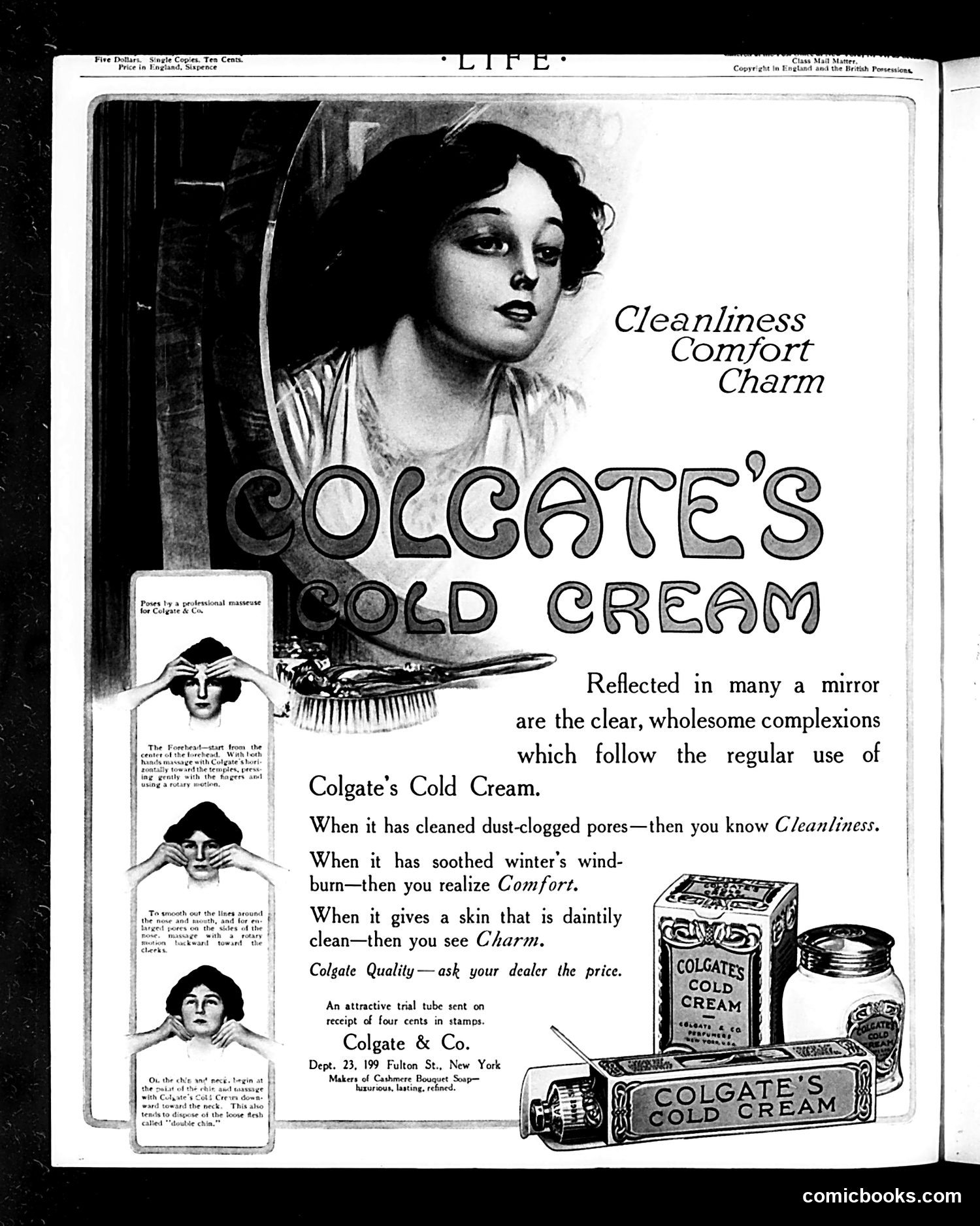
This page is **primarily a cosmetics advertisement** for Colgate's Cold Cream, not political satire. The main image shows a woman's face with the headline "Cleanliness Comfort Charm" promoting the product's benefits. The left side contains small instructional diagrams labeled with skincare advice (treating dust-clogged pores, wind-burn, and achieving clear skin). These appear to be practical beauty tips rather than satirical commentary. The advertisement emphasizes the product's three claimed benefits and includes contact information for Colgate & Co. in New York. The overall tone is straightforward marketing typical of early 20th-century beauty product advertising, with no apparent political content or social satire present on this particular page.
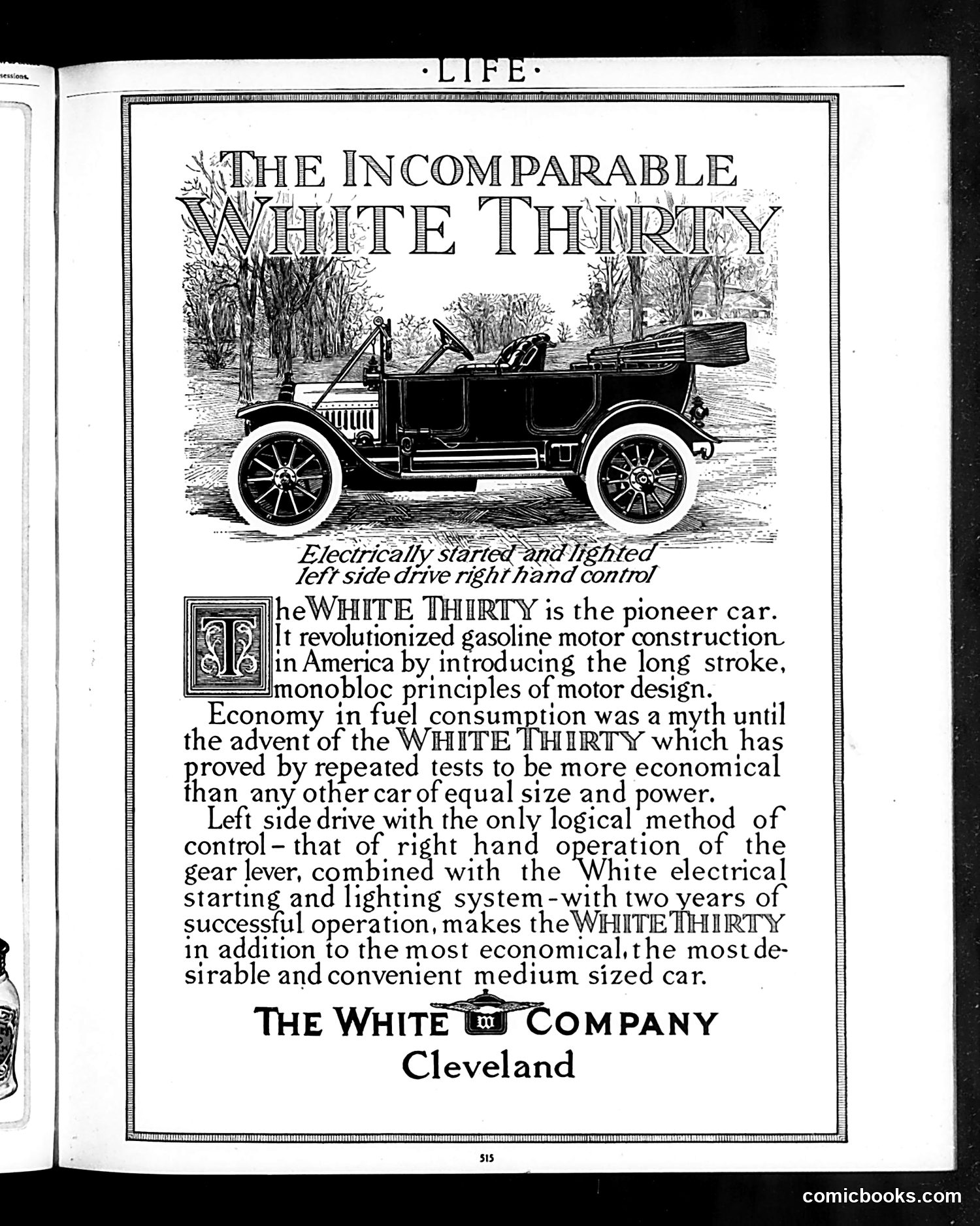
This page is **not a cartoon or satire**—it's a straightforward automobile advertisement for the White Thirty, published in Life magazine. The White Company of Cleveland marketed this car as a technological pioneer, emphasizing its innovative gasoline motor design with a long-stroke, monobloc engine. The ad highlights practical features: electrical starting and lighting (relatively new at the time), left-side drive with right-hand gear control, and superior fuel economy. The engraving shows a touring car typical of the 1910s era. The "incomparable" language and claims about economic efficiency reflect standard early automotive advertising rhetoric. This appears to be genuine promotional content rather than satirical commentary—Life magazine accepted substantial paid advertising alongside its humorous editorial content.
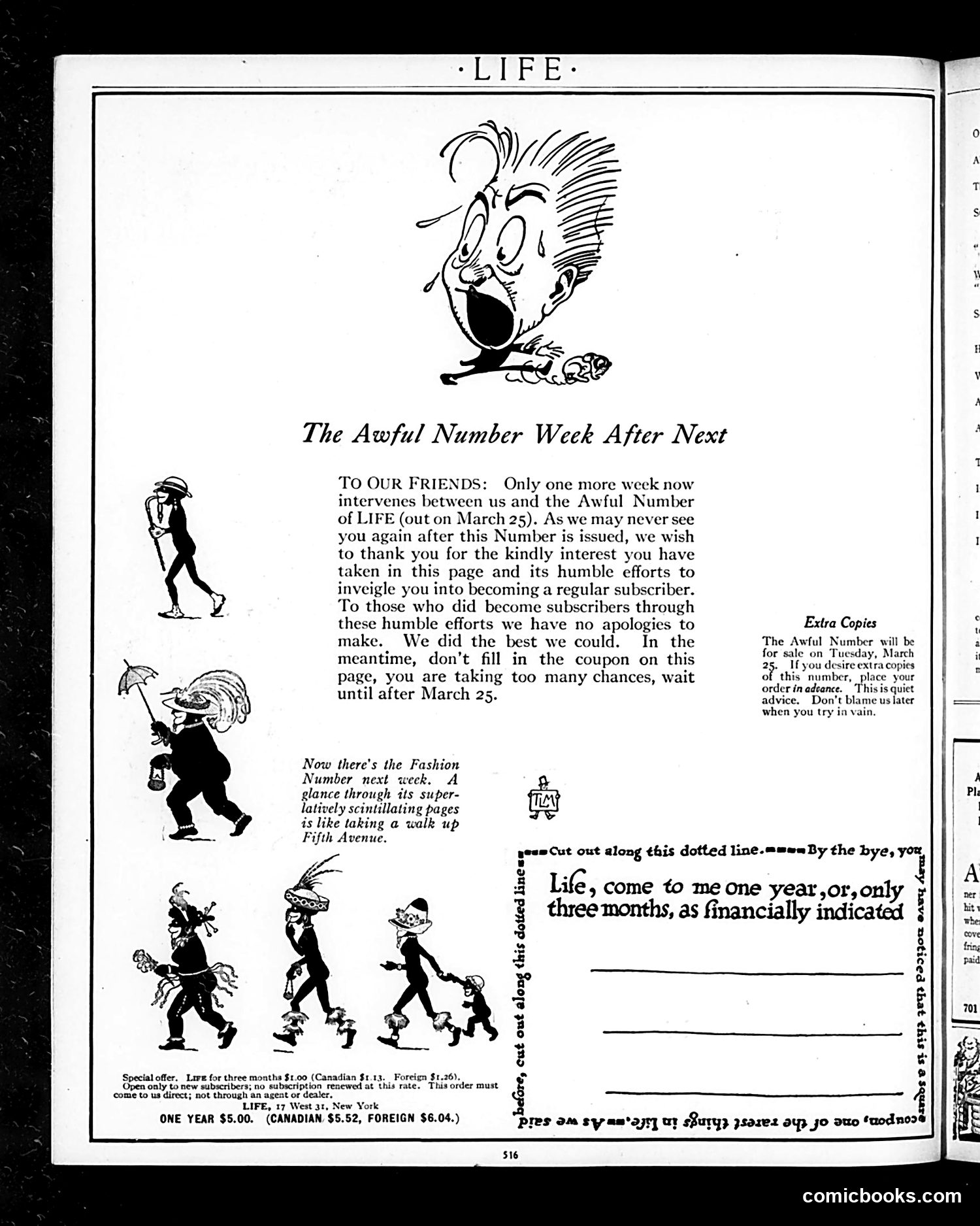
This page is primarily a **subscription solicitation** rather than political satire. The main content announces Life's "Awful Number" launching March 25, urging readers to subscribe before that issue. The cartoons are generic comic illustrations showing exaggerated characters in humorous situations—a distressed man at top, figures struggling with umbrellas and running with children—typical of early 20th-century comic style. These appear decorative rather than referential to specific political events or figures. The text emphasizes this is the **final issue** before implementation of their subscription model, pleading with casual readers to become regular subscribers. A subscription box at bottom offers three months for $1.00. The page functions as **magazine house advertisement** rather than satirical commentary on current events or politics.
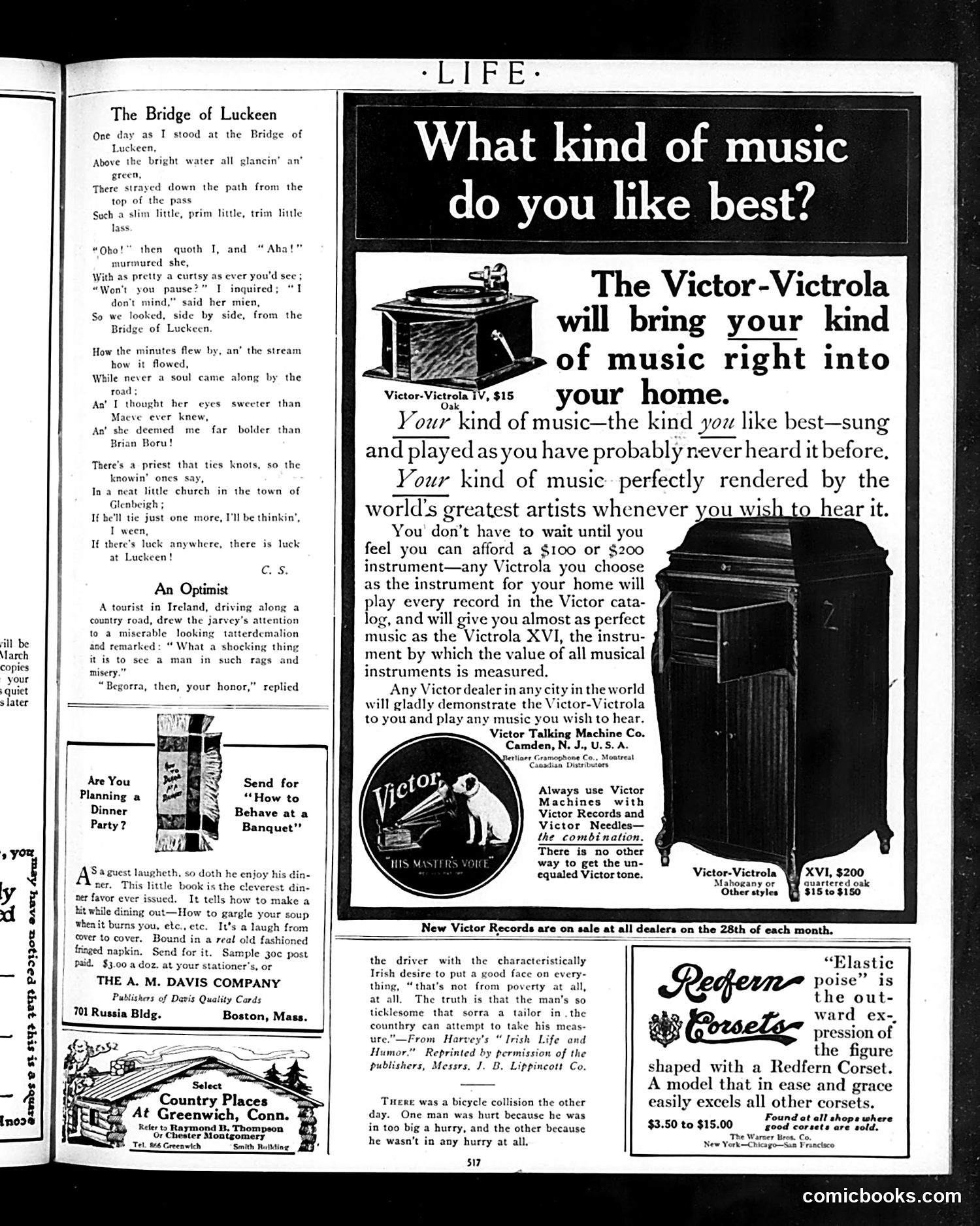
This page is **primarily advertising**, not satire or political commentary. The dominant content is a full-page Victor-Victrola advertisement (center-right), promoting phonograph machines and records as a way to bring desired music into the home. The left side contains three unrelated items: a poem titled "The Bridge of Luckeen," a short humorous anecdote called "An Optimist" about a tourist and a jarvey (carriage driver), and period advertisements for dinner party etiquette guides and corsets. There is **no political cartoon** on this page. The content reflects early 20th-century consumer culture and leisure—the main editorial joke being the brief "Optimist" story about misery and luck, which is light social humor rather than satire.
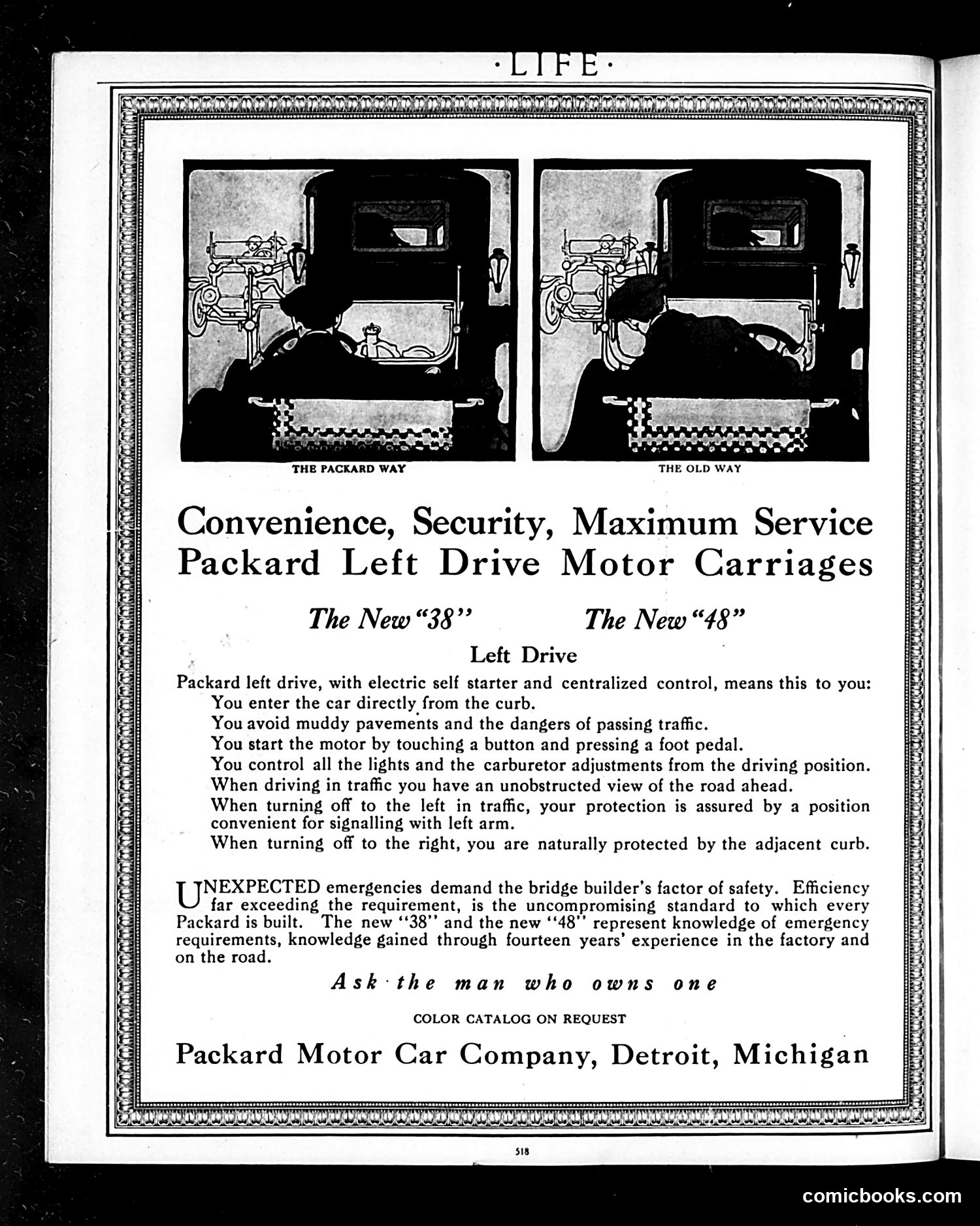
This is **primarily advertising**, not satire or political commentary. It's a Packard Motor Car Company advertisement from *Life* magazine promoting their left-drive automobiles (the "38" and "48" models). The two illustrations compare "The Packard Way" (left-drive) versus "The Old Way" (right-drive), showing silhouettes of drivers. The advertisement emphasizes the safety and convenience advantages of left-drive vehicles: entering from the curb, avoiding traffic dangers, and improved visibility and control while driving. The text highlights Packard's engineering standards and fourteen years of road experience. The phrase "Ask the man who owns one" was Packard's famous advertising slogan. This reflects early automotive history when left-drive configurations were still being promoted as modern innovations over traditional right-drive designs.
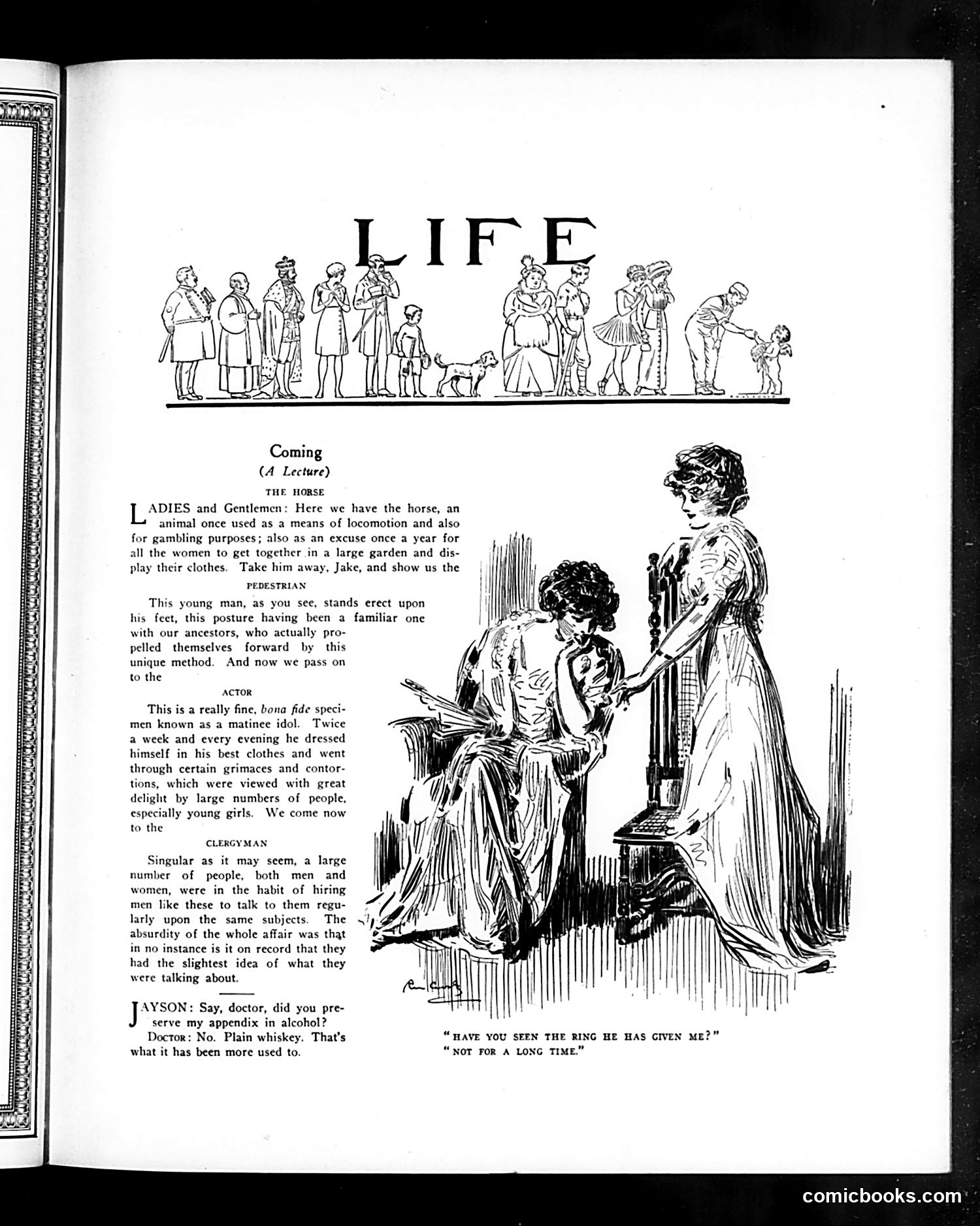
This page presents a lecture titled "Coming: A Lecture" that satirizes three Victorian social types: a **Pedestrian** (man standing upright), an **Actor** (well-dressed gentleman), and a **Clergyman** (religious figure). The satire mocks how members of these professions habitually adopt distinctive physical postures and mannerisms—the pedestrian's upright stance, the actor's theatrical gestures, the clergyman's peculiar conversational habits. The accompanying illustration shows two women, with one asking "Have you seen the ring he has given me? Not for a long time"—suggesting the clergyman's tendency toward repetitive, meaningless conversation. The joke ridicules how professional identity shapes not just behavior but personality itself, making these men predictable and somewhat absurd figures in polite society.
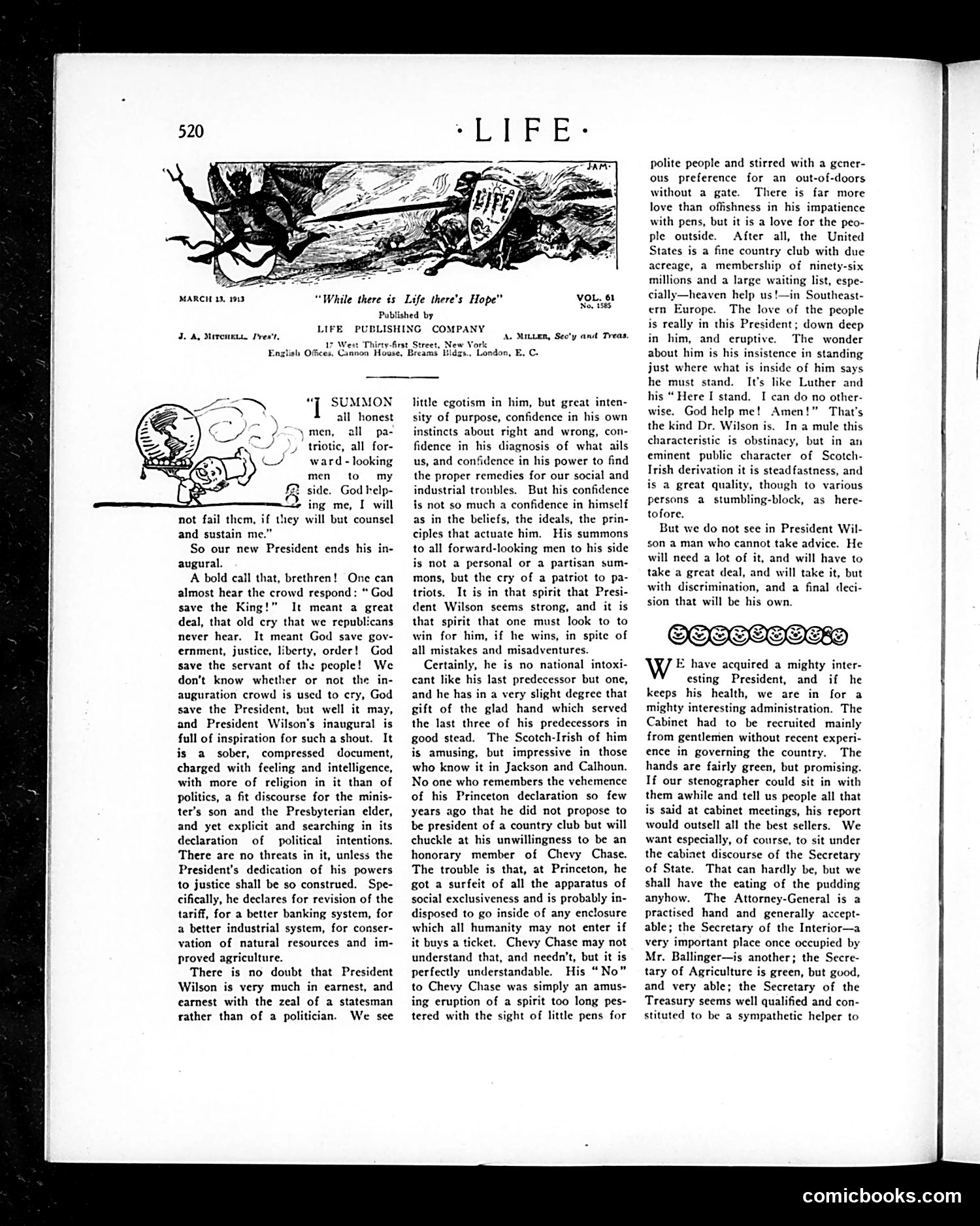
The top cartoon depicts a death-like figure labeled "LIFE" lying prone, with the caption "While there is Life there's Hope." This appears to be editorial commentary on President Wilson's recent inauguration. The accompanying article discusses Wilson's character, praising his earnestness as a "statesman rather than a politician." The text references his Presbyterian elder background and his refusal to join exclusive clubs like the Chevy Chase Club—positioning this as admirable principle rather than mere rudeness. The article expresses cautious optimism about Wilson's Cabinet appointments, noting they come from "gentlemen without recent experience in governing," suggesting both promise and risk in his new administration. The overall tone is supportive but measured toward the newly-inaugurated president.
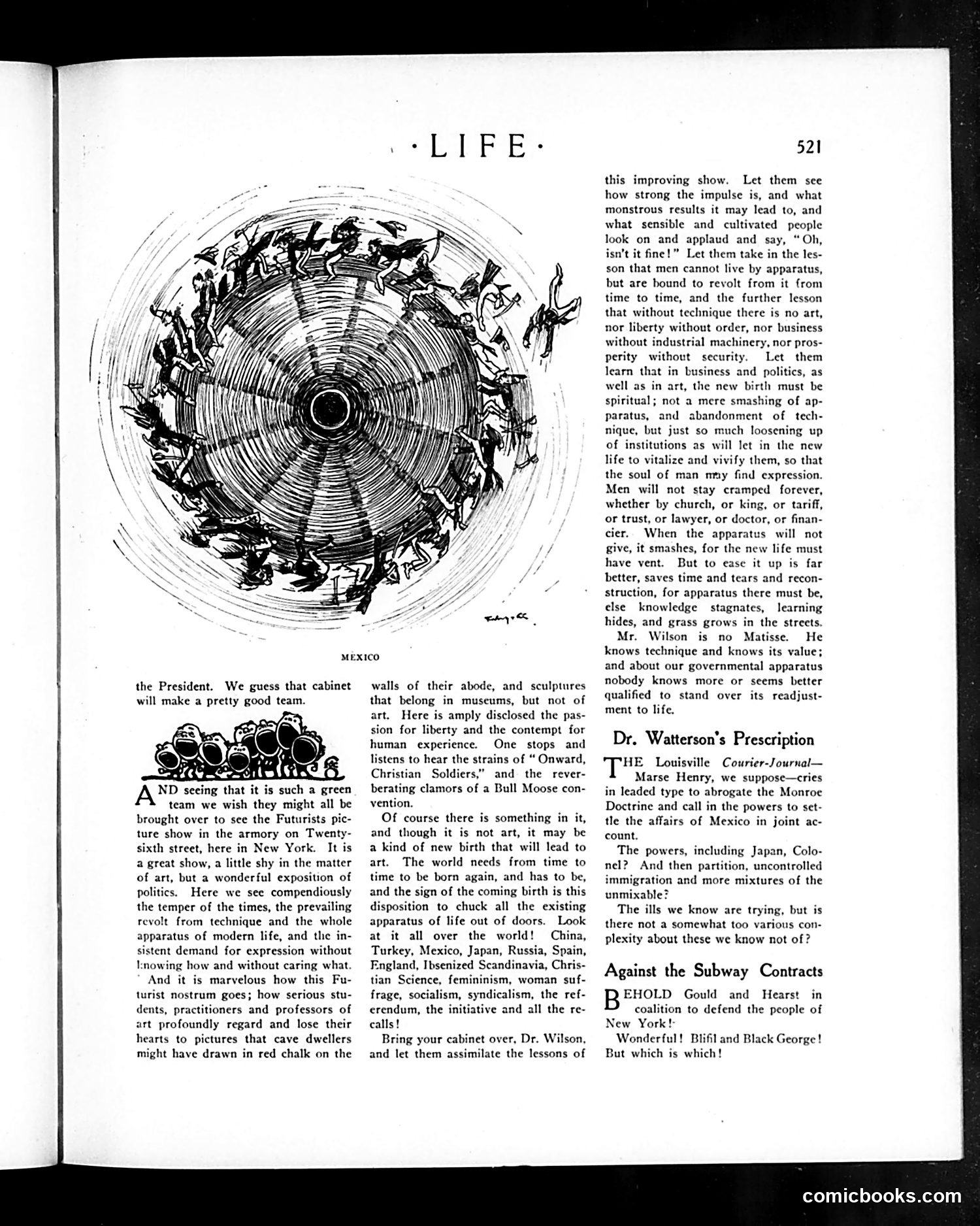
The circular illustration labeled "MEXICO" depicts a chaotic scene of figures arranged around a wheel or circular mechanism, suggesting Mexico as a metaphor for a broken, spinning apparatus of government or social order. The accompanying text critiques the Futurist art movement's exhibition at New York's Armory Show (1913), dismissing it as mere technical display without genuine artistic merit. The author argues that while the Futurists celebrate destroying existing institutions and apparatus, such destruction without constructive replacement leads only to chaos—using Mexico's political turmoil as a real-world cautionary example. The text also includes sections titled "Dr. Watterson's Prescription" and "Against the Subway Contracts," suggesting commentary on contemporary New York political issues.
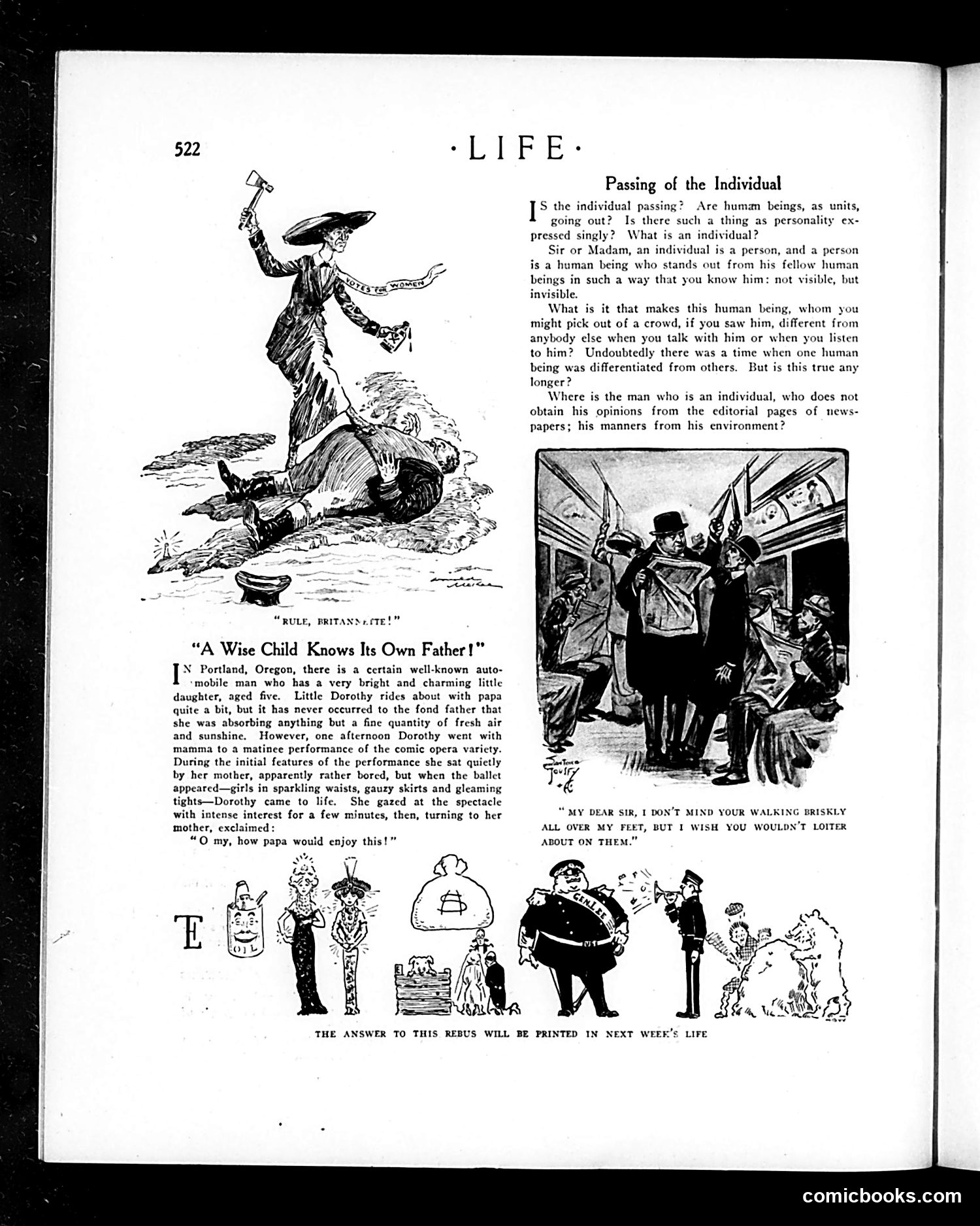
This page contains satirical commentary on **individualism** and **conformity**. The top section questions whether true individuality exists—asking whether people's opinions, manners, and personalities are genuinely their own or merely absorbed from newspapers and environment. The lower section, "A Wise Child Knows Its Own Father," depicts a story about a young girl (Dorothy) attending the opera with her mother. The satire suggests the mother expects her daughter to be bored, but Dorothy finds genuine enjoyment in the performance. The accompanying illustration shows crowded public transport, with a caption about someone's inconsiderate walking habits. The overall theme critiques how society pressures conformity while claiming to value individuality—a perennial social concern that remains relevant today.
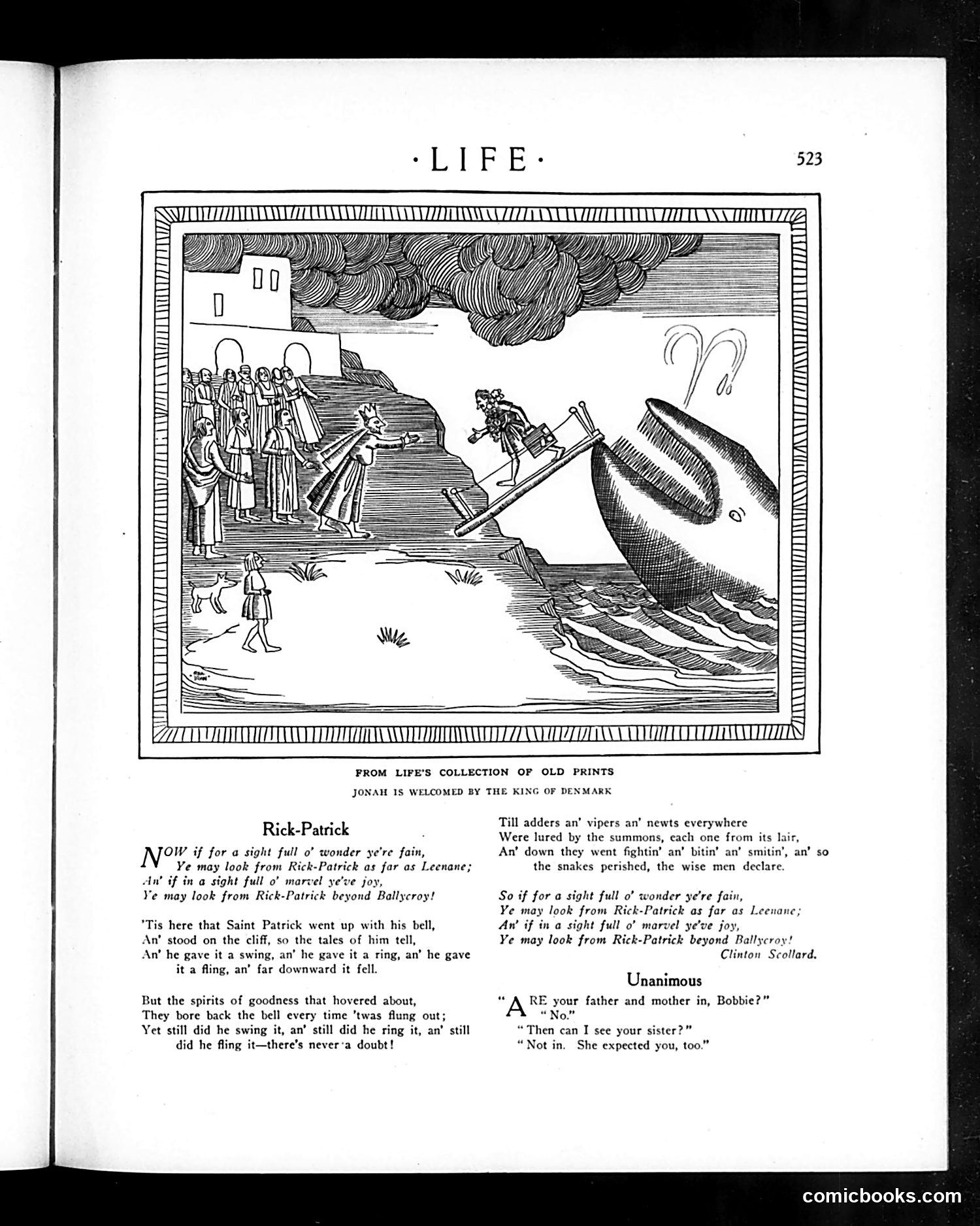
This page from *Life* magazine presents a satirical engraving titled "Jonah Is Welcomed by the King of Denmark," depicting a biblical scene in a Renaissance style. The image shows a ship, figures on shore greeting passengers, and a large fish. Below the image are three literary pieces: "Rick-Patrick" by Clinton Scollard (a poem about Saint Patrick), and "Unanimous" (an untitled dialogue). The page appears designed as a literary and artistic miscellany rather than political satire. The biblical engraving serves as illustration for the Patrick poem, which humorously presents the saint's legend in colloquial verse. "Unanimous" offers light comedic dialogue, likely about family reunion expectations. The content emphasizes *Life*'s role as a general-interest magazine mixing humor, literature, and classical imagery rather than direct political commentary.
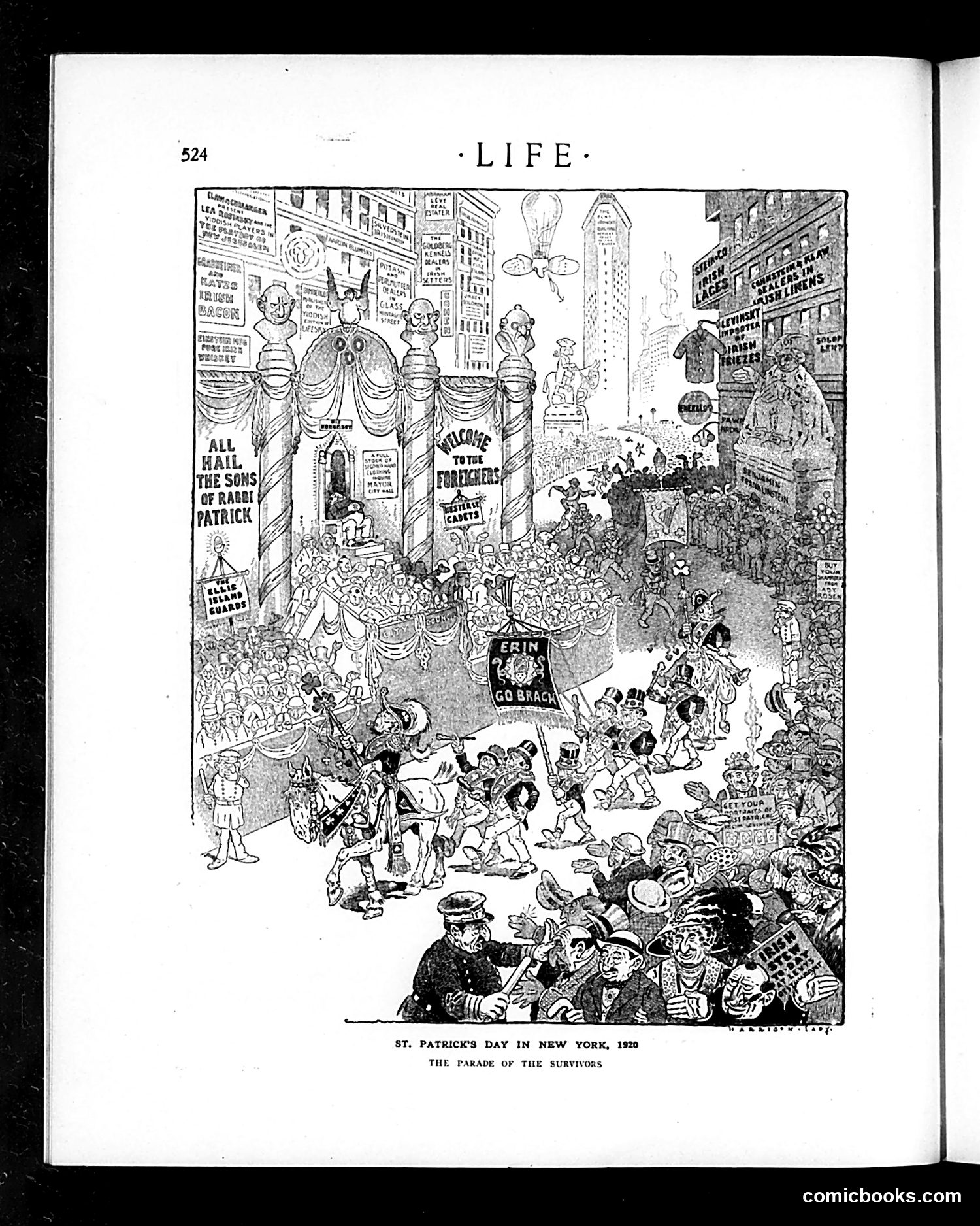
This illustration depicts the St. Patrick's Day parade in New York City in 1920, captioned "The Parade of the Survivors." The cartoon shows a massive, chaotic street celebration with large decorative structures and crowds. The key historical context: 1920 was shortly after World War I ended (1918), so "survivors" refers to soldiers returning home. The satire appears to celebrate Irish-American participation in the war effort, with various patriotic and celebratory signage visible throughout the crowded street scene. The cartoon captures both the exuberance of post-war celebration and the ethnic identity of Irish-Americans during the Prohibition era, using the traditional parade as a vehicle for depicting American society's relief and joy at war's conclusion.
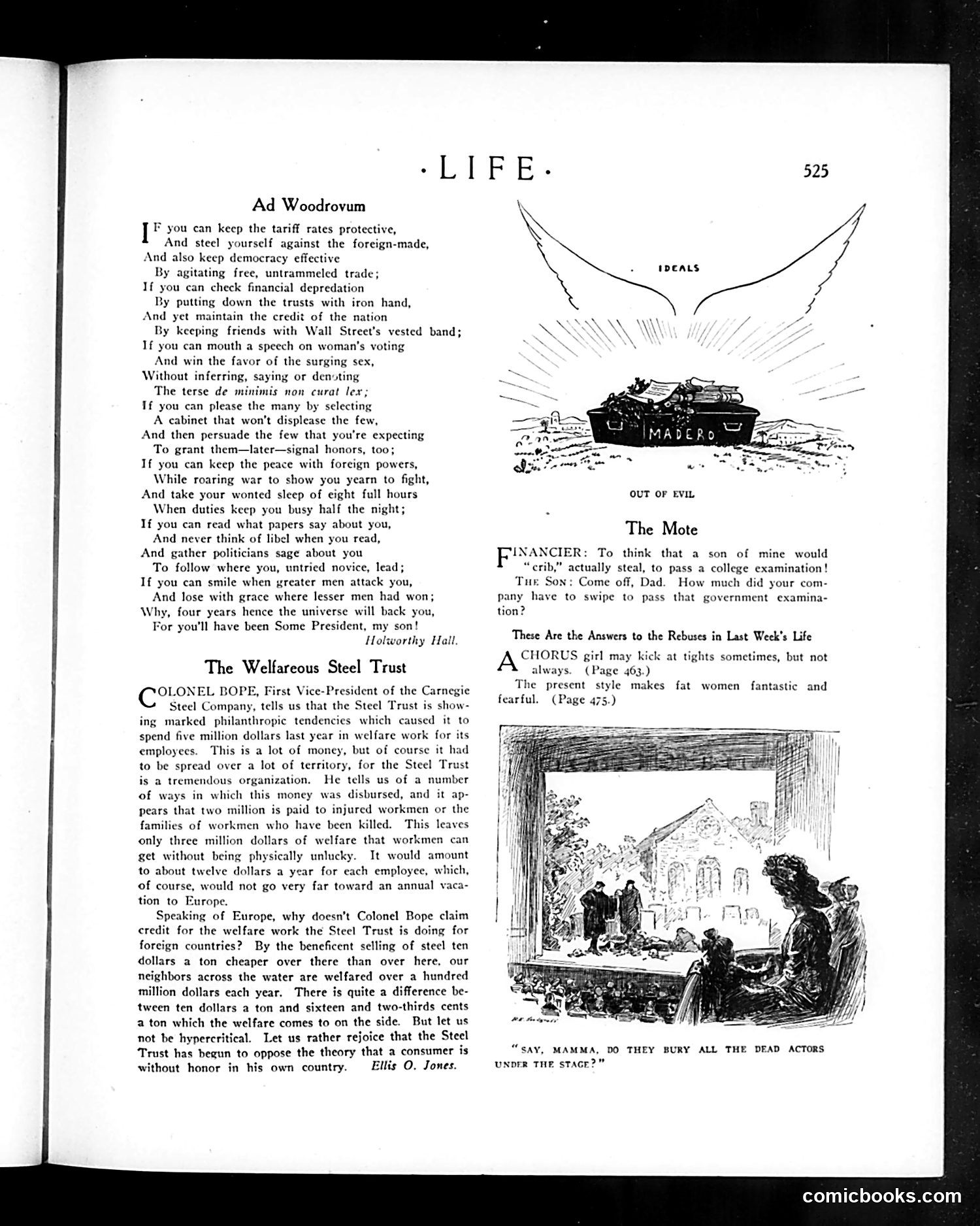
This page contains three distinct pieces of satire: 1. **"Ad Woodrovum"** - A poem mocking President Woodrow Wilson's political compromises and pragmatism, using conditional "if" statements to satirize his balancing act between ideals and political reality. 2. **"The Welfareous Steel Trust"** - An editorial critique of the Carnegie Steel Company's welfare spending. The author argues that while the company claims five million dollars in welfare work, only three million actually reaches workers—the rest funding administrative overhead. The satire highlights corporate hypocrisy: spending less per employee annually than a European vacation costs. 3. **"The Mote"** - A brief humorous exchange about academic cheating, with a cartoon showing what appears to be a theatrical scene. The joke concerns passing examinations dishonestly. The page represents typical early-20th-century American satirical journalism critiquing corporate practices and political leadership.
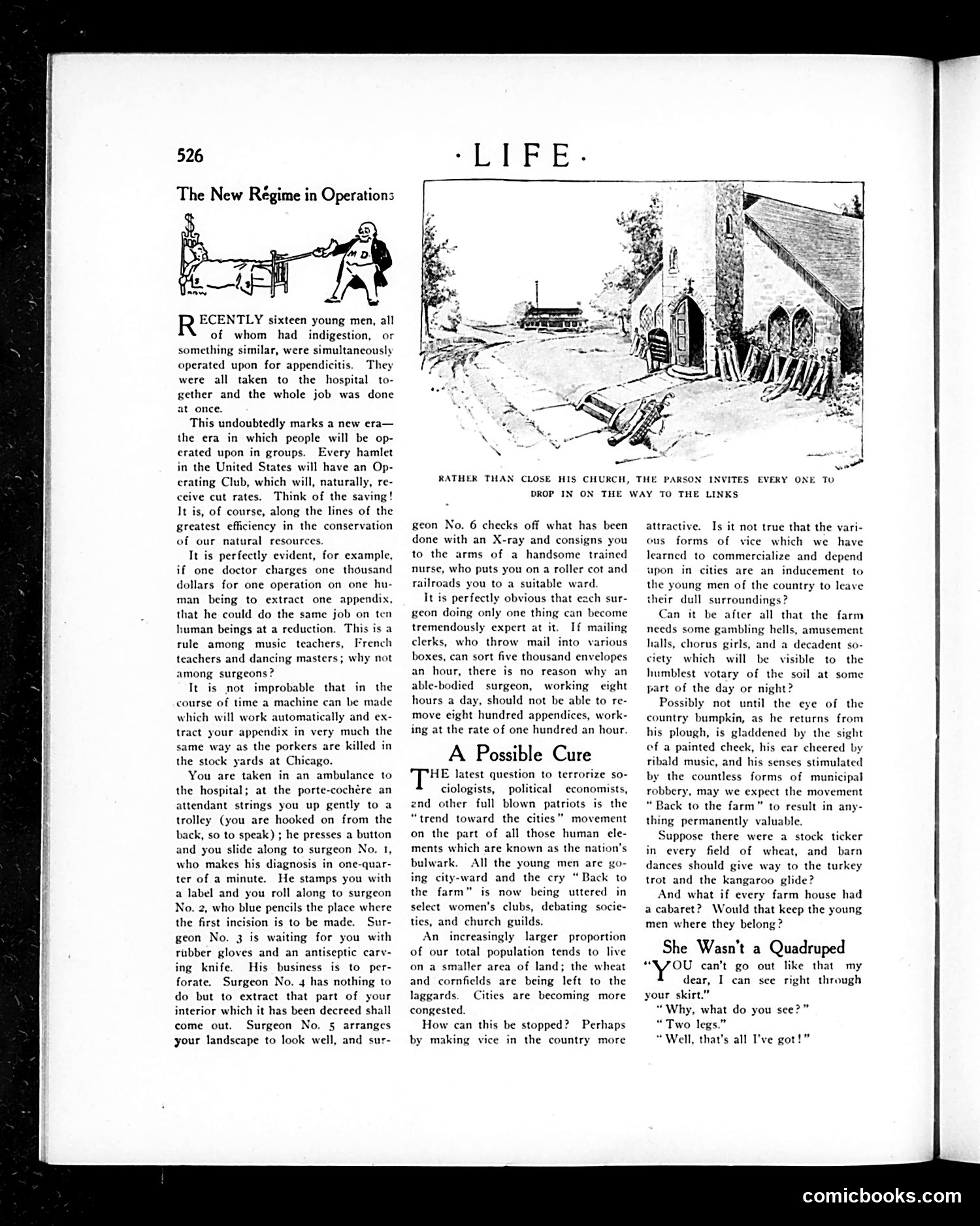
This page satirizes early 20th-century medical and social efficiency movements. The top cartoon, "The New Régime in Operation," mocks the era's obsession with mechanized surgery and mass-production efficiency. It depicts a doctor operating on a patient like an assembly-line worker, humorously suggesting that medical procedures have become dehumanized factory processes. The text criticizes the "trend toward the cities" movement—a social concern that young people were abandoning rural life. The article proposes a satirical solution: make farm life more entertaining by adding gambling, dance halls, and "decadent society" amusements to farming communities. This biting satire mocks both urban reformers' anxiety about rural depopulation and the absurdity of trying to make farming competitive with city attractions through vice and frivolity rather than genuine improvement.
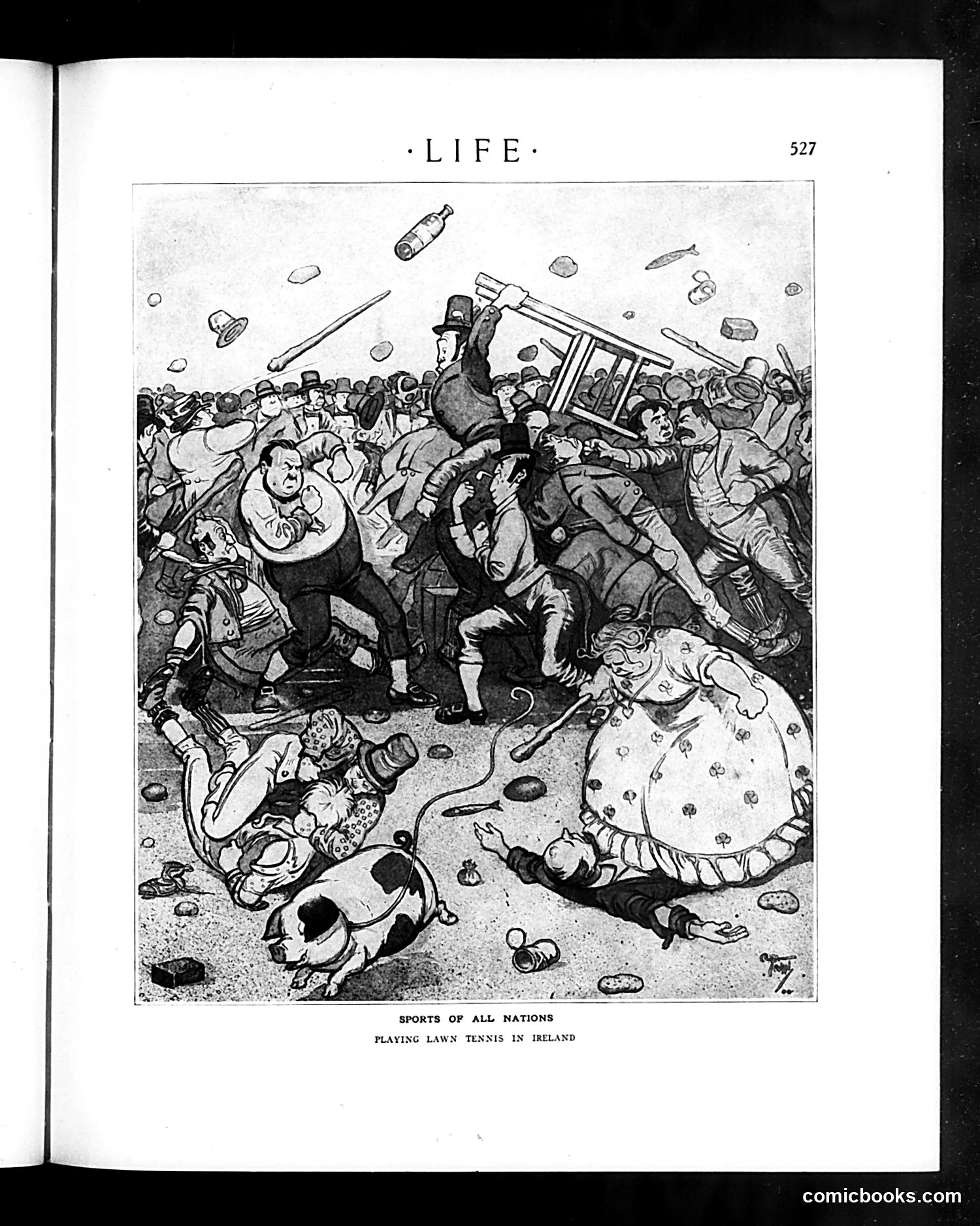
This satirical cartoon depicts chaos masquerading as lawn tennis. A crowd of people in formal Victorian dress engage in violent mayhem—fighting, throwing objects (bottles, sticks), and general disorder—while a few scattered tennis implements lie about. The joke targets Irish stereotypes: the caption's dry, neutral language ("Playing Lawn Tennis") contrasts absurdly with the actual scene of rioting and brawling. This appears to satirize either Irish civil unrest of the period or ethnic stereotypes portraying Irish people as inherently violent and disorderly, unable to participate in civilized British leisure activities without descending into chaos. The cartoon reflects period prejudices common in early 20th-century American satirical magazines.
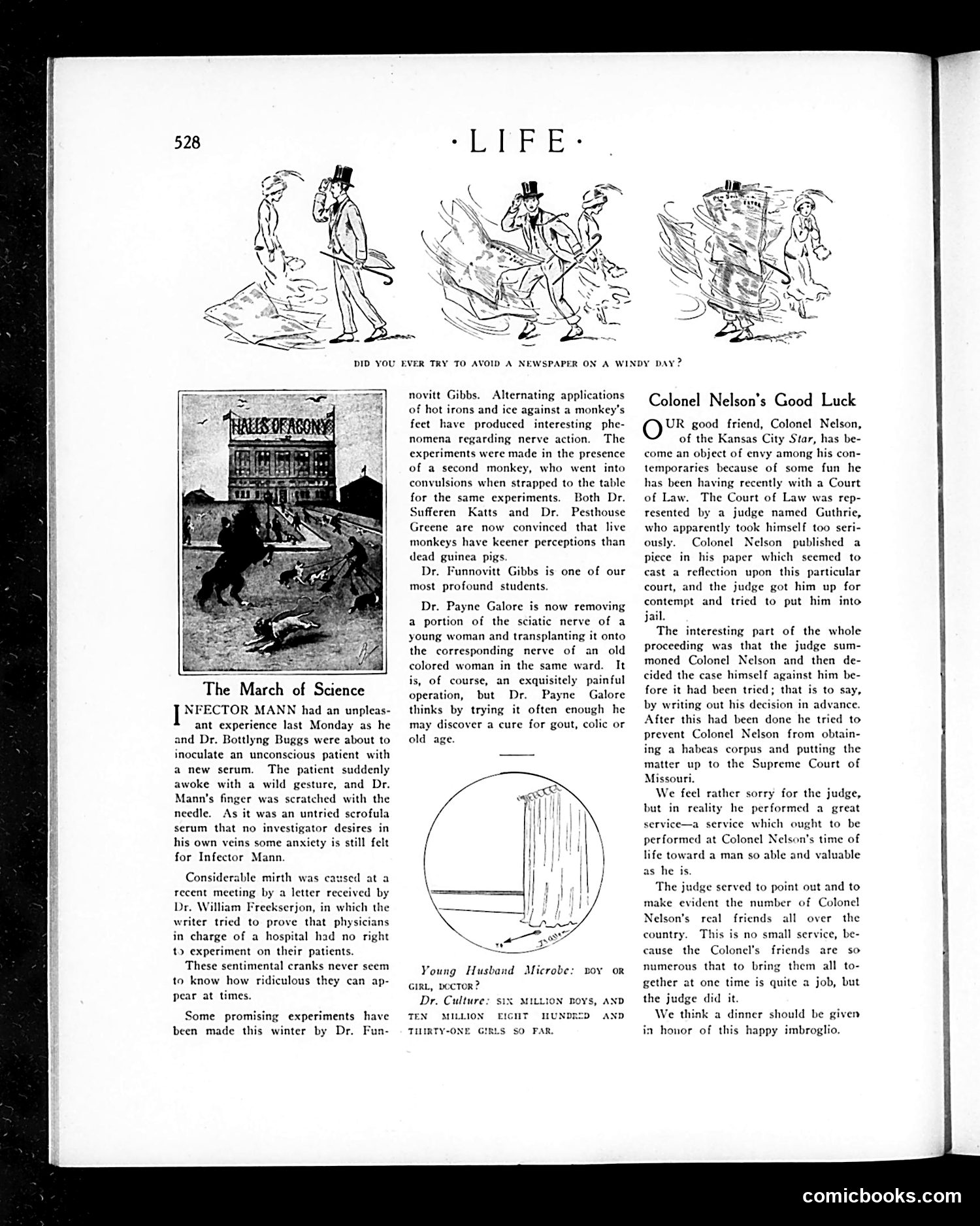
This page satirizes medical ethics violations of the early 20th century. The cartoons mock doctors conducting dangerous, unethical experiments: **"The March of Science"** section ridicules physicians experimenting on patients and animals without consent or proper justification. Dr. Mann accidentally inoculates himself; Dr. Gibbs applies extreme heat and cold to monkeys' feet; Dr. Galore transplants nerves between patients. The satire targets the medical establishment's callous disregard for suffering—both human and animal—justified by pseudo-scientific advancement. Doctors with absurd names (Funnovitt Gibbs, Payne Galore) emphasize the mockery. The microscopic cartoon jokes about bacterial reproduction ("six million boys...thirty-one girls so far"). **"Colonel Nelson's Good Luck"** celebrates a Kansas City newspaper editor who challenged judicial overreach—a judge who prejudged a case against him. The piece ironically praises the judge for inadvertently uniting Nelson's supporters through this abuse of power. Both sections critique institutional authority abusing power while evading accountability.
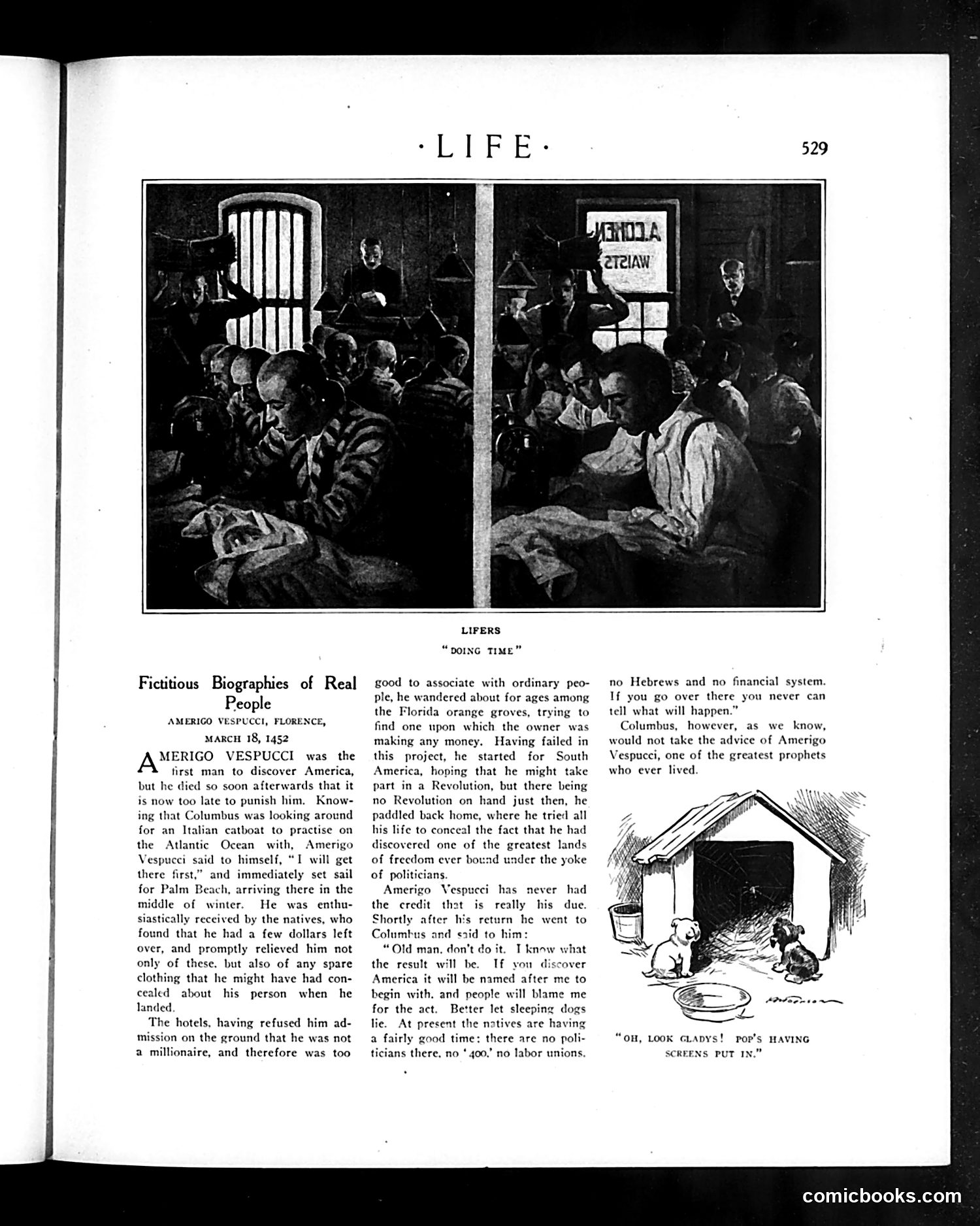
This satirical piece mocks both historical revisionism and early 20th-century American social problems. The text humorously credits Vespucci with discovering America first, then suggests he wisely warned Columbus against it—predicting America's future ills with dark comedy. The joke: Vespucci claims that once colonized, America will be plagued by politicians, the wealthy elite ("the 400"), labor unions, and financial systems—problems absent from the pristine pre-Columbian world. This biting critique skewers contemporary American society: political corruption, class division, labor strife, and financial speculation. The accompanying illustrations (labeled "Lifers—Doing Time") show prison scenes, likely reinforcing the theme that civilization itself is a kind of imprisonment compared to natural freedom. The satire reflects early 1900s progressive anxieties about urbanization, industrialization, and wealth inequality.
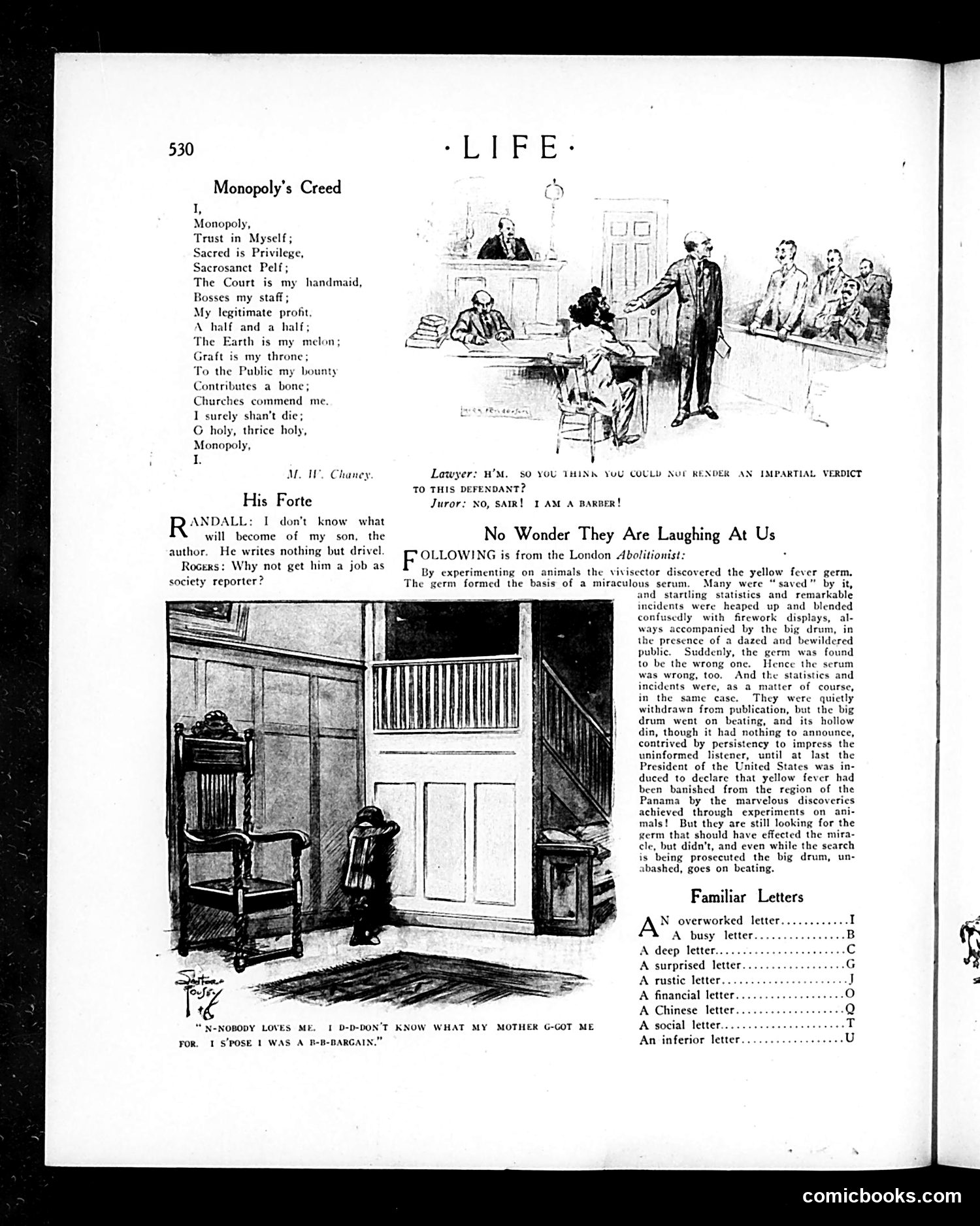
This page contains multiple satirical pieces targeting American corruption and public deception circa early 1900s. **"Monopoly's Creed"** mocks corporate monopolies as quasi-religious entities, personifying "Monopoly" as an amoral force that corrupts courts, controls bosses, and distributes token charity ("contributes a bone") while accumulating vast wealth through graft. **The courtroom cartoon** satirizes jury bias: a lawyer asks if a juror can render impartial judgment; the juror admits he's a barber—implying ordinary citizens lack the competence or independence for fair verdicts, corrupted by self-interest or simple ignorance. **"No Wonder They Are Laughing At Us"** criticizes sensationalized scientific claims about yellow fever cures. It describes how miraculous statistics were promoted via "big drum" (media hype), then quietly retracted when the germ identified proved wrong—yet promotion continued anyway. This satirizes how Americans are duped by authorities (even the President) making false claims about medical breakthroughs. The page's overall theme: institutional corruption, media manipulation, and public gullibility.
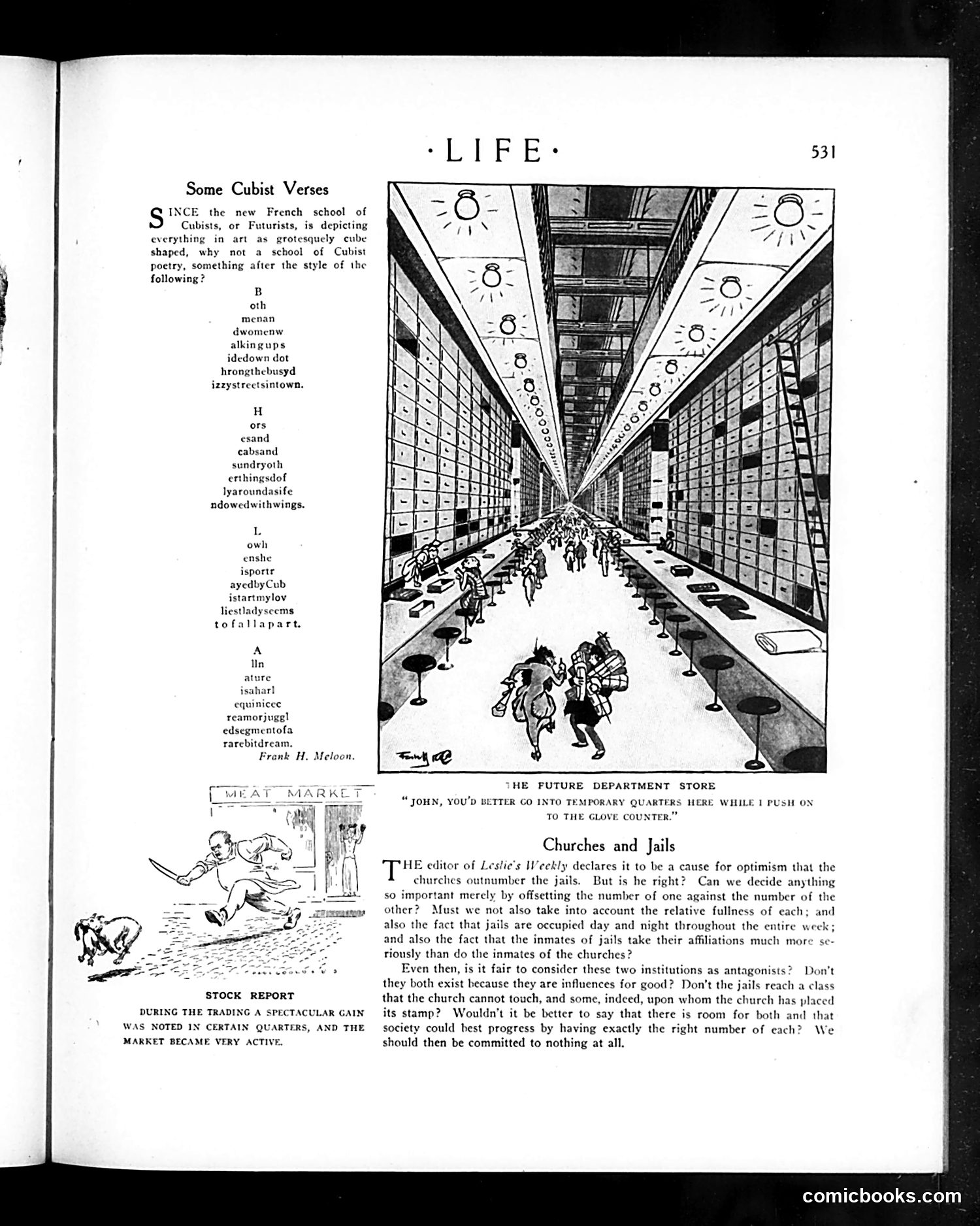
This page contains three satirical pieces mocking contemporary art and social trends: **"Some Cubist Verses"** parodies Cubism and Futurism—avant-garde art movements fragmenting subjects into geometric shapes. The poem deliberately breaks words into scattered syllables, visually mimicking Cubist distortion. It's mockery of modernist art as incomprehensible nonsense. **"The Future Department Store"** shows a massive, impossibly long corridor with tiny figures and suns. The joke: department stores have grown so vast and bewildering that customers get lost en route to basic sections like the glove counter. It satirizes American consumer culture's expansion and complexity. **"Churches and Jails"** argues against a *Leslie's Weekly* editor's claim that more churches than jails proves societal progress. Life's counterargument: jails operate 24/7 with committed inmates, while churches lack similar engagement. The piece sardonically suggests society needs "exactly the right number" of both institutions—deadpan commentary on American morality and social inequality. All three pieces reflect early 20th-century anxieties about modernism, commercialism, and social order.
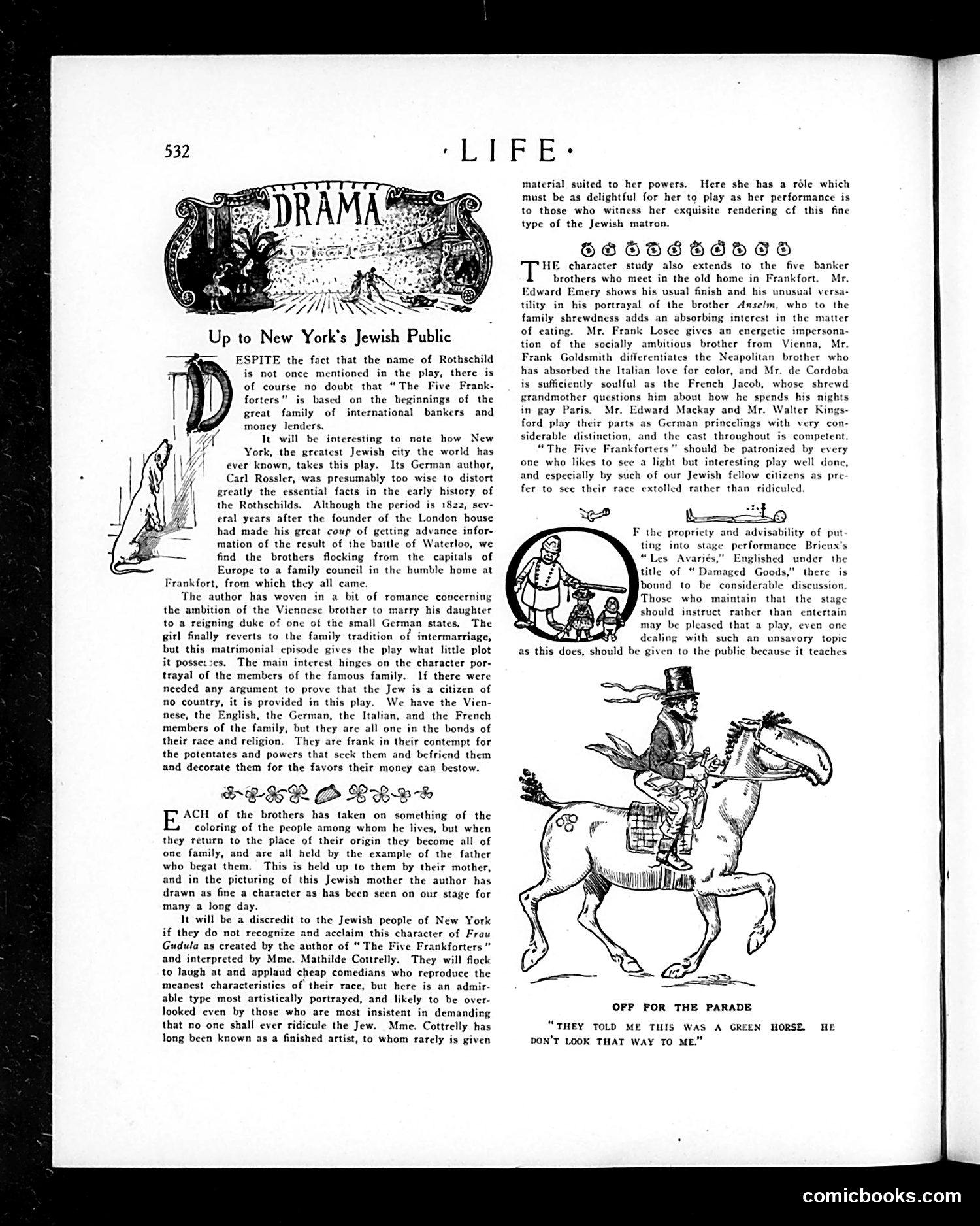
This is a theater review of a play based on the early history of the Rothschild banking family. The article discusses how a German playwright, Carl Rossler, dramatized the origins of this prominent Jewish dynasty, focusing on a family council in Frankfurt where brothers from across Europe (Vienna, England, Germany, Italy, France) reunite. The review praises the character portrayal of the Jewish mother, "Frau Gudula" (played by Mme. Mathilde Cottrelly), as a dignified representation of Jewish identity. It specifically appeals to New York's Jewish community to recognize and support this "admirable type artistically portrayed," contrasting it with stereotypical comedic caricatures of Jewish people. The illustrations appear to show period costume sketches related to the theatrical production. The review ultimately advocates for respecting serious, nuanced portrayals of Jewish characters on stage.
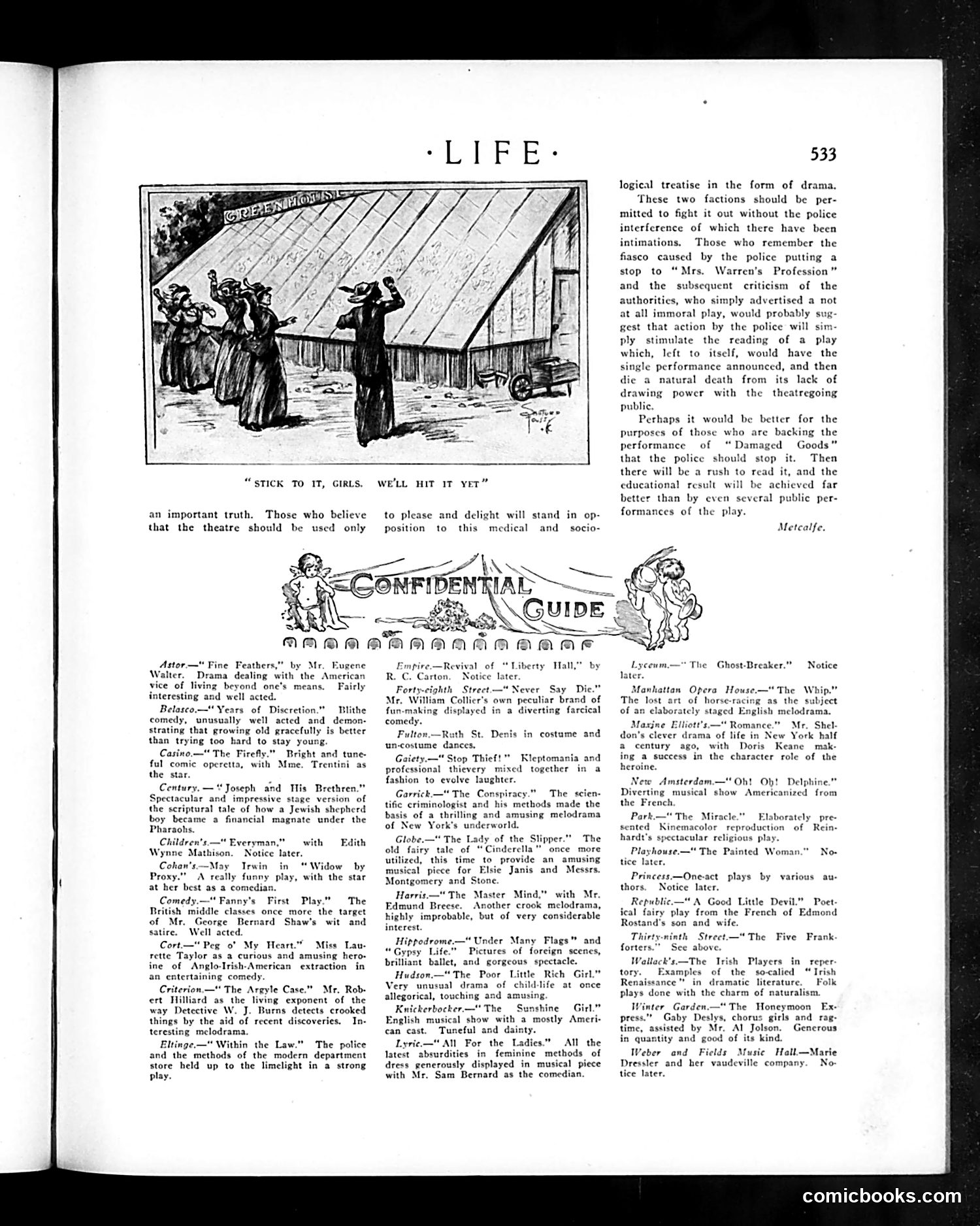
This page from *Life* magazine presents theater reviews alongside a single cartoon. The cartoon depicts women in what appears to be a warehouse or industrial space, with one man saying "STICK TO IT, GIRLS. WE'LL HIT IT YET"—likely satirizing labor organizing or a strike effort by working-class women. The accompanying text discusses theatrical censorship, specifically referencing the police suppression of Shaw's "Mrs. Warren's Profession" (a play about sex work). The author argues that police interference inadvertently *promotes* controversial plays by generating publicity, and that plays should be permitted to succeed or fail naturally with audiences. The bulk of the page lists Broadway theater reviews, offering brief critiques of contemporary productions. The "Confidential Guide" section was standard *Life* fare, providing entertainment recommendations. Overall, this page combines social commentary on censorship with entertainment coverage typical of the era's sophisticated humor magazine.
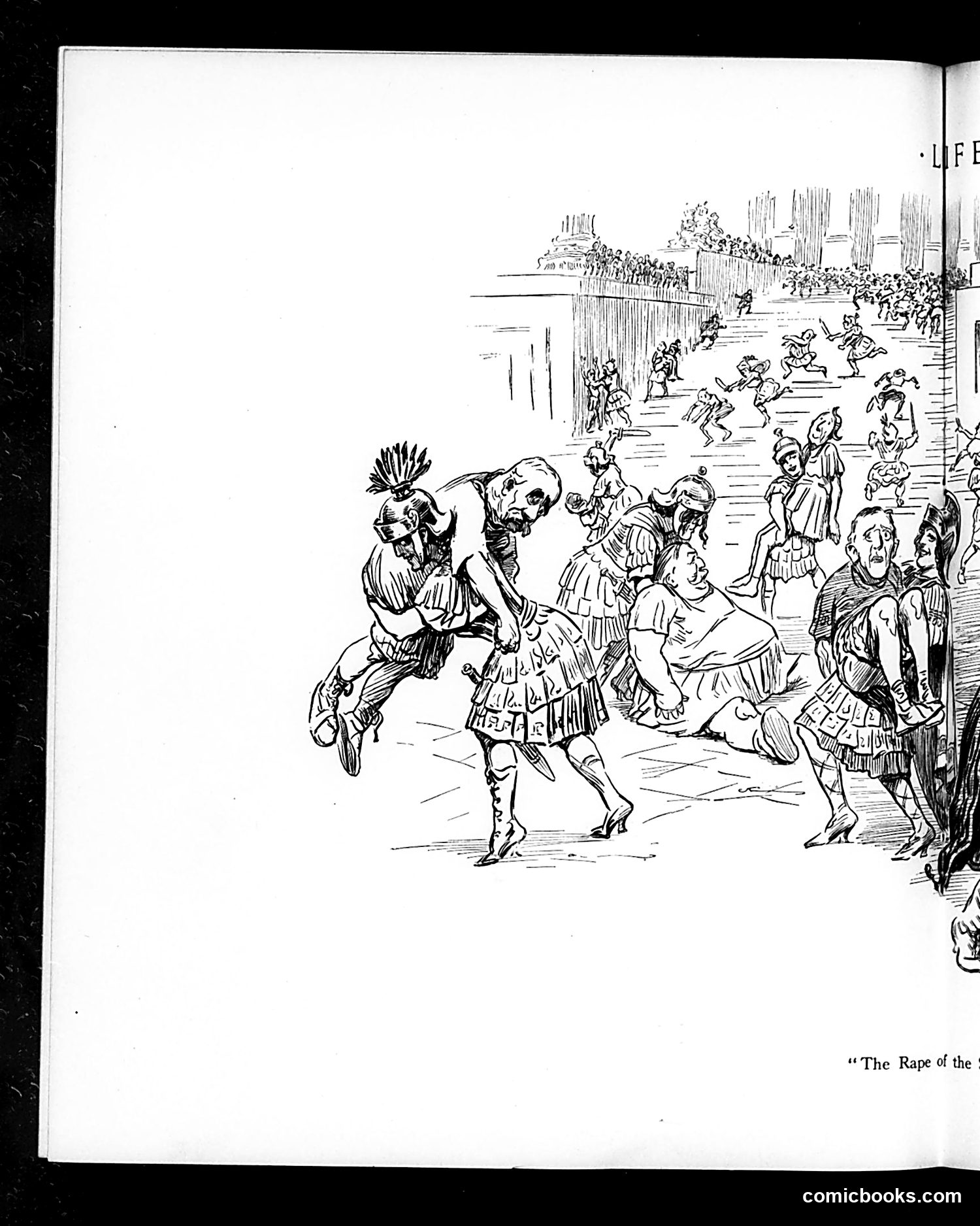
This page shows a classical theatrical scene with Roman or Greek military figures and civilians gathered in what appears to be a public space or arena. The title "The Rape of the [text cuts off]" references a classical subject matter—likely depicting a scene from classical mythology or history involving abduction. The sketch style is typical of early 20th-century Life magazine satire. The elaborate costumes, dramatic poses, and crowded background suggest this illustrates either a theatrical production or operatic performance of a classical drama popular during that era. Without the complete title or additional context, the specific political satire intended remains unclear. The rendering appears to mock or comment on theatrical presentations of classical material, though whether this critiques the production itself, contemporary politics via classical allegory, or audience tastes remains uncertain from this fragment alone.
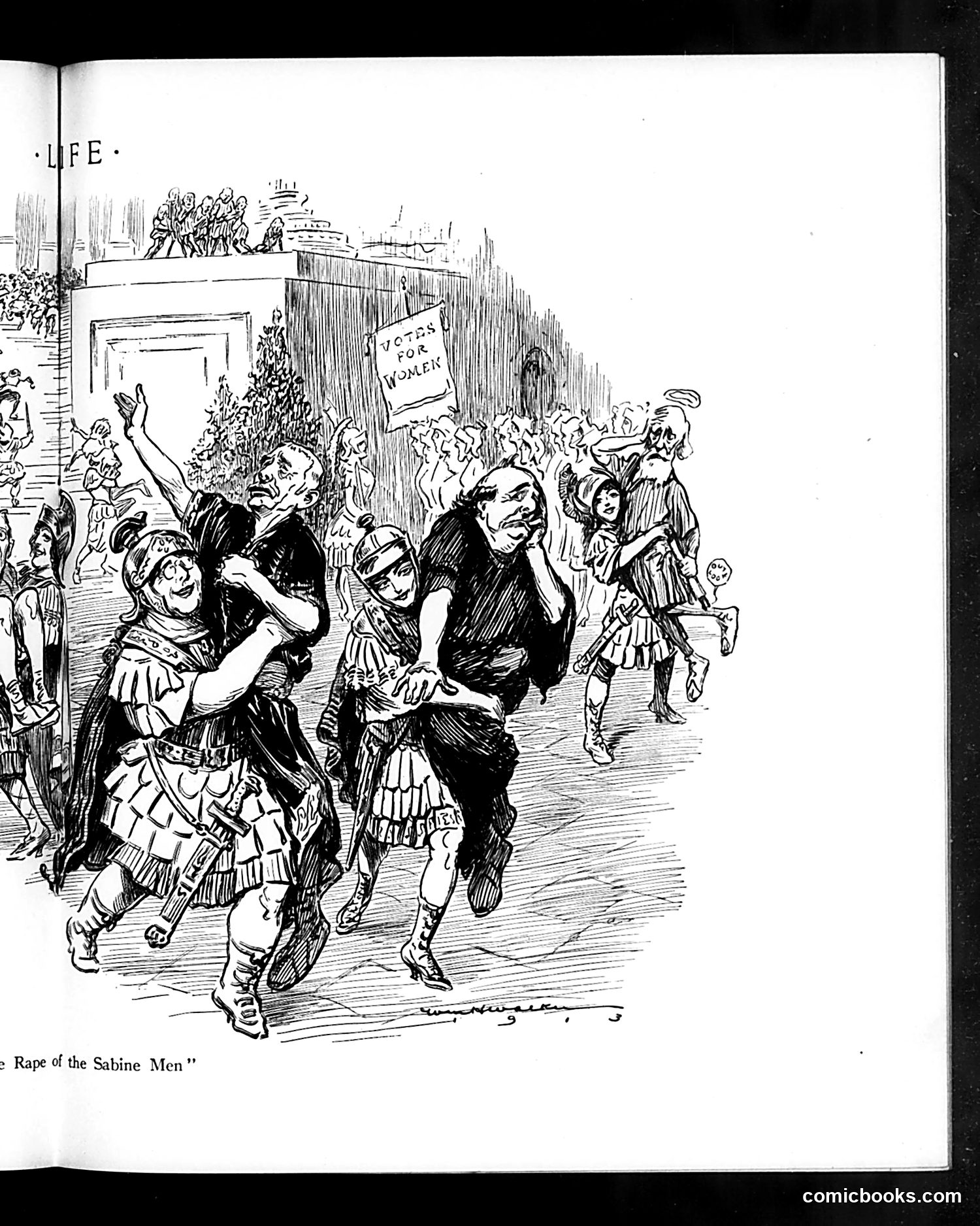
This cartoon is a satirical inversion of the classical "Rape of the Sabine Women" legend. Rather than depicting the historical Roman abduction of Sabine women, the artist reverses the scenario: here, women appear to be forcefully pursuing or "abducting" men. A visible sign reads "VOTES FOR WOMEN," indicating this is suffrage-era satire (likely early 1900s). The cartoon mocks women's voting rights advocates by suggesting that female political empowerment represents a threatening reversal of traditional gender roles—portraying women as aggressors rather than passive subjects. The exaggerated, somewhat grotesque depictions of the pursuing women was typical of anti-suffrage propaganda, using humor and caricature to ridicule the movement and those supporting women's political equality.
This is primarily a **book review and literary criticism page**, not a political cartoon. The decorative header "The Latest Books" features cherubs with a printing press—a whimsical touch typical of Life's design. The main essay discusses how we approach art and living, arguing that "art" and "business" should be viewed equally as fundamental life activities, not separated by pretense. The author criticizes the artificial capitalization and reverence we give "Art" while treating life practically. The page then lists contemporary book reviews, including works by Auguste Rodin, Milton C. Work, Ida M. Tarbell, Max Beerbohm, James Stephens, and George Moore. These reviews are straightforward literary criticism without apparent satire. **The satire here is subtle and intellectual**—mocking the pretentiousness of high-brow culture rather than specific political figures or events.
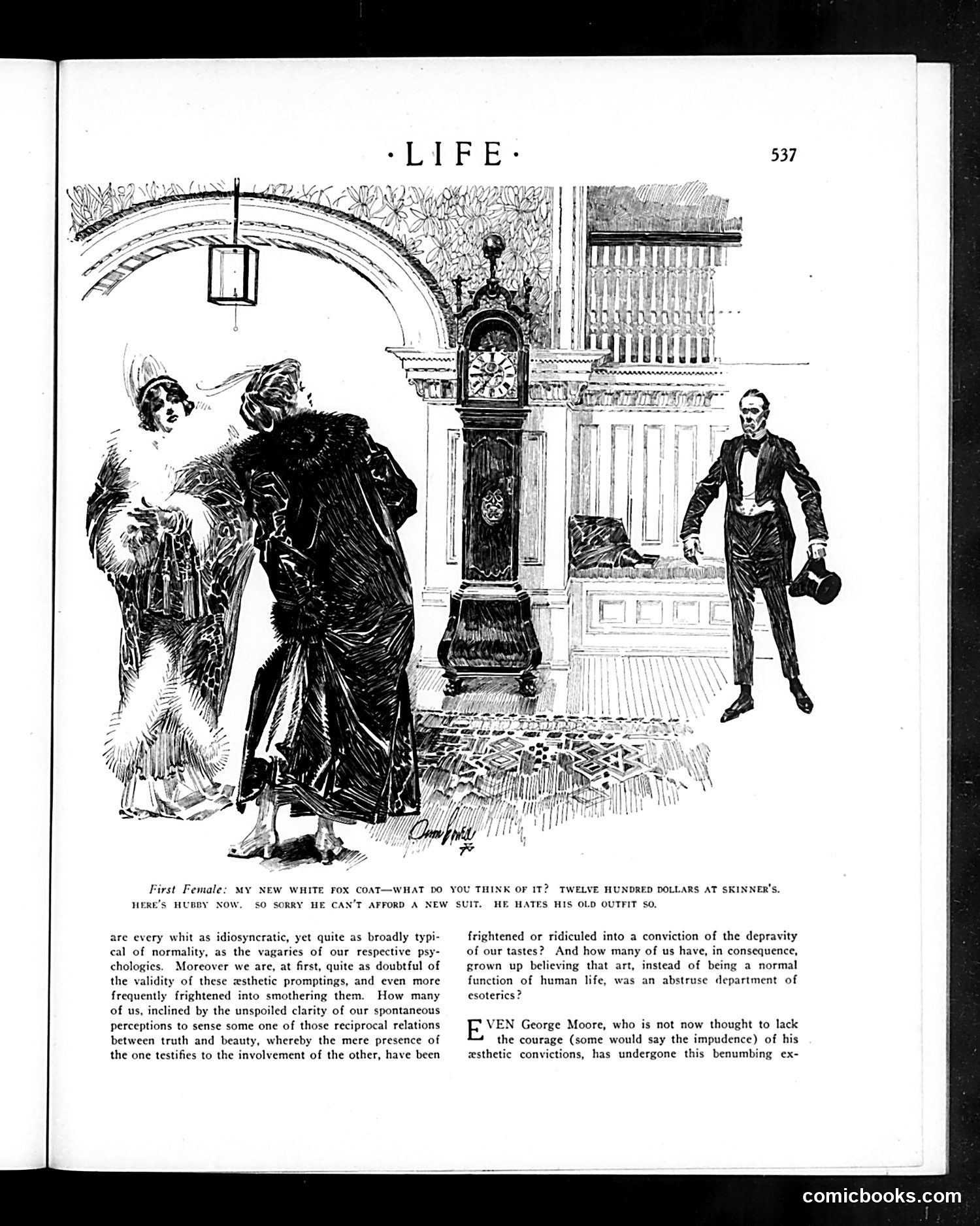
This satirical illustration critiques marital economic inequality and gender dynamics. A woman proudly displays her expensive new white fox coat (costing $1,200 at Skinner's department store) to another woman. Behind them stands her husband, who cannot afford a new suit and must wear his old outfit, which he apparently despises. The joke targets the absurdity of wives' luxury spending while husbands lack basic necessities. It satirizes either the husband's financial irresponsibility in allowing such extravagance, or—more likely—critiques the social expectation that wives control household spending on frivolous fashions while men's needs go unmet. The accompanying article discusses aesthetic judgment and social conformity, suggesting the broader satire concerns how people prioritize superficial status symbols over practical family welfare.
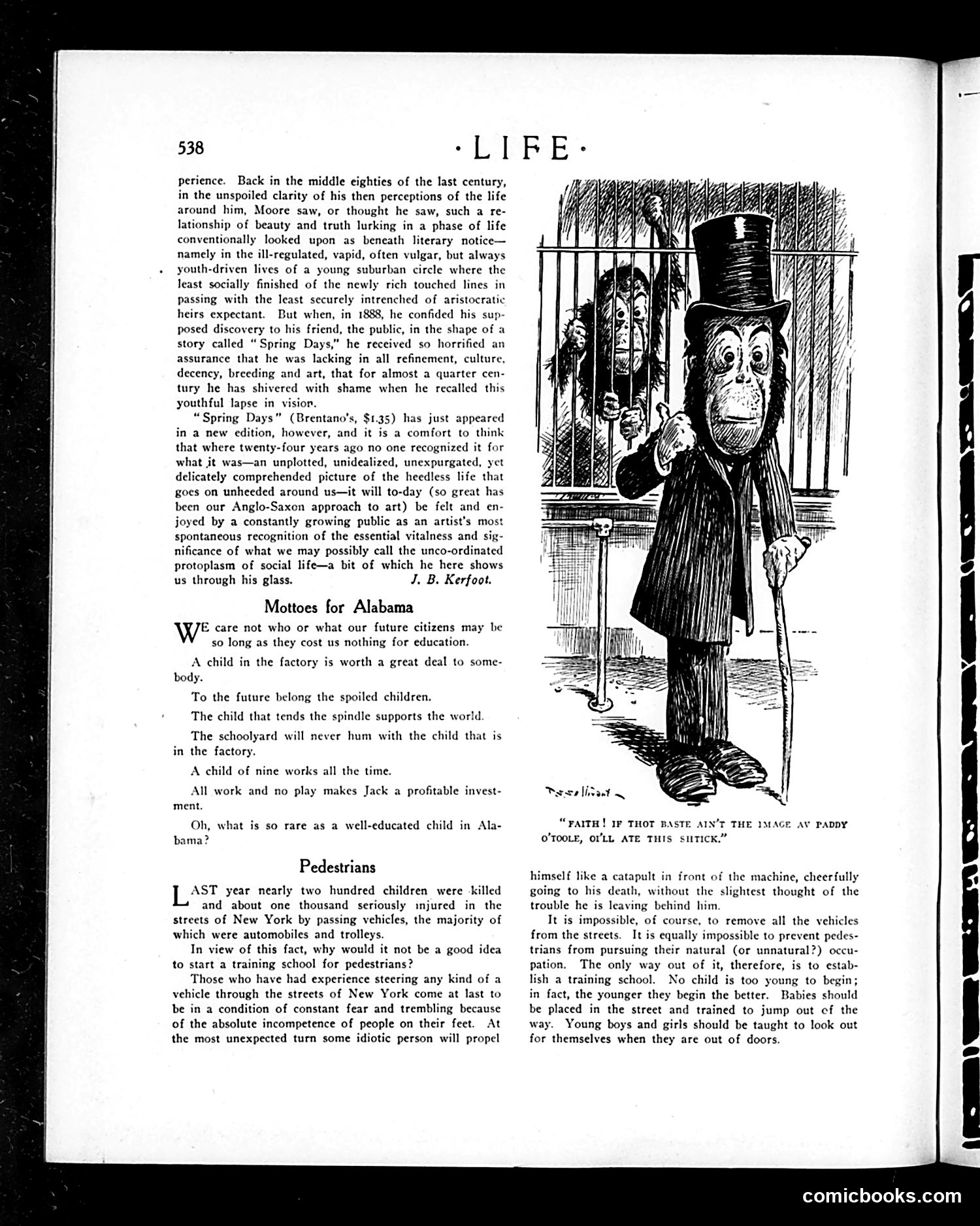
This page contains three distinct sections satirizing American society: **Top illustration**: A caricatured Irish immigrant (identifiable by the exaggerated features and dialect caption) peers through a fence at what appears to be monkeys. The caption suggests mistaking the animals for fellow Irish ("Paddy O'Toole"), mocking Irish immigrants through crude ethnic stereotyping common to the era. **"Mottoes for Alabama"**: Bitter sarcasm attacking child labor practices in Southern mills. Each "motto" inverts moral values—celebrating factory work over education, treating children as profitable investments rather than human beings. This directly critiques Alabama's industrial exploitation of child workers. **"Pedestrians"**: Satirizes New Yorkers' dangerous street behavior amid increasing automobile traffic. The piece proposes absurdly training infants and children to navigate traffic rather than regulating vehicles, mocking both pedestrian recklessness and the period's inability to adapt social behavior to new transportation technology. All three sections use satire to expose social problems: ethnic prejudice, child labor, and urban safety failures.
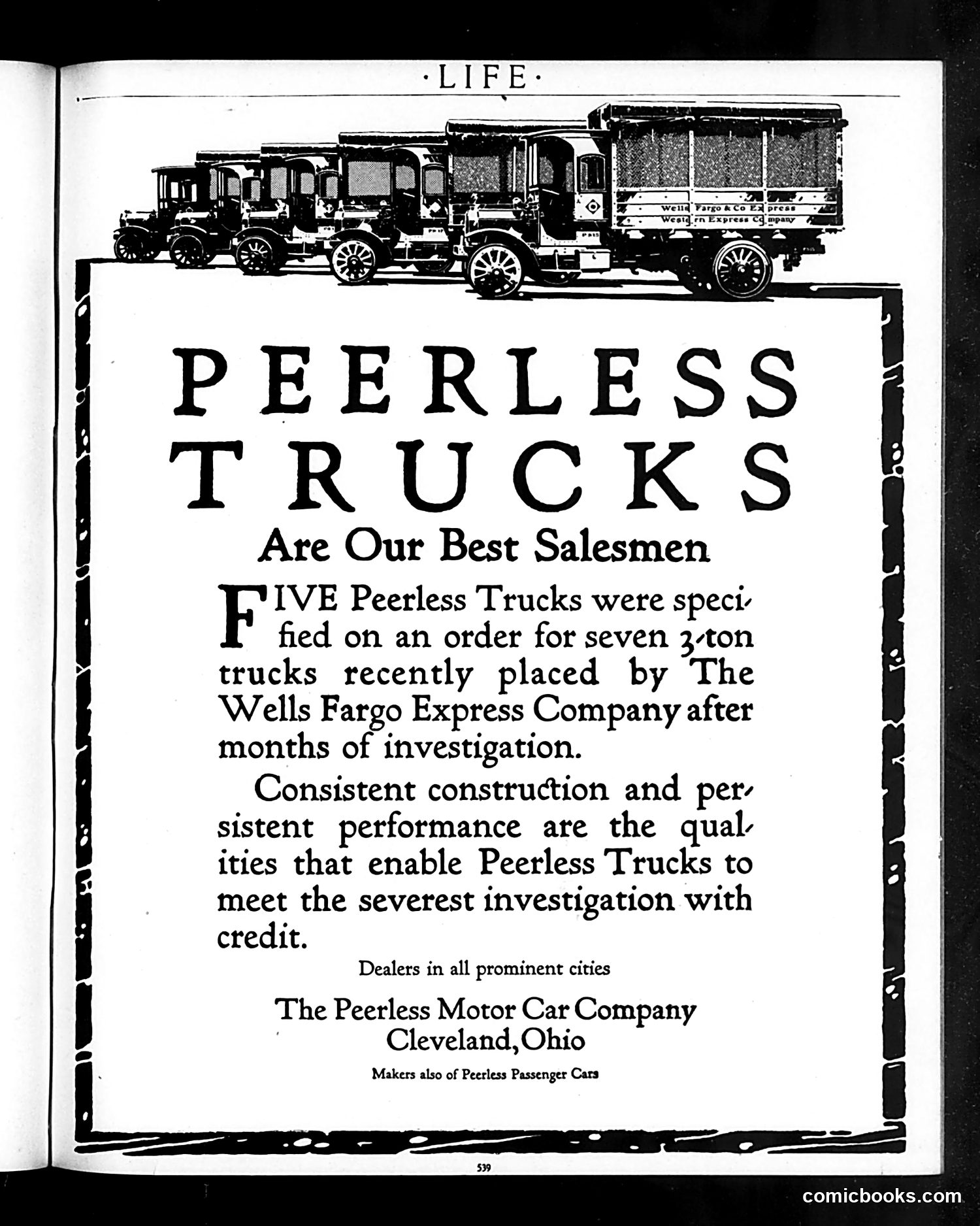
This is a straightforward **product advertisement**, not satire or political commentary. It promotes Peerless Motor trucks manufactured in Cleveland, Ohio. The ad claims that Wells Fargo Express Company—a major, prestigious shipping firm—selected five Peerless trucks after months of investigation, implying rigorous testing validated the product's quality. The headline "Peerless Trucks Are Our Best Salesmen" suggests the trucks' proven performance serves as their own marketing. The illustration shows a progression of trucks, likely representing different models or the fleet in use. For modern readers: This represents early 20th-century industrial advertising, where endorsements from established companies like Wells Fargo carried significant weight. The emphasis on "investigation" and "severest" testing reflects contemporary concerns about vehicle reliability when automotive technology was still developing. The ad appears in *Life* magazine's advertising section.
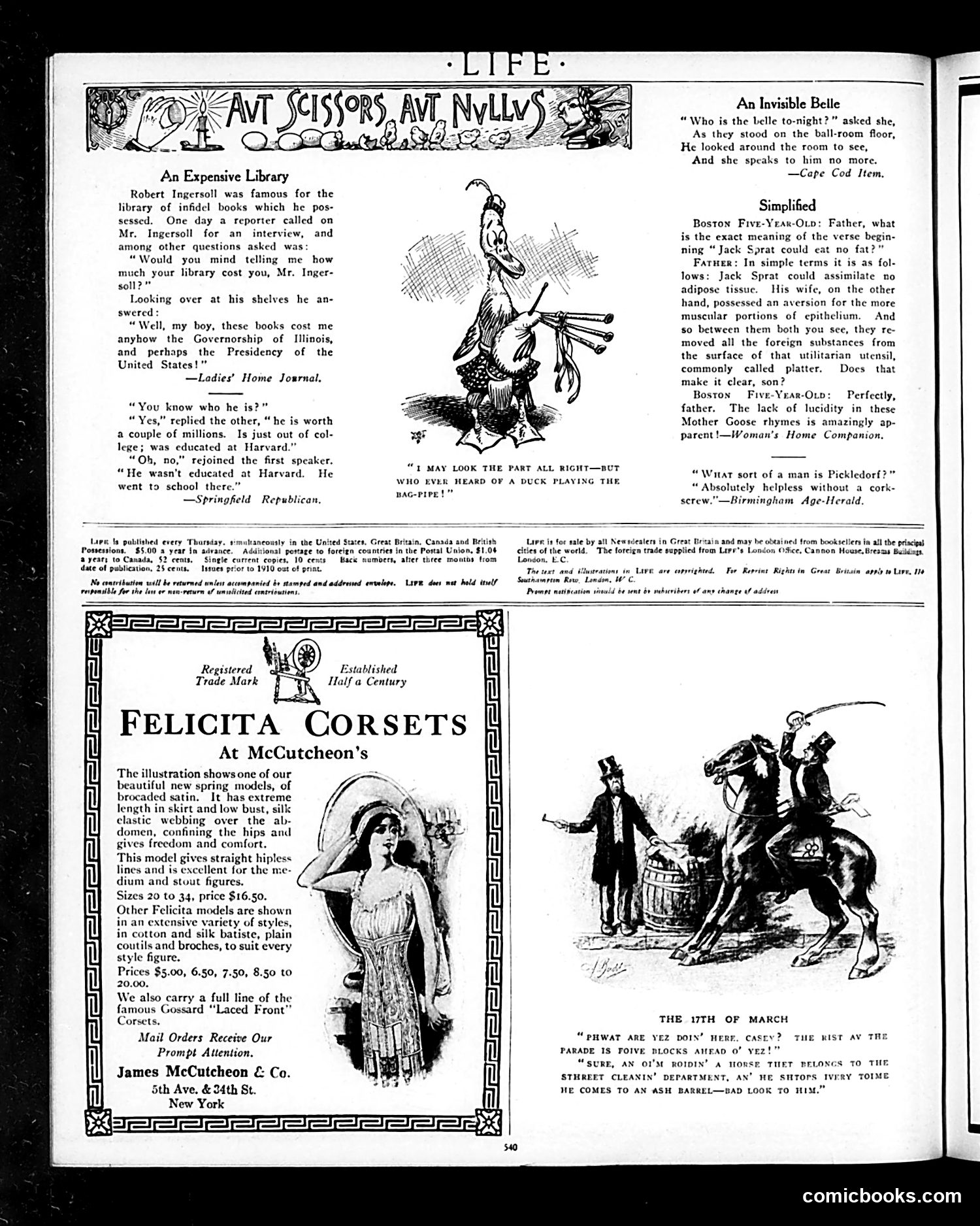
This page contains several short humorous pieces typical of early 20th-century American satire magazines: **"An Expensive Library"** mocks Robert Ingersoll, a famous atheist and orator, quoting his claim that his collection of "infidel books" cost him political opportunities—the Illinois governorship and perhaps the U.S. presidency. The joke satirizes both Ingersoll's priorities and the religious prejudice that would exclude a freethinker from high office. **"Simplified"** ridicules overly intellectual parents who use unnecessarily complex language (adipose tissue, epithelium) when explaining simple nursery rhymes to children. **"An Invisible Belle"** is a brief romantic joke about a woman ignored because she's not visibly attractive. **"The 17th of March"** features Irish-dialect humor about a street-cleaner riding a horse during a St. Patrick's Day parade. The page also includes a Felicita Corsets advertisement and miscellaneous jokes. The content reflects period attitudes toward religion, education, ethnicity, and gender typical of 1910s American humor.
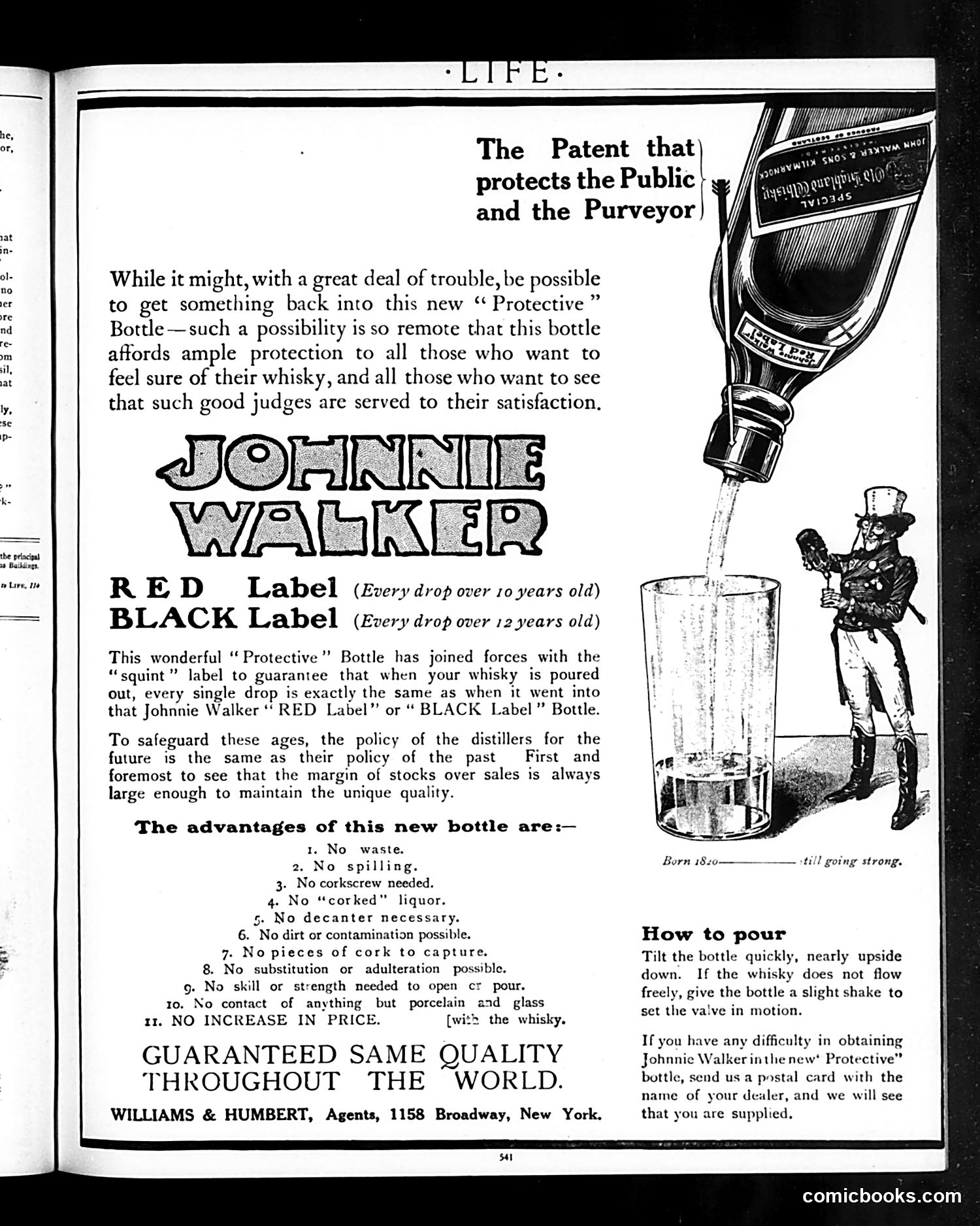
This is primarily a **Johnnie Walker whisky advertisement**, not political satire. The page promotes a new patented bottle design featuring a valve mechanism. The humor is gentle and commercial rather than satirical. The illustration shows a jovial figure (the Johnnie Walker "squint" label mascot—the brand's long-standing mascot) pouring whisky from the innovative bottle into a glass. **Key selling points advertised:** - The bottle prevents tampering, spoilage, and contamination - No corkscrew, decanter, or special skill needed - Guarantees consistent quality and age (Red Label: 10+ years; Black Label: 12+ years) - No price increase The ad's ironic tone ("The Patent that protects the Public and the Purveyor") suggests gentle mockery of competitors' inferior packaging, implying their products suffer from adulteration or deterioration—a common concern in early 20th-century spirits commerce before modern quality controls. The "Born 1820—till going strong" tagline emphasizes the brand's longevity and reliability.
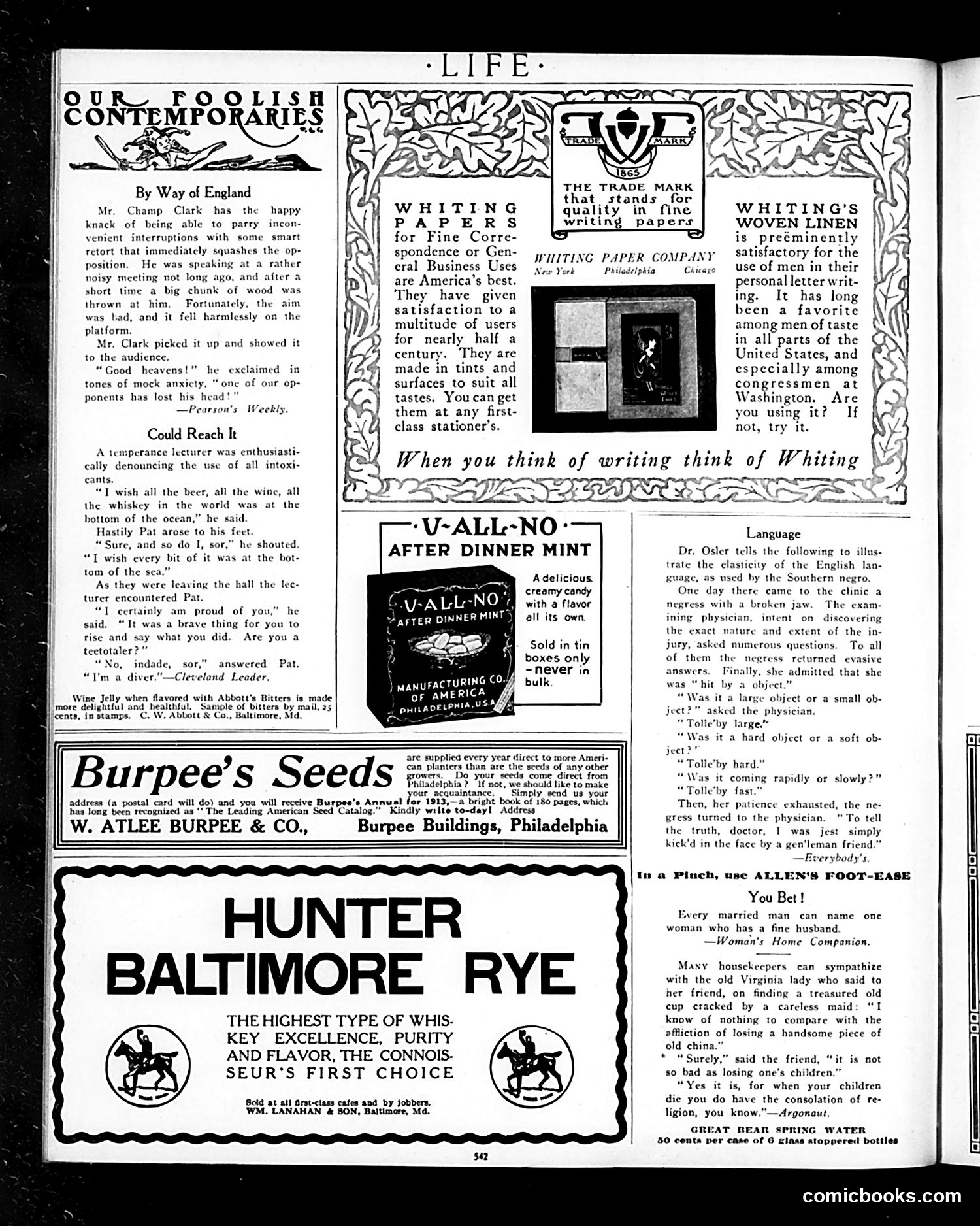
This page from *Life* magazine contains three humor pieces satirizing contemporary figures and situations: **"By Way of England"** mocks **Champ Clark** (U.S. politician), claiming he cleverly deflected heckling at a speech by picking up a wooden chunk someone threw and quipping that "one of our opponents has lost his head." The satire suggests Clark's opponents are foolish. **"Could Reach It"** is an ethnic joke about an Irish man ("Pat") at a temperance lecture. When the lecturer wishes all alcohol were at the ocean bottom, Pat enthusiastically agrees—revealing he's a "diver," implying he'd retrieve it. The humor relies on stereotyping Irish immigrants as alcoholics. **"Language"** presents a brief anecdote about a Southern Black woman's dialect, finding humor in her repetitive, supposedly awkward phrasing ("Tolle'by") when describing injuries. This reflects period racism in *Life*'s treatment of African Americans. The page is primarily **advertising** (Whiting Papers, seeds, whiskey, candy), with satire filling remaining space.
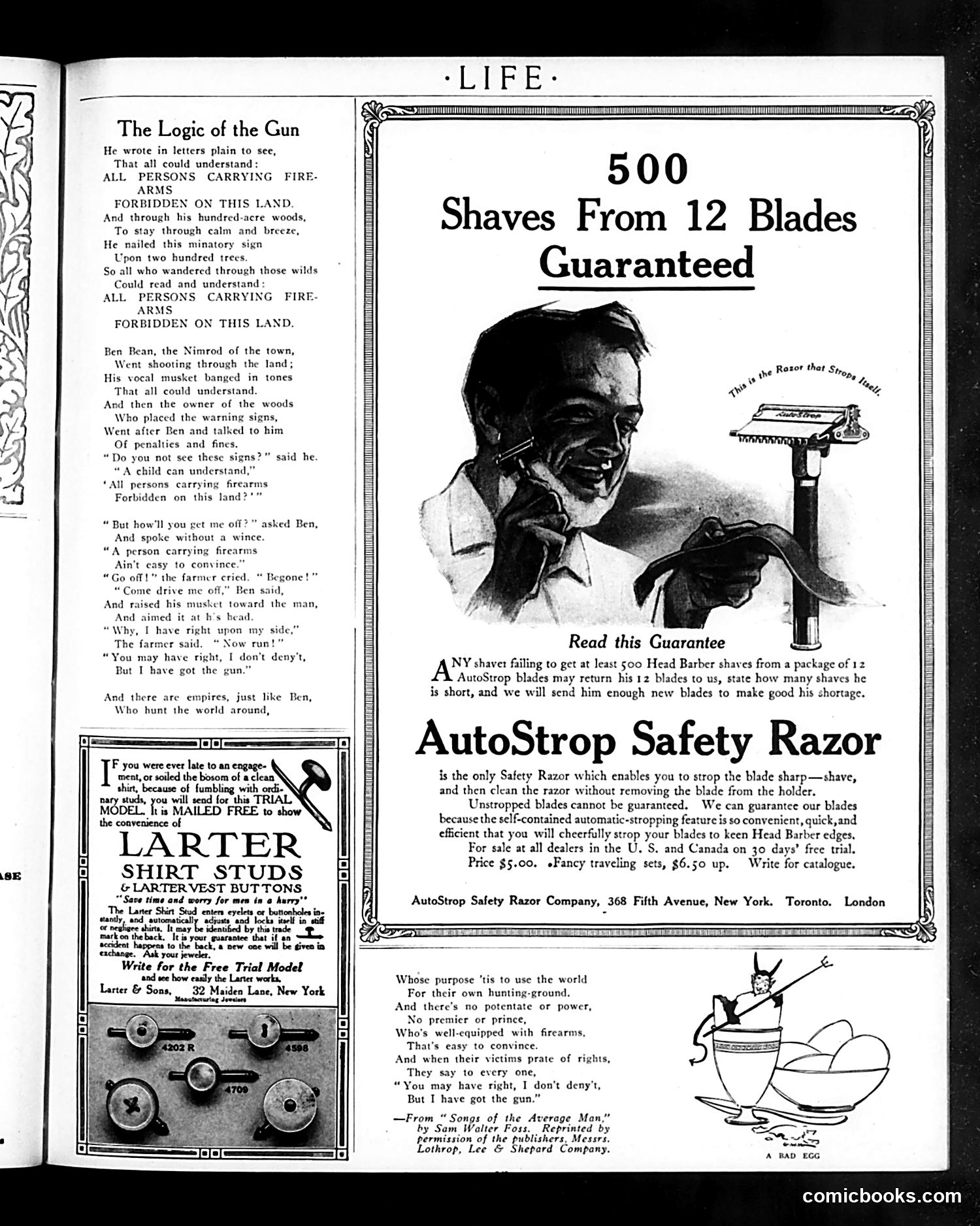
This poem satirizes imperial power and militarism through a parable. A landowner posts signs forbidding firearms on his property, but Ben Bean ignores them and hunts anyway. When confronted, Ben refuses to leave, claiming "I have got the gun"—making physical force the ultimate argument. The poem then explicitly extends this to nation-states: empires operate like Ben, disregarding laws and rights because they possess military power. The satirical point is that international relations, despite claims of law and justice, ultimately rest on military might. Whoever has "the gun" wins, regardless of moral or legal right. This likely reflects early-20th-century anxieties about imperialism and the logic of great-power politics—a critique that "might makes right" governs both rural confrontations and global affairs. The satire exposes the hollowness of civilized rules when backed by no enforcement mechanism against the powerful.
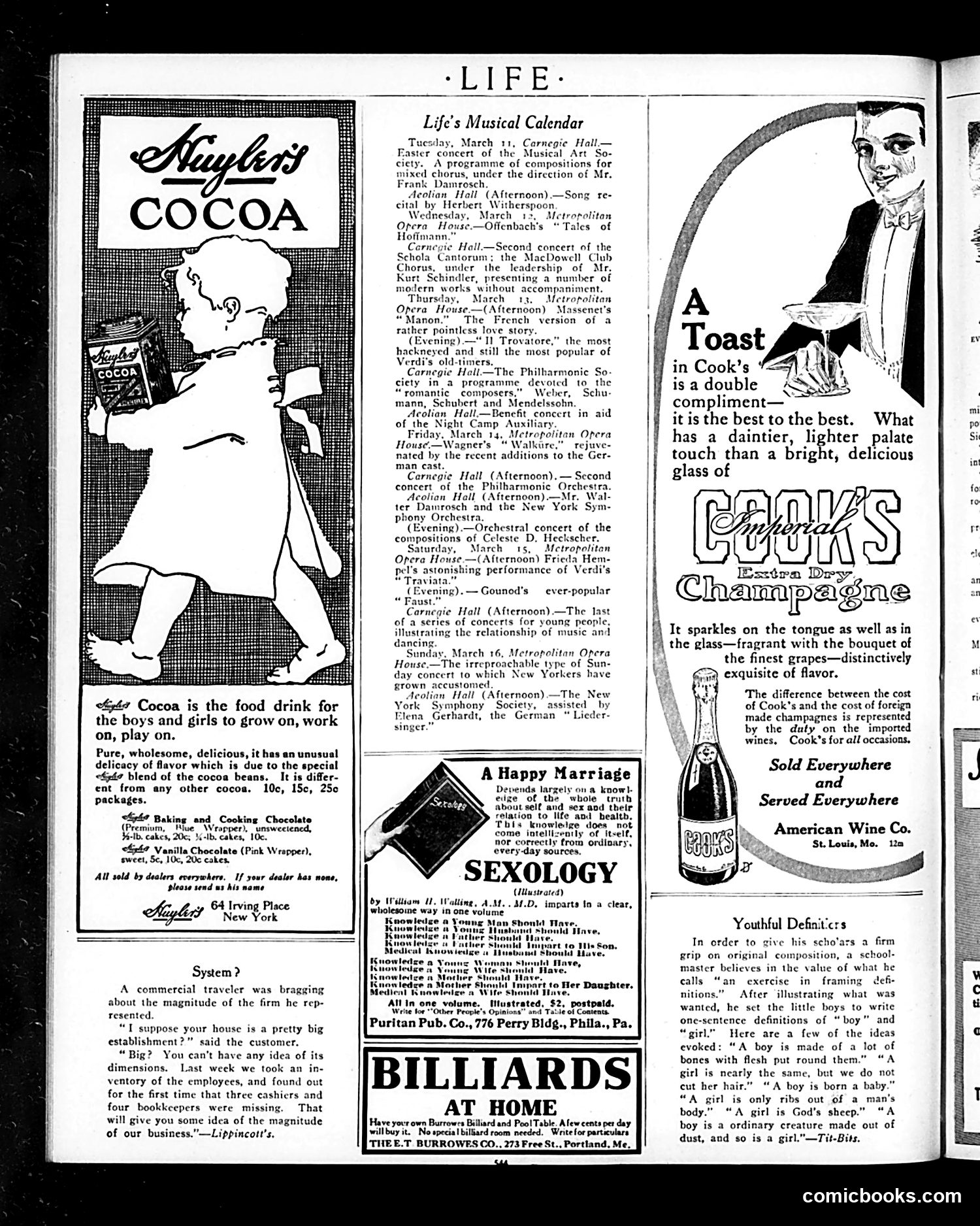
This page is primarily **advertising and entertainment listings**, not political satire. The main content includes: **Advertisements:** Neylist's Cocoa (featuring a cherub-like child), Cook's Champagne, billiards tables, and a "Sexology" instructional book—typical early 20th-century product placements. **"Life's Musical Calendar":** A comprehensive listing of New York concerts and opera performances (March 11-16), indicating the magazine's urban, culturally affluent readership. **Humor Section:** A brief joke about a commercial traveler boasting his company is "so big" they didn't notice three cashiers and four bookkeepers were missing—a gentle satire on corporate inefficiency and bureaucratic absurdity. **"Youthful Definers":** A lighthearted segment where children provide humorous definitions (e.g., "A boy is made of a lot of bones with flesh put around"). The page reflects *Life*'s identity as a magazine for educated, urban Americans interested in culture, business humor, and consumer goods.
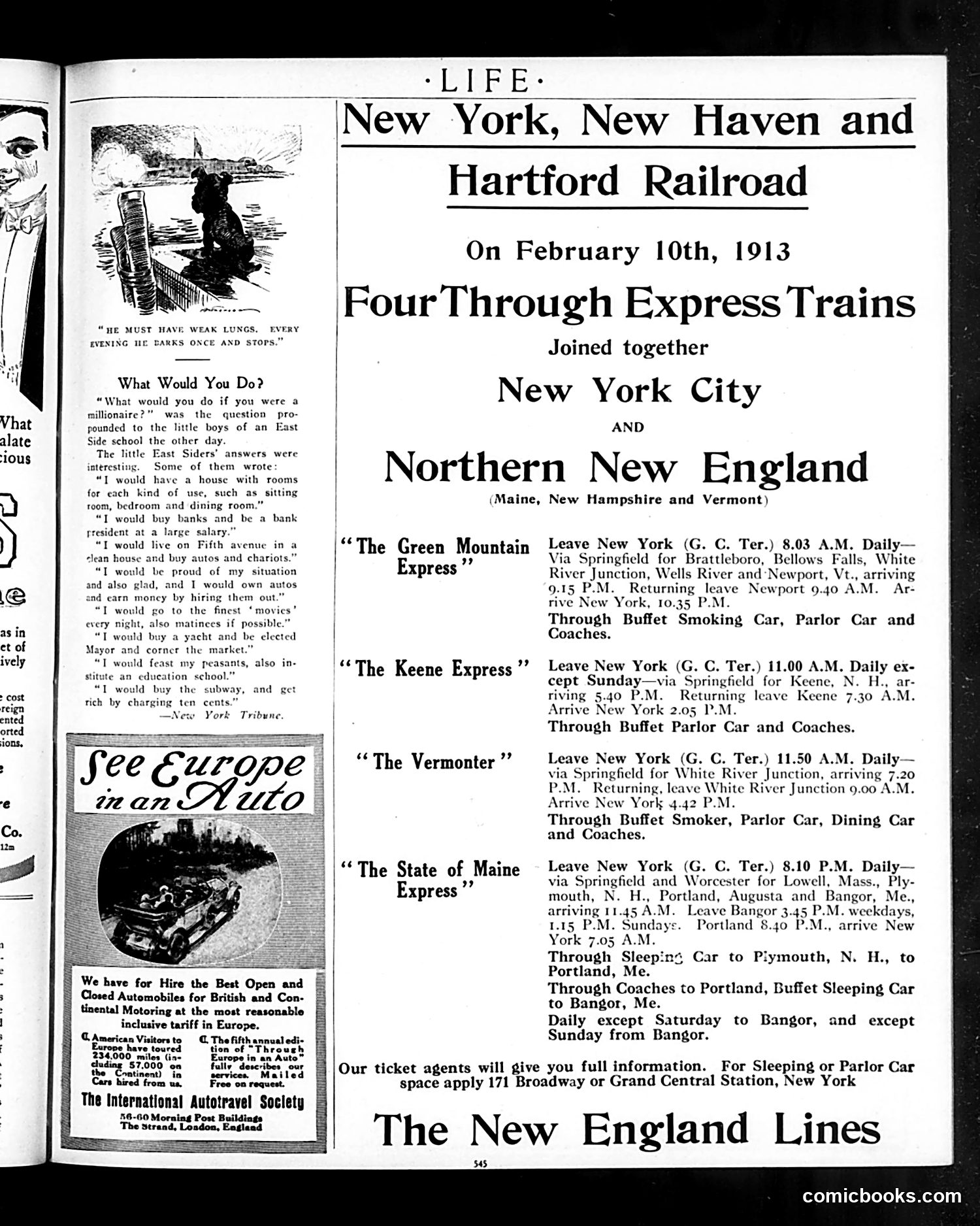
The cartoon on the left satirizes the answers given by poor East Side schoolboys (likely immigrant children) when asked "What would you do if you were a millionaire?" Their responses—buying banks, mansions on Fifth Avenue, subways, yachts, and "feasting peasants"—reveal both innocent ambition and naive understanding of wealth and power. The satire works on multiple levels: the children's dreams reflect American capitalist values they've absorbed, yet their answers (like "hiring out" autos for profit, or cornering markets) show they've learned ruthless business practices. The reference to "weak lungs" and the evocative illustration of a hunched child suggest these are sickly slum children. The piece gently mocks both the children's earnest materialism and, implicitly, the social system that teaches poor immigrant youth that wealth and exploitation are life's ultimate goals.
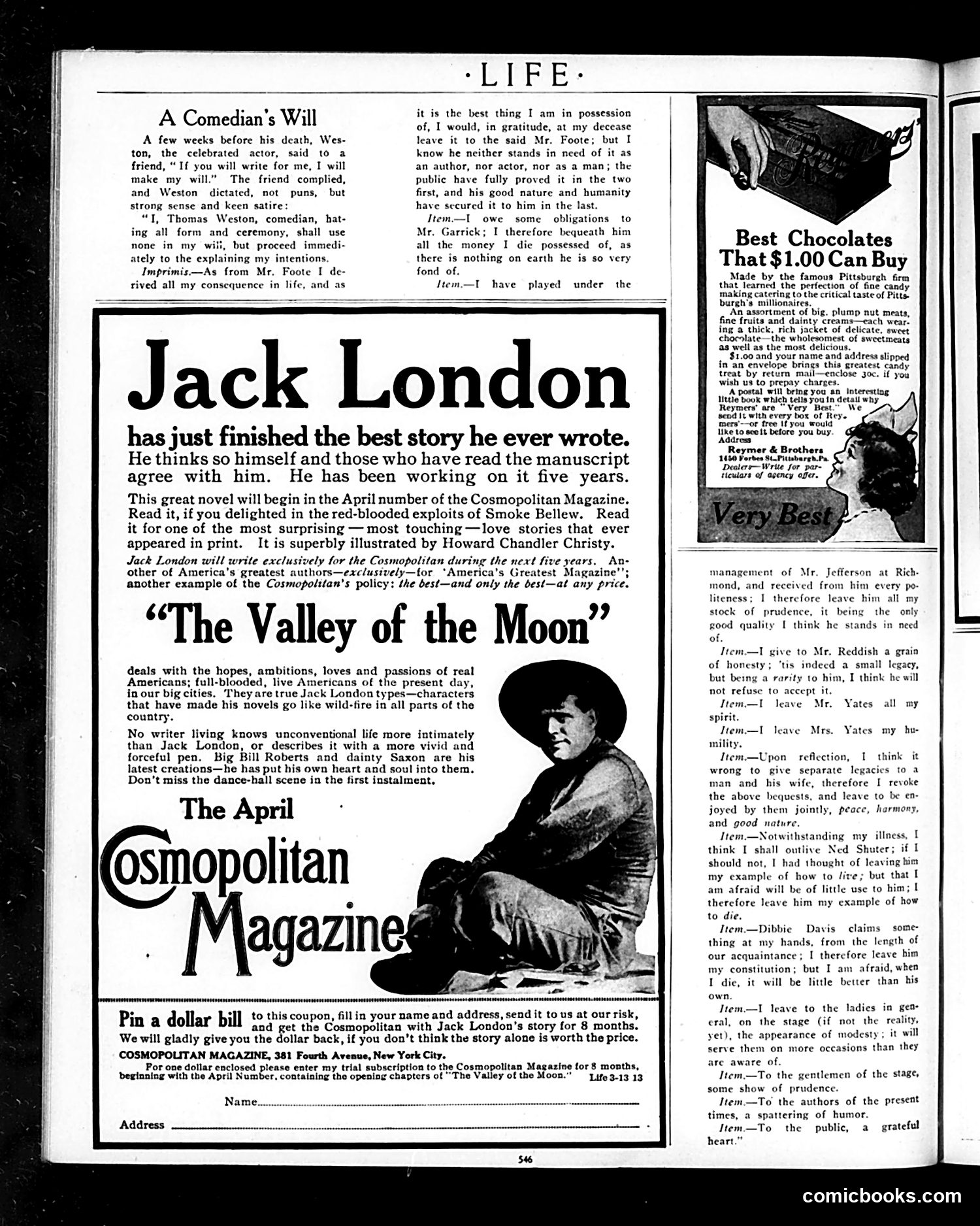
This page primarily contains **advertising and promotional content** rather than political satire or cartoons. The main feature is an advertisement for Jack London's serialized novel "The Valley of the Moon," appearing in the April issue of Cosmopolitan Magazine. The text promotes London as America's greatest author, emphasizing his exclusive five-year contract with Cosmopolitan. The accompanying photograph shows a man in period clothing, presumably representing a character from the novel. At the top is "A Comedian's Will"—a historical piece about actor Thomas Weston's actual will, notable for its witty bequests to fellow performers Foote and Garrick, written with satirical humor rather than formal language. The right column contains a chocolate advertisement for "Reymers," a Pittsburgh candy maker. **For modern readers**: This reflects early 20th-century magazine culture where serialized fiction drove subscriptions, and literary celebrity endorsements were major marketing tools. The Weston anecdote represents 18th-century theatrical humor and professional relationships.
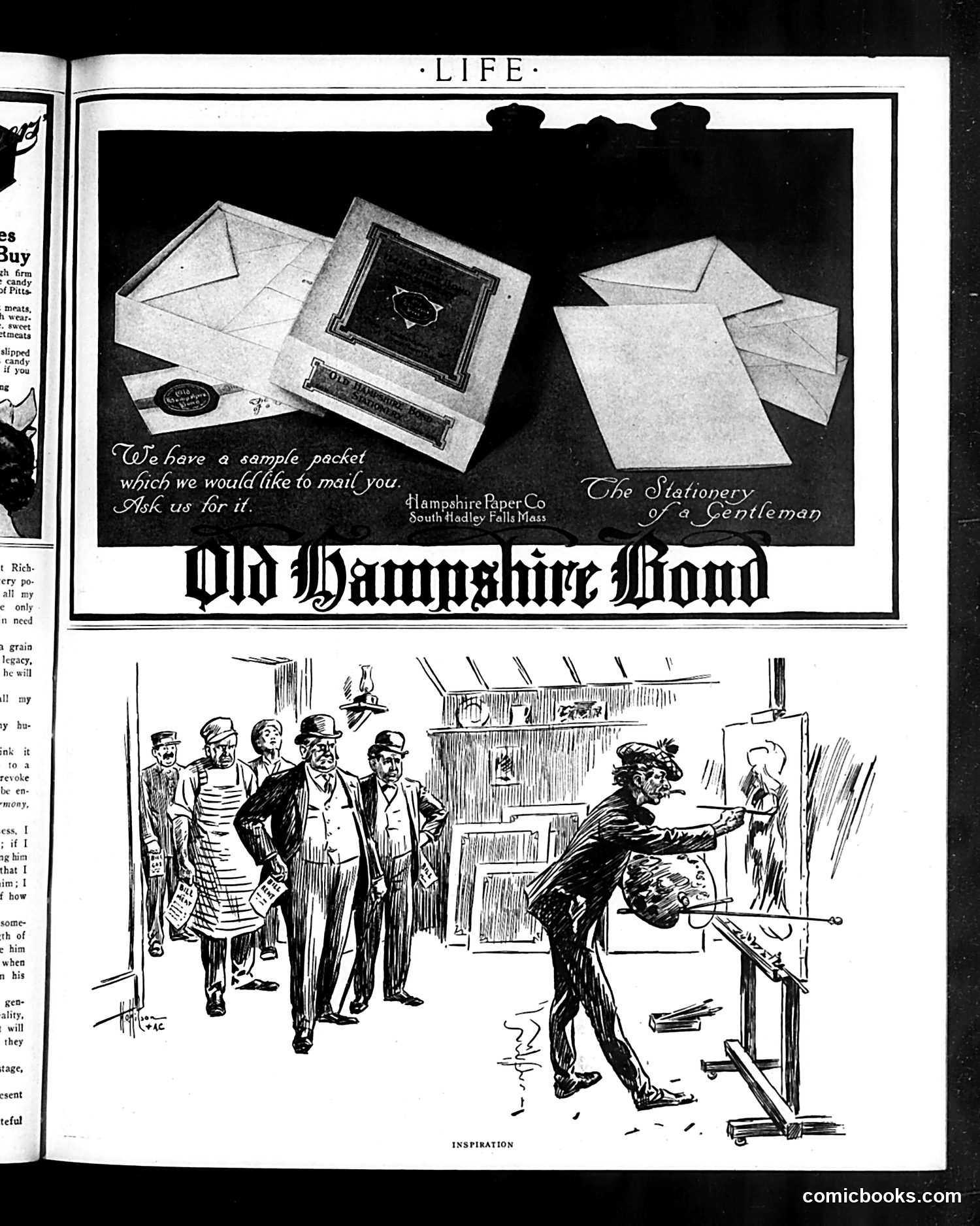
This page combines advertising with a satirical cartoon. The top section is a **stationery advertisement** for Hampshire Paper Co., showing elegant letterhead and envelopes—marketed as "The Stationery of a Gentleman." The lower cartoon, titled "INSPIRATION," depicts a **street artist or caricaturist** sketching passersby. A group of well-dressed men in suits and hats (appearing to represent typical gentlemen or businessmen) watch as the artist frantically draws at an easel. The satire seems to mock the contrast between the refined "gentleman's stationery" advertised above and the lower-class street artists who operate publicly. The cartoon likely critiques either artistic pretension, social climbing, or the commercialization of culture—suggesting that even street sketchers aspire to genteel status.
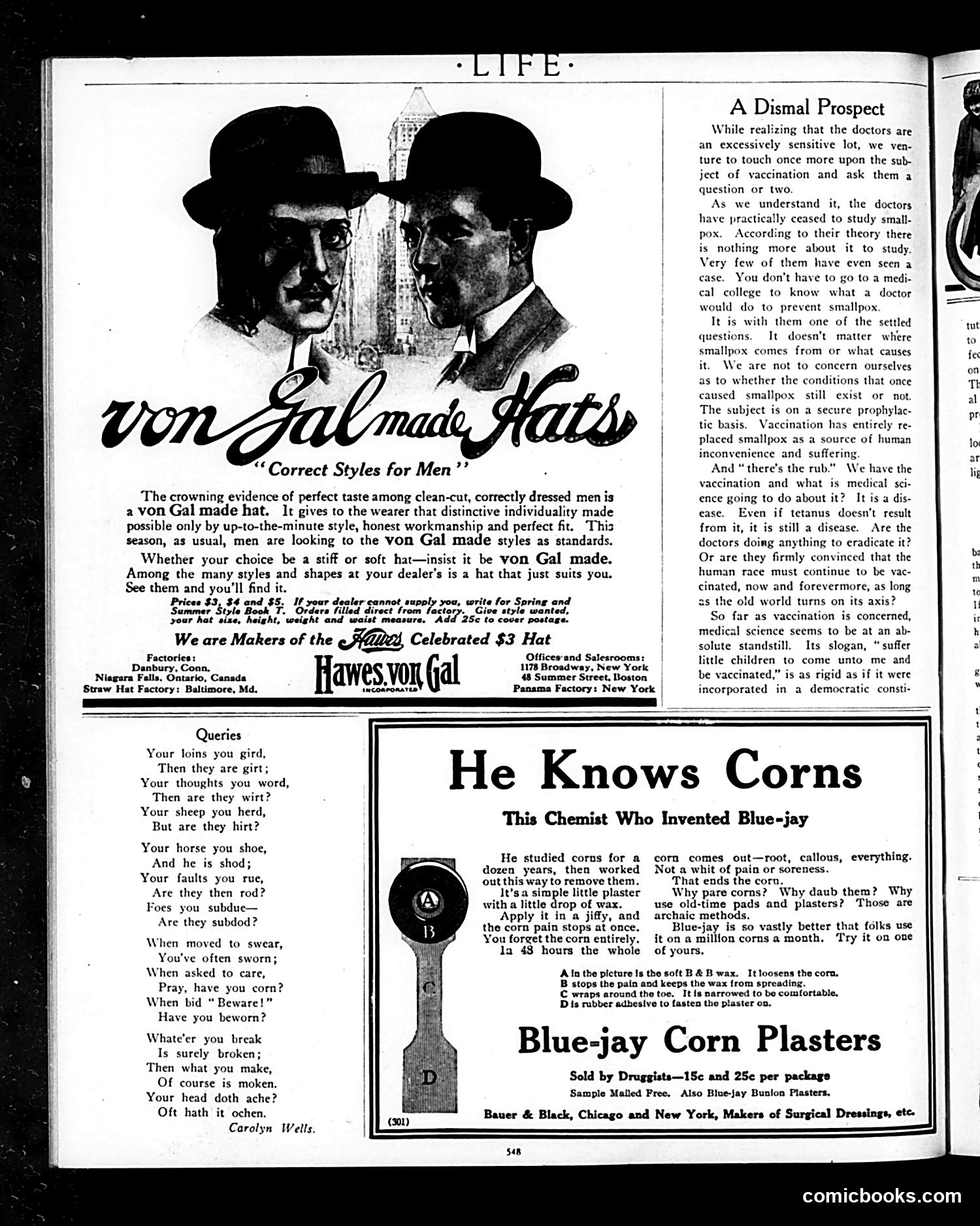
This page contains editorial satire about vaccination alongside period advertisements. **The Editorial Cartoon/Essay ("A Dismal Prospect"):** Life's editors satirize doctors for treating smallpox vaccination as a settled scientific question requiring no further study. The piece mocks physicians for treating vaccination as dogma—"suffer little children to come unto me and be vaccinated"—rather than continuing rigorous medical investigation. The editors argue doctors have abandoned serious inquiry into whether vaccination's original conditions still exist or whether better preventative methods might emerge. The satire suggests medical science has become complacent, treating vaccination as an unquestionable democratic institution rather than an evolving science. **The Advertisements:** The von Gal hat ad and Blue-jay Corn Plasters are standard period product promotions with no satirical content. **The Poetry ("Queries"):** Carolyn Wells' light verse about word transformations is unrelated filler material. This reflects early 20th-century skepticism about mandatory vaccination programs, a recurring public debate.
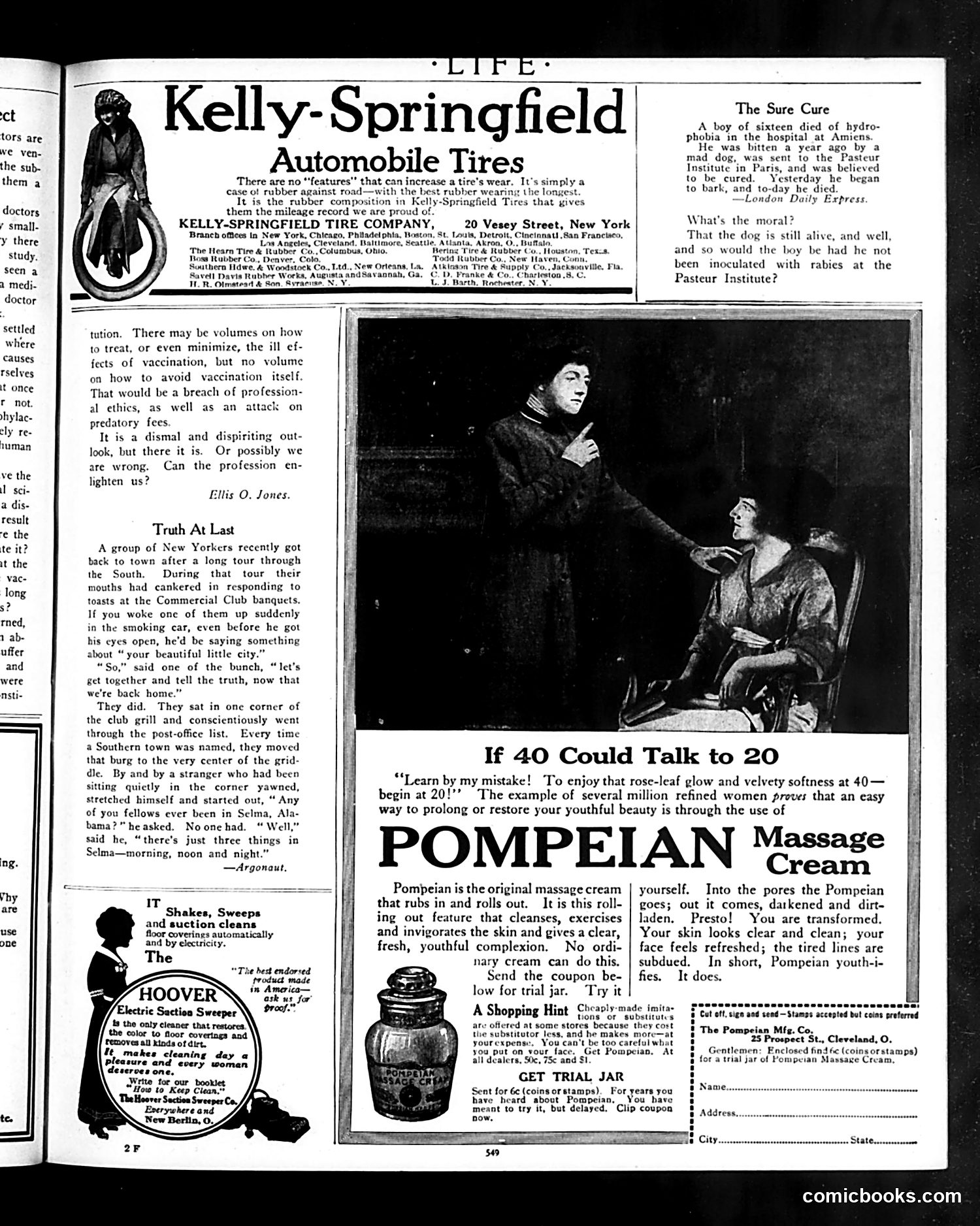
This page is primarily **advertising**, not political satire. It contains three main advertisements: 1. **Kelly-Springfield Automobile Tires** — a standard product ad emphasizing rubber composition and durability. 2. **Pompeian Massage Cream** — the dominant advertisement featuring a photograph of two women with the headline "If 40 Could Talk to 20." This pitches anti-aging skincare to women, promising to restore "youthful beauty" through massage cream. The messaging reflects early 20th-century beauty culture targeting female vanity and age anxiety. 3. **Hoover Electric Suction Sweeper** — a vacuum cleaner ad. The page also includes brief satirical articles like "Truth At Last" (poking fun at insincere Southern hospitality toasts) and "The Sure Cure" (a medical anecdote). However, these are minor editorial content amid advertising. The page represents typical Life magazine content from this era: mixing light social commentary with commercial promotions targeting middle-class consumers.
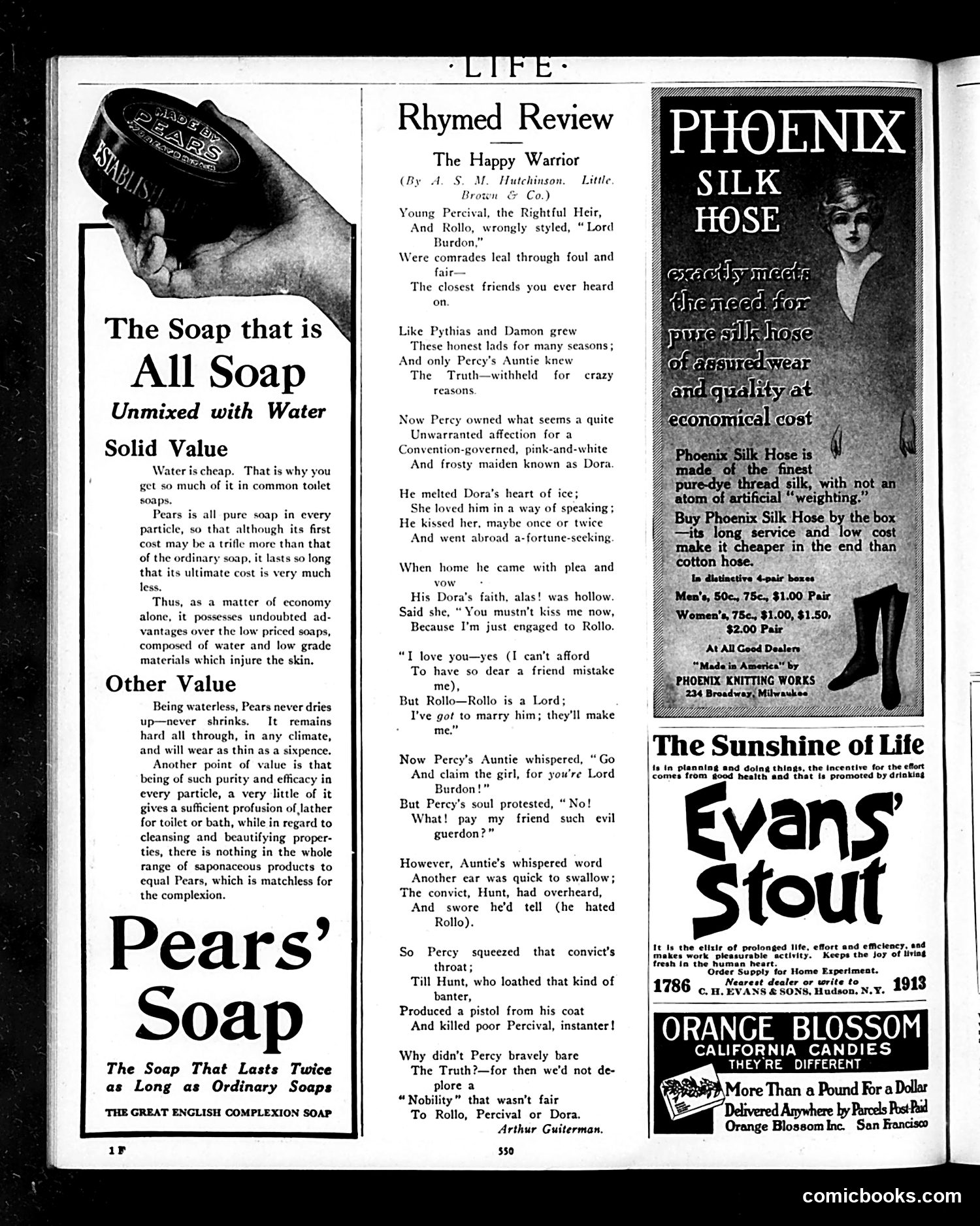
This page is primarily **advertising**, not political satire. It features commercial ads for Pears' Soap, Phoenix Silk Hose, Evans' Stout, and Orange Blossom Candies. The only non-advertising content is a **book review in verse** by Arthur Guiterman, humorously critiquing A.S.M. Hutchinson's novel *The Happy Warrior*. The poem summarizes a melodramatic plot: two friends, Percy and Rollo, both love a woman named Dora. Percy discovers he's actually the rightful Lord Burdon but nobly refuses to use this advantage against his friend. A convict overhears this secret, threatens to expose it, and Percy kills him to prevent it—ultimately leading to Percy's own death. Guiterman's satire mocks the novel's sentimental morality, suggesting Percy's self-sacrifice was foolish: "Why didn't Percy bravely bare / The Truth?—for then we'd not deplore a / 'Nobility' that wasn't fair." The review gently ridicules overwrought Victorian-era plotting and noble-suffering tropes popular in contemporary literature.
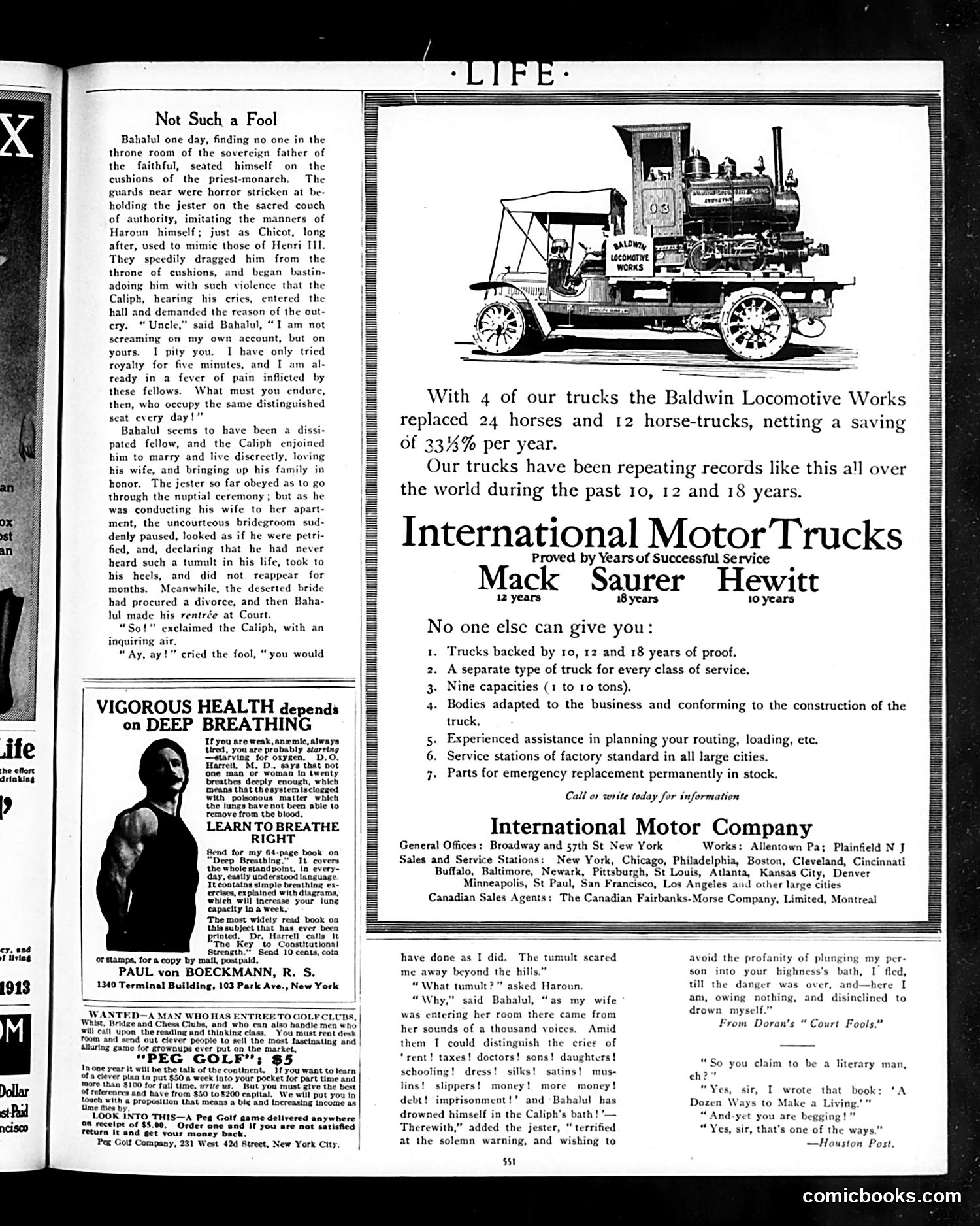
This page contains a narrative story rather than a political cartoon. It recounts an anecdote about **Bahalul**, a historical jester figure in an Islamic court (appears to reference the Caliph Haroun), and compares him to **Chicot**, a famous French court jester under Henri III. The satire works through ironic reversal: Bahalul sits on the sacred throne as a joke, gets brutally beaten by guards, then uses this experience to mock the Caliph's suffering—implying that wielding absolute power is itself a form of punishment. When ordered to marry respectably, Bahalul flees on his wedding night, claiming the bride's noise was unbearable, thereby satirizing both duty and domesticity. The story's point: even a fool recognizes that authority and responsibility bring their own painful consequences. The page is primarily this literary content, with advertisements for International Motor Trucks and a health/breathing book filling the margins.
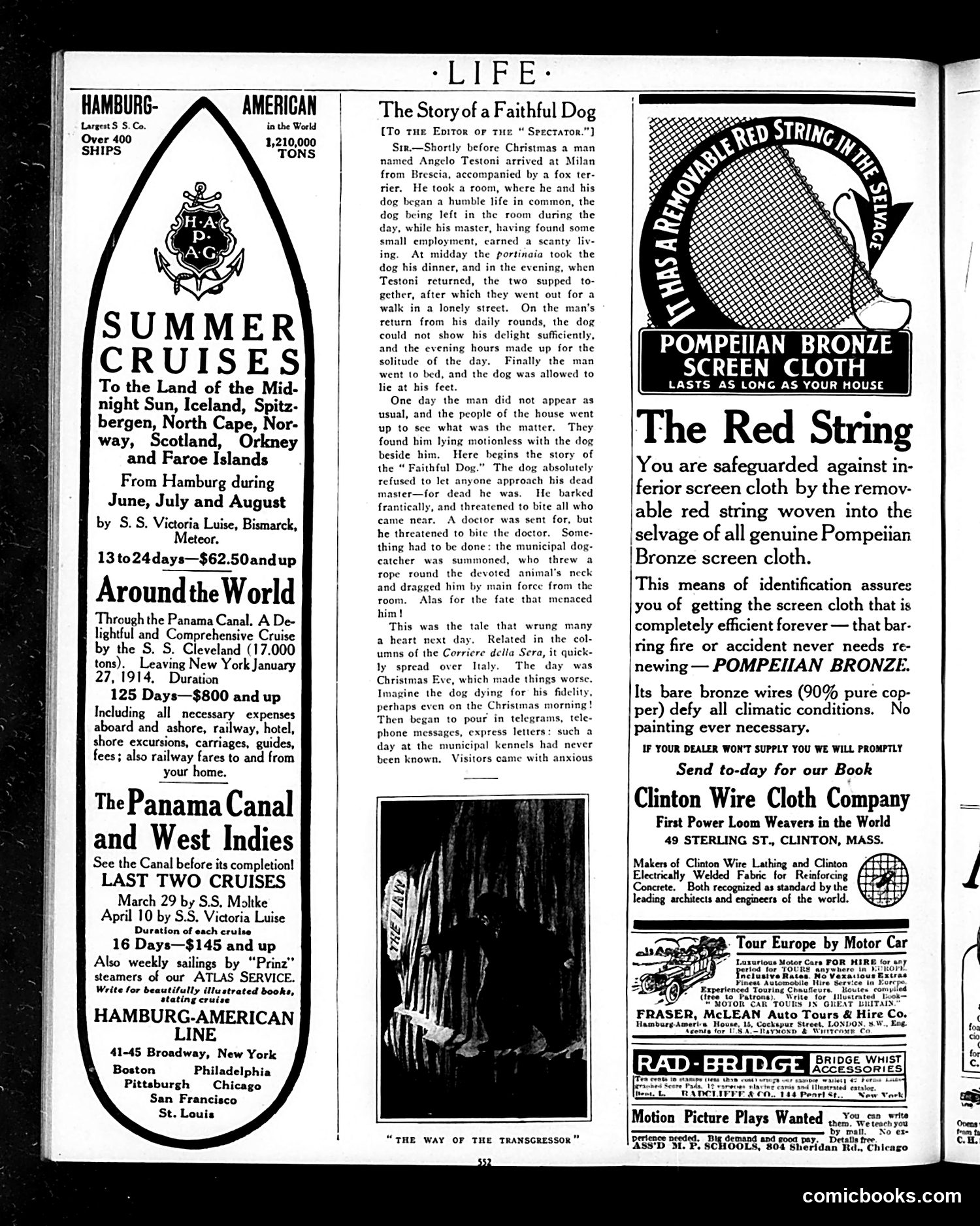
This page is primarily **advertising**, with one substantial editorial feature. The main content is "The Story of a Faithful Dog," a sentimental narrative about an Italian laborer (Angelo Testoni) whose fox terrier refuses to leave his dead master's side. When authorities forcibly remove the dog to a municipal kennel, the story spreads through Milan newspapers on Christmas Eve, generating an outpouring of sympathy—telegrams, letters, and visitor inquiries flood the kennels. The story appears designed to tug at readers' heartstrings through themes of loyalty and the bond between man and dog, set against a poignant holiday backdrop. The accompanying illustration, captioned "The Way of the Transgressor," is dark and unclear in meaning from the image alone. The remainder comprises standard period advertisements for cruise lines (Hamburg-American Line), wire cloth products, and motor-car hire services—typical commercial content for *Life* magazine circa 1914.
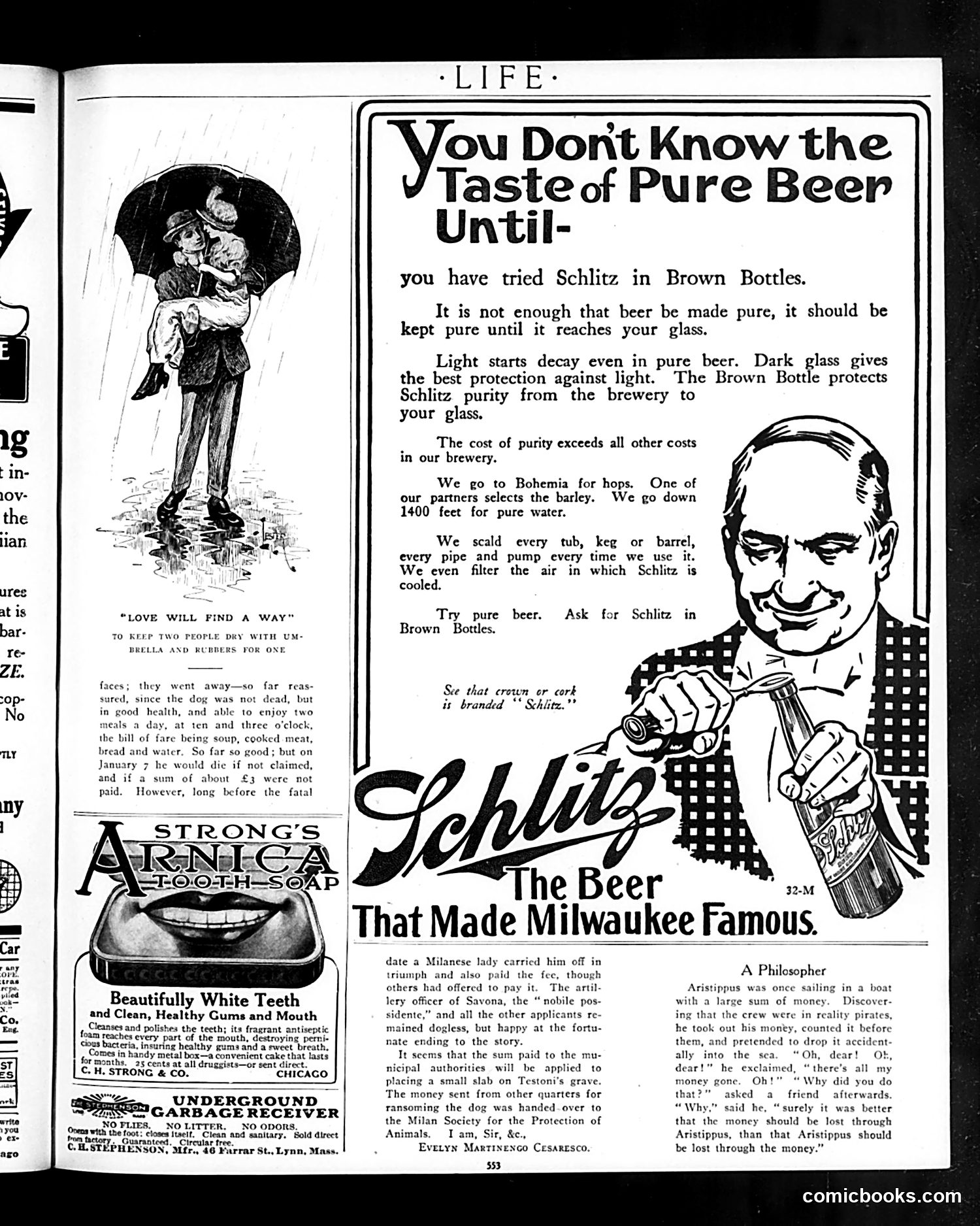
This page contains **multiple unrelated advertisements and stories**, typical of Life's satirical magazine format. The dominant feature is a **Schlitz beer advertisement** claiming brown bottles preserve beer purity from brewery to glass, protecting against light decay. The accompanying illustration shows a smiling man in a checkered shirt holding a bottle—a straightforward product pitch, not satire. Below are two smaller, unrelated items: a **Strong's Arnica Tooth Soap ad** promoting dental hygiene, and an **Underground Garbage Receiver advertisement** for sanitary waste disposal. The page also includes a brief story titled "A Philosopher" about Aristippus, an ancient Greek figure, who pretended to lose money overboard to pirates, claiming it better that money be lost through him than he through money—a moral anecdote with no political content. The "Love Will Find a Way" illustration on the left appears to reference umbrella-sharing, likely a sentimental or humorous vignette unrelated to the advertisements. **No political satire or commentary appears on this page.**
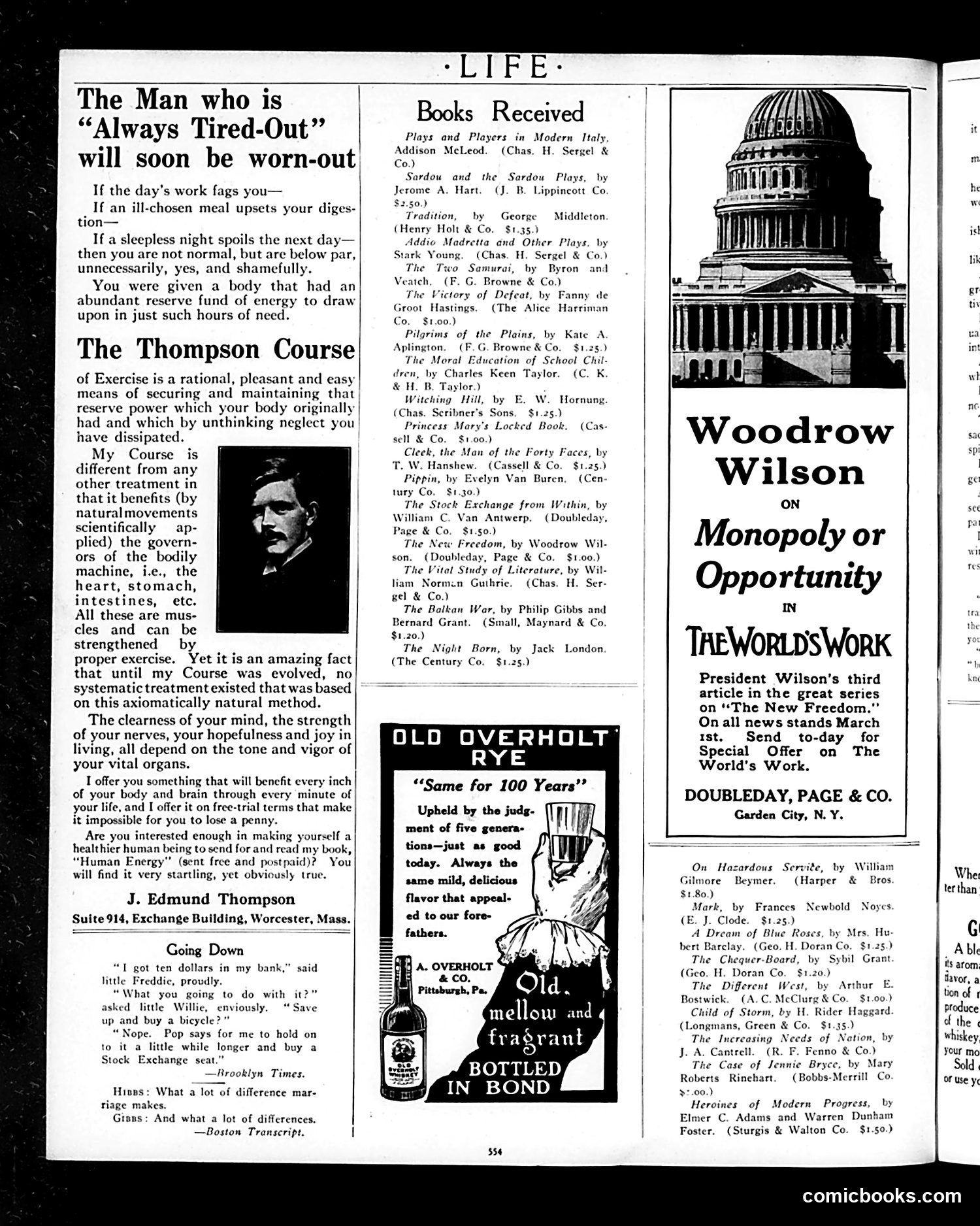
This Life magazine page (circa 1913, based on Woodrow Wilson references) contains **advertisements and book reviews**—not political cartoons. The satirical content is minimal and indirect. The notable elements: **"Going Down" joke**: A child plans to buy a "Stock Exchange seat" rather than save money—satirizing the 1912-era financial speculation bubble and parents encouraging risky investment over prudent saving. **Thompson Course ad**: Promotes exercise as cure-all for fatigue, a common early-1900s wellness pitch claiming scientific backing for what amounts to basic exercise. **Old Overholt Rye ad**: Uses the phrase "Same for 100 Years" to market whiskey as trustworthy despite Prohibition sentiment rising. **Wilson advertisement**: Promotes President Woodrow Wilson's article "The New Freedom," his progressive platform opposing monopolies—timely for 1913 when trust-busting was central political debate. The page reflects Progressive Era concerns: worker fatigue, market manipulation, and executive power over free enterprise.
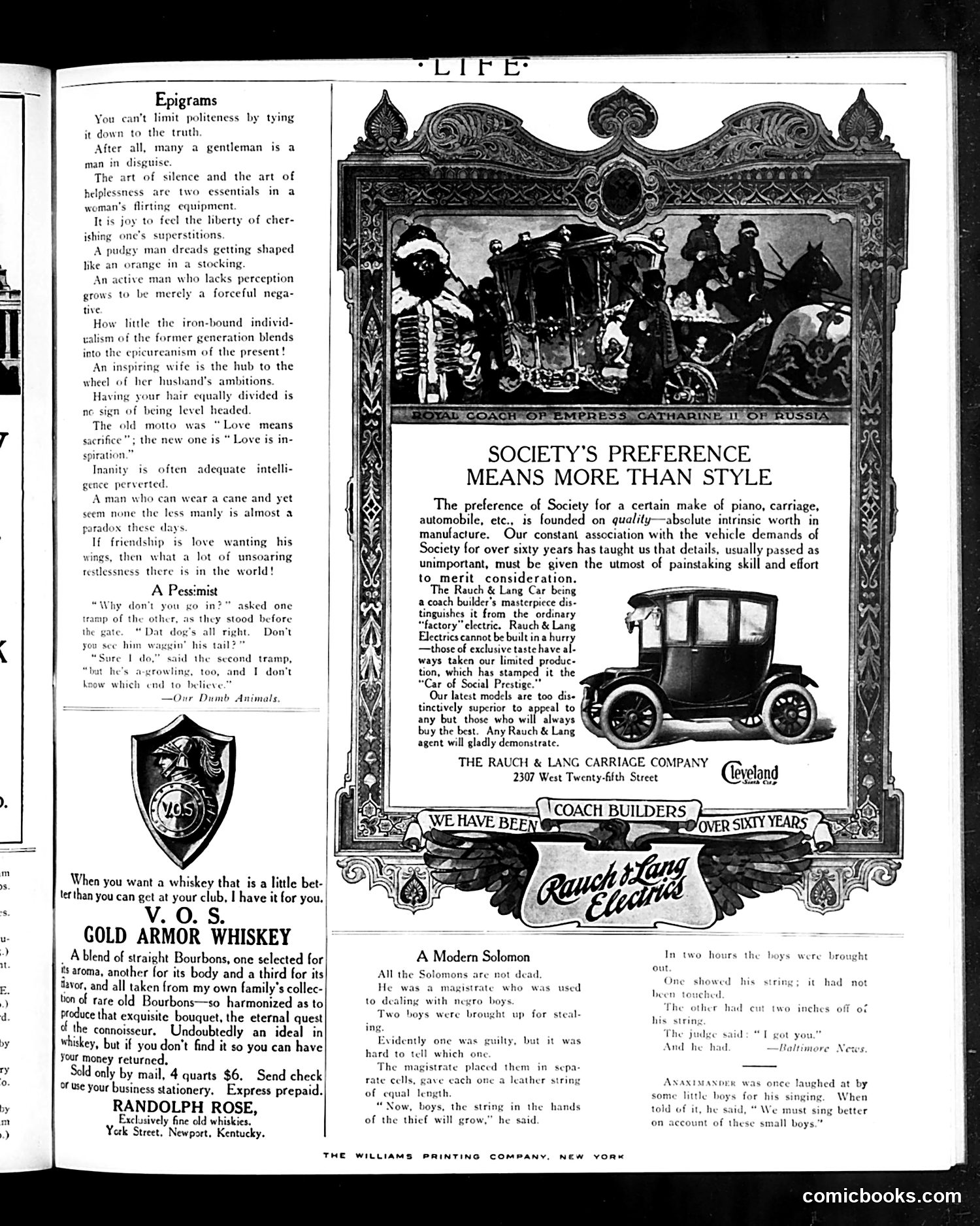
This page from *Life* magazine contains primarily **advertisements and humorous epigrams** rather than political cartoons. The left column features satirical one-liners mocking social conventions—politeness, gender relations, fashion (the "hair equally divided" joke about being "level headed"), and masculinity (men wearing canes). One anecdote, "A Pessimist," jokes about two tramps debating which end of a dog's tail to trust. The main image shows a historical coach scene, accompanying an advertisement for **Rauch & Lang electric carriages**, emphasizing exclusivity and "social prestige" for the wealthy elite. Below are ads for **Gold Armor Whiskey** (sold by mail from Kentucky) and **V.O.S. whiskey** pitched as superior to club liquor. The final section, "A Modern Solomon," recounts a magistrate's folk-tale test: he gives two boys twine, claiming "the thief's string will grow." One cuts his short, exposing himself—an ironic twist on the biblical Solomon's wisdom. The page reflects early 20th-century class anxieties, luxury consumption, and genteel humor rather than political satire.
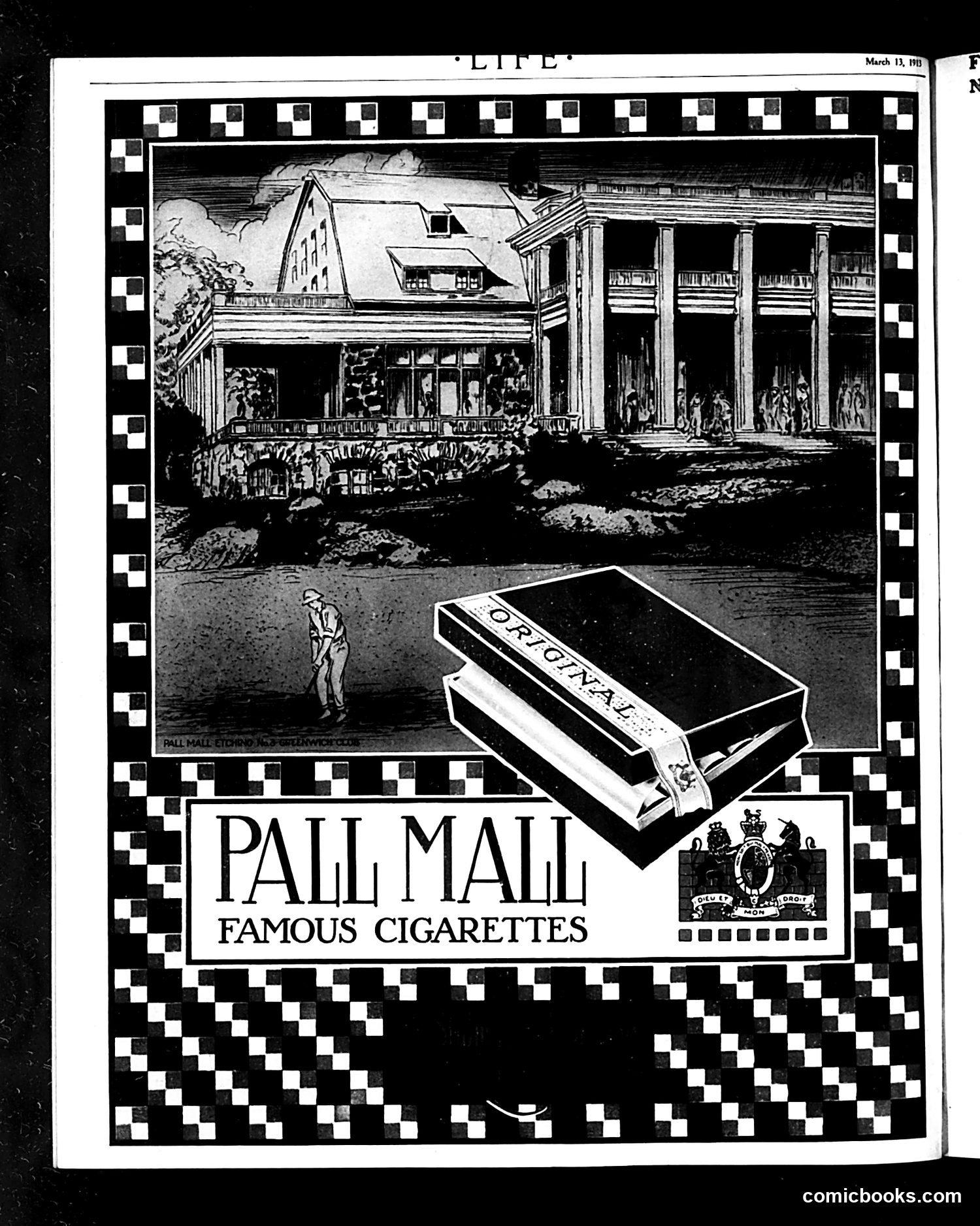
This is a full-page advertisement for Pall Mall cigarettes from *Life* magazine (dated March 13, 1911). The ad features an illustration of an elegant mansion with columned portico and manicured grounds, with a small figure of a man standing in the foreground. A large cigarette package labeled "ORIGINAL" is prominently displayed. The advertisement uses aspirational imagery—the grand estate suggests wealth and refined taste—to market the cigarettes as a luxury product. The juxtaposition of the mansion with the tiny human figure emphasizes exclusivity and prestige. This reflects early 20th-century advertising practices that associated smoking with social status and sophistication, before health warnings or advertising restrictions existed.