
Life, 1913-03-13 · page 16 of 44
Life — March 13, 1913 — page 16: what you’re looking at
What you’re looking at
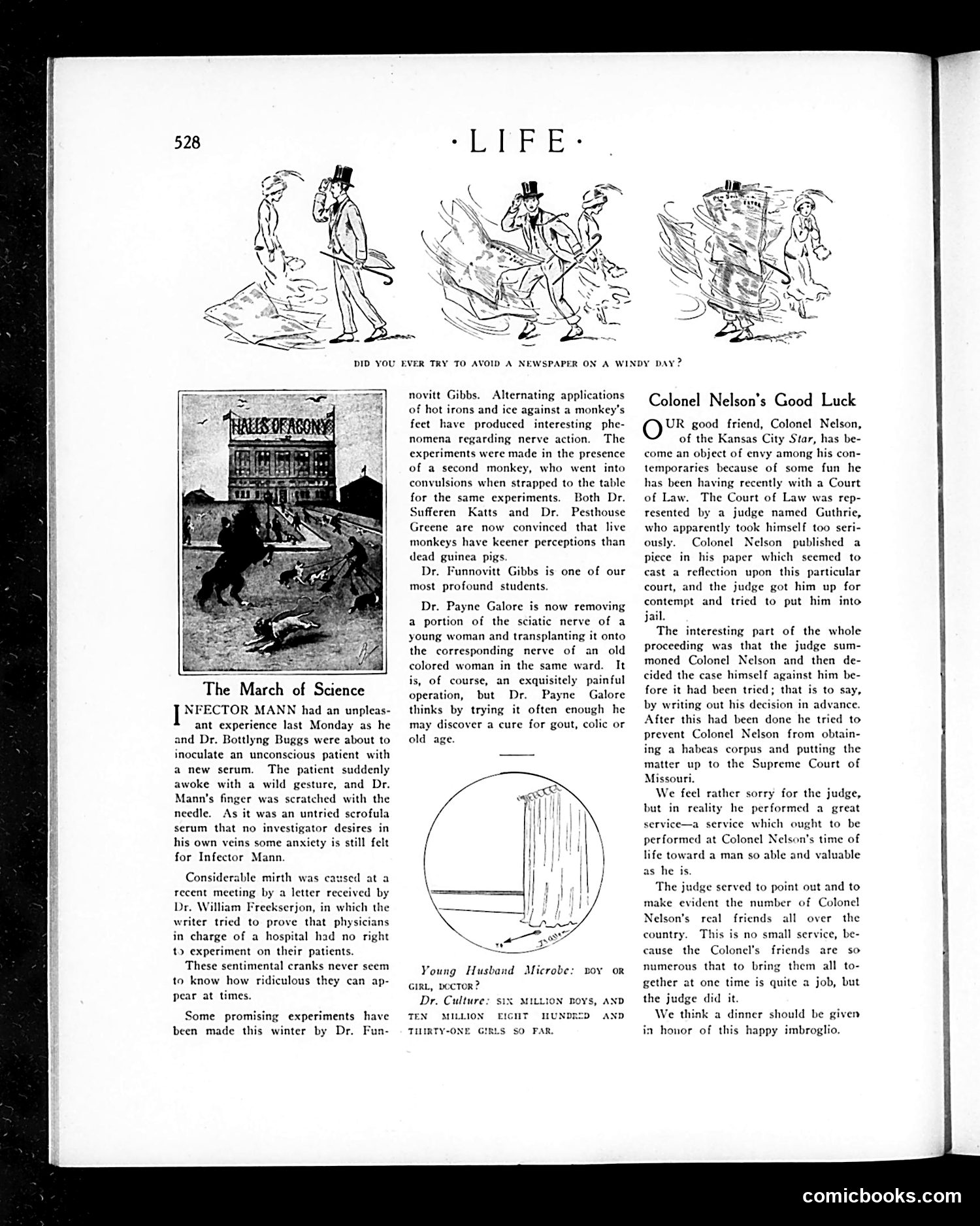
This page satirizes medical ethics violations of the early 20th century. The cartoons mock doctors conducting dangerous, unethical experiments: **"The March of Science"** section ridicules physicians experimenting on patients and animals without consent or proper justification. Dr. Mann accidentally inoculates himself; Dr. Gibbs applies extreme heat and cold to monkeys' feet; Dr. Galore transplants nerves between patients. The satire targets the medical establishment's callous disregard for suffering—both human and animal—justified by pseudo-scientific advancement. Doctors with absurd names (Funnovitt Gibbs, Payne Galore) emphasize the mockery. The microscopic cartoon jokes about bacterial reproduction ("six million boys...thirty-one girls so far"). **"Colonel Nelson's Good Luck"** celebrates a Kansas City newspaper editor who challenged judicial overreach—a judge who prejudged a case against him. The piece ironically praises the judge for inadvertently uniting Nelson's supporters through this abuse of power. Both sections critique institutional authority abusing power while evading accountability.
📄 Transcribed text from this page (OCR, searchable)
Machine-transcribed from the original scan — historical spelling and the odd misread are preserved.
The March of Science I* ECTOR MANN had an unpleas- ant experience last Monday as he and Dr. Bottlyng Buggs were about to inoculate an unconscious patient with a new serum. The patient suddenly awoke with a wild gesture, and Dr. Mann’s finger was scratched with the needle. As it was an untried scrofula serum that no investigator desires in his own veins some anxiety is still felt for Infector Mann. Considerable mirth was caused at a recent meeting by a letter received by Dr. William Freekserjon, in which the writer tried to prove that physicians in charge of a hospital had no right to experiment on their patients. These sentimental cranks never seem to know how ridiculous they can ap- pear at times, Some promising experiments have been made this winter by Dr. Fun- PAPER ON A WID novitt Gibbs. Alternating applications of hot irons and ice against a monkey's feet have produced interesting phe- nomena regarding nerve action. The experiments were made in the presence of a second monkey, who went into convulsions when strapped to the table for the same experiments. Both Dr. Sufferen Katts and Dr. Pesthouse Greene are now convinced that live monkeys have keener perceptions than dead guinea pigs. Dr. Funnovitt Gibbs is one of our most profound students. Dr. Payne Galore is now removing a portion of the sciatic nerve of a young woman and transplanting it onto the corresponding nerve of an old colored woman in the same ward. It is, of course, an exquisitely painful operation, but Dr. Payne Galore thinks by trying it often enough he may discover a cure for gout, colic or old age. Young Husband Microbe: voy or GIRL, DoCTOR? Dr. Culture: six M1Lui0N nos, AND TEN MILLION EIGHT MUNDRED AND TIIRTY-ONE GIRLS SO FAR. Colonel Nelson’s Good Luck UR good friend, Colonel Nelson, of the Kansas City Star, has be- come an object of envy among his con- temporaries because of some fun he has been having recently with a Court of Law. The Court of Law was rep- resented by a judge named Guthrie, who apparently took himself too seri- ously. Colonel Nelson published a piece in his paper which seemed to cast a reflection upon this particular court, and the judge got him up for contempt and tried to put him into jail. The interesting part of the whole proceeding was that the judge sum- moned Colonel Nelson and then de- cided the case himself against him be- fore it had been tried; that is to say, by writing out his decision in advance. After this had been done he tried to prevent Colonel Nelson from obtain- ing a habeas corpus and putting the matter up to the Supreme Court of Missouri. We feel rather sorry for the judge, but in reality he performed a great service—a service which ought to be performed at Colonel Nelson's time of life toward a man so able and valuable as he is. The judge served to point out and to make evident the number of Colonel Nelson’s real friends all over the This is no small service, be- are so country. the Colonel's friends numerous that to bring them all to- cause gether at one time is quite a job, but the judge did it. We think a dinner should be given in honor of this happy imbroglio. comicbooks.com