
Life, 1913-03-13 · page 20 of 44
Life — March 13, 1913 — page 20: what you’re looking at
What you’re looking at
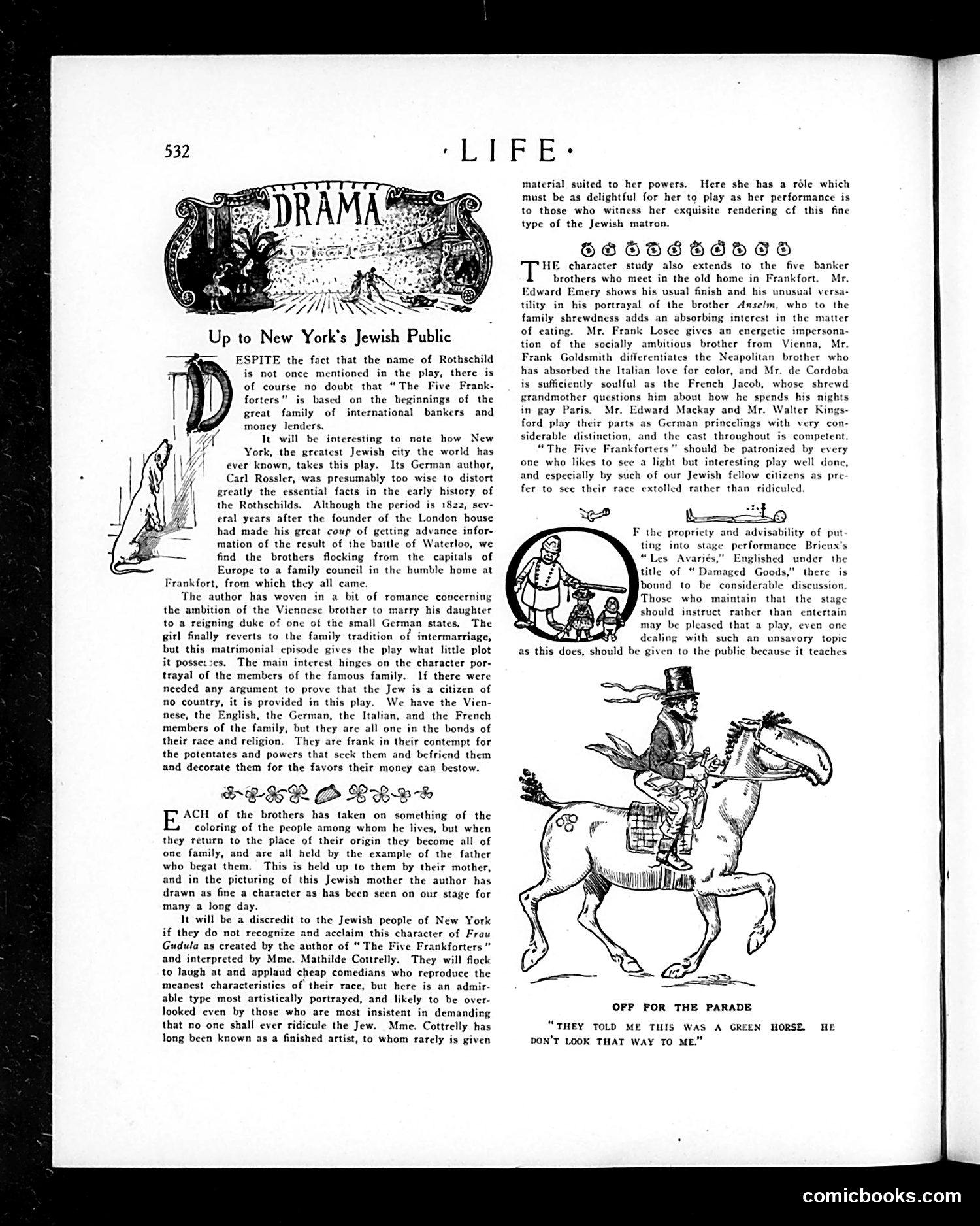
This is a theater review of a play based on the early history of the Rothschild banking family. The article discusses how a German playwright, Carl Rossler, dramatized the origins of this prominent Jewish dynasty, focusing on a family council in Frankfurt where brothers from across Europe (Vienna, England, Germany, Italy, France) reunite. The review praises the character portrayal of the Jewish mother, "Frau Gudula" (played by Mme. Mathilde Cottrelly), as a dignified representation of Jewish identity. It specifically appeals to New York's Jewish community to recognize and support this "admirable type artistically portrayed," contrasting it with stereotypical comedic caricatures of Jewish people. The illustrations appear to show period costume sketches related to the theatrical production. The review ultimately advocates for respecting serious, nuanced portrayals of Jewish characters on stage.
📄 Transcribed text from this page (OCR, searchable)
Machine-transcribed from the original scan — historical spelling and the odd misread are preserved.
oe ew Uo Up to New York's Jewish Public ESPITE the fact that the name of Rothschild is not once mentioned in the play, there is of course no doubt that “The Five Frank- forters” is based on the beginnings of the great family of international bankers and money lenders. It will be interesting to note how New York, the greatest Jewish city the world has ever known, takes this play. Its German author, Carl Rossler, was presumably too wise to distort greatly the essential facts in the early history of the Rothschilds. Although the period is 1 eral years after the founder of the London house had made his great coup of getting advance infor- mation of the result of the battle of Waterloo, we find the brothers flocking from the capitals of Europe to a family council in the humble home at Frankfort, from which they all came. The author has woven in a bit of romance concerning the ambition of the Viennese brother to marry his daughter to a reigning duke of one of the small German states. The girl finally reverts to the family tradition of intermarriage, but this matrimonial episode gives the play what little plot it posser:es. The main interest hinges on the character por- trayal of the members of the famous family. If there were needed any argument to prove that the Jew is a citizen of no country, it is provided in this play. We have the Vien- nese, the English, the German, the Italian, and the French members of the family, but they are all one in the bonds of their race and religion. They are frank in their contempt for the potentates and powers that scck them and befriend them and decorate them for the favors their moncy can bestow. FEKBROD LEYS E“s of the brothers has taken on something of the coloring of the people among whom he lives, but when they return to the place of their origin they become all of one family, and are all held by the example of the father who begat them. This is held up to them by their mother, and in the picturing of this Jewish mother the author has drawn as fine a character as has been seen on our stage for many a long day. It will be a discredit to the Jewish people of New York if they do not recognize and acclaim this character of Frau Gudula as created by the author of “ The Five Frankforters” and interpreted by Mme. Mathilde Cottrelly. They will flock to laugh at and applaud cheap comedians who reproduce the meanest characteristics of their race, but here is an admir- able type most artistically portrayed, and likely to be over- looked even by those who are most insistent in demanding that no one shall ever ridicule the Jew. Mme. Cottrelly has long been known as a finished artist, to whom rarely is given material suited to her powers. Here she has a réle which must be as delightful for her to play as her performance is to those who witness her exquisite rendering cf this fine type of the Jewish matron, S6SHEEBSDGS HE character study also extends to the five banker brothers who meet in the old home in Frankfort. Mr. Zdward Emery shows his usual finish and his unusual vers: tility in his portrayal of the brother Anselm, who to the family shrewdness adds an absorbing interest in the matter of eating. Mr. Frank Losce gives an energetic impersona- tion of the socially ambitious brother from Vienna, Mr. Frank Goldsmith differentiates the Neapolitan brother who has absorbed the Italian love for color, and Mr. de Cordoba is sufficiently soulful as the French Jacob, whose shrewd grandmother questions him about how he spends his nights in gay Paris. Mr. Edward Mackay and Mr. Walter Kings- ford play their parts as German princelings with very con- siderable distinction, and the cast throughout is competent “The Five Frankforters” should be patronized by every one who likes to see a light but interesting well done, and especially by such of our Jewish fellow citizens as pre fer to see their race extolled rather than ridiculed. F the propriety and advisability of put ting into stage performance Bricux’ “Les Avariés,” Englished under the title of “Damaged Goods,” there is bound to be considerable discussion. Those who maintain that the should instruct rather than entertain may be pleased that a play, even one dealing with such an unsavory topic as this does, should be given to the public because it teaches OFF FOR THE PARADE “THEY TOLD ME THIS WAS A GRE! DON’T LOOK THAT WAY TO ME.” HORSE, HE comicbooks.com