
Life, 1913-03-13 · page 14 of 44
Life — March 13, 1913 — page 14: what you’re looking at
What you’re looking at
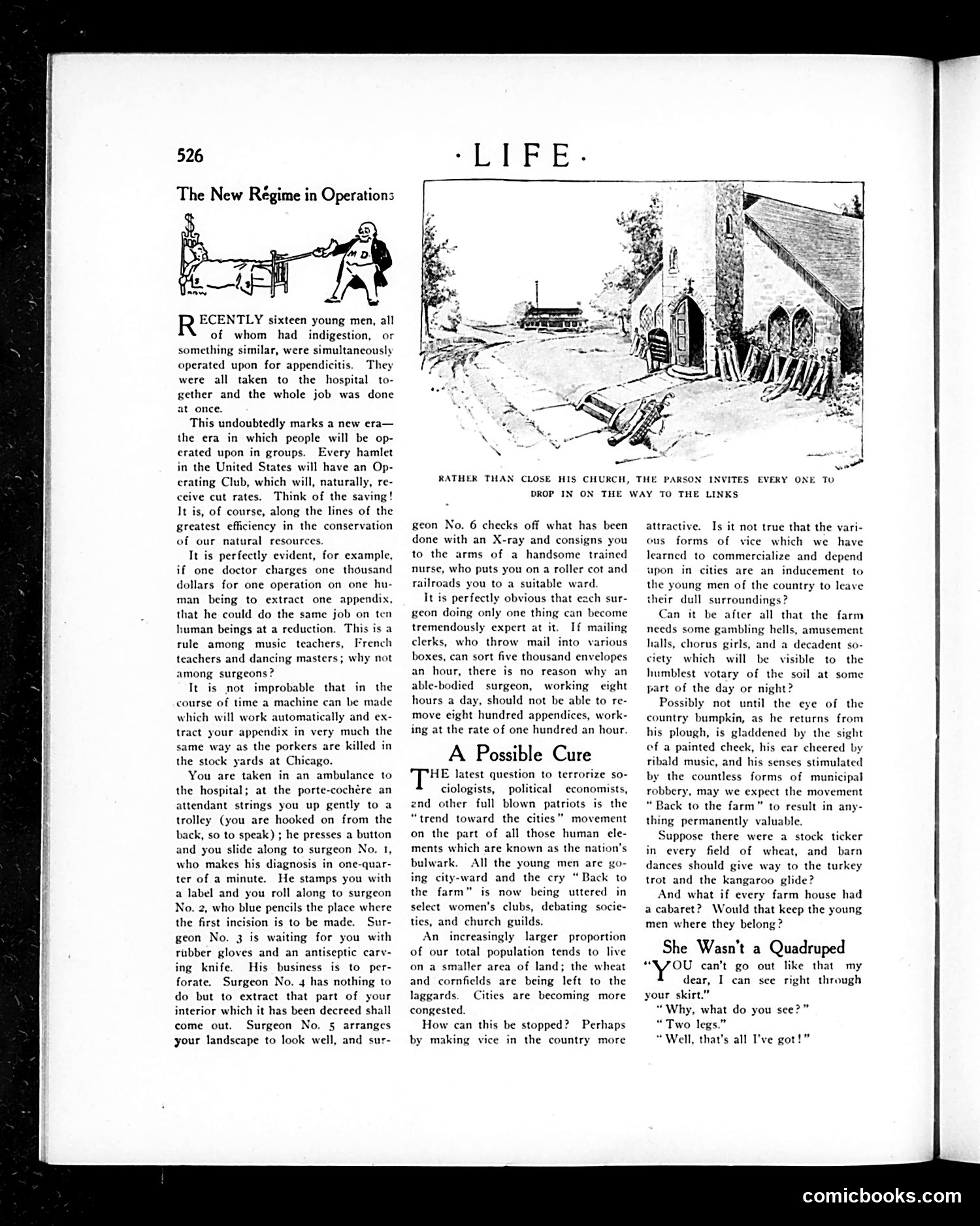
This page satirizes early 20th-century medical and social efficiency movements. The top cartoon, "The New Régime in Operation," mocks the era's obsession with mechanized surgery and mass-production efficiency. It depicts a doctor operating on a patient like an assembly-line worker, humorously suggesting that medical procedures have become dehumanized factory processes. The text criticizes the "trend toward the cities" movement—a social concern that young people were abandoning rural life. The article proposes a satirical solution: make farm life more entertaining by adding gambling, dance halls, and "decadent society" amusements to farming communities. This biting satire mocks both urban reformers' anxiety about rural depopulation and the absurdity of trying to make farming competitive with city attractions through vice and frivolity rather than genuine improvement.
📄 Transcribed text from this page (OCR, searchable)
Machine-transcribed from the original scan — historical spelling and the odd misread are preserved.
526 The New Régime in Operations RECESTLY sixteen young men, all of whom had indigestion, or something similar, were simultancously operated upon for appendicitis. They were all taken to the hospital to- gether and the whole job was done at once. This undoubtedly marks a new era— the era in which people will be op- crated upon in groups. Every hamlet in the United States will have an Op- erating Club, which will, naturally, re- ceive cut rates. Think of the saving! It is, of course, along the lines of the greatest efficiency in the conservation of our natural resource: It is perfectly evident, for example, if one doctor charges one thousand dollars for one operation on one hu- man being to extract one appendix, that he could do the same job on ten human beings at a reduction. This rule among music teachers, French teachers and dancing masters; why not among surgeons? It is not improbable that in the course of time a machine can be made which will work automatically and ex tract your appendix in very much the same way as the porkers are killed in the stock yards at Chicago. You are taken in an ambulance to the hospital; at the porte-cochére an attendant strings you up gently to a trolley (you are hooked on from the back, so to speak) ; he presses a button and you slide along to surgeon No. 1, who makes his diagnosis in one-quar- ter of a minute. He stamps you with a label and you roll along to surgeon No. 2, who blue pencils the place where the first incision is to be made. Sur- geon No. 3 is waiting for you with rubber gloves and an antiseptic carv- ing knife. His business is to per- forate. Surgeon No, 4 has nothing to do but to extract that part of your interior which it has been decreed shall come out. Surgeon No. 5 arranges your landscape to look well, and sur- isa RATHER THAN CLOSE HIS CHURCH, TI DROP IN ON THE WA geon No. 6 checks off what has been done with an X-ray and consigns you to the arms of a handsome trained nurse, who puts you on a roller cot and railroads you to a suitable ward. It is perfectly obvious that geon doing only one thing can become tremendously expert at it. If mailing clerks, who throw mail into boxes, can sort five thousand envelopes an hour, there is no reason why an able-bodied surgeon, working eight hours a day, should not be able to re- move eight hundred appendices, work- ing at the rate of one hundred an hour. A Possible Cure HE latest question to terrorize so- ciologists, political economists, znd other full blown patriots is the “trend toward the cities” movement on the part of all those human cle- ments which are known as the nation’s bulwark. All the young men are go- ing city-ward and the cry “Back to the farm” is now being uttered in select women’s clubs, debating socie- ties, and church guilds. An increasingly larger proportion of our total population tends to live on a smaller area of land; the wheat and cornfields are being left to the laggards. Cities are becoming more congested. How can this be stopped? Perhaps by making vice in the country more various E PARSON INVITES EVERY To Y TO THE LINKS ONE attractive. ous Is it not true that the vari- forms of vice which we have learned to commercialize and depend upon in cities are an inducement to the young men of the country to leave their dull surroundings? Can it be after all that the farm needs some gambling hells, amusement halls, chorus girls, and a decadent so- ciety which will be visible to the humblest votary of the soil at some part of the day or night? Possibly not until the eye of the country bumpkin, as he returns from his plough, is gladdened by the sight of a painted cheek, his ear cheered by ribald music, and his senses stimulated by the countless forms of municipal robbery, may we expect the movement “Back to the farm” to result in any- thing permanently valuable. Suppose there were a stock ticker in every field of wheat, and barn dances should give way to the turkey trot and the kangaroo glide? And what if every farm house had a cabaret? Would that keep the young men where they belong? She Wasn't a Quadruped ‘ OU can’t go out like that my dear, I can see right through your skirt.” “Why, what do you sce?” “Two legs.” “Well, that’s all I've got!” comicbooks.com