
Life, 1913-03-13 · page 26 of 44
Life — March 13, 1913 — page 26: what you’re looking at
What you’re looking at
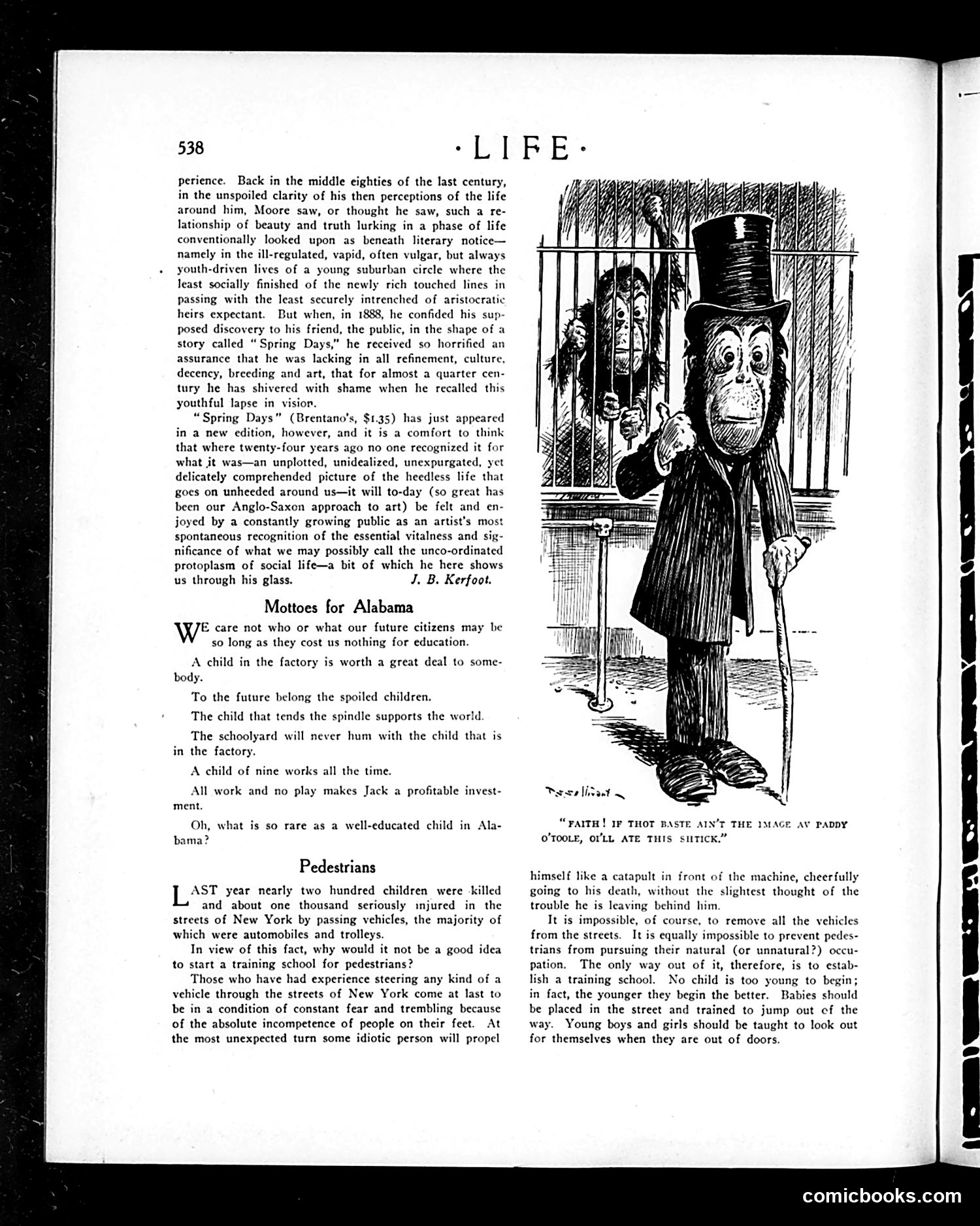
This page contains three distinct sections satirizing American society: **Top illustration**: A caricatured Irish immigrant (identifiable by the exaggerated features and dialect caption) peers through a fence at what appears to be monkeys. The caption suggests mistaking the animals for fellow Irish ("Paddy O'Toole"), mocking Irish immigrants through crude ethnic stereotyping common to the era. **"Mottoes for Alabama"**: Bitter sarcasm attacking child labor practices in Southern mills. Each "motto" inverts moral values—celebrating factory work over education, treating children as profitable investments rather than human beings. This directly critiques Alabama's industrial exploitation of child workers. **"Pedestrians"**: Satirizes New Yorkers' dangerous street behavior amid increasing automobile traffic. The piece proposes absurdly training infants and children to navigate traffic rather than regulating vehicles, mocking both pedestrian recklessness and the period's inability to adapt social behavior to new transportation technology. All three sections use satire to expose social problems: ethnic prejudice, child labor, and urban safety failures.
📄 Transcribed text from this page (OCR, searchable)
Machine-transcribed from the original scan — historical spelling and the odd misread are preserved.
538 -LIFE- perience. Back in the middle eighties of the last century, in the unspoiled clarity of his then perceptions of the life around him, Moore saw, or thought he saw, such a re- lationship of beauty and truth lurking in a phase of life conventionally looked upon as beneath literary notice— namely in the ill-regulated, vapid, often vulgar, but always youth-driven lives of a young suburban circle where the least socially finished of the newly rich touched lines in passing with the least securely intrenched of aristocratic heirs expectant. But when, in 1888, he confided his sup- posed discovery to his friend, the public, in the shape of a story called “Spring Days,” he received so horrified an assurance that he was lacking in all refinement, culture, decency, breeding and art, that for almost a quarter cen- tury he has shivered with shame when he recalled this youthful lapse in visior. “Spring Days” (Brentano's, $1.35) has just appeared in a new edition, however, and it is a comfort to think that where twenty-four years ago no one recognized it for what jt was—an unplotted, unidealized, unexpurgated, yet delicately comprehended picture of the heedless life that goes on unheeded around us—it will to-day (so great has been our Anglo-Saxon approach to art) be felt and en- joyed by a constantly growing public as an artist’s most spontaneous recognition of the essential vitalness and sig- nificance of what we may possibly call the unco-ordinated protoplasm of social life—a bit of which he here shows us through his glass. J. B. Kerfoot. Mottoes for Alabama E care not who or what our future citizens may be so long as they cost us nothing for education. A child in the factory is worth a great deal to some- body. To the future belong the spoiled children. The child that tends the spindle supports the world The schoolyard will never hum with the child that is in the factory. A child of nine works all the time. All work and no play makes Jack a profitable invest- ment. Oh, what is so rare as a well-educated child in Ala- bama? Pedestrians [Az year nearly two hundred children were -killed and about one thousand seriously injured in the streets of New York by passing vehicles, the majority of which were automobiles and trolleys. In view of this fact, why would it not be a good idea to start a training school for pedestrians? Those who have had experience steering any kind of a vehicle through the streets of New York come at last to be in a condition of constant fear and trembling because of the absolute incompetence of people on their feet. At the most unexpected turn some idiotic person will propel Bese lidat \ “PaITH! IF THOT BASTE AIN’T THE IMAGE AV PADDY O'TOOLE, O1LL ATE THIS SITICK.” himself like a catapult in front of the machine, cheerfully going to his death, without the slightest thought of the trouble he is leaving behind him It is impossible, of course, to remove all the vehicles from the streets. It is equally impossible to prevent pedes- trians from pursuing their natural (or unnatural?) occu- pation, The only way out of it, therefore, is to estab- lish a training school. No child is too young to begin; in fact, the younger they begin the better. Babies should be placed in the street and trained to jump out cf the way. Young boys and girls should be taught to look out for themselves when they are out of doors. YY. hed ce gah wes NY Me NA SE UY comicbooks.com