
Life, 1913-03-13 · page 24 of 44
Life — March 13, 1913 — page 24: what you’re looking at
What you’re looking at
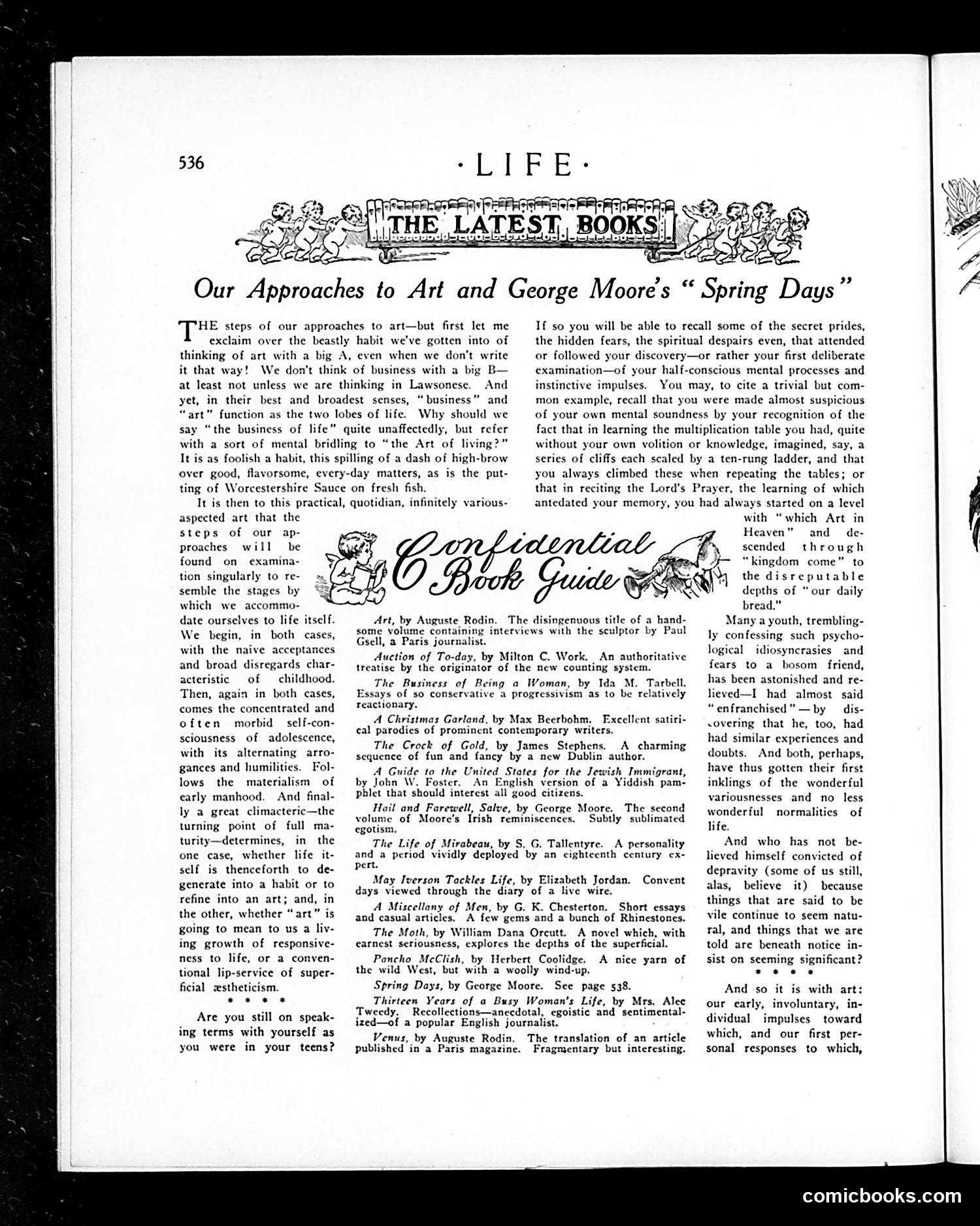
This is primarily a **book review and literary criticism page**, not a political cartoon. The decorative header "The Latest Books" features cherubs with a printing press—a whimsical touch typical of Life's design. The main essay discusses how we approach art and living, arguing that "art" and "business" should be viewed equally as fundamental life activities, not separated by pretense. The author criticizes the artificial capitalization and reverence we give "Art" while treating life practically. The page then lists contemporary book reviews, including works by Auguste Rodin, Milton C. Work, Ida M. Tarbell, Max Beerbohm, James Stephens, and George Moore. These reviews are straightforward literary criticism without apparent satire. **The satire here is subtle and intellectual**—mocking the pretentiousness of high-brow culture rather than specific political figures or events.
📄 Transcribed text from this page (OCR, searchable)
Machine-transcribed from the original scan — historical spelling and the odd misread are preserved.
Our Approaches to Art and George Moore's “ Spring Days’ TR steps of our approaches to art—but first let me exclaim over the beastly habit we've gotten into of thinking of art with a big A, even when we don't write it that wa: We don’t think of business with a big B— at least not unless we are thinking in Lawsonese. And yet, in their best and broadest senses, “business” and “art” function as the two lobes of life. Why should we say “the business of life” quite unaffectedly, but refer with a sort of mental bridling to “the Art of living?” It is as foolish a habit, this spilling of a dash of high-brow over good, flavorsome, every-day matters, as is the put- ting of Worcestershire Sauce on fresh fish. It is then to this practical, quotidian, infinitely various- aspected art that the steps of our ap- proaches will be found on examina- tion singularly to re- semble the stages by which wi date ourselves to life itself. We begin, in both with the naive acceptances and broad disregards char- acteristic of childhood. Then, again in both cases, comes the concentrated and often morbid _ self-con- sciousness of adolescence, with its alternating arro- gances and humilities. Fol- lows the materialism of early manhood. And final- ly a great climacteric—the turning point of full ma- turity—determines, in the one case, whether life it- self is thenceforth to de- generate into a habit or to refine into an art; and, in the other, whether “art” is Art, by Auguste Rodin. Gsell, a Paris journalist. reactionary. A Guid by John W. Foster. egotism. pert. The disingenuous title of a hand- some volume containing interviews with the sculptor by Paul Auction of To-day, by Milton C. Work. An authoritative treatise by the originator of the new counting system. The Business of Being a Woman, by Ida M. Tarbell. Essays of so conservative a progressivism as to be relatively A Christmas Garland, by Max Beerbohm, Excellent satiri- cal parodies of prominent contemporary writers. The Crock of Gold, by James Stephens. sequence of fun and fancy by a new Dublin author. to the United States for the Jewish Immigrant, An English version of a Yiddish pam: phlet that should interest all good citizens. Hoil and Farewell, Salve, by George Moore. volume of Moore's Irish reminiscences. The Life of Mirabeau, by S. G. Tallentyre. and a period vividly deployed by an cighteenth century ex- May Iverson Tackles Life, by Elizabeth Jordan. days viewed through the diary of a live wire. A Miscellany of Men, by G. K. Chesterton. and casual articles. A few gems and a bunch of Rhinestones. 2 If so you will be able to recall some of the secret prides, the hidden fears, the spiritual despairs even, that attended or followed your discovery—or rather your first deliberate examination—of your half-conscious mental processes and instinctive impulses. You may, to cite a trivial but com- mon example, recall that you were made almost suspicious of your own mental soundness by your recognition of the fact that in learning the multiplication table you had, quite without your own volition or knowledge, imagined, say, a series of cliffs each scaled by a ten-rung ladder, and that you always climbed these when repeating the tables; or that in reciting the Lord’s Prayer, the learning of which antedated your memory, you had always started on a level with “which Art in Heaven” and de- scended through “kingdom come” to the disreputable depths of “our daily bread.” Many a youth, trembling- ly confessing such psycho- logical idiosyncrasies and fears to a bosom friend, has been astonished and re- lieved—I_ had almost said “enfranchised” —by — dis- sovering that he, too, had had similar experiences and doubts. And both, perhaps, have thus gotten their first inklings of the wonderful variousnesses and no less wonderful normalities of life. A personality And who has not be- lieved himself convicted of depravity (some of us still, alas, believe it) because things that are said to be vile continue to seem natu- ral, and things that we are A. charming The second Subtly sublimated Convent Short essays going to mean to us a li ing growth of responsive- ness to life, or a conven- tional lip-service of super- ficial xstheticism. oeee Are you still on speak- ing terms with yourself as you were in your teens? The Moth, by William Dana Orcutt. A novel which, with carnest seriousness, explores the depths of the superficial. Poncho McClish, by Herbert Coolidge. the wild West, but with a woolly wind-up. Spring Days, by George Moore. See page 538. Thirteen Years of a Busy Woman's Life, by Mrs. Alec Tweedy. Recollections—ancedotal, egoistic and sentimental- ized—of a popular English journalist. Venus, by Auguste Rodin. The translation of an article published in a Paris magazine. Fragmentary but interesting. A nice yarn of told are beneath notice in- sist on seeming significant? seee And so it is with art: our early, involuntary, in- dividual impulses toward which, and our first per- sonal responses to which, comicbooks.com