
A complete issue · 48 pages · 1913
Life — February 20, 1913
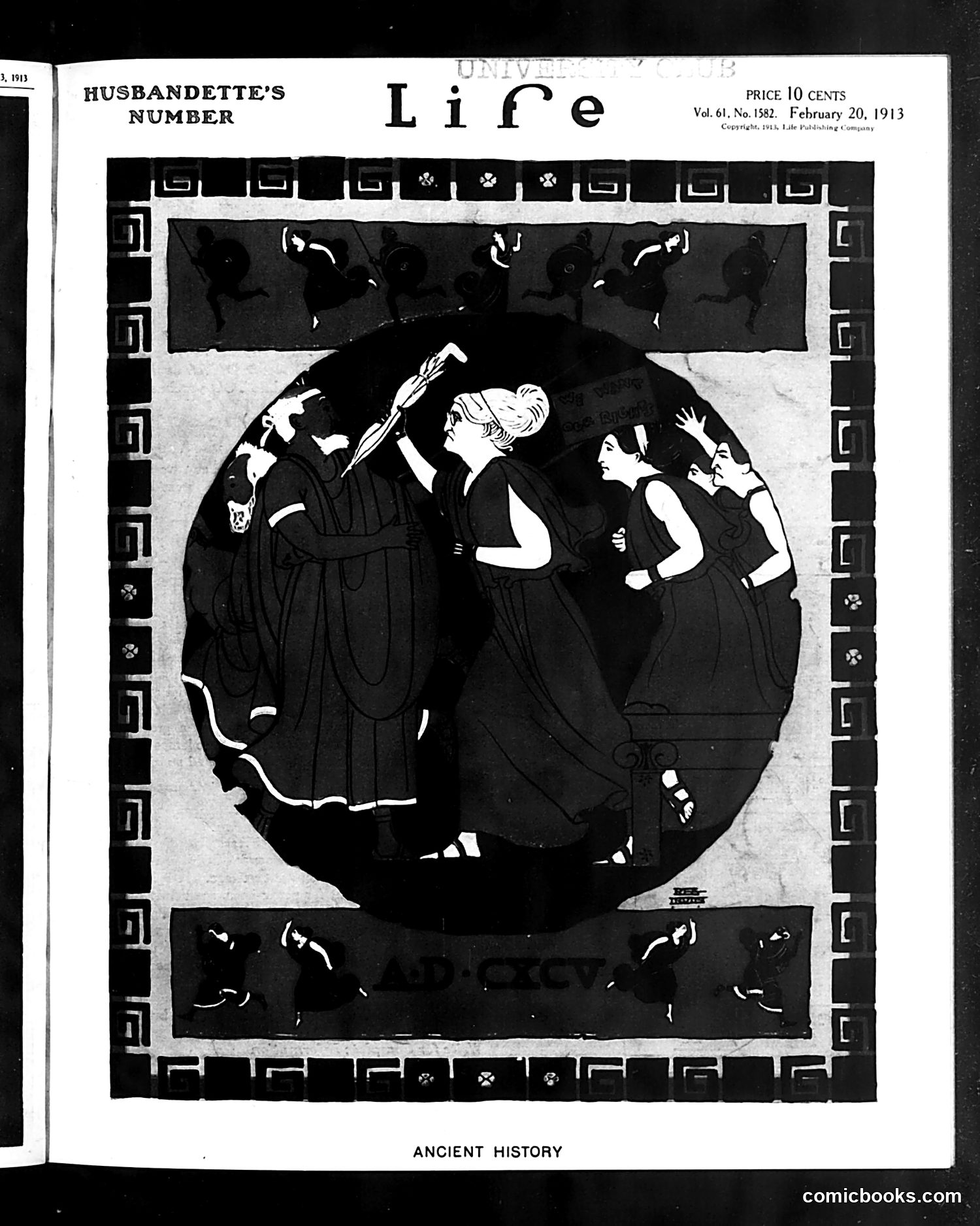
This is the cover of Life magazine's "Husbandette's Number" from February 20, 1913. The circular illustration depicts five women in classical Greek or Roman dress, gathered together under an umbrella. The style and clothing suggest they're meant to represent ancient female figures or goddesses. The "Ancient History" caption at the bottom appears to be the joke's framing. Given the issue's theme ("Husbandette's Number"), this likely satirizes women's roles—suggesting that traditional domestic femininity or wifehood is "ancient history," or conversely, mocking contemporary women's changing roles by treating modern husbandettes as if they're classical relics. The exact satirical angle remains somewhat unclear without additional context from the issue's contents.
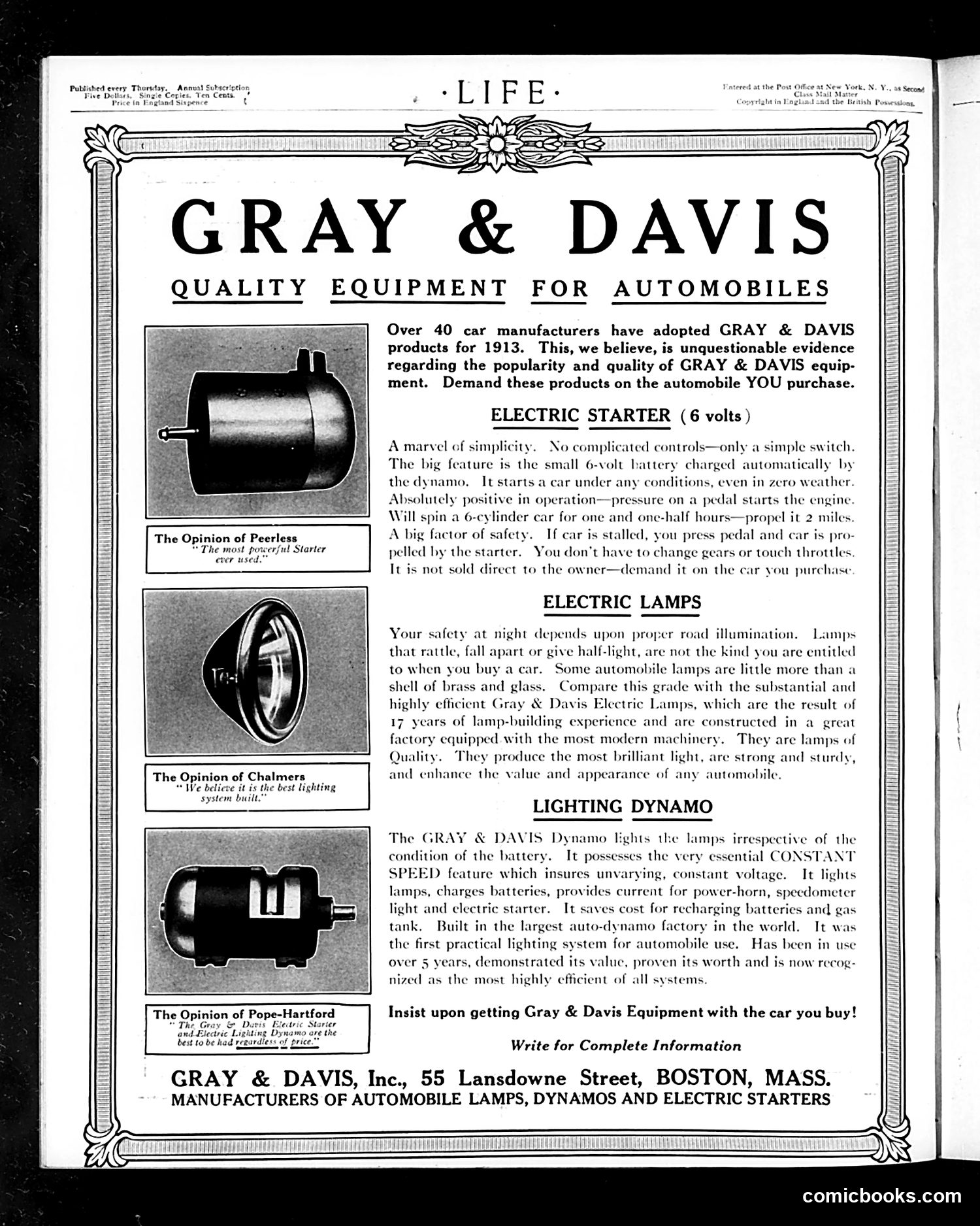
This is **not a cartoon page** but rather a **full-page advertisement** for Gray & Davis, Inc., an automobile equipment manufacturer based in Boston, Massachusetts. The page promotes three products: an electric starter (6-volt), electric lamps, and a lighting dynamo for automobiles. Each product is illustrated with a photograph and accompanied by endorsement quotes from unnamed car manufacturers and companies like Chalmers and Pope-Hartford—all presented as "The Opinion of Peerless," "The Opinion of Chalmers," etc. This represents early 1913 automotive technology marketing, highlighting innovations like electric starters (which replaced hand-cranking) as safety and convenience features. The testimonials were standard advertising practice to build consumer confidence in new automotive technologies.
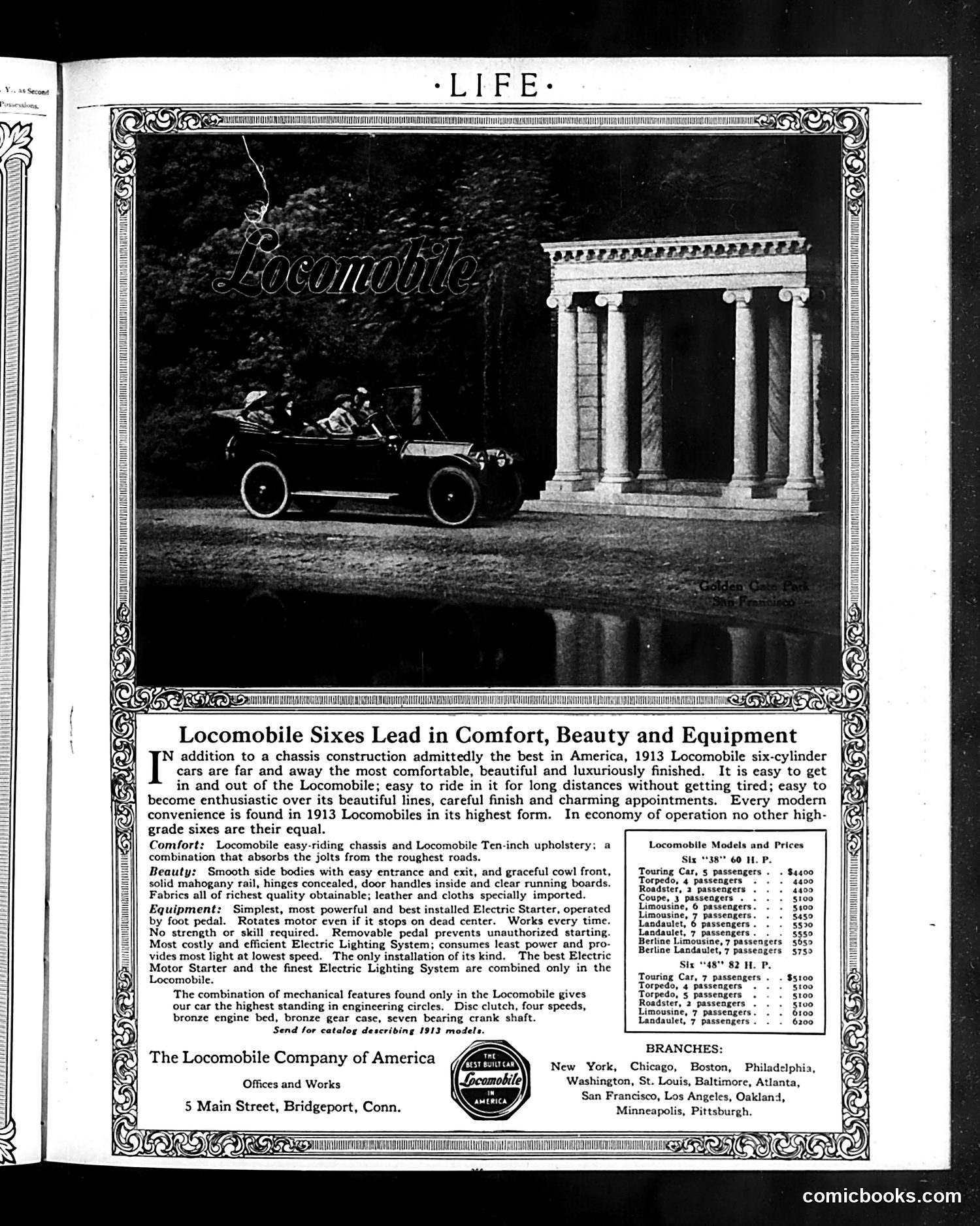
This is primarily **advertising, not satire or political commentary**. The page promotes Locomobile automobiles, a luxury car manufacturer, through a 1913 advertisement. The image shows a Locomobile automobile parked beside a classical columned building (likely representing wealth and status). The ad emphasizes the car's premium features: comfortable chassis, beautiful smooth bodies, and advanced electric starter technology. The text lists various Locomobile models and prices, branches across major American cities, and company details (headquarters in Bridgeport, Connecticut). There is no cartoon or political satire present. This represents typical early-automotive-era advertising targeting affluent buyers, emphasizing luxury, comfort, and technological innovation as status symbols.
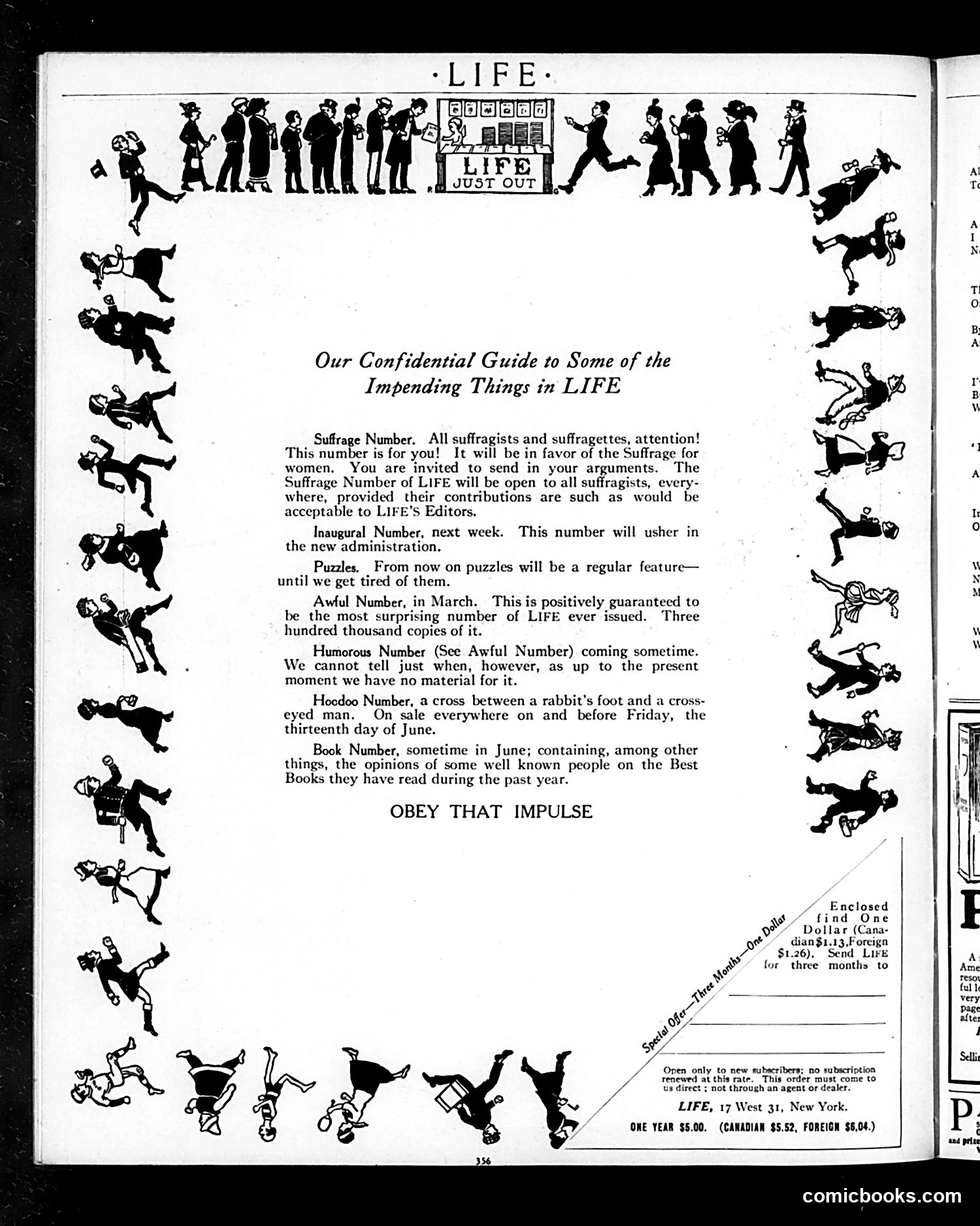
This page announces upcoming special issues of *Life* magazine using humorous silhouettes of people in exaggerated poses—falling, stumbling, and flailing—arranged as decorative borders. The text promises: - **Suffrage Number**: For women's voting rights advocates - **Inaugural Number**: Introducing a new administration (unclear which) - **Awful Number**: Described as "positively guaranteed to be the most surprising number of LIFE ever issued" - **Hoodoo Number**: A superstition-themed issue (June 13th) - **Book Number**: Featuring opinions on best-read books The silhouettes and chaotic poses suggest *Life's* comedic approach to serious topics like women's suffrage and politics. The final exhortation "OBEY THAT IMPULSE" encourages subscription, using humor to market the magazine's satirical commentary on contemporary social issues.
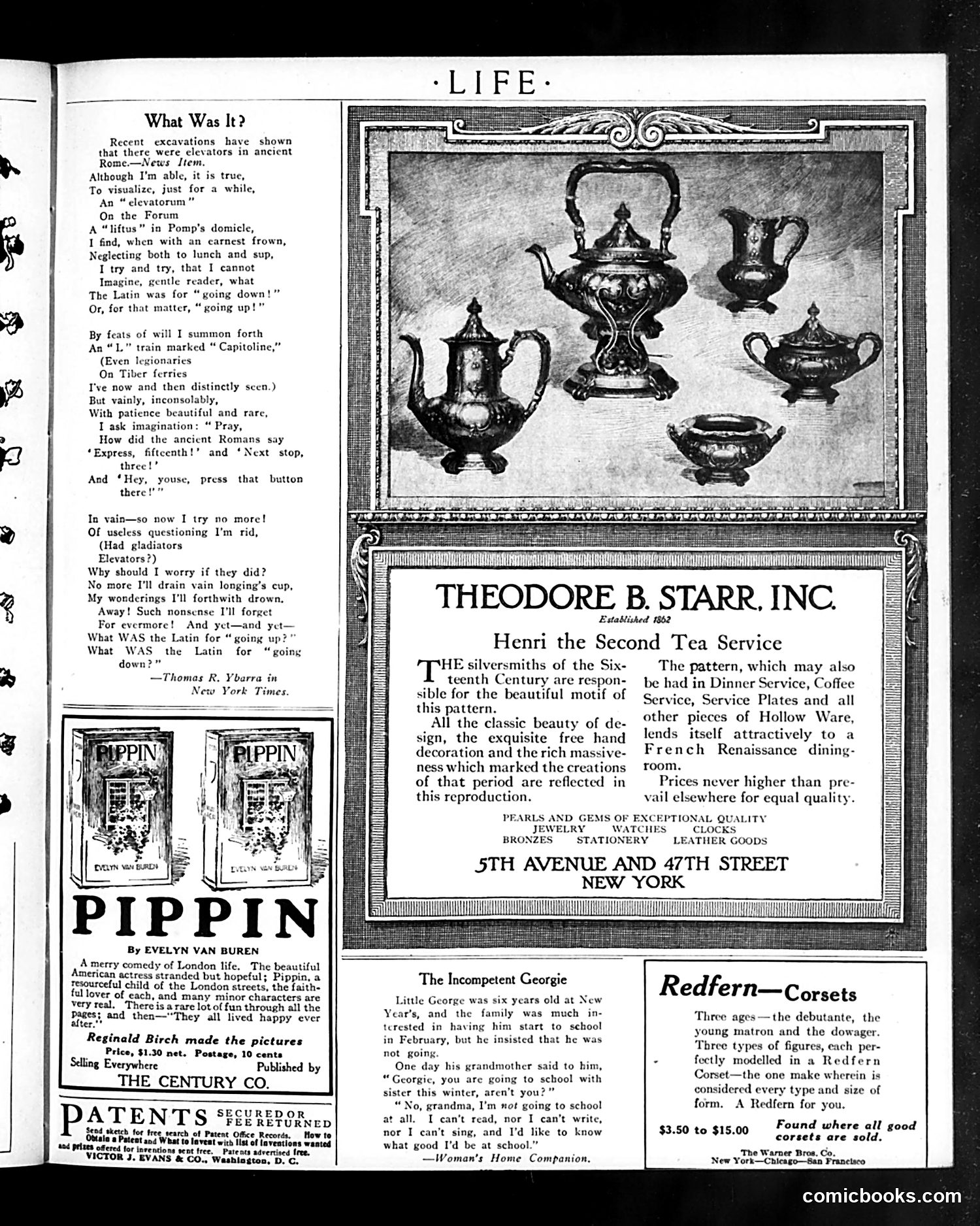
This page is primarily **advertising and light entertainment** rather than political commentary. The left side features a poem titled "What Was It?" by Thomas R. Ybarra, humorously questioning Roman terminology for going "down" versus "up" (likely referring to elevator/escalator terminology). Below are ads for the film *Pippin* and a patent notice. The main image shows **decorative silver tea service pieces** from Theodore B. Starr, Inc.—a luxury goods advertisement emphasizing the "Henri the Second Tea Service" pattern's classical Renaissance beauty. The text stresses quality and competitive pricing. The bottom right contains a brief anecdotal piece titled "The Incompetent Georgie" about a six-year-old refusing school. This is paired with a **Redfern Corsets advertisement** offering three figure types at $3.50-$15.00. The page reflects early 20th-century consumer culture and gender marketing norms.
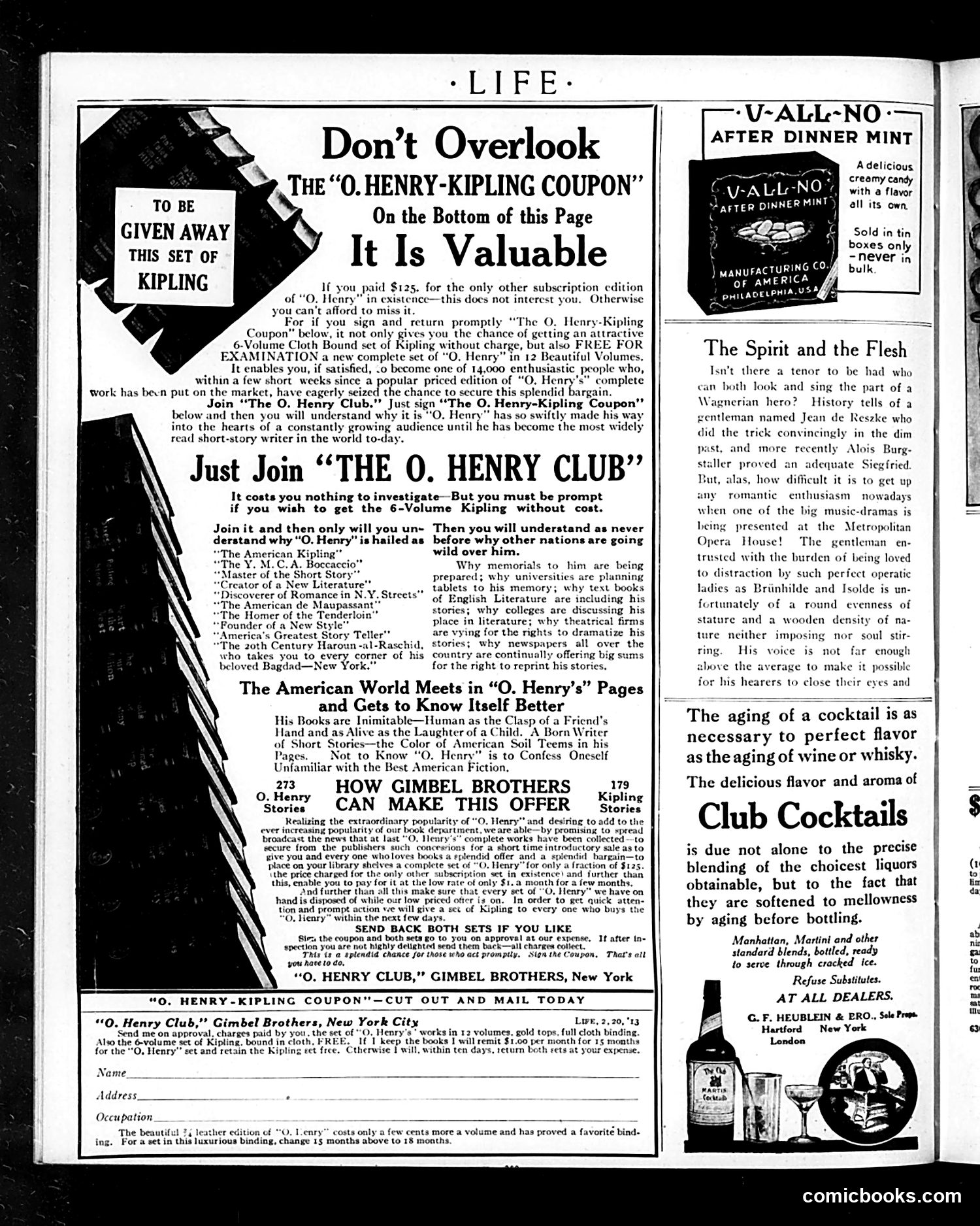
This page is primarily **advertising and promotional content**, not political satire. The main content includes: 1. **"O. Henry Club" promotion** (left): A subscription offer from Gimbel Brothers department store for a 6-volume set of O. Henry short stories, free to new "O. Henry" magazine subscribers. The copy emphasizes O. Henry's popularity and cultural significance. 2. **"The Spirit and the Flesh"** (right): A literary article discussing a historical figure named Jean de Rezske, apparently a renowned tenor, discussing the tension between physical performance demands and artistic ambition in opera. 3. **Club Cocktails advertisement** (lower right): Promoting aged cocktails with blended liquors. The page reflects early 20th-century magazine advertising conventions, mixing literature promotion with luxury goods marketing.
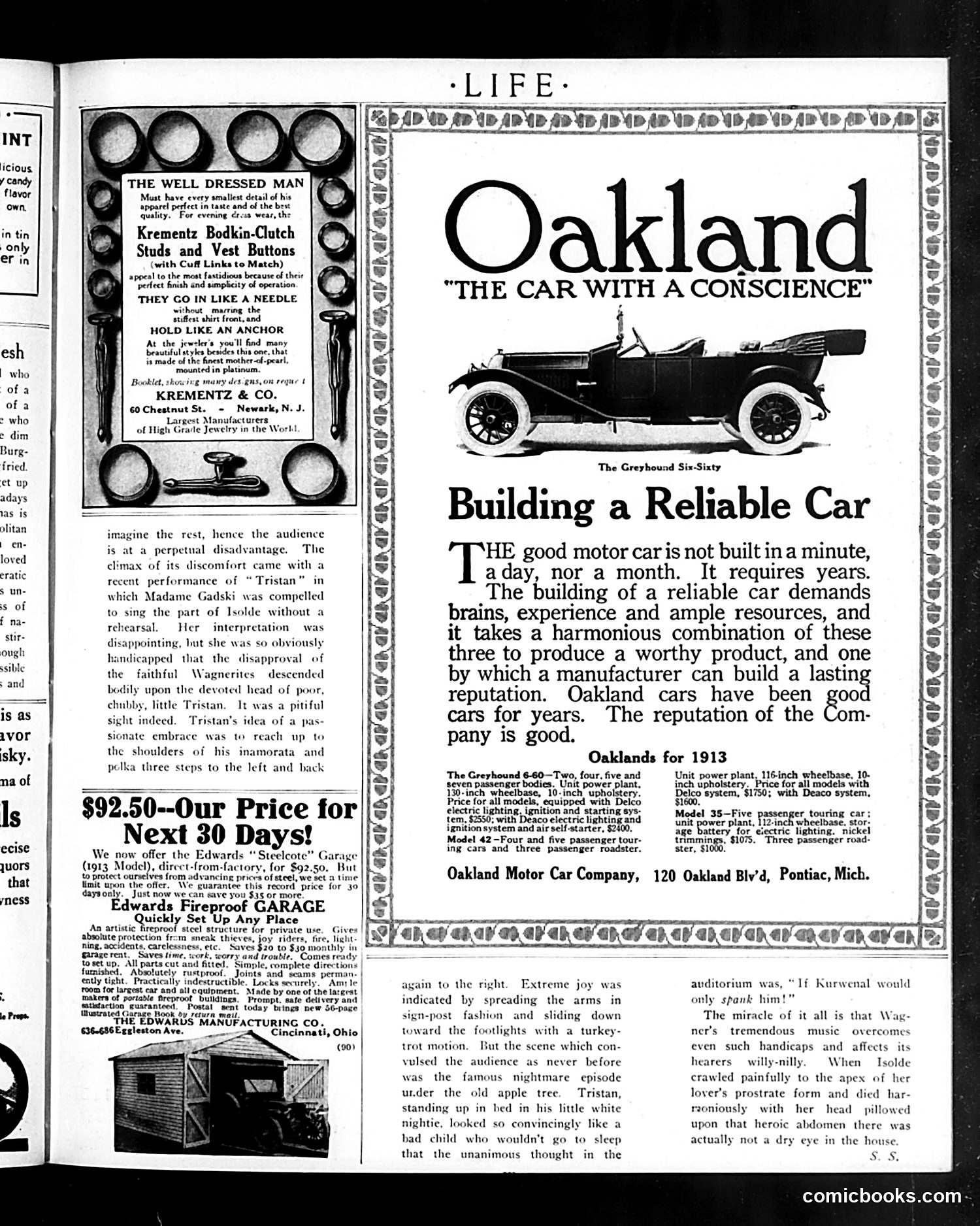
This page consists primarily of **advertisements rather than satirical cartoons**. The main content includes: 1. **Krementz & Co. advertisement** (top left): Promotes men's clothing studs and vest buttons, emphasizing quality craftsmanship for the well-dressed man. 2. **Oakland automobile advertisement** (center/right): The dominant feature advertising Oakland cars as "The Car with a Conscience." The ad emphasizes reliable manufacturing, claiming good motor cars require "years" of experience and resources to build properly. Lists specific 1913 Oakland models with prices. 3. **Edwards Fireproof Garage advertisement** (bottom left): Promotes a steel garage structure for private use. The page reflects early 1910s consumer culture, with no evident political satire or social commentary—it's a commercial publication page typical of Life magazine's revenue model.
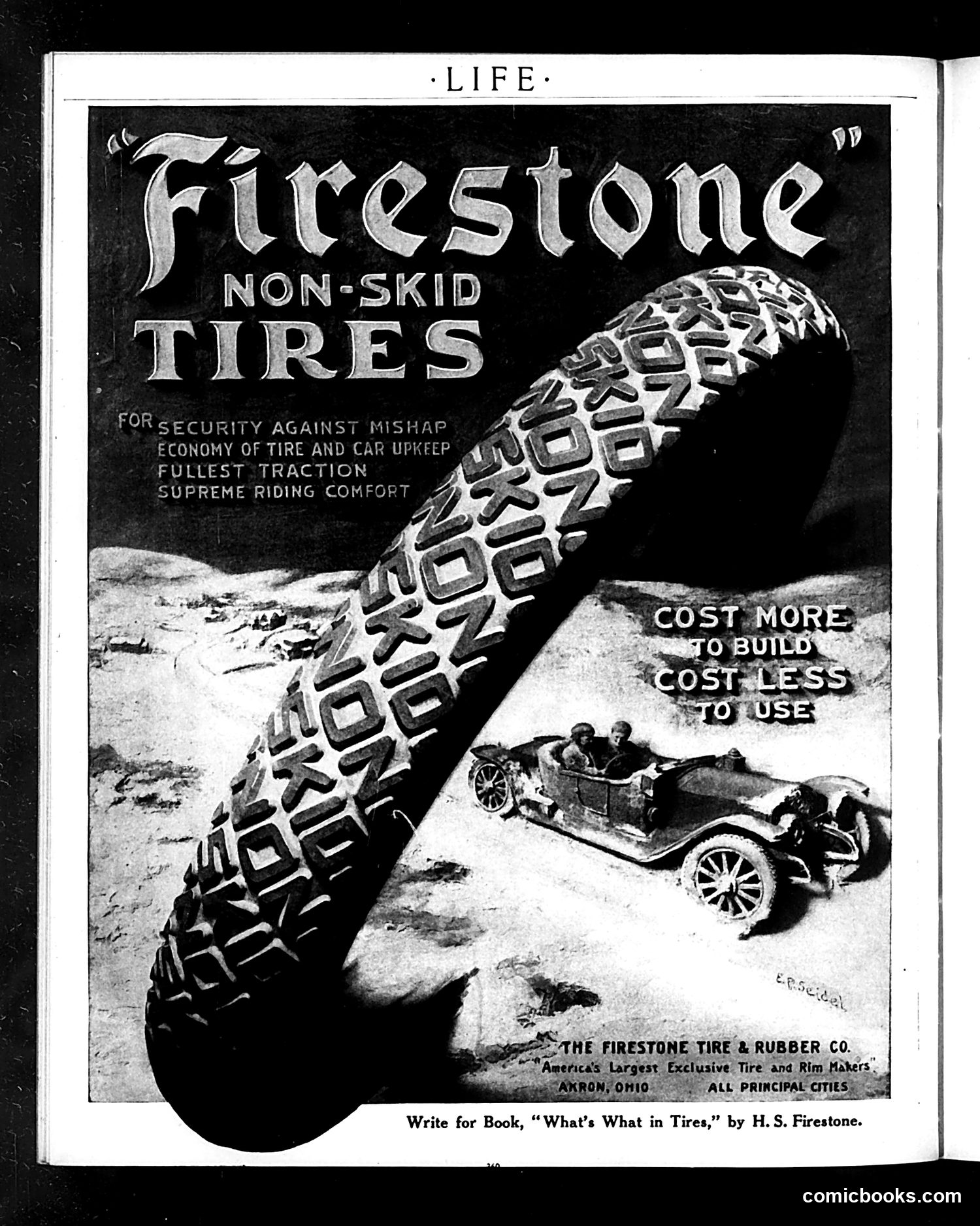
This is a **commercial advertisement**, not satire or political commentary. The Firestone Tire & Rubber Company promotes their "Non-Skid Tires" through an early 20th-century marketing approach. The image shows a massive tire looming over an automobile with passengers, emphasizing the product's size and presence. The tagline "Cost More to Build / Cost Less to Use" argues that while Firestone tires are expensive initially, they're economical long-term through durability and reduced maintenance. The listed benefits—security against mishaps, tire economy, car upkeep savings, traction, and riding comfort—represent standard tire-quality claims of the era. The company, based in Akron, Ohio, positions itself as "America's Largest Exclusive Tire and Rim Makers." This is straightforward product promotion without satirical content.
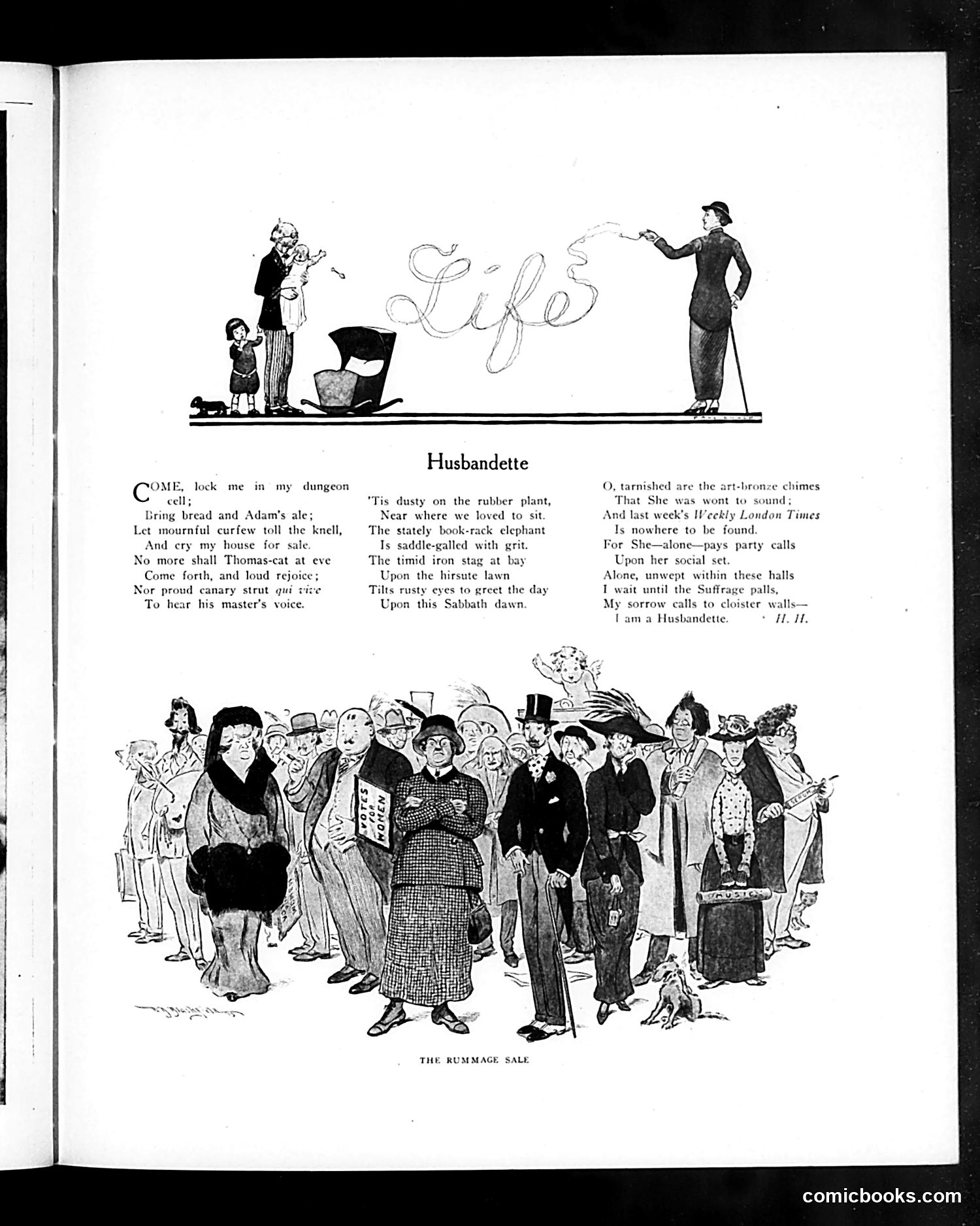
This page contains two satirical pieces about women's domestic and social roles. **"Husbandette"** (top) mocks a woman who adopts masculine authority at home, locking her husband in a "dungeon" and dominating him—inverting traditional gender hierarchies for comic effect. The byline "H.H." credits the author. **"The Rummage Sale"** (bottom) depicts a crowded scene of mostly women conducting a charity sale, with one woman prominently featured in the center. This satirizes women's volunteer charitable activities and social gatherings, suggesting both their importance in community life and the satirist's view of such activities as somewhat frivolous or worthy of gentle mockery. Both pieces reflect early 20th-century anxieties about shifting gender roles and women's increasing public participation.
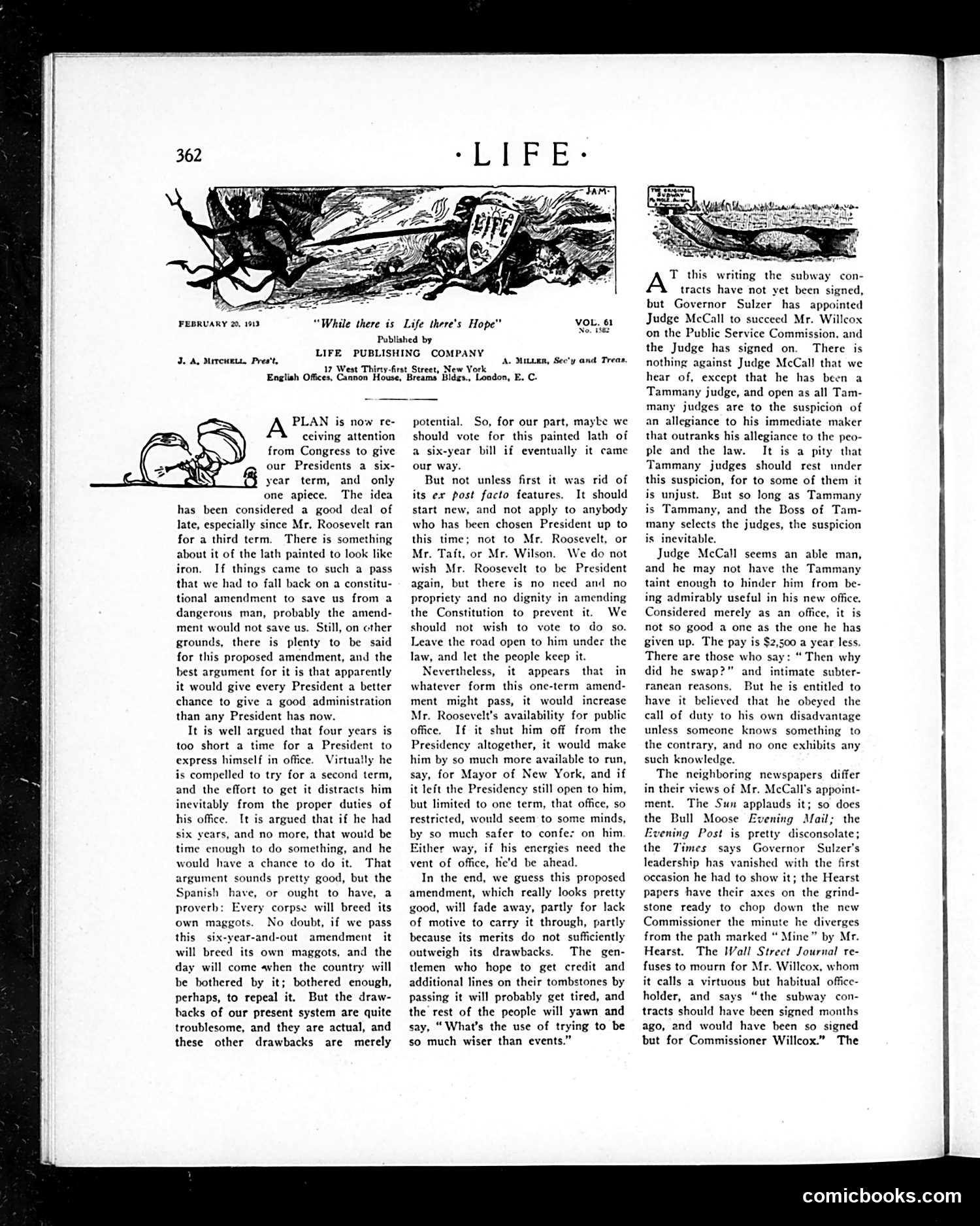
The page's main cartoon, titled "While there is Life there's Hope," depicts a skeletal or death-like figure alongside what appears to be political imagery. The accompanying article discusses a proposed constitutional amendment limiting presidential terms to six years with one term only. The satire criticizes this amendment as unnecessary constitutional tampering. The skeleton imagery likely represents the danger of weakening executive power or the "death" of strong presidential authority. The text argues that four years is already short enough, and that attempting to restrict Roosevelt (or whichever president) serves no legitimate purpose. The article references Judge McCall's appointment to the Public Service Commission, discussing concerns about "Tammany judges" and political corruption—key Progressive Era anxieties about urban machine politics compromising public office.
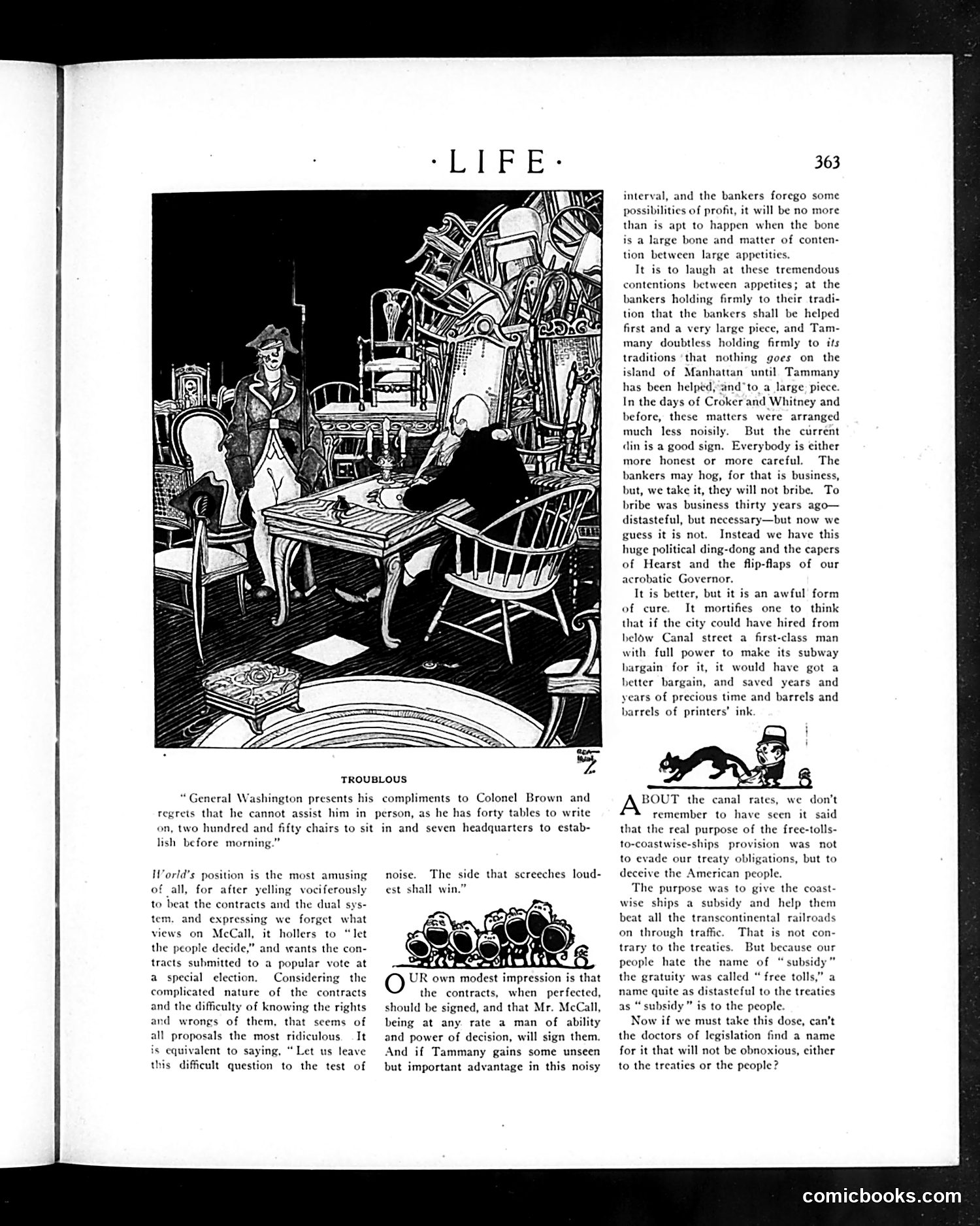
This satirical cartoon depicts a crowded, chaotic office scene labeled "Troublous," showing General Washington presenting compliments to Colonel Brown while regretting he cannot assist in person due to having "forty tables to write on, one hundred and fifty clerks to sit in and seven headquarters to establish before morning." The satire targets bureaucratic inefficiency and administrative chaos—the overwhelming proliferation of paperwork, clerks, and multiple headquarters during wartime operations. The crowded, almost absurdist rendering of furniture and officials suggests the absurdity of military administration becoming so bloated it prevents actual military leadership. The cartoon criticizes how administrative machinery had grown unwieldy, preventing commanders from executing their duties effectively.
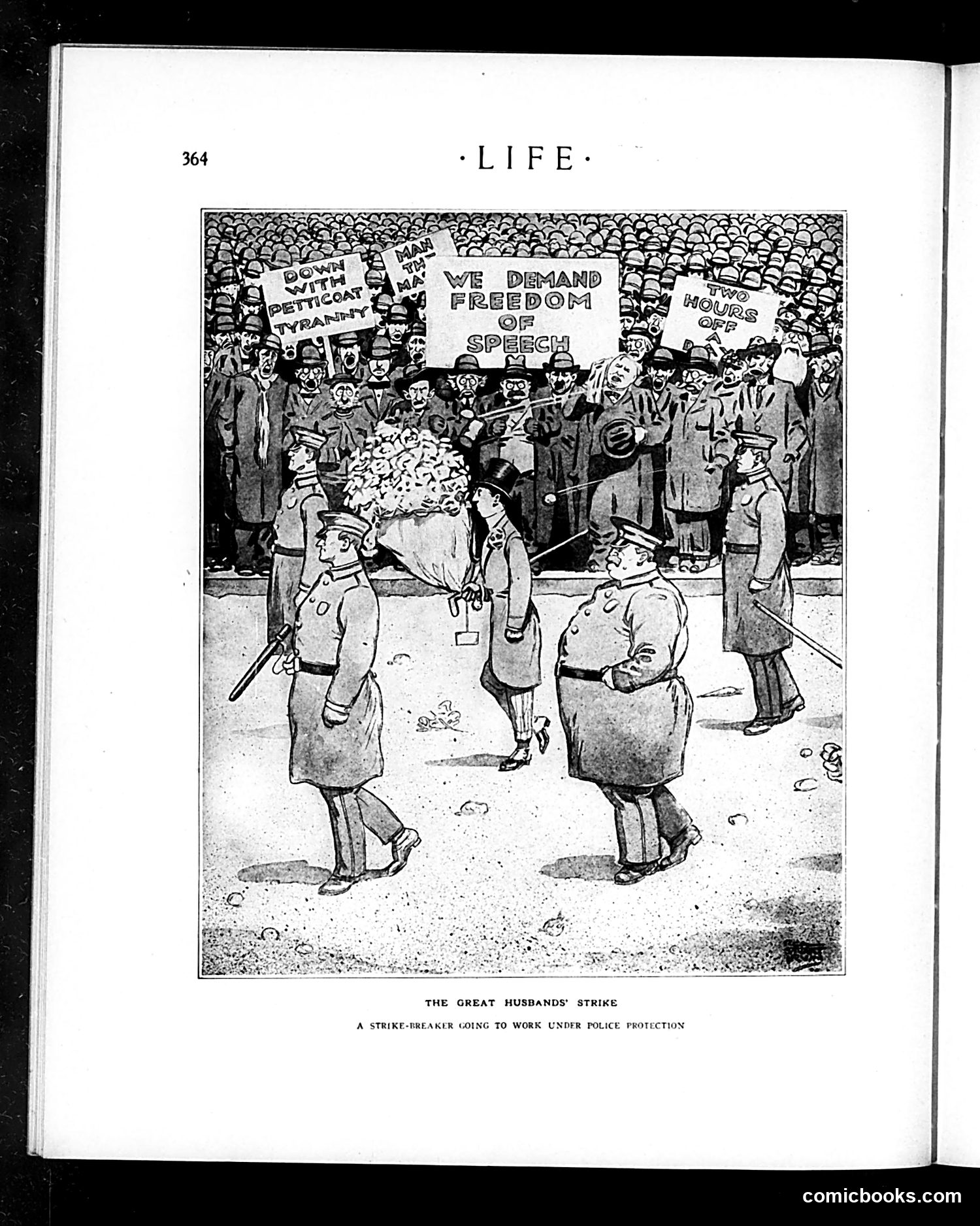
This satirical cartoon depicts a labor strike scenario in reverse. The caption reads "A STRIKE-BREAKER GOING TO WORK UNDER POLICE PROTECTION," but the "strike-breaker" appears to be a woman, while the massive crowd behind holding protest signs represents striking husbands demanding "FREEDOM OF SPEECH," "PETTICOAT TYRANNY," and "TWO HOURS OFF." The satire inverts typical labor disputes: rather than workers striking against employers, husbands are portrayed as oppressed laborers rebelling against wives' domestic control. The cartoon mocks contemporary anxieties about women's growing independence and authority within marriages, presenting marital conflict through the lens of industrial labor unrest. The woman proceeding under police protection suggests she represents a threat to male domestic power.
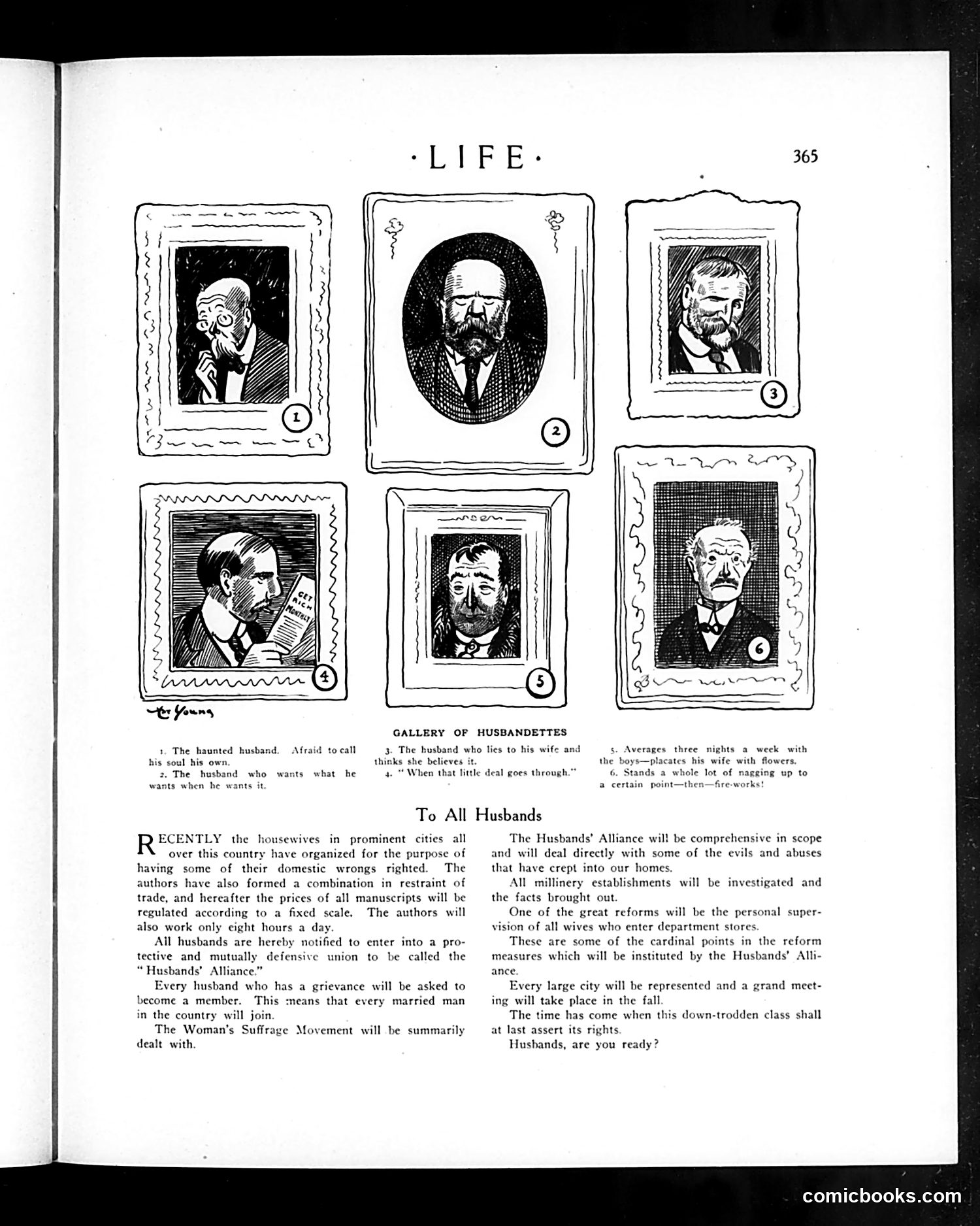
This satirical page mocks the emerging Women's Suffrage Movement by presenting six caricatured "types" of husbands supposedly threatened by women's rights activism. The cartoon accompanies an article titled "To All Husbands," which sarcastically proposes a "Husbands' Alliance"—a defensive union to combat wives' demands for equality. The six portraits represent stereotypical male anxieties: the haunted husband, the deceived husband, and others experiencing domestic discord. The satire suggests husbands feel emasculated or threatened by women organizing for political and economic rights. The accompanying text ridicules women's suffrage as a destabilizing force while ironically framing husbands as an oppressed class needing collective protection—inverting actual power dynamics to delegitimize women's legitimate grievances about domestic wrongs and economic inequality.
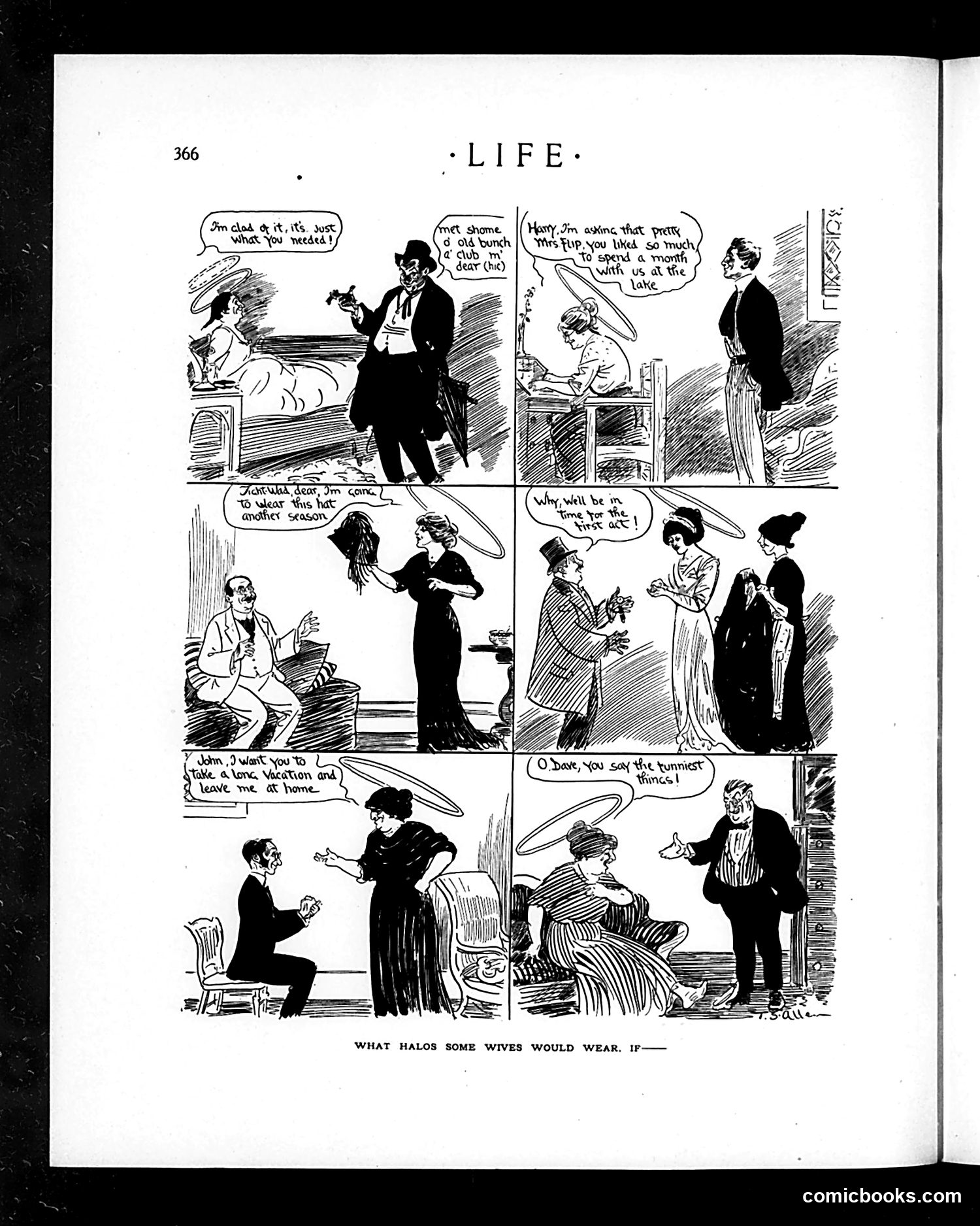
This satirical comic strip depicts domestic marital conflicts through six panels, showing wives in various exasperating situations with their husbands. The humor relies on visual metaphors: each panel shows a woman wearing an increasingly large halo, suggesting she deserves sainthood for her patience. The scenarios include a husband dismissing his hat as "just worn-out" while the wife must endure it, invitations to boring club gatherings, a husband requesting a lengthy vacation while leaving the wife home, and a husband asking her to abandon a vacation to stay home instead. The final panels show wives tolerating their husbands' contradictory demands and poor judgment. The satire targets the era's domestic power imbalances, depicting wives as long-suffering and morally superior to their unreasonable husbands—a commentary on marital inequality of the period.
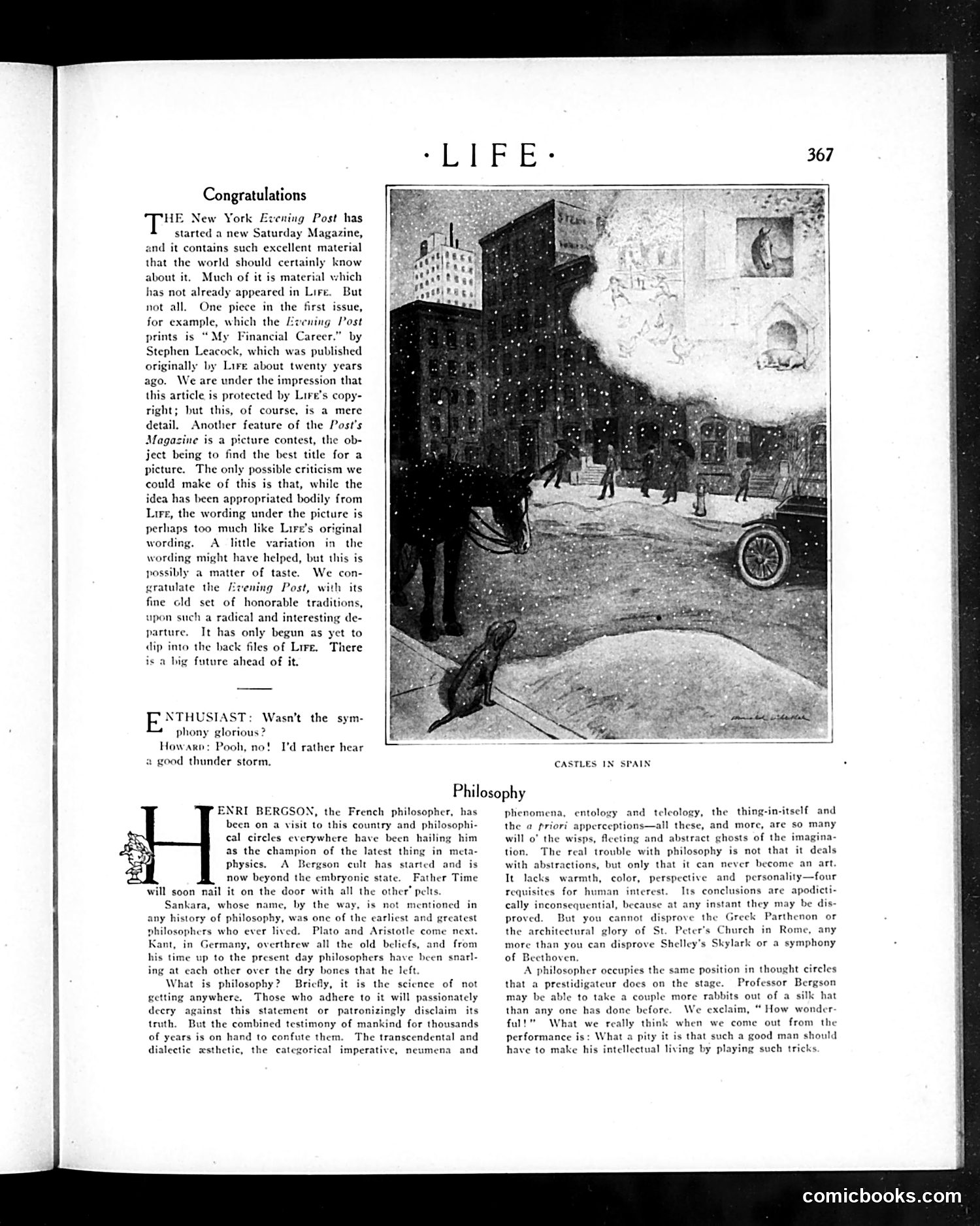
**The "Congratulations" Section** satirizes the *New York Evening Post*'s new Saturday Magazine for plagiarizing from Life. The piece accuses the *Post* of reprinting Stephen Leacock's "My Financial Career" (originally published in Life twenty years earlier) and copying Life's picture-contest format—down to nearly identical captions. The satire is tongue-in-cheek; Life "congratulates" the *Post* while pointedly noting these borrowings violate copyright and lack originality, suggesting the *Post* has "a big future" of continued raids on Life's back catalog. **The "Philosophy" Section** critiques Henri Bergson, a fashionable French philosopher then visiting America, dismissing philosophy itself as a worthless pursuit. The author argues that philosophy—despite its abstract terminology—never actually *arrives* anywhere or achieves anything concrete, unlike art or architecture. Bergson is likened to a stage magician pulling rabbits from a hat: impressive performance, but ultimately hollow intellectual sleight-of-hand. Both pieces employ Life's characteristic satirical tone: mock praise concealing sharp criticism.
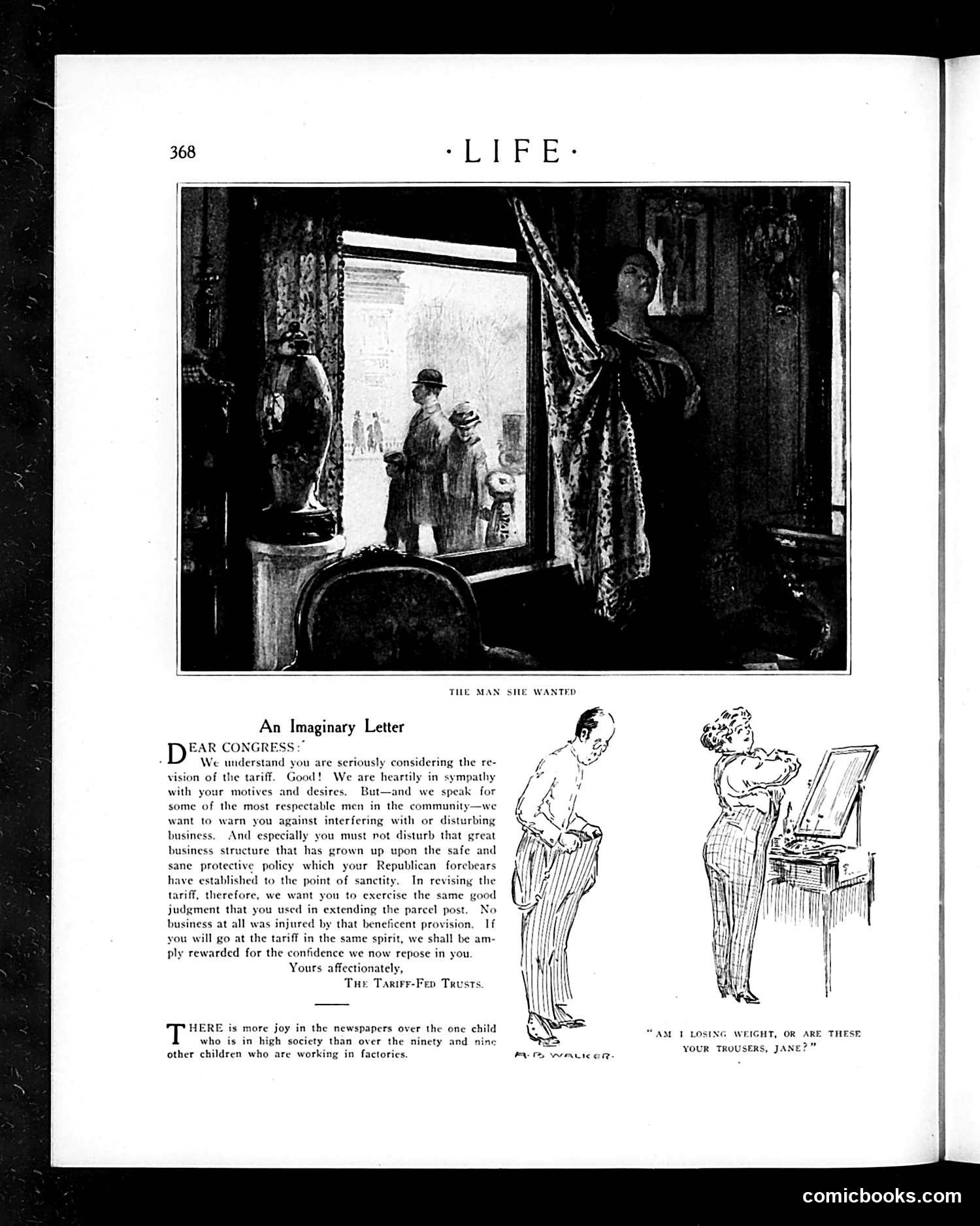
This page satirizes **tariff protection and corporate influence** on Congress. The "Imaginary Letter" is written by "The Tariff-Fed Trusts"—big businesses that profited from protective tariffs (taxes on imports). They're supposedly "warning" Congress against revising tariffs, claiming to support reform while actually demanding the status quo remain undisturbed. The satire lies in their transparent hypocrisy: they praise Congress's good judgment on minor issues (parcel post) to manipulate them into preserving lucrative tariff protections. The upper photograph, "The Man She Wanted," shows figures looking out a window at street life, illustrating the magazine's broader critique in the text below: newspapers celebrate a single wealthy child's social prominence while ignoring ninety-nine working children in factories—a commentary on media priorities and class inequality during the Progressive Era. The cartoon couple on the right appears unrelated domestic humor.
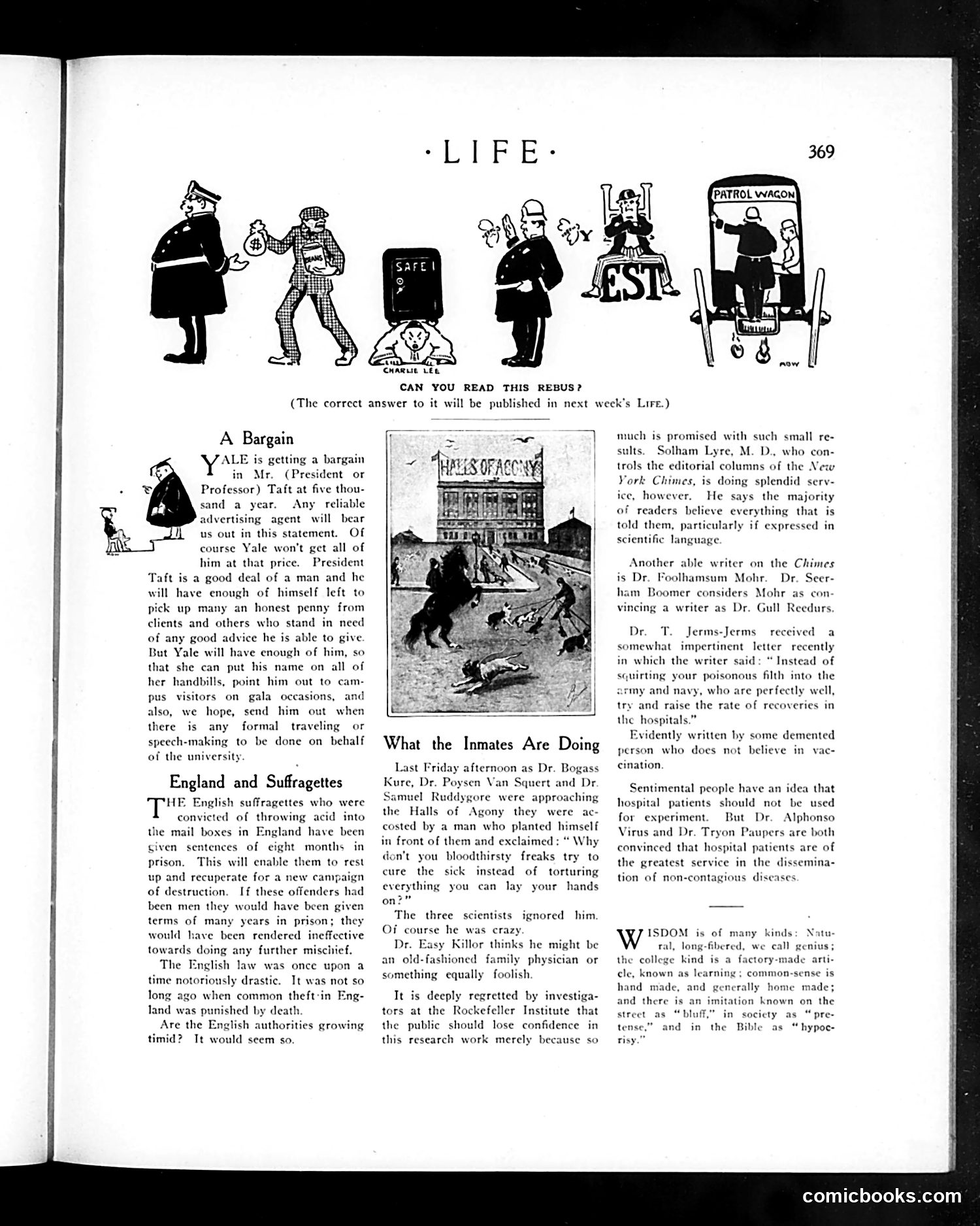
This page from Life magazine (circa 1910s) contains several satirical pieces: **The Rebus** at top is a visual puzzle readers were invited to solve, with the answer published the following week—a common interactive feature. **"A Bargain"** mocks President William Howard Taft's $5,000-per-year appointment to Yale University, sarcastically suggesting he's overqualified and could profitably moonlight consulting elsewhere. **"England and Suffragettes"** criticizes the light sentencing (eight months) given to British suffragettes convicted of vandalizing mailboxes with acid, comparing it unfavorably to historical harsh English punishments and suggesting authorities have grown "timid." **"What the Inmates Are Doing"** satirizes medical researchers at institutions like the Rockefeller Institute, mocking the gap between their grand promises and modest results, and lampooning their defense that the public simply believes whatever they claim if dressed in scientific language. The implied criticism: unethical experimentation on hospital patients. The overall tone reflects Progressive Era skepticism toward established institutions—universities, government, science, and the legal system.
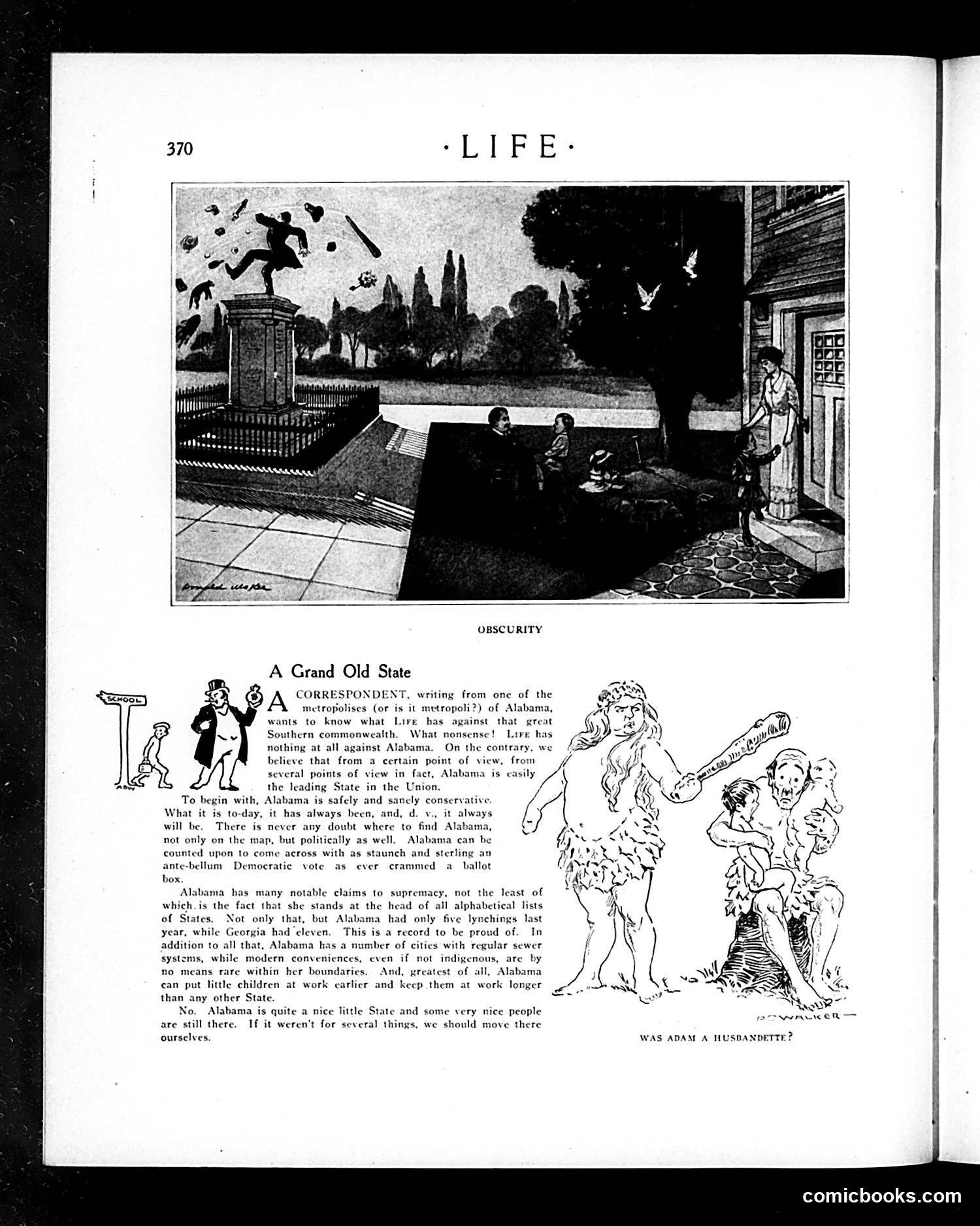
This is satirical mock-praise of Alabama from a Life magazine correspondent. The piece uses sarcasm to critique the state's actual conditions by listing them as "achievements": **The Satire's Targets:** - Alabama's conservative politics (locked into ante-bellum Democratic voting) - Child labor practices (boasting it keeps children working longer than other states) - Lynching violence (claiming only 5 lynchings versus Georgia's 11 as something to be "proud of") - Lack of modern infrastructure and conveniences - General backwardness masked by alphabetical ranking as "first" state **The Joke:** By pretending Alabama is exemplary while describing genuinely deplorable conditions—child exploitation, racial violence, poverty—Life exposes these as the state's actual failures. The correspondent's closing quip ("we should move there ourselves") undercuts the entire "praise," revealing it as biting criticism of Southern social conditions and Democratic political conservatism. The right-side cartoon "Was Adam a Husbandette?" appears unrelated to the Alabama piece, likely addressing gender issues separately.
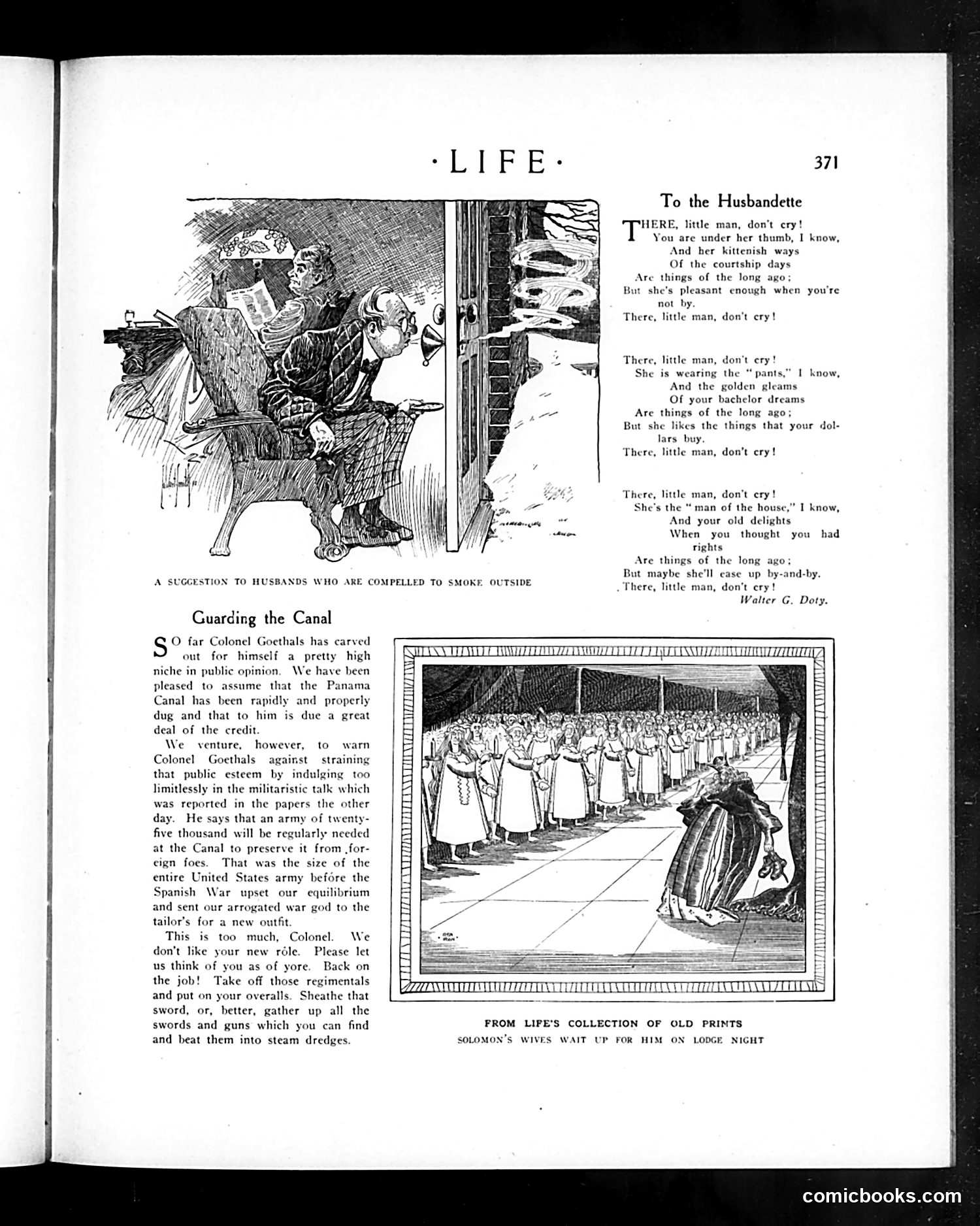
**Top Cartoon**: "A Suggestion to Husbands Who are Compelled to Smoke Outside" depicts a man forced outdoors to smoke while his wife remains inside—satirizing domestic power dynamics and new anti-smoking restrictions (likely in homes or public spaces). The humor mocks the husband's loss of authority in his own house. **Poem**: "To the Husbandette" by Walter G. Doty humorously consoleshusbands about marriage. It presents a wife who dominates the household ("wearing the pants," is "man of the house"), controls finances ("things that your dollars buy"), and has abandoned courtship pleasantness. The refrain "don't cry" mocks male submission to female authority—a common satirical theme of this era about shifting domestic power. **Article**: "Guarding the Canal" discusses Colonel Goethals (Panama Canal chief engineer), warning him against inflating military needs. The text criticizes his claim that 25,000 soldiers are necessary to defend the Canal, suggesting this militaristic talk threatens his public reputation as a civilian engineer. **Bottom Print**: References Solomon's wives waiting for him, likely contrasting biblical polygamy with modern monogamous domestic situations.
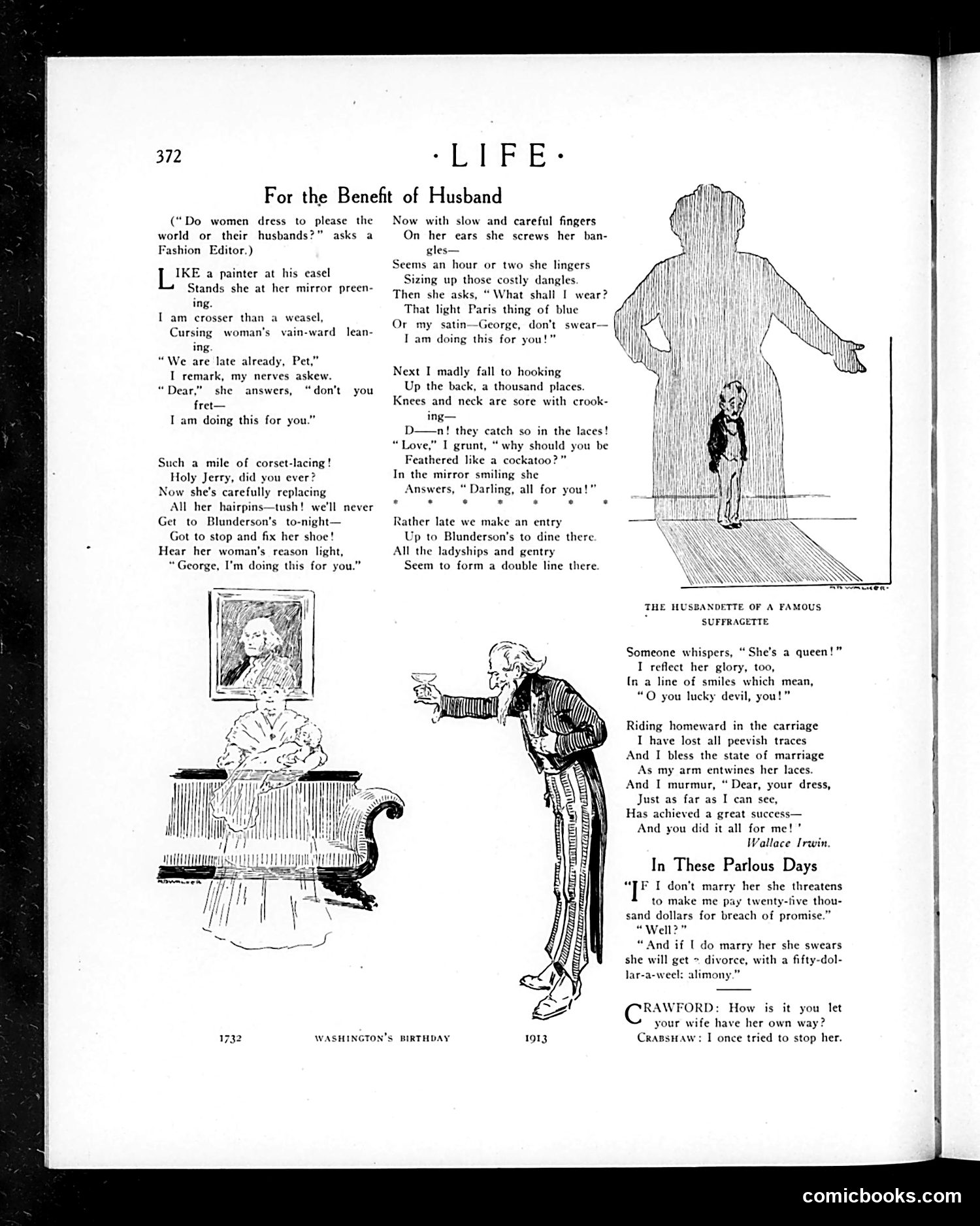
This page satirizes the common male complaint that women dress elaborately "for their husbands" rather than vanity. The long poem, illustrated with sketches, follows a husband's irritation as his wife takes hours preparing—lacing corsets, arranging hair, selecting jewelry and gowns—while repeatedly claiming "I am doing this for you!" The humor reverses the claim: her elaborate grooming actually delays their evening, annoys him, yet he eventually admits her dressed appearance reflects well on *him* at dinner, validating her original excuse. The accompanying cartoons mock marital dynamics: one shows a tiny man dwarfed inside a large woman's silhouette, and another depicts a man admitting he "once tried to stop her"—implying wives inevitably get their way despite husbands' attempts at control. The satire targets both female vanity masquerading as wifely devotion and male powerlessness in marriage, typical early 20th-century domestic humor.
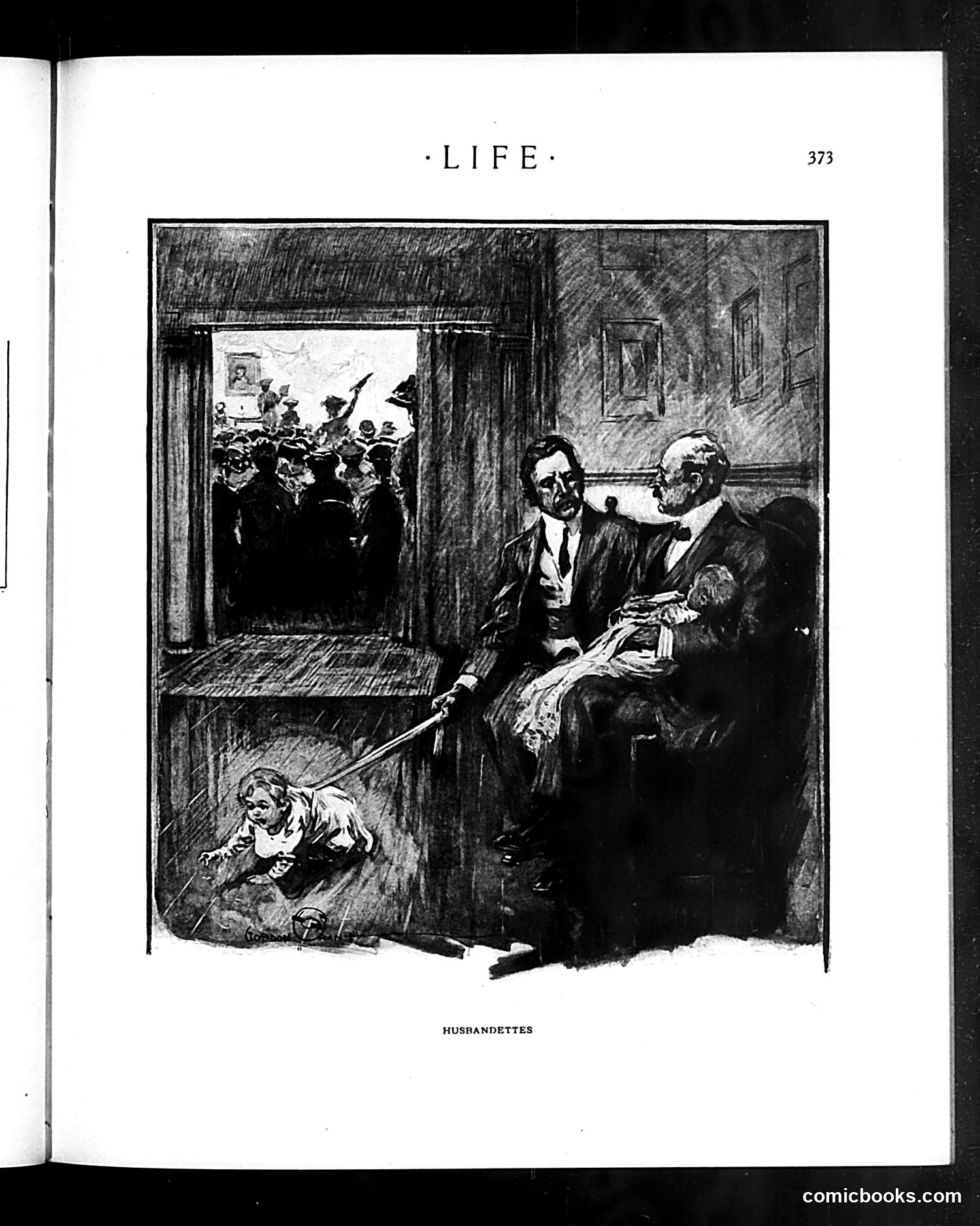
This satirical cartoon depicts a domestic scene where the power dynamic has reversed. Two men sit comfortably indoors while a woman crawls on the floor with a stick, apparently being controlled or directed by one of the seated men—who holds the stick like a leash or prod. Through the doorway, a crowd of women gathers outside, suggesting a women's movement or gathering. The title "Husbandettes" appears to be satirical wordplay mocking women's increasing independence and activism (likely referencing suffrage or labor movements). The cartoon sarcastically presents a "solution" where women are reduced to subservient, animal-like status. It mocks both the idea of female independence and exaggerates the fears some men held about women's rights movements—suggesting anxieties about traditional gender hierarchies being challenged.
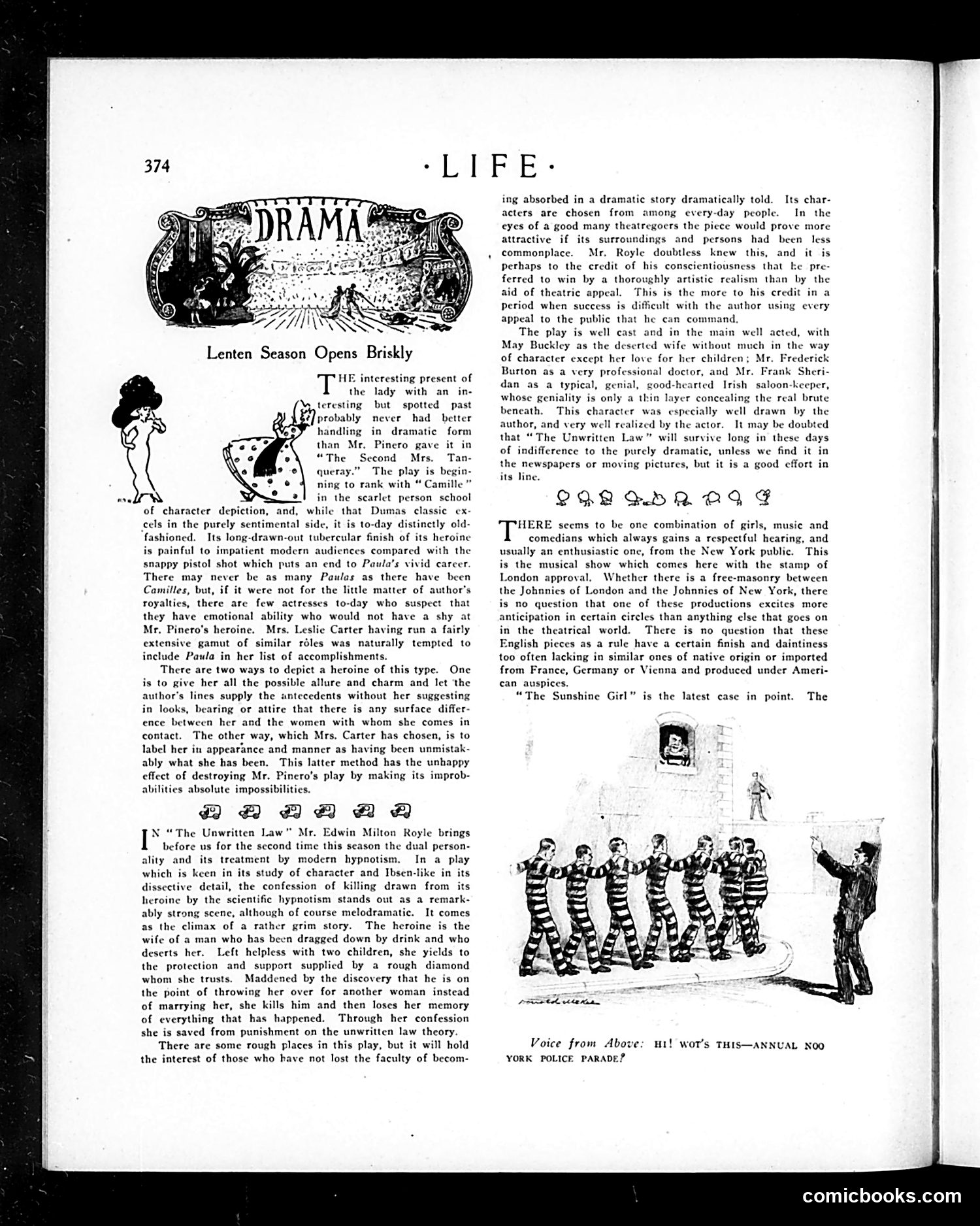
This page contains two theater reviews from Life magazine's drama section. The first reviews "The Second Mrs. Tanqueray," a play about a woman with a scandalous past. The critic discusses how actress Mrs. Leslie Carter depicts this "fallen woman" character—debating whether she should appear morally corrupted in appearance or maintain respectability. The review suggests Carter's choice to "label her" visibly as disreputable undermines the play's believability. The second review covers "The Unwritten Law," which uses hypnotism to reveal a woman's murder confession. The heroine kills her lover after he abandons her for another woman, then loses her memory. She escapes punishment through an "unwritten law" (likely referring to crimes of passion defenses). The critic praises the realistic, everyday casting despite the melodramatic plot. The small cartoon at bottom shows New York police in a parade, captioned "Hi! Wot's this—Annual Noo York Police Parade?"—likely satirizing police spectacle or pageantry.
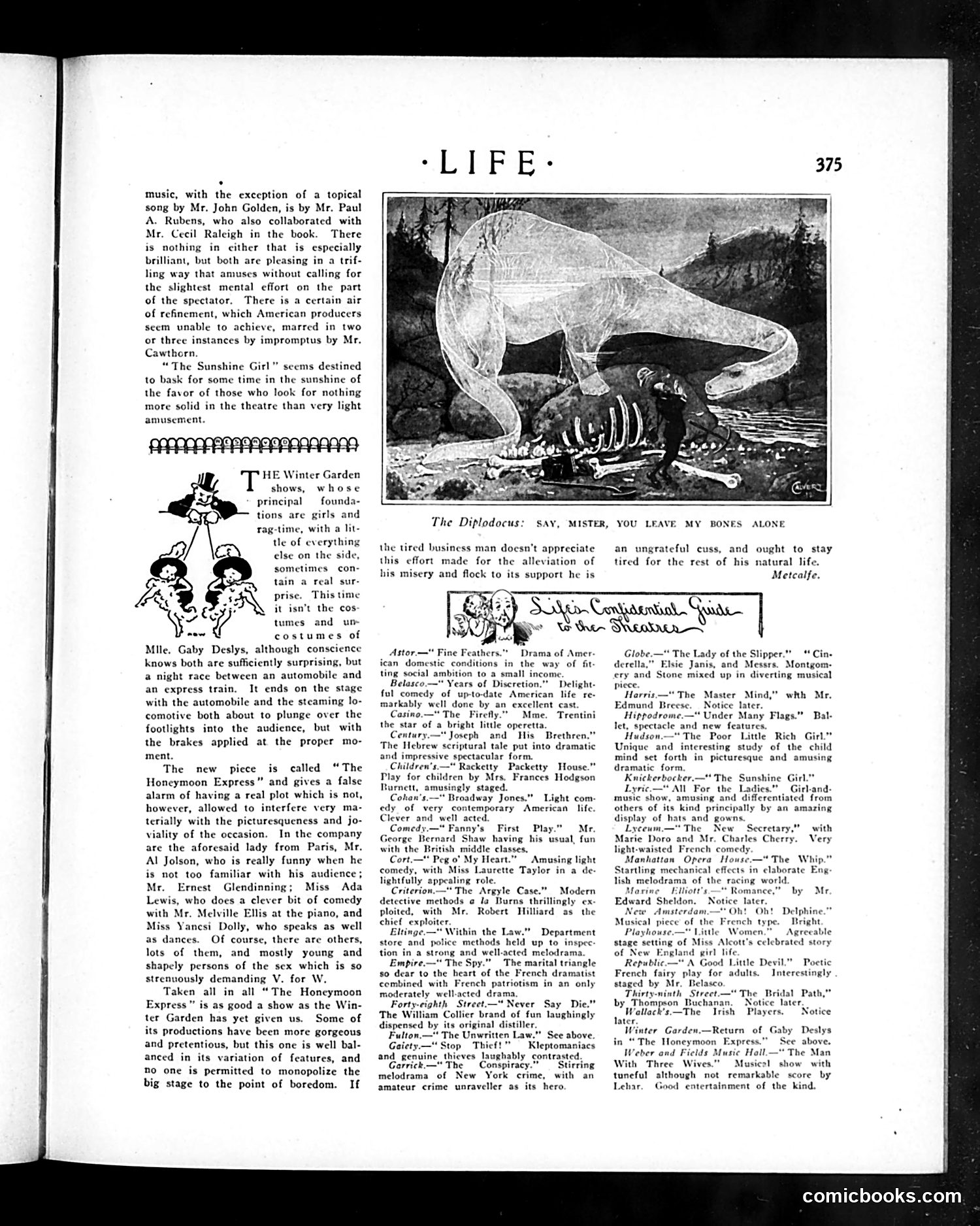
This page features a theatrical review with a cartoon showing a dinosaur skeleton (labeled "The Diplodocus") speaking to a man. The dinosaur says, "Say, Mister, you leave my bones alone"—an ungrateful complaint, the text notes, as the tired businessman should appreciate efforts made for his entertainment and support the theater. The joke is a visual pun: the dinosaur represents something ancient and extinct, metaphorically comparing the theatrical productions discussed (described as light amusement without substance) to fossils. The cartoon satirizes how audiences take entertainment for granted, while also gently mocking the "tired business man"—a stock figure of the era—who sought escapist theater. The dinosaur humorously demands respect for providing distraction, though it's literally dead and buried.
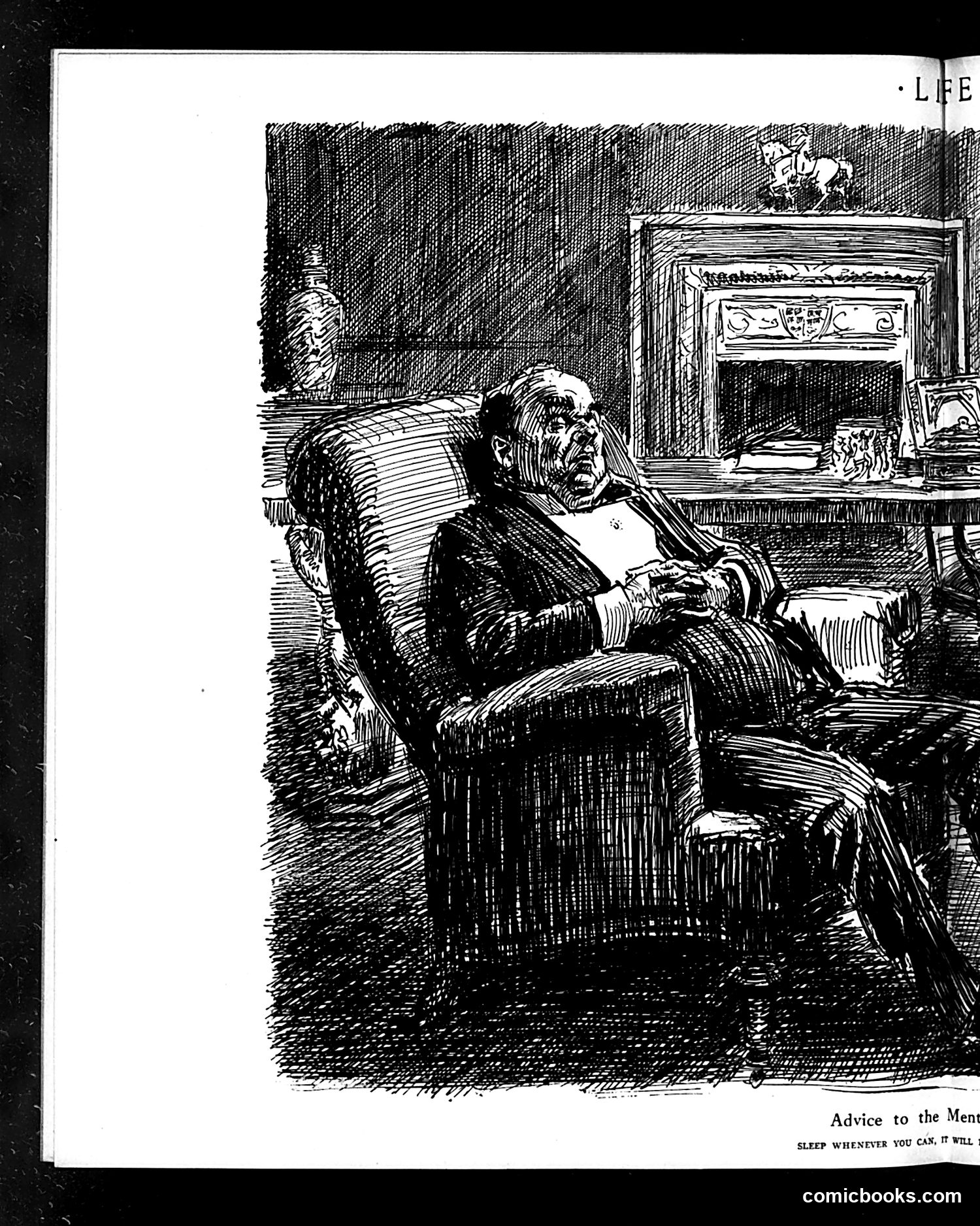
This page shows a political cartoon titled "Advice to the Men" with the partial caption "SLEEP WHENEVER YOU CAN, IT WILL..." The image depicts an older man in formal Victorian-era clothing, seated and appearing weary or contemplative. He's positioned in what appears to be an elegant interior with a fireplace and furnishings visible in the background. The cartoon's satirical point appears to be advice directed at men—likely husbands or working men—to rest when possible. Without the complete caption, the full joke is unclear, but it suggests commentary on men's exhaustion from work, domestic life, or social obligations typical of the era. The worn expression of the figure supports a theme of fatigue or stress in male social experience. The specific historical or political context cannot be fully determined from the incomplete text visible.
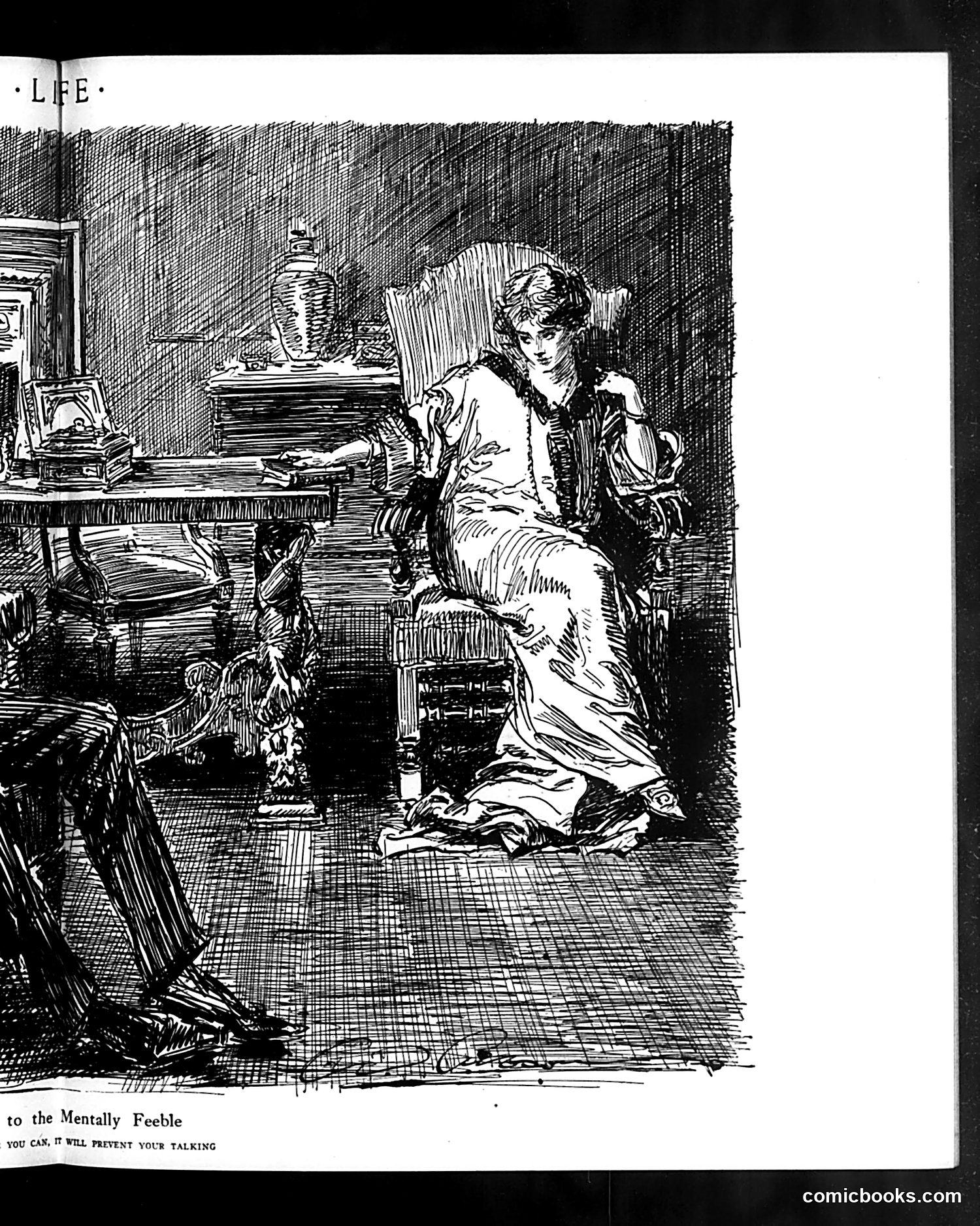
This appears to be a satirical cartoon from *Life* magazine showing a woman kneeling before a desk, seemingly in a submissive or pleading position. The caption reads "to the Mentally Feeble: you can, it will prevent your talking." The satire targets what appears to be a condescending attitude toward women or those perceived as intellectually inferior. The image suggests that silencing or controlling "the mentally feeble" (likely a derogatory reference to women or a specific group) is presented as a solution to their "talking." This reflects early 20th-century gender politics and paternalistic attitudes, where women's voices were often dismissed or discouraged. The cartoon mocks this dismissive perspective through dark satire, highlighting the absurdity of such controlling attitudes toward a person's right to speak.
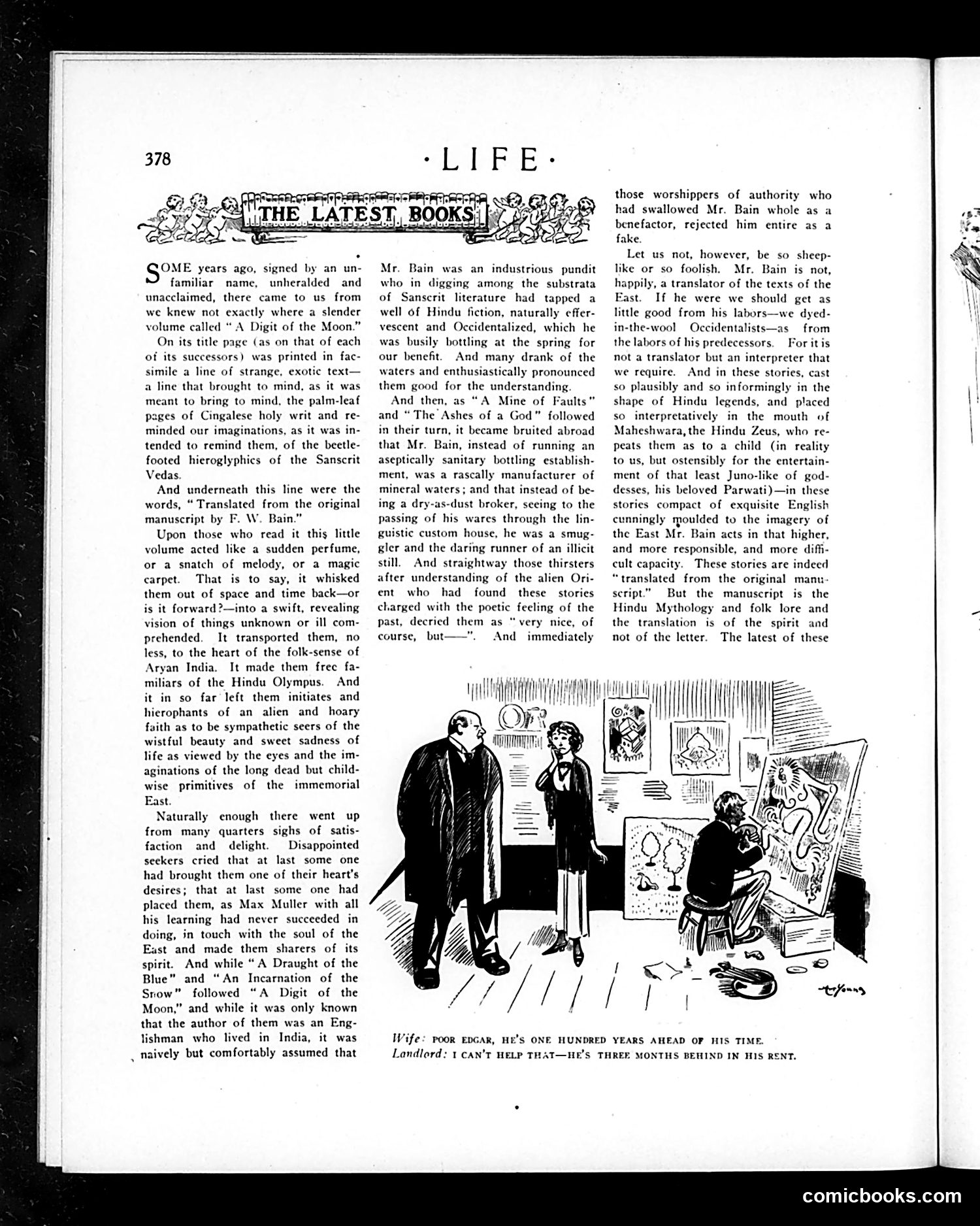
This page reviews F.W. Bain's books presenting Hindu legends and philosophy to Western readers. The article defends Bain against critics who discovered he was a British writer in India, not a Sanskrit scholar translating ancient texts. The accompanying cartoon satirizes literary pretension: a landlord confronts a tenant surrounded by artwork and manuscripts. The caption reveals the tenant is "poor Edgar" who lives 100 years ahead of his time—his rent is three months overdue. This mocks impoverished artists and writers who pursue bohemian, avant-garde work while failing at practical finances. The article's point: Bain's value lies not in literal translation but in *interpreting* Eastern philosophy for Western audiences. His imaginative recreation captures the spirit better than scholarly accuracy would.
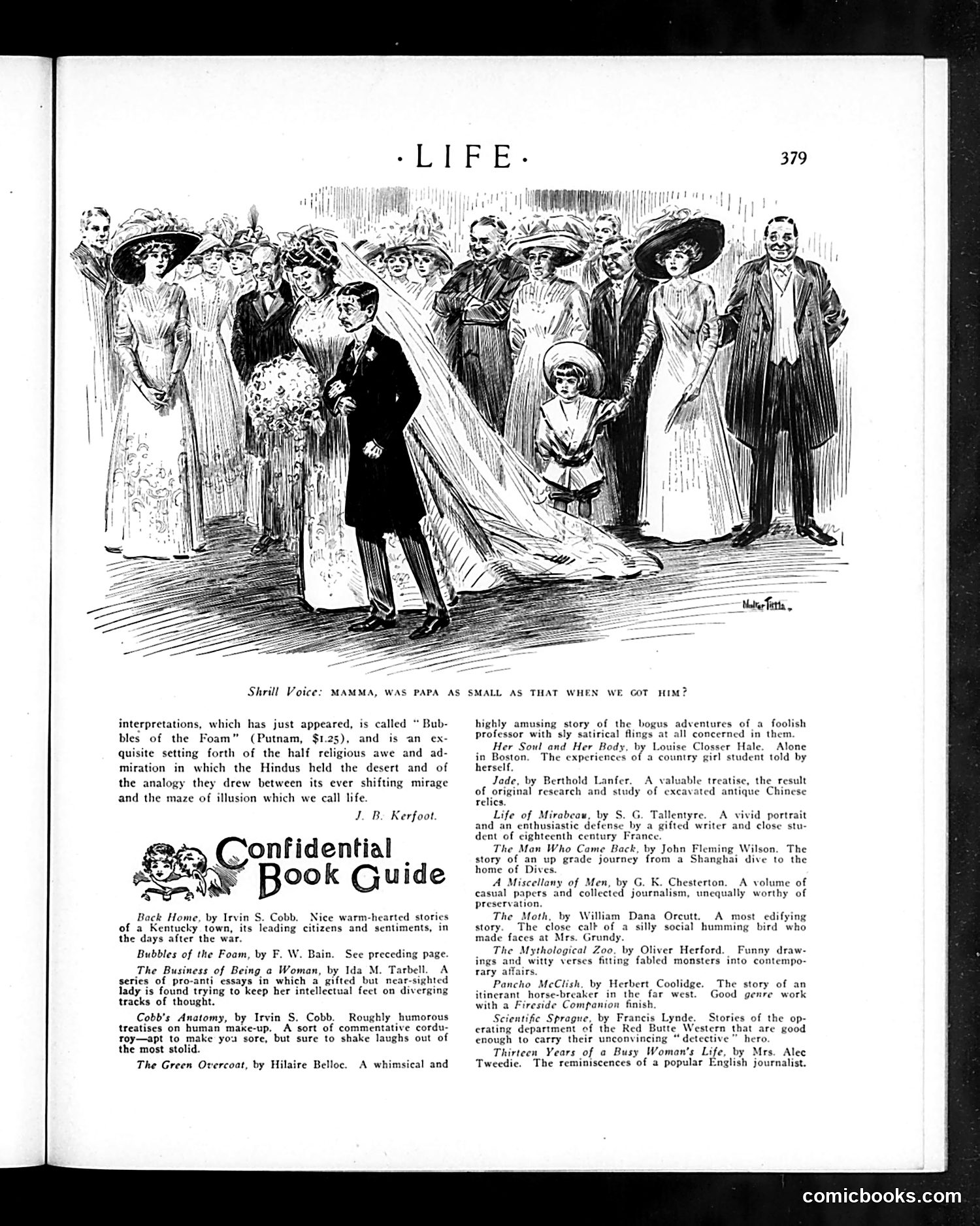
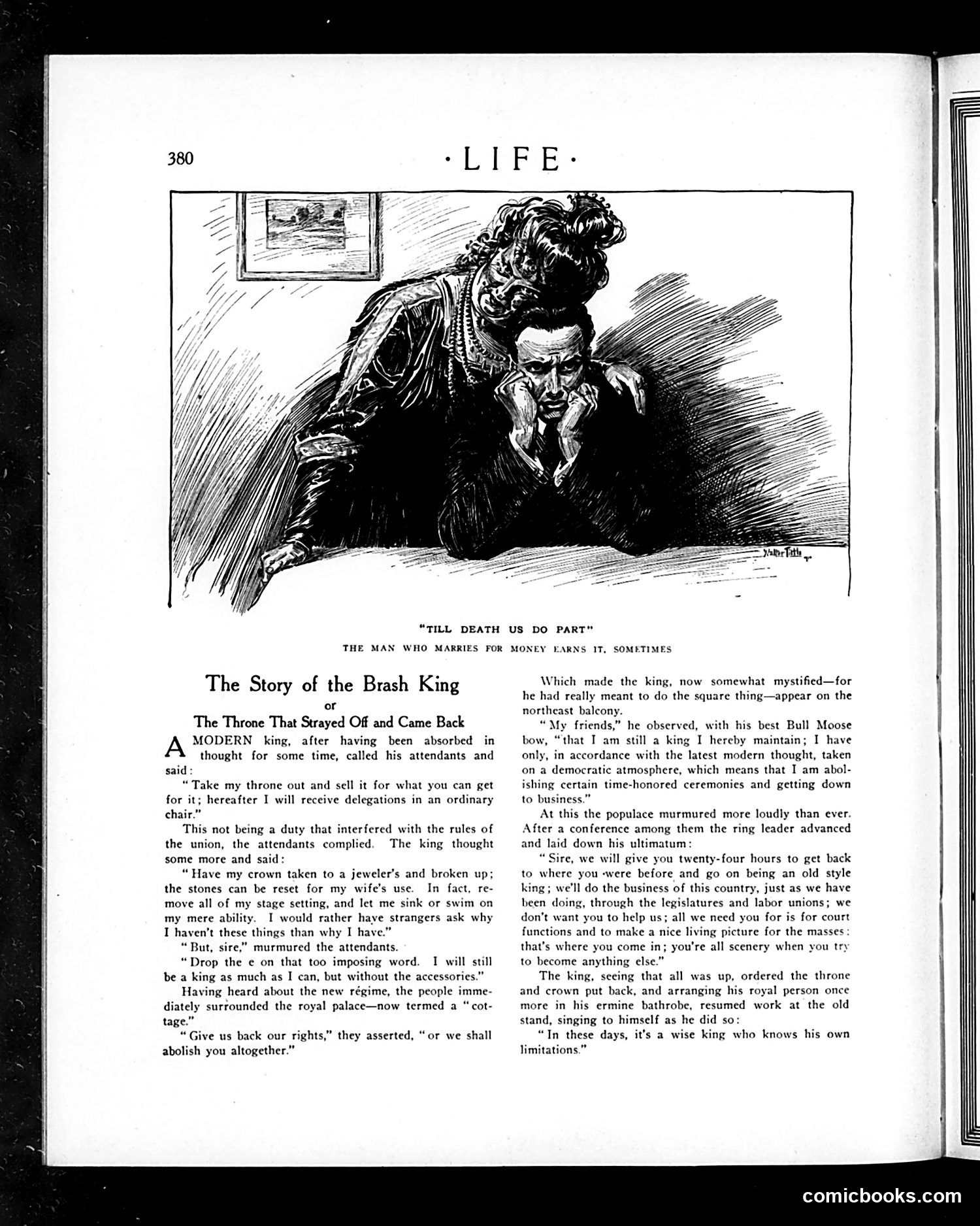
This satirical story mocks early-20th-century progressive reformers who attempted to democratize institutions by removing ceremonial trappings. A "modern king" sells his throne, melts down his crown, and adopts democratic ways—only to be confronted by angry citizens demanding he return to his ornamental role. The joke targets two groups: idealistic reformers who believe stripping away ceremony achieves real change, and the public who actually *want* the spectacle and ceremony of monarchy/authority. The populace explicitly tells the king his value is purely symbolic—he should provide "scenery" and "court functions" while they handle actual governance through legislatures and unions. The satire suggests that people fundamentally need and desire ceremony and hierarchy, and that attempts to eliminate these are futile. The "Bull Moose" reference likely alludes to Theodore Roosevelt's progressive movement, positioning this as contemporary political commentary on reform efforts circa 1910s.
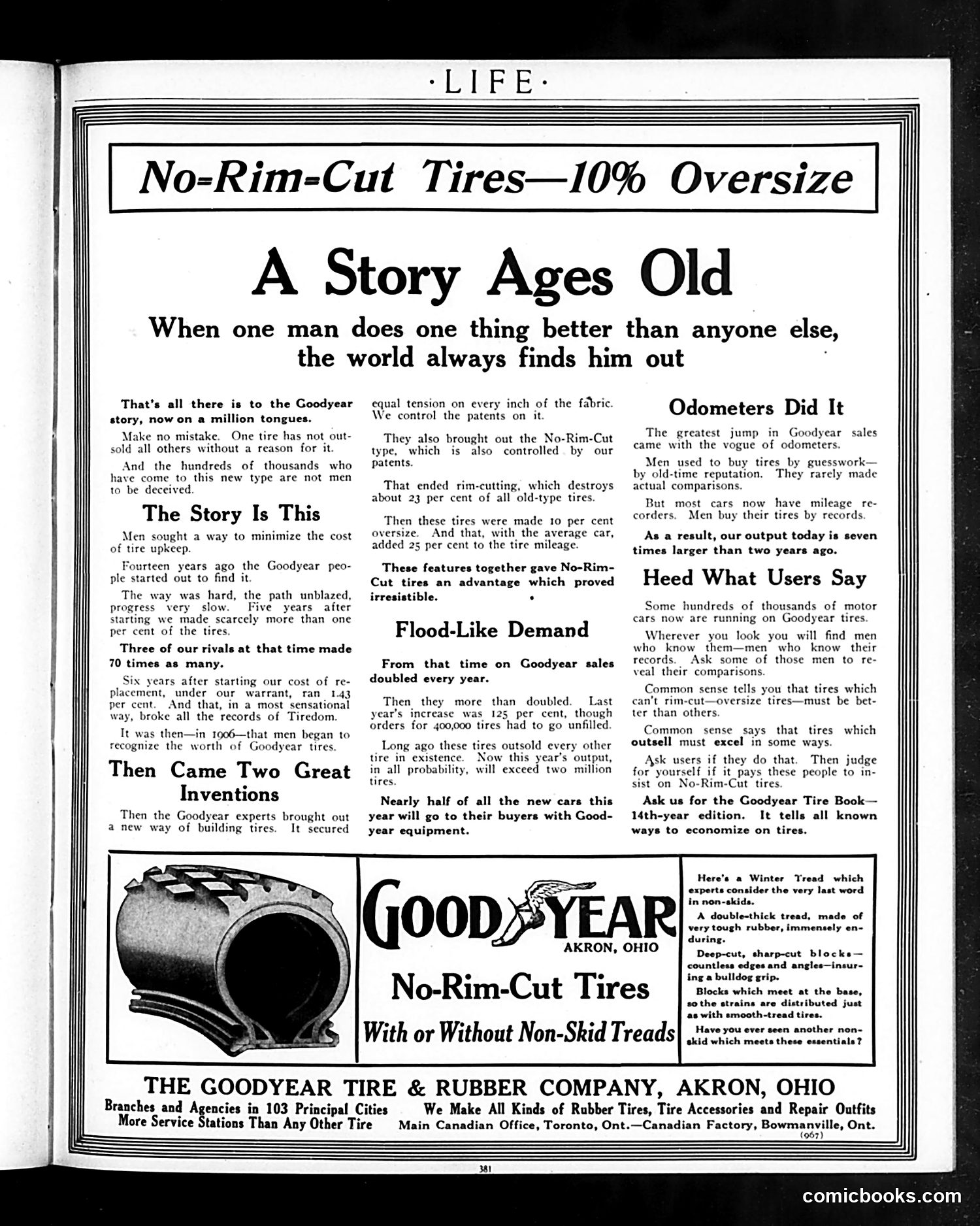
This is entirely a **Goodyear Tire advertisement**, not satire or political content. The "story" framing is purely marketing rhetoric. The page presents Goodyear's narrative of innovation: fourteen years of development (from ~1896) culminating in two patented inventions—even fabric tension and "No-Rim-Cut" tire design—that allegedly eliminated rim damage (which destroyed 23% of older tires) and added 25% mileage through 10% larger sizing. The key persuasion tactic: **odometers**. The text claims consumers shifted from buying tires by "old-time reputation" to demanding documented mileage records, allowing Goodyear's superior performance to prove itself measurably. This sales explosion (125% year-over-year growth, 2 million tires annually) allegedly followed once buyers could compare actual results. The "Story Ages Old" headline—"when one man does one thing better than anyone else, the world always finds him out"—is simply corporate mythology: innovation speaks for itself. There is no actual satire here; this is straightforward early-20th-century product advertising dressed in narrative form.
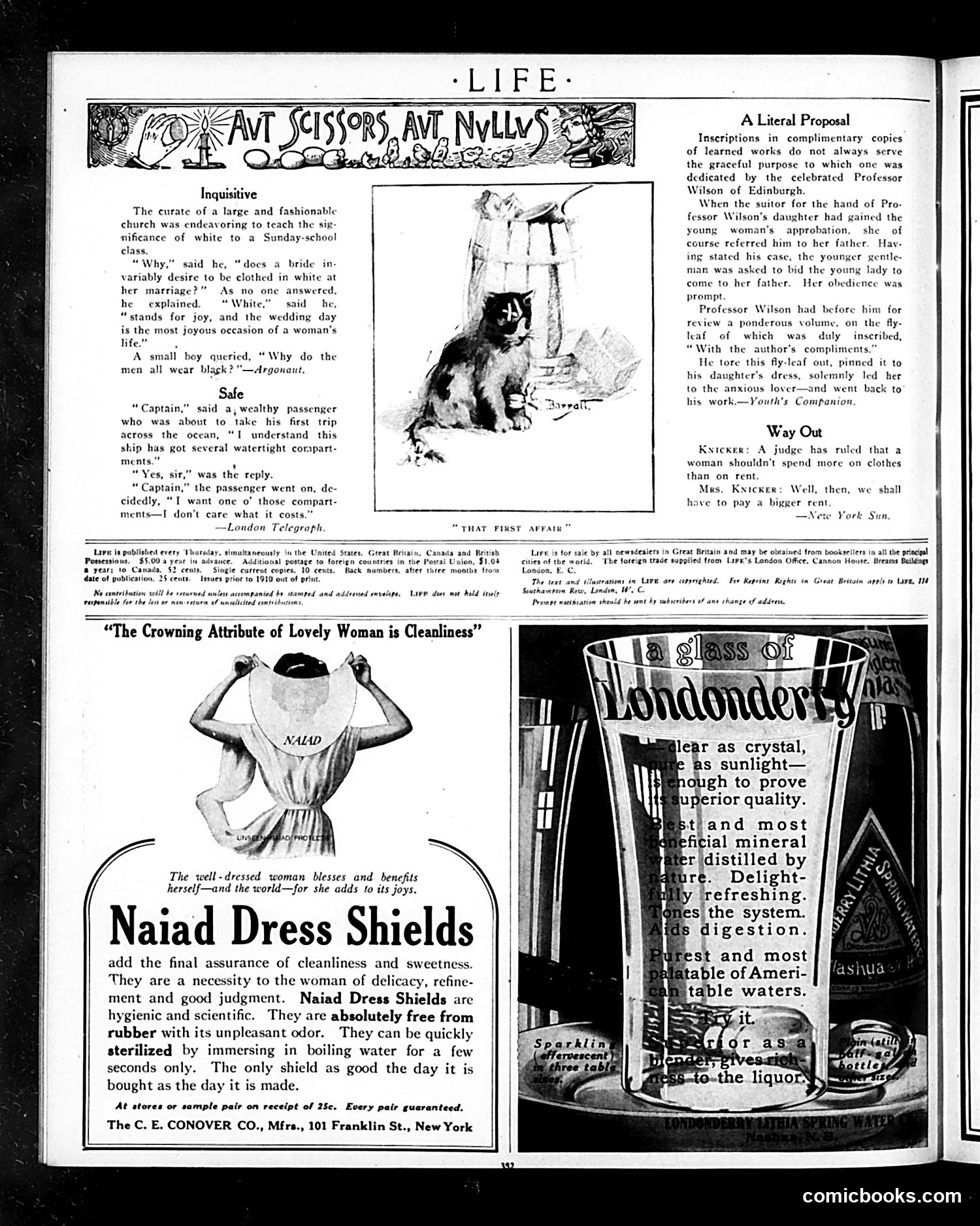
This page contains several brief satirical humor pieces typical of early Life magazine: **"Inquisitive"**: A Sunday school joke where a curate explains white symbolizes joy at weddings, then a child asks why men wear black—implying men's marriages are joyless. The satire targets both religious instruction and marital unhappiness. **"Safe"**: A wealthy ocean passenger wants a watertight compartment for his cabin, misunderstanding their purpose. The joke mocks nervous first-time travelers and their excessive caution. **"A Literal Proposal"**: A father responds to a suitor's marriage proposal by literally pinning the girl to him via an inscription from a book, treating it as a business transaction. This satirizes formal Victorian courtship rituals as absurdly mechanical. **"Way Out"**: A judge rules women shouldn't spend more on clothes than rent; a woman responds they'll simply pay higher rent. This jokes about women's spending habits and judges' attempts to regulate them. The page is otherwise dominated by period **advertisements** for Naiad Dress Shields and Londonderry mineral water—products marketed with era-specific concerns about feminine "cleanliness" and genteel refinement.
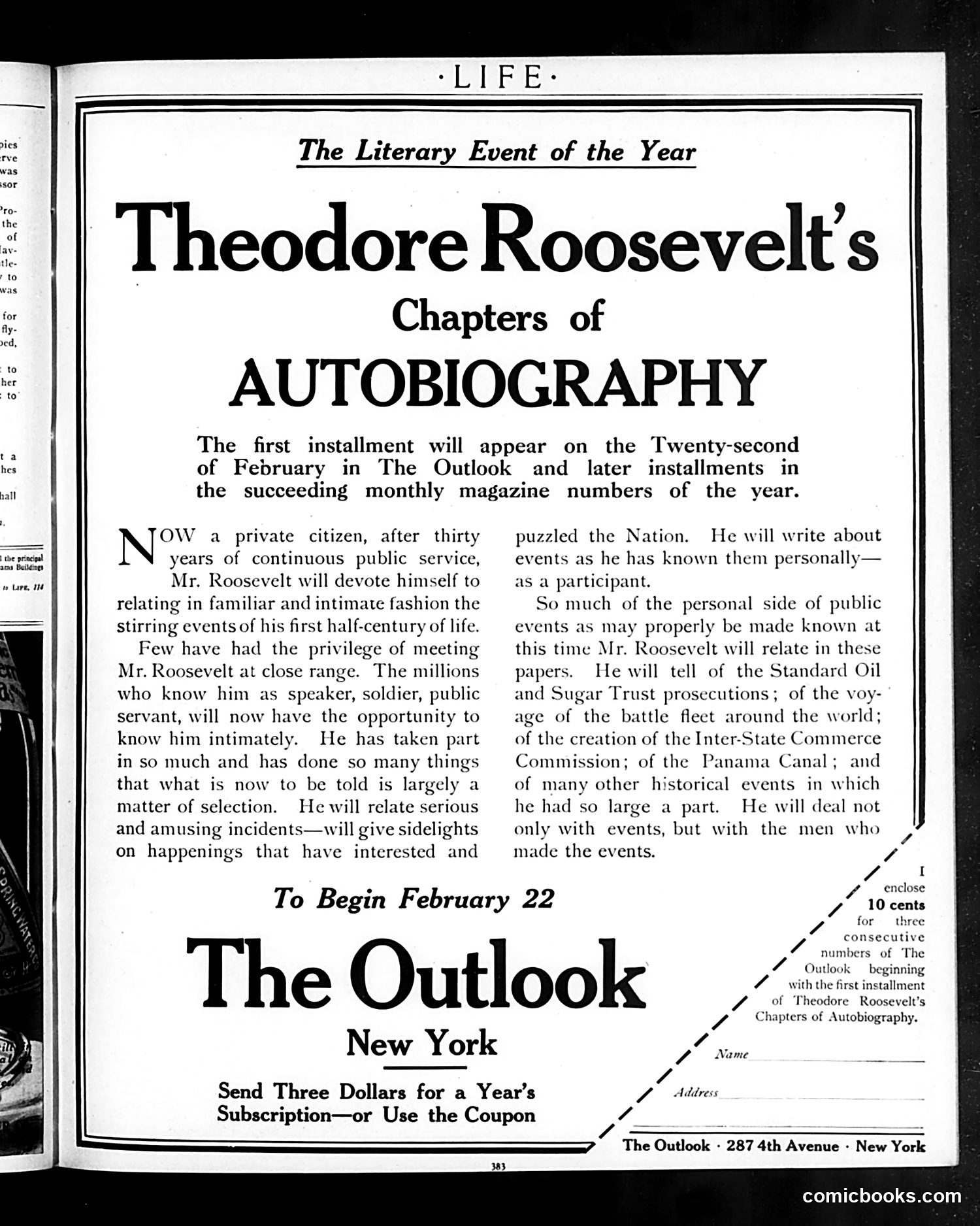
This page is a *Life* magazine advertisement announcing Theodore Roosevelt's serialized autobiography in *The Outlook* magazine, beginning February 22. There are no cartoons or caricatures. The ad emphasizes Roosevelt's insider perspective on major events: trust prosecutions, the global naval voyage, the Panama Canal, and the Interstate Commerce Commission. It appeals to readers' curiosity about Roosevelt's personal accounts of these historical moments and the "men who made the events." The sales pitch—"few have had the privilege of meeting Mr. Roosevelt at close range"—positions the autobiography as intimate access to a celebrated public figure. At the time (post-presidency), Roosevelt remained a prominent national personality, making his personal reflections a significant "literary event."
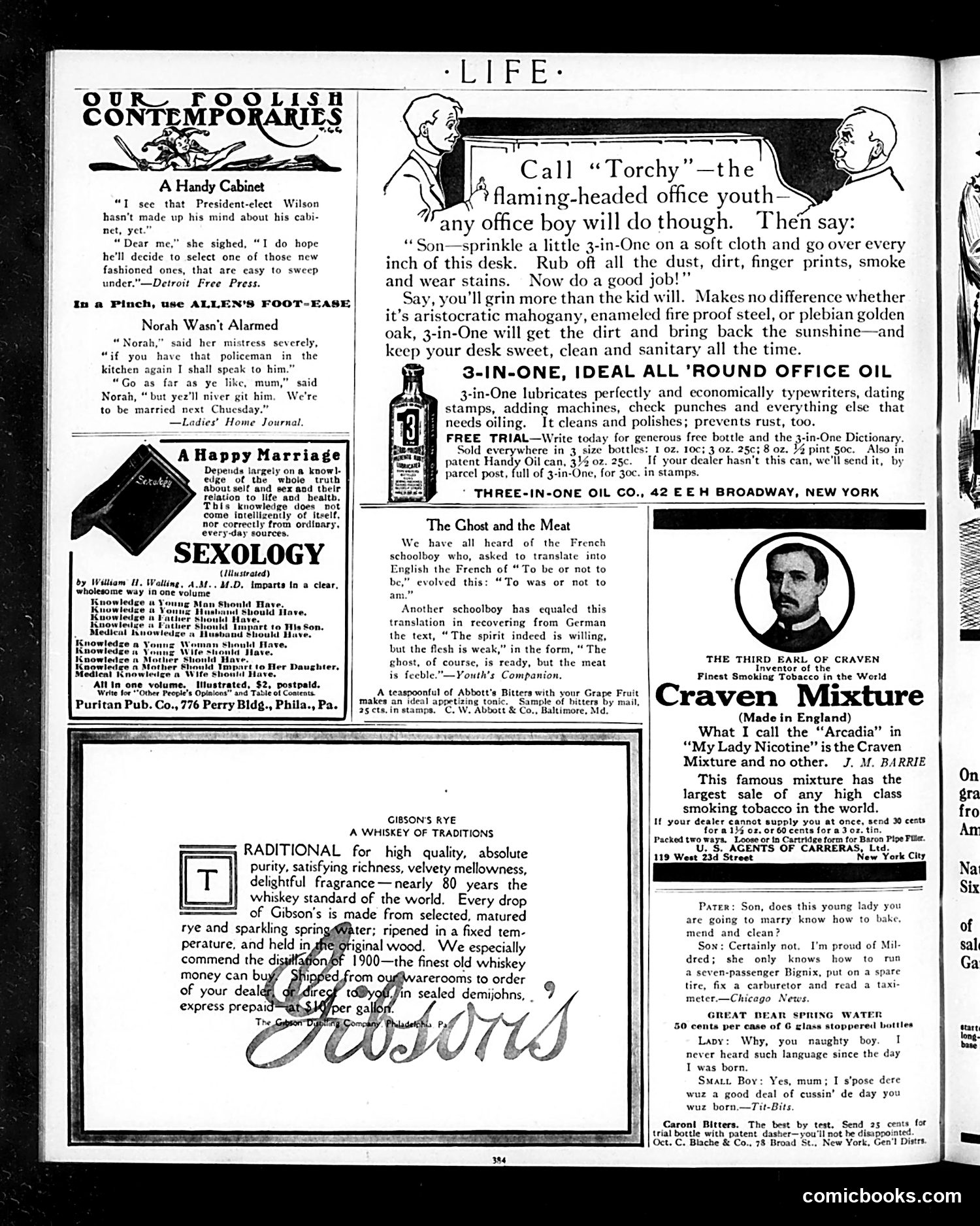
This page mixes satirical commentary with advertising typical of early 1910s Life magazine. **Political Satire**: "A Handy Cabinet" references President-elect Woodrow Wilson's delayed cabinet selections, mocking his indecision through a domestic angle—a woman hopes he'll choose "fashioned" men for his team. **Social Humor**: The remaining short pieces satirize domestic life and gender roles. "Norah Wasn't Alarmed" jokes about an Irish servant's casual attitude toward her mistress threatening to report her to a policeman—she'll marry him anyway. The "Happy Marriage" and "Ghost and the Meat" pieces mock translation errors and marital misunderstandings. **Advertising**: The bulk of the page comprises product ads (3-in-One Oil, Gibson's Rye whiskey, Craven tobacco, Great Bear Spring Water) with testimonial quotes. One ad mockingly portrays a modern woman bragging she can't cook or sew—only drive cars and fix carburetors—reversing traditional expectations humorously. The satire assumes readers familiar with Wilson's presidency and traditional gender roles being disrupted by modernity.
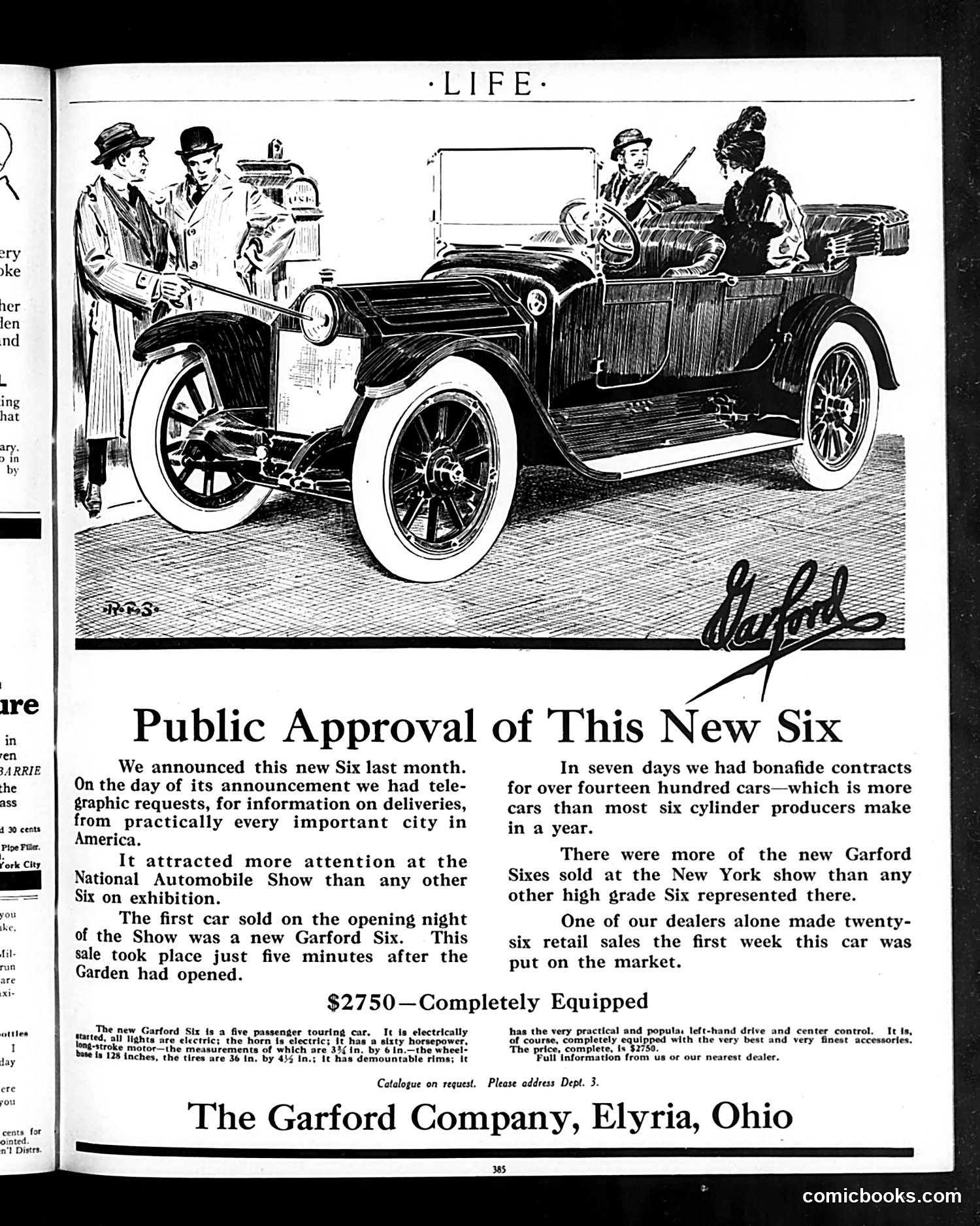
This is primarily **advertising, not satire or political cartooning**. The page features an illustration of a Garford Six automobile with well-dressed passengers and onlookers, accompanied by promotional text claiming exceptional market success. The "Public Approval" headline and testimonial-style copy emphasize rapid sales: 1,400 contracts in seven days, strong showroom performance, and dealer enthusiasm. For a modern reader: this represents early 1910s automotive marketing. The car cost $2,750 (roughly $80,000 today), positioning it as a luxury good for affluent buyers. The detailed specifications and claims of popularity are typical period advertising tactics. The illustration's formal style and the emphasis on electric lights and "left-hand drive" reflect contemporary technological selling points. **Life magazine** hosted such paid advertisements alongside its satirical content—this page simply demonstrates how magazines subsidized journalism through commercial sponsorship. There is no cartoon or joke intended here; it's straightforward product promotion.
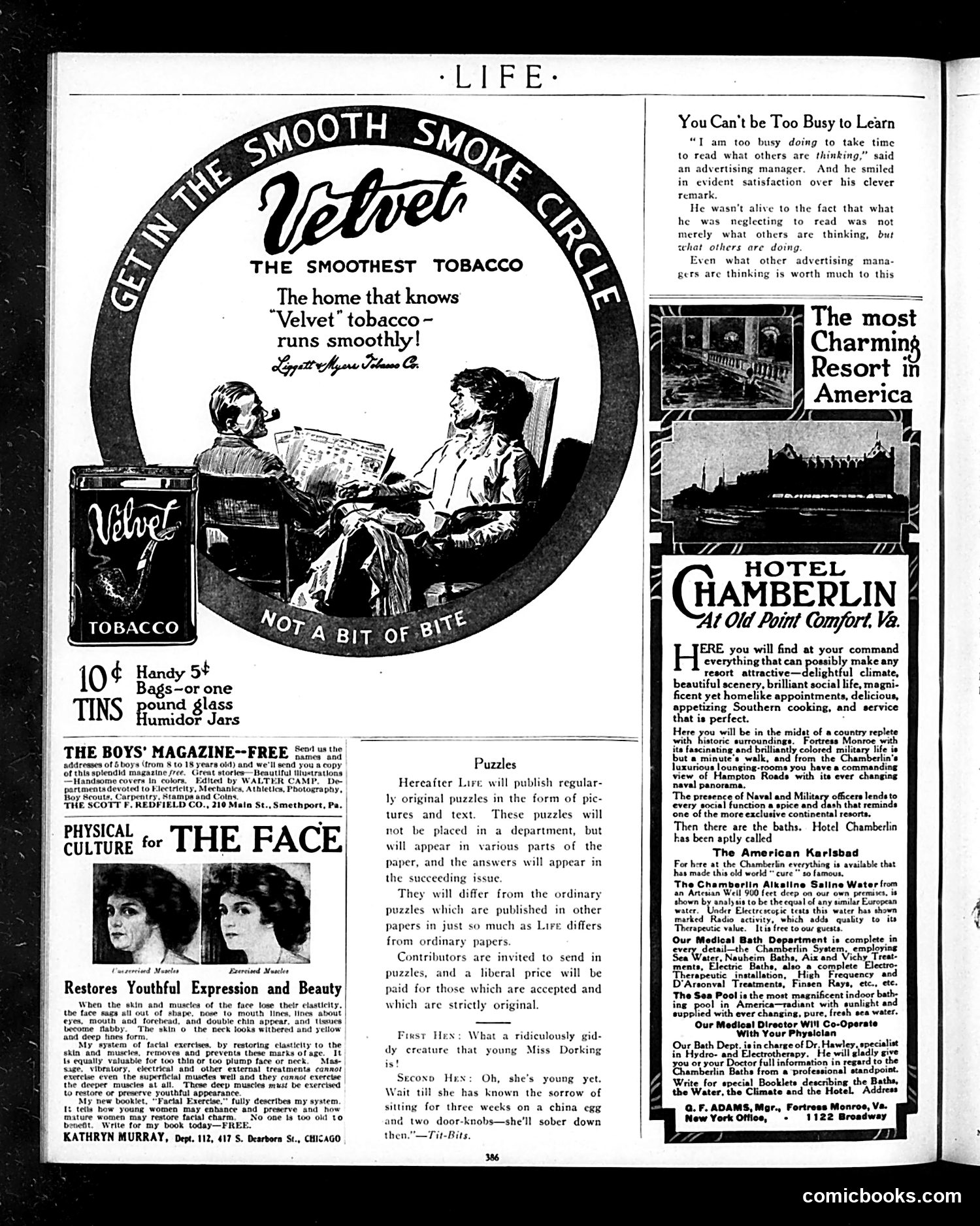
This page combines advertisements with editorial content typical of early 20th-century American magazines. **Main Advertisement:** Velvet tobacco dominates the left side, featuring a circular illustration of two men relaxing at home with newspapers—depicting the product as conducive to leisure and domestic comfort. The tagline "Not a Bit of Bite" emphasizes smoothness. **Editorial Content:** The right side includes practical advice: an article titled "You Can't be Too Busy to Learn" criticizes busy professionals who neglect reading what competitors are thinking and doing. Below that, the Hotel Chamberlin advertises itself as America's most charming resort, emphasizing luxury, Southern hospitality, and proximity to military sites (Fortress Monroe). **Minor Features:** Other advertisements promote facial exercises to restore youthful appearance and a free boys' magazine about mechanics and scouting. The page reflects early 1900s values: leisure consumption, self-improvement, and aspirational travel—all marketed through print advertising.
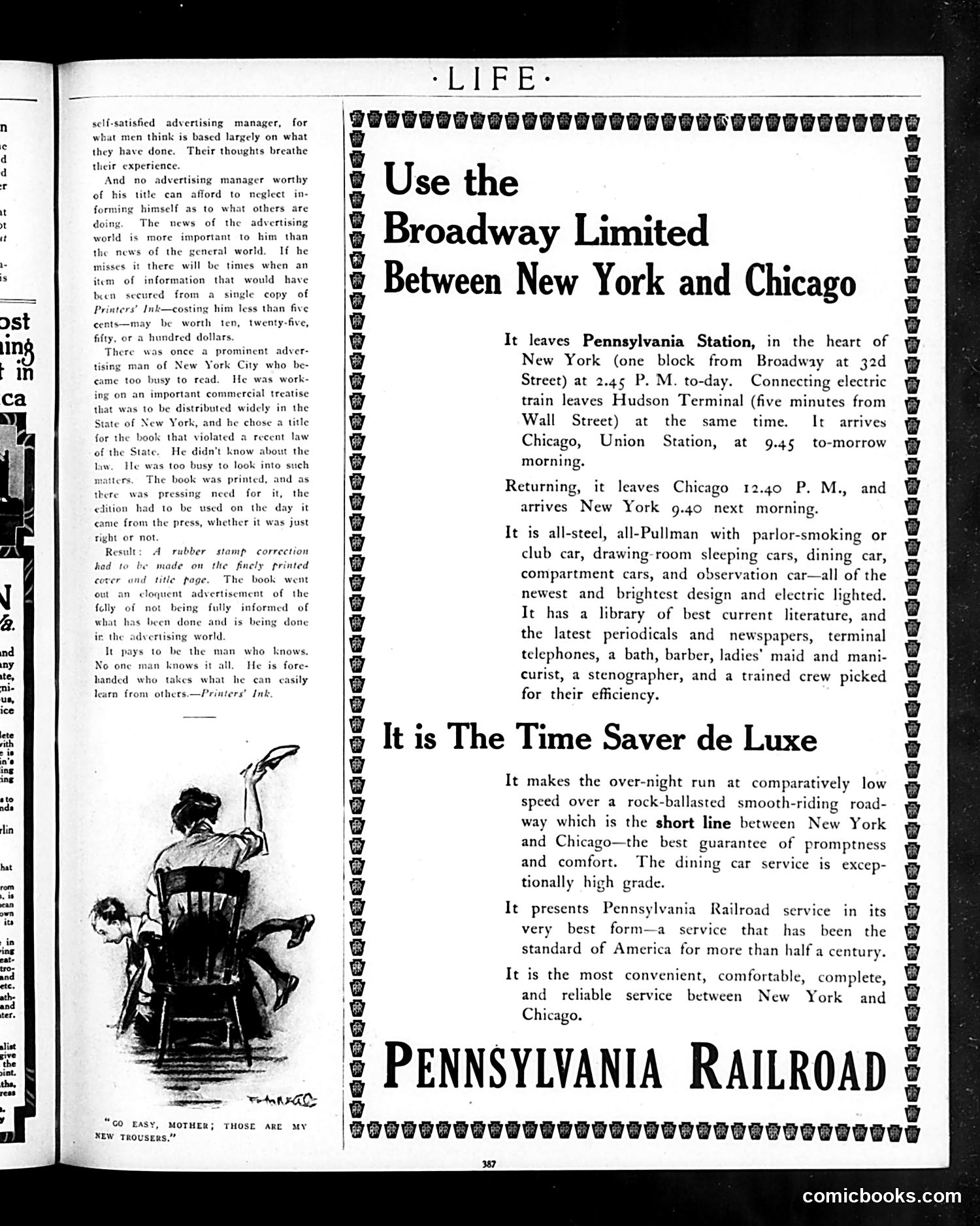
This page is primarily **advertising** for the Pennsylvania Railroad's "Broadway Limited" train service between New York and Chicago, framed within editorial content about advertising professionals. **The Editorial Content (left):** A satirical piece mocking self-satisfied advertising managers who neglect to stay informed. It describes an advertiser too busy to research state laws, resulting in his book requiring embarrassing rubber-stamp corrections—a cautionary tale about the consequences of ignorance. **The Cartoon (bottom left):** A sketch captioned "Go easy, Mother; Those are my new trousers" appears unrelated to the surrounding text—likely a standalone joke about a child or young person sitting in what looks like a chair or vehicle, with an older woman (presumably the mother) concerned about damage to new clothing. **The Advertisement (right):** A detailed pitch for the Pennsylvania Railroad's luxury overnight train, emphasizing speed, comfort, and amenities (Pullman cars, dining service, library, stenographer) to appeal to business travelers and affluent passengers needing quick, reliable New York-Chicago transit.
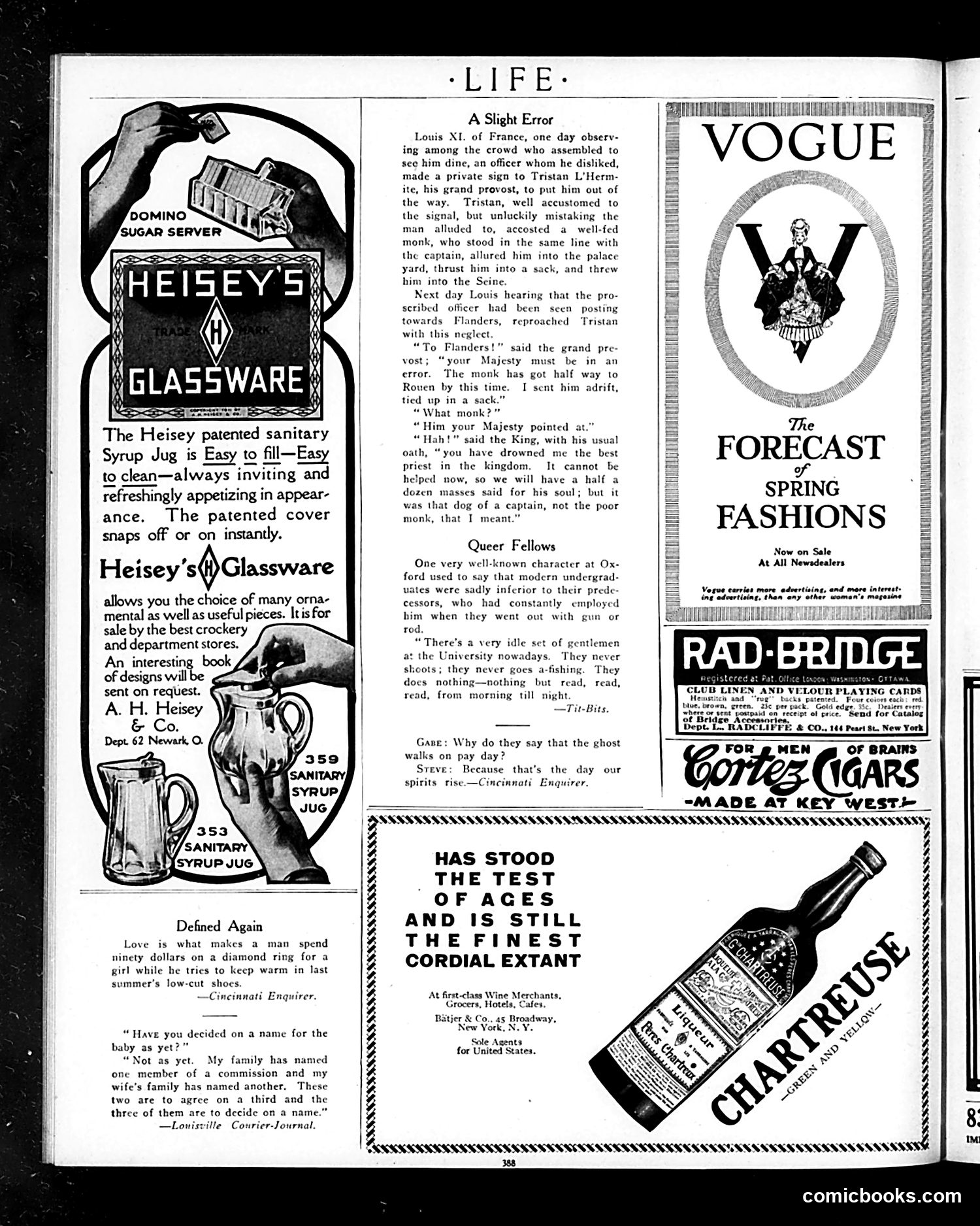
This page is primarily **advertising with some humorous content**, typical of Life magazine's format. The main humor pieces are brief anecdotes: 1. **"A Slight Error"** — A historical story about King Louis XI of France mistakenly ordering his provost to execute the wrong person (a monk instead of an officer). The satire mocks bureaucratic incompetence and blind obedience to authority. 2. **"Queer Fellows"** — An Oxford character laments that modern undergraduates are idle and don't hunt or fish like their predecessors, speaking in exaggerated dialect. It's gentle mockery of nostalgic complaints about youth. 3. **Two brief jokes** about diamond rings, baby naming, and ghosts on payday—typical period humor about courtship, family disputes, and pay schedules. The page is dominated by **product advertisements**: Heisey glassware, Vogue fashion forecasts, Rad-Bridge playing cards, Cortez cigars, and Chartruse liqueur. These reflect early 20th-century consumer goods and leisure interests.
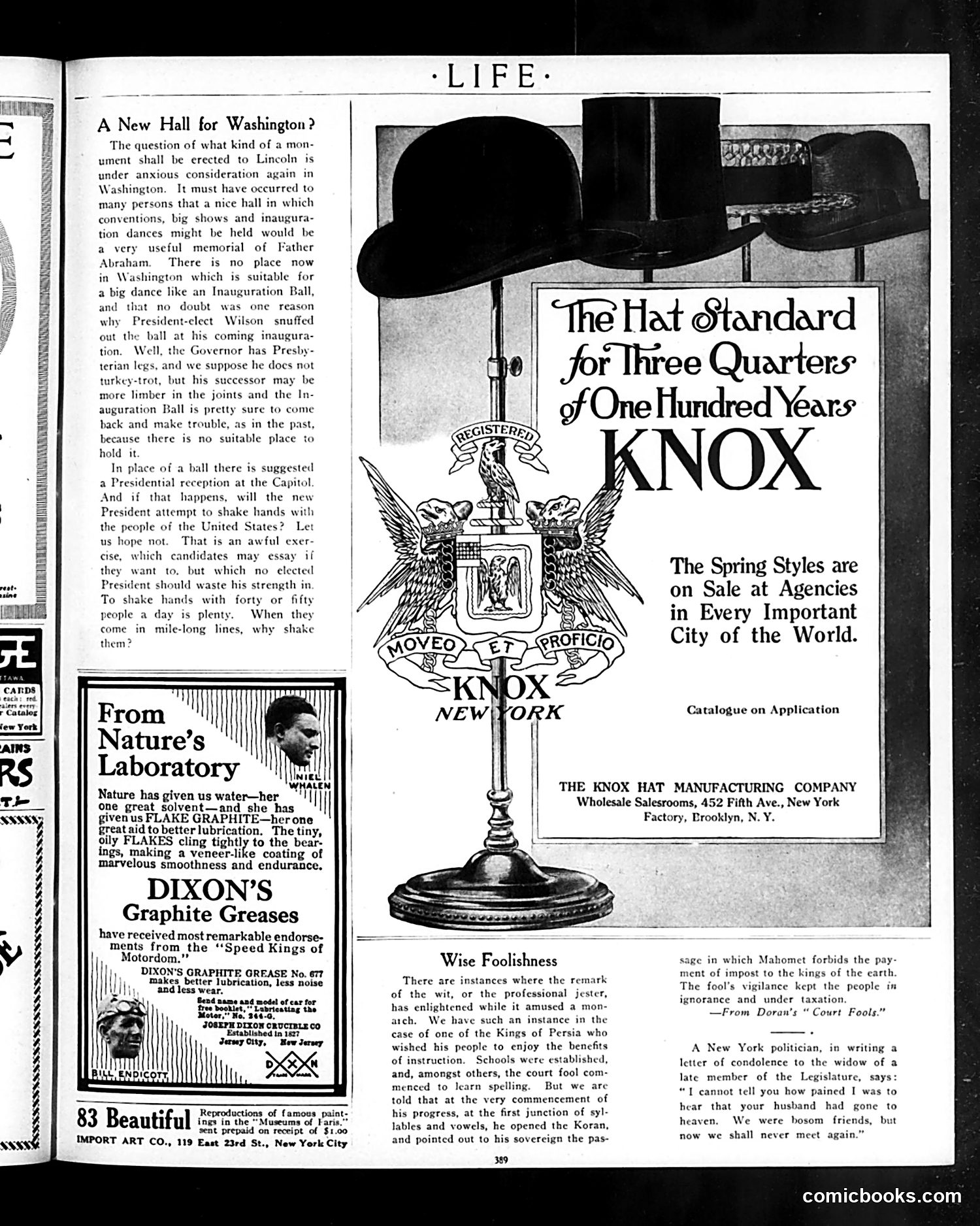
This page combines editorial commentary with period advertising. The main article, "A New Hall for Washington?," discusses practical politics: President-elect Wilson (inaugurated 1913) cancelled his Inauguration Ball due to lacking suitable venues. The author sarcastically suggests building a Lincoln memorial hall for conventions and dances, then critiques the exhausting custom of Presidents shaking hands with crowds—noting Wilson's Presbyterian conservatism made cancellation convenient, though future presidents will likely revive the tradition. The page's other content is mostly **advertisements** (Knox Hats, Dixon's Graphite Greases, Import Art Co.) interspersed with brief humorous anecdotes under "Wise Foolishness"—including a Persian king's court fool and a politician's awkward condolence letter. The satire targets both Wilson's political caution and the absurd physical demands placed on elected officials by democratic tradition.
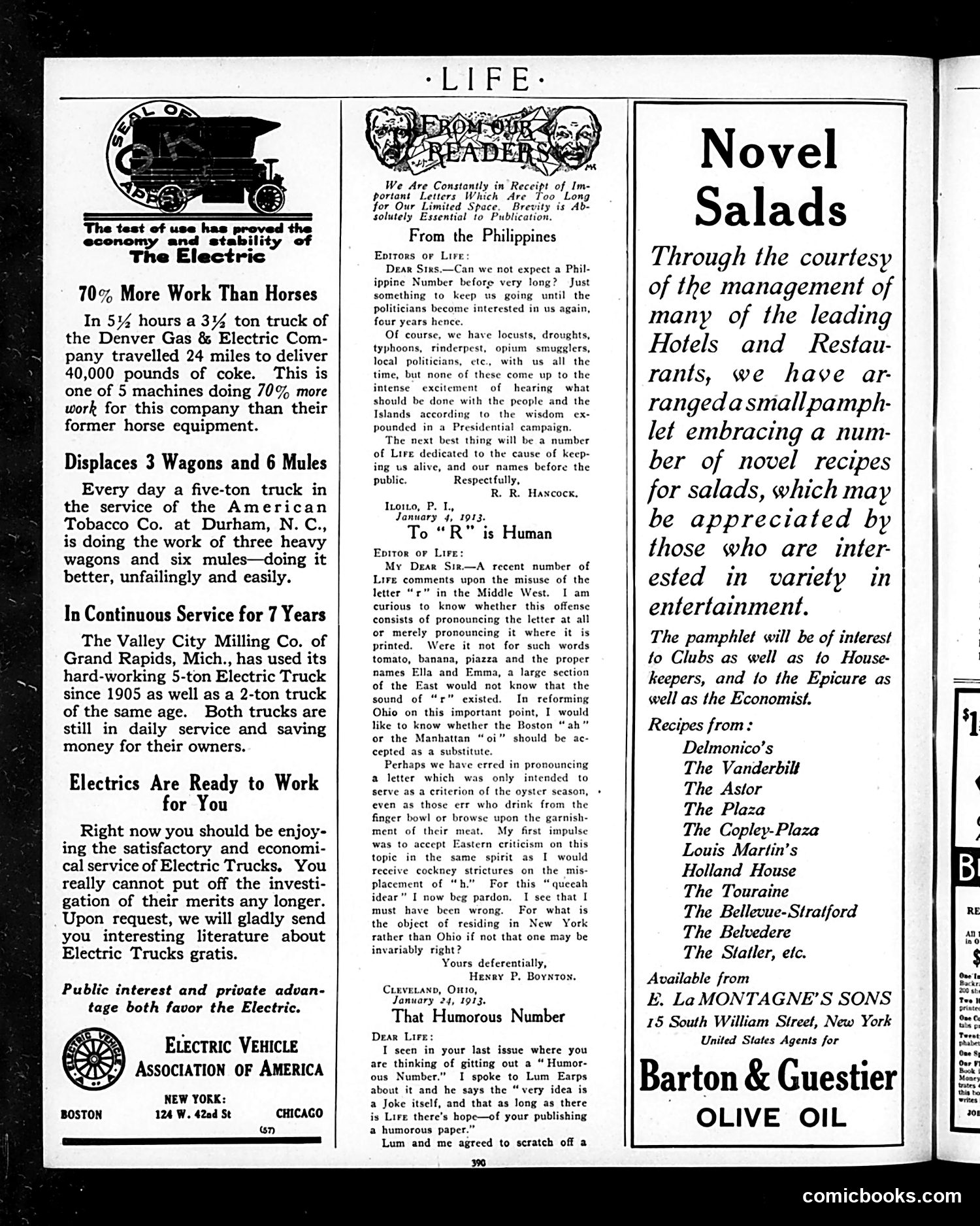
This page is primarily **advertising and reader letters**, not satire or political cartoons. The left side advertises **Electric Trucks** from the Electric Vehicle Association of America, promoting them as superior to horse-drawn wagons—a genuine business pitch highlighting newfangled motorized vehicles' efficiency and reliability (one truck doing the work of six mules, etc.). The center contains three **reader letters to the editor**: 1. A Philippine correspondent requesting Life coverage of the islands, frustrated that American political interest in the Philippines only emerges during presidential campaigns. 2. A letter debating regional American pronunciation of the letter "r," contrasting Boston, Ohio, and Manhattan speech patterns—a lighthearted linguistic observation. 3. A brief note joking that Life couldn't publish a "humorous number" because Life itself is already a joke. The right side advertises **salad recipes** from fancy hotels (the Vanderbilt, the Plaza, etc.). The content reflects early 1900s concerns: nascent automotive technology, colonial administration, and regional American dialect differences.
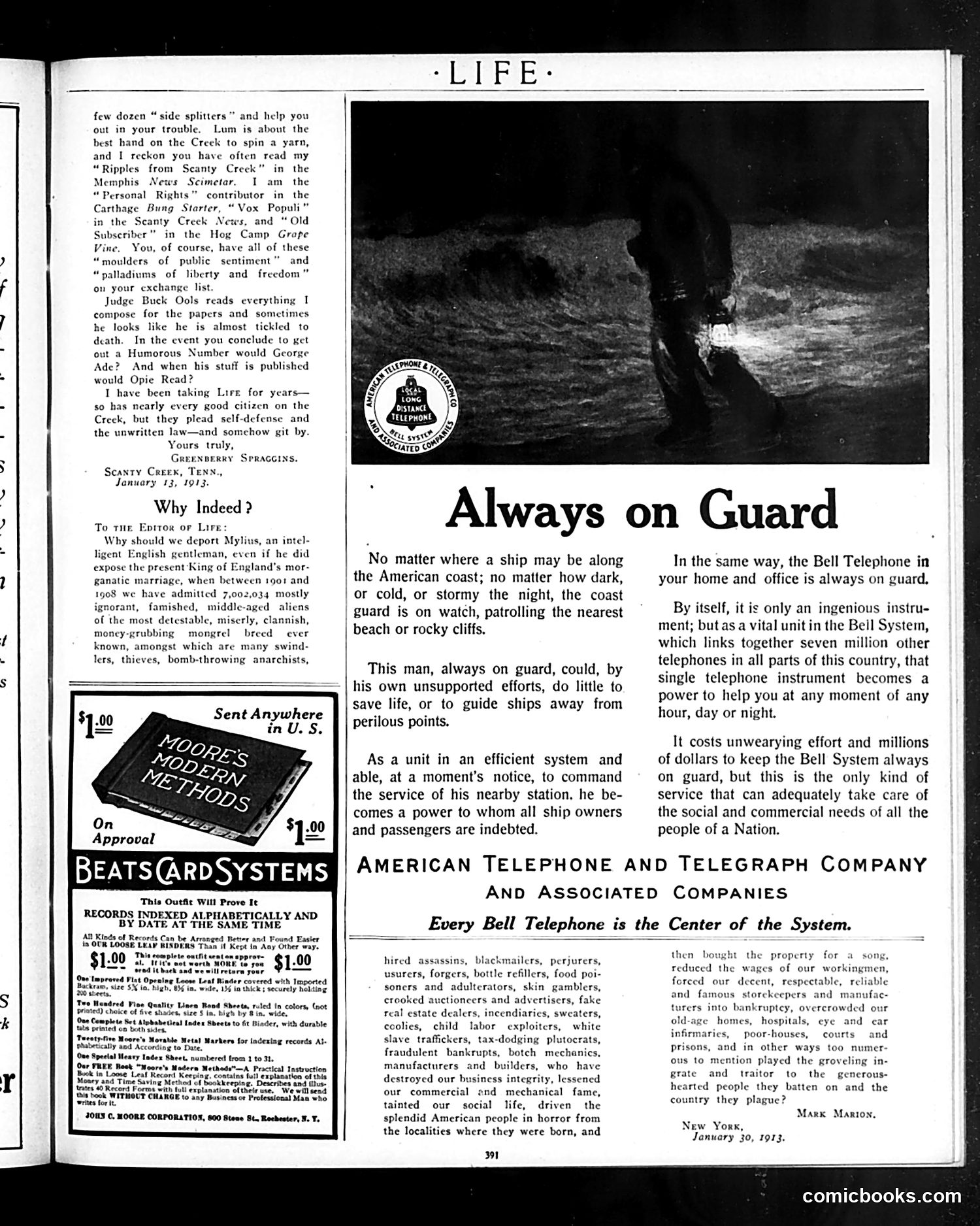
This page contains two distinct elements: **Left side:** Reader letters to the editor. One humorously defends local rural contributors to newspapers ("Scanty Creek"). Another makes a nativist argument against deporting an English critic of the King while America admits millions of immigrants, whom the writer stereotypes as criminals and undesirables—reflecting the anti-immigrant sentiment prevalent in 1910s America. **Right side:** A full-page advertisement for the American Telephone and Telegraph Company. The large photograph shows a coast guard watchman on duty. The ad uses this patriotic imagery as a metaphor: just as the isolated guard becomes powerful when connected to an efficient system, so too is a home telephone valuable as part of the Bell System's network of "seven million" connected phones. The ad emphasizes reliability and national utility rather than the telephone's novelty, suggesting the technology was becoming normalized by 1913.
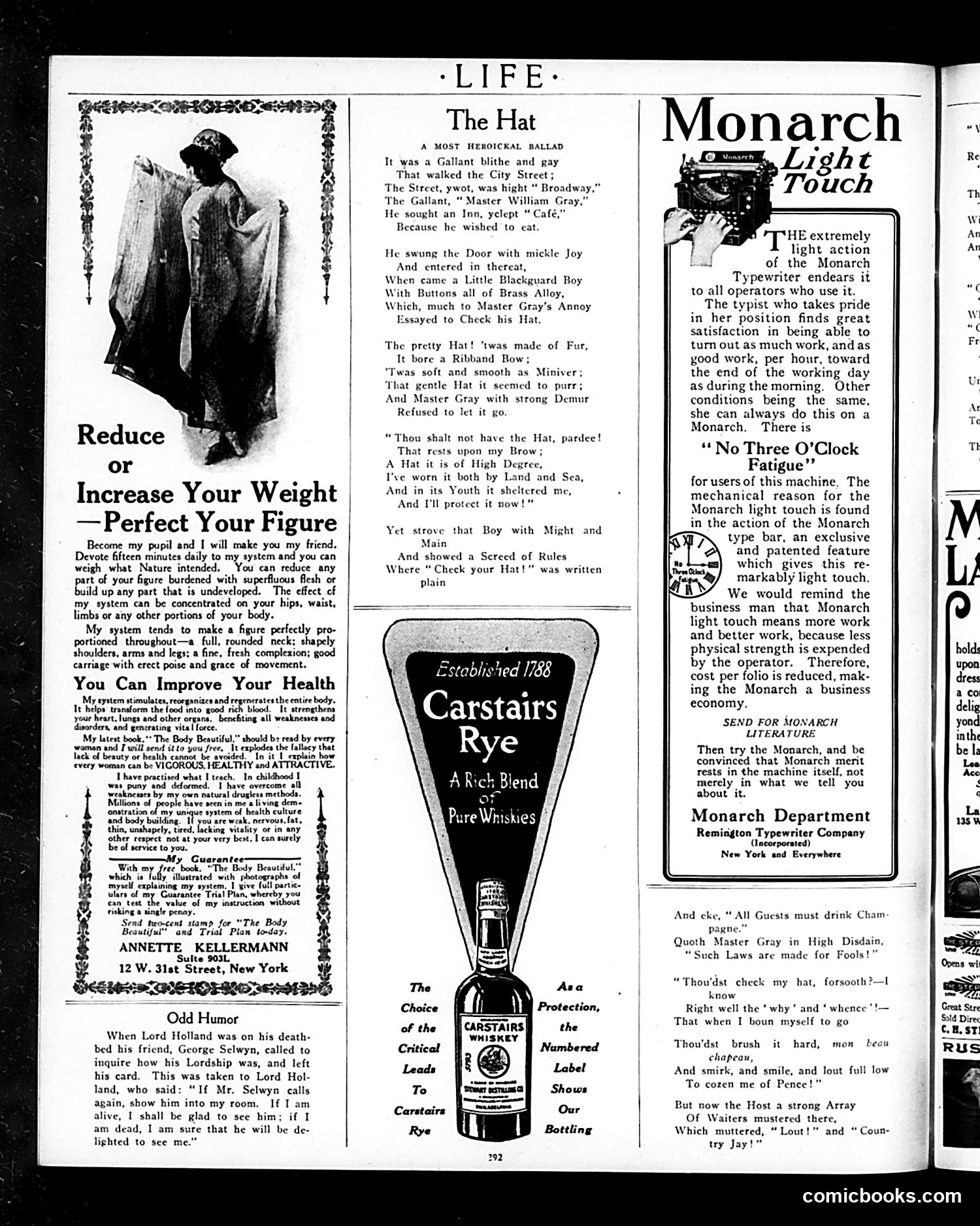
This Life magazine page contains **three distinct elements**: 1. **Left side**: A full-page advertisement by Annette Kellermann (a famous swimmer and fitness pioneer) promoting her "Body Beautiful" system for weight reduction and figure improvement through exercise—representative of early 1900s physical culture marketing. 2. **Center**: A humorous ballad in mock-heroic verse about "The Hat"—a comedic poem depicting a gallant gentleman's struggle with a bellhop over hat-checking at an inn, written in deliberately archaic language ("yclept," "pardee," "ywot"). The satire mocks overwrought literary pretension by treating a trivial dispute with inflated dramatic language. 3. **Right side**: Two advertisements—one for Carstairs Rye whiskey and one for Monarch typewriters, emphasizing the machine's "light touch" feature reducing operator fatigue. The page exemplifies Life's mix of satire, practical consumer advertising, and literary humor typical of early-20th-century American magazines.
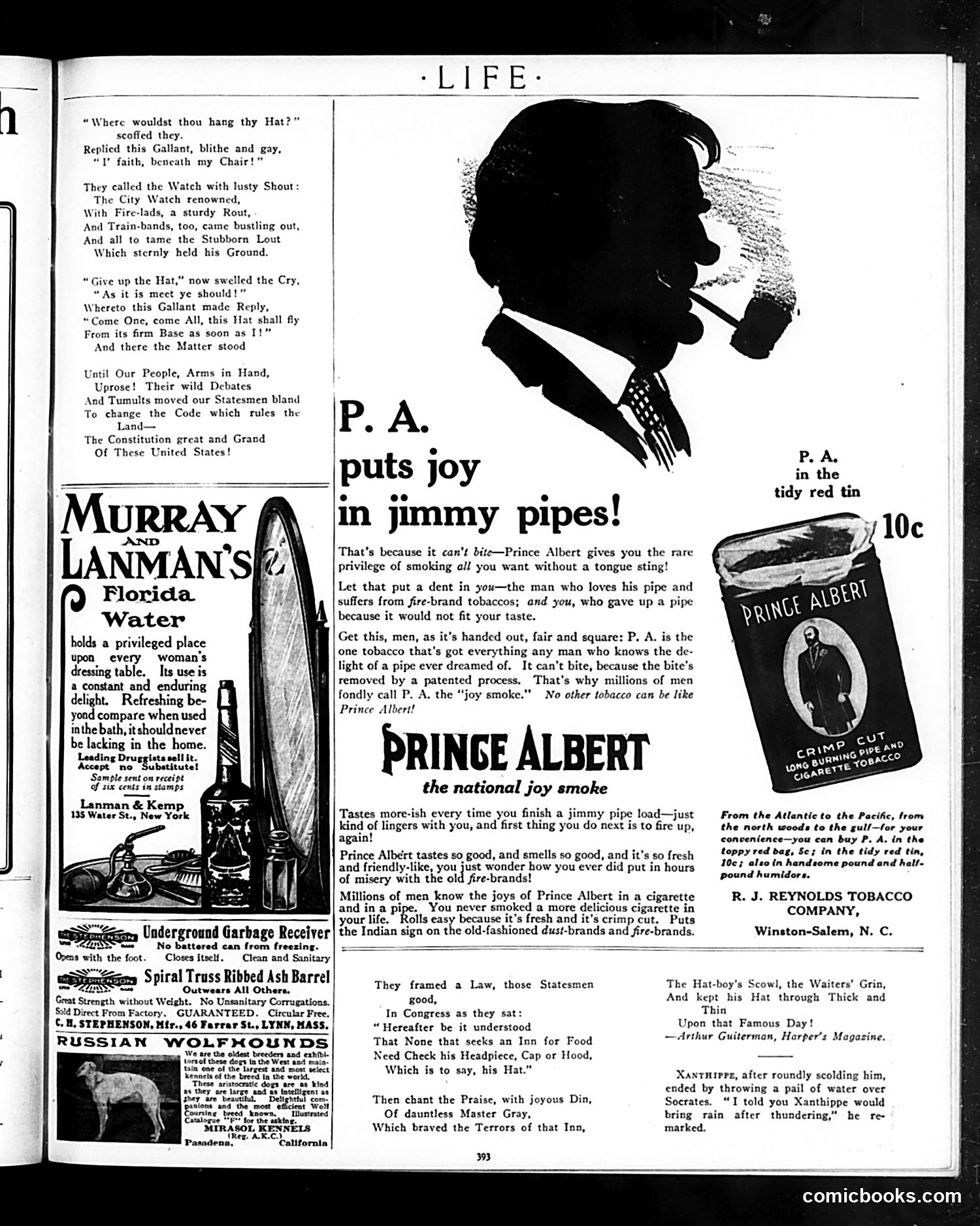
This page combines a **poetic narrative** with **period advertising**. The main content is a humorous verse story by Arthur Guiterman (credited to Harper's Magazine) about a man named Gray who refuses to remove his hat indoors—a breach of etiquette that sparks such public uproar that Congress passes a law protecting hat-wearers' rights. The satire mocks both rigid social conventions and excessive government intervention, using absurdist escalation for comedy. The story frames hat-wearing as a civil liberties issue, paralleling real American constitutional debates about individual freedom. The punchline: Gray's defiance becomes so celebrated that removing one's hat becomes legally optional. The page is primarily filled with vintage advertisements (Prince Albert tobacco, Florida Water, garbage receptacles, Russian wolfhounds), typical of Life magazine's commercial content. These ads are historically interesting but not satirical themselves.
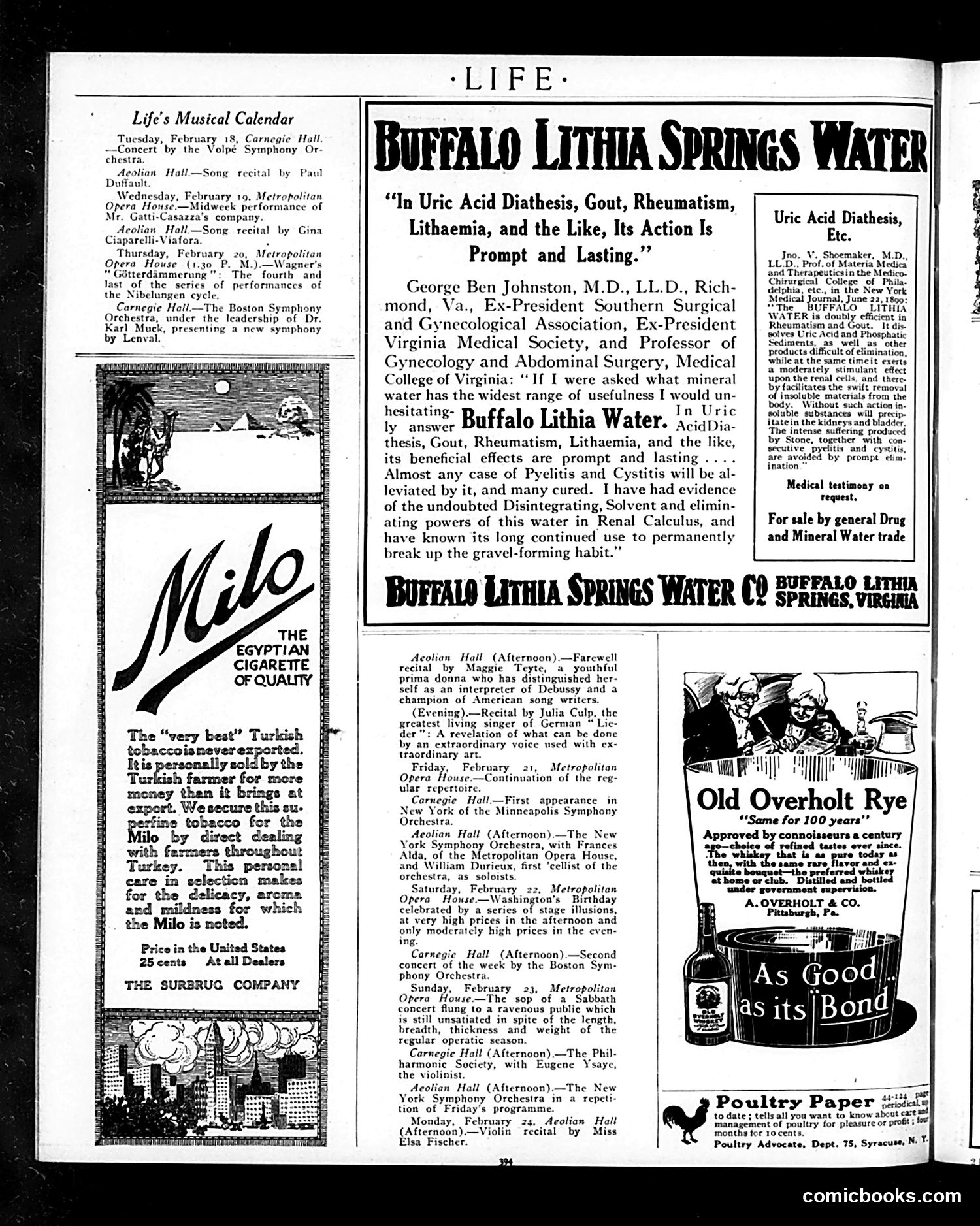
This page is primarily **advertising**, not satire. The dominant content features a medical testimonial advertisement for Buffalo Lithia Springs Water, endorsed by Dr. George Ben Johnston, a prominent Virginia physician. The ad claims the water treats "Uric Acid Diathesis, Gout, Rheumatism, Lithaemia" with "prompt and lasting" effects. The smaller advertisements include: - **Milo cigarettes**: Turkish tobacco marketed as superior quality, sold personally by Turkish farmers - **Old Overholt Rye whiskey**: Claimed to be "Same for 100 years," appealing to tradition-minded connoisseurs - **Poultry Paper**: A practical farming publication The page's left side lists classical music performances at New York concert halls (Carnegie Hall, Metropolitan Opera House, Aeolian Hall) from mid-February, serving as cultural programming information for affluent readers. There is **no political cartoon or satirical content** visible—this reflects Life's dual identity as both satirical magazine and lifestyle publication for wealthy audiences.
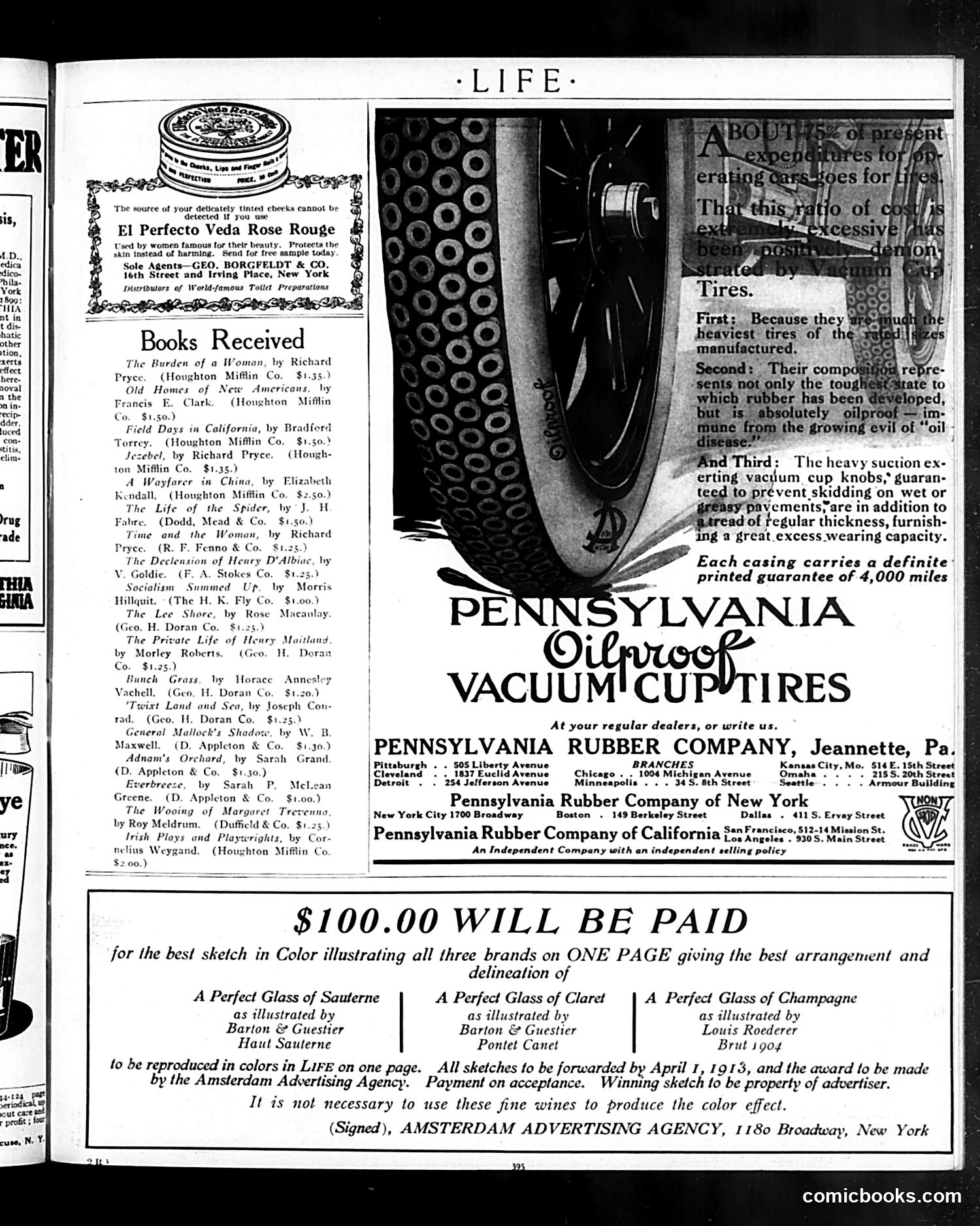
This is primarily an **advertising and book review page**, not a satirical cartoon page. The page features: 1. **Product advertisements**: El Perfecto Veda Rose Rouge (cosmetics), Pennsylvania Rubber Company Oilproof Vacuum Cup Tires, and French wines (Sauterne, Claret, Champagne) 2. **"Books Received" section**: A list of newly published books from 1913, including titles by Richard Pryce, Joseph Conrad, and Sarah Grand—typical literary offerings of the era 3. **Art contest announcement**: The Amsterdam Advertising Agency offers $100 for the best color sketch illustrating three wine brands, to be published in Life magazine The tire advertisement's three selling points (heaviest tires, superior rubber composition, vacuum cup knobs preventing skidding) represent genuine product claims rather than satire. This page exemplifies early 20th-century magazine advertising aimed at middle and upper-class readers through cultural and commercial content.
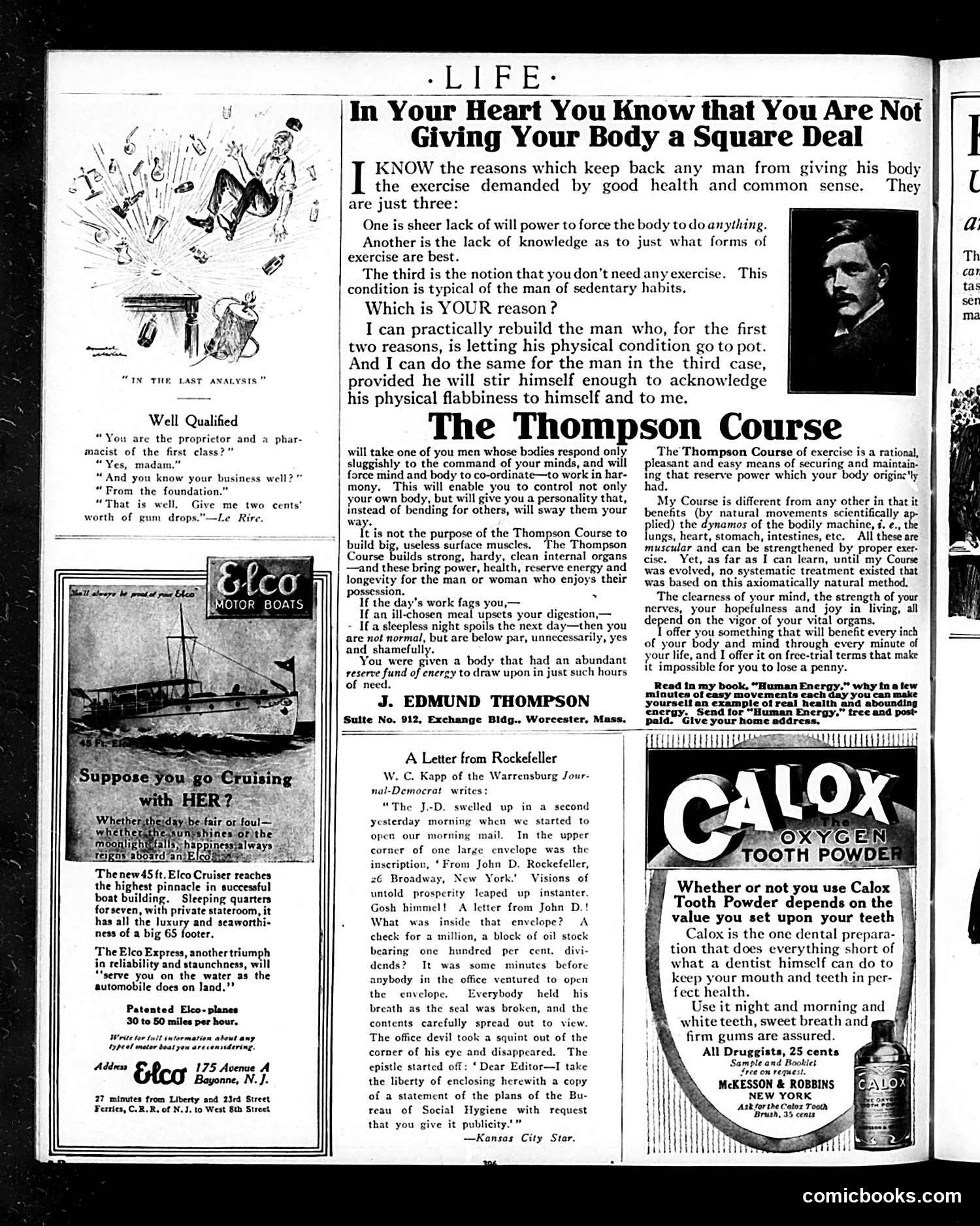
This page contains early 20th-century advertising and editorial content. The cartoon "In the Last Analysis" (top left) depicts a well-dressed man falling or being ejected, likely satirizing pomposity or pretense — a common Life magazine trope mocking the self-important. The main content is a self-promotional advertisement from J. Edmund Thompson advertising his mail-order "Thompson Course" — a system of exercises claimed to restore physical vigor. Thompson's pitch targets sedentary men (office workers, likely), claiming three reasons prevent exercise: lack of willpower, ignorance, or the false belief that exercise isn't needed. His course promises to build internal organ strength through "natural movements." This reflects early 1900s health anxieties about sedentary lifestyles during America's transition to office work, and the era's enthusiasm for pseudo-scientific fitness schemes marketed directly to vulnerable readers. The page also includes ads for Elco boats and Calox tooth powder — typical Life magazine revenue sources.
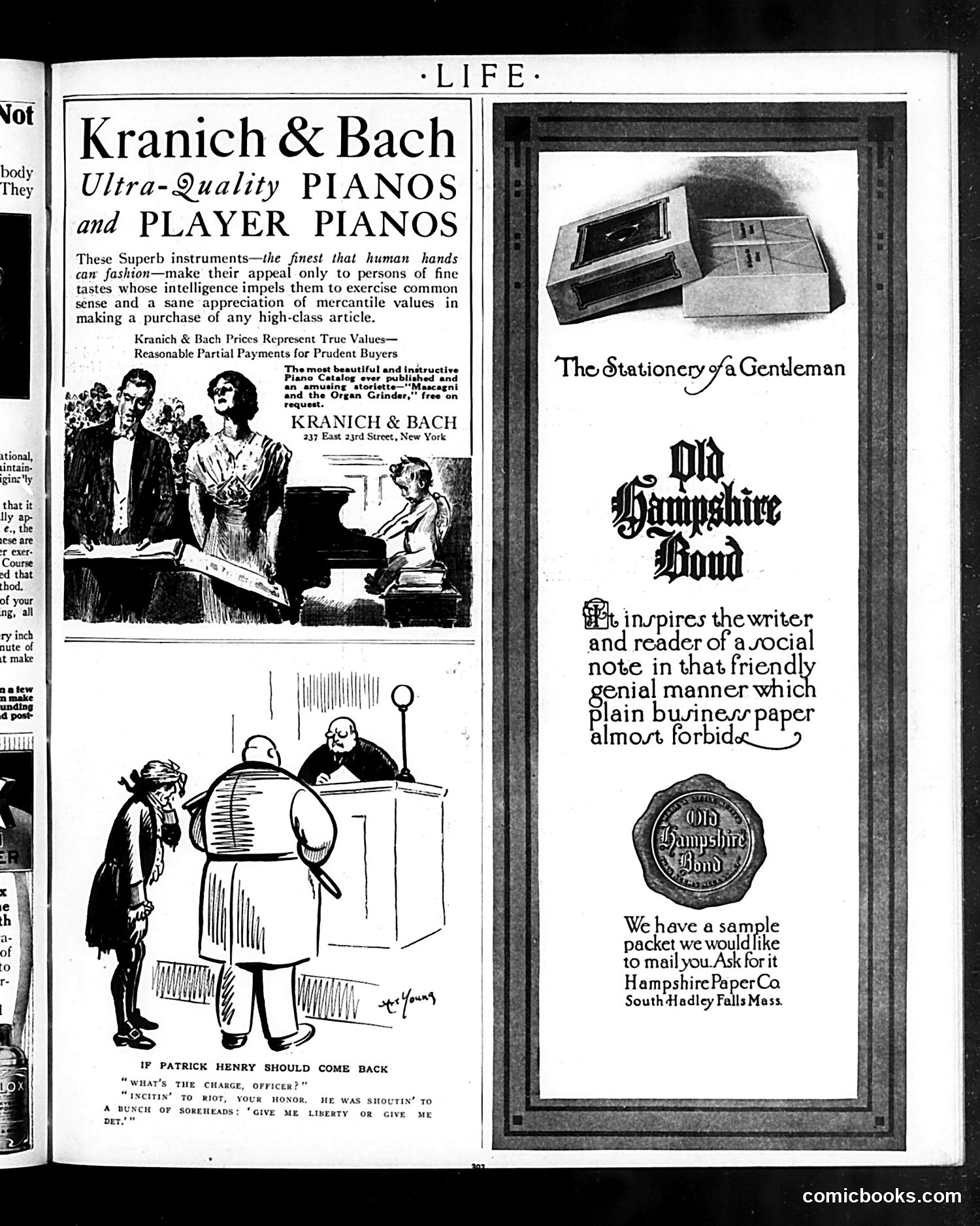
This page contains two separate advertisements with one embedded cartoon satirizing American civil liberties. **The Cartoon:** The bottom illustration references Patrick Henry, the Revolutionary War patriot famous for declaring "Give me liberty or give me death." The satire imagines Henry arrested in modern times for "inciting to riot" when speaking to "soreheads." The joke critiques contemporary American society: the same revolutionary rhetoric that founded the nation would now be criminalized. This reflects early 20th-century anxieties about free speech restrictions, likely referencing wartime sedition laws or labor unrest suppression. **Context:** The cartoon suggests tension between America's founding ideals and current government control of dissent—implying that modern authorities would arrest the nation's founding heroes for their own words. The page also features advertisements for Kranich & Bach pianos and Hampshire Bond stationery, targeting affluent consumers.
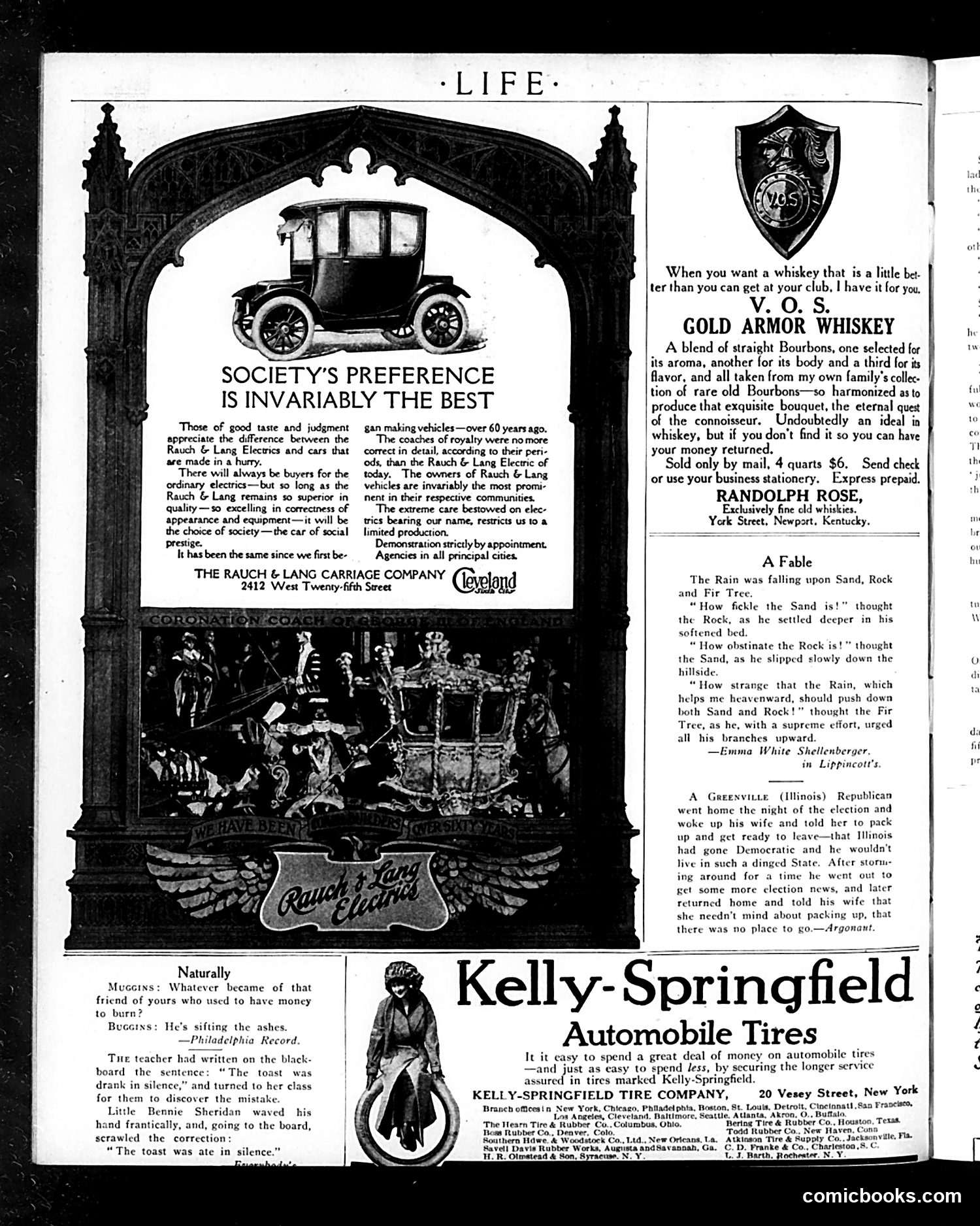
This Life magazine page contains advertisements and light humor pieces rather than political cartoons. The main content includes: **Rauch & Lang Electrics advertisement**: Promotes expensive electric cars as a "society" choice, claiming superior quality justifies their prestige and limited production. This reflects early 1900s class consciousness—luxury goods marketed to the wealthy as markers of good taste. **Gold Armor Whiskey ad**: Sells mail-order bourbon from Newport, Kentucky, positioning it as superior to what clubs offer. **Humor pieces**: Include a fable about Rain, Sand, Rock, and Fir Tree (each responding differently to hardship), and jokes from various publications about a Republican fleeing Illinois after it goes Democratic, and a schoolboy's grammar correction. The page reflects turn-of-the-century American consumer culture, class divisions, and light satirical humor—not substantive political commentary. The magazine was primarily a humor and lifestyle publication, not a serious political voice.
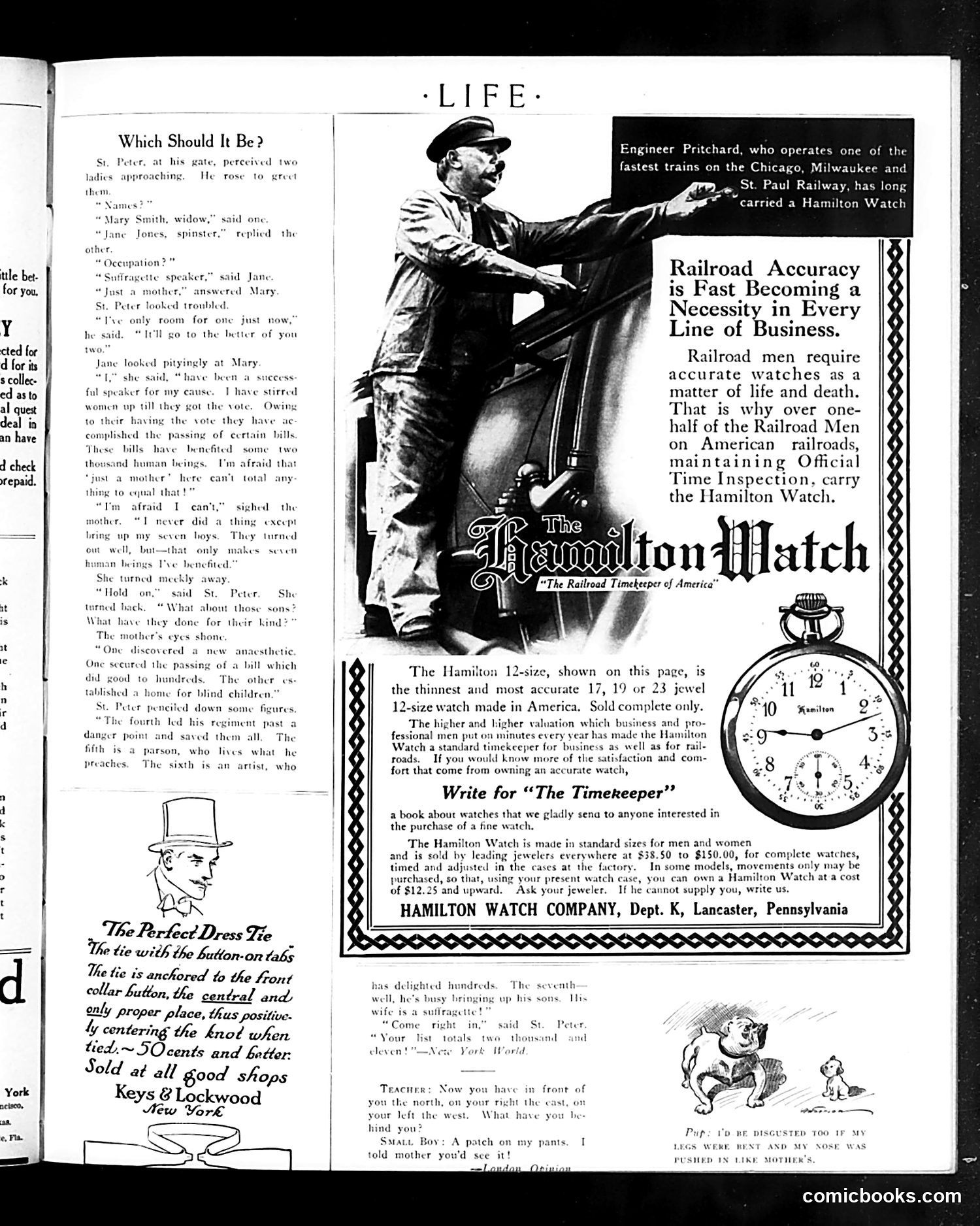
This cartoon presents a theological thought-experiment about female value. St. Peter encounters two women at heaven's gate: Jane, a public speaker who fought for women's suffrage, and Mary, a mother of seven sons. Jane initially appears superior—she's accomplished concrete social good: women won the vote, and legislation passed benefiting thousands. Mary seems worthless by comparison: she "never did a thing except bring up my seven boys." However, St. Peter's recount reveals the twist: Mary's sons became a medical innovator, legislator, orphanage founder, military officer, and clergyman—collectively benefiting far more people than Jane's direct efforts. **The satire's target**: This piece mocks the era's devaluation of motherhood relative to public achievement. By ultimately vindicating the mother's contribution through her sons' accomplishments, it argues—somewhat sardonically—that women's greatest worth lay in raising men to do important work, not in their own independent activism. This reflects 1910s-1920s anxieties about women's expanding public roles.
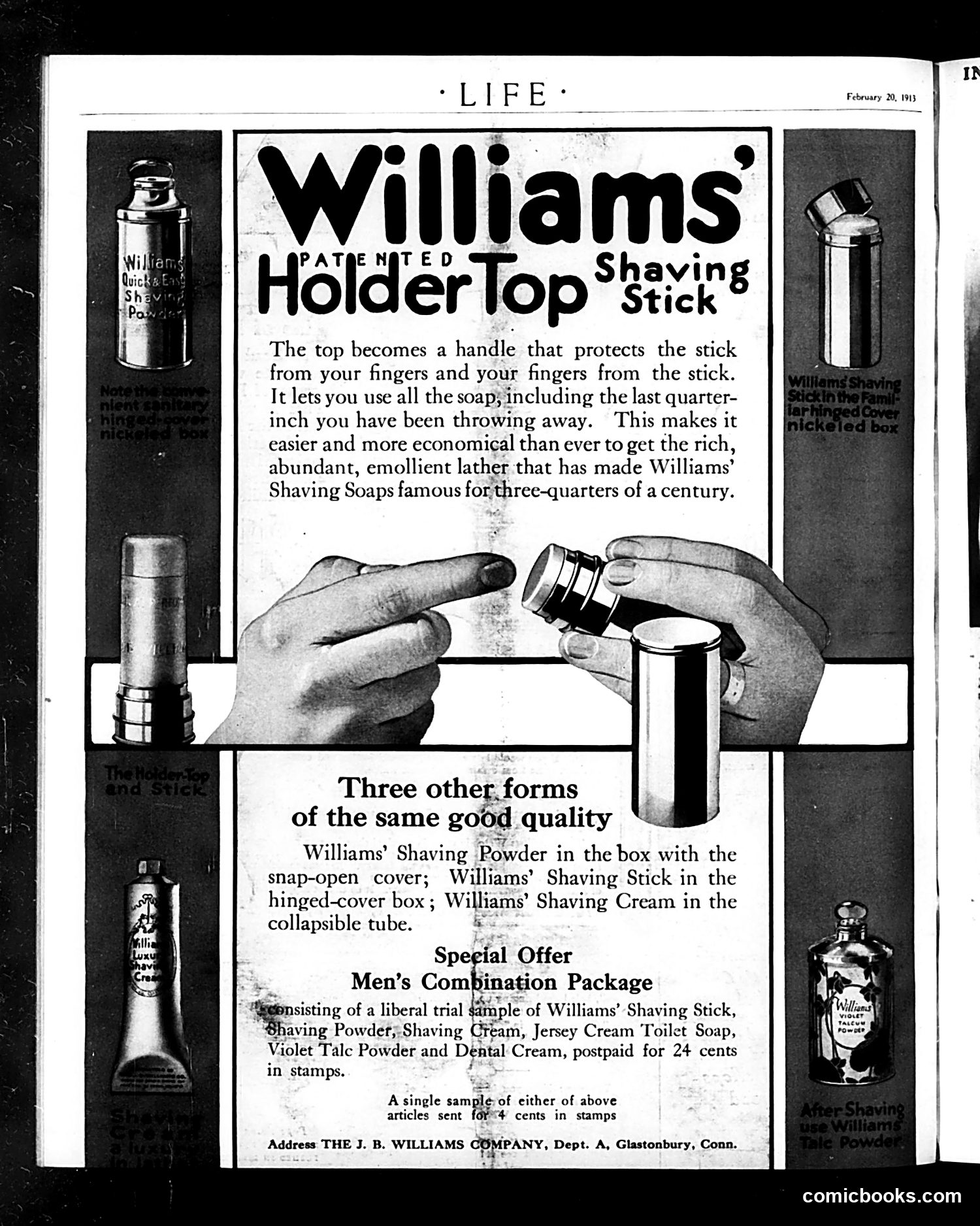
This is a **product advertisement**, not political satire or editorial cartoon. It appears on the February 20, 1913 issue of *Life* magazine. The J. B. Williams Company advertises their **patented "Holder Top" shaving stick**—a cylindrical soap product with a removable cap that doubles as a protective handle. The innovation allows users to grip the stick safely and utilize every bit of soap, including the last quarter-inch that would previously be wasted. The central image shows hands demonstrating how the holder-top functions. Side panels display related Williams products: shaving powder, cream, and aftershaving lotion. The "special offer" promotes a men's combination trial package containing multiple Williams grooming products for 24 cents in stamps. This is straightforward commercial advertising targeting male consumers interested in efficient, economical personal grooming products—there is no political meaning or satire intended.