
Life, 1913-02-20 · page 15 of 48
Life — February 20, 1913 — page 15: what you’re looking at
What you’re looking at
**The "Congratulations" Section** satirizes the *New York Evening Post*'s new Saturday Magazine for plagiarizing from Life. The piece accuses the *Post* of reprinting Stephen Leacock's "My Financial Career" (originally published in Life twenty years earlier) and copying Life's picture-contest format—down to nearly identical captions. The satire is tongue-in-cheek; Life "congratulates" the *Post* while pointedly noting these borrowings violate copyright and lack originality, suggesting the *Post* has "a big future" of continued raids on Life's back catalog. **The "Philosophy" Section** critiques Henri Bergson, a fashionable French philosopher then visiting America, dismissing philosophy itself as a worthless pursuit. The author argues that philosophy—despite its abstract terminology—never actually *arrives* anywhere or achieves anything concrete, unlike art or architecture. Bergson is likened to a stage magician pulling rabbits from a hat: impressive performance, but ultimately hollow intellectual sleight-of-hand. Both pieces employ Life's characteristic satirical tone: mock praise concealing sharp criticism.
📄 Transcribed text from this page (OCR, searchable)
Machine-transcribed from the original scan — historical spelling and the odd misread are preserved.
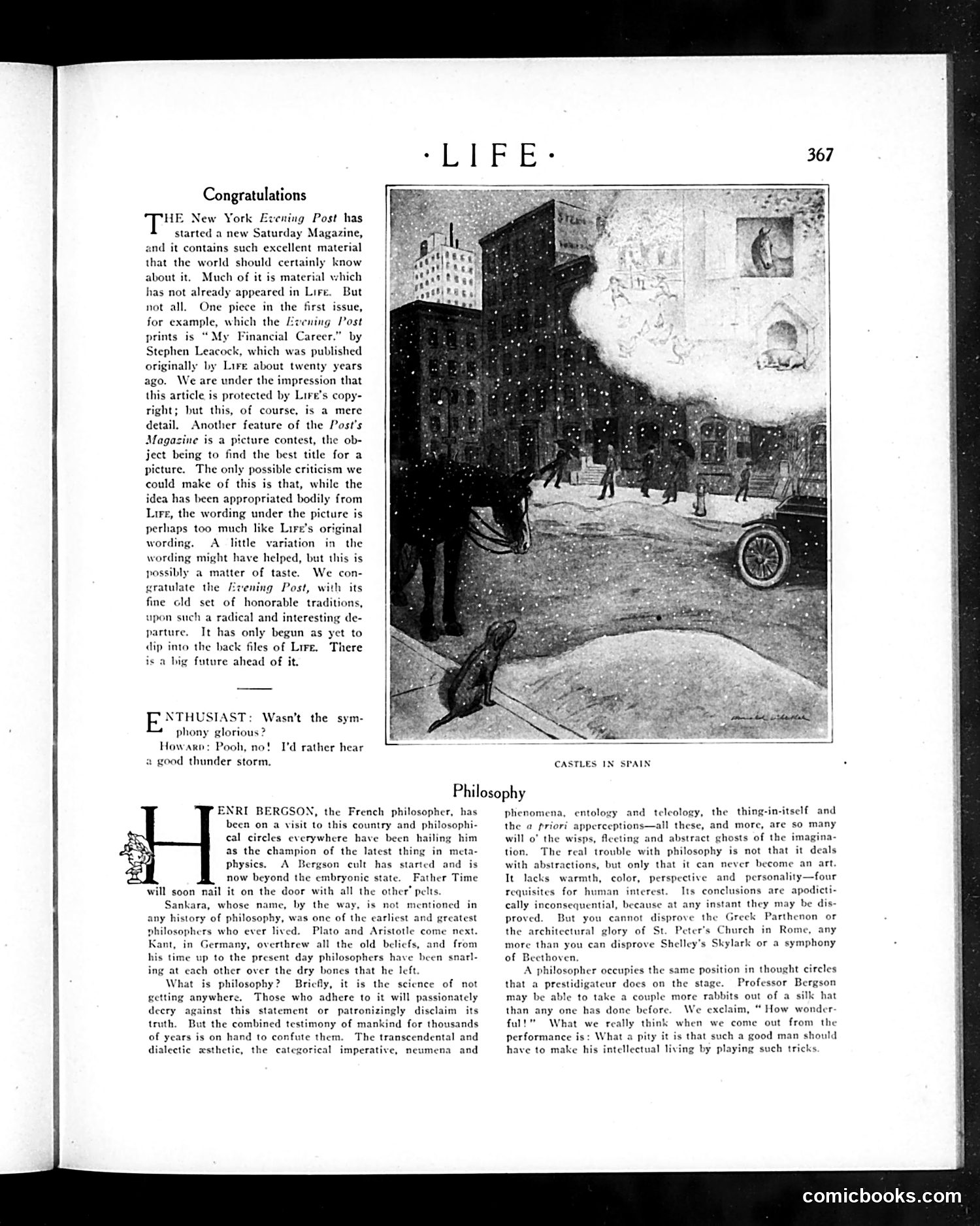
Congratulations HE New York Evening Post has started a new Saturday Magazine, nd it contains such ‘ellent material that the world should certainly know about it. Much of it is material which has not already appeared in Lire. But not all. One piece in the first issue, for example, which the Evening Post prints is “My Financial Career.” by Stephen Leacock, which was published originally by Lire about twenty years ago. We are under the impression that this article is protected by Live's copy- right; but this, of course, is a mere detail. Another feature of the Post's Magazine is a picture contest, the ob- ject being to find the best title for a picture. The only possible criticism we could make of this is that, while the idea has been appropriated bodily from Lire, the wording under the picture is perhaps too much like Lire’s original wording. A_ little variation in the wording might have helped, but this is possibly a matter of taste. We con- gratulate the ning Post, with its fine cld set of honorable traditions, a radical and interesting de- It has only begun as yet to dip into the back files of Lire, There is a big future ahead of it. upon suc parture. NTHUSIAST: Wasn’t the sym- phony glorious? Howakn: Pooh, no! I'd rather hear a good thunder storm. CASTLES IN SPAIN Philosophy ENRI BERGSON, the French philosopher, has been on a visit to this country and philosophi- cal circles everywhere have been hailing him as the champion of the latest thing in meta- physics. A Bergson cult has started and now beyond the embryonic state. Father Time will soon nail it on the door with all the other’ pelts. Sankara, whose name, by the way, is not mentioned in any history of philosophy, was one of the earliest and greatest philosophers who ever lived. Plato and Aristotle come next. Kant, in Germany, overthrew all the old beliefs, and from his time up to the present day philosophers have been snarl- ing at cach other over the dry bones that he left. What is philosophy? Bricfly, it is the science of not getting anywhere, Those who adhere to it will passionately decry against this statement or patronizingly disclaim its truth. But the combined testimony of mankind for thousands of years is on hand to confute them. The transcendental and dialectic xsthetic, the categorical imperative, neumena and phenomena, entology and teleology, the thing-in-itself and the @ priori apperceptions—all these, and more, are so many will 0° the wisps, fleeting and abstract ghosts of the imagina- tion. The real trouble with philosophy is not that it deals with abstractions, but only that it can never become an art. It lacks warmth, color, perspective and personality—four requisites for human interest. Its conclusions are apodicti- cally inconsequential, because at any instant they may be dis- proved. But you cannot disprove the Greek Parthenon or the architectural glory of St. Peter's Church in Rome, any more than you can disprove Shelley's Skylark or a symphony of Beethoven. A philosopher occupies the same position in thought circles that a prestidigateur does on the stage. Professor Bergson may be able to take a couple more rabbits out of a silk hat than any one has done before. We exclaim, “ How wonder. ful!" What we really think when we come out from the performance is: What a pity it is that such a good man should have to make his intellectual living by playing such tricks comicbooks.com