
Life, 1913-02-20 · page 11 of 48
Life — February 20, 1913 — page 11: what you’re looking at
What you’re looking at
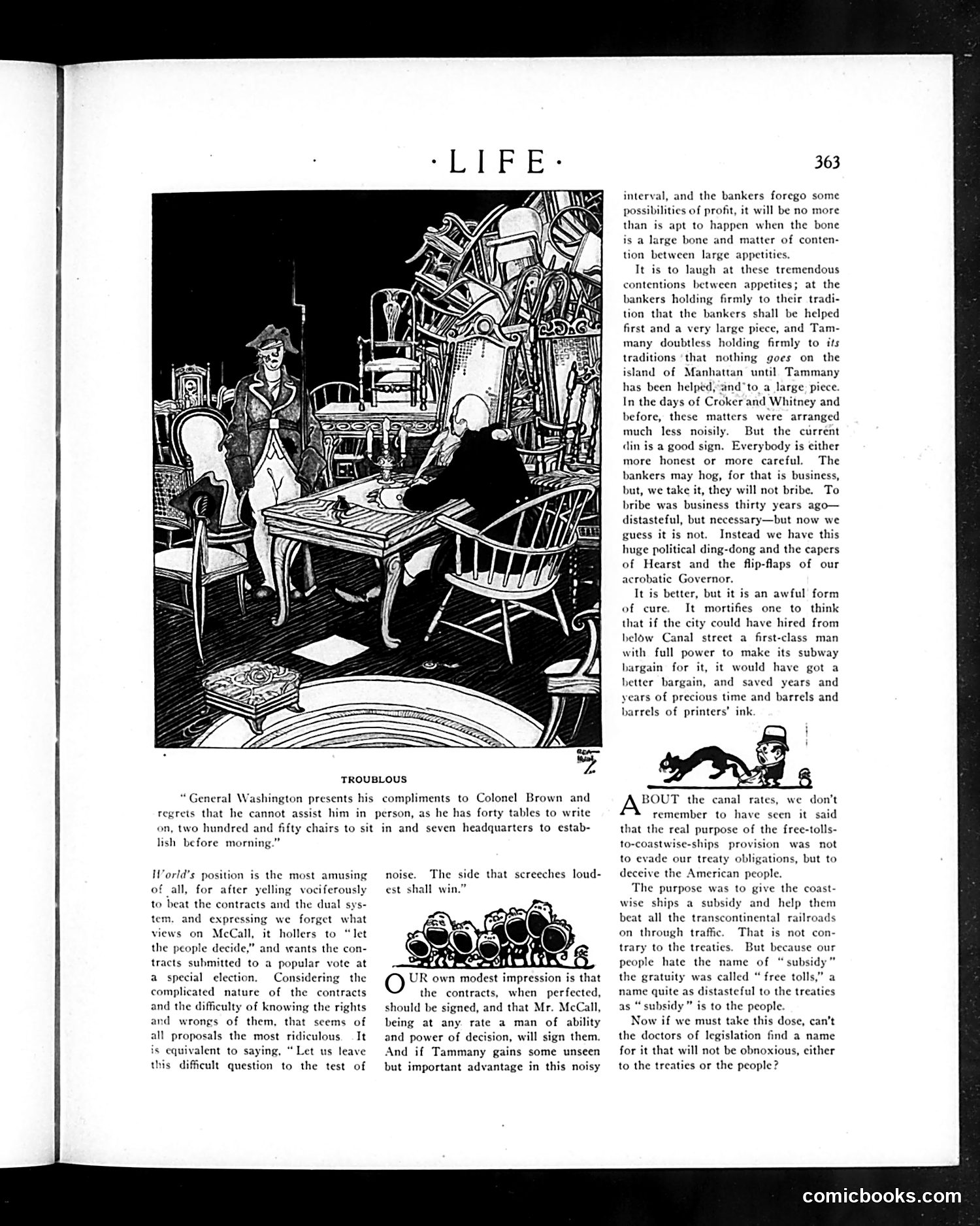
This satirical cartoon depicts a crowded, chaotic office scene labeled "Troublous," showing General Washington presenting compliments to Colonel Brown while regretting he cannot assist in person due to having "forty tables to write on, one hundred and fifty clerks to sit in and seven headquarters to establish before morning." The satire targets bureaucratic inefficiency and administrative chaos—the overwhelming proliferation of paperwork, clerks, and multiple headquarters during wartime operations. The crowded, almost absurdist rendering of furniture and officials suggests the absurdity of military administration becoming so bloated it prevents actual military leadership. The cartoon criticizes how administrative machinery had grown unwieldy, preventing commanders from executing their duties effectively.
📄 Transcribed text from this page (OCR, searchable)
Machine-transcribed from the original scan — historical spelling and the odd misread are preserved.
TROUBLOUS General Washington presents his compliments to Colonel Brown and regrets that he cannot assist him in person, as he has forty tables to write on, two hundred and fifty chairs to sit in and seven headquarters to estab- lish before morning.” HWorld’s position is the most amusing of all, for after yelling vociferously to beat the contracts and the dua tem. and expressing we forget what views on McCall, it hollers to “let the people decide,” and ants the con- tracts submitted to a popular vote at a special election. Considering the complicated nature of the contracts and the difficulty of knowing the rights and wrongs of them, that all proposals the most rit is equivalent to saying, “Let us leave this difficult question to the test of noise. The side that screeches loud- est shall win.” ng OX t R own modest impression is that the contracts, when perfected, should be signed, and that Mr. McCall, being at any. rate a man of ability and power of decision, will sign them. And if Tammany gains some unseen but important advantage in this noisy 363 interval, and the bankers forego some possibilities of profit, it will be no more than is apt to happen when the bone is a large bone and matter of conten- tion between large appetities. It is to laugh at these tremendous contentions between appetites; at the bankers holding firmly to their tradi- tion that the bankers shall be helped first and a very large piece, and Tam- many doubtless holding firmly to its traditions ‘that nothing goes on the island of Manhattan until Tammany has been helped, and’ to a large, piece. In the days of Croker and Whitney and before, these matters were arranged much less noisily. But the current din is a good sign. Everybody is either more honest or more careful. The bankers may hog, for that is business, but, we take it, they will not bribe. To bribe was business thirty years ago— distasteful, but necessary—but now we guess it is not. Instead we have this huge political ding-dong and the capers of Hearst and the flip-flaps of our acrobatic Governor. It is better, but it is an awful form of cure. It mortifies one to think that if the city could have hired from below Canal street a first-class man with full power to make its subway bargain for it, it would have got a better bargain, and saved years and years of precious time and barrels and barrels of printers’ ink. BOUT the canal we don't remember to have seen it said that the real purpose of the free-tolls- to-coastwise-ships provision was not to evade our treaty obligations, but to deceive the American people. The purpose was to give the coast- wise ships a subsidy and help them beat all the transcontinental railroads on through traffic. That is not con- trary to the treaties. But because our people hate the name of “subsidy” the gratuity was called “ free tolls,” a name quite as distasteful to the treaties as “ subsidy” is to the people Now if we must take this dose, can’t the doctors of legislation find a name for it that will not be obnoxious, cither to the treaties or the people? rates, comicbooks.com