
Life, 1913-02-20 · page 26 of 48
Life — February 20, 1913 — page 26: what you’re looking at
What you’re looking at
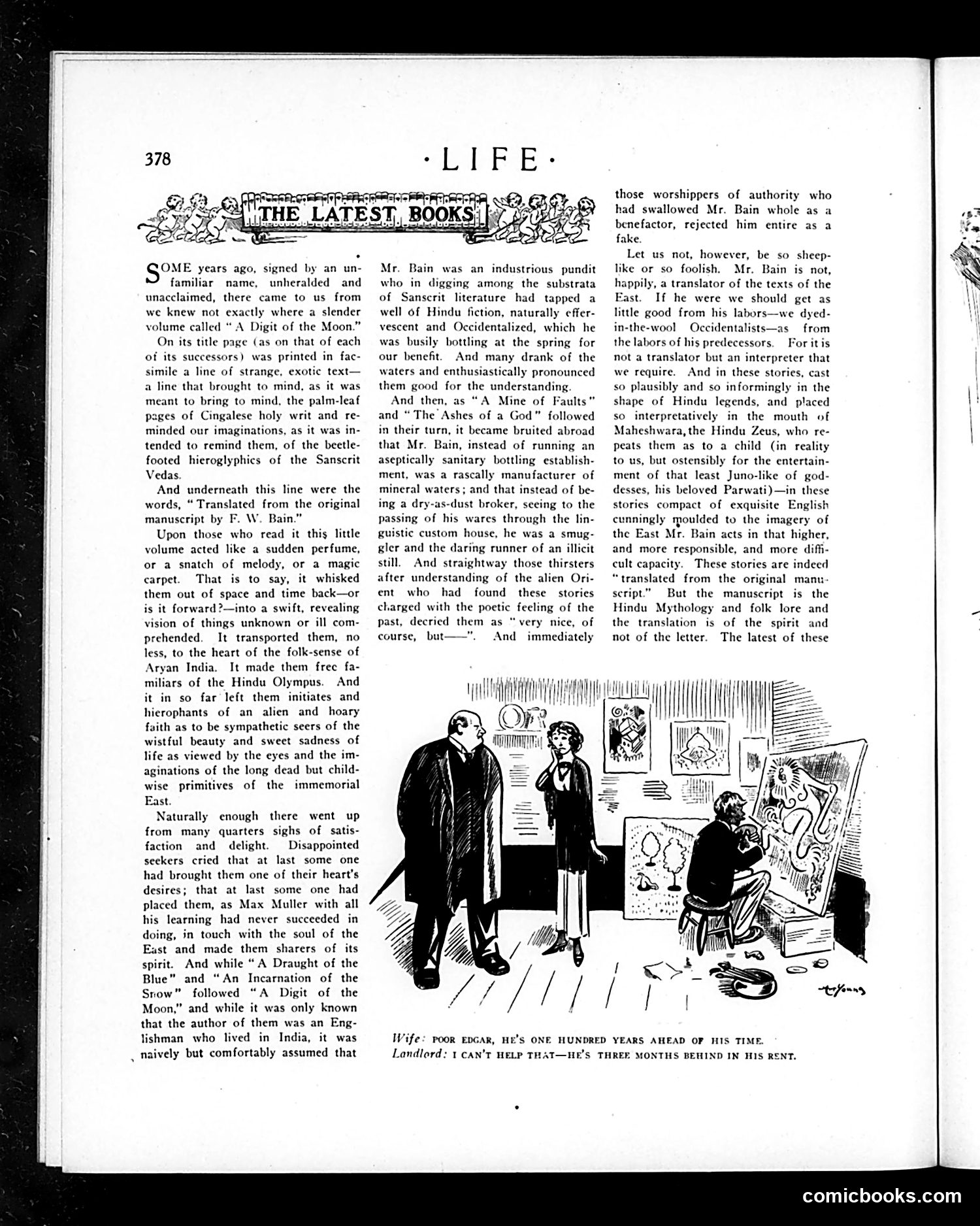
This page reviews F.W. Bain's books presenting Hindu legends and philosophy to Western readers. The article defends Bain against critics who discovered he was a British writer in India, not a Sanskrit scholar translating ancient texts. The accompanying cartoon satirizes literary pretension: a landlord confronts a tenant surrounded by artwork and manuscripts. The caption reveals the tenant is "poor Edgar" who lives 100 years ahead of his time—his rent is three months overdue. This mocks impoverished artists and writers who pursue bohemian, avant-garde work while failing at practical finances. The article's point: Bain's value lies not in literal translation but in *interpreting* Eastern philosophy for Western audiences. His imaginative recreation captures the spirit better than scholarly accuracy would.
📄 Transcribed text from this page (OCR, searchable)
Machine-transcribed from the original scan — historical spelling and the odd misread are preserved.
OME years ago, signed by an un- familiar name, unheralded and unacclaimed, there came to us from we knew not exactly where a slender volume called “ A Digit of the Moon.” On its title page (as on that of each of its successors) was printed in fac- simile a line of strange, exotic text— a line that brought to mind, as it was meant to bring to mind, the palm-leaf pages of Cingalese holy writ and re- minded our imaginations, as it was in- tended to remind them, of the beetle- footed hieroglyphics of the Sanscrit Vedas. And underneath this line were the words, “ Translated from the original manuscript by F. W. Bain.” Upon those who read it this little volume acted like a sudden perfume, or a snatch of melody, or a magic carpet. That is to say, it whisked them out of space and time back—or is it forward?—into a swift, revealing vision of things unknown or ill com- prehended. It transported them, no less, to the heart of the folk-sense of Aryan India. It made them free fa- miliars of the Hindu Olympus. And it in so far left them initiates and hierophants of an alien and hoary faith as to be sympathetic seers of the wistful beauty and sweet sadness of life as viewed by the eyes and the im- aginations of the long dead but child- wise primitives of the immemorial East. Naturally enough there went up from many quarters sighs of satis- faction and delight. Disappointed seekers cried that at last some one had brought them one of their heart’s desires; that at last some one had placed them, as Max Muller with all his learning had never succeeded in doing, in touch with the soul of the East and made them sharers of its spirit. And while “ A Draught of the Blue” and “An Incarnation of the Srow” followed “A Digit of the Moon,” and while it was only known that the author of them was an Eng- lishman who lived in India, it was | naively but comfortably assumed that Mr. Bain was an industrious pundit who in digging among the substrata of Sanscrit literature had tapped a well of Hindu fiction, naturally effer- vescent and Occidentalized, which he was busily bottling at the spring for our benefit. And many drank of the waters and enthusiastically pronounced them good for the understanding And then, as “A Mine of Faults” and “ The Ashes of a God” followed in their turn, it became bruited abroad that Mr. Bain, instead of running an aseptically sanitary bottling establish- ment, was a rascally manufacturer of mineral waters; and that instead of be- ing a dry-as-dust broker, seeing to the passing of his wares through the lin- guistic custom house, he was a smug- gler and the daring runner of an illicit still. And straightway those thirsters after understanding of the alien Ori- ent who had found these stories charged with the poetic feeling of the past, decried them as “very nice, of course, but——". And immediately Hi AR il Wife those worshippers of authority who had swallowed Mr. Bain whole as a benefactor, rejected him entire as a fake. Let us not, however, be so sheep- like or so foolish, Mr. Bain is not, happily, a translator of the texts of the East. If he were we should get as little good from his labors—we dyed- in-the-wool Occidentalists—as from the labors of his predecessors. For it is not a translator but an interpreter that we require. And in these stories, cast so plausibly and so informingly in the of Hindu legends, and placed so interpretatively in the mouth of Maheshwara, the Hindu Zeus, who re- peats them as to a child (in reality to us, but ostensibly for the entertain- ment of that least Juno-like of god- desses, his beloved Parwati)—in these stories compact of exquisite English cunningly moulded to the imagery of the East Mr. Bain acts in that higher, and more responsible, and more diffi- cult capacity. These stories are indeed “translated from the original manu script.” But the manuscript is the Hindu Mythology and folk lore and the translation is of the spirit and not of the letter. The latest of these POOR EDGAR, HE'S ONE HUNDRED YEARS AHEAD OF HIS TIME. Landlord: 1 CAN'T HELP THAT—HE'S THREE MONTHS BEHIND IN HIS RENT. comicbooks.com