
Life, 1913-02-20 · page 10 of 48
Life — February 20, 1913 — page 10: what you’re looking at
What you’re looking at
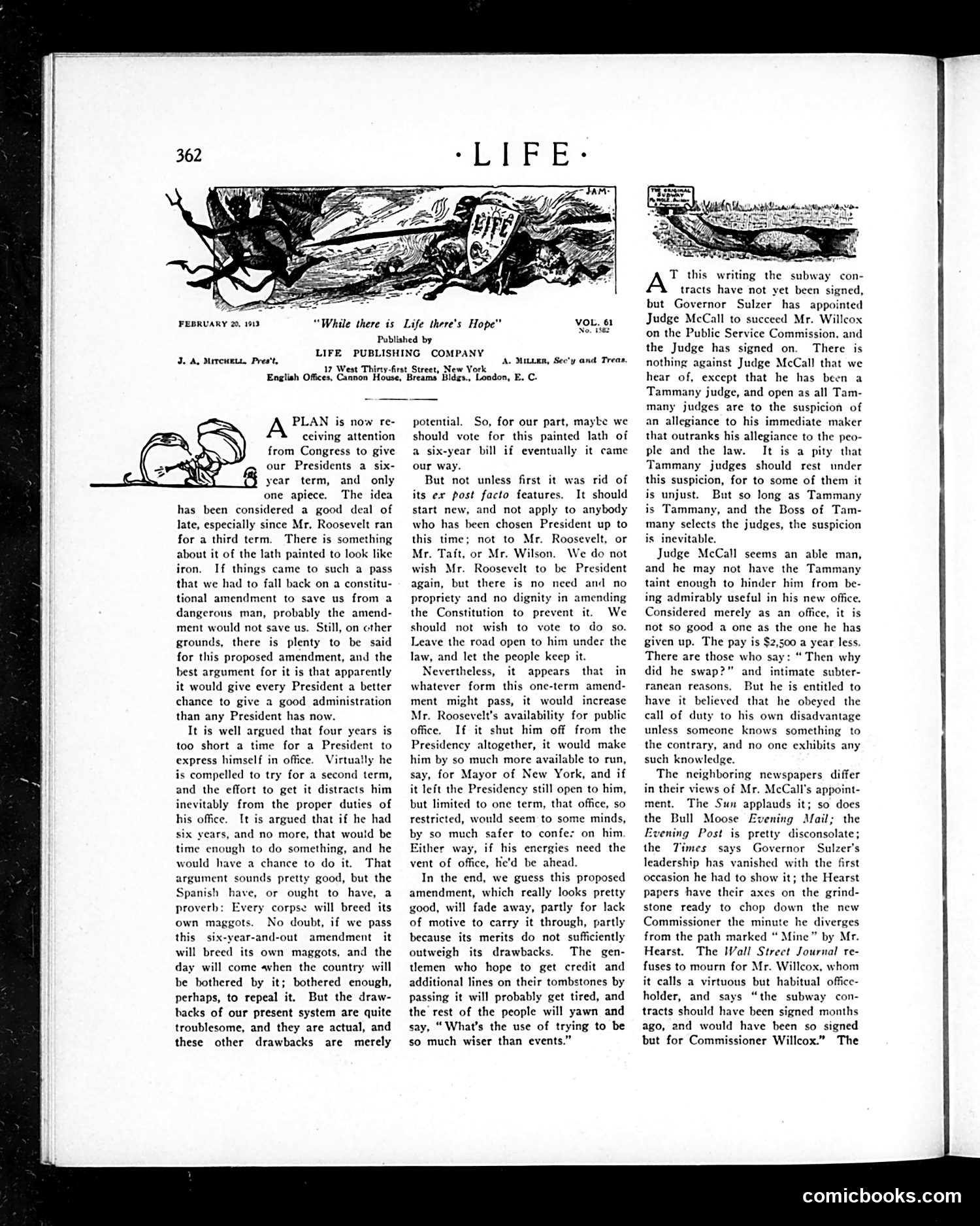
The page's main cartoon, titled "While there is Life there's Hope," depicts a skeletal or death-like figure alongside what appears to be political imagery. The accompanying article discusses a proposed constitutional amendment limiting presidential terms to six years with one term only. The satire criticizes this amendment as unnecessary constitutional tampering. The skeleton imagery likely represents the danger of weakening executive power or the "death" of strong presidential authority. The text argues that four years is already short enough, and that attempting to restrict Roosevelt (or whichever president) serves no legitimate purpose. The article references Judge McCall's appointment to the Public Service Commission, discussing concerns about "Tammany judges" and political corruption—key Progressive Era anxieties about urban machine politics compromising public office.
📄 Transcribed text from this page (OCR, searchable)
Machine-transcribed from the original scan — historical spelling and the odd misread are preserved.
FEBRUARY 2, 1913 “While there is Life there's Hope" Published by LIFE PUBLISHING COMPANY J. A, Drrewnet, Pres’t, 17 West Thi English Offices, Cant PLAN is now re- ceiving attention from Congress to give our Presidents a six- year term, and only one apiece. The idea has been considered a good deal of late, especially since Mr. Roosevelt ran for a third term. There is something about it of the lath painted to look like iron. If things came to such a pass that we had to fall back on a constitu- tional amendment to save us from a dangerous man, probably the amend- ment would not save us. Still, on other grounds, there is plenty to be said for this proposed amendment, and the best argument for it is that apparently it would give every President a better chance to give a good administration than any President has now. It is well argued that four years is too short a time for a President to express himself in office. Virtually he is compelled to try for a second term, and the effort to get it distracts him inevitably from the proper duties of his office. It is argued that if he had six years, and no more, that would be time enough to do something, and he would have a chance to do it. That argument sounds pretty good, but the Spanish have, or ought to have, a proverb ery corpse will breed its own maggots. No doubt, if we pass this six-year-and-out amendment it will breed its own maggots, and the day will come ahen the country will be bothered by it; bothered enough, perhaps, to repeal it. But the draw- backs of our present system are quite troublesome, and they are actual, and these other drawbacks are merely A. MILLER, Sec'y and Treas, y-first Street, New York non House, Breams’ Bldgs., London, E. C. potential, So, for our part, maybe we should vote for this painted lath of a six-year bill if eventually it came our way. But not unless first it was rid of its ex post facto features. It should start new, and not apply to anybody who has been chosen President up to this time; not to Mr. Roosevelt, or Mr. Taft, or Mr. Wilson. We do not wish Mr. Roosevelt to be President again, but there is no need and no propriety and no dignity in amending the Constitution to prevent it. We should not wish to vote to do so. Leave the road open to him under the law, and let the people keep it. Nevertheless, it appears that in whatever form this one-term amend- ment might pass, it would increase Mr. Roosevelt’s availability for public office. If it shut him off from the Presidency altogether, it would make him by so much more available to run, say, for Mayor of New York, and if it left the Presidency still open to him, but limited to one term, that office, so restricted, would seem to some minds, by so much safer to confe: on him Zither way, if his energies need the vent of office, He'd be ahead. In the end, we guess this proposed amendment, which really looks pretty good, will fade away, partly for lack of motive to carry it through, partly because its merits do not sufficiently outweigh its drawbacks. The gen- tlemen who hope to get credit and additional lines on their tombstones by passing it will probably get tired, and the rest of the people will yawn and say, “What's the use of trying to be so much wiser than events.” T this writing the subway con- tracts have not yet been signed, but Governor Sulzer has appointed Judge McCall to succeed Mr. Willcox on the Public Service Commission, and the Judge has signed on. There is nothing against Judge McCall that we hear of, except that he has been a Tammany judge, and open as all Tam- many judges are to the suspicion of an allegiance to his immediate maker that outranks his allegiance to the peo- ple and the law. It is a pity that Tammany judges should rest under this suspicion, for to some of them it is unjust. But so long as Tammany is Tammany, and the Boss of Tam- many selects the judges, the suspicion is inevitable. Judge McCall seems an able man, and he may not have the Tammany taint enough to hinder him from be- ing admirably useful in his new office. Considered merely as an office, it is not so good a one as the one he has given up. The pay is $2,300 a year less. There are those who say: “Then why did he swap?” and intimate subter- ranean reasons. But he is entitled to have it believed that he obeyed the call of duty to his own disadvantage unless someone knows something to the contrary, and no one exhibits any such knowledge. The neighboring newspapers differ in their views of Mr. McCall's appoint- ment. The Sun applauds it; so does the Bull Moose Evening Mail; the Evening Post is pretty disconsolate; the Times says Governor Sulzer’s leadership has vanished with the first occasion he had to show it; the Hearst papers have their axes on the grind- stone ready to chop down the new Commissioner the minute he diverges from the path marked “ Mine” by Mr. Hearst. The Wall Street Journal re- fuses to mourn for Mr. Willcox, whom it calls a virtuous but habitual office- holder, and says “the subway con- tracts should have been signed months ago, and would have been so signed but for Commissioner Willcox.” The comicbooks.com