
Life, 1913-02-20 · page 28 of 48
Life — February 20, 1913 — page 28: what you’re looking at
What you’re looking at
This satirical story mocks early-20th-century progressive reformers who attempted to democratize institutions by removing ceremonial trappings. A "modern king" sells his throne, melts down his crown, and adopts democratic ways—only to be confronted by angry citizens demanding he return to his ornamental role. The joke targets two groups: idealistic reformers who believe stripping away ceremony achieves real change, and the public who actually *want* the spectacle and ceremony of monarchy/authority. The populace explicitly tells the king his value is purely symbolic—he should provide "scenery" and "court functions" while they handle actual governance through legislatures and unions. The satire suggests that people fundamentally need and desire ceremony and hierarchy, and that attempts to eliminate these are futile. The "Bull Moose" reference likely alludes to Theodore Roosevelt's progressive movement, positioning this as contemporary political commentary on reform efforts circa 1910s.
📄 Transcribed text from this page (OCR, searchable)
Machine-transcribed from the original scan — historical spelling and the odd misread are preserved.
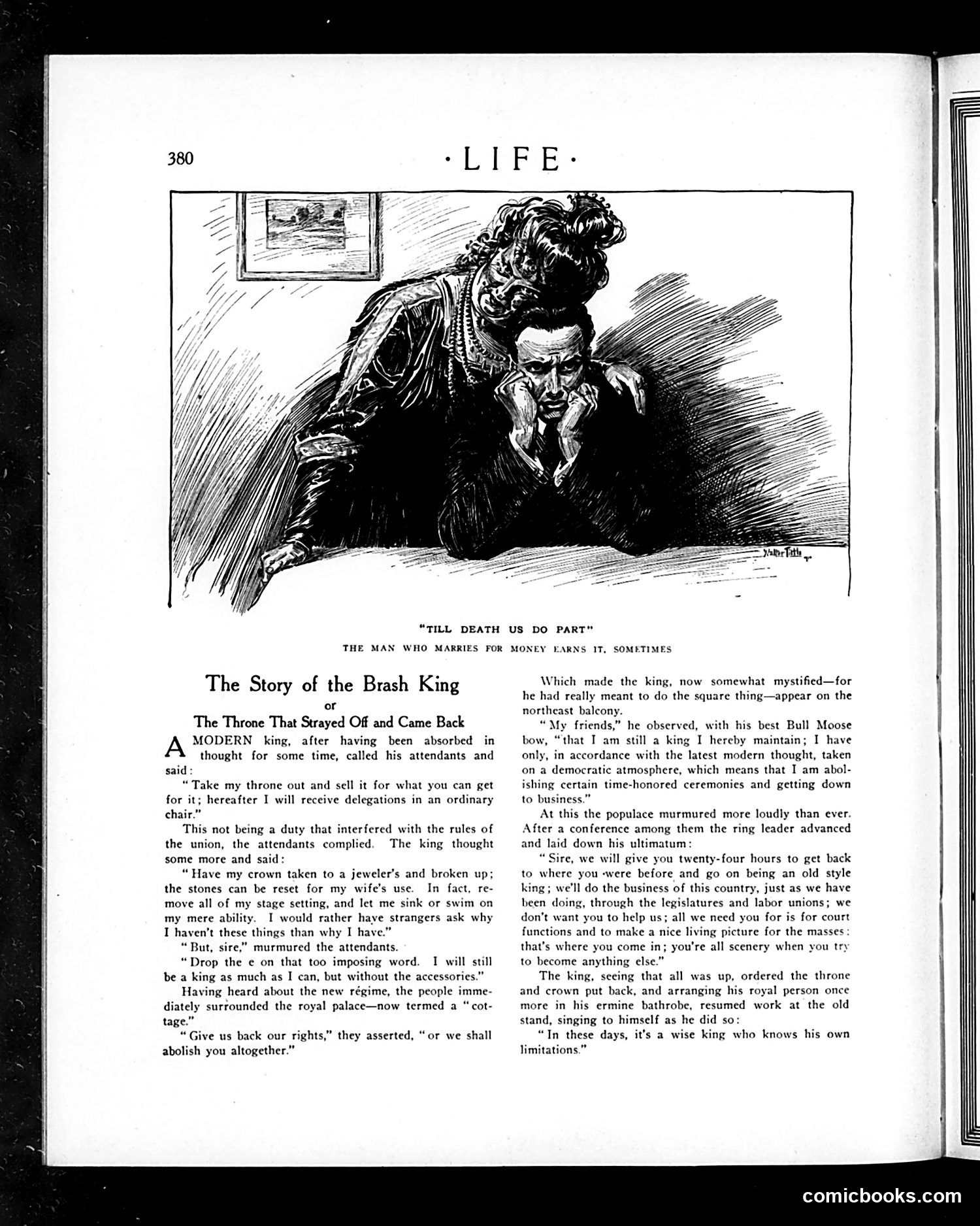
“TILL DEATH THE MAN WHO MARRIES FOR The Story of the Brash King or The Throne That Strayed Off and Came Back MODERN king, after having been absorbed in thought for some time, called his attendants and said: “Take my throne out and sell it for what you can get for it; hereafter I will receive delegations in an ordinary chair.” This not being a duty that interfered with the rules of the union, the attendants complied. The king thought some more and said: “Have my crown taken to a jeweler’s and broken up; the stones can be reset for my wife’s use. In move all of my stage setting, and let me sink or swim on my mere ability. I would rather haye strangers ask why I haven't these things than why I have.” “But, sire,” murmured the attendants. “Drop the ¢ on that too imposing word. I will still be a king as much as I can, but without the accessories.” Having heard about the new régime, the people imme- diately surrounded the royal palace—now termed a “ cot- tage. “Give us back our rights,” they asserted, “or we shall abolish you altogether.” US DO PART" MONEY EARNS 1T, SOMETIMES Which made the king, now somewhat mystified—for he had really meant to do the square thing—appear on the northeast baleony. “My friends,” he observed, with his best Bull Moose bow, “that T am still a king I hereby maintain; I have only, in accordance with the latest modern thought, taken on a democratic atmosphere, which means that I am abol- ishing certain time-honored ceremonies and getting down to business.” At this the populace murmured more loudly than ever. After a conference among them the ring leader advanced and laid down his ultimatum: “Sire, we will give you twenty-four hours to get back to where you -were before and go on being an old style king; we'll do the business of this country, just as we have been doing, through the legislatures and labor unions; we don’t want you to help us; all we need you for is for court functions and to make a nice living picture for the masses : that’s where you come in; you're all scenery when you try to become anything else.” The king, seeing that all was up, ordered the throne and crown put back, and arranging his royal person once more in his ermine bathrobe, resumed work at the old stand, singing to himself as he did so: “In these days, it's a wise king who knows his own limitations.” comicbooks.com