
Life, 1913-02-20 · page 22 of 48
Life — February 20, 1913 — page 22: what you’re looking at
What you’re looking at
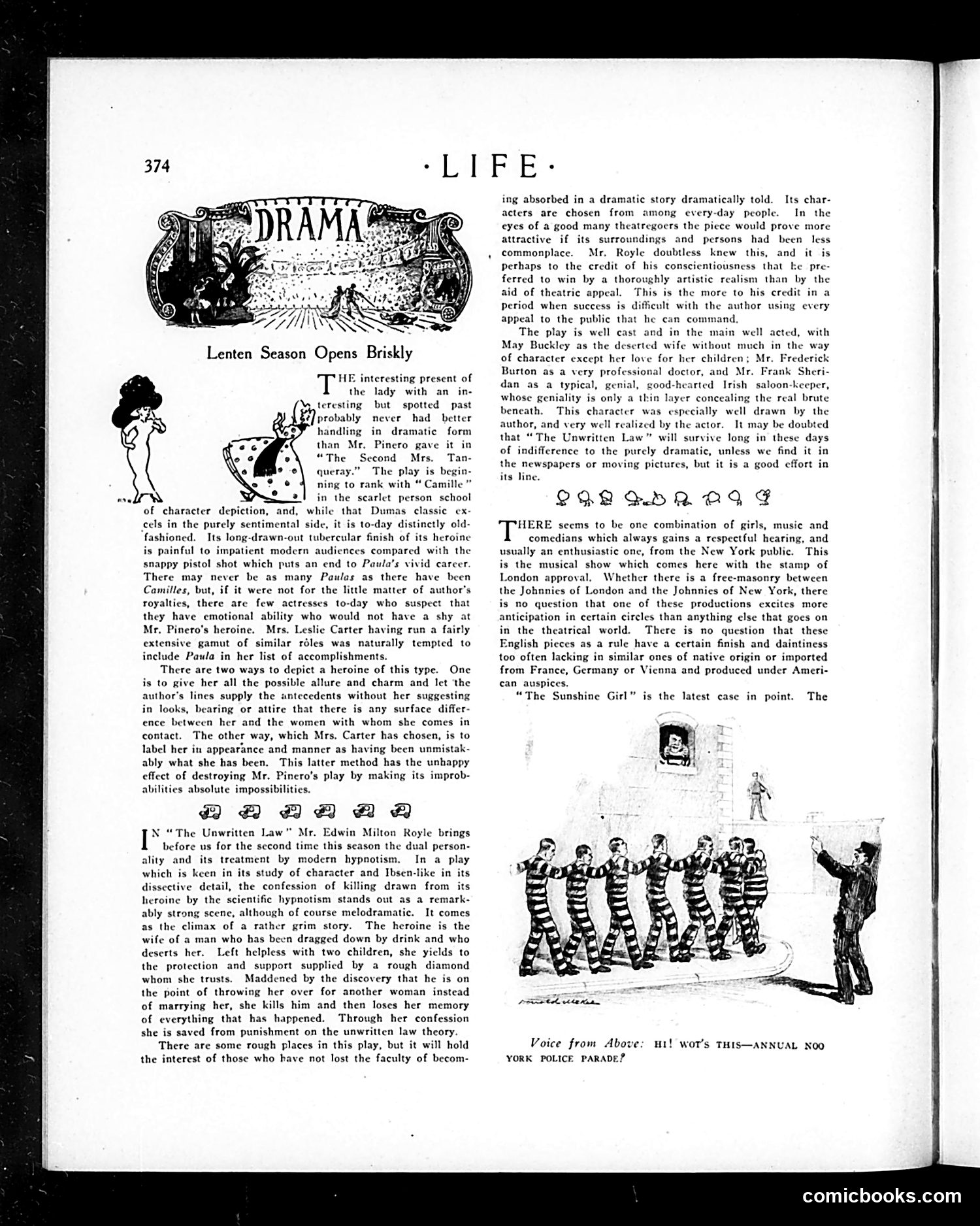
This page contains two theater reviews from Life magazine's drama section. The first reviews "The Second Mrs. Tanqueray," a play about a woman with a scandalous past. The critic discusses how actress Mrs. Leslie Carter depicts this "fallen woman" character—debating whether she should appear morally corrupted in appearance or maintain respectability. The review suggests Carter's choice to "label her" visibly as disreputable undermines the play's believability. The second review covers "The Unwritten Law," which uses hypnotism to reveal a woman's murder confession. The heroine kills her lover after he abandons her for another woman, then loses her memory. She escapes punishment through an "unwritten law" (likely referring to crimes of passion defenses). The critic praises the realistic, everyday casting despite the melodramatic plot. The small cartoon at bottom shows New York police in a parade, captioned "Hi! Wot's this—Annual Noo York Police Parade?"—likely satirizing police spectacle or pageantry.
📄 Transcribed text from this page (OCR, searchable)
Machine-transcribed from the original scan — historical spelling and the odd misread are preserved.
»LAISBAB * Lenten Season Opens Briskly HE interesting present of the lady with an ine Mteresting but spotted past ¢] probably never had better handling in dramatic form than Mr, Pinero gave it in “The Second Mrs. Tan- queray.” The play is begin- ning to rank with “ Camille” ‘ in the scarlet person school of character depiction, and, while that Dumas classic ex- cels in the purely sentimental side, it is to-day distinctly old- fashioned. Its long-drawn-out tubercular finish of its heroine is painful to impatient modern audiences compared with the snappy pistol shot which puts an end to Paula’s vivid career There may never be as many Paulas as there have been Camilles, but, if it were not for the little matter of author's royalties, there are few actresses to-day who suspect that they have emotional ability who would not have a shy at Mr. Pinero's heroine. Mrs. Leslie Carter having run a fairly extensive gamut of similar réles was naturally tempted to include Paula in her list of accomplishments. There are two ways to depict a heroine of this type. One is to give her all the possible allure and charm and let ‘the author's lines supply the antecedents without her suggesting in looks, b that there is any surface differ- ence between her and the women with whom she comes in contact. The other way, which Mrs. Carter has chosen, is to label her in appearance and manner as having been unmistak- ably what she has been, This latter method has the unhappy effect of destroying Mr. Pinero’s play by making its improb- abilities absolute impossibilities. AHA AA AA I* “The Unwritten Law” Mr. Edwin Milton Royle brings before us for the second time this season the dual person- ality and its treatment by modern hypnotism. In a play which is keen in its study of character and Ibsen-like in its dissective detail, the confession of killing drawn from its heroine by the scientific hypnotism stands out as a remark- ably strong scene, although of course melodramatic. It comes as the climax of a rather grim story. The heroine is the wife of a man who has been dragged down by drink and who deserts her. Left helpless with two children, she yields to the protection and support supplied by a rough diamond whom she trusts. Maddened by the discovery that he is on the point of throwing her over for another woman instead of marrying her, she kills him and then loses her memory of everything that has happened. Through her confession she is saved from punishment on the unwritten law theory. There are some rough places in this play, but it will hold the interest of those who have not lost the faculty of becom- ing absorbed in a dramatic story dramatically told. Its char- acters are chosen from among every-day people. In the eyes of a good many theatregoers the piece would prove more attractive if its surroundings and persons had been less commonplace. Mr. Royle doubtless knew this, and it is perhaps to the eredit of his conscientiousness that ke pre- ferred to win by a thoroughly artistic realism than by the aid of theatric appeal. This is the more to his credit in a Period when success is difficult with the author using every appeal to the public that he can command, The play is well cast and in the main well acted, with May Buckley as the deserted wife without much in the way of character except her love for her children; Mr. Frederick Burton as a very professional doctor, and Mr. Frank Sheri- dan as a typical, genial, good-hearted Irish saloon-keeper, whose geniality is only a thin layer concealing the real brute beneath. This character was especially well drawn by the author, and very well realized by the actor. It may be doubted that “The Unwritten Law” will survive long in these d of indifference to the purely dramatic, unless we find it in the newspapers or moving pictures, but it is a good effort in 998252 0299 HERE seems to be one combination of girls, music and comedians which always gains a respectful hearing, and usually an enthusiastic one, from the New York public. This is the musical show which comes here with the stamp of London approval. Whether there is a free-masonry between the Johnnies of London and the Johnnics of New York, there is no question that one of these productions excites more anticipation in certain circles than anything else that goes on in the theatrical world. There is no question that these English picces as a rule have a certain finish and daintiness too often lacking in similar ones of native origin or imported from France, Germany or Vicnna and produced under Ameri- can auspices. “The Sunshine Girl” is the latest case in point. The Voice from Above: ui! wot’s THIS—ANNUAL Noo YORK POLICE PARADE? comicbooks.com