
A complete issue · 44 pages · 1912
Life — September 5, 1912
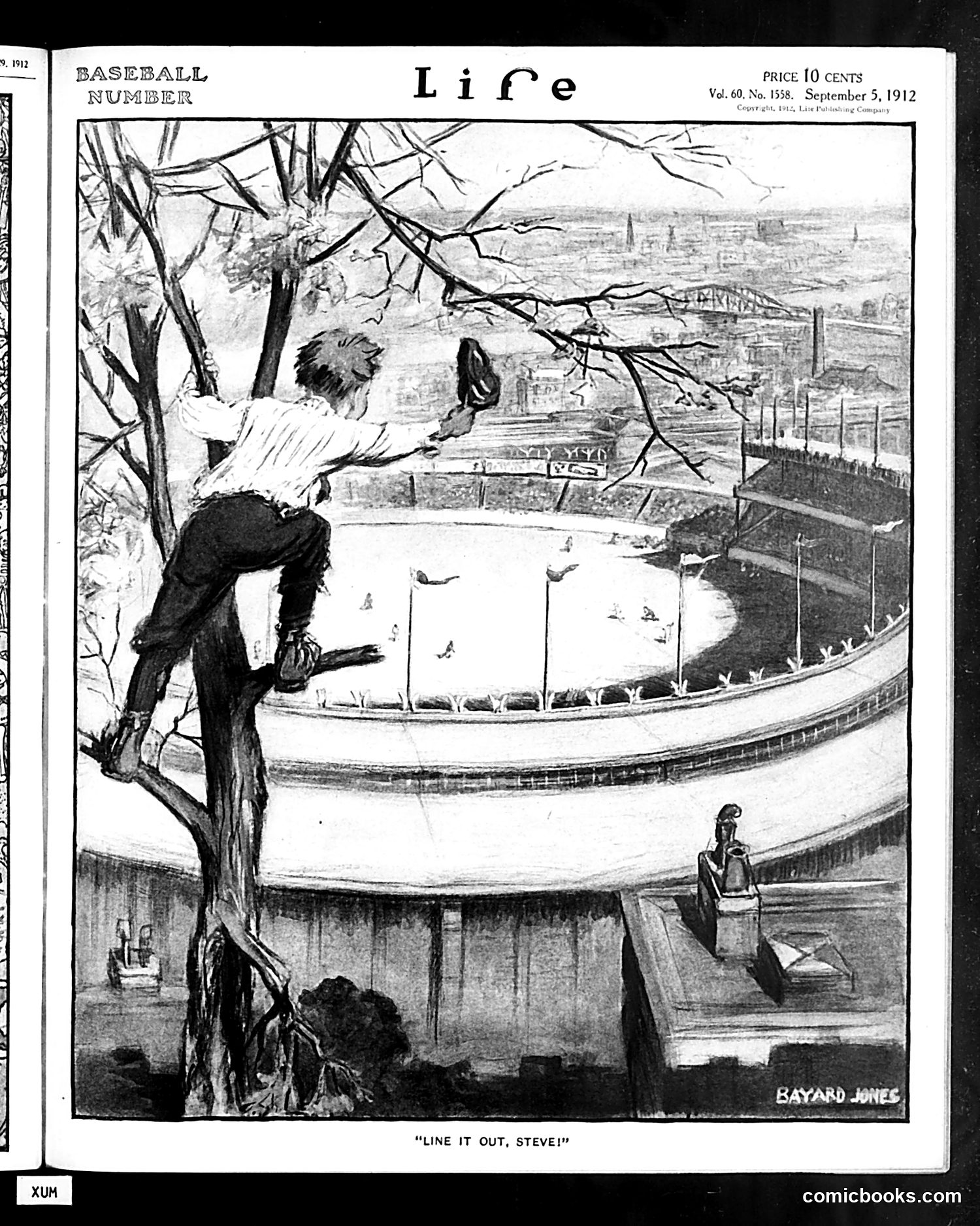
This baseball-themed cartoon by Bayard Jones depicts a figure perched in a tree overlooking a baseball stadium, preparing to catch a ball. The caption "Line It Out, Steve!" suggests someone named Steve is being instructed to hit the ball in a particular direction. The image appears to be straightforward sports humor rather than political satire—a common subject for Life magazine's illustrations. The elevated vantage point and dramatic composition create comic tension around the baseball action below. Without additional context identifying "Steve" as a specific player or public figure of 1912, the cartoon's primary appeal seems to be the amusing visual gag of an enthusiastic fan positioned to intercept play.
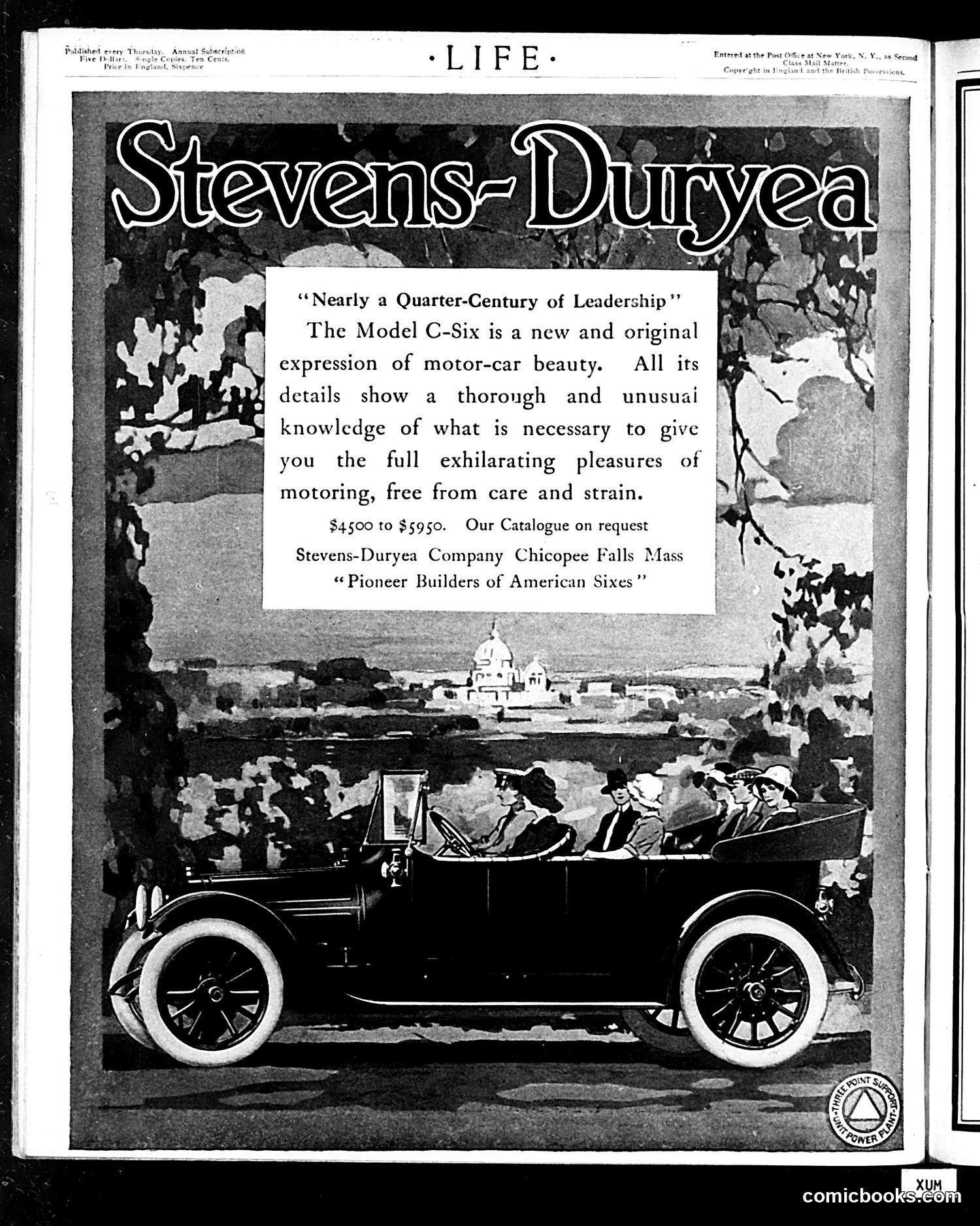
This is primarily a **commercial advertisement**, not political satire. The page advertises the Stevens-Duryea Model C-Six automobile from Chicopee Falls, Massachusetts, described as a "new and original expression of motor-car beauty." The ad emphasizes the car's quality and reliability ("Nearly a Quarter-Century of Leadership"), positioning Stevens-Duryea as "Pioneer Builders of American Sixes." The price range is $4,100 to $5,950. The accompanying illustration shows well-dressed passengers in an open touring car with the Capitol Building visible in the background—suggesting prestige, leisure, and American prosperity. This aspirational imagery was typical of early-20th-century automobile marketing aimed at wealthy consumers.

This is not a cartoon or satirical content—it's a **straightforward advertisement** for Michelin tires, specifically their "Quick Detachable Clincher" product. The page shows a technical illustration of a tire with its detachable rim component, highlighting the innovation that this clincher design could fit "any Q.D. Clincher Rim" easily. The ad emphasizes Michelin's global reputation for tire quality. The copy promises convenience and superior engineering. This represents early automotive-era advertising (likely early 1900s based on style) when tire technology was still developing and manufacturers competed on practical innovations like quick-change systems. There is no satire, political commentary, or hidden meaning—just product promotion from a major French tire manufacturer advertising to American readers in Life magazine.
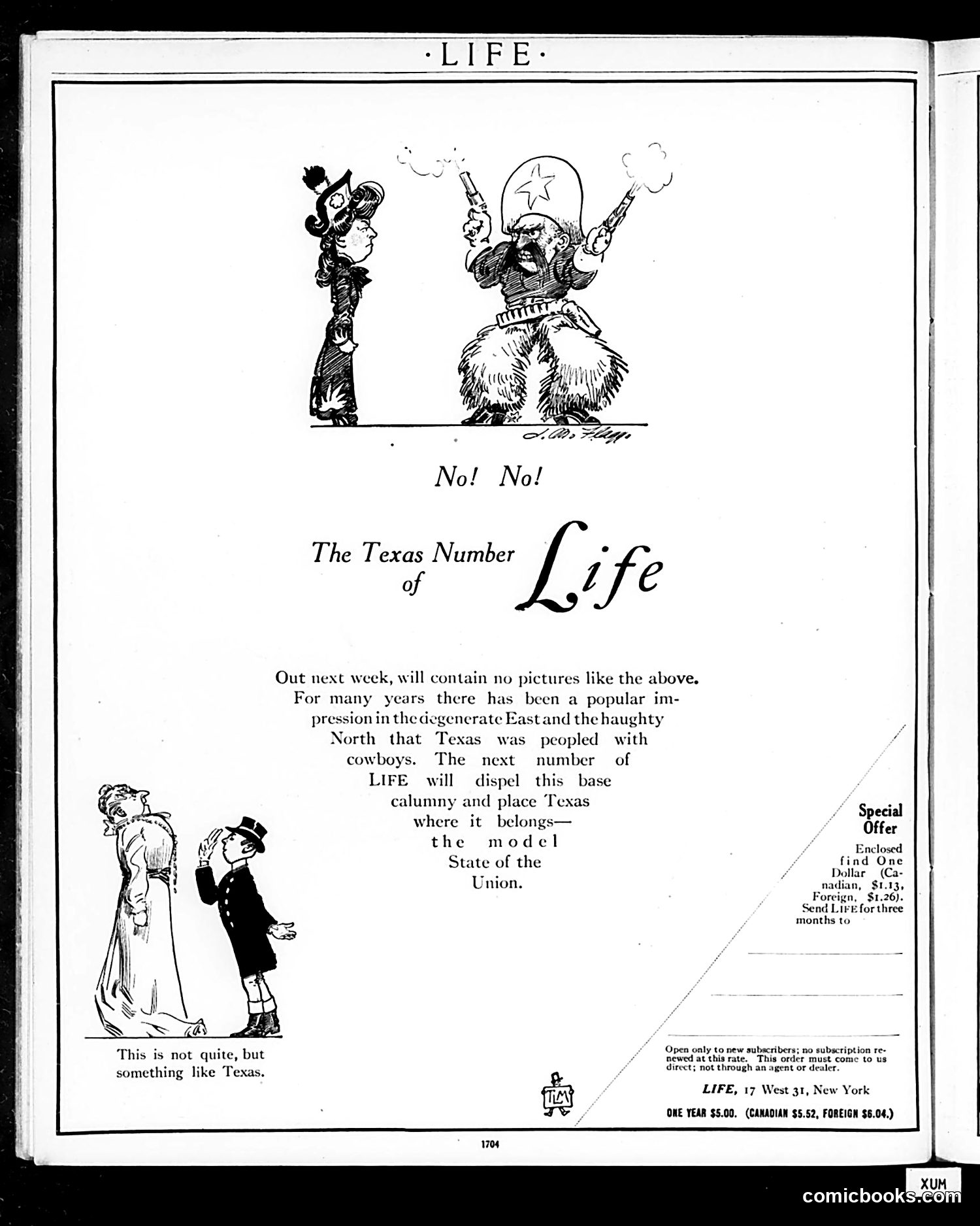
This page satirizes stereotypes about Texas. The top cartoon shows a woman in elegant Eastern dress rejecting a wild, gun-wielding figure wearing a star-emblazoned hat—a caricature of the stereotypical Texas cowboy. The accompanying text announces that next week's Texas-focused issue will correct "a popular impression in the degenerate East and the haughty North that Texas was peopled with cowboys." Life promises to show Texas as "the model State of the Union"—sophisticated and civilized, not lawless frontier. The lower cartoon depicts refined society (woman in proper dress, man in top hat), captioned "This is not quite, but something like Texas," further emphasizing the contrast between crude stereotypes and Texas's actual development. The page uses humor to challenge regional prejudices prevalent among Eastern magazine readers.
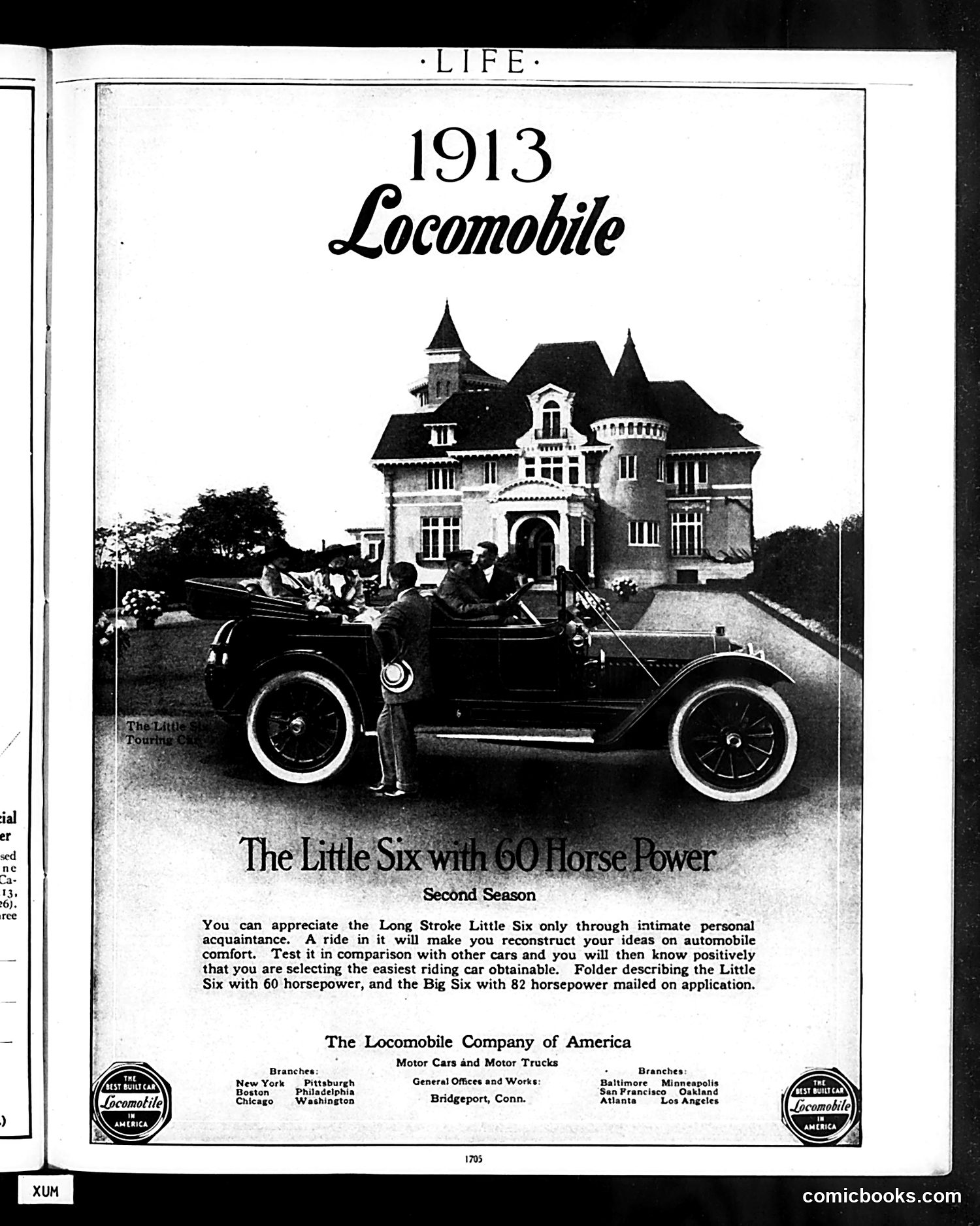
This is not a political cartoon but rather a **full-page advertisement** for the Locomotile automobile company, published in Life magazine. The ad showcases the "Little Six with 60 Horse Power," marketed as the company's "Second Season" model. The image features a luxurious open-air automobile parked before an ornate mansion, with well-dressed passengers and an attendant, emphasizing affluence and social status. The accompanying text appeals to wealthy consumers by positioning the vehicle as combining comfort with performance, inviting potential buyers to test-drive it against competitors. The Locomotile Company lists multiple branches across major American cities and manufacturing works in Bridgeport, Connecticut. This represents early automotive marketing targeting the upper class.

This is primarily **advertising, not satire or editorial content**. The page features a Kelly-Springfield Automobile Tires advertisement from the early 20th century (company founded 1895, per the text). The visual shows a fashionably-dressed woman sitting inside a large tire—a striking image designed to grab attention. The accompanying text argues that Kelly-Springfield tires' superior rubber composition delivers longer mileage than competitors. There is **no political cartoon or satirical content** here. The image is purely a commercial marketing technique: using an attractive female figure to make the product memorable and appealing to automobile owners (presumably male). This represents standard advertising practice of the era, not editorial commentary or social satire.
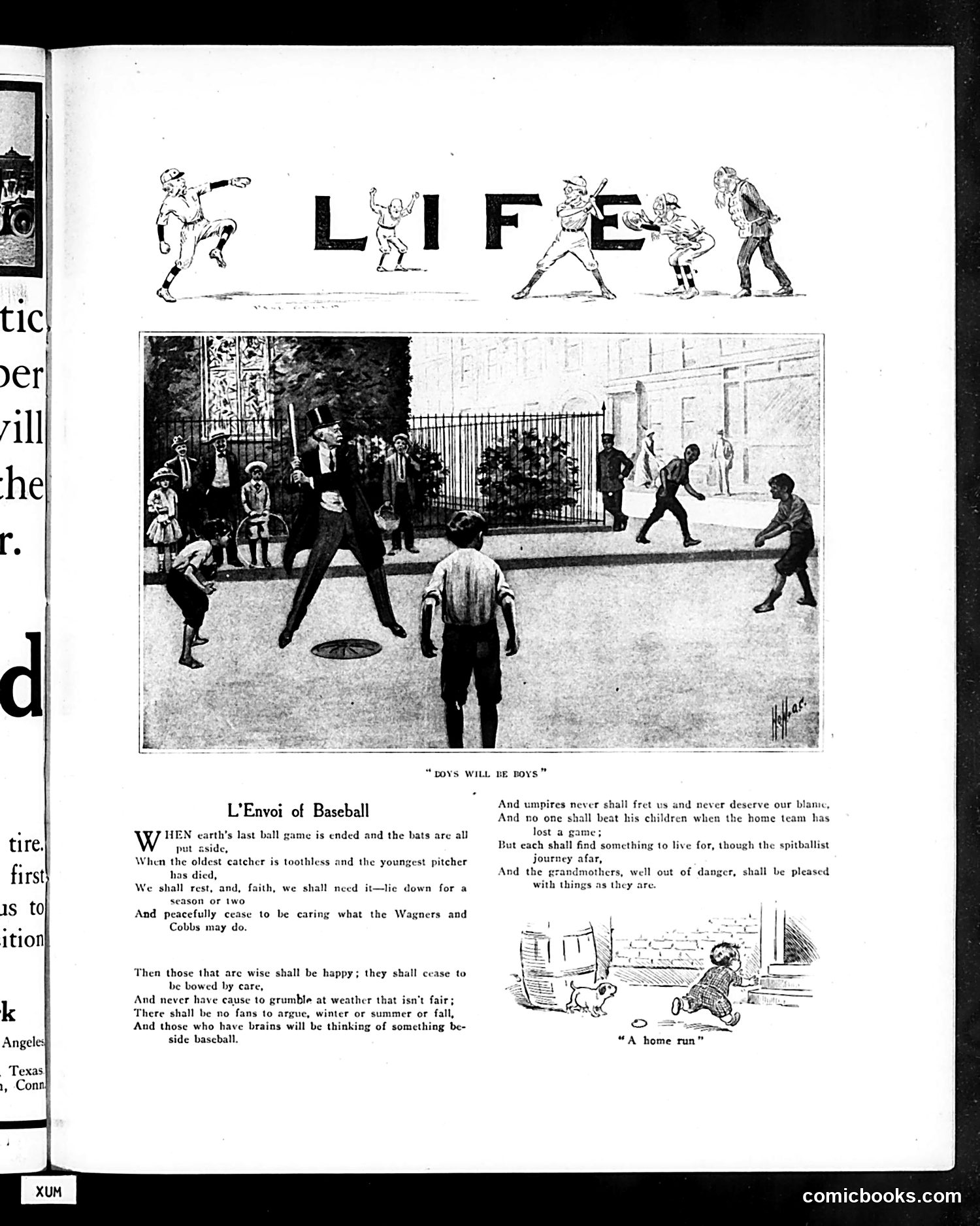
This page celebrates baseball as an American institution during what appears to be the early 20th century. The large illustration shows a street game with boys playing near a fence, watched by adults and children—depicting baseball as accessible to all social classes. The poem below, titled "Boys Will Be Boys," expresses nostalgia for baseball's virtues: it promises rest after labor, warns against obsessive fan complaints about umpires and weather, and suggests the sport builds character in youth. References to "Wagners and Cobbs" (likely baseball stars) indicate the sport's celebrity status. The smaller illustration captioned "A home run" shows children playing informally, reinforcing baseball's role as wholesome recreation that transcends class boundaries—a distinctly American ideal.
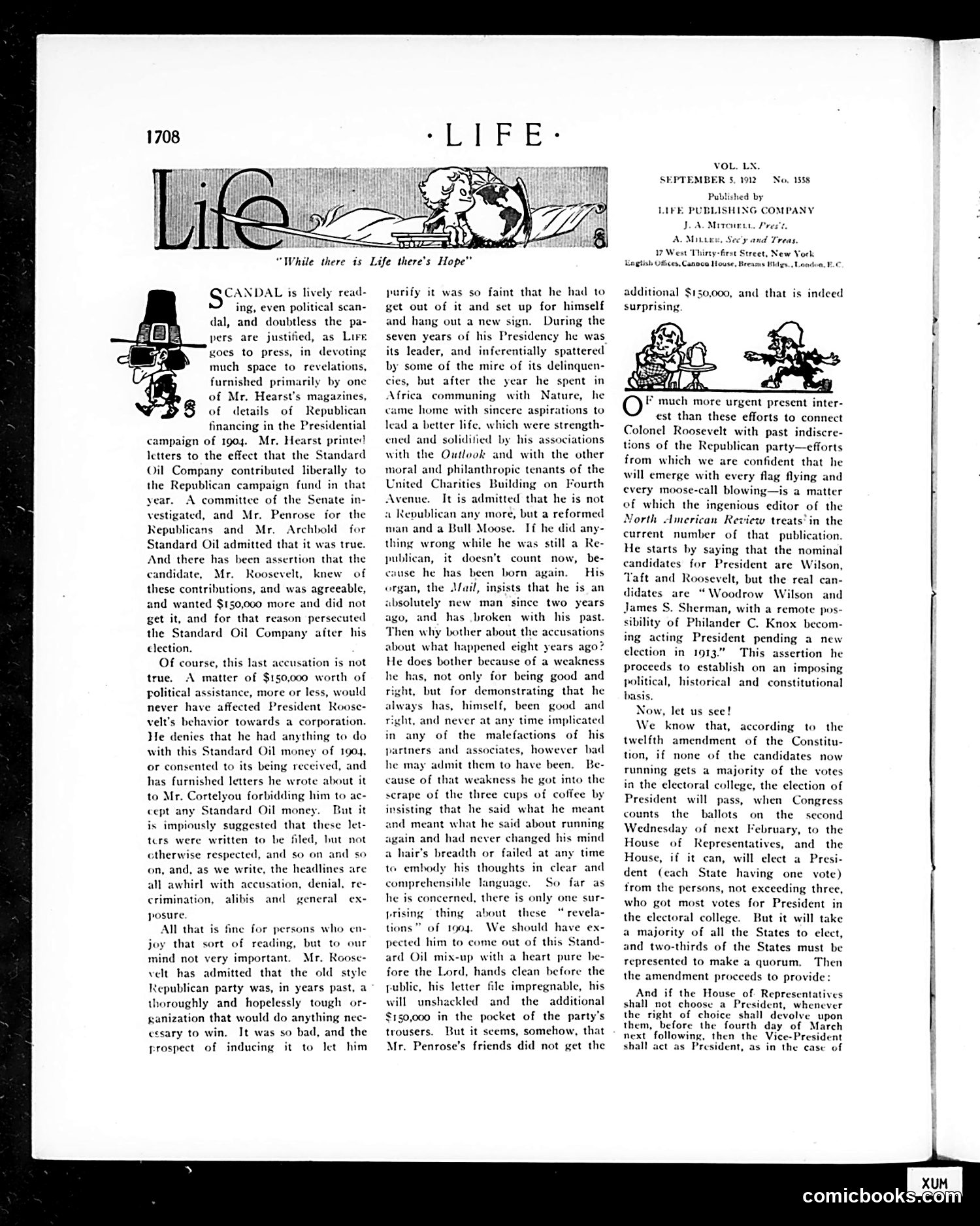
This page critiques President Roosevelt's denials regarding the Standard Oil Company's contributions to his 1904 campaign. The article sarcastically documents Roosevelt's claim that he knew nothing of a $150,000 donation, despite accusations from oil magnate Henry H. Rogers and Standard Oil executive John D. Archbold. The text mocks Roosevelt's subsequent "reformed" Republican stance, questioning his credibility given this financial entanglement. The piece also previews the 1912 presidential race, discussing Wilson, Taft, and Roosevelt as candidates. The cartoon (left margin) appears to caricature Roosevelt, emphasizing the hypocrisy between his "clean" political image and his actual acceptance of corporate money—a central scandal of the Progressive Era.
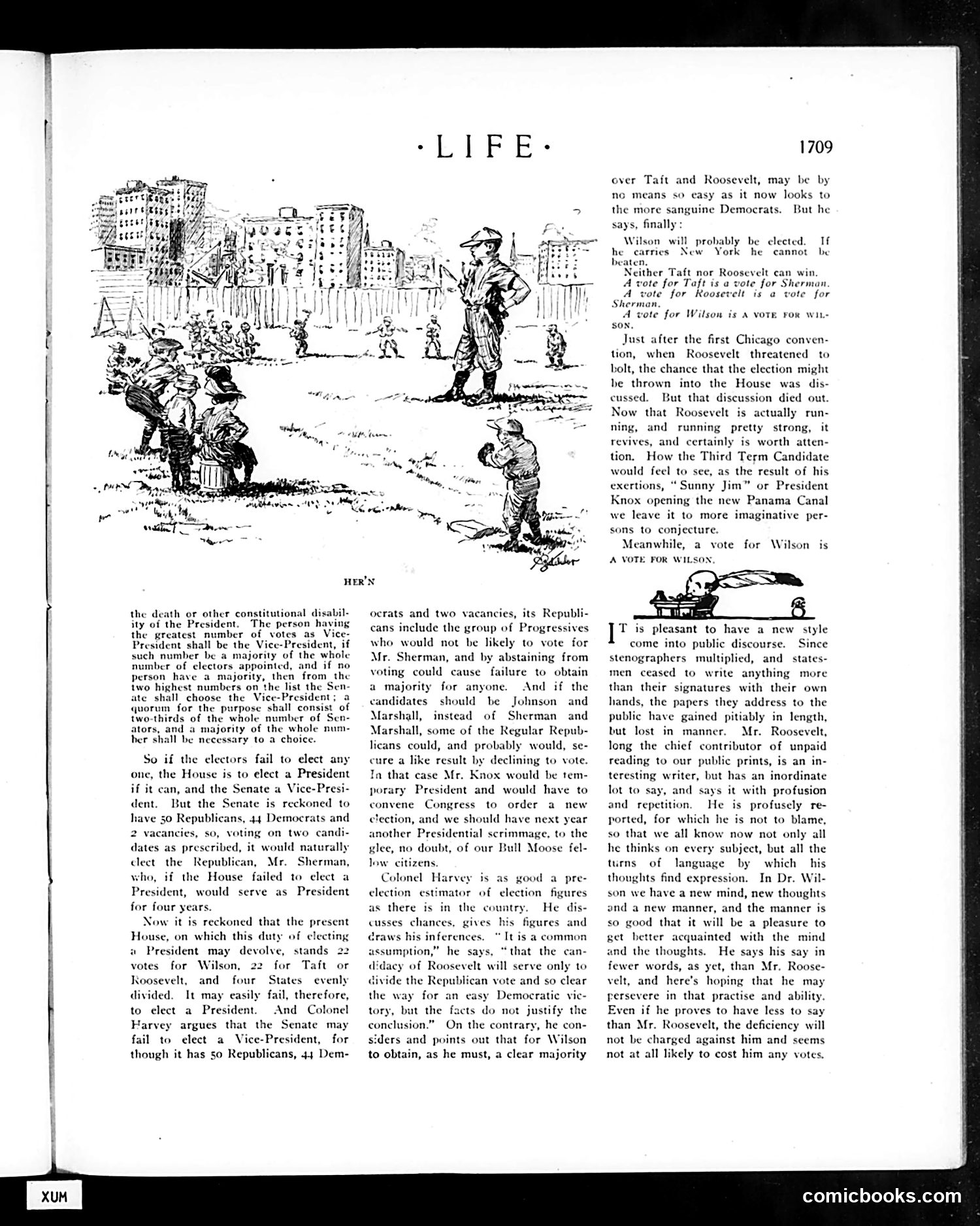
This page discusses the 1912 U.S. presidential election, featuring a sketch of a tall figure (likely Theodore Roosevelt) standing prominently while other candidates appear smaller below. The cartoon satirizes the fractured Republican vote. The text explains that a vote for Wilson (Democrat) effectively helps Wilson win, while splitting Republican votes between Taft, Roosevelt, and Progressive Party candidates weakens their chances. The article references Roosevelt's "Third Term" ambitions and mentions "Sunny Jim" (President James Sherman, Taft's running mate). The satire critiques how the Progressive split from the GOP—with Roosevelt running as a "Bull Moose"—could hand the election to Democrat Woodrow Wilson by dividing the conservative vote. The cartoon visually emphasizes Roosevelt's outsized role in this electoral calculus.
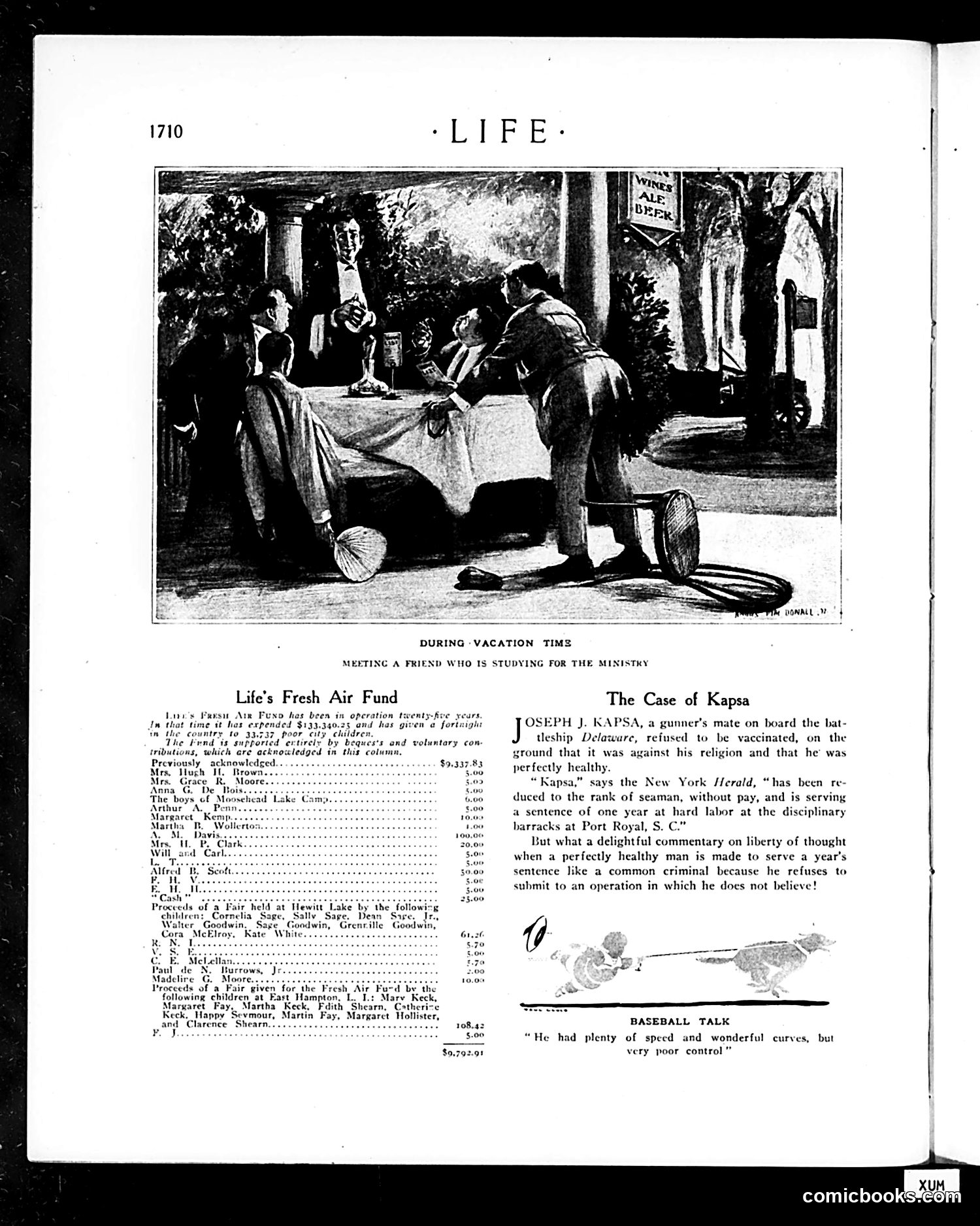
**Top Image:** "During Vacation Time—Meeting a Friend Who is Studying for the Ministry" depicts an outdoor social gathering at what appears to be a seaside venue (sign reads "Ale Beer"). The cartoon satirizes the contrast between leisure and religious devotion, showing how acquaintances might awkwardly encounter someone pursuing ministerial studies during casual vacation time—suggesting the incongruity of religious seriousness interrupting social pleasantries. **"The Case of Kapsa":** This article criticizes the disciplinary punishment of Joseph J. Kapsa, a Navy sailor who refused vaccination on religious grounds and received a one-year hard labor sentence. The text presents this as a commentary on liberty of conscience, questioning whether a healthy man should be imprisoned for declining medical procedures against his religious beliefs. **"Baseball Talk":** A brief humorous caption about poor pitching control.
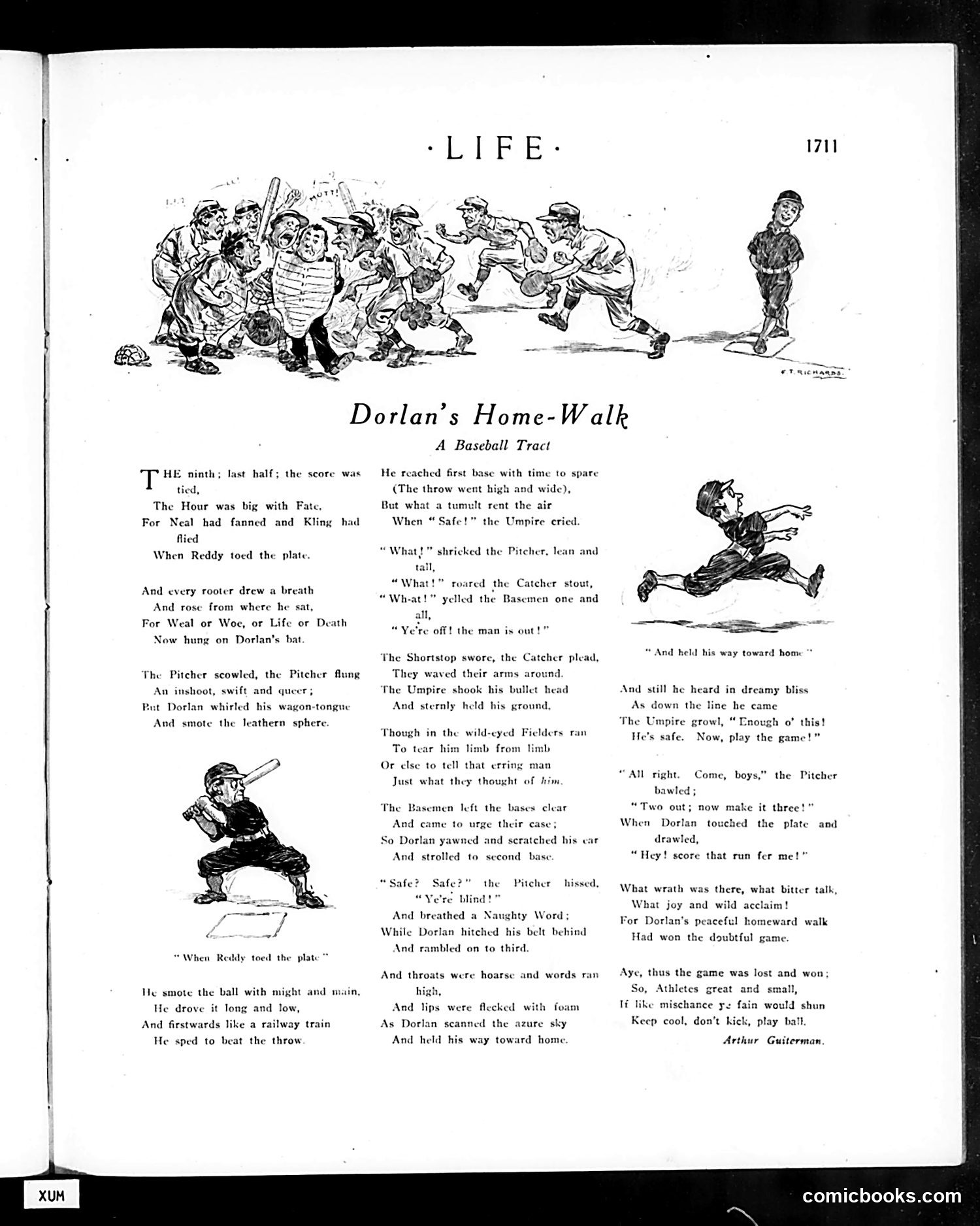
This page presents a humorous baseball poem by Arthur Guiterman illustrated with action sketches. The narrative follows a player named Dorlan during a crucial ninth-inning game. The "tract" format—typically used for moral instruction—parodies religious language by applying it to baseball instead. The illustrations depict baseball action: batters, catchers, and fielders in dynamic poses. The poem describes Dorlan's dramatic at-bat and subsequent base-running, using elevated language to mock both sports enthusiasm and moralistic literature common in the era. The humor lies in treating a baseball game with the gravity usually reserved for spiritual salvation, a satire on how Americans invested emotional importance in sports while Life magazine satirized contemporary culture through such irreverent juxtapositions.
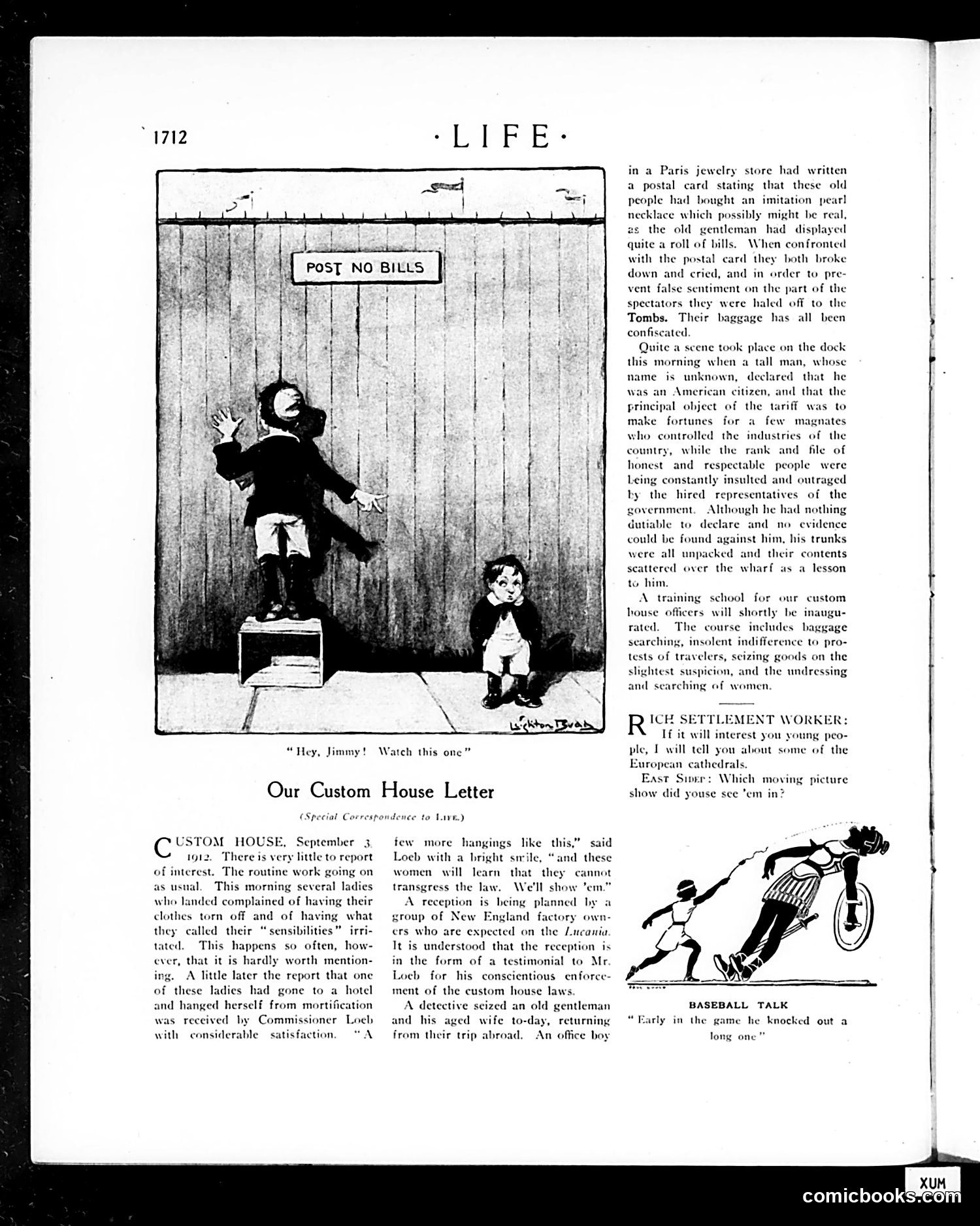
The main cartoon satirizes U.S. Customs House procedures. It depicts an official roughly interrogating travelers at a dock, with a "POST NO BILLS" sign above. The caption "Hey, Jimmy! Watch this one" suggests abuse of authority during luggage inspection. The accompanying article describes complaints from women whose clothes were torn during searches, calling their treatment "sensibilities irritated." It also mentions a detective seizing an elderly gentleman, implying excessive zeal in tariff enforcement. The satire targets overzealous customs officials who harass honest travelers while supposedly protecting against smuggling. The cartoonist mocks both the officials' rough tactics and the bureaucratic pretense of legitimate government function. This reflects early-20th-century concerns about administrative overreach at ports of entry.
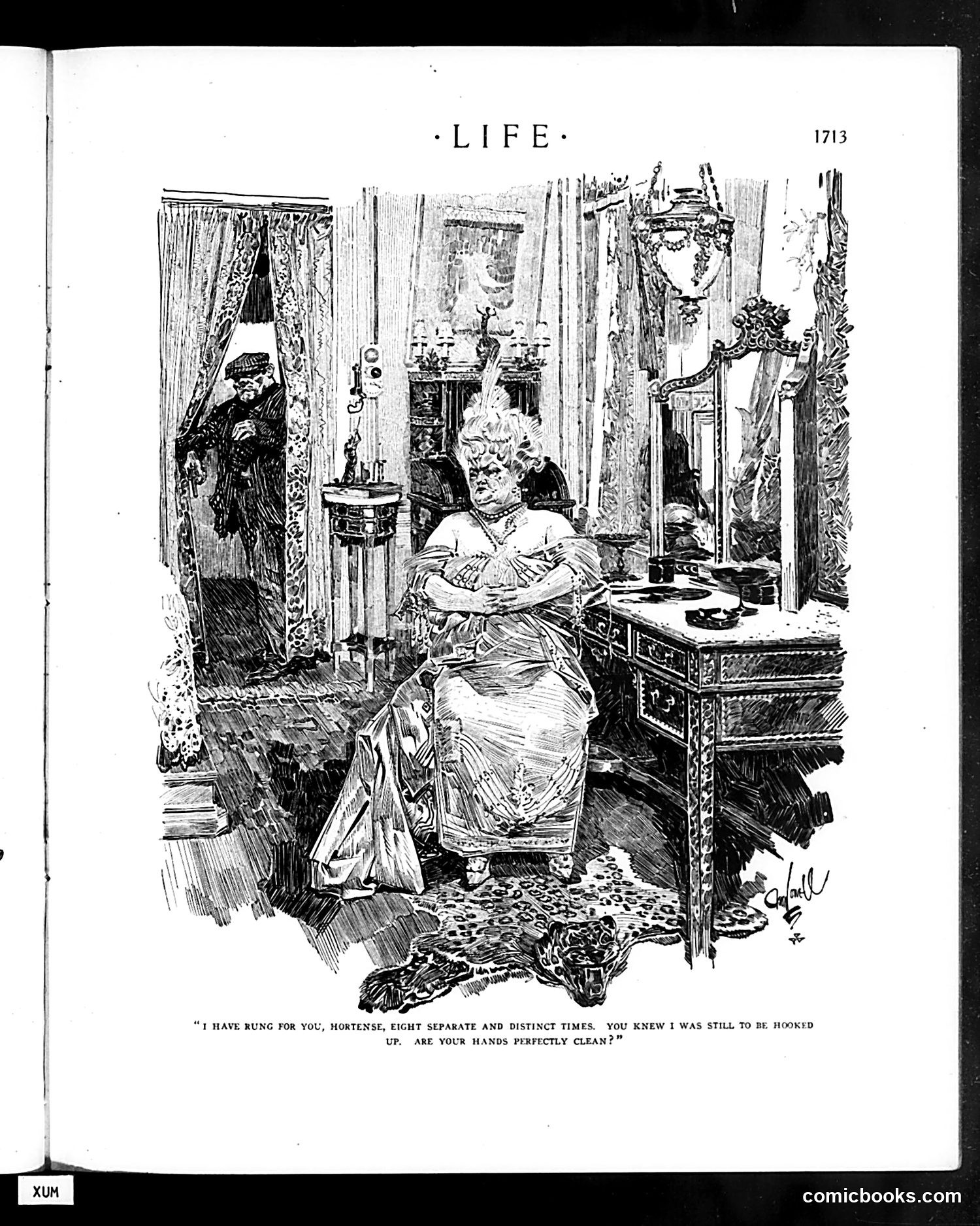
This is a single satirical cartoon from Life magazine (dated 1713 in the header, though this appears to be a printing error or section marker). The drawing depicts a wealthy woman at her vanity table being attended by a servant. The caption reads: "I HAVE RUNG FOR YOU, HORTENSE, EIGHT SEPARATE AND DISTINCT TIMES. YOU KNEW I WAS STILL TO BE HOOKED UP. ARE YOUR HANDS PERFECTLY CLEAN?" The satire targets upper-class pretension and hypocrisy. The woman has summoned her servant repeatedly—a display of imperious behavior—yet her concern about the servant's "clean hands" suggests anxiety about contamination from a social inferior. The joke exposes the absurdity of aristocratic vanity and the dehumanizing treatment of domestic staff, while the woman's elaborate dress and grooming ritual underscore her self-absorption.
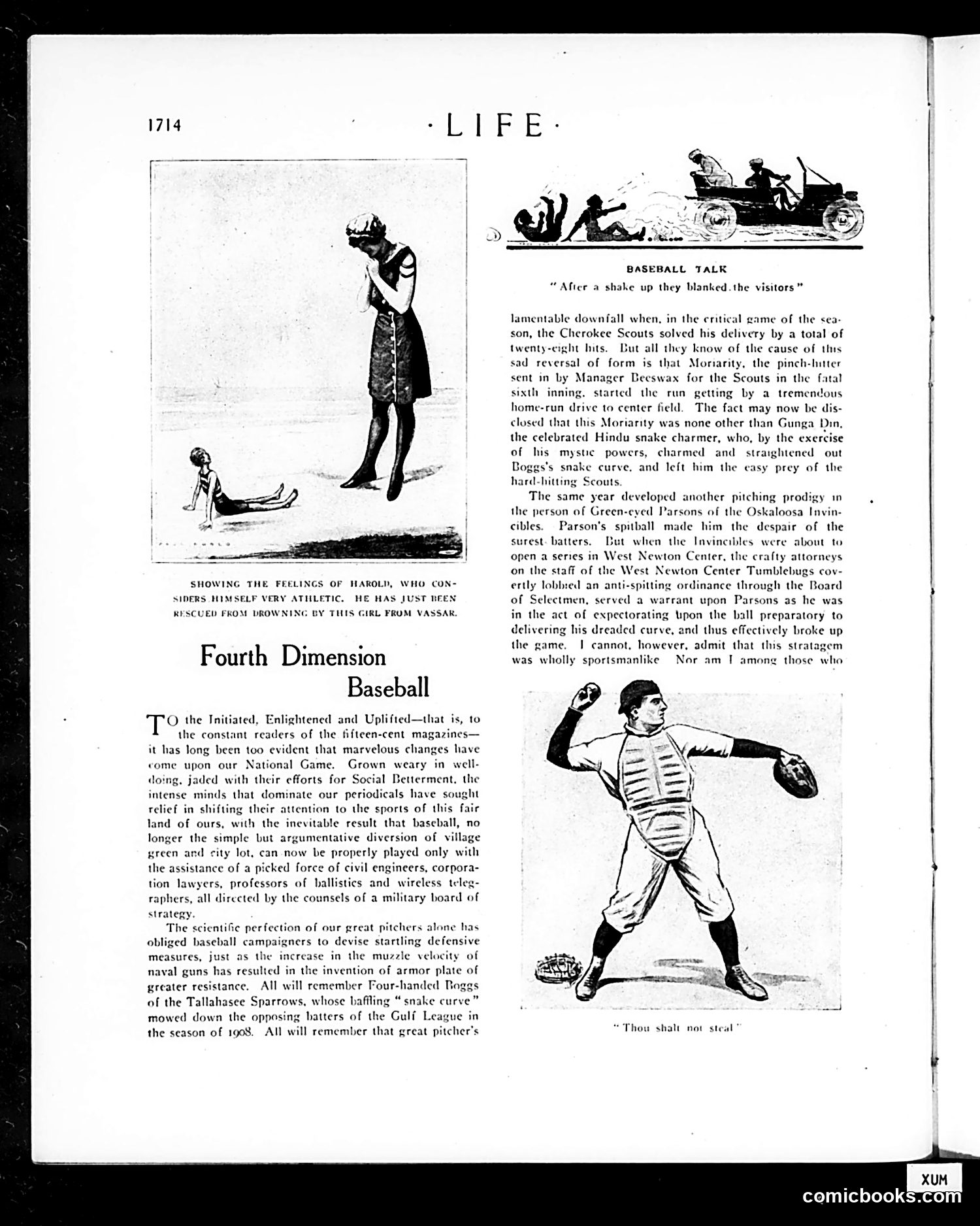
This Life magazine page satirizes how baseball had become overly complicated and militarized by 1914. The article's title—"Fourth Dimension Baseball"—mocks the sport's transformation from simple recreation into a pseudo-scientific enterprise requiring "evil engineers, corporation lawyers, professors of ballistics and wireless telegraphers." The left illustration shows a man ("Harold") rescued from drowning—a sarcastic comment on how seriously people took athletic pursuits. The right side mentions specific pitchers like Gunga Din and Green-eyed Parsons, whose innovative pitching techniques (particularly the "snake curve") had become strategically complex. The satire suggests that modern baseball had lost its simplicity, becoming an intellectualized game requiring specialized expertise rather than pure athletic skill.
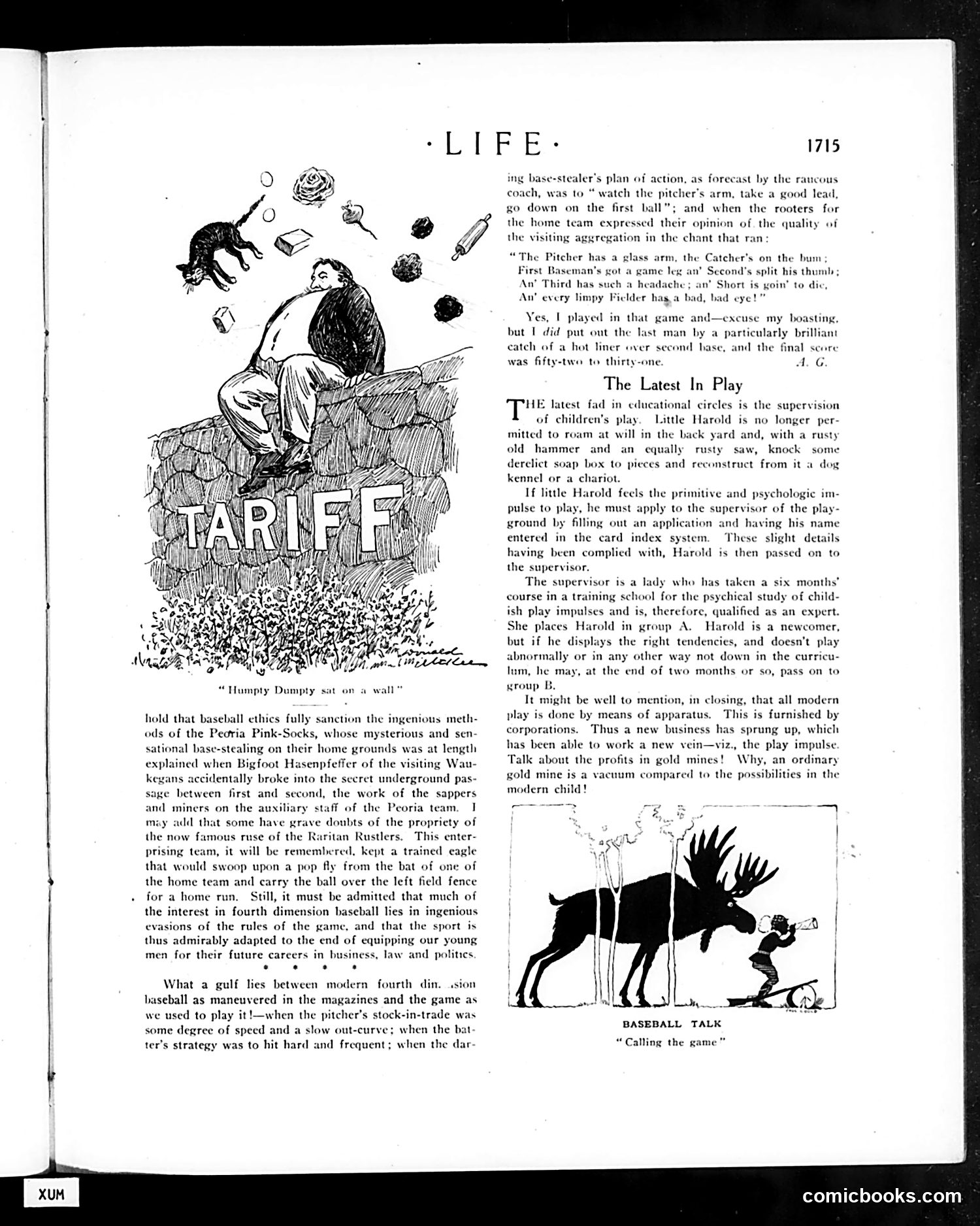
This page satirizes two modern trends: organized baseball and supervised childhood play. The **baseball section** mocks how magazine writers have invented absurdly complex schemes (underground passages, trained eagles) to explain base-stealing, contrasting this with the straightforward game the author actually played. The satire suggests that writers embellish sports stories for entertainment, and that creative rule-breaking has become valued over actual athletic skill—paralleling dishonesty in business and politics. **"The Latest In Play"** ridicules the emerging professionalization of children's recreation. A child named Harold can no longer freely build from scrap materials; instead, he must file applications, receive "expert" supervision from someone with minimal training, and join standardized groups. The author sarcastically notes corporations now profit from this regimented play through apparatus sales—comparing it to gold mining. The satire targets both excessive bureaucratization of childhood and commercialization of what should be free, creative activity.
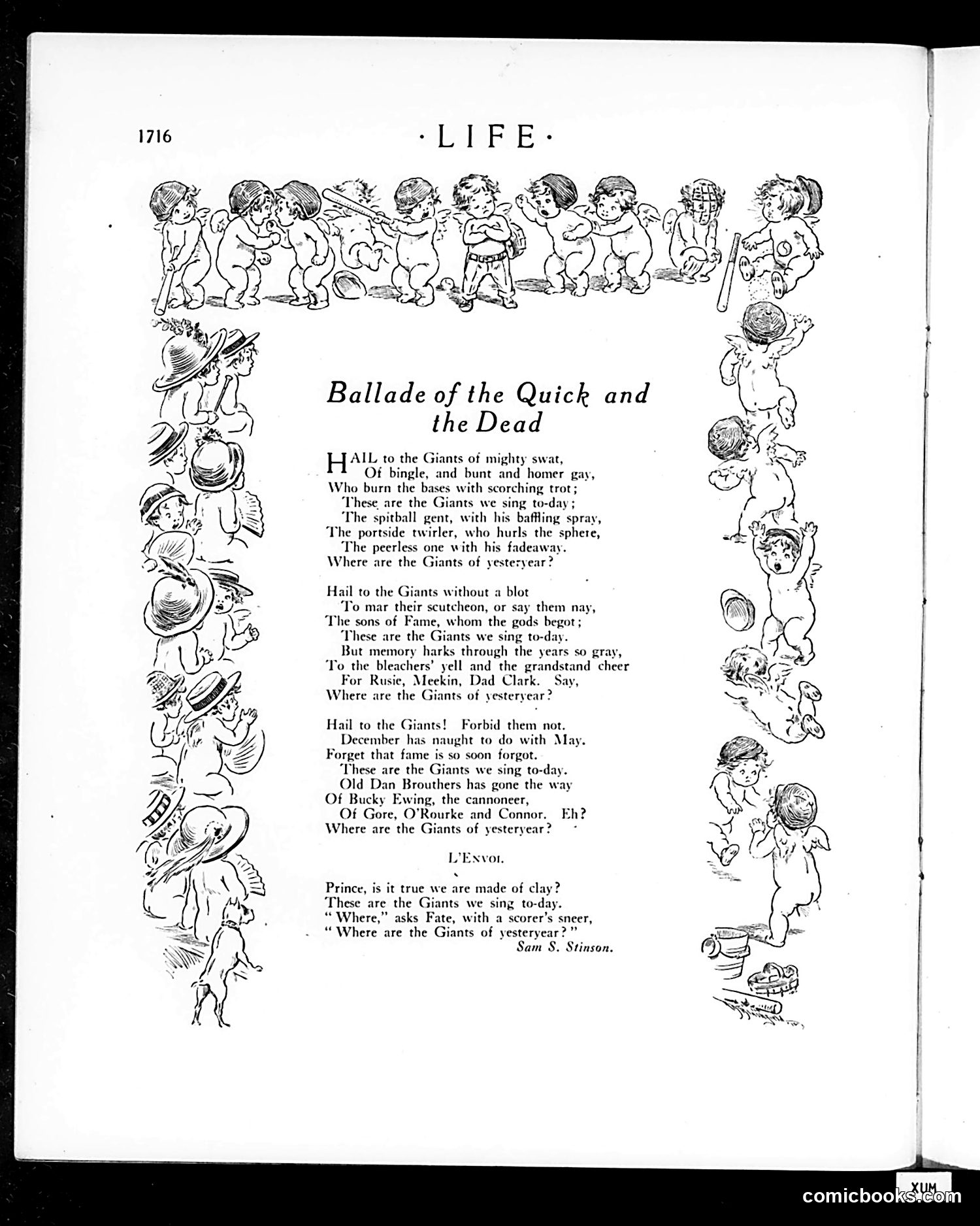
This poem by Sam S. Stinson celebrates the **New York Giants baseball team**, using the medieval poetic form of a ballade to reflect on baseball mortality and legacy. The satire contrasts **present-day Giants players** (praised for their "spitball," "fadeaway," and batting prowess) with **legendary dead or retired players** from earlier eras—Amos Rusie, "Dad" Clark, Dan Brouthers, Bucky Ewing, Gore, O'Rourke, and Connor. The refrain "Where are the Giants of yesteryear?" echoes Villon's famous medieval poem, applying its melancholy meditation on death and transience to baseball. The joke is **treating dead ballplayers with the grand, solemn language reserved for actual death**—mocking both baseball obsession and the inevitable decline of even celebrated athletes. The decorative cherub borders reinforce the mock-funeral tone. The piece appeared around **1900-1910**, when these players were genuinely passing from living memory.
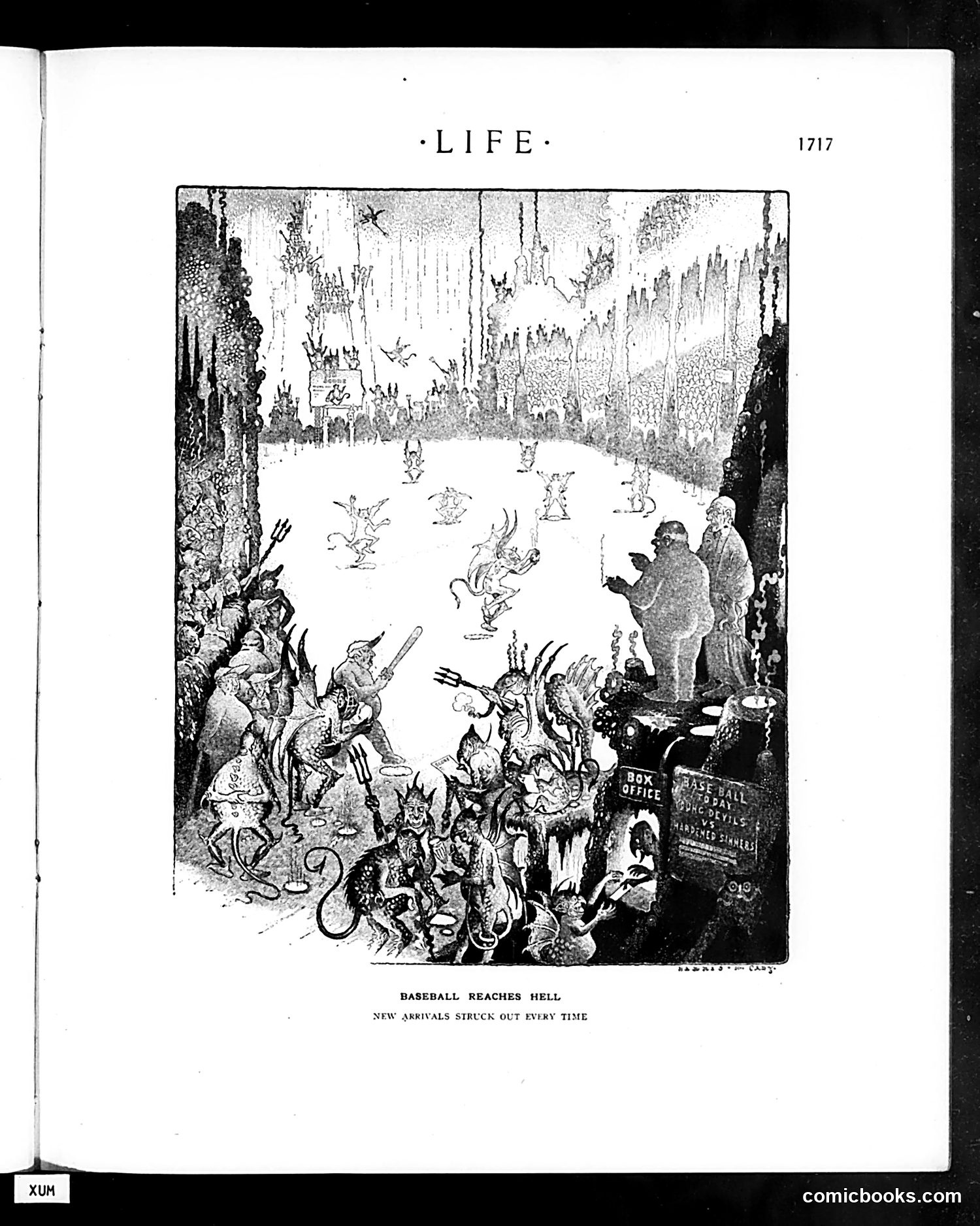
This satirical cartoon depicts baseball arriving in Hell, with devils and demons depicted as the inhabitants. The caption "New Arrivals Struck Out Every Time" plays on baseball terminology—being "struck out" means failure in the sport, but here suggests newcomers to Hell are perpetually failing or suffering. The cartoon appears to be social commentary on baseball's popularity or cultural impact circa 1917. The detailed rendering shows Hell's landscape populated with demonic figures observing a baseball game, with what appears to be a "Box Office" sign visible—possibly satirizing baseball's commercial success or the sport's perceived corrupting influence. The exact target of satire remains unclear without additional context, though it likely critiques either baseball's cultural dominance, its commercialism, or contemporary anxieties about the sport's moral implications.
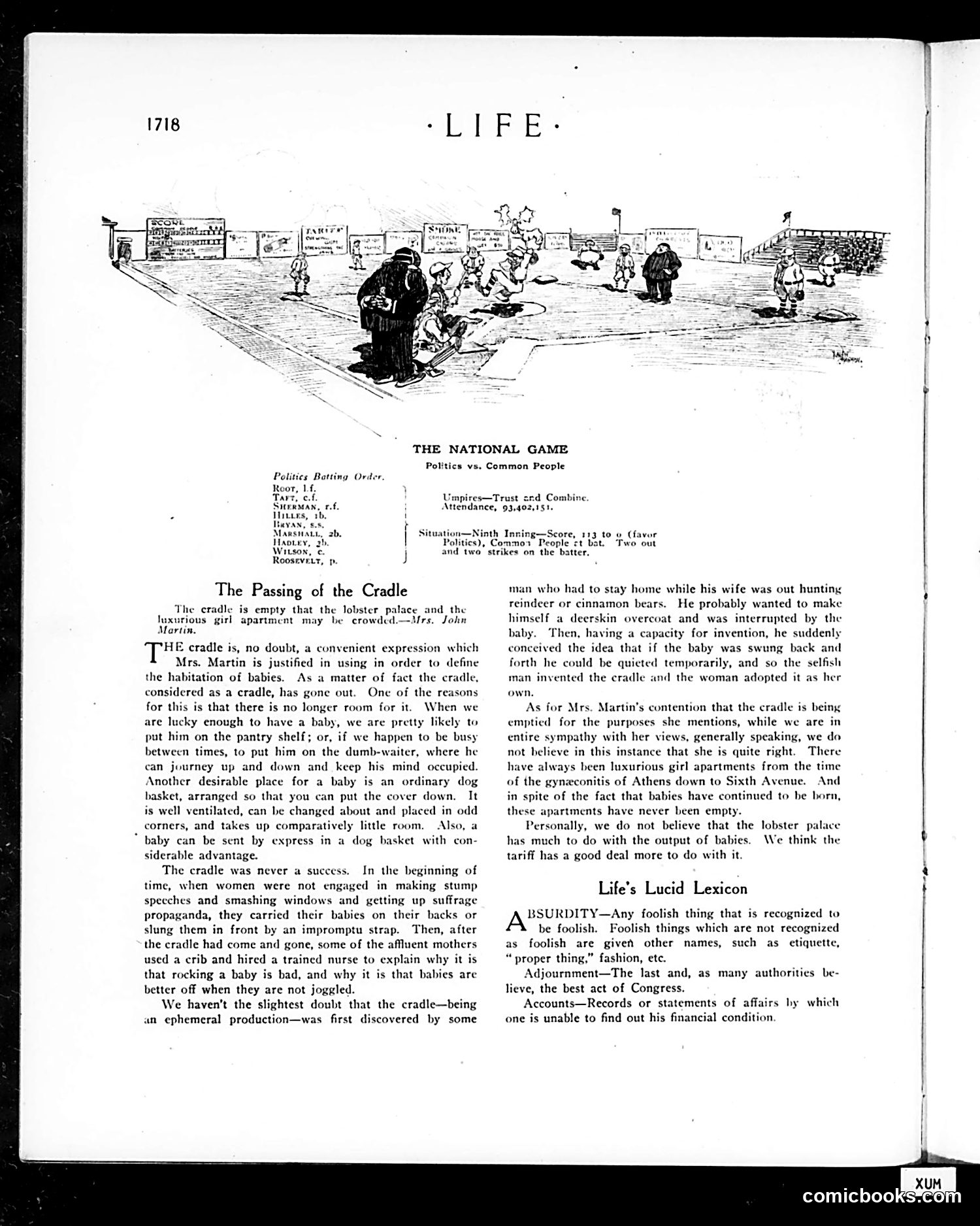
This 1718 *Life* magazine page contains two satirical pieces targeting early 20th-century social issues. **"The National Game"** (top) is a baseball cartoon labeled "Politics vs. Common People," with Roosevelt listed as pitcher. The lineup includes politicians and trust monopolies playing against ordinary citizens. The joke: politics and big business are a rigged game where the common people are outmatched. **"The Passing of the Cradle"** (main article) responds to a Mrs. John Martin's claim that cradles are disappearing because women pursue "lobster palaces" (fancy restaurants) and apartments instead of child-rearing. *Life* sardonically defends women's changing roles, arguing luxurious establishments have always existed and aren't actually replacing babies—rather, tariff policies (economic issues) better explain birth rates than women's leisure activities. The piece mocks both Mrs. Martin's domesticity argument and broader anxieties about changing female social roles.
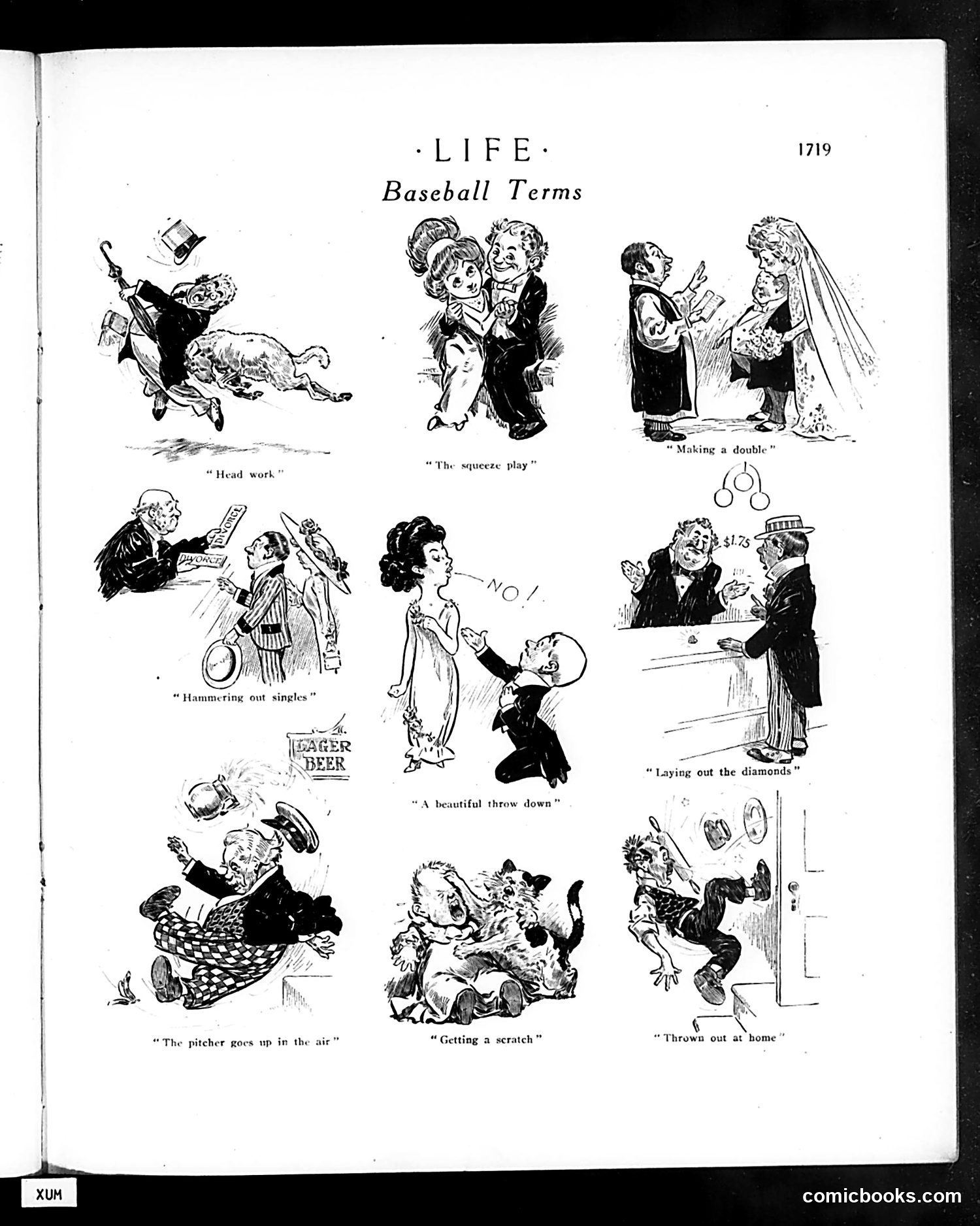
This is a humorous page that uses baseball terminology as double entendres for romantic and domestic situations. Each cartoon illustrates a baseball phrase with a non-baseball scenario: - "Head work" shows a man being hit by a woman - "The squeeze play" depicts romantic embrace - "Making a double" shows a wedding scene - "Hammering out singles" depicts a man being beaten - "A beautiful throw down" shows a woman rejecting a man's advances - "Laying out the diamonds" shows people discussing jewelry/valuables - "The pitcher goes up in the air" shows someone losing their temper - "Getting a scratch" shows a baby being scratched - "Thrown out at home" shows someone being ejected from their house The satire mocks both baseball jargon and domestic/romantic conflict through visual puns, suggesting these everyday situations are as dramatic as baseball games.
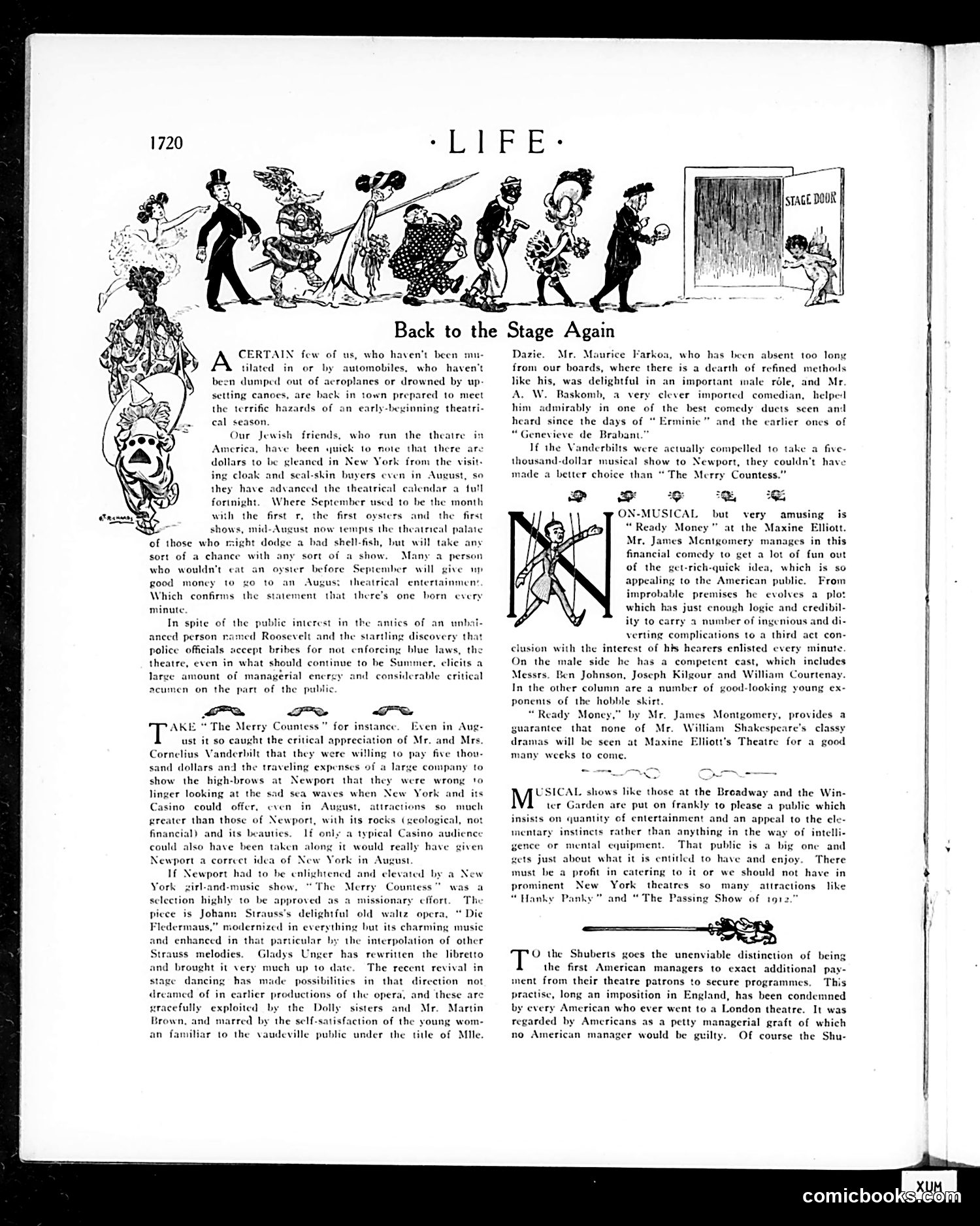
This page satirizes the early August 1912 theatrical season in New York. The main target is wealthy New York society—specifically the Vanderbilts—who the author mockingly suggests have *extended* the theater season into summer specifically to entertain visiting "cloak and seal-skin buyers" (wealthy Jewish merchants). The author's tone is caustic: he implies theater owners (whom he identifies as "Jewish friends") profit by pushing shows earlier, and he portrays the Vanderbilts as needing to display culture at Newport during summer. Reviews follow for "*The Merry Countess*" (a Strauss operetta revival) and "*Ready Money*" (a financial comedy). The cartoon above depicts theatrical performers in exaggerated poses—stock characters representing the season's offerings. **Key context for modern readers**: This reflects period anti-Semitic stereotypes about Jewish involvement in American theater, casual ethnic caricature typical of 1912 Life, and class-conscious mockery of wealthy patrons funding Broadway productions.
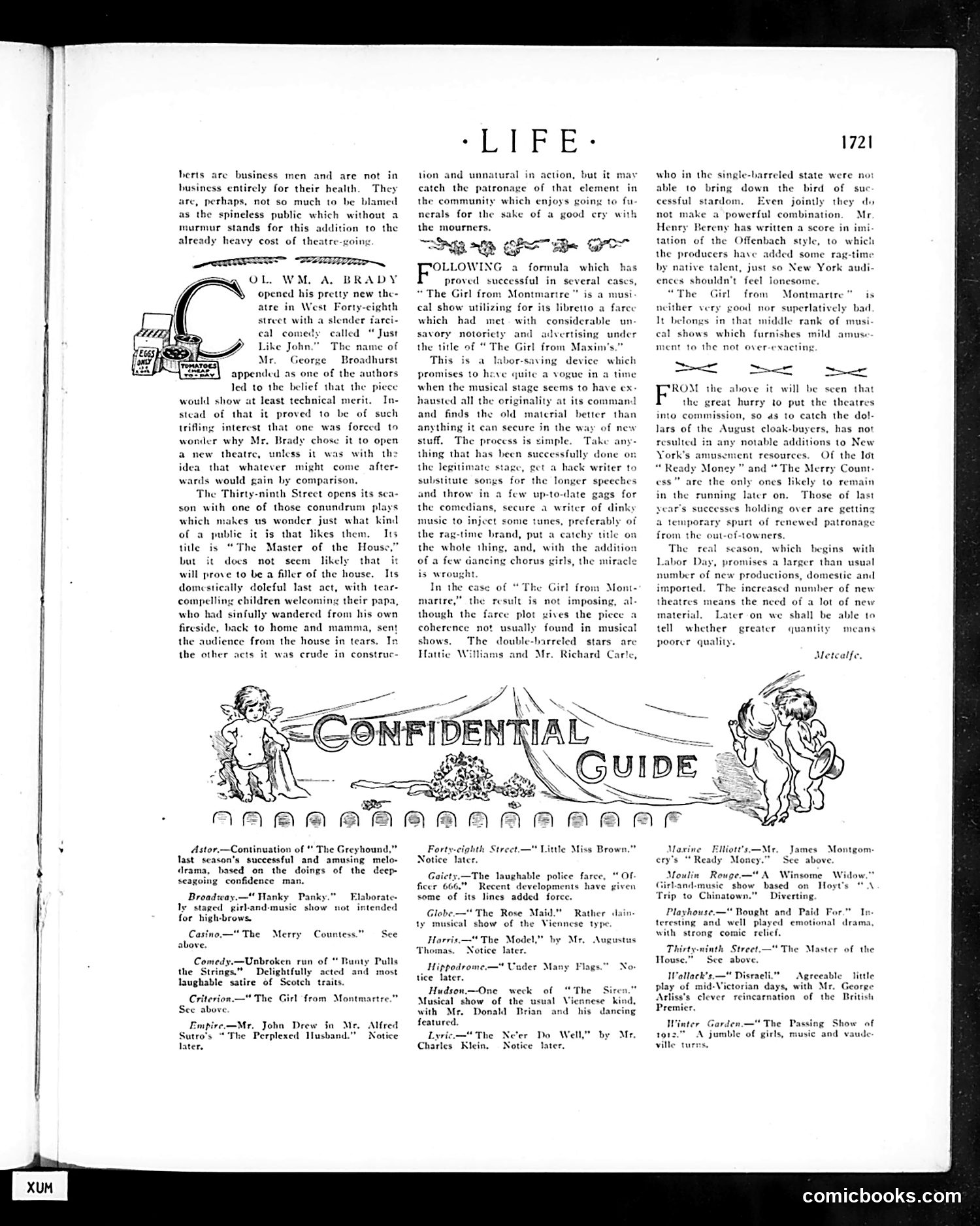
This page contains theatrical reviews from Life magazine's "Confidential Guide" section, critiquing Broadway productions. The main text attacks theater owners for charging high admission prices while presenting mediocre productions—calling them "business men" prioritizing profit over quality. Specific criticisms include: - **"Just Like John"** at Brady's new theater: dismissed as a trivial farce unworthy of its venue - **"The Master of the House"**: criticized as domestically manipulative, using tears and sentimentality to move audiences rather than genuine dramatic merit - **"The Girl from Montmartre"**: satirized as a formulaic musical hack job—taking a successful farce, replacing dialogue with songs by mediocre composers, adding dancing girls and tired jokes, then repackaging it with a catchy title The satire targets the commercial cynicism of Broadway producers who recycle proven material lazily rather than develop original work. The complaint about "spineless public" accepting poor quality suggests audience complicity in this mediocrity.
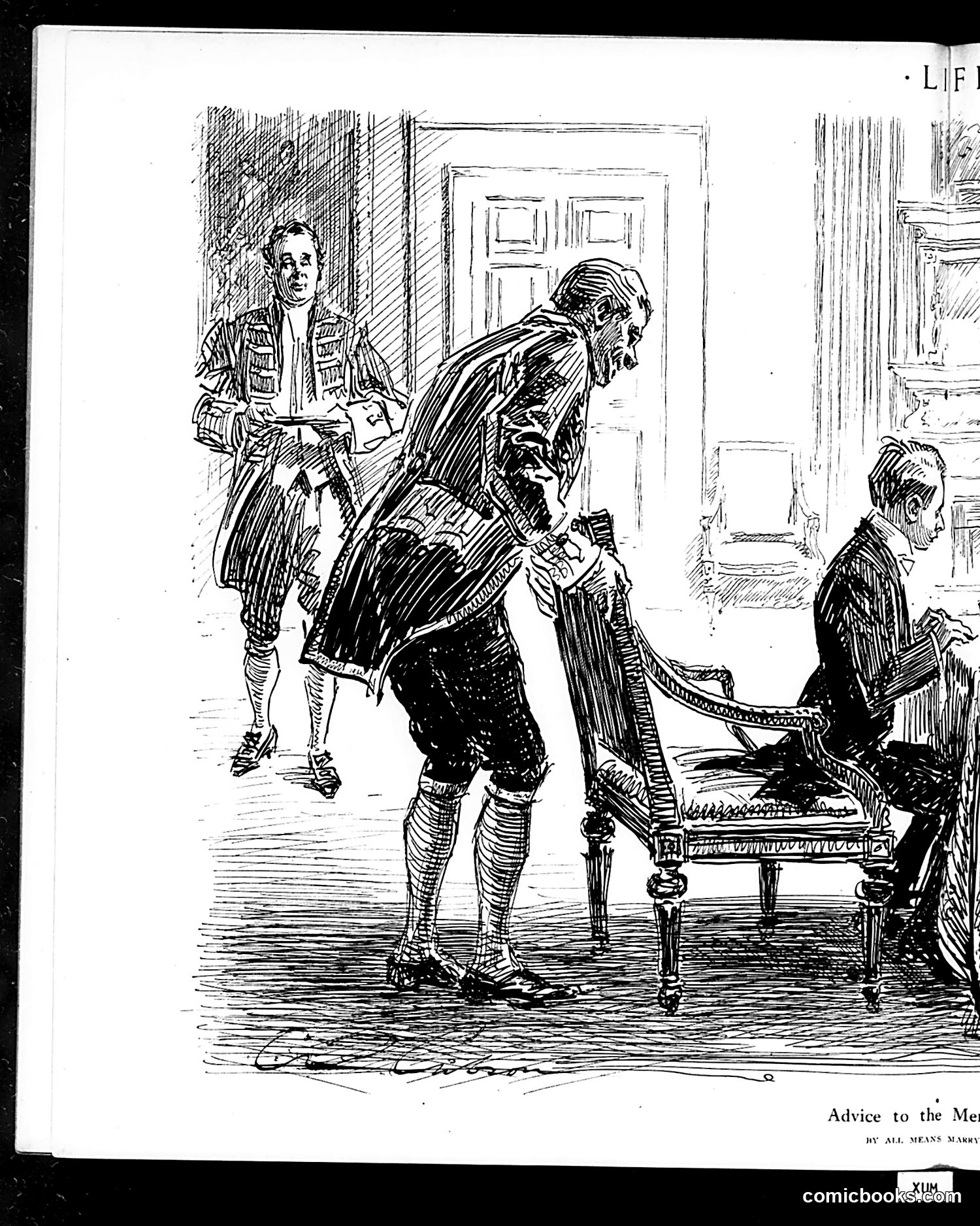
This satirical sketch depicts what appears to be a military or diplomatic scene. A uniformed officer (center) stands prominently, while other figures in formal dress observe from the left and right. A man sits in a chair on the right side of the composition. The title "Advice to the Men" suggests commentary on male conduct or decision-making, likely political or military in nature. The formal setting and uniforms indicate this addresses leadership or authority figures. The OCR text is partially illegible, but the caption structure suggests this was a satirical commentary on contemporary (to Life magazine) male behavior or policy choices. Without clearer text or publication date visible, the specific political/social reference remains unclear, though the formal military-diplomatic context suggests early-to-mid 20th century publication. The artist's signature appears at the bottom.
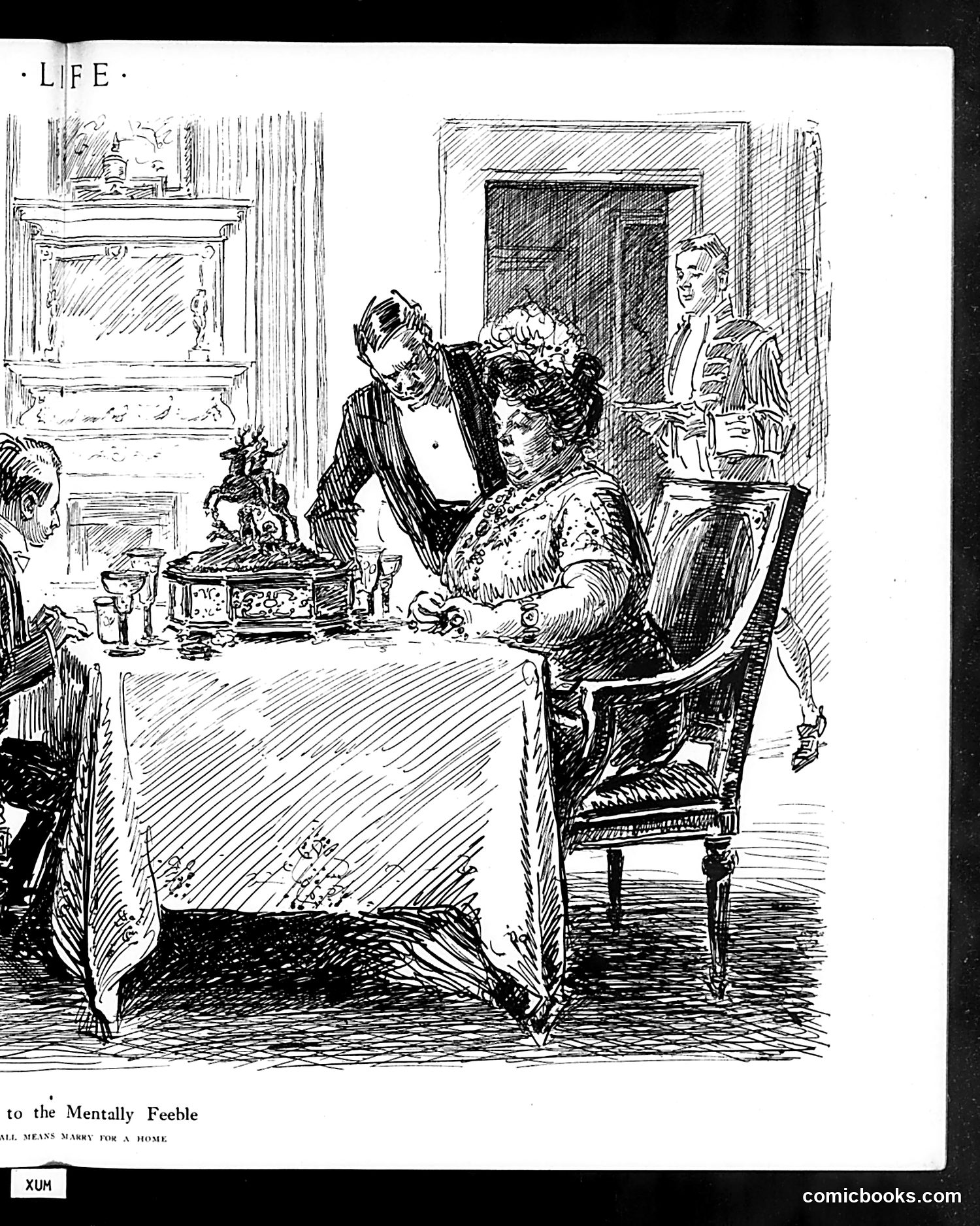
This is a satirical cartoon from *Life* magazine titled "to the Mentally Feeble," with a subtitle suggesting "All Means Marry for a Home." The scene depicts what appears to be a social gathering where a woman (seated, wearing ornate clothing) is being presented to or courted by a man in formal attire, while other figures observe. The cartoon satirizes marriages motivated by financial security rather than genuine affection—specifically, women marrying for economic stability ("a home") rather than love. The phrase "mentally feeble" suggests the satire targets those considered foolish enough to make such pragmatic, loveless marital arrangements. This reflects late 19th/early 20th-century social criticism about mercenary marriages among both wealthy and middle-class women who lacked independent financial means. The formal domestic setting and the woman's elaborate appearance emphasize the transactional nature of such unions.
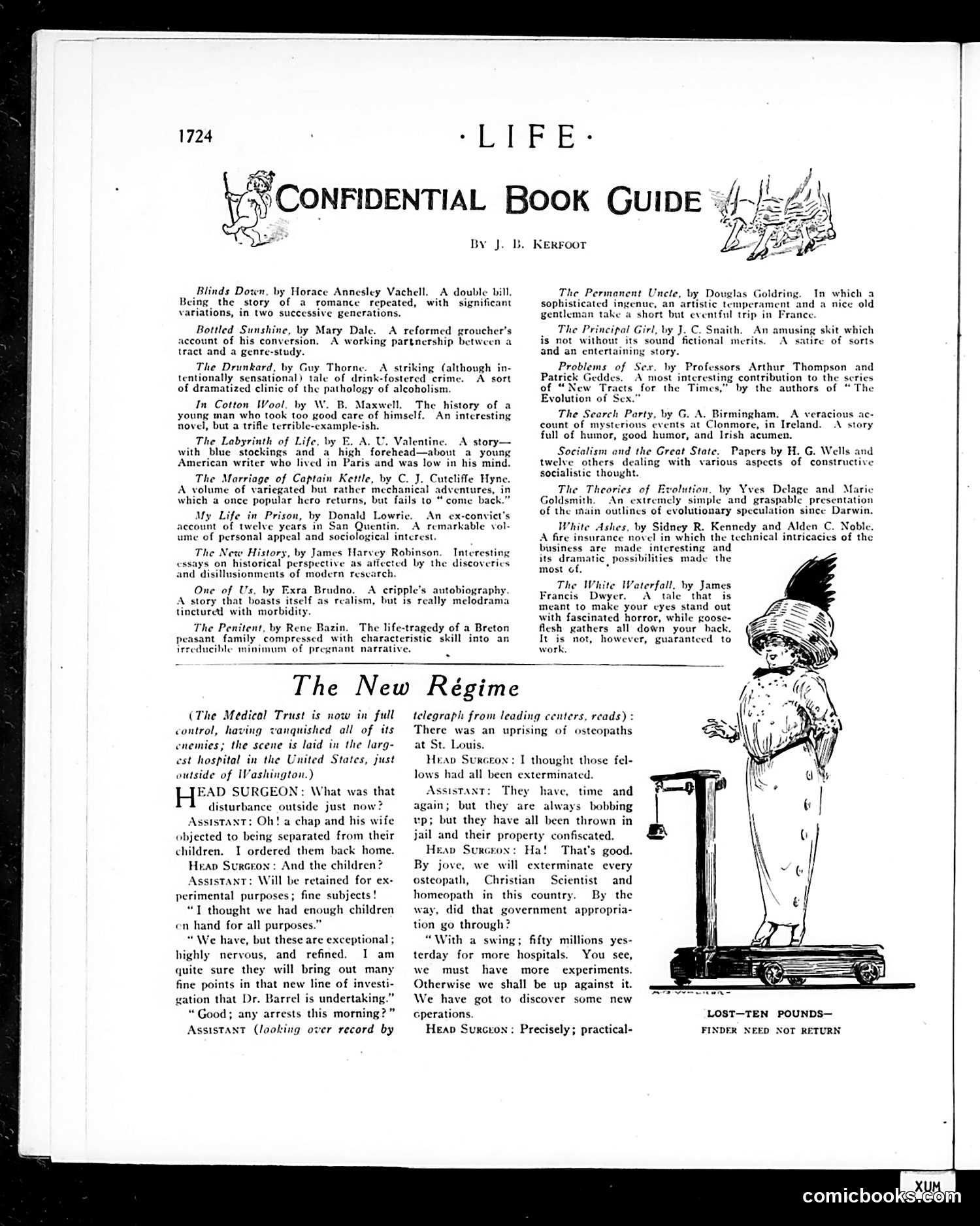
Likely the assistant meant "on hand for all purposes. "We have, but these are exceptional; highly nervous, and refined. I am quite sure they will bring out many fine points in that new line of investi- gation that Dr. Barrel is undertaking." "Good; any arrests this morning?" ASSISTANT (looking over record by telegraph from leading centers, reads): There was an uprising of osteopaths at St. Louis. Head Surcrox: I thought those fel- lows had all been exterminated. Assistant: They have, time and again; but they are always bobbing up; but they have all been thrown in jail and their property confiscated. HEAD SURGEON: Ha! That's good. By jove, we will exterminate every osteopath, Christian Scientist and homeopath in this country. By the way, did that government appropria- tion go through? "With a swing; fifty millions yes- terday for more hospitals. You see, we must have more experiments. Otherwise we shall be up against it. We have got to discover some new operations. HEAD SURGEON: Precisely; practical- ly LOST-TEN POUNDS- FINDER NEED NOT RETURN This page is a "Confidential Book Guide" reviewing recent publications. Below is a satirical dialogue titled "The New Régime" set in a hospital run by a "Medical Trust" that has eliminated all competition. The Head Surgeon and Assistant discuss imprisoning osteopaths, Christian Scientists, and homeopaths—alternative medicine practitioners whom mainstream medicine viewed as frauds or threats. They also discuss using children from separated families for medical experiments and obtaining government funding for hospitals supposedly for "discoveries." The satire m
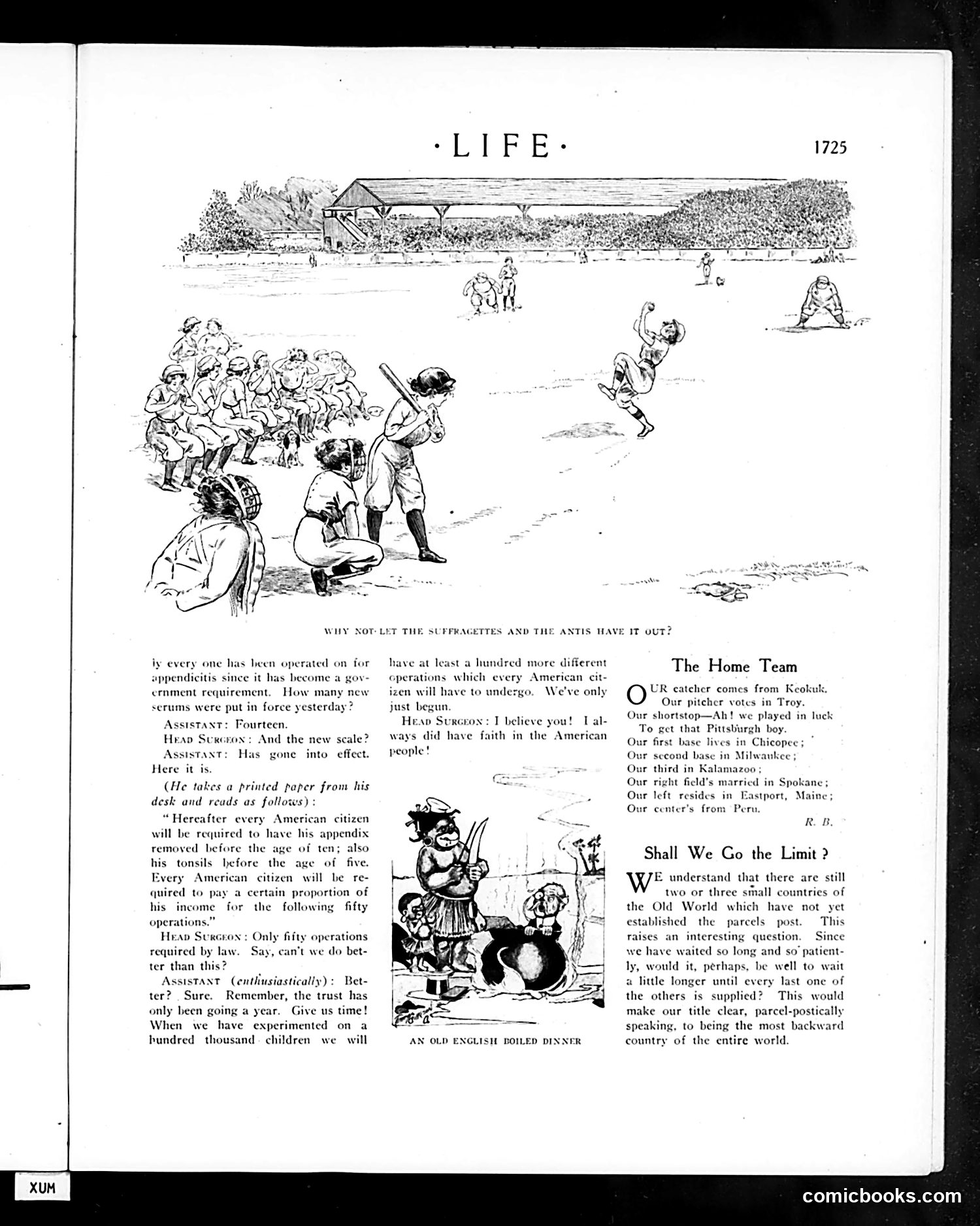
This 1725 Life magazine page satirizes aggressive medical intervention and government mandates. The main cartoon depicts a conversation between a Head Surgeon and Assistant about compulsory medical procedures for all American citizens—appendix removal before age ten, tonsil removal before age five, and payment for fifty additional unspecified operations. The satire mocks both corporate medical expansion (the "trust" seeking to experiment on "a hundred thousand children") and government overreach imposing these requirements. The Assistant's enthusiastic response—that they need time to develop more operations after experimenting on children—reveals the dark joke: medical procedures are being invented and mandated not from necessity but from profit motive and bureaucratic expansion. The cartoon appears to reference contemporary debates about mandatory medical procedures and government health requirements, though the specific historical context remains unclear without additional research.
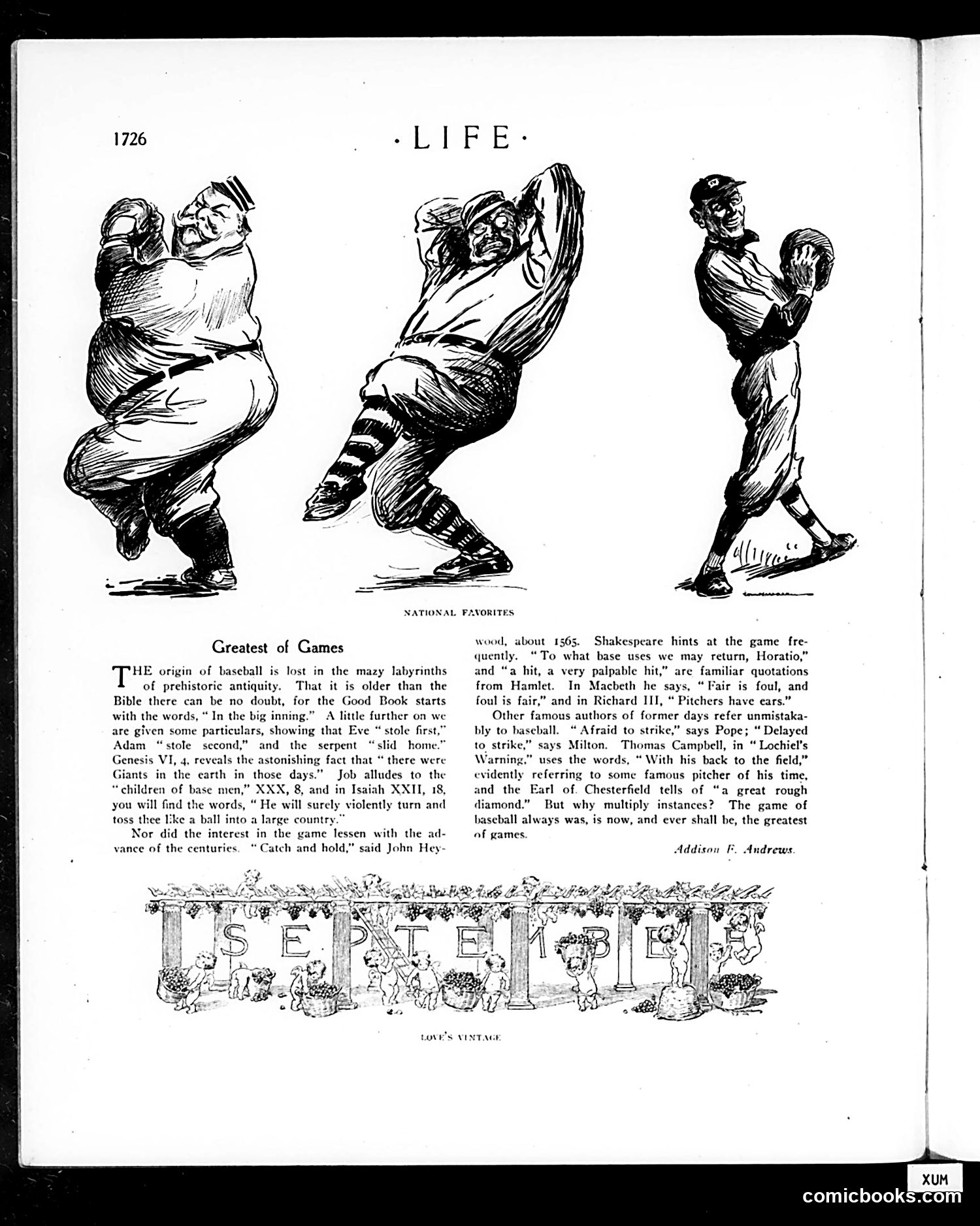
This is a humorous article claiming baseball's ancient origins by mining classical literature for baseball terminology. The author, Addison F. Andrews, deliberately misreads famous literary passages—treating biblical and classical references as hidden baseball allusions. **The Satire:** Andrews finds "base" references in Genesis, "stealing" in Adam's actions, "giants" in Job, and claims Shakespeare's famous lines about "base uses" and "palpable hits" prove baseball predates modern times. He similarly twists quotes from Pope, Milton, and Campbell into supposed baseball references. **The Joke:** This is absurdist humor—the author knows he's forcing ridiculous baseball interpretations onto literature that has nothing to do with the sport. The three ink sketches show exaggerated baseball players in dynamic poses, emphasizing baseball as a modern, vigorous American pastime. The piece gently mocks both overzealous literary scholars and America's obsession with baseball as a national institution, suggesting it's so central to American culture that people retroactively "discover" it everywhere in the cultural canon.
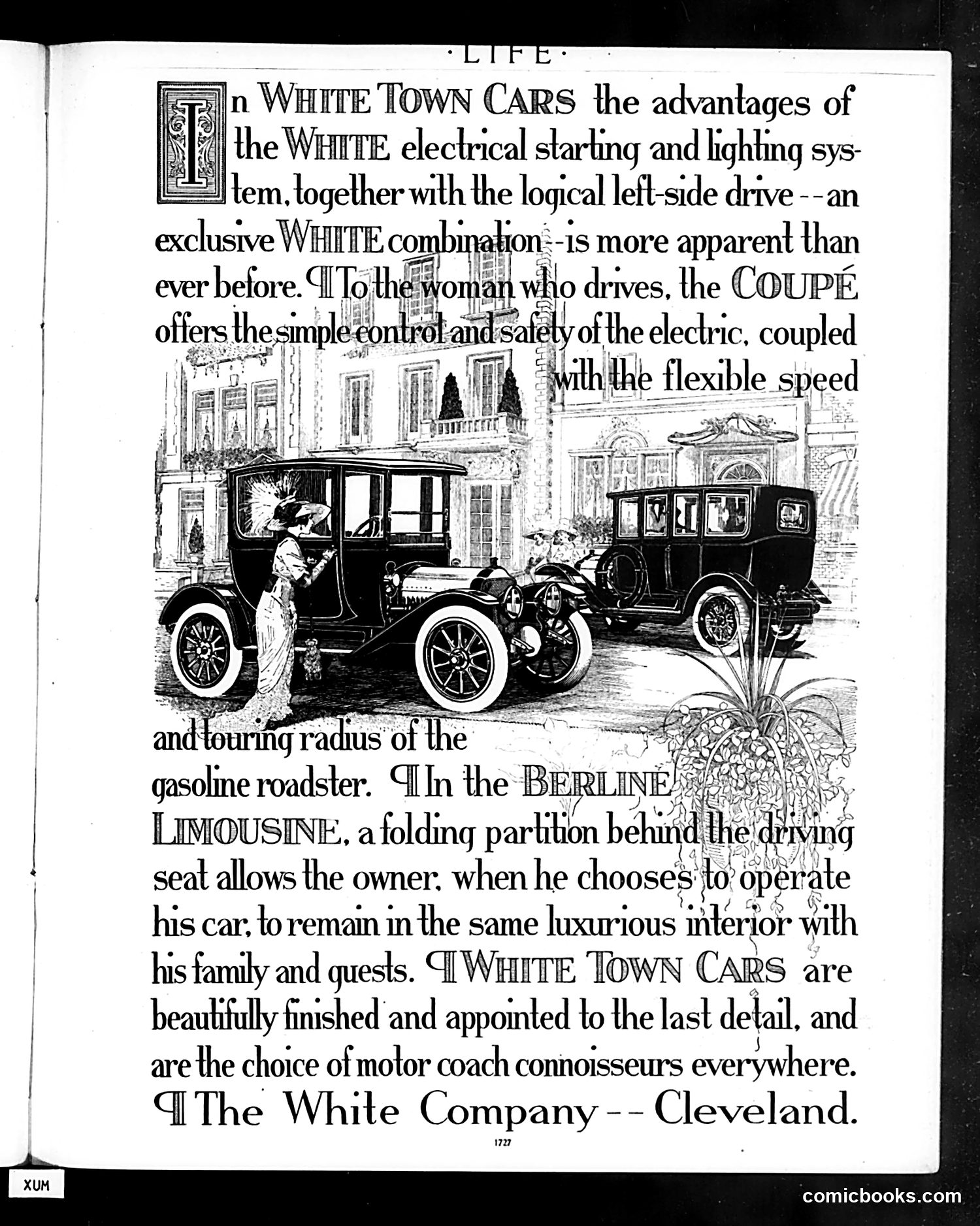
This page is primarily a **product advertisement** for White Town Cars, manufactured by The White Company in Cleveland. It is not satirical content but rather a straightforward early automotive advertisement. The image shows two elegant electric automobiles from the early 1900s parked on a city street, with well-dressed passengers and drivers. The ad emphasizes luxury features targeting affluent women drivers: electric starting and lighting systems, left-side drive (then novel), simple controls, and safety. The "Berlin Limousine" model features a folding partition allowing owners to operate the vehicle while remaining in the passenger cabin with family and guests—a status symbol for the wealthy. The advertisement presents cars as refined, beautifully finished luxury items for "motor coach connoisseurs," reflecting early automotive marketing that emphasized elegance and exclusivity rather than practical transportation.
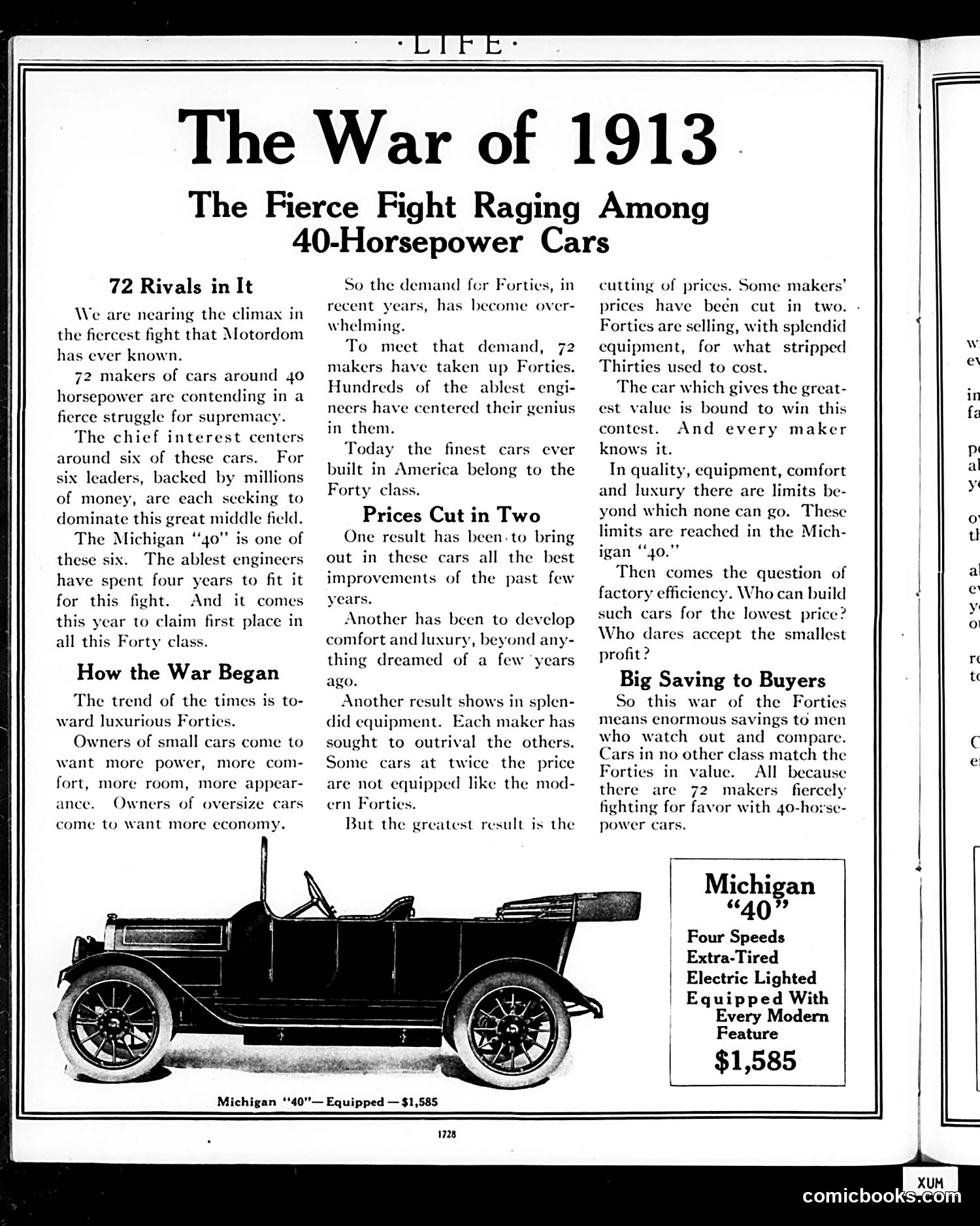
This is primarily **advertising copy disguised as satire**, not a political cartoon. Life magazine uses mock-military language to describe genuine 1913 automobile market competition. The "war" refers to 72 manufacturers competing in the lucrative 40-horsepower car segment—the middle market. As consumers upgraded from small cars seeking more power and comfort, or downsized from large cars seeking economy, demand exploded. The satirical framing celebrates **competitive capitalism**: price-cutting, technological innovation, and manufacturers "fiercely fighting" for market share ultimately benefits buyers through lower prices and better equipment. The Michigan "40" is positioned as the winner—offering modern features (four speeds, electric lights) at $1,585, undercutting competitors. The humor lies in treating commercial rivalry as military conflict, but the underlying message is earnest: competition drives progress and value. This reflects early 20th-century American optimism about free-market competition benefiting consumers.
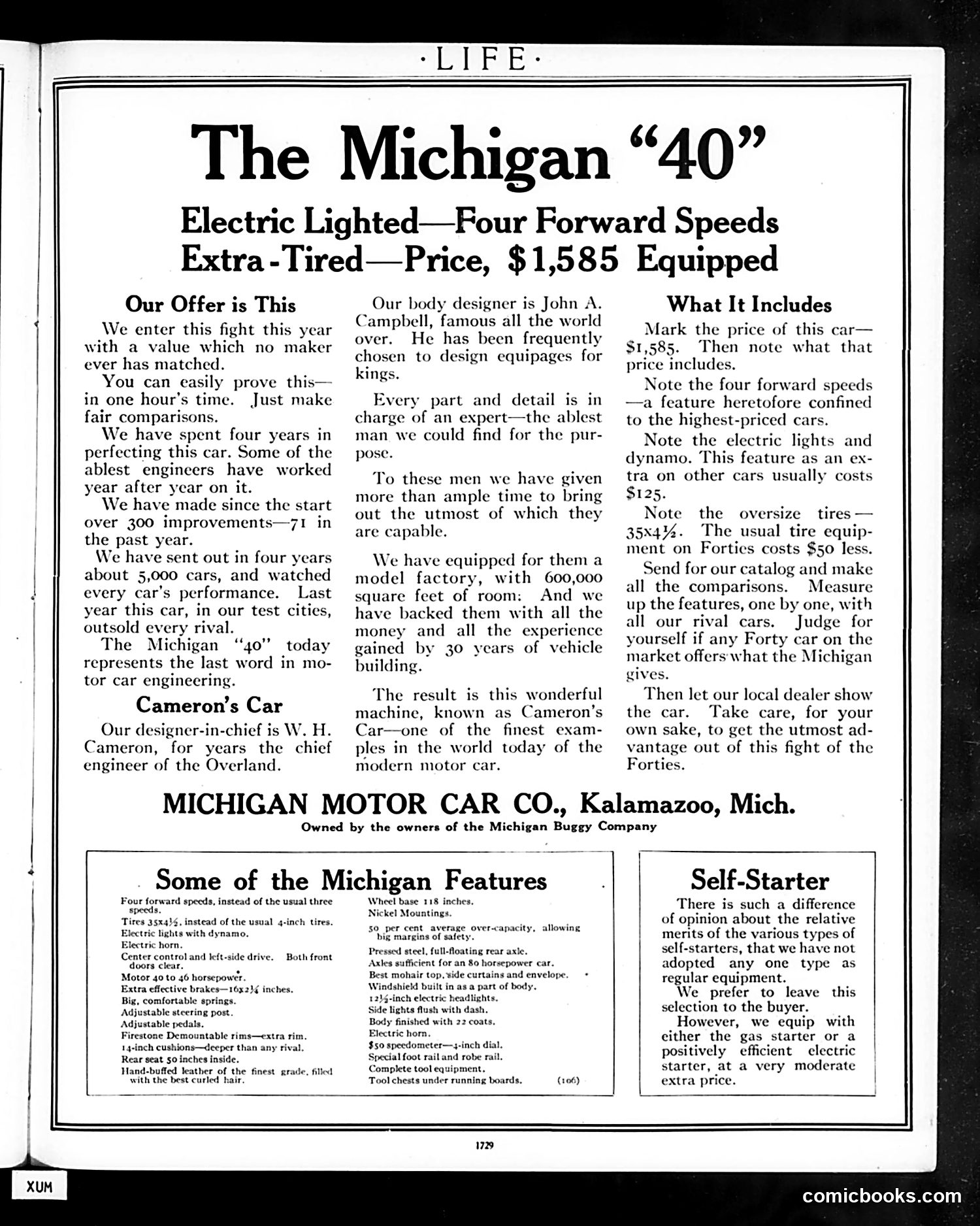
This is a car advertisement, not satire or political commentary. The Michigan Motor Car Company of Kalamazoo is promoting their "40" model automobile, priced at $1,585 with electric lighting and four forward speeds. The ad emphasizes value by listing extensive features—oversize tires, electric lights with dynamo, comfortable springs, quality leather—claiming these justify the price when compared to rivals. It highlights the design credentials of chief engineer W.H. Cameron (formerly of Overland) and body designer John A. Campbell, positioning the car as engineered by experts. The "Self-Starter" section notes the company leaves starter-type choice to buyers, offering either gas or electric options at moderate extra cost. For modern readers: this reflects early 1910s automobile marketing emphasizing engineering specifications and prestige designers as selling points. The four forward speeds and electric lighting were genuinely advanced features for the era.
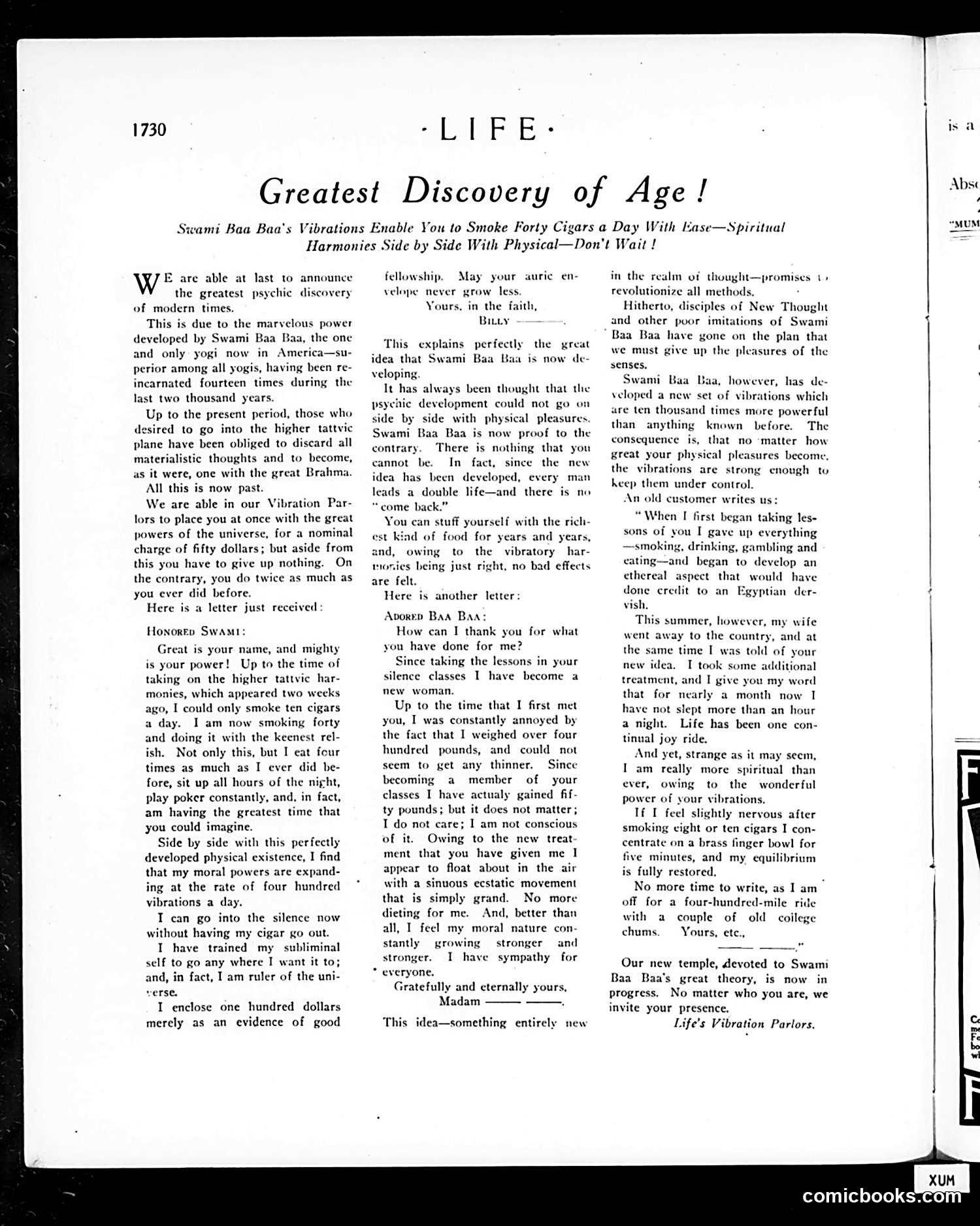
This is a full-page advertisement parody mocking the "New Thought" spiritual movement and yoga fads popular in 1920s-30s America. The satirical "Swami Baa Baa" promises miraculous "vibrations" that allegedly allow followers to indulge in excess—smoking 40 cigars daily, overeating, staying up late—while experiencing spiritual development and moral improvement. Life's target is twofold: charlatans peddling fake Eastern mysticism to gullible wealthy Americans, and the contradictory promise that one can abandon self-discipline yet achieve enlightenment. The fake testimonials (gaining 50 pounds while "floating" spiritually; gaining moral strength while abandoning restraint) ridicule how believers rationalize hedonism as spirituality. The satirical charge of fifty dollars per session reflects real exploitation of affluent seekers during this era's wellness and occult crazes.
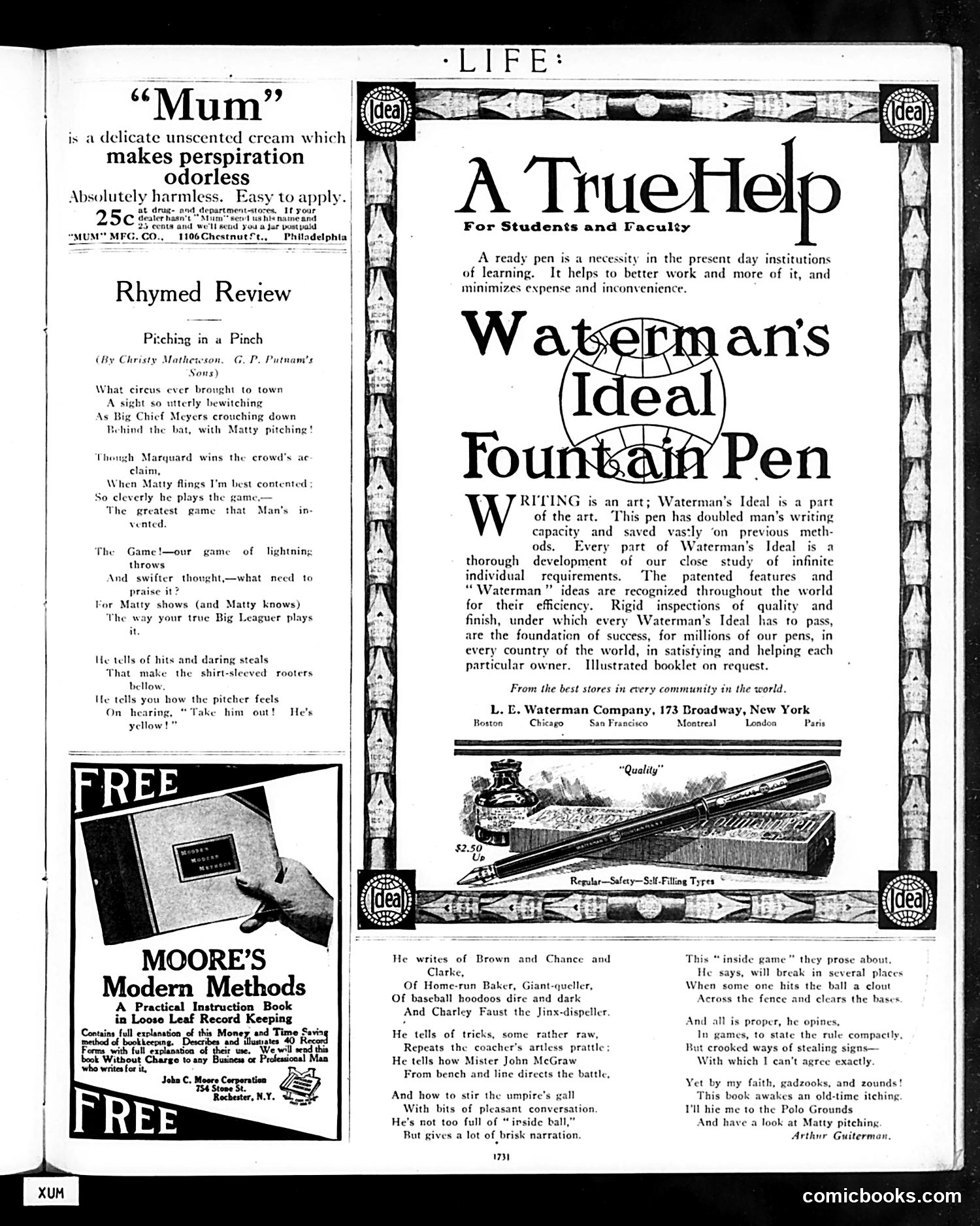
This page is primarily **advertisements and literary content**, not political satire. The dominant content is a **Waterman's Ideal Fountain Pen advertisement**, positioned as "A True Help for Students and Faculty." It emphasizes the pen's reliability and efficiency for academic work. The **"Rhymed Review"** section reviews Christy Mathewson's baseball book *Pitching in a Pinch*. Mathewson was a famous New York Giants pitcher; the poem praises his pitching skill and McGraw's managerial direction, referencing contemporary players like Marquard and Baker. The reviewer uses baseball as a metaphor for strategy and excellence. A secondary **Moore's Modern Methods advertisement** offers a free instruction book on record-keeping systems. The final poem by Arthur Guiterman playfully critiques baseball's "inside game"—suggesting while strategic play is acceptable, dishonest sign-stealing crosses ethical lines. **No political cartoons appear on this page.** It reflects early 1900s concerns: modern business efficiency, quality products for students, and baseball's cultural prominence in American life.
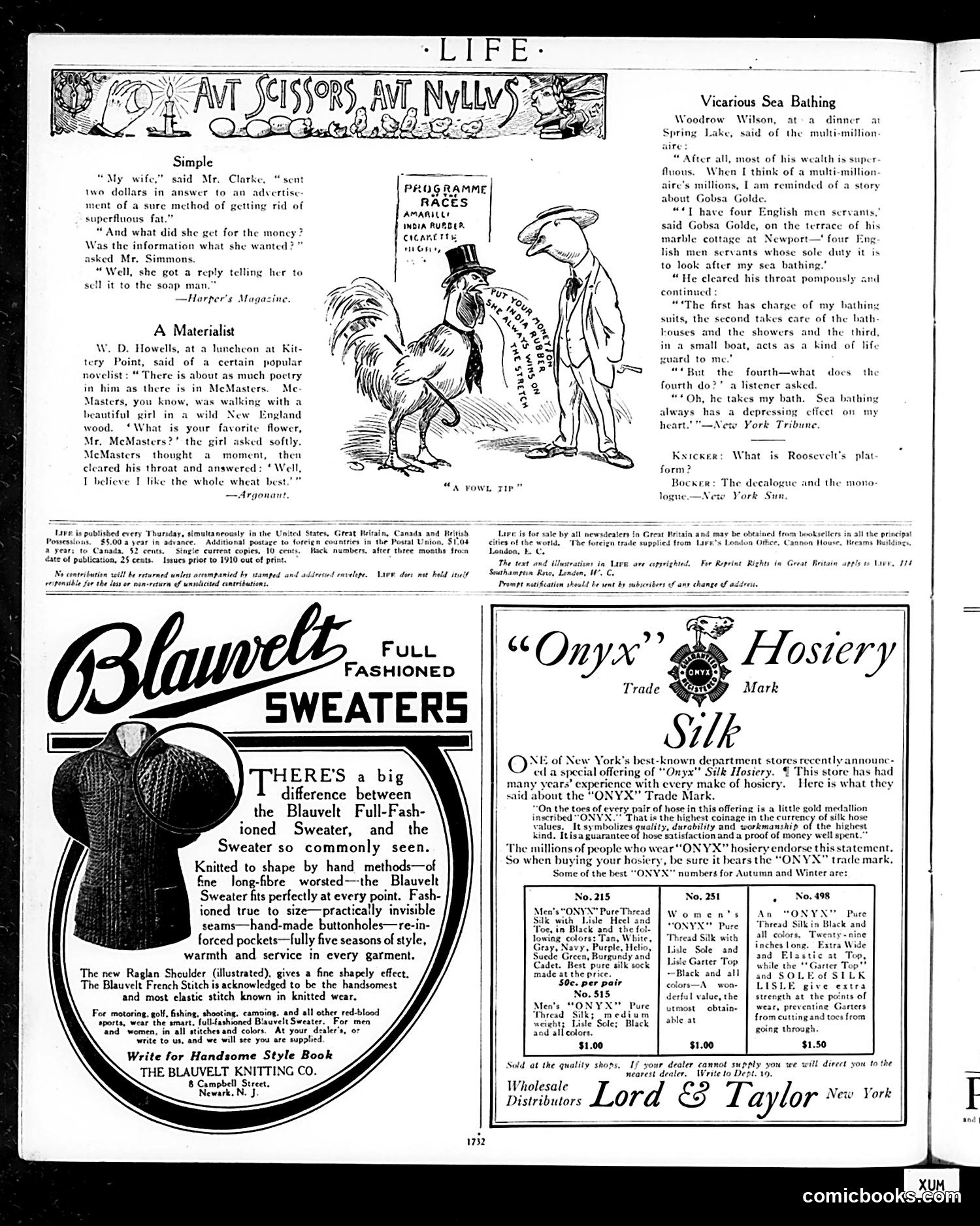
This page contains three distinct humor pieces: **"Simple"** (top left): A joke about a woman seeking a method to lose weight. The punchline plays on literal interpretation—she's told to "sell it to the soap man," suggesting her fat could be sold as soap stock (a common industrial use of animal fat). **"A Materialist"** (middle left): A brief anecdote mocking W.D. Howells' colleague McMasters as unpoetic. When asked his favorite flower, McMasters answers "whole wheat"—prioritizing practical sustenance over aesthetic appreciation, thus revealing a crude, materialistic worldview rather than romantic sensibility. **"A Fowl Zip"** (right): A cartoon showing a man with a rooster. The caption suggests wordplay on "zip" (possibly relating to zipping clothes or the rooster's crow), though the exact joke is unclear from the image alone. The page is otherwise dominated by period advertisements for sweaters and hosiery. These pieces reflect early 20th-century genteel humor targeting educated readers familiar with literary figures and social pretension.
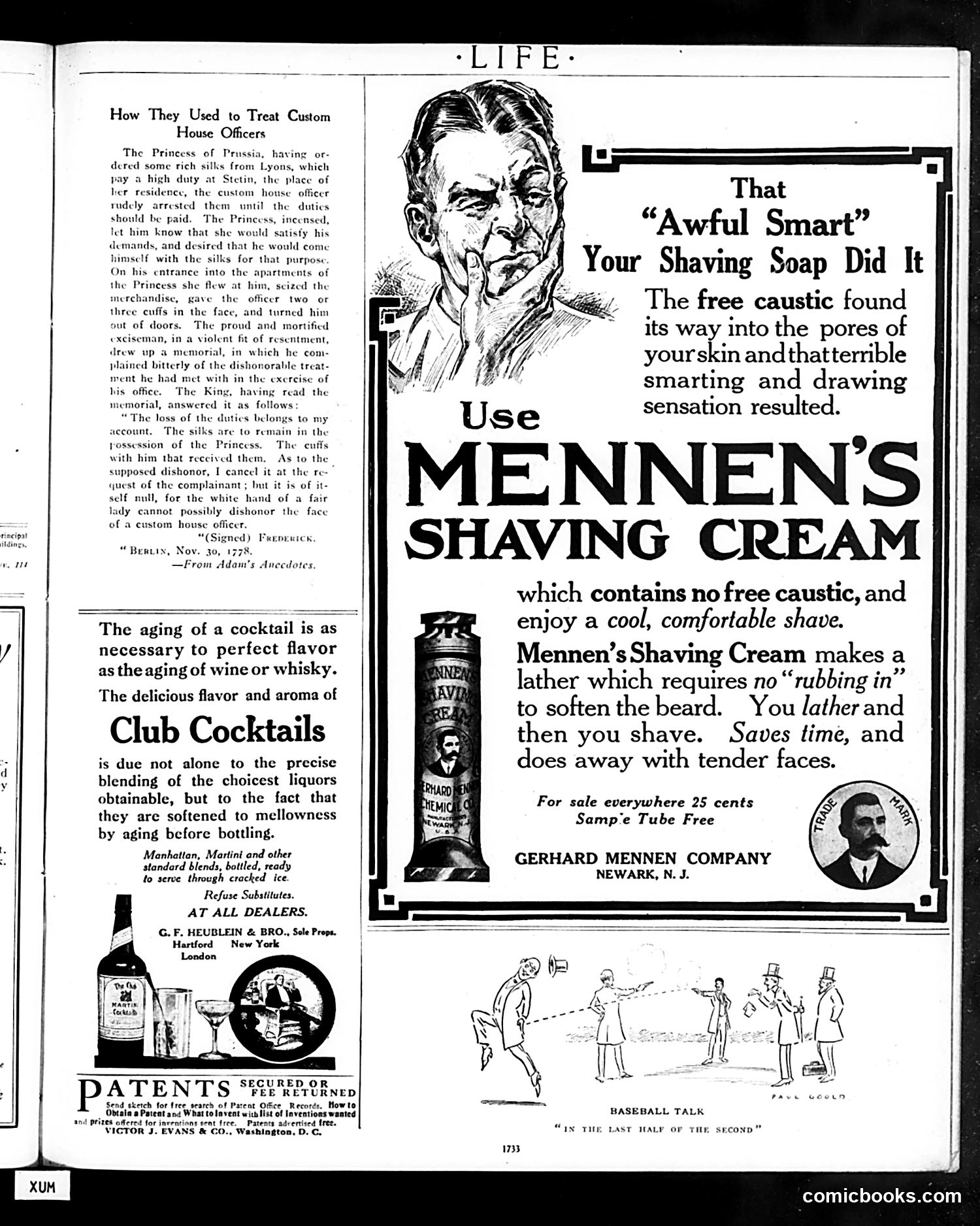
This page contains three distinct elements: **Left Column - Historical Anecdote**: A dated story (Berlin, Nov. 30, 1778) about the Princess of Prussia slapping a customs officer over silk duties. The King's response humorously "cancels" the officer's dishonor by declaring that a lady's hand cannot dishonor a man's face—a satirical jab at aristocratic privilege and the powerlessness of bureaucrats against nobility. **Center - Mennen's Shaving Cream Advertisement**: A product ad addressing a common complaint: inferior shaving soaps contained caustic chemicals that burned skin. Mennen's positioned itself as the solution—gentler, requiring no extra work ("rubbing in"), and saving time. The era's standards for masculine grooming and consumer anxiety about product safety are evident. **Bottom - Baseball Cartoon**: A simple joke labeled "In the Last Half of the Second," showing players on a field with the caption appearing to reference baseball terminology in a humorous context (unclear without more context). The page is primarily **advertising-driven**, typical of *Life* magazine's revenue model.
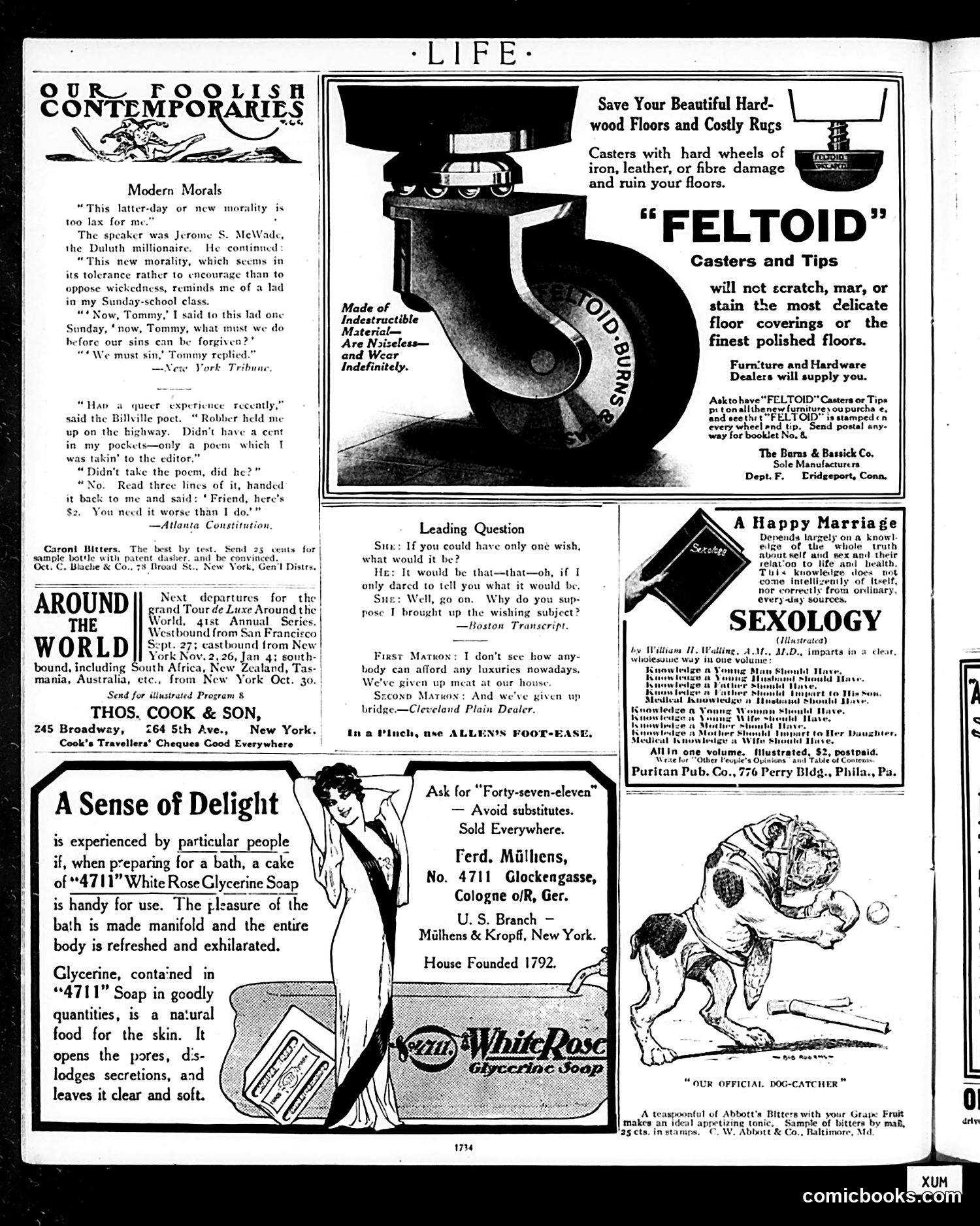
This page is primarily **advertising** interspersed with **brief satirical anecdotes** about modern life—typical of *Life* magazine's format. The humor pieces mock contemporary social anxieties: 1. **"Modern Morals"** satirizes older generations' complaints about declining morality. A millionaire criticizes "new morality" as too permissive, illustrated by a Sunday school joke where a boy concludes that one must sin before sins can be forgiven—turning the moral lesson absurd. 2. **"Poet's Bad Luck"** is a joke about an untalented poet: a highway robber reads three lines and *refuses* the poem, declaring the poet needs money more than he does—implying the poetry is worthless. 3. **"Leading Question"** gently mocks courtship propriety: a woman invites a man to state his deepest wish, but he remains too bashful to express romantic desire directly. The bulk of the page features period advertisements (soap, furniture casters, travel services) typical of early 20th-century magazines.
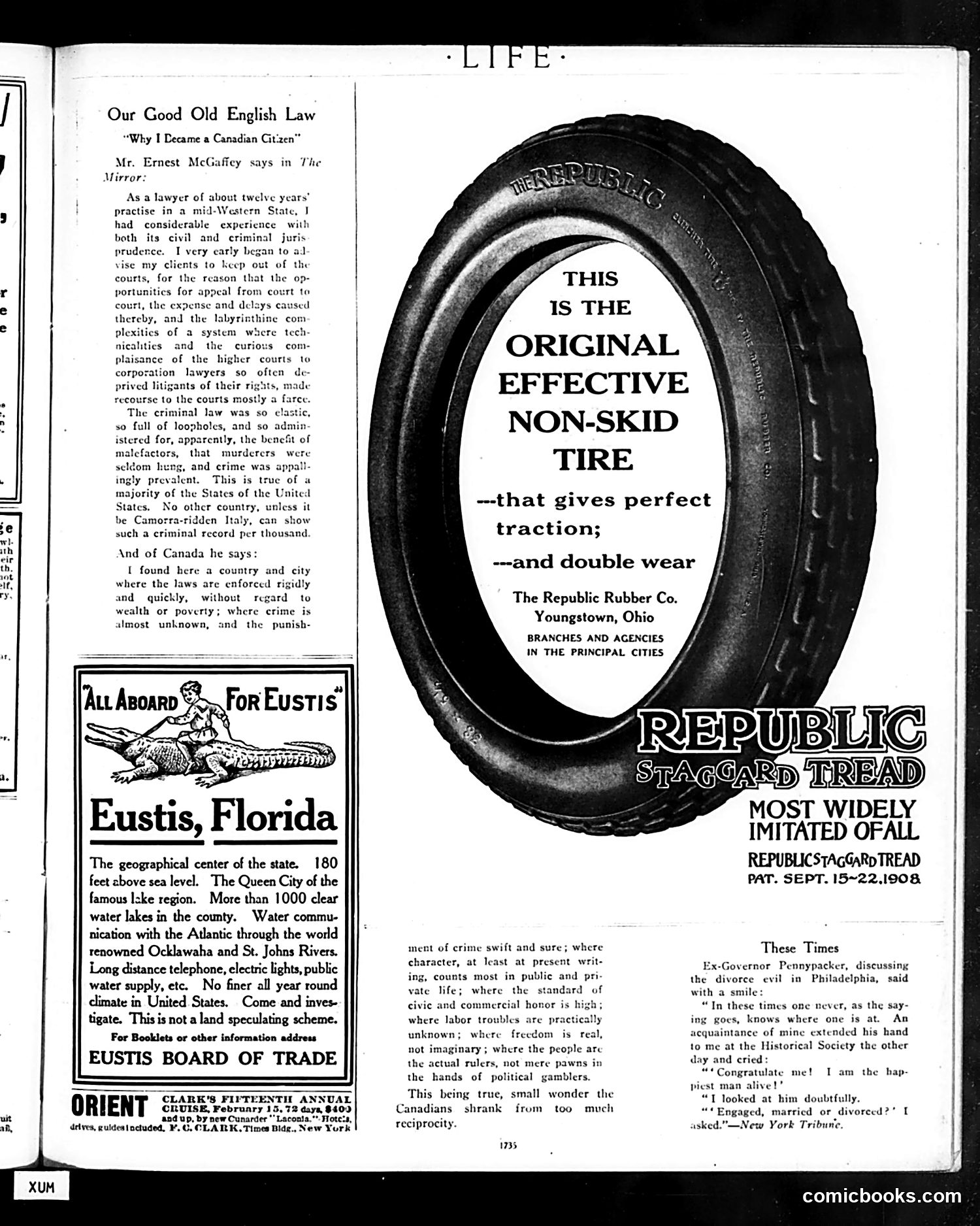
This page contains **testimonial advertising disguised as editorial content**, a common early-20th-century practice. **The Main Content:** Ernest McGaffey's essay argues that American law—particularly criminal justice—is corrupt and ineffective. Judges favor corporation lawyers, appeals are endless and expensive, and murderers escape punishment. By contrast, Canada enforces laws "rigidly and quickly" with minimal crime. His conclusion: he became a Canadian citizen. **The Satire:** Life magazine is mocking American legal incompetence by presenting McGaffey's earnest praise of Canadian efficiency. The implication: American law is so broken that honest citizens flee north. **The Advertisements:** The page features unrelated ads (Eustis, Florida tourism; Republic Staggard Tread tires; a cruise offering). The "These Times" anecdote about Governor Pennypacker appears designed to fill space. **Historical Context:** This reflects Progressive Era criticism of American institutions as corrupt and inefficient—a common theme in Life's satirical commentary on American governance, business, and society.
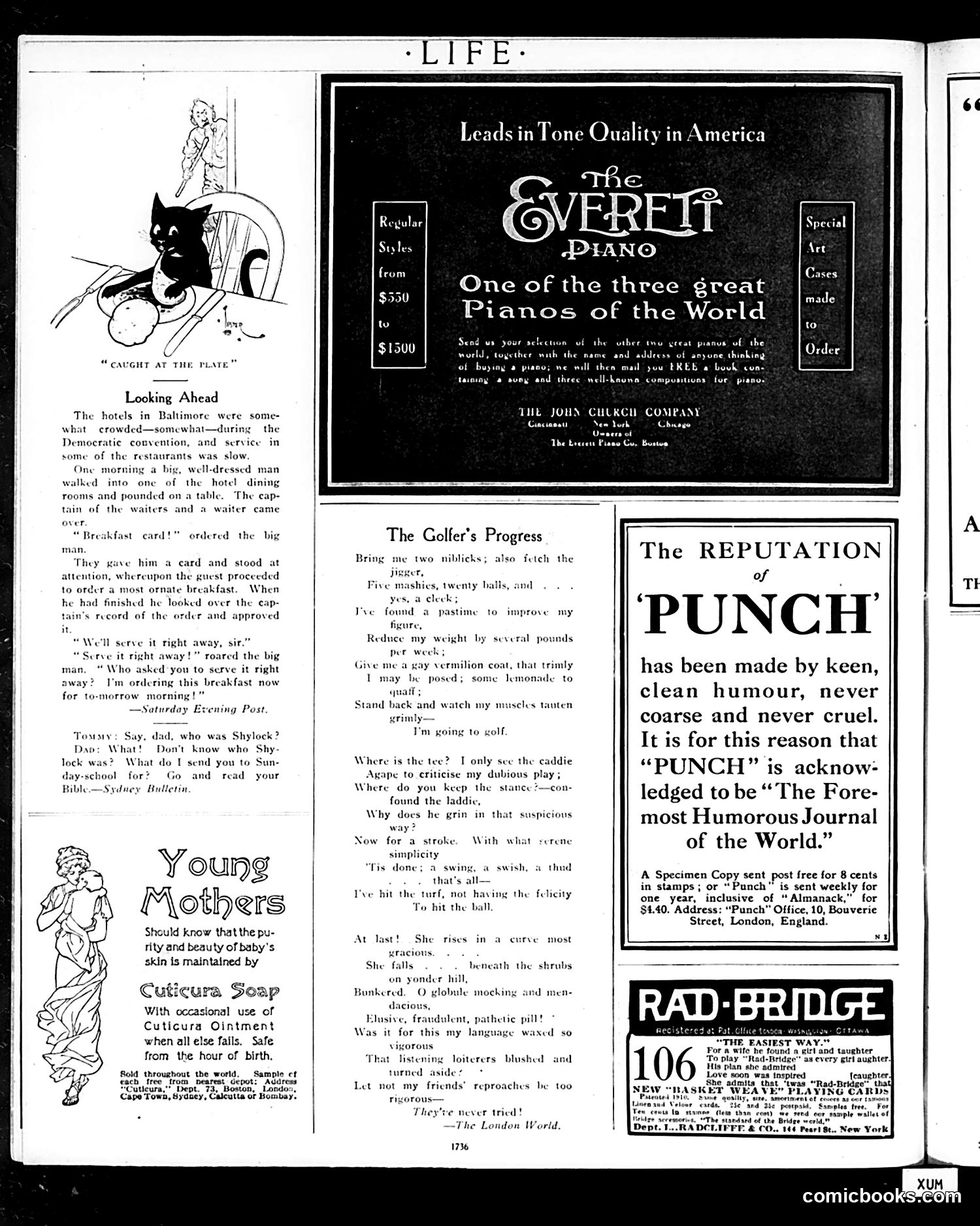
This page is primarily **advertising and literary content** rather than political satire. The main cartoon, "Caught at the Plate," shows a cat caught in a chair—a visual pun with minimal satirical intent. The substantial text piece "Looking Ahead" recounts a humorous anecdote from the Democratic convention in Baltimore: a impatient hotel guest demands breakfast be served immediately rather than tomorrow morning, satirizing excessive rudeness and entitlement among convention attendees during the crowded event. "The Golfer's Progress" is a long, whimsical poem chronicling a beginner golfer's delusional optimism versus reality—he imagines physical improvement and graceful play, but actually hits the turf, gets stuck in bunkers, and becomes the object of ridicule. The page is dominated by **product advertisements**: Everett Pianos, Cuticura Soap, and Punch magazine. These reflect early 20th-century Life magazine's business model: mixing light humor with commercial messaging. The content targets middle-class readers with disposable income for luxury goods and leisure pursuits like golf.
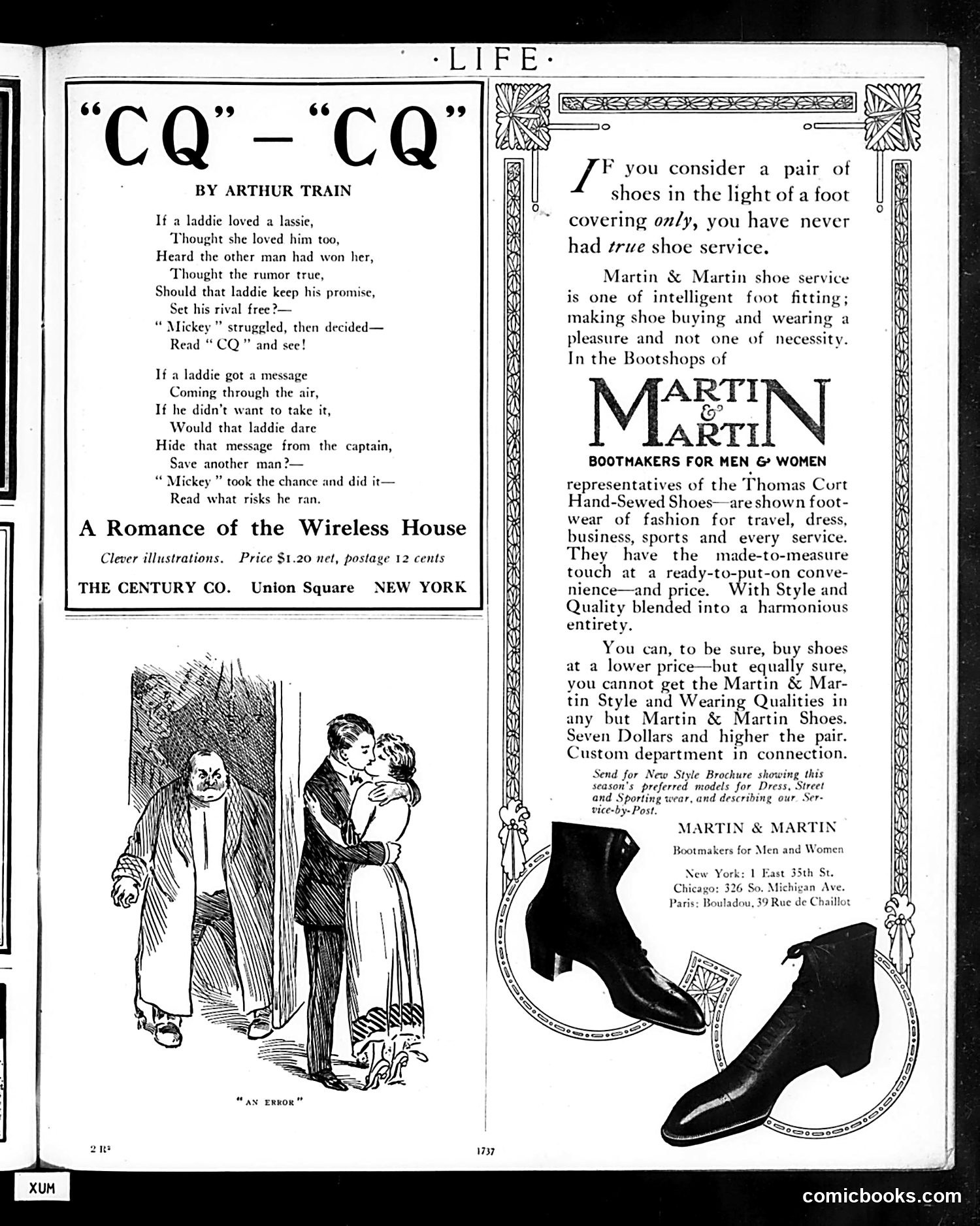
This page mixes a serialized story with advertising. The left side presents "CQ—CQ," a morality tale by Arthur Train about a character named "Mickey" facing ethical dilemmas: whether to keep a romantic promise when a rival exists, and whether to hide a wireless message from his captain to save another man. The narrative uses these scenarios to explore questions of honor and duty, inviting readers to "read CQ and see" the outcomes. The right side is a Martin & Martin Bootmakers advertisement emphasizing that true "shoe service" means expert fitting beyond mere foot-covering—positioning quality shoes as a luxury good at seven dollars or higher, with locations in New York, Chicago, and Paris. The small illustration labeled "An Error" depicts a comedic domestic scene, likely supporting the serialized story's themes about relationship mistakes.
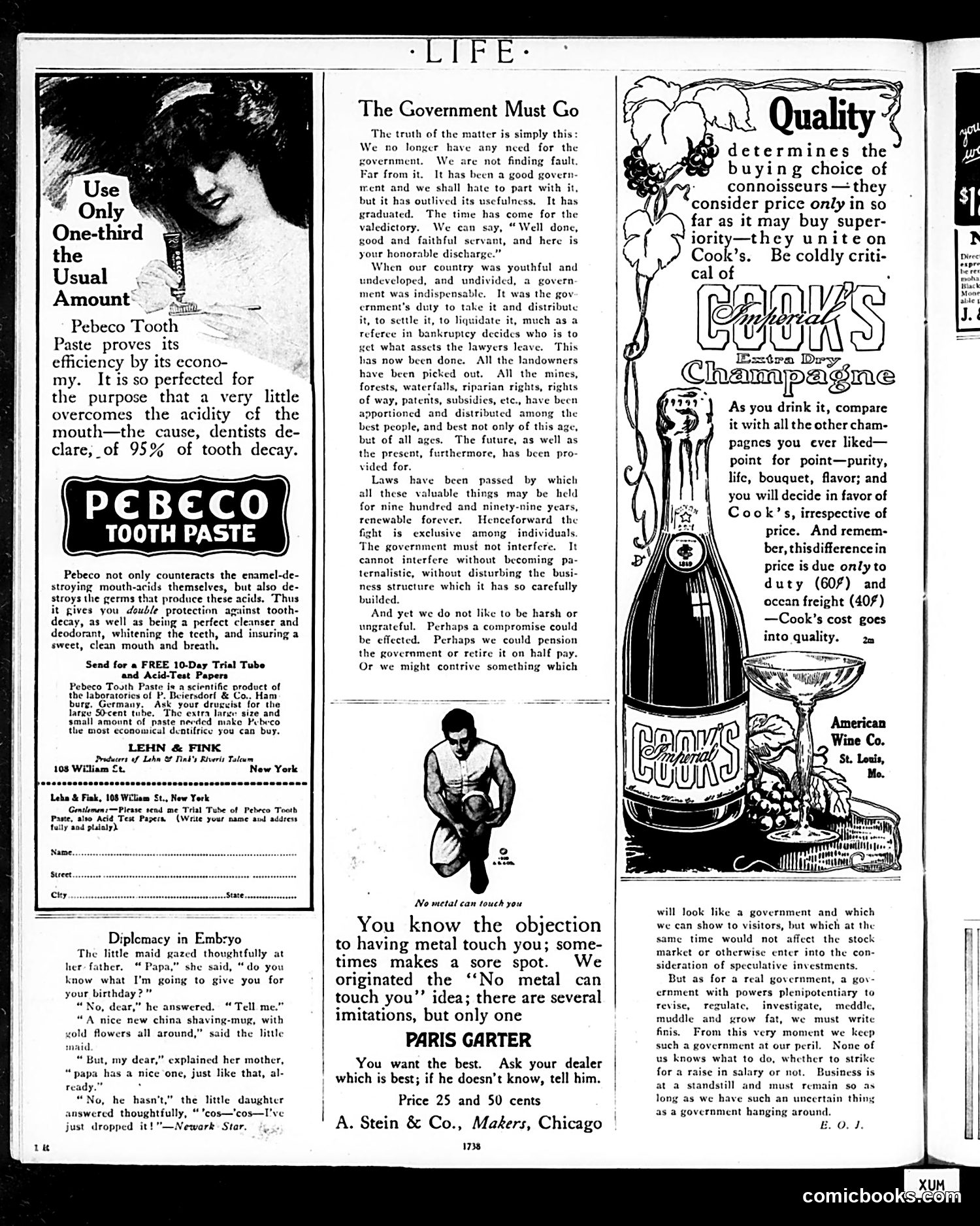
This page blends advertisements with satirical editorial content. The main political piece, "The Government Must Go," argues that government has become obsolete now that capitalists have distributed all valuable resources—land, minerals, water rights, patents, subsidies—among "the best people" for 999-year renewable leases. The author sarcastically suggests the government should be pensioned off or retired on half-pay since its work of resource distribution is complete, and further interference would be "paternalistic." The satire targets laissez-faire ideology and wealthy industrialists' desire to eliminate government regulation. It mocks the notion that capitalism is self-sufficient once initial distribution occurs. The page also contains lighter satirical content: "Diplomacy in Embryo," a brief joke about a child damaging her father's shaving mug then claiming he never owned one. The remaining content consists of period advertisements for Pebeco tooth paste, Paris garters, and Cook's champagne—typical of Life's revenue model.
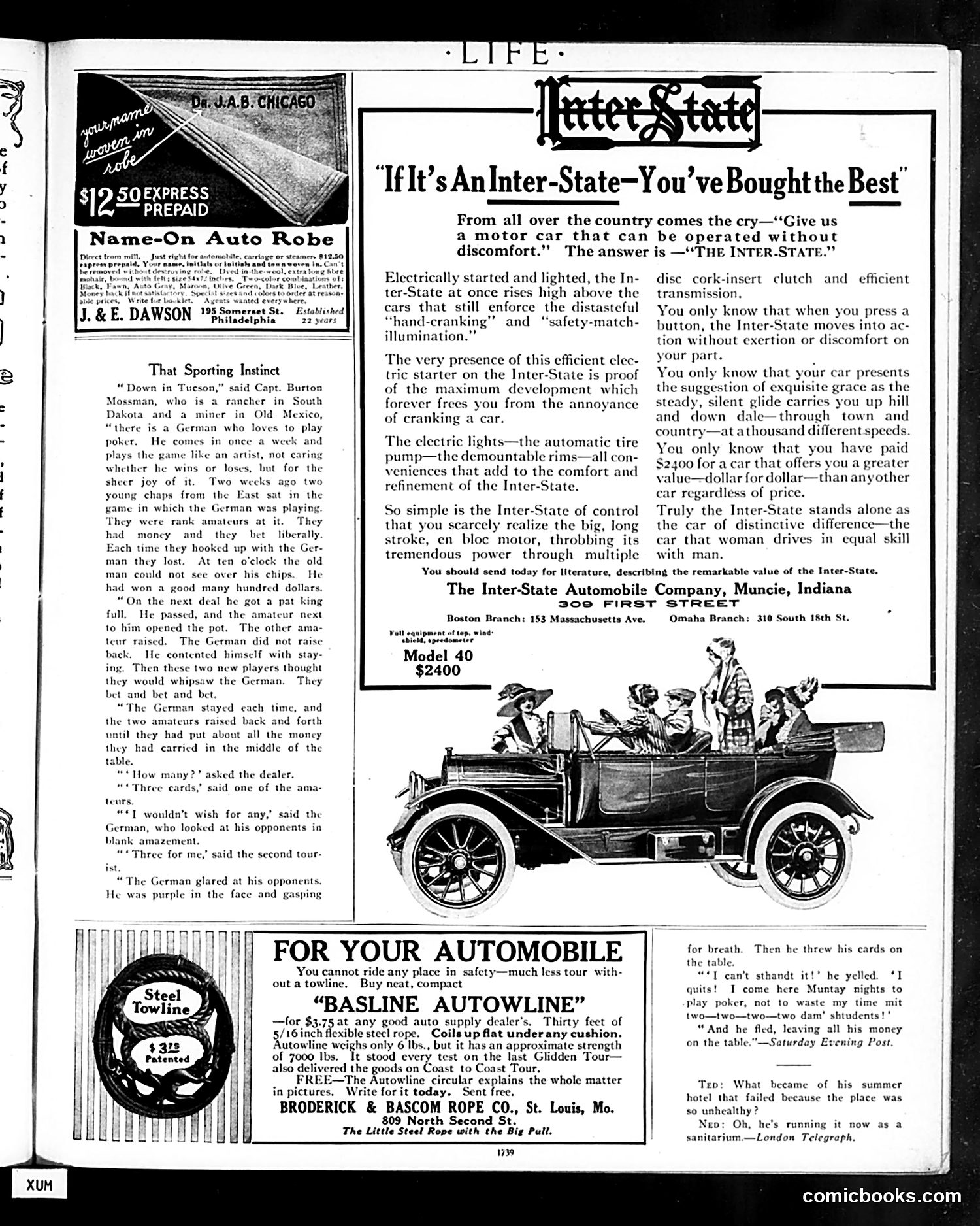
This page is primarily **automobile advertising** rather than political cartoon content. The dominant feature is a large advertisement for the Inter-State automobile (Model 40, priced at $2400), emphasizing its modern electrical conveniences—electric starter, lights, and automatic tire pump—marketed as eliminating the need for manual hand-cranking, which was apparently a major inconvenience of older cars. The brief story "That Sporting Instinct" is an unrelated anecdote about a German poker player in the Old West who outwits two American tourists. It demonstrates the man's skill and composure, with no clear satirical political intent—it's simply a humorous tall tale. Supporting advertisements include the "Gasoline Autowline" rope product and a "Name-On Auto Robe" from Philadelphia. The page reflects early 20th-century consumer culture and automotive technology advancement, not political satire.
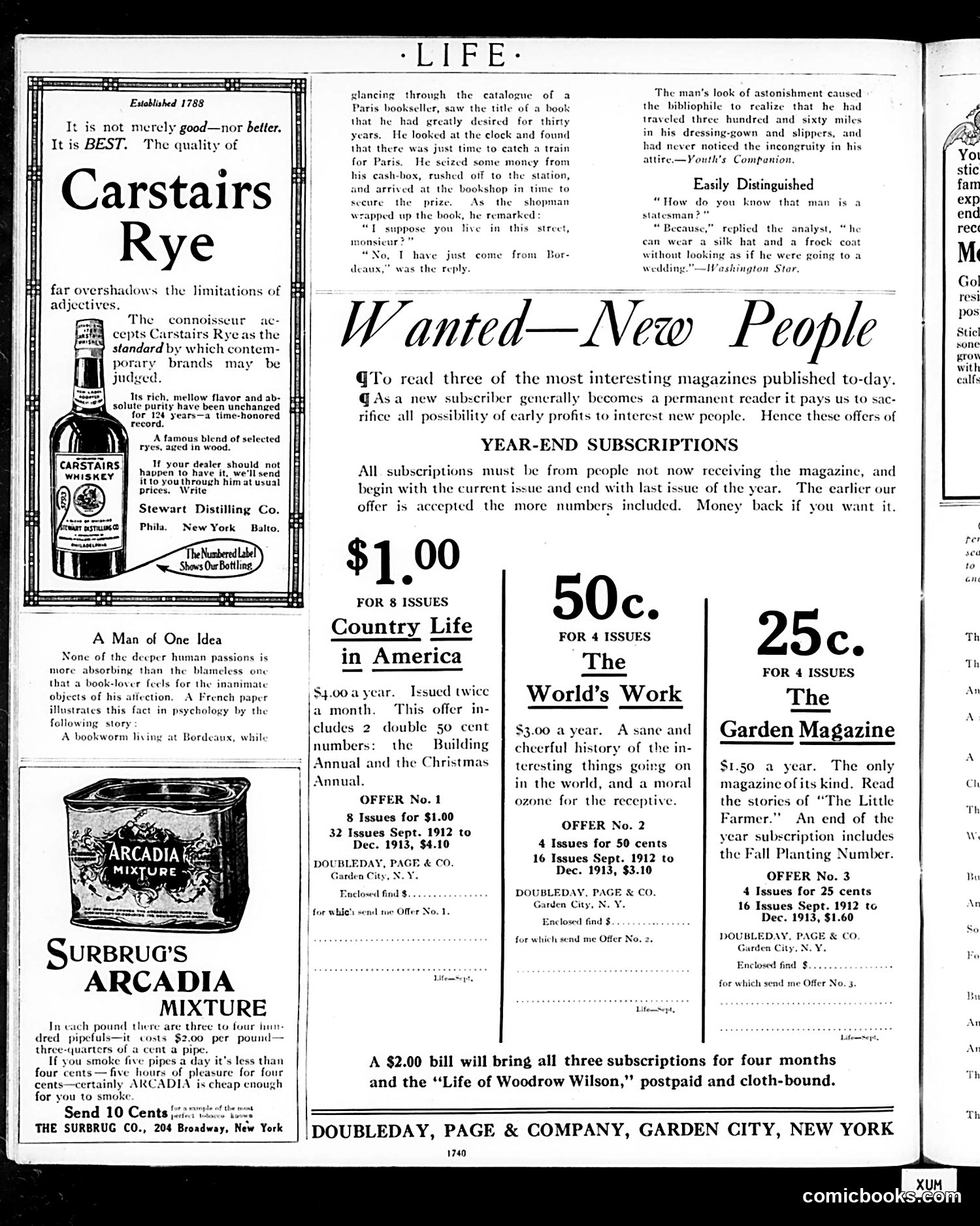
This page is primarily **advertising and subscription offers**, not political satire. The main content includes: **Advertisements:** Carstairs Rye whiskey and Surburg's Arcadia pipe tobacco dominate the left side, using period marketing language about quality and tradition. **Magazine Subscriptions:** The center and right feature year-end subscription offers for three publications: *Country Life in America*, *The World's Work*, and *The Garden Magazine*—all priced between 25¢-$1.00 for partial-year terms. **Brief Anecdotes:** Two short humor pieces appear: 1. A Parisian bibliophile's obsessive journey to buy a desired book 2. A joke about distinguishing a statesman (he won't look like he's going to a wedding) These are gentle, character-based humor typical of *Life* magazine's lighter content—not political cartooning. The page reflects early 1910s consumer culture and magazine industry competition for readers.
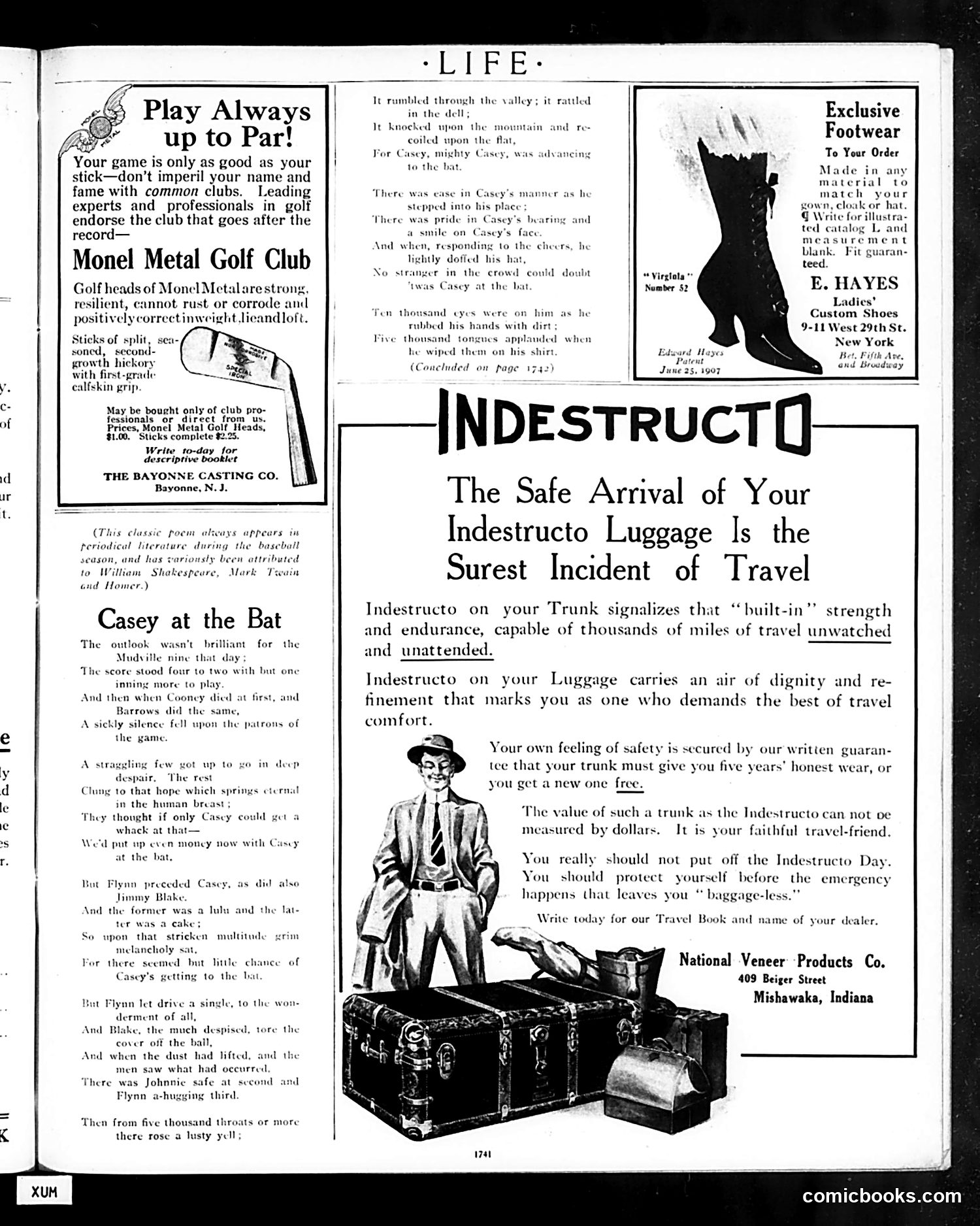
This page combines classic American literature with period advertisements. The main content is an excerpt from **"Casey at the Bat,"** Ernest Thayer's famous 1888 baseball poem about a star player's critical moment at bat in a close game. The poem celebrates American sporting culture and the drama of individual performance under pressure. The advertisements—for Monel Metal golf clubs, Indestructo luggage, and E. Hayes custom shoes—target affluent readers engaged in leisure activities (golf, travel, fashion). The luggage ad's emphasis on a written guarantee and durability appeals to early-20th-century travelers concerned with protecting possessions during rail journeys. The page reflects Life magazine's dual function: mixing highbrow literary content with consumer advertising for middle-to-upper-class readers. There's no political satire here—rather, it represents turn-of-the-century American optimism about leisure, technology, and material progress.
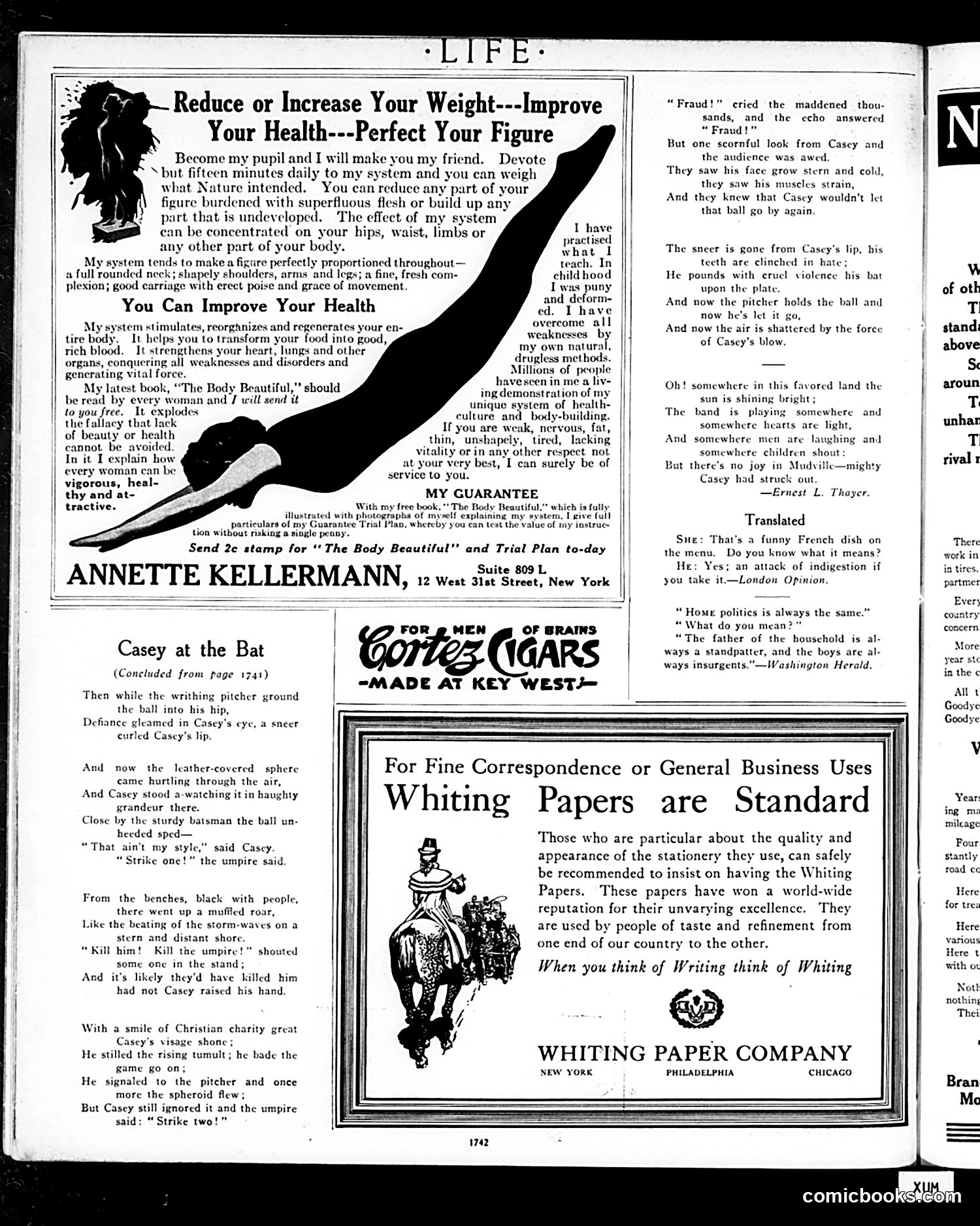
This page contains three distinct elements: **1. Weight-Loss Advertisement (Top)** Annette Kellermann advertises a mail-order fitness system promising to reshape your body through her proprietary exercises. She claims to have overcome childhood weakness through "drugless methods" and guarantees results or your money back. This represents early 20th-century diet/fitness marketing—before FDA regulations—making expansive health claims that would be illegal today. **2. "Casey at the Bat" Conclusion (Left)** The famous baseball poem concludes with Casey striking out despite his confidence. The satire targets overconfidence and hubris—a wealthy, arrogant player fails when it matters most. **3. Whiting Paper Advertisement (Center)** Standard stationery marketing emphasizing quality and social refinement—unremarkable. The page juxtaposes absurd commercial promises (instant body transformation) with a cautionary tale about false confidence, creating ironic commentary on American consumer culture and exaggerated claims.
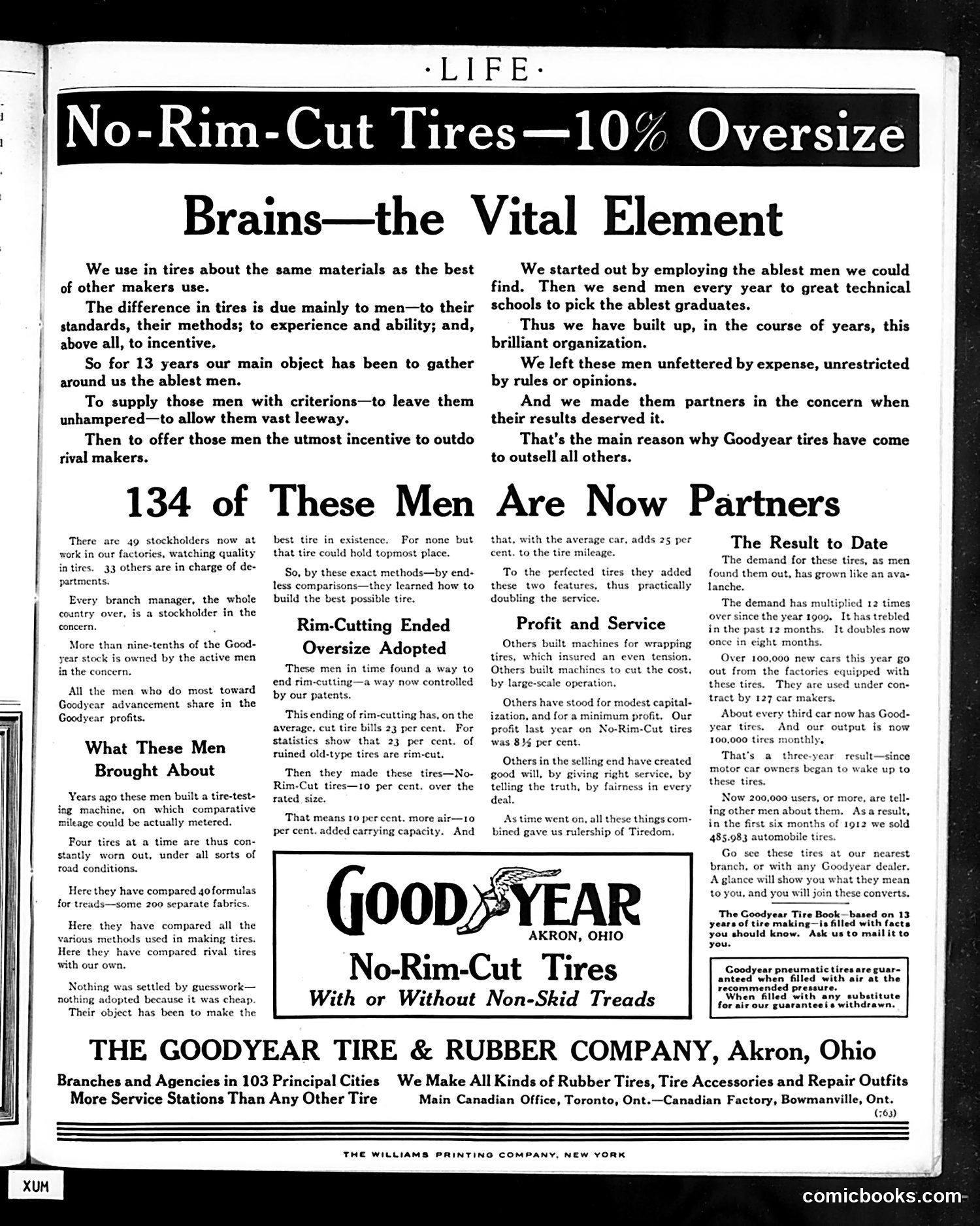
This is **not a political cartoon or satire**—it's a corporate advertisement disguised as editorial content, a common practice in early 20th-century magazines. The "content" describes Goodyear's business philosophy: employing talented engineers, granting them autonomy and profit-sharing, and using rigorous testing (comparative tire analysis on machines) rather than guesswork. The claim is that this human capital—"brains"—differentiates Goodyear from competitors. Key selling points highlighted: - **134 men became stockholder-partners** through results-based incentives - **No-Rim-Cut tires** (10% oversized) reduced tire failure by 23% and added carrying capacity - **Demand multiplied 12 times since 1909**, doubling every 8 months The advertisement uses an employee-partnership narrative to suggest Goodyear's superiority stems from treating workers well and valuing expertise—a progressive message for 1910s business journalism, though the actual profit-sharing was likely limited to management. There are no caricatures or satirical targets here; this is straightforward corporate messaging.
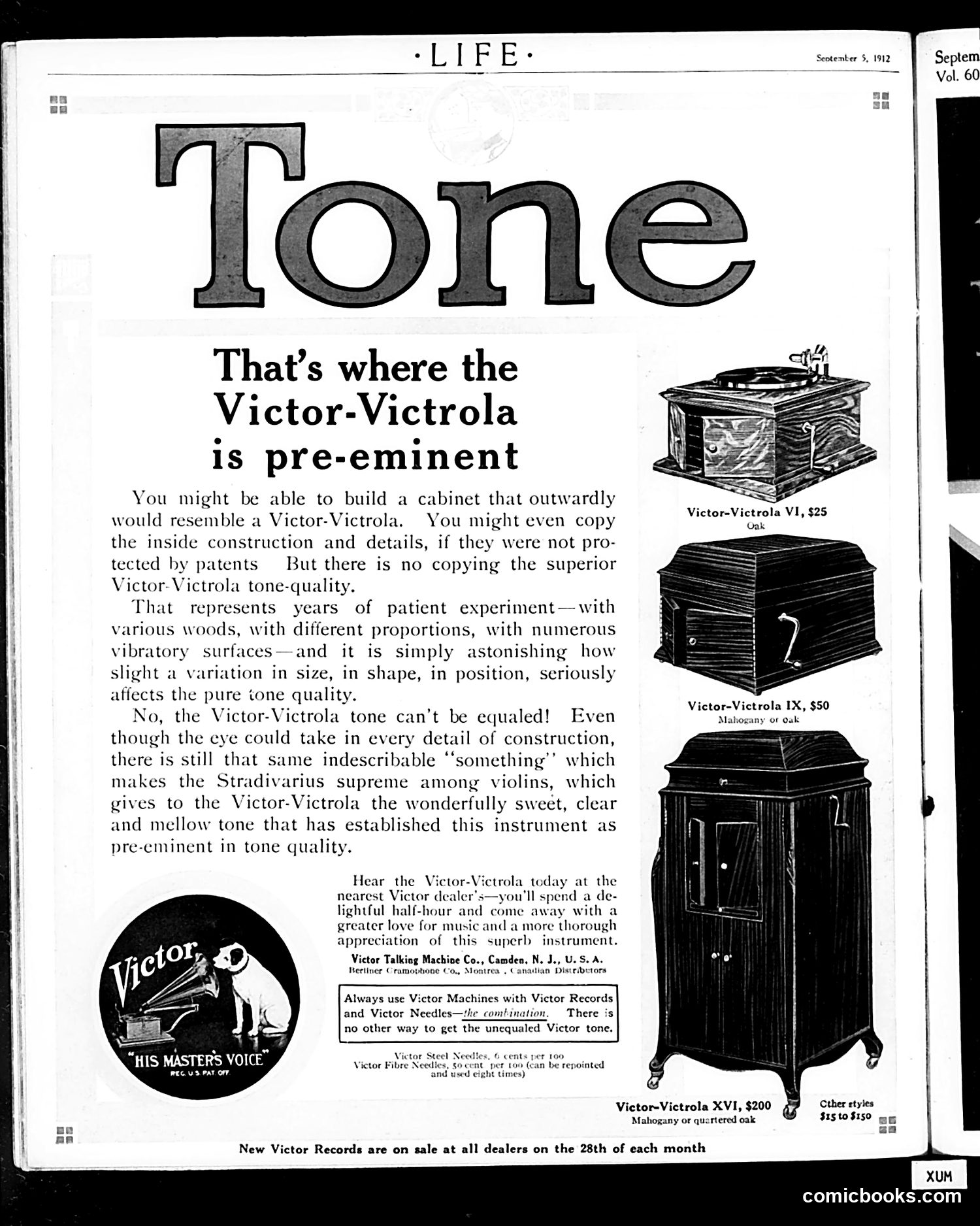
This is primarily a **product advertisement** for the Victor-Victrola phonograph, not satirical political content. It appears in *Life* magazine from September 5, 1912. The ad argues that while competitors might copy the Victor-Victrola's external design and patent-protected internal construction, they cannot replicate its superior sound quality. The text compares this intangible superiority to the Stradivarius violin—implying that certain qualities cannot be manufactured through imitation alone, only through years of genuine experimentation. The "His Master's Voice" logo (the famous Victor trademark showing a dog listening to a gramophone) anchors the brand identity. The page displays three phonograph cabinet models with prices ($25-$200), emphasizing that quality sound justifies the cost. The real satire, if any, is subtle: the ad's claim that tone quality cannot be copied is itself a marketing strategy to justify premium pricing against cheaper competitors.