
Life, 1912-09-05 · page 9 of 44
Life — September 5, 1912 — page 9: what you’re looking at
What you’re looking at
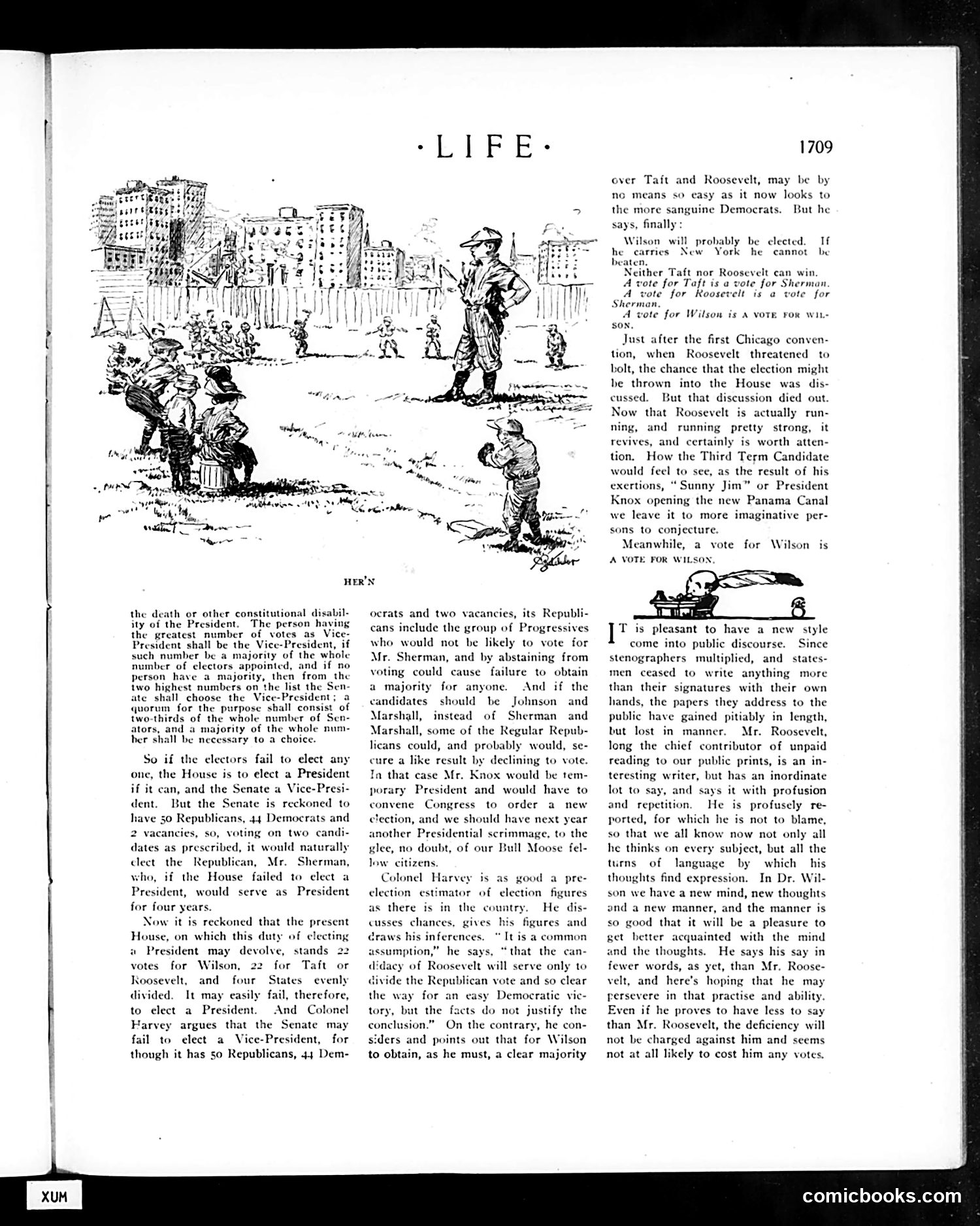
This page discusses the 1912 U.S. presidential election, featuring a sketch of a tall figure (likely Theodore Roosevelt) standing prominently while other candidates appear smaller below. The cartoon satirizes the fractured Republican vote. The text explains that a vote for Wilson (Democrat) effectively helps Wilson win, while splitting Republican votes between Taft, Roosevelt, and Progressive Party candidates weakens their chances. The article references Roosevelt's "Third Term" ambitions and mentions "Sunny Jim" (President James Sherman, Taft's running mate). The satire critiques how the Progressive split from the GOP—with Roosevelt running as a "Bull Moose"—could hand the election to Democrat Woodrow Wilson by dividing the conservative vote. The cartoon visually emphasizes Roosevelt's outsized role in this electoral calculus.
📄 Transcribed text from this page (OCR, searchable)
Machine-transcribed from the original scan — historical spelling and the odd misread are preserved.
Dre ee HER'N the death or other constitutional disabil- ity of the President. The person having the greatest number of votes as Vice- President shall be the Vice-President, if such number be a majority of the whole number of electors appointed, and if no person have a majority, then from the two highest numbers on the list the Sen- ate shall choose the Vice-President; a quorum for the purpose sball consist’ of two-thirds of the whole number of Sen- ators, and a majority of the whole num- ber shall be necessary to a choice. So if the electors fail to elect any one, the House is to elect a President if it can, and the Senate a Vice-Presi- dent. But the Senate is reckoned to ns, 44 Democrats and sting on two candi- ‘scribed, it would naturally elect the Republican, Mr. Sherman, who, if the House failed to elect a President, would serve as President for four years. ww it is reckoned that the present on which this duty of electing Hou a President may devolve, stands votes for Wilson, 22 for Taft or Koosevelt, and four States evenly divided. It may easily fail, therefore, to elect a President. And Colonel Harvey argues that the Senate may fail to elect a Vice-President, for though it has 50 Republicans, 44 Dem- ocrats and two vacancies, its Republi- cans include the group of Progressives who would not be likely to vote for Mr. Sherman, and by abstaining from voting could cause failure to obtain a majority for anyone. And if the candidates should be Johnson and Marshall, instead of Sherman and Marshall, some of the Regular Repub- licans could, and probably would, se- cure a like result by declining to vote. Tn that case Mr. Knox would be tem- porary President and would have to convene Congress to order a new election, and we should have next year another Presidential scrimma to the glee, no doubt, of our Bull Moose fel- low citizens. Colonel Harvey is as gt election estimator of election oda pre: as there is in the country cusses chances, gives his figures a Craws his inferen It is a common assumption,” he says, “that the can- didacy of Roosevelt will serve only to divide the Republican vote and so clear . for an easy Democratic vic- tory, but the facts do not justify the conclusion.” On the contrary, he con- lers and points out that for Wilson to obtain, as he must, a clear majority the w 1709 over Taft and Roosevelt, may be by no means so easy it now looks to the more sanguine Democrats. But he says, finally : Wilson will probably be elected. If he carries New York he cannot be beaten. ther Taft nor Roosevelt ¢ te for Taft is a vote for Sherman. vote for Roosevelt is a for Shermon. A vote for Wilson is 4 vore ror wit- n win, SON, Just after the first Chicago conven- tion, when Roosevelt threatened to holt, the chance that the election might be thrown into the House was dis- cussed. But that discussion died out. Now that Roosevelt is actually run- ning, and running pretty strong, it revives, and certainly is worth atten- tion. How the Third Term Candidate would feel to see, as the result of his exertions, “Sunny Jim” or President Knox opening the new Panama Canal we leave it to more imaginative per- sons to conjecture, Meanwhile, a vote for Wilson is A VOTE FOR WIL: I" is pleasant to have a new style come into public discourse. Since stenographers multiplied, and_ states- men ceased to write anything more than their signatures with their own hands, the papers they address to the public have gained pitiably in length, but lost in manner. Mr. Roosevelt, long the chief contributor of unpaid reading to our public prints, is an in- teresting writer, but has an inordinate lot to say, and says it with profusion and repetition. He is profusely re- ported, for which he is not to blame, ve all know now not only all s on every subject, but all the turns of language by which his thoughts find expression. In Dr. Wil- son we have a new mind, new thoughts and a new manner, and the manner is so good that it will be a pleasure to get better acquainted with the mind and the thoughts. He says his say in fewer words, as yet, than Mr. Roose- t, and here's hoping that he may fersevere in that practise and ability. Even if he proves to have less to say than Mr. Roosevelt, the deficiency will not be charged against him and seems not at all likely to cost him any votes, comicbooks.com