
Life, 1912-09-05 · page 20 of 44
Life — September 5, 1912 — page 20: what you’re looking at
What you’re looking at
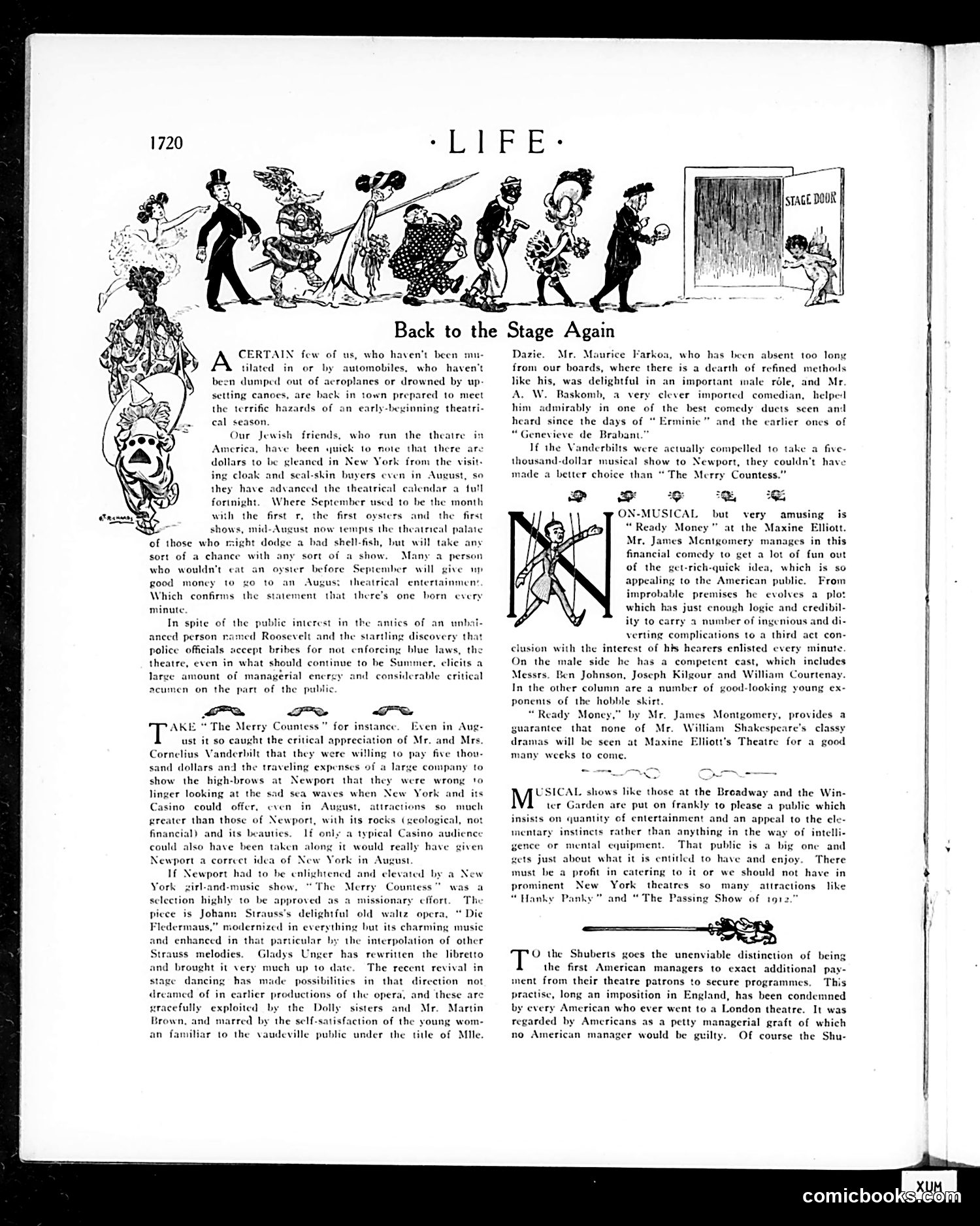
This page satirizes the early August 1912 theatrical season in New York. The main target is wealthy New York society—specifically the Vanderbilts—who the author mockingly suggests have *extended* the theater season into summer specifically to entertain visiting "cloak and seal-skin buyers" (wealthy Jewish merchants). The author's tone is caustic: he implies theater owners (whom he identifies as "Jewish friends") profit by pushing shows earlier, and he portrays the Vanderbilts as needing to display culture at Newport during summer. Reviews follow for "*The Merry Countess*" (a Strauss operetta revival) and "*Ready Money*" (a financial comedy). The cartoon above depicts theatrical performers in exaggerated poses—stock characters representing the season's offerings. **Key context for modern readers**: This reflects period anti-Semitic stereotypes about Jewish involvement in American theater, casual ethnic caricature typical of 1912 Life, and class-conscious mockery of wealthy patrons funding Broadway productions.
📄 Transcribed text from this page (OCR, searchable)
Machine-transcribed from the original scan — historical spelling and the odd misread are preserved.
CERTAIN few of us, who haven't been mu- tilated in or by automobiles, who haven't been dumped out of acroplanes or drowned by up setting canoes, are back in town prepared to mect the terrific hazards of an cal season. ly-bexinning theatri- Our Jewish friends, who run the theatre in America, have been quick to note that there are dollars to be gleaned in New York from the visit ing cloak and scal-skin buyers even in August, s they have advanced the theatrical calendar a tu'l fortnight. Where September used to be the month with the first r, the first oysters and the first shows, mid-August now tempts the theatrical palate ‘of those who might dodge a bad shell-fish, but will take sort of a chance with any sort of a show, Many a person who wouldn't cat an oyster before Si good money to to an Augus; theatrical entertainment Which confirms th minute In spite of the public interest in the antics of an unbai anced person named Roosevelt and the startling discovery that police officials accept bribes for not enforcing blue laws, the theatre, even in what should continue to be Summer, elicits a large amount of managerial encrgy and considerable critical acumen on the part of the public Fue_eFR KS AKE “The Merry Countess” for instance. Even in Aug- ust it so caught the critical appreciation of Mr. and Mrs Cornelius Vanderbilt that they were willing 10 sand dollars and the traveling expenses of a large company to show the high-brows at Newport that they were wrong to linger looking at the sad sea waves when New York and it Casino could offer, even in August, attra greater than those of Newport, with its rocks ( financial) and its beauties. If only s could also have been taken alon Newport a correet idea of New York in August If Newport had to be enlightened and clevated by a New York zirl-and-music show, “The Merry Countess” was selection highly to be approved as a missionary effort. The picce is Johann Strauss’s delightful old waltz opera, “ Die Fledermaus,” modernized in everything but its charming music and enhanced in that riicular by the interpolation of other rauss melodies. Gladys Unger has rewritten the libretto and brought it very much up to date. The recent revival in stage dancing has made possibilities in that direction not dreamed of in are xracefully exploited by the Dolly sisters and Mr. Martin rred by the self-satisfaction of the young wom- viliar to the vaudeville public under the title of Mile. mbher will give amy pent at there’s one horn every te five thou- tions so muc ecological, not typical Casino audience it would really have given -arlier productions of the opera, and these Brown, and m1 Back to the Stage Again Dazie. Mr. Maurice Farkoa, who has been absent too long from our boards, where there is a dearth of refined methods like his, was delightful in an important male réle, and Mr. A. W. Baskomb, a very clever imported comedian, helped ably in one of the best comedy ducts scen ancl heard since the days of “Erminic” and the earlier ones of “Genevieve de Brabant.” If the Vanderbilts were actually compelled to take a five- thousand-dollar musical show to Newport, they couldn't have made a better choice than “The Merry Countess.” ON-MUSICAL but very amusing is “Ready Money” at the Maxine Elliott. Mr, James Mentgomery manages in this financial comedy to get a lot of fun out of the get-rich-quick idea, which is so appealing to the American public. From improbable premises he evolves a plot which has just cnough logic and credibil- ity to carry a number of ingenious and di- verting complications to a third act con- clusion with the interest of his hearers enlisted every minute On the male side he has a competent cast, which includes Messrs. Ben Johnson, Joseph Kilgour and William Courtenay. In the other column are a number of good-looking young ex- ponents of the hobble skirt. “Ready Money,” by Mr. James Montgomery, provides a guarantee that none of Mr. William Shakespeare's clas dramas will be seen at Maxine Elliott's Theatre for a good many weeks to come. him ni USICAL shows like those at the Broadway and the Win- ter Garden are put on frankly to please a public which insists on quantity of entertainment and an appeal to the ele- ther than anything in the way of intelli- gence or mental cquipment. That public is a big one and gets just about what it is entitled to have and enjoy. There must be a profit in catering to it or we should not have in prominent New York theatres so many attractions like “Hanky Panky” and “The Passing Show of 1912." ———35 O the Shuberts goes the unenviable distinction of being the first American managers to exact additional pay- nent from their theatre patrons to secure programmes. practise, long an imposition in England, has been condemned by every American who ever went to a London theatre. It was regarded by Americans as a petty managerial graft of which no American manager would be guilty. Of course the Shu- mentary instinets comicboolhe us —