
Life, 1912-09-05 · page 15 of 44
Life — September 5, 1912 — page 15: what you’re looking at
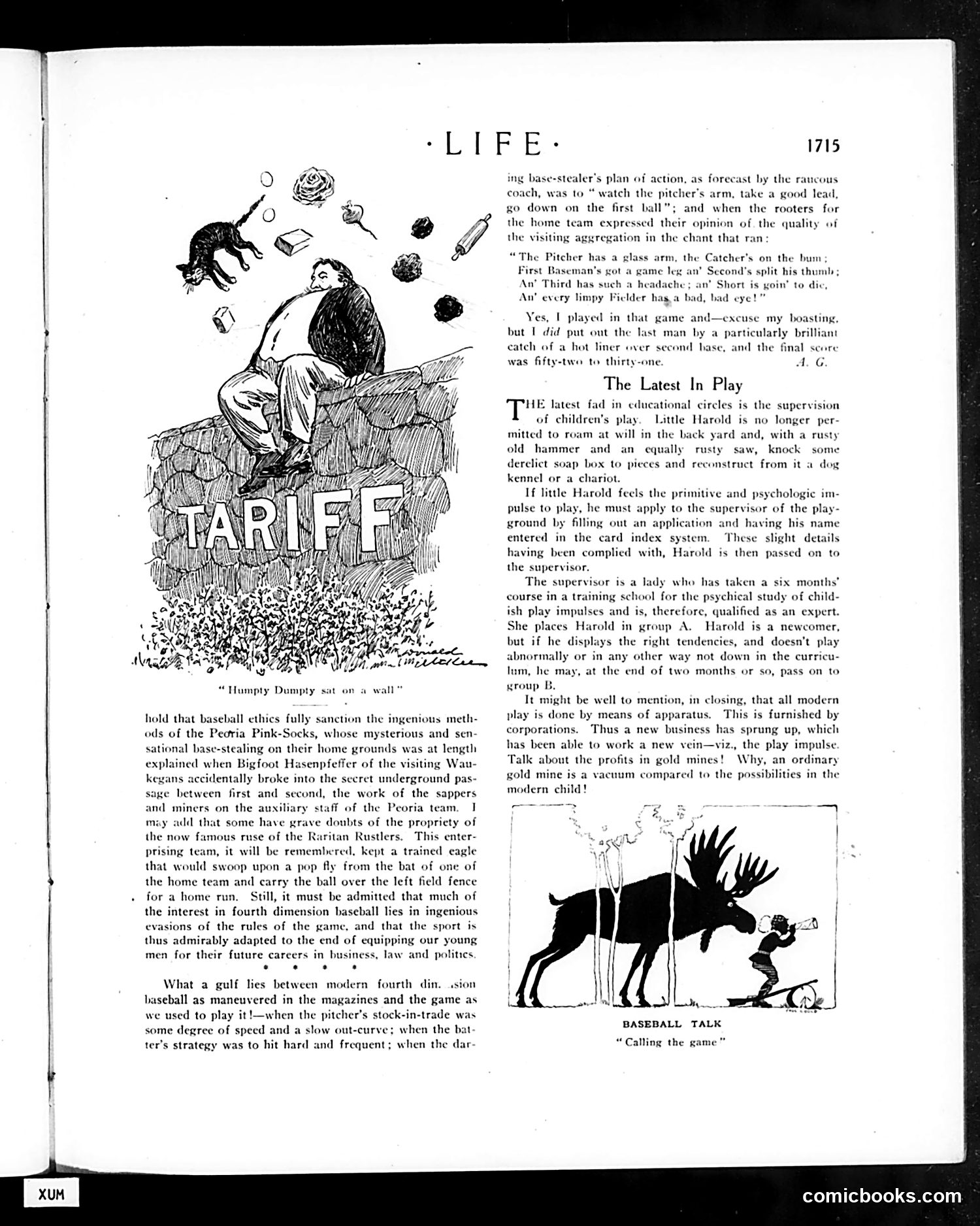
What you’re looking at
This page satirizes two modern trends: organized baseball and supervised childhood play. The **baseball section** mocks how magazine writers have invented absurdly complex schemes (underground passages, trained eagles) to explain base-stealing, contrasting this with the straightforward game the author actually played. The satire suggests that writers embellish sports stories for entertainment, and that creative rule-breaking has become valued over actual athletic skill—paralleling dishonesty in business and politics. **"The Latest In Play"** ridicules the emerging professionalization of children's recreation. A child named Harold can no longer freely build from scrap materials; instead, he must file applications, receive "expert" supervision from someone with minimal training, and join standardized groups. The author sarcastically notes corporations now profit from this regimented play through apparatus sales—comparing it to gold mining. The satire targets both excessive bureaucratization of childhood and commercialization of what should be free, creative activity.
📄 Transcribed text from this page (OCR, searchable)
Machine-transcribed from the original scan — historical spelling and the odd misread are preserved.
-L.1 F E.- “Humpty Dumpty sat on a wal hold that baseball ethics fully sanction the ingenious meth- ods of the Peoria Pink-Socks, whose mysterious and sen- sational base-stealing on their home grounds was at length explained when Bigfoot Hasenpfeffer of the visiting Wau- kegans accidentally broke into the secret underground pas- sage between first and second, the work of the sappers 1 miners on the auxiliary staff of the Peoria team. 1 y add that some have grave doubts of the propriety of the now famous ruse of the Raritan Rustlers. This enter- prising team, it will be remem! trained eagle that would swoop upon a pop fly from the bat of one of the home team and carry the ball over the left field fence for a home run, Still, it must be admitted that much of the interest in fourth dimension baseball lies in ingenious evasions of the rules of the game, and that the sport is thus admirably adapted to the end of equipping our young men for their future careers in business, law and polities. eo 8 8 6 What a gulf lies between modern fourth din. .sion baseball as maneuvered in the magazines and the game as we used to play it!—when the pitcher's stock-in-trade was some degree of speed and a slow out-curve; when the bat ter’s strategy was to hit hard and frequent; when the dar- 1715 base-stealer’s plan of action, as forecast hy the raucous ch, was to “watch the pitcher's arm, take a good lead, go down on the first ball”; and when the rooters for the home team expressed their opinion of the quality of the visiting aggregation in the chant that ran: co: “The Pitcher has a g First Baseman’s got a At . the Catcher's on the bum ; n” Second’s split his thumb ; n’ Short i: every limpy Fielder has.a bad, bad ey hird has such a headache ; coin’ to dic, Yes, | played in that game and—excuse my boasting. but I did put out the last man by a particularly brilliant catch of a hot liner « was fifty-two to thirty er second base, and the final score oe. ALG. The Latest In Play HE latest fad in educational circles is the supervision of children’s play. Little Harold is no longer per- mitted to roam at will in the back yard and, with a rusty old hammer and an equally rusty saw, knock derelict soap box to pieces and reconstruct from it a dog kennel or a chariot. If little Harold feels the primitive and psychologic im- pulse to play, he must apply to the supervisor of the play- ground by filling out an application and having his name entered in the card index system. These slight details having been complied with, Harold is then passed on to the supervisor. The supervisor is a lady who has taken a six months’ course in a training school for the psychical study of child- ish play impulses and is, therefore, qualified She places Harold in group A. Harold is a newcomer, but if he displays the right tendencies, and doesn’t play abnormally or in any other way not down in the curricu- Ium, he may, at the end of two months or so, pass on to group B. It might be well to mention, in closing, that all modern play is done by means of apparatus, This is furnished by corporations. Thus a new business has sprung up, which has been able to work a new vein—viz., the play impulse. Talk about the profits in gold mines! Why, an ordinary gold mine is a vacuum compared to the possibilities in the modern child! some as an expert. ay BASEBALL TALK “Calling the game” comicbooks.com