
Life, 1912-09-05 · page 18 of 44
Life — September 5, 1912 — page 18: what you’re looking at
What you’re looking at
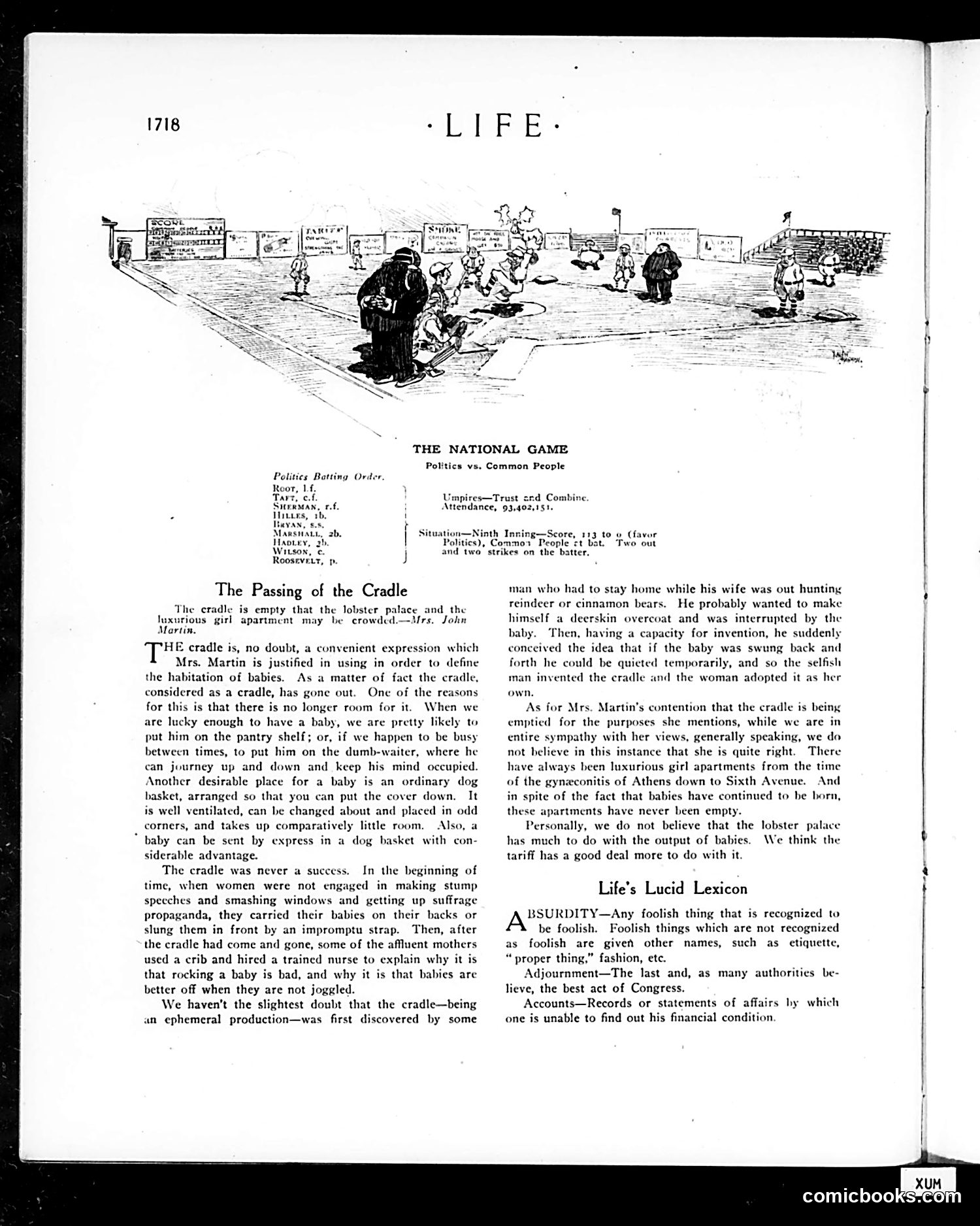
This 1718 *Life* magazine page contains two satirical pieces targeting early 20th-century social issues. **"The National Game"** (top) is a baseball cartoon labeled "Politics vs. Common People," with Roosevelt listed as pitcher. The lineup includes politicians and trust monopolies playing against ordinary citizens. The joke: politics and big business are a rigged game where the common people are outmatched. **"The Passing of the Cradle"** (main article) responds to a Mrs. John Martin's claim that cradles are disappearing because women pursue "lobster palaces" (fancy restaurants) and apartments instead of child-rearing. *Life* sardonically defends women's changing roles, arguing luxurious establishments have always existed and aren't actually replacing babies—rather, tariff policies (economic issues) better explain birth rates than women's leisure activities. The piece mocks both Mrs. Martin's domesticity argument and broader anxieties about changing female social roles.
📄 Transcribed text from this page (OCR, searchable)
Machine-transcribed from the original scan — historical spelling and the odd misread are preserved.
Polities Botting Order Roor, Lf. Tart, cf. Suntan, rf, - Hines, + lavas, ss. Masia Haotey, 3 Witson, ¢. Roosrvetr, p. J The Passing of the Cradle The cradle is empty that the lobster palace and the luxurious girl apartment may be crowded.—Mrs. John Martin. Uny HE cradle is, no doubt, a convenient expression which Mrs. Martin is justified in using in order to define the habitation of babies. As a matter of fact the cradle, considered as a cradle, has gone out. One of the reasons for this is that there is no longer room for it. When we are lucky enough to have a baby, we are pretty likely to put him on the pantry shelf; or, if we happen to be busy between times, to put him on the dumb-waiter, where he can journey up and down and keep his mind occupied. Another desirable place for a baby is an ordinary dog basket, arranged so that you can put the cover down. It is well ventilated, can be changed about and placed in odd corners, and takes up comparatively little room. Also, a * baby can be sent by express in a dog basket with con- siderable advantage. The cradle was never a su In the beginning of time, when women were not engaged in making stump specches and smashing windows and getting up suffrage propaganda, they carried their babies on their backs or slung them in front by an impromptu strap. Then, after the cradle had come and gone, some of the affluent mothers used a crib and hired a trained nurse to explain why it is that rocking a baby is bad, and why it is that babies are better off when they are not joggled. We haven't the slightest doubt that the cradle—being an ephemeral production—was first discovered by some THE NATIONAL GAME Politics vs. es—Trust Attendance, 93,41 Politics), Commo People rt Dat. and two’ strikes on the batter, Common People rd Combine sh jth Inning—Score, 113 to v (favor Two out who had to stay home while his wife was out hunting reindeer or cinnamon bears. He probably wanted to make himself a deerskin overcoat and was interrupted by the | baby. Then, having a capacity for invention, he suddenly | conceived the idea that if the baby was swung back and forth he could be quieted temporarily, and so the selfish man invented the cradle and the woman adopted it as her own. As for Mrs. Martin’s contention that the cradle is being emptied for the purposes she mentions, while we are in entire sympathy with her views, generally speaking, we do not believe in this instance that she is quite right. There have always been luxurious girl apartments from the time of the gynxconitis of Athens down to Sixth Avenue. And in spite of the fact that babies have continued to be born, these apartments have never been empty. Personally, we do not believe that the lobster palace has much to do with the output of babies. We think the tariff has a good deal more to do with it. — race Life’s Lucid Lexicon BSURDITY—Any foolish thing that is recognized to be foolish. Foolish things which are not recognized as foolish are given other names, such as etiquette, “ proper thing,” fashion, etc. Adjournment—The last and, as many authorities be- lieve, the best act of Congress. Accounts—Records or statements of affairs hy which one is unable to find out his financial condition. comicbookeel