
Life, 1912-09-05 · page 26 of 44
Life — September 5, 1912 — page 26: what you’re looking at
What you’re looking at
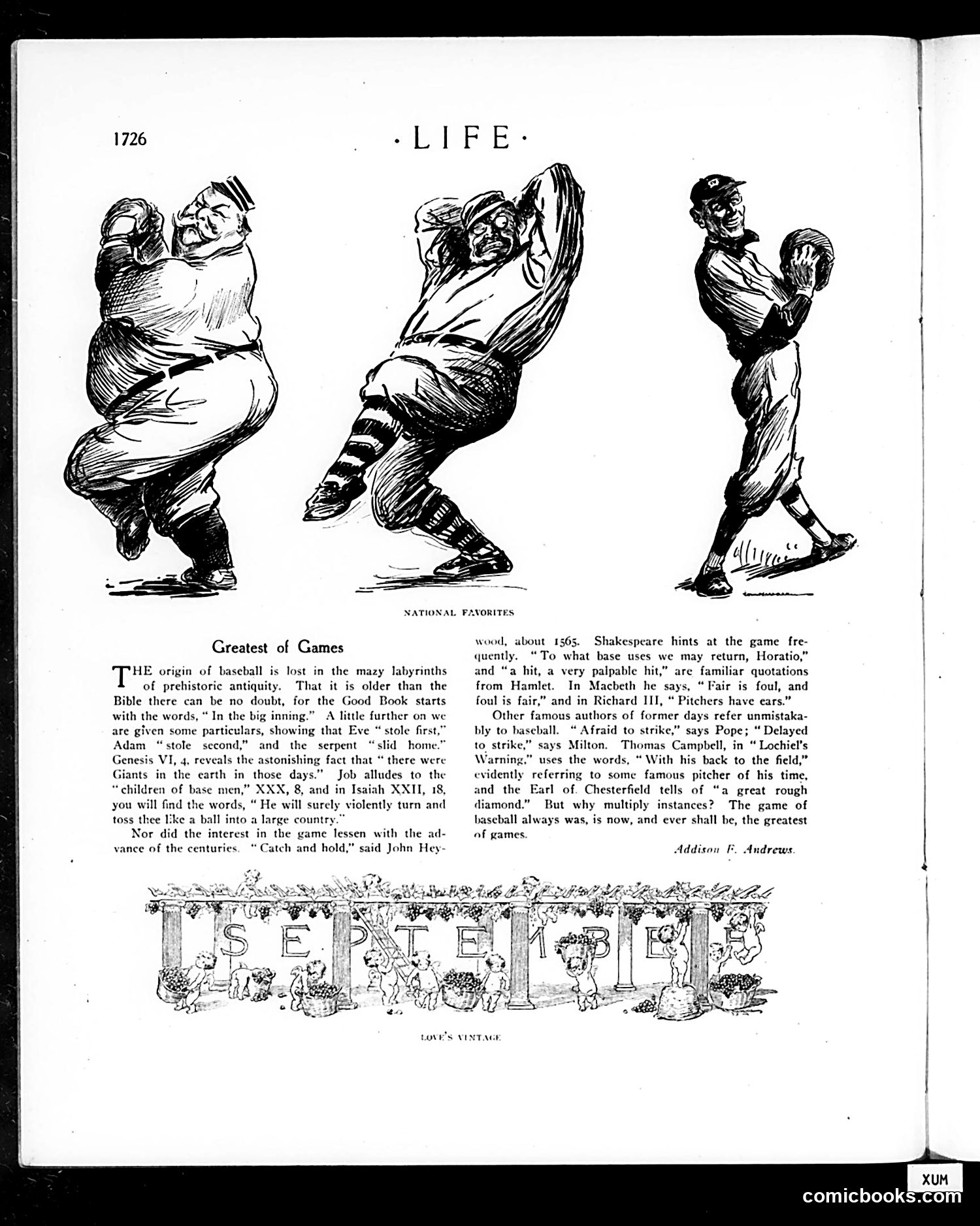
This is a humorous article claiming baseball's ancient origins by mining classical literature for baseball terminology. The author, Addison F. Andrews, deliberately misreads famous literary passages—treating biblical and classical references as hidden baseball allusions. **The Satire:** Andrews finds "base" references in Genesis, "stealing" in Adam's actions, "giants" in Job, and claims Shakespeare's famous lines about "base uses" and "palpable hits" prove baseball predates modern times. He similarly twists quotes from Pope, Milton, and Campbell into supposed baseball references. **The Joke:** This is absurdist humor—the author knows he's forcing ridiculous baseball interpretations onto literature that has nothing to do with the sport. The three ink sketches show exaggerated baseball players in dynamic poses, emphasizing baseball as a modern, vigorous American pastime. The piece gently mocks both overzealous literary scholars and America's obsession with baseball as a national institution, suggesting it's so central to American culture that people retroactively "discover" it everywhere in the cultural canon.
📄 Transcribed text from this page (OCR, searchable)
Machine-transcribed from the original scan — historical spelling and the odd misread are preserved.
Greatest of Games HE origin of baseball is lost in the mazy labyrinths of prehistoric antiquity. That it is older than the Bible there can be no doubt, for the Good Book starts with the words, “In the big innin; A litle further on we are given some particulars, showing that Eve Adam “stole second,” and the serpent “s Genesis VI, 4, reveals the astonishing fact that “ there were Giants in the carth in those days.” Job alludes to the “children of base men,” 8, and in Isaiah XXII, 18, you will find the word: jolently turn and toss thee [ike a ball into a large country ‘or did the interest in the game lessen with the ad- vance of the centuries. “Catch and hold,” said John Hey- FAVORITES wood, about 1565. Shakespeare hints at the game fre- quently. “To what base uses we may return, Horatio,” and “a hit, a very palpable hit,” are familiar quotations from Hamlet. In Macbeth he says, “Fair is foul, and foul is fair,” and in Richard III, “ Pitchers have ears.” Other famous authors of former days refer unmistaka- bly to baseball. “ Afraid to strike,” says Pope; “ Delayed to strike,” says Milton. Thomas Campbell, in “ Lochiel’s Warning,” uses the words, “ With his back to the field,” evidently referring to some famous pitcher of his time, and the Earl of. Chesterfield tells of “a great rough diamond.” But why multiply instances? The game of baseball always was, is now, and ever shall be, the greatest of games. Addison F. Andrews. LOVE'S VINTAGE comicbook | a s.com