
Life, 1912-09-05 · page 8 of 44
Life — September 5, 1912 — page 8: what you’re looking at
What you’re looking at
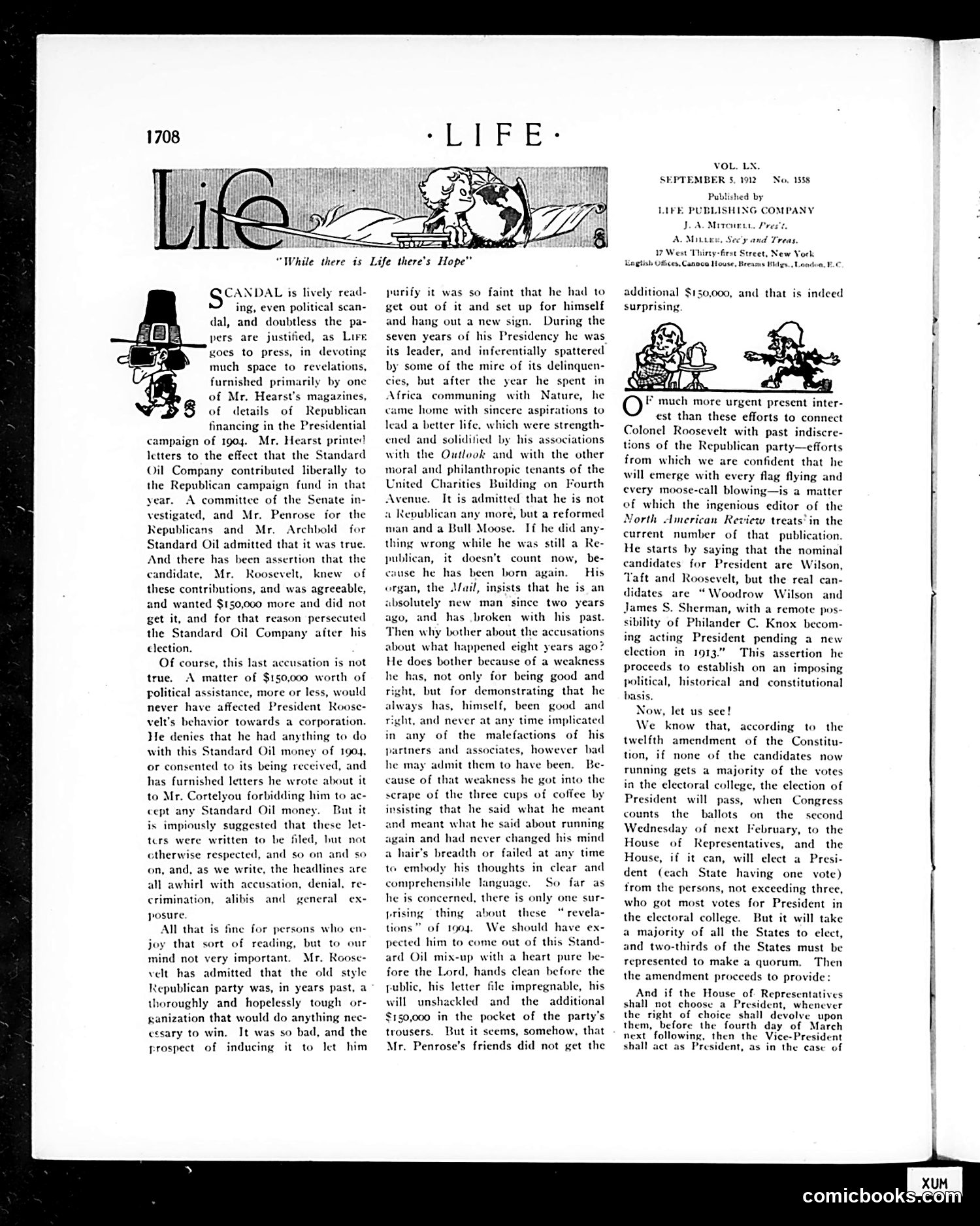
This page critiques President Roosevelt's denials regarding the Standard Oil Company's contributions to his 1904 campaign. The article sarcastically documents Roosevelt's claim that he knew nothing of a $150,000 donation, despite accusations from oil magnate Henry H. Rogers and Standard Oil executive John D. Archbold. The text mocks Roosevelt's subsequent "reformed" Republican stance, questioning his credibility given this financial entanglement. The piece also previews the 1912 presidential race, discussing Wilson, Taft, and Roosevelt as candidates. The cartoon (left margin) appears to caricature Roosevelt, emphasizing the hypocrisy between his "clean" political image and his actual acceptance of corporate money—a central scandal of the Progressive Era.
📄 Transcribed text from this page (OCR, searchable)
Machine-transcribed from the original scan — historical spelling and the odd misread are preserved.
CANDAL is lively read- ing, even political scan- dal, and doubtless the pa- pers are justified, as Lire goes to press, in devoting much space to revelations, furnished primarily by one of Mr. Hearst's magazines, of details of Republican financing in the Presidential campaign of 1904. Mr. Hearst printe’ letters to the effect that the Standard Oil Company contributed liberally to the Republican campaign fund in that year. A committee of the Senate in- vestigated, and Mr. Penrose for the Republicans and Mr. Archbold for Standard Oil admitted that it was true. And there has been assertion that the candidate, Mr. Roosevelt, knew of these contributions, and was agreeable, and wanted $150,000 more and did not get it, and for that reason persecuted the Standard Oil Company after his lection. Of course, this last accusation is not true, A matter of $150,000 worth of Political assistance, more or less, would never have affected President Roose- velt's behavior towards a corporation. He denies that he had anything to do with this Standard Oil money of 1904, or consented to its being received, and has furnished letters he wrote about it to Mr. Cortelyou forbidding him to ac- cept any Standard Oil money. But it is impiously suggested that these let- tors were written to be filed, but not otherwise respected, and so on on, and, as we write, the headlines are all awhirl with accusation, denial, re- mination, alibis and general < posure. All that is fine for persons who en- joy that sort of reading, but to our mind not very important. Mr. Roos velt has admitted that the old style Republican party was, in years past, a thoroughly and hopelessly tough or- ganization that would do anything nec- essary to win. It was so bad, and the prospect of inducing it to let him “While there is Life there's Hope purify it was so faint that he had to get out of it and set up for himself and hang out a new sign. During the seven years of his Presidency he was its leader, and inferentially spattered by some of the mire of its delinquen- i but after the year he spent in Africa communing with Nature, he came home with sincere aspirations to lead a better life, which were strength- ened and solidified by his associations with the Outlook and with the other moral and philanthropic tenants of the United Charities Building on Fourth Avenue. It is admitted that he is not x Republican any more, but a reformed man and a Bull Moose. If he did an: thing wrong while he was still a R publican, it doesn’t count now, be- cause he has been born again. — His ‘gan, the AJail, insists that he is an bsolutely new man since two years o, and has broken with his past. Then why bother about the accusations about what happened eight years ago? He does bother because of a weakness he has, not only for being good and ht, but for demonstrating that he always has, himself, been good and right, and never at any time implicated in any of the malefactions of his partners and associates, however bad he may admit them to have been. Be- ci cause of that weakness he got into the scrape of the three cups of coffee by insisting that he said what he meant and meant what he said about running again and had never changed his mind a hair’s breadth or failed at any time to embody his thoughts in clear and far as one sur- comprehensible language. he is concerned, there is on prising thing about these “ revela- tions” of 1904. We should have ex- pected him to come out of this Stand- ard Oil mix-up with a heart pure be- fore the Lord, hands clean before the public, his letter file impregnable, his will unshackled and the additional $150,000 in the pocket of the party's trousers. But it seems, somehow, that Mr. Penrose’s friends did not get the VOL. LX. SEPTEMBER 5, 1912 No, 1588 ed by LIFE PUBLISHING COMPANY J. A. Mironrna. Pres A. Minuee, Sey and Treas. 17 West Thinty-first Street, New Vork Lagthh Ufices, Canaca House, Be on Whigs. , Leadon, BC additional $150,000, and that is indeed surprising. est than these efforts to connect Colonel Roosevelt with past indiscre- tions of the Republican party—efforts from which we are confident that he will emerge with every flag flying and every moose-call blowing—is a matter of which the ingenious editor of the North American Review treats’ in the current number of that publication. He starts by saying that the nominal candidates for President are Wilson, ‘Taft and Roosevelt, but the real can- didates are “Woodrow Wils sibility of Philander C. Knox bei ing acting President pending a new election in 1913.” This assertion he proceeds to establish on an imposing political, historical and constitutional basis. Now, let us see! We know that, according to the twelfth amendment of the Constitu- tion, if none of the candidates now running gets a majority of the votes in the electoral college, the election of President will pass, when Congress counts the ballots on the second Wednesday of next February, to the House of Representatives, and the House, if it can, will elect a Presi- dent (cach State having one vote) from the persons, not exceeding three, who got most votes for President in the electoral college. But it will take a majority of all the States to elect, and two-thirds of the States must be represented to make a quorum. Then the amendment proceeds to provide: And if the House of Representatives shall not choose a President, whenever the right of choice shall devolve upon them, before the fourth day of March next following, then the Vice-President shall act as President, as in the case of comicbook $-CO! ie