
Life, 1912-09-05 · page 21 of 44
Life — September 5, 1912 — page 21: what you’re looking at
What you’re looking at
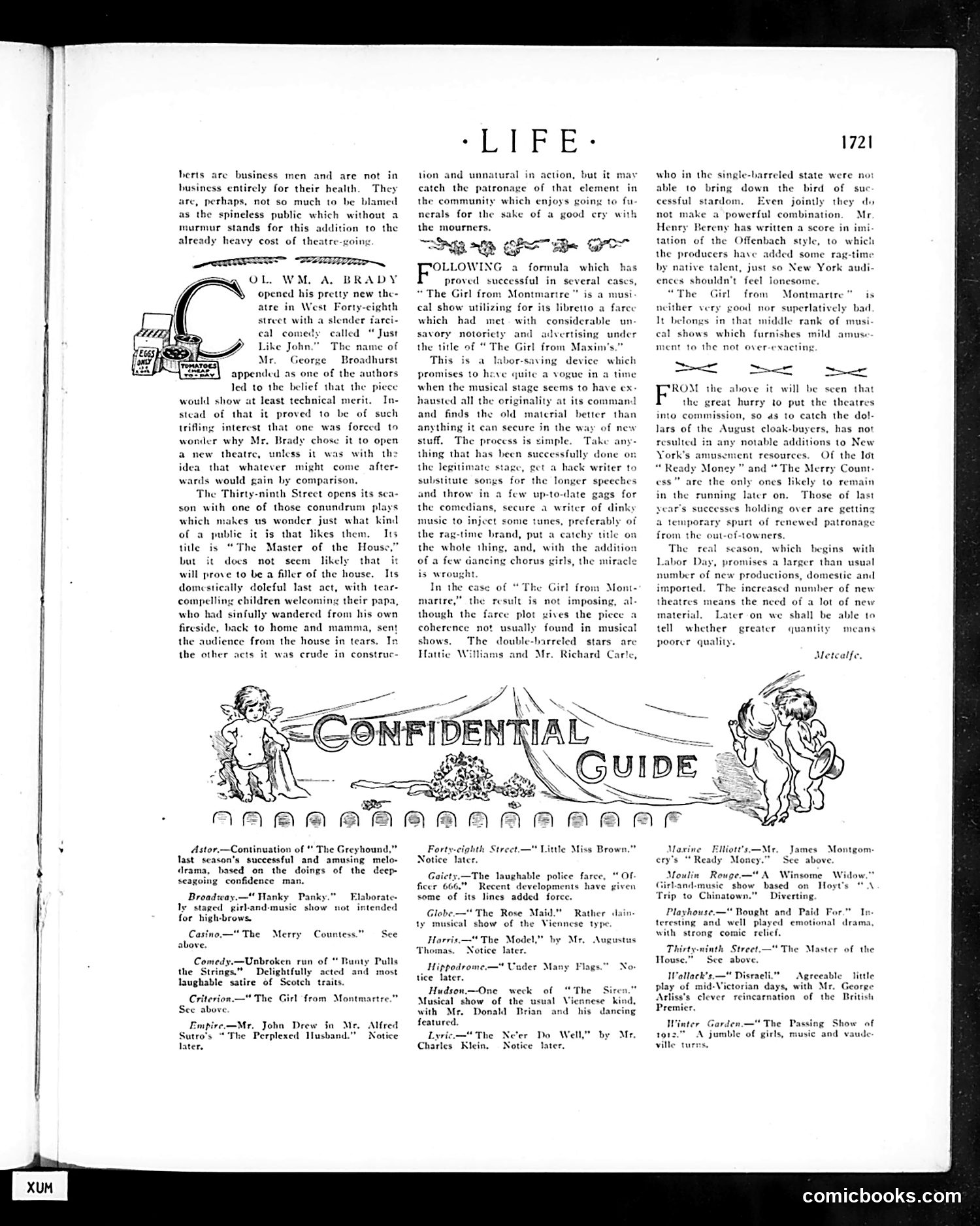
This page contains theatrical reviews from Life magazine's "Confidential Guide" section, critiquing Broadway productions. The main text attacks theater owners for charging high admission prices while presenting mediocre productions—calling them "business men" prioritizing profit over quality. Specific criticisms include: - **"Just Like John"** at Brady's new theater: dismissed as a trivial farce unworthy of its venue - **"The Master of the House"**: criticized as domestically manipulative, using tears and sentimentality to move audiences rather than genuine dramatic merit - **"The Girl from Montmartre"**: satirized as a formulaic musical hack job—taking a successful farce, replacing dialogue with songs by mediocre composers, adding dancing girls and tired jokes, then repackaging it with a catchy title The satire targets the commercial cynicism of Broadway producers who recycle proven material lazily rather than develop original work. The complaint about "spineless public" accepting poor quality suggests audience complicity in this mediocrity.
📄 Transcribed text from this page (OCR, searchable)
Machine-transcribed from the original scan — historical spelling and the odd misread are preserved.
a Herts are business men and are not in business entirely for their health. They are, perhaps, not so much to be blamed as the spineless public which without a murmur stands for this addition to the already heavy cost of theatre Smeal 0227 a Bae OL. WM. AL BRADY opened his pretty new the- atre in West Forty-cighth street with a slender farci- cal comedy called “ Just Like John.” The name of Mr. George Broadhurst appended as one of the authors led to the belief that the piece would show at least technical merit. In- stead of that it proved to be of such trifling interest that one was forced to wonder why Mr. Brady chose it to open theatre, unless it was with the a that whatever might come after- wards would gain by comparison. The Thirty-ninth Strect opens its sea- son with one of those conundrum plays which makes us wonder just what kind of a public it is that likes them, Its tile is “The Master of the House,” but it docs not seem likely that will prove to be a filler of the house. Its domestically doleful last act, with tear- compelling children welcoming their papa, who had sinfully wandered from his own fireside, back to home and mamma, sent the audience from the house in tears, 1 the other acts it was crude in construc- a ne Astor.—Continuation of * The Greyhound,’ last season's successful and amusing melo- drama, hased on the doings of the deep seagoing confidence man. Broadveay.—" Wanky Panky." Elaborate. Iy staged girland-music show not intended for high-brows, Cas above. "The Merry Countess." See Comedy.—Unbroken run of “Bunty Pulls the Strings” Delightfully acted and most laughable satire of Scotch traits The Girl from Montmartre.” Criterion See above Empire-—Me. John Drew in Mr. Alfred Sutro’s “The Perplexed Husband.” Notice later. LIFE tion and unnatural in action, but it may catch the patronage of that clement in the community which enjoys going 10 fu nerals for the sake of a good cry wit the mourners. SABA GS GO OLLOWING a formula which + proved successful in several cases, “The Girl from Montmartre” is a musi cal show utilizing for its libretto a farc« which had met with considerable un savory notoriety and advertising under the title of “The Girl from Maxim's.” This promises to have q sa labor-saving device which te a Vogue in a time when the musical stage secms to have ex hausted all the or and finds the old anything it can secure in the way of new ff. The process is simple. Take any: thing that has been successfully done on the legitiv . get a hack writer to substitute songs for the longer speeches and throw in a few up-to-date gags for the comedians, secure a writer of dinky music to inject some t the rag-time brand, put a catchy title on the whole thing, and, with the of a few dancing chorus girls, the » is wrough In the pe Girl from Mont- marire,” the result is not imposing, a though the farce plot wives the picce a coherence not usually found in musi shows, The double-barreled stars are Hate ams and Mr. Richard Carle, ity at its command better than nes, preferably of Idition racle Forty-cighth Strect.—" Little Miss Brown.” Notice later. Gaicty.—The laughable police farce, “ OF ficer 666." Recent developments have given some of its lines added force. Globe.—" The Rose Maii ty musical show of the Horris—" The Model," } Thomas. Notice later. Rather dlain- jennese type Mr, Augustus Hippodrome.—"* Under Many Flags." No» tice later. Hudson.—One_ week of Musical show of the usual V' with Mr. Donald Brian featured. Lyric." The Ne’er Do Charles Klein, e later. ennese kind, his dancing 1721 who in the single-barreled state were no able to bring down the bird of suc Even jointly they de ake a powerful combination. Mr cessful stardom, not Henry Bereny has written a score in imi tation of the Offenbach style, to which the producers have added some rag-time by native talent, just so New York audi- ences shouldn't feel me, “The Girl from Montmartre” is neither very good nor superlatively bad It belongs in that middle rank of musi. cal shows which furnishes mild amuse ment to the not over-exacting. nd ROM the above it will be seen that the great hurry to put the theatres into commission, so 4s to catch the dol- Jars of the August cloak-buyers, has not resulted in any notable additions to New York's amuseni resources. Of the lot “ Ready Money he Merry Count- ess” are the only ones likely to remain in the running later on. Those of last year's successes holding over are gettin: and “ a temporary spurt of renewed patrona from 1) The real season, which begins with Labor Day, promises a larger than usual number of new productions, domestic and © out-of-towners. imported. The increased number of new theatres means the need of a lot of new material. Later on we shall be able to tell whether greater quantity means poorer quality. Metcalfe, AM AARAAAAAAAAAR Ss Maxine Eltiott's—Mr, Jat ery’s “Ready Money.” See above. Moulin Rouge—"A Winsome Widow." Lani-music show based on Hoyt’s “.\ Trip to Chinatown.” Diverting. Playhouse-—" Rought and Paid For.” In teresting and well played emotional drama, with strong comic relief. Thirty-ninth Street,—" The Master of the House.” See above. Wallack’ Disraeli.” — Agreeable little play of mid-Victorian days, with Mr. Georg Arliss's clever reincarnation of the British Premier. es Montgom- Winter Garden. —" The Passing Show of torz." A jumble of girls, music and vaude ville turns. comicbooks.com