
A complete issue · 42 pages · 1912
Life — August 29, 1912
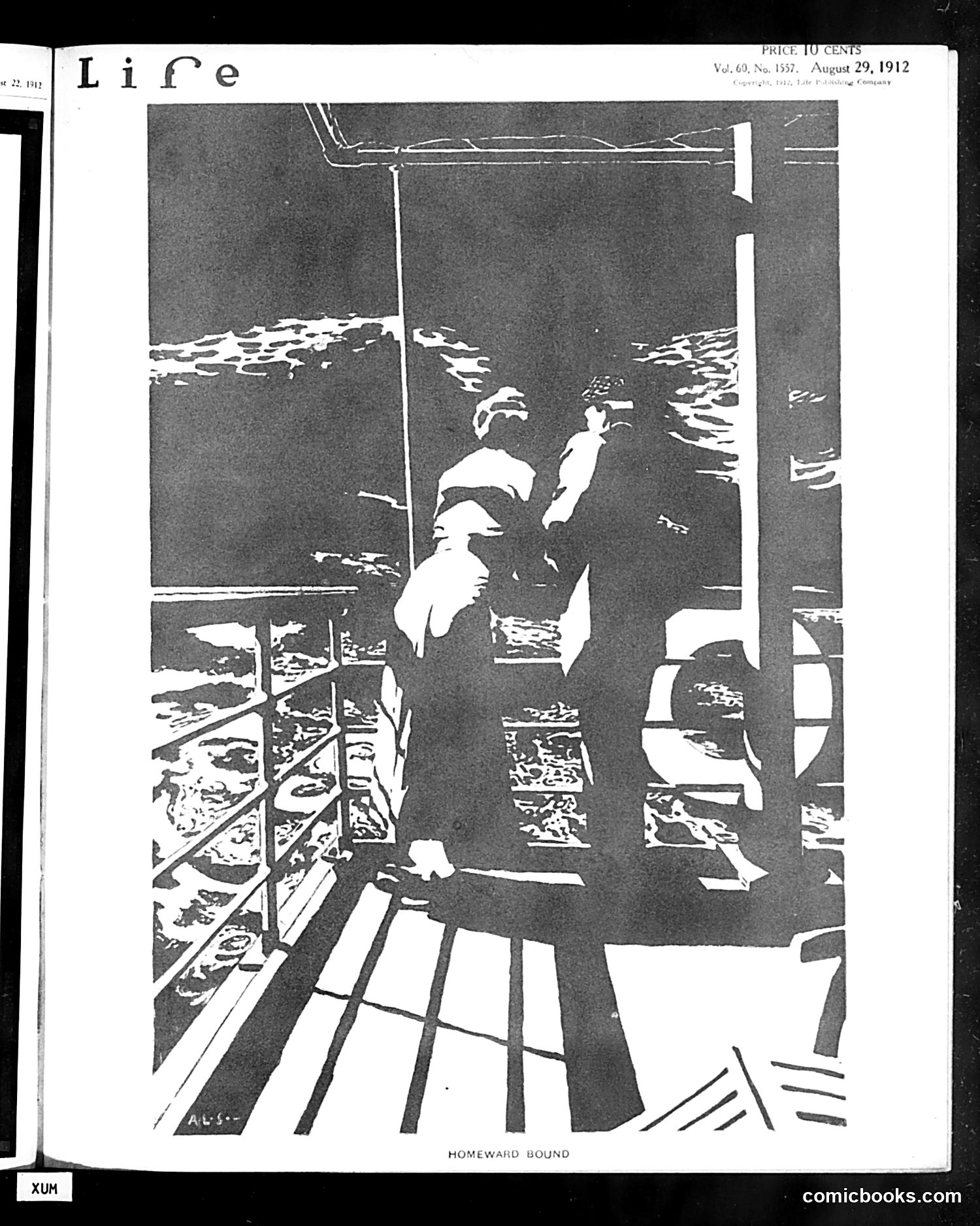
**Title:** "Homeward Bound" This cartoon depicts passengers on what appears to be a ship's deck looking out at the ocean. The image shows people in early 1900s attire gazing at the water from the vessel's railings and windows. Without additional context or caption text visible in the image, the specific satirical point remains unclear. However, given the 1912 date and "Homeward Bound" title, this likely references contemporary maritime travel or possibly alludes to a notable shipping event from that period. The perspective emphasizes the passengers' vantage point and their apparent contemplation of the voyage. The OCR text provided contains no readable captions that would clarify the cartoon's intended political or social commentary.
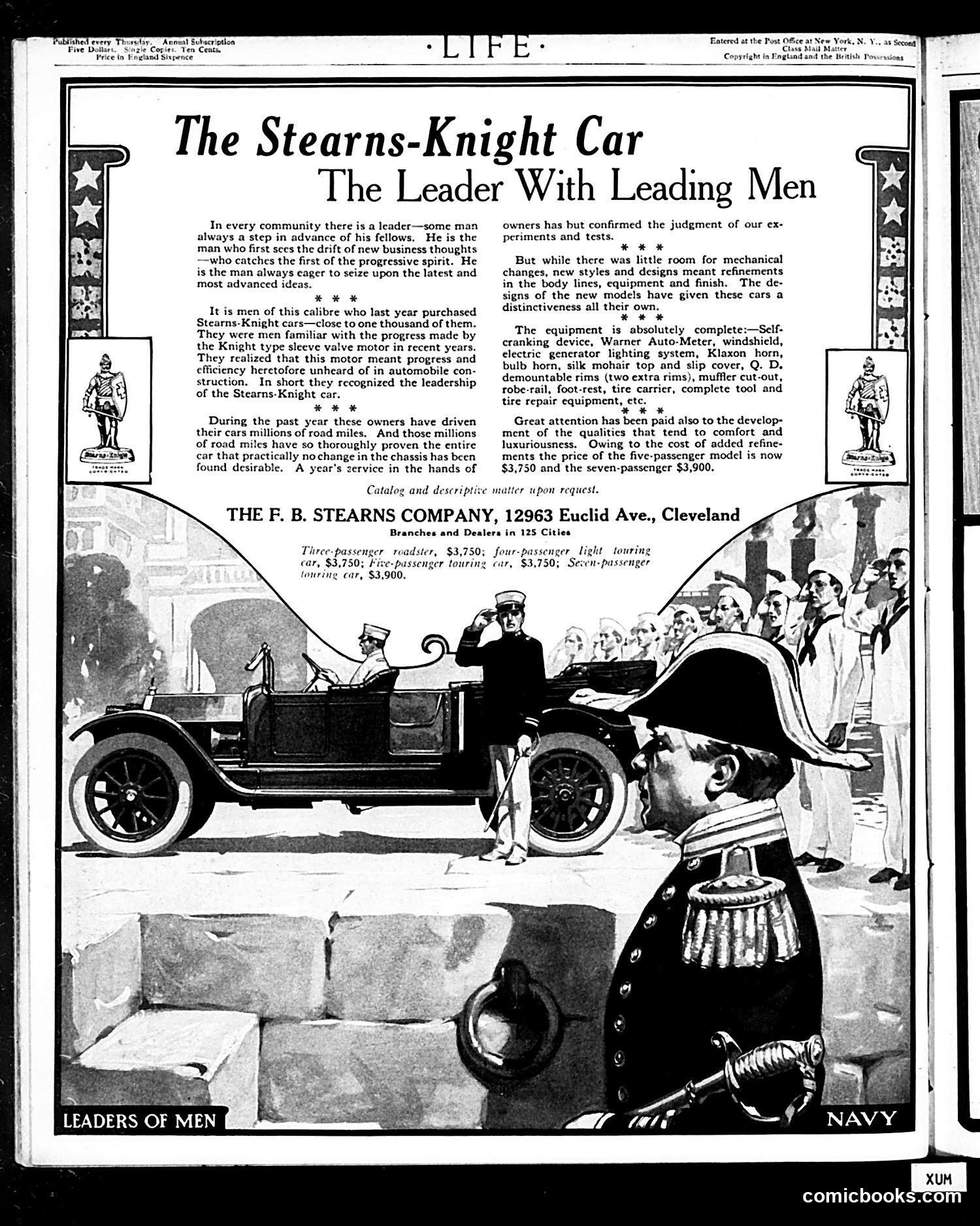
This page is primarily **advertising, not satire**. It promotes the Stearns-Knight automobile from The F.B. Stearns Company in Cleveland. The main illustration depicts a naval officer in dress uniform admiring a Stearns-Knight car, with the caption "LEADERS OF MEN" and "NAVY." The ad's headline claims "The Leader With Leading Men," arguing that prominent figures—including military officers—choose this vehicle. The text boasts of the car's technical innovations (sleeve valve motor, Warner Auto-Meter, electric lighting) and competitive pricing ($3,750-$3,900). The naval officer imagery appears designed to associate the automobile with authority, leadership, and prestige. This is straightforward product promotion using status symbols rather than political commentary or satire.
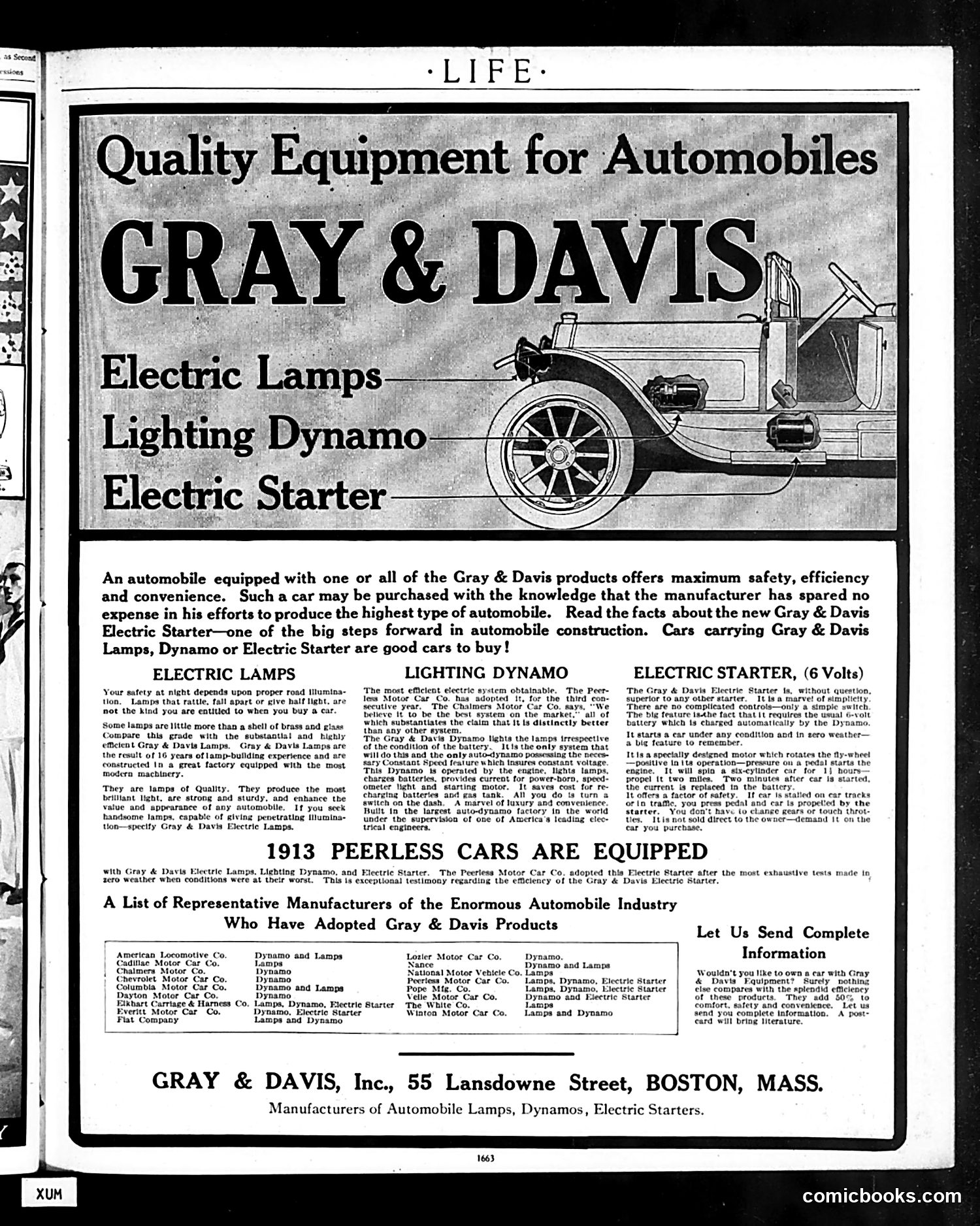
This page is primarily **advertising, not satire or cartoon content**. It's a full-page advertisement for Gray & Davis, Inc., a Boston-based manufacturer of automobile electrical equipment (lamps, dynamos, and electric starters). The ad features a simple line drawing of an early 1910s automobile with its door open, illustrating the products being sold. The text emphasizes quality and safety features, listing numerous automobile manufacturers who adopted Gray & Davis products, including Peerless Motor Company. There is **no political satire, caricature, or joke** on this page. It represents straightforward early-20th-century industrial advertising aimed at car buyers and manufacturers, demonstrating how automobiles were being marketed as premium products requiring quality electrical components.
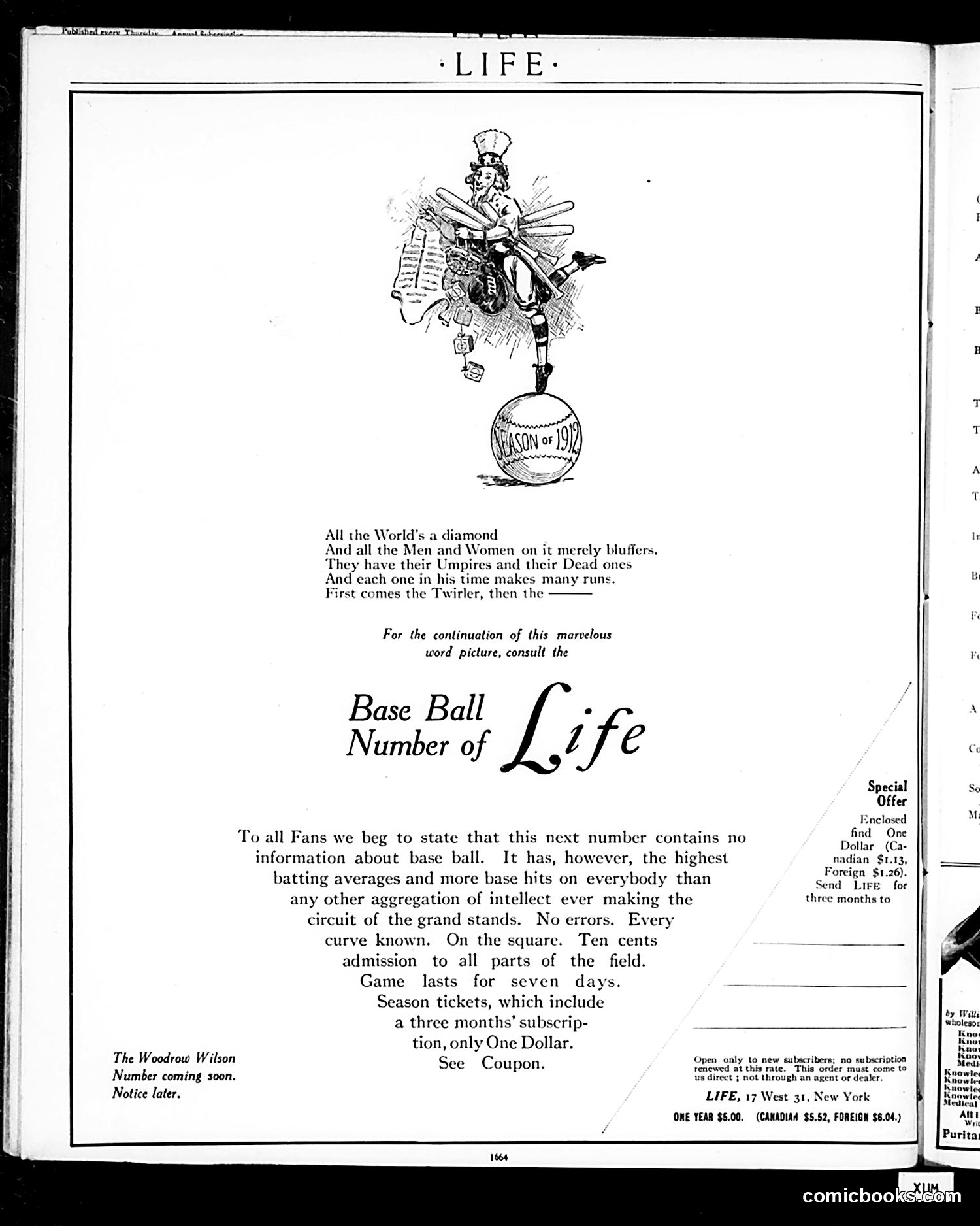
This page is primarily **advertising** for Life magazine's "Base Ball Number," promoting an upcoming baseball-themed issue. The central illustration depicts a chaotic figure juggling multiple items while balancing on a baseball marked "Season of 1907," representing the complexity and excitement of the baseball season. The accompanying verse playfully references Shakespeare ("All the world's a diamond") and establishes baseball as America's central cultural obsession, with references to "Umpires" and "Dead ones" (likely meaning retired players). The advertisement emphasizes this special baseball number contains "the highest batting averages and more base hits on everybody than any other aggregation of intellect ever making the circuit of the grand stands"—essentially claiming superior baseball coverage and analysis. The offer: a three-month subscription to Life for one dollar.
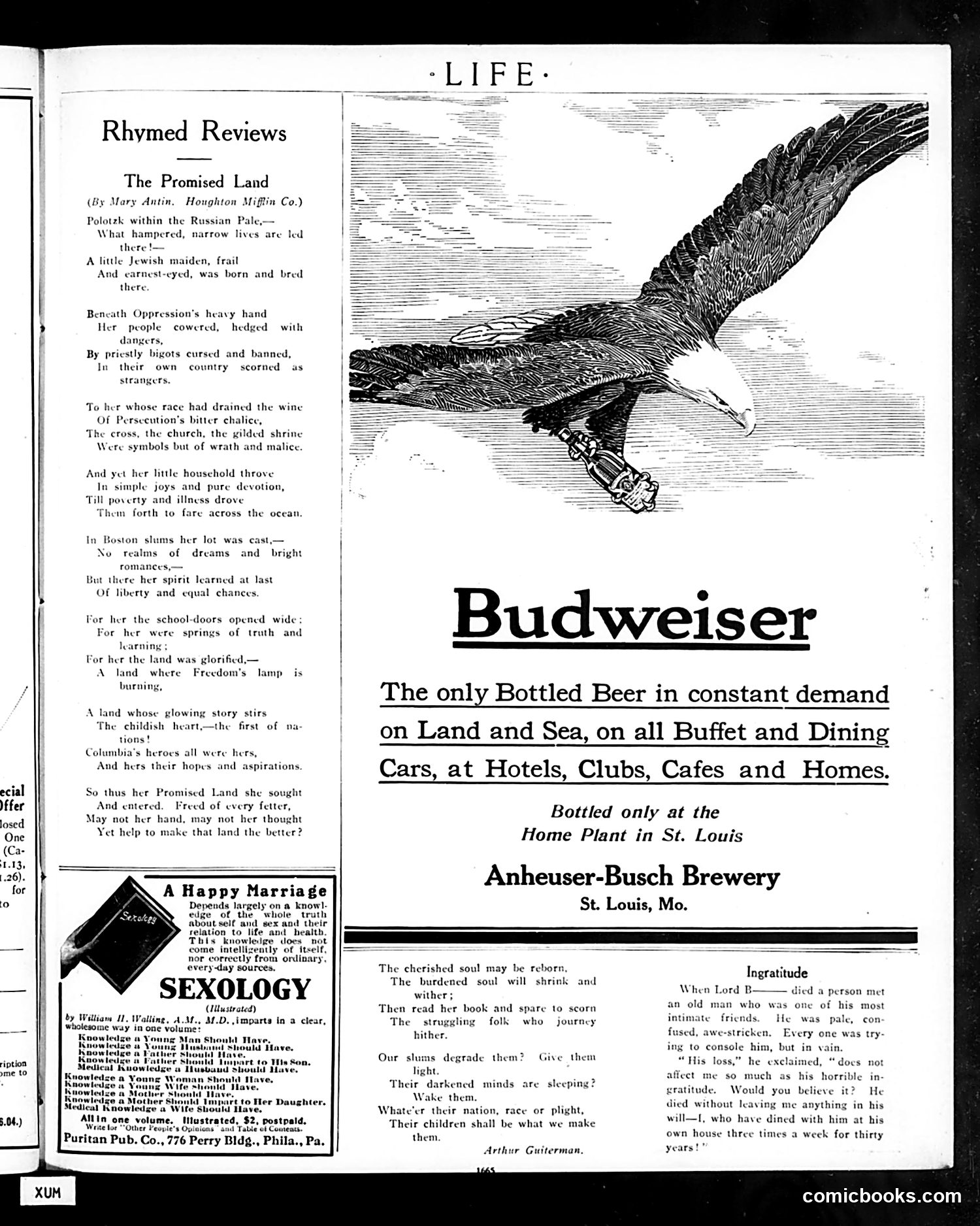
This page is primarily **advertising and poetry**, not political satire. The left column features "The Promised Land," a poem by Mary Antin about Jewish immigration to America, depicting escape from Russian persecution and oppression to find freedom and education in Boston and beyond. Below is an advertisement for a **Sexology book** by William H. Walling, marketed as medical knowledge for married couples. The dominant right-side advertisement is for **Budweiser beer** by Anheuser-Busch (St. Louis), featuring an eagle carrying a bottle. The ad claims it's "The only Bottled Beer in constant demand on Land and Sea, on all Buffet and Dining Cars." The bottom includes a poem on the soul and children's upbringing, and an "Ingratitude" anecdote about Lord B. There is **no political cartoon** on this page—it's a standard magazine layout mixing editorial content with period advertising.
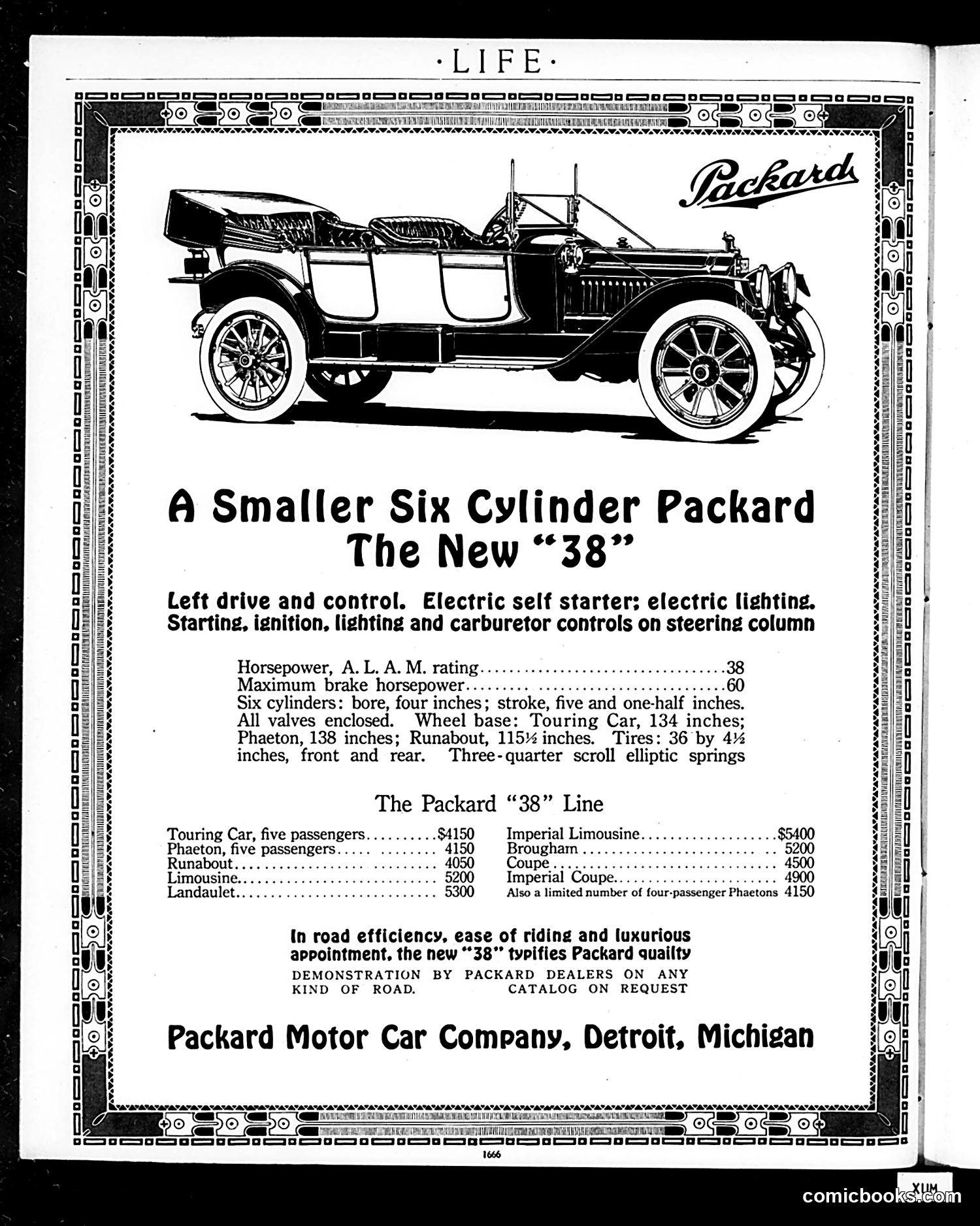
This is **not a cartoon or satirical content** — it's a straightforward automobile advertisement for the Packard Motor Car Company of Detroit, Michigan. The page features a technical illustration of the Packard "38," a six-cylinder touring car, alongside detailed specifications (horsepower, engine bore/stroke, wheelbase, tire dimensions, etc.) and pricing for various body styles ($4,150–$5,500). The advertised features emphasize luxury and modern convenience: left-hand drive, electric self-starter, electric lighting, and steering-column controls — innovations that would have appealed to affluent early 20th-century buyers. This represents standard commercial advertising from Life magazine's era, promoting premium automobiles to wealthy readers rather than political or social satire.
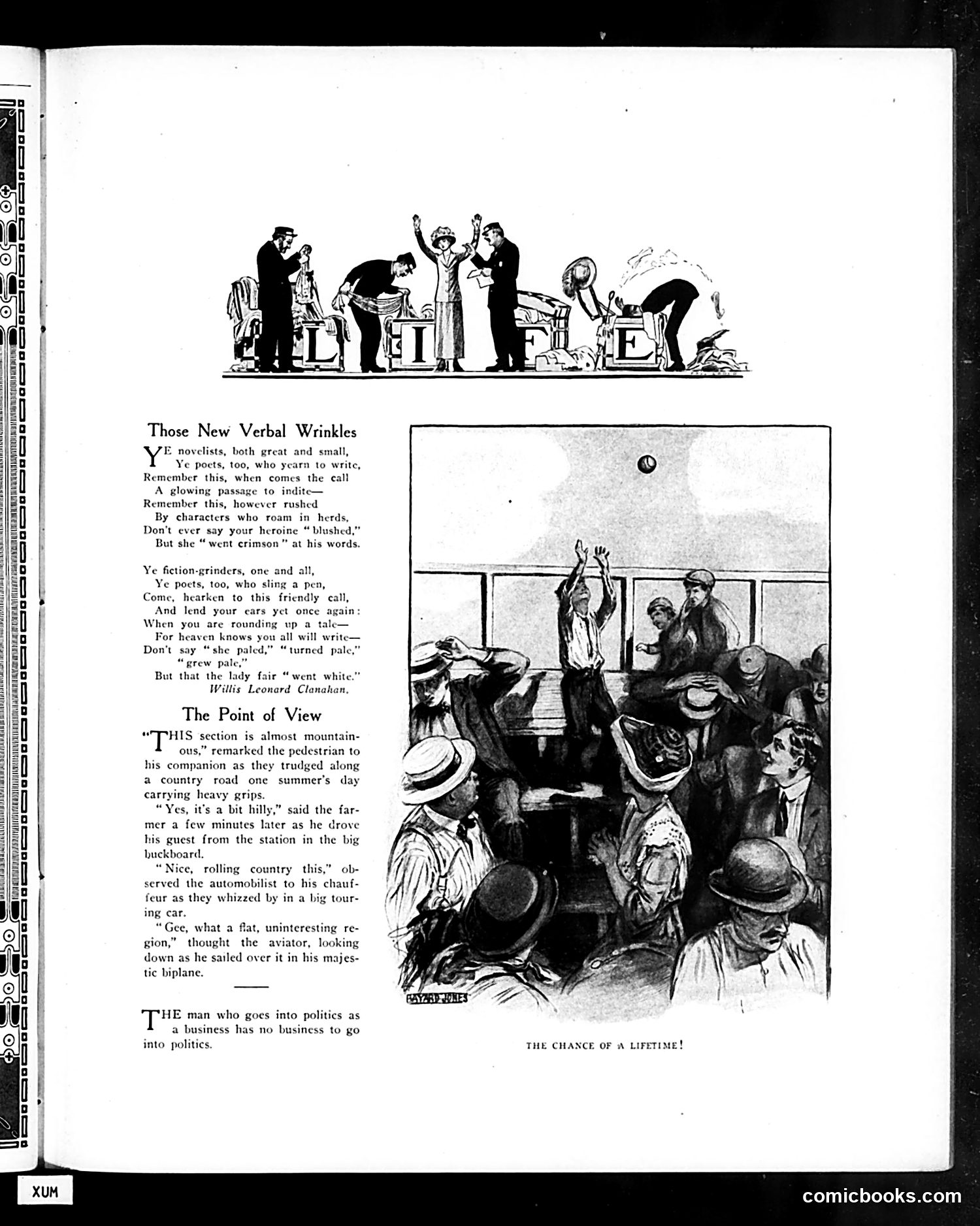
This page contains two separate pieces: **Top cartoon**: A decorative header showing people at desks labeled with letters, illustrating writing or literary work. **"Those New Verbal Wrinkles"**: A poem by Willis Leonard Clanahan advising writers against using outdated clichés. It specifically warns against phrases like "blushed," "went crimson," "paled," "turned pale," and "went white" when describing female characters' emotional reactions. The satire targets overworn Victorian literary conventions that Life's audience would recognize as tired, melodramatic writing. **"The Point of View"**: A sketch depicting an automobile driving through mountainous countryside, with a farmer commenting on the "flat, uninteresting region" as seen from the car. The cartoon satirizes how technology (automobiles) changes perspective—literally and figuratively—altering how people experience landscape.
This is **not a cartoon or satire page** — it's a **straightforward automobile advertisement** from Life magazine's advertising section. The page promotes the Packard Motor Car Company's new "38" model, a six-cylinder luxury automobile made in Detroit, Michigan. The ad emphasizes modern features: electric self-starter, electric lighting, left-hand drive, and steering-column controls. The text lists various body styles (Touring Car, Phaeton, Runabout, Limousine, etc.) with prices ranging from $4150 to $5400 — substantial sums for the era, indicating this was a premium vehicle. There is **no political commentary, satire, or social critique** present. This is purely product marketing aimed at affluent buyers seeking a quality automobile.
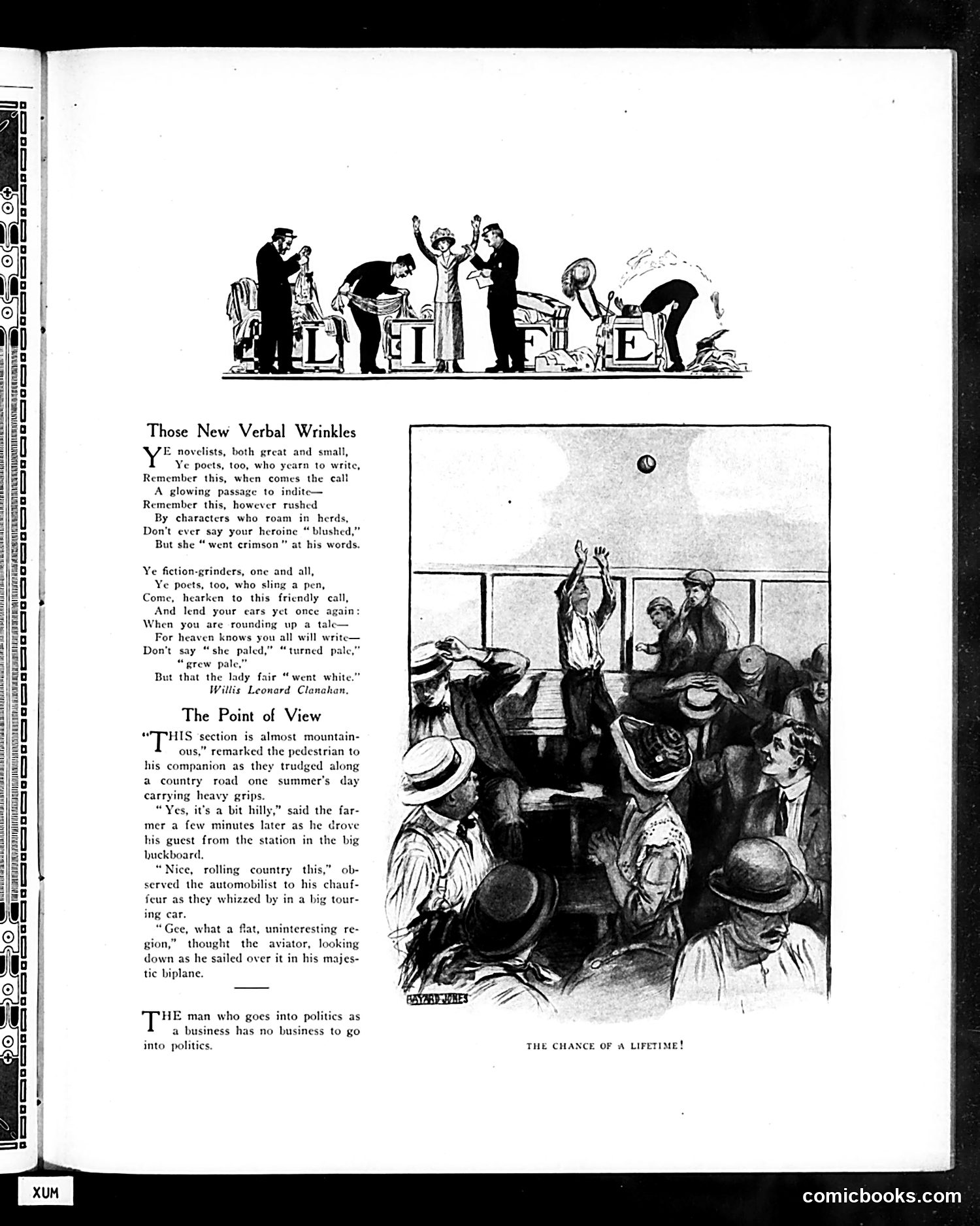
This page contains two pieces of satirical commentary: **"Those New Verbal Wrinkles"** is a poem by Willis Leonard Clanaham addressing writers about outdated descriptive language. It mocks novelists and poets for using clichéd phrases like "blushed," "went crimson," "paled," and "went white" when depicting female characters' emotional reactions. **"The Point of View"** presents a short scene about an automobile ride, with the accompanying illustration showing multiple figures observing an airplane overhead. The humor appears to derive from contrasting perspectives—wealthy passengers in a car versus common people on the ground—experiencing the same spectacle differently. The caption "THE CHANCE OF A LIFETIME!" suggests ironic commentary on access to new technology or experiences based on social class.
This is a political commentary piece from *Life* magazine (August 29, 1912) discussing Colonel Theodore Roosevelt and his political ambitions. The text critiques Roosevelt's reputation and his apparent desire to remain influential in politics despite having left office. The main argument: Roosevelt is being urged by admirers to re-enter politics, but the article warns this would be unwise. It compares his situation to wealthy businessmen who retire then attempt dangerous new ventures—suggesting his return would damage his legacy. The piece acknowledges Roosevelt's genuine accomplishments and popularity ("extraordinary store of fame"), but argues his best course is dignified retirement rather than pursuing further office. The tone is cautionary rather than harshly satirical, suggesting internal *Life* debate about Roosevelt's continued political relevance in the 1912 election period. The illustrations appear decorative rather than carrying specific satirical content.
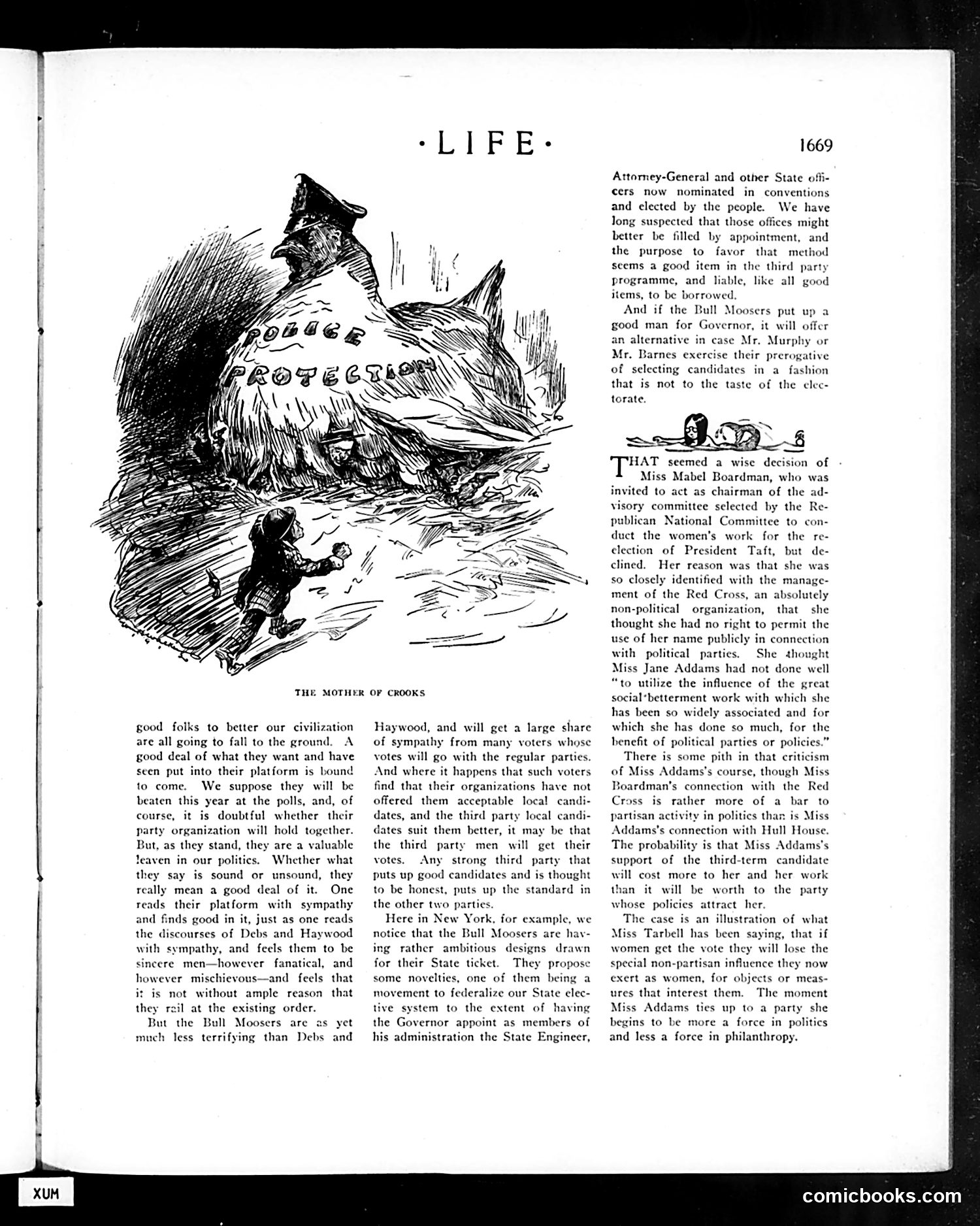
The cartoon depicts a large hen labeled "DODGE PROTECTION" brooding over chicks, with a small figure (likely representing a politician or voter) approaching below. The satire critiques the "Bull Moosers"—supporters of Theodore Roosevelt's Progressive Party (symbolized by the protective hen). The text argues that while the Bull Moosers present themselves as offering honest alternatives to corrupt establishment parties, they actually function as a breeding ground for political corruption and poor governance. The "mother of crooks" metaphor suggests that the Progressive Party, despite reform rhetoric, merely incubates the same corrupt politicians and practices they claim to oppose. The cartoon mocks their third-party candidacies as ineffectual and potentially dangerous to the existing political order.
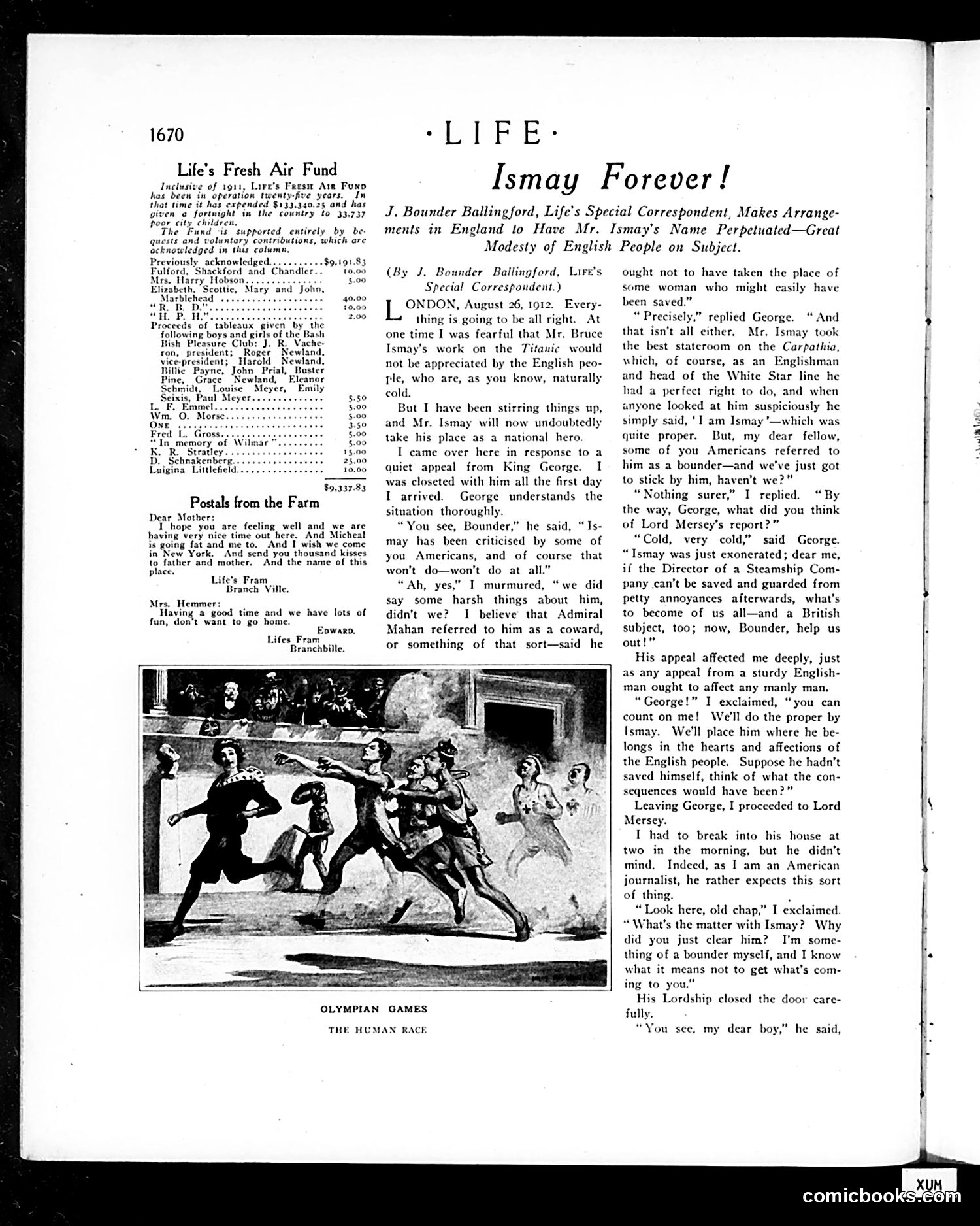
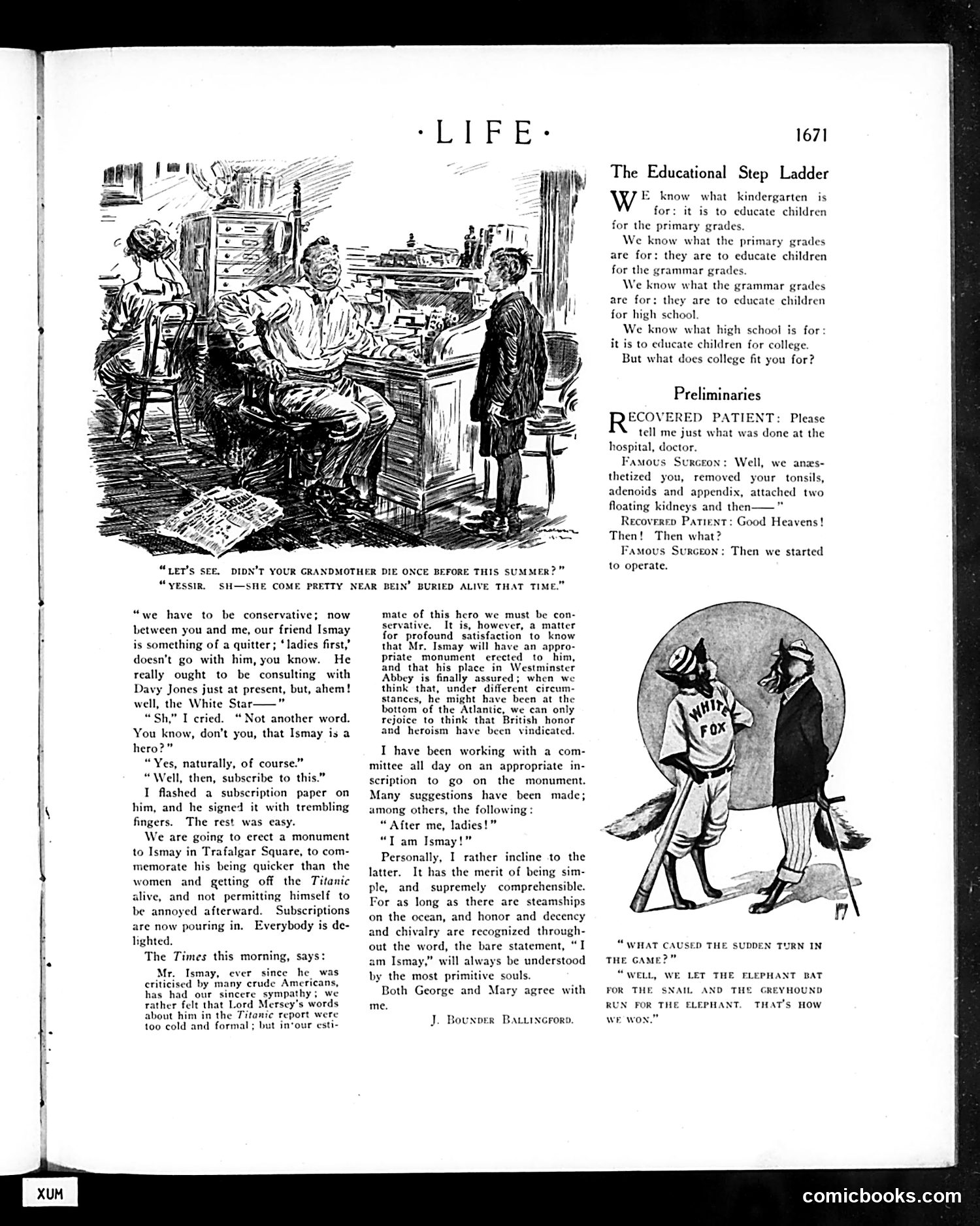
This page contains two distinct cartoons and accompanying text discussing early 1900s social topics. **Top cartoon**: Shows a doctor addressing a wealthy patient about surgical procedures (tonsils, adenoids, appendix removal), satirizing aggressive medical interventions of the era. **Bottom cartoon**: Depicts a woman labeled "Whiffing Fox" with a man, likely mocking sports or gambling culture. The caption references "the elephant bat for the snail and the greyhound" — appears to be absurdist wordplay about game animals or betting. **Text sections**: Include discussion of the Titanic disaster, monument proposals for Ismay (the ship's owner/captain), and debates about British honor. There's also "The Educational Step Ladder" — satirizing how education supposedly prepares children for specific life roles. The overall tone critiques both medical overtreatment and contemporary social pretensions.
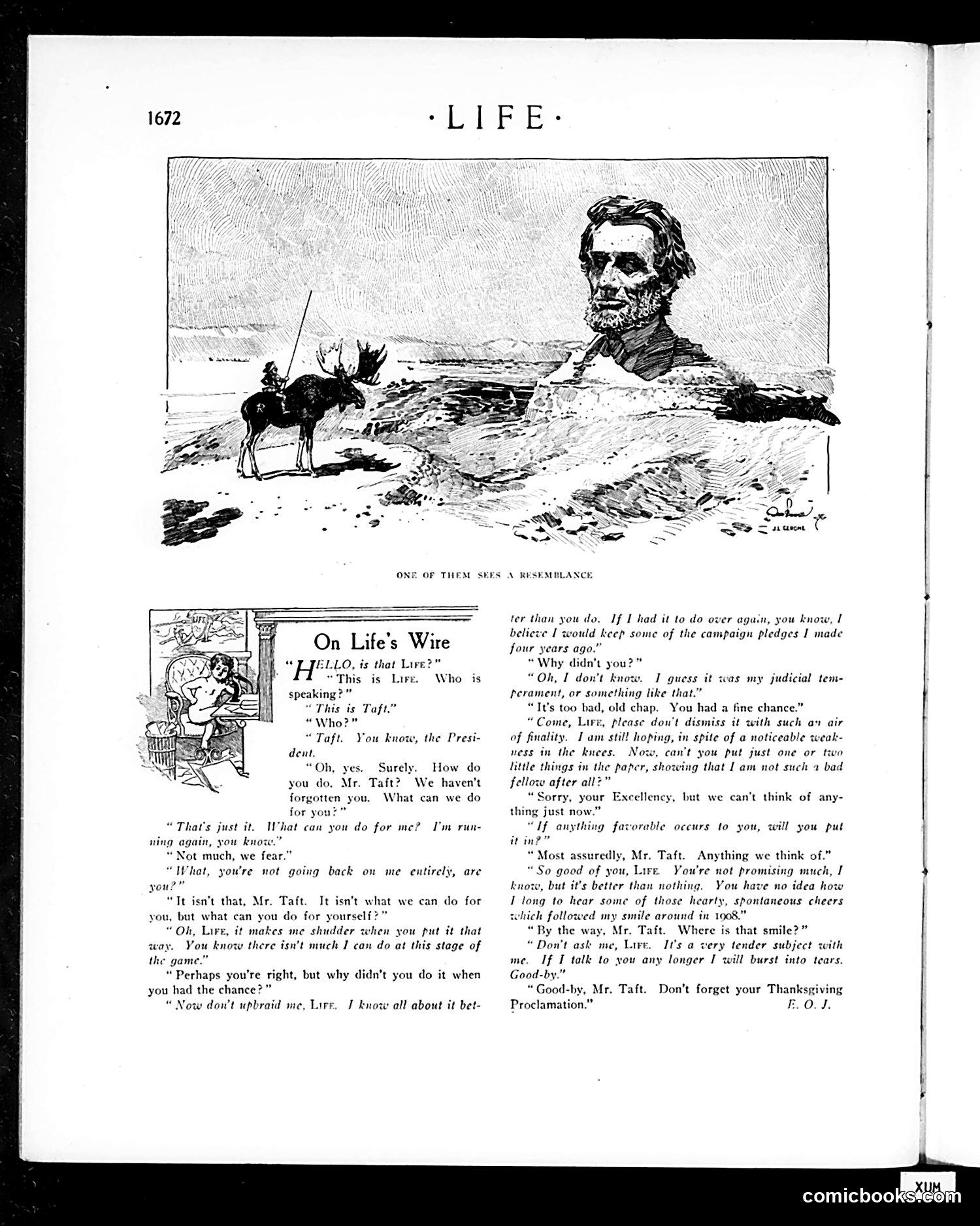
The page features a satirical dialogue titled "On Life's Wire" between two characters: **Lire** and **Mr. Taft** (likely President William Howard Taft, based on the formal title and historical context of Life magazine's political satire). The cartoon depicts Taft as a large head emerging from rocky terrain with a moose nearby—referencing **Theodore Roosevelt's famous 1909 hunting expedition** and the broader split between Roosevelt and Taft's Republican faction. The dialogue mocks Taft's political struggles, with Lire urging him not to abandon his campaign pledges despite poor circumstances. The satire emphasizes Taft's weak political position and suggests he's compromising his principles under pressure—a commentary on his troubled presidency and the growing rift with Roosevelt that would lead to the 1912 party split.
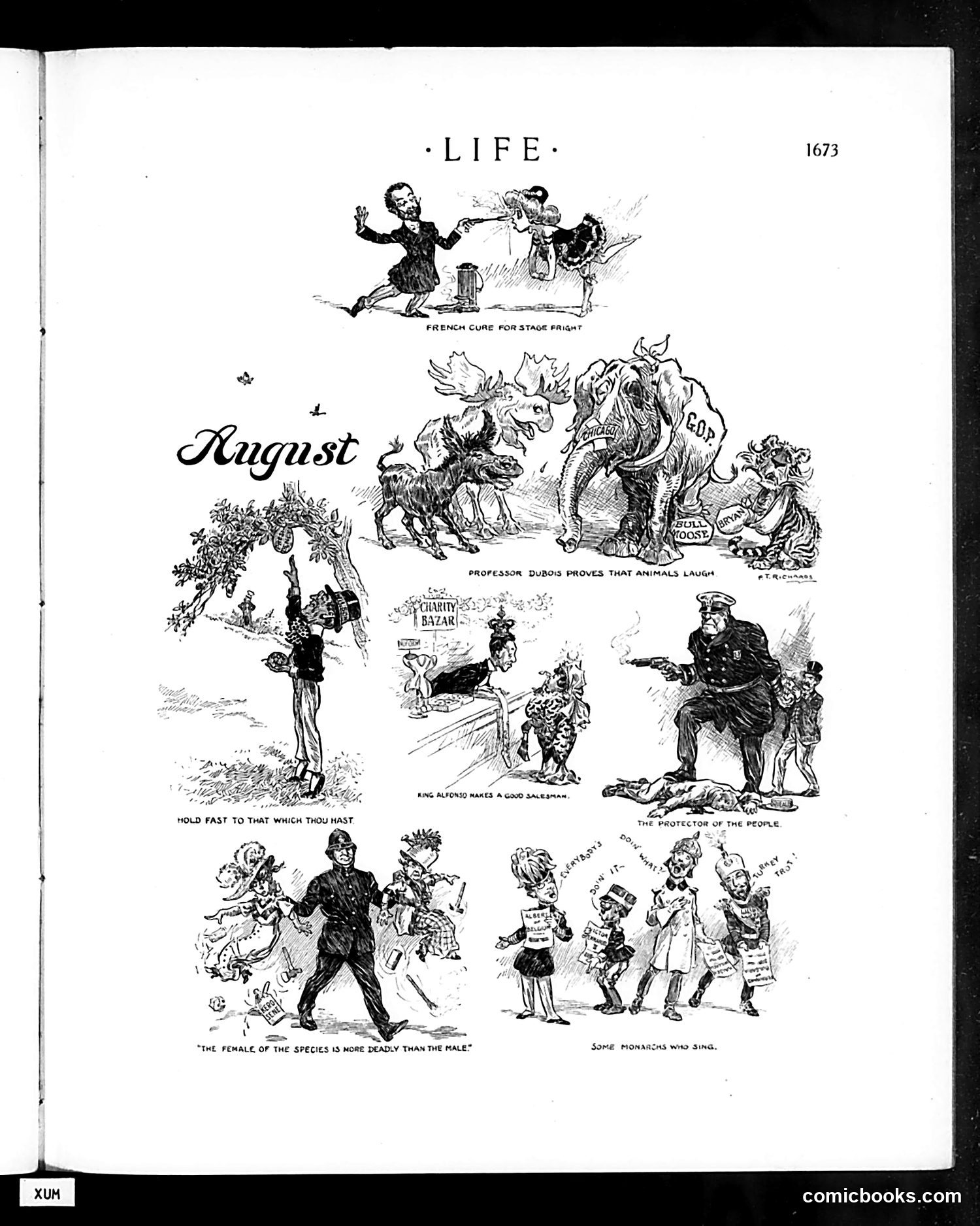
This page contains multiple political cartoons satirizing contemporary figures and issues. The captions reference: - **"French Cure for Stage Fright"** — likely mocking French theatrical or political practices - **"Professor Dubois Proves That Animals Laugh"** — satirizing pseudoscientific claims - **"King Alfonso Makes a Good Salesman"** — appears to reference Spain's King Alfonso and commercial/political dealings - **"The Protector of the People"** — ironic commentary on a political leader's claimed role - **"The Female of the Species is More Deadly Than the Male"** — referencing Kipling's famous poem, applied to female political/social figures - **"Some Monarchs Who Sing"** — mocking various rulers' pretensions The cartoons employ exaggerated caricature typical of satirical journalism. Without clearer identification of specific individuals depicted, the precise political targets remain partially unclear, though the overall tone criticizes political hypocrisy, false claims, and monarchical authority.
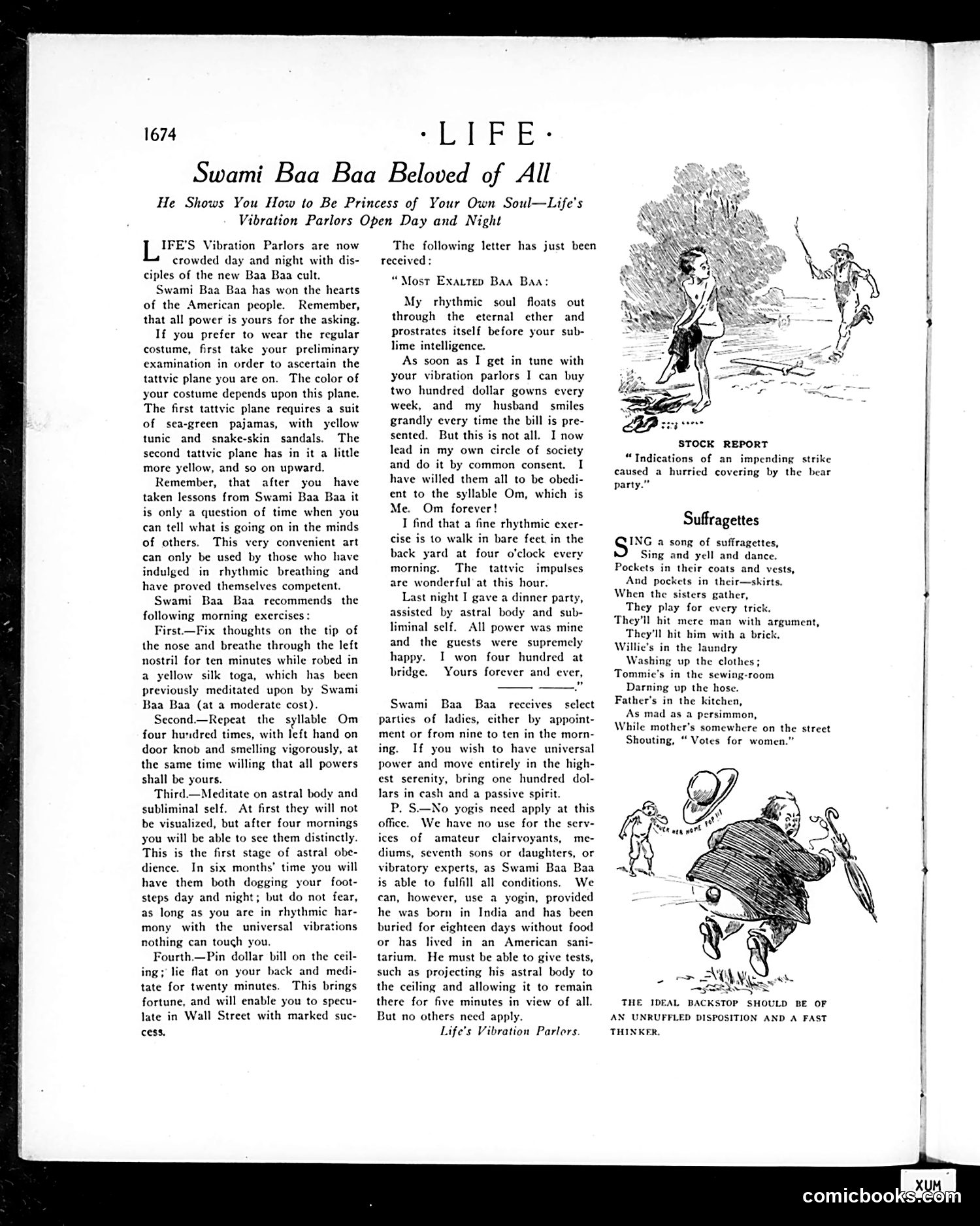
This page satirizes the early 1900s craze for Eastern mysticism and "New Thought" spirituality among wealthy Americans, particularly women. "Swami Baa Baa" appears to be a fictional charlatan running "Vibration Parlors"—establishments promising spiritual enlightenment through elaborate, nonsensical rituals (breathing exercises, meditating on dollar bills, wearing colored pajamas based on "tattvic planes"). The satire targets gullible wealthy clients, especially women seeking social power and financial gain. A testimonial letter from a female client reveals the real appeal: buying expensive gowns, winning at bridge, and dominating her social circle—all framed as spiritual achievement rather than materialism. The joke is the transparent con: spiritual instruction costs money, requires specific costumes (sold separately), and conveniently produces wealth. Life mocks both the fake gurus exploiting spiritual fashion and the clients who mistake consumerism for transcendence.
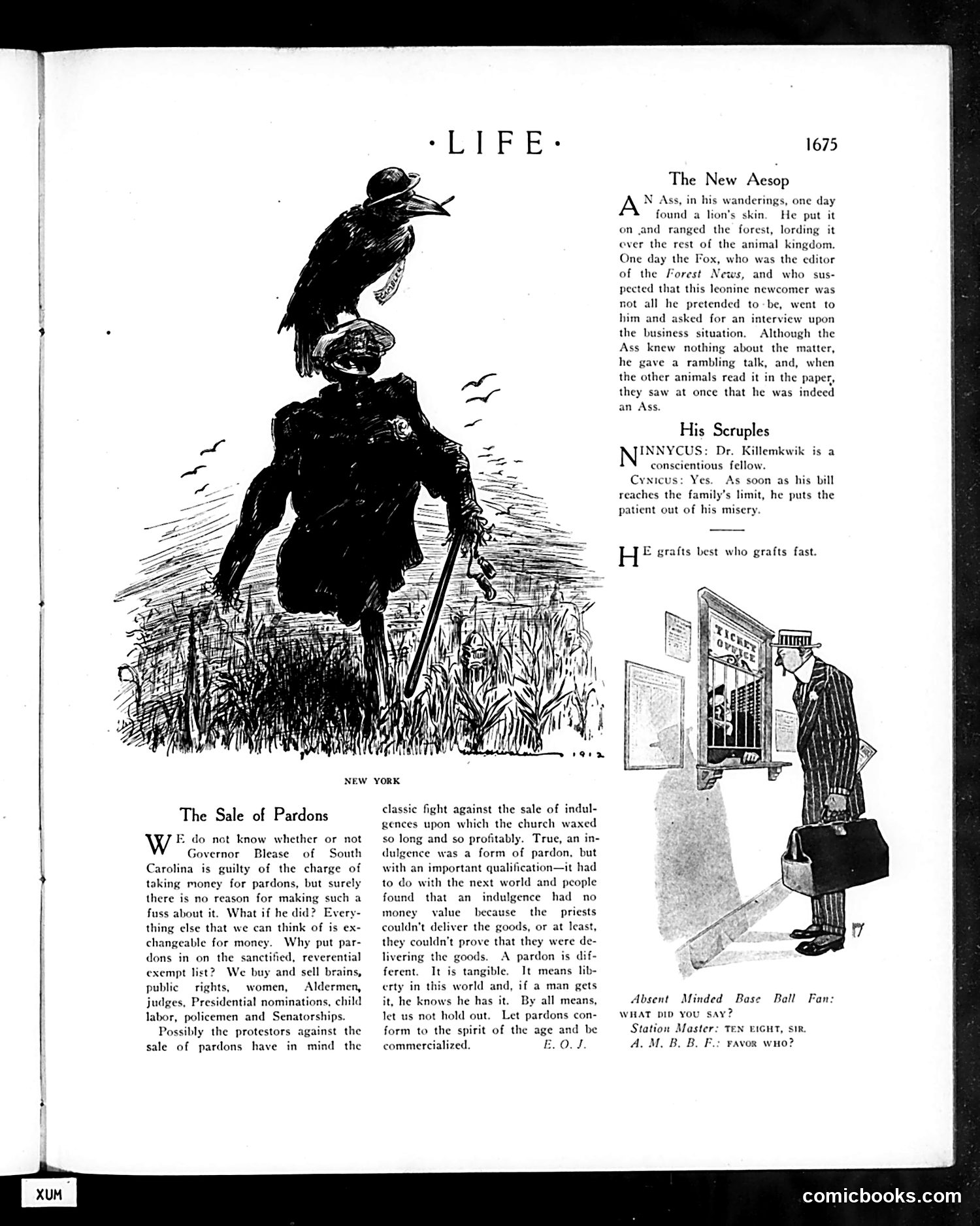
This page contains three satirical pieces attacking corruption and hypocrisy in 1920s America: **"The Sale of Pardons"** mocks Governor Blease of South Carolina (apparently accused of accepting bribes for pardons). The satirist argues cynically that since everything else—brains, judges, political nominations—is already "for sale," why exempt pardons? The piece sarcastically compares selling pardons to the historical Church selling indulgences, noting the key difference: pardons actually deliver tangible freedom in this world, making them genuinely valuable and thus commercializable. **"The New Aesop"** uses a fable format: an Ass wears a lion's skin to fool the forest, but when interviewed by the Fox (a newspaper editor), his rambling ignorance exposes him as a fraud. This appears to mock politicians or public figures who hide behind appearances but reveal their incompetence when questioned. **"His Scruples"** presents a dark joke about Dr. Killemkwik, supposedly conscientious—but only because once a patient's bill reaches the family limit, he "puts the patient out of his misery" (kills them). This satirizes medical profiteering. Together, these pieces attack corruption across government, media, and medicine.
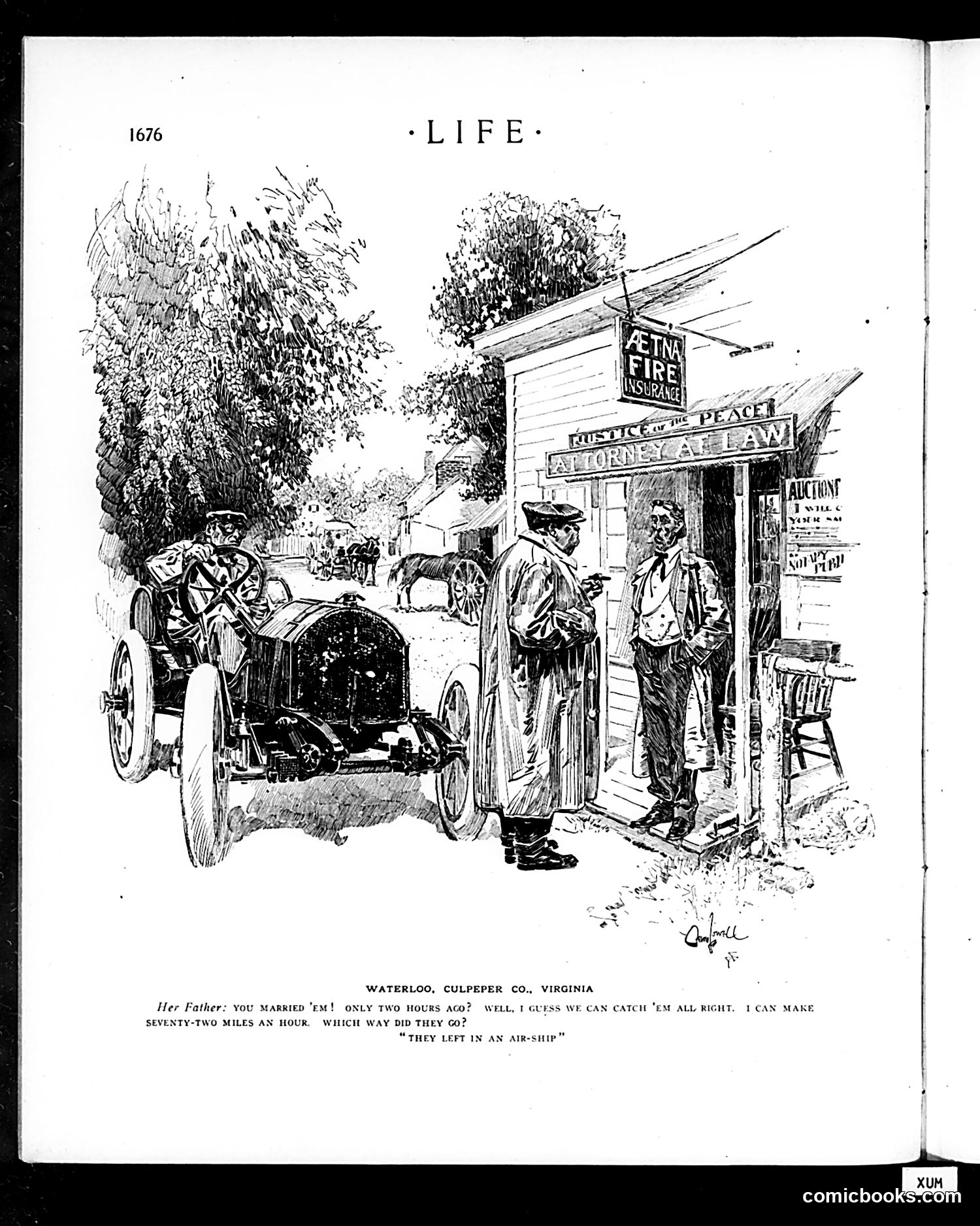
This cartoon satirizes early aviation's rapid advancement and its disruption of traditional society. Set in rural Virginia, an angry father pursues his daughter who eloped just two hours prior. He boasts he can chase them at seventy-two miles per hour—extraordinarily fast for 1676 (the page number). The punchline: the couple escaped in an "air-ship" (airship/early aircraft), making his ground-based pursuit impossible. The joke critiques how aviation technology is rendering conventional pursuits literally futile and upending social conventions. The contrast between the father's proud speed and the newlyweds' aerial escape mocks both dated courtship customs and society's struggle to adapt to modern technology. The rural setting emphasizes how aviation was transforming even remote communities.
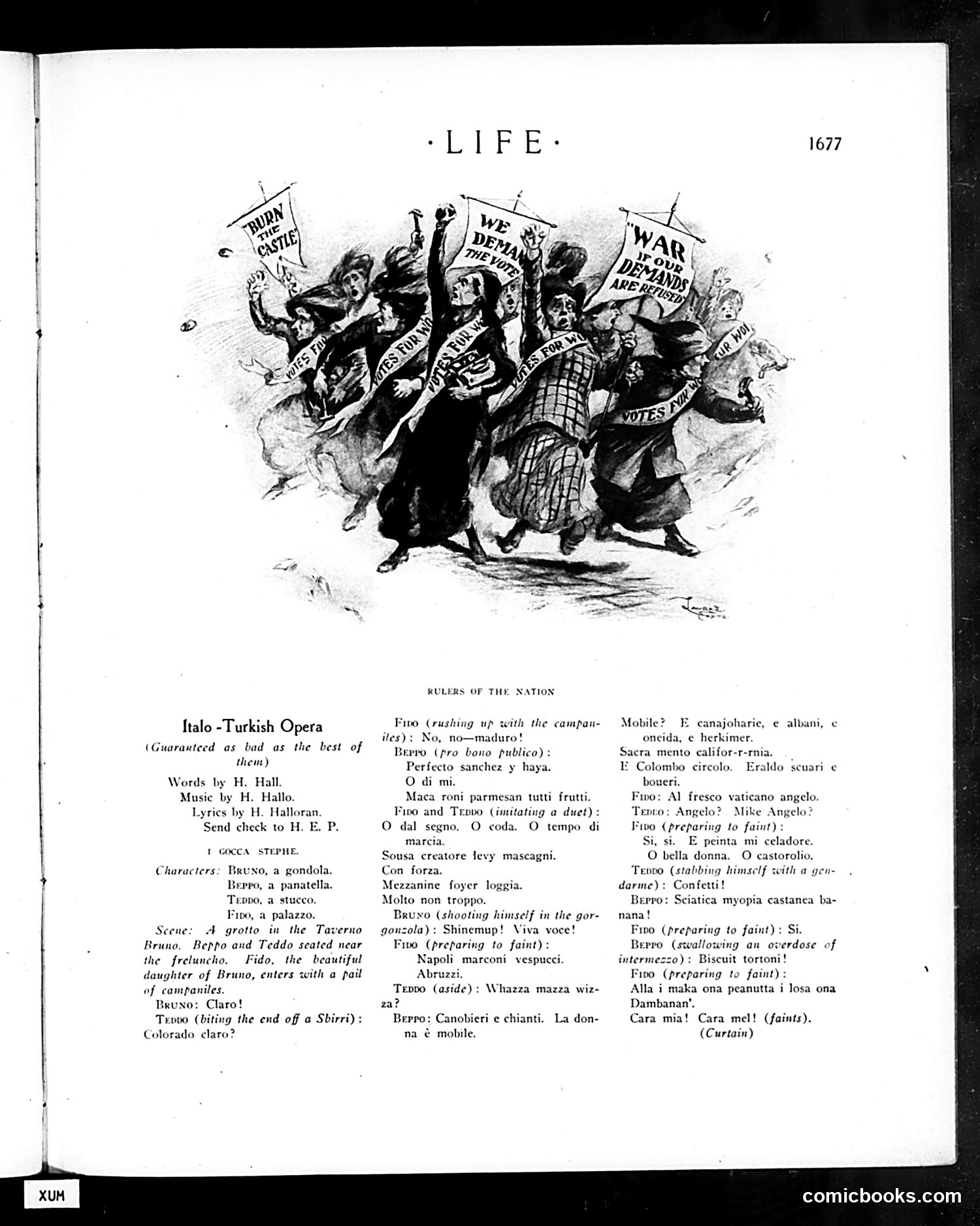
This is a parody of contemporary Italian opera, mocking both the genre's dramatic absurdity and the recent Italo-Turkish War (1911-1912). The "opera" features nonsensical dialogue mixing Italian words, musical terminology, food items ("panatella," "gondola," "biscuit tortoni"), and random proper nouns strung together without coherent meaning. The cartoon above—labeled "Rulers of the Nation"—depicts chaotic figures waving protest signs demanding war, suggesting political agitation or warmongers influencing national policy. Together, the page satirizes how opera distorts reality through overwrought emotion and incomprehensible spectacle, while implying that political rhetoric about war operates similarly—full of sound and fury, signifying nothing. The humor relies on absurdist juxtaposition: treating serious military conflict and nationalistic demands with the same dismissive mockery applied to operatic excess.
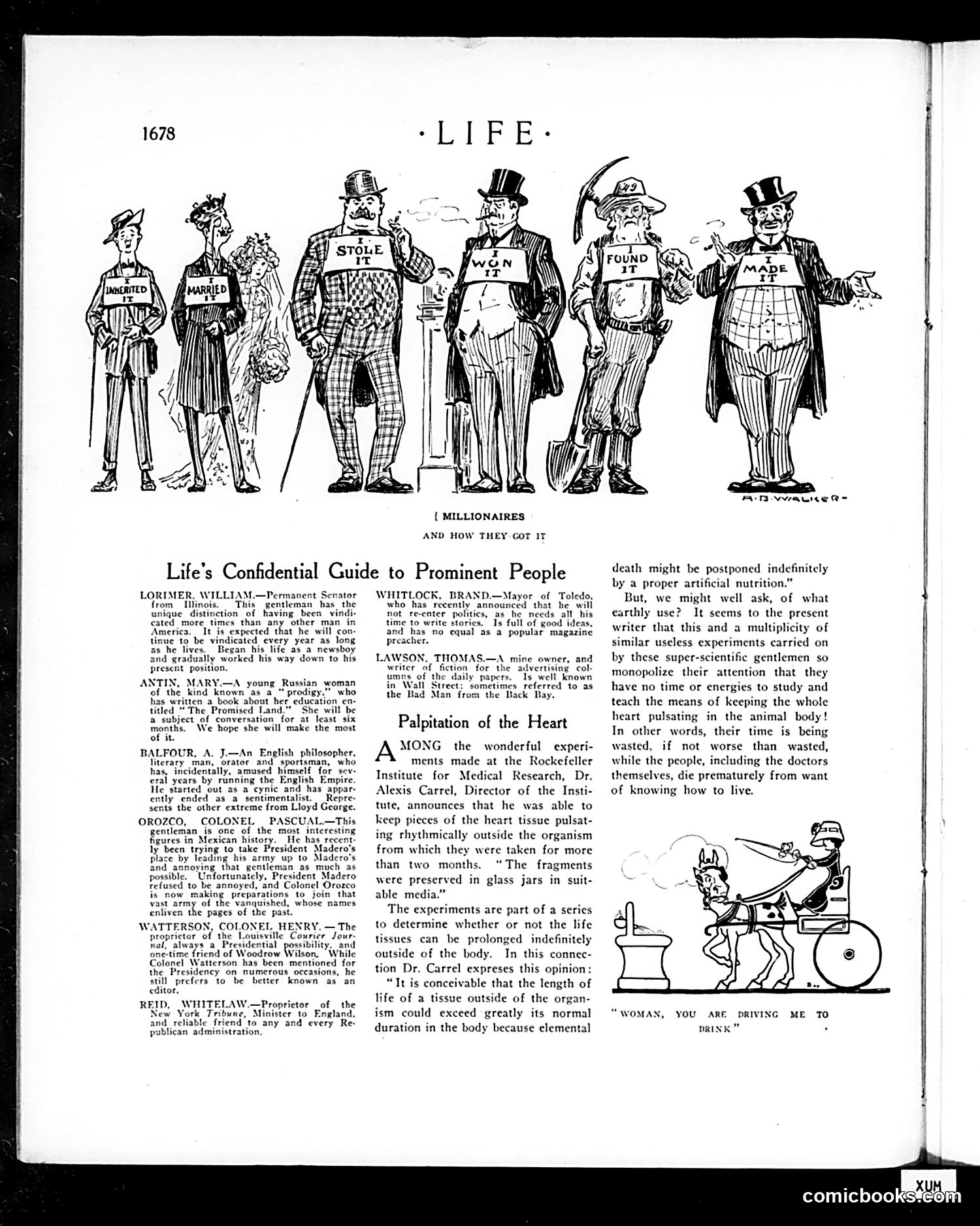
This page combines two satirical features. The top cartoon depicts six "millionaires and how they got it," each labeled with their dubious path to wealth: "INHERITED," "MARRIED," "STOLE IT," "WON IT," "FOUND IT," and "MADE IT." This is social satire mocking how the wealthy accumulate fortunes through morally questionable means rather than honest work. Below is "Life's Confidential Guide to Prominent People"—brief, mocking biographical sketches of contemporary figures including Senator William Lorimer (characterized as repeatedly "vindicated" despite scandal), English philosopher Balfour, and various politicians and publishers. The tone is consistently irreverent, using backhanded compliments and ironic observations about their actual accomplishments. The "Palpitation of the Heart" section critiques Dr. Alexis Carrel's medical experiments keeping heart tissue alive in jars—dismissing the research as pointless when doctors cannot even teach people how to live healthily. The cartoon caption "Woman, you are driving me to drink" provides dark humor. Overall, the page attacks institutional corruption, pretentiousness, and misplaced scientific priorities.
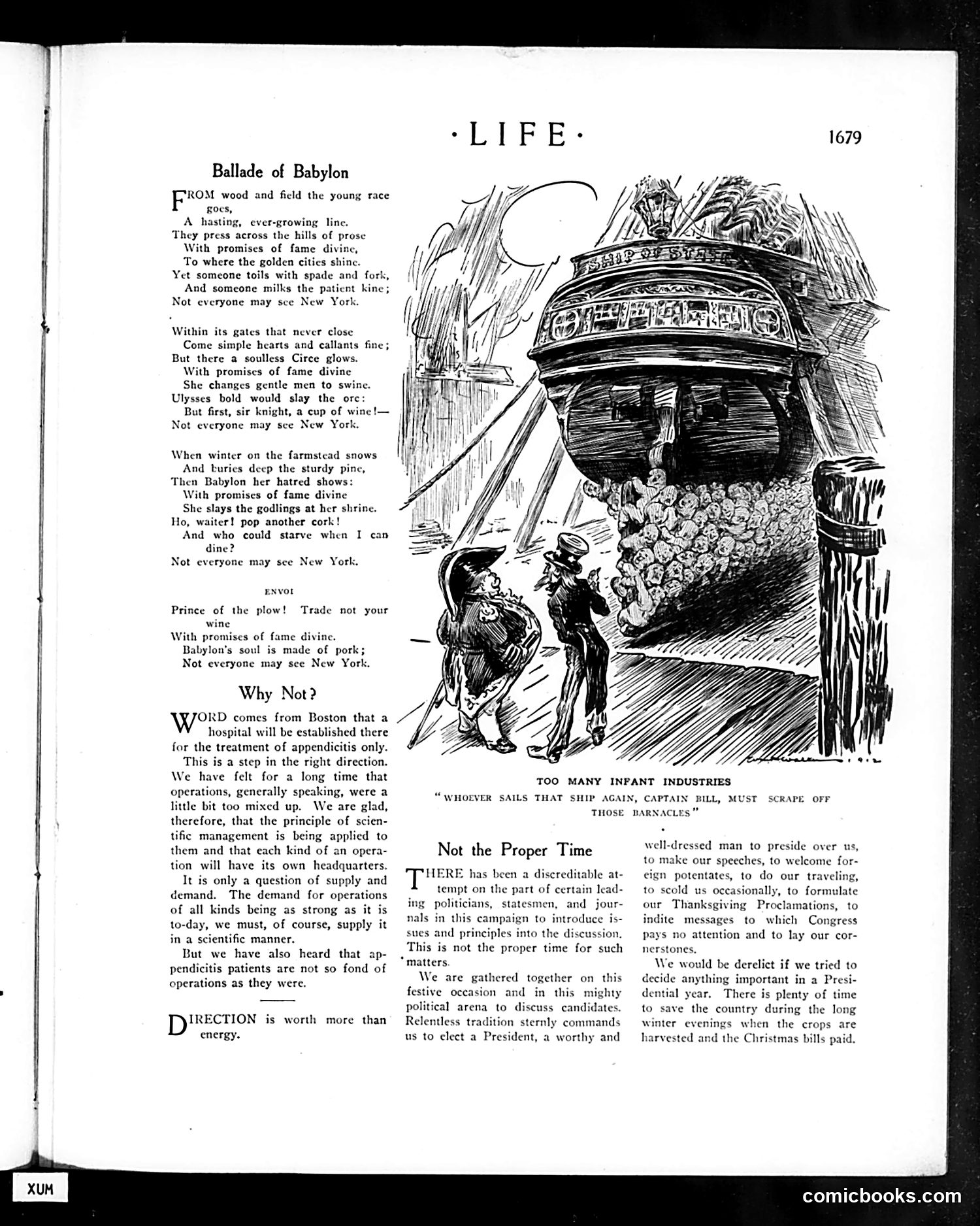
This 1679 *Life* magazine page contains satirical poetry and commentary mocking American urbanization and political campaigns. **"Ballade of Babylon"** uses New York City as a corrupt temptress ("Babylon") luring rural Americans with promises of fame and fortune. The repeated refrain "Not everyone may see New York" ironically laments those trapped in agricultural labor. The poem warns farmers against trading honest work for city life's false glamour—New York's wealth is built on exploitation ("made of pork," suggesting meat-packing industry abuses). **The cartoon** depicts a ship labeled with industrial symbols, covered in "barnacles" (excessive regulations/inefficient practices). "Captain Bill" must scrape them off—likely satirizing government's failure to modernize or regulate growing industries during this period of rapid industrialization. **"Not the Proper Time"** sarcastically attacks politicians avoiding substantive policy debate during elections, instead focusing on ceremonial presidential duties. It mocks the notion that serious national problems should wait until after harvest season—skewering how campaigns prioritize personalities over principles.
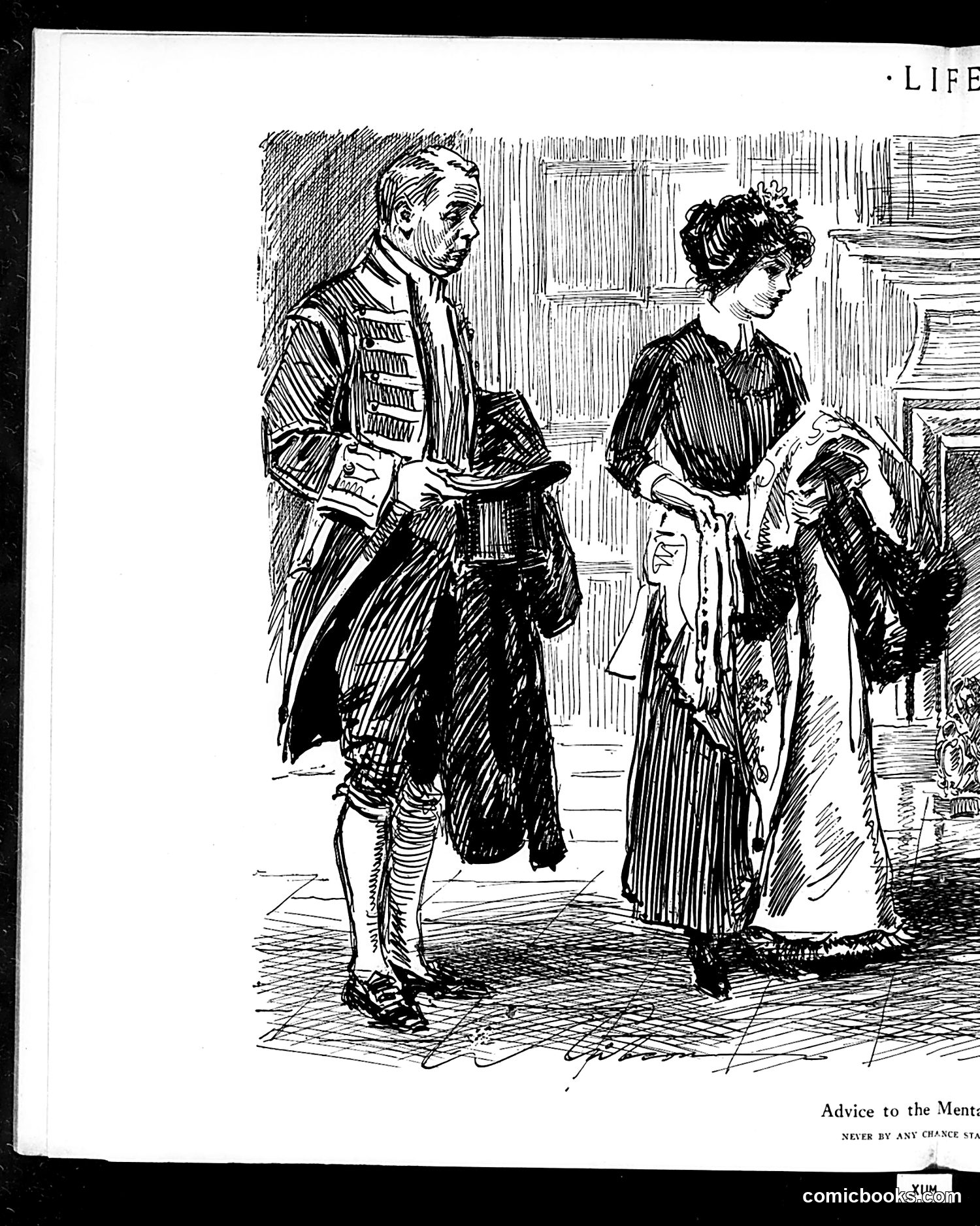
This appears to be a satirical illustration titled "Advice to the Ment[al]" (text partially cut off). The image depicts two figures in what appears to be an interior setting: an older man in military dress uniform with decorative buttons and insignia, and a woman in dark clothing holding what appears to be papers or documents. The cartoon likely offers satirical "advice" to military officers or officials, though the exact message is unclear due to the incomplete caption. The formal military dress and the woman's serious demeanor suggest commentary on authority figures or military matters. Without the complete caption text, the specific political or social reference cannot be definitively determined, though it appears to critique military leadership or decision-making of the period when Life magazine published satirical content.
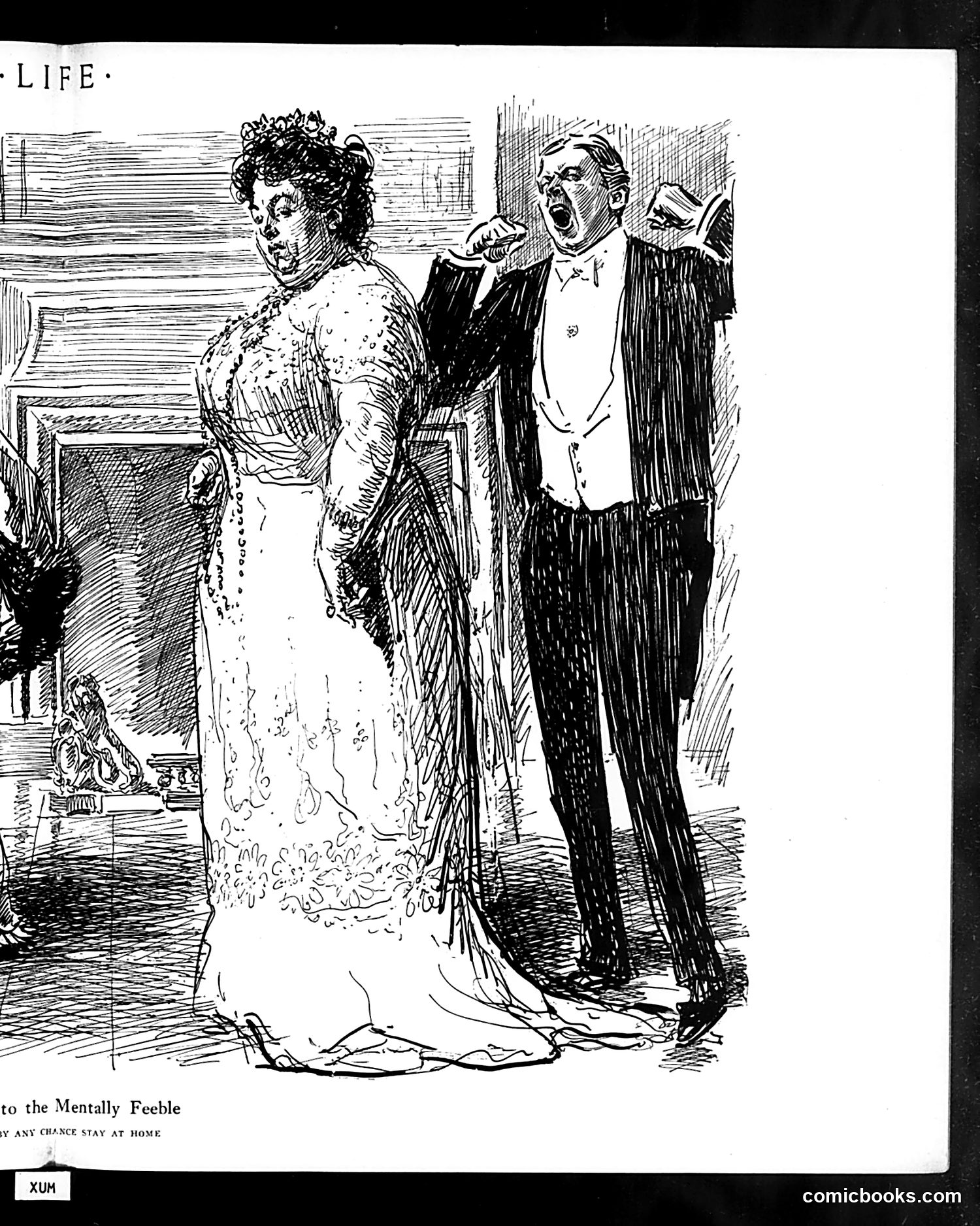
This appears to be a satirical cartoon critiquing public health or social policy regarding people with intellectual disabilities. The text "to the Mentally Feeble" and "BY ANY CHANCE STAY AT HOME" suggests messaging directed at institutionalization or segregation. The illustration shows a well-dressed couple at what appears to be a formal social event. The cartoon likely satirizes either: (1) paternalistic attitudes toward disabled individuals, or (2) eugenic-era policies that were debated in early 20th-century America. The specific date and publication context remain unclear from this page alone, but the terminology and artistic style suggest this is from the early 1900s, when such discussions were unfortunately common in American popular discourse.
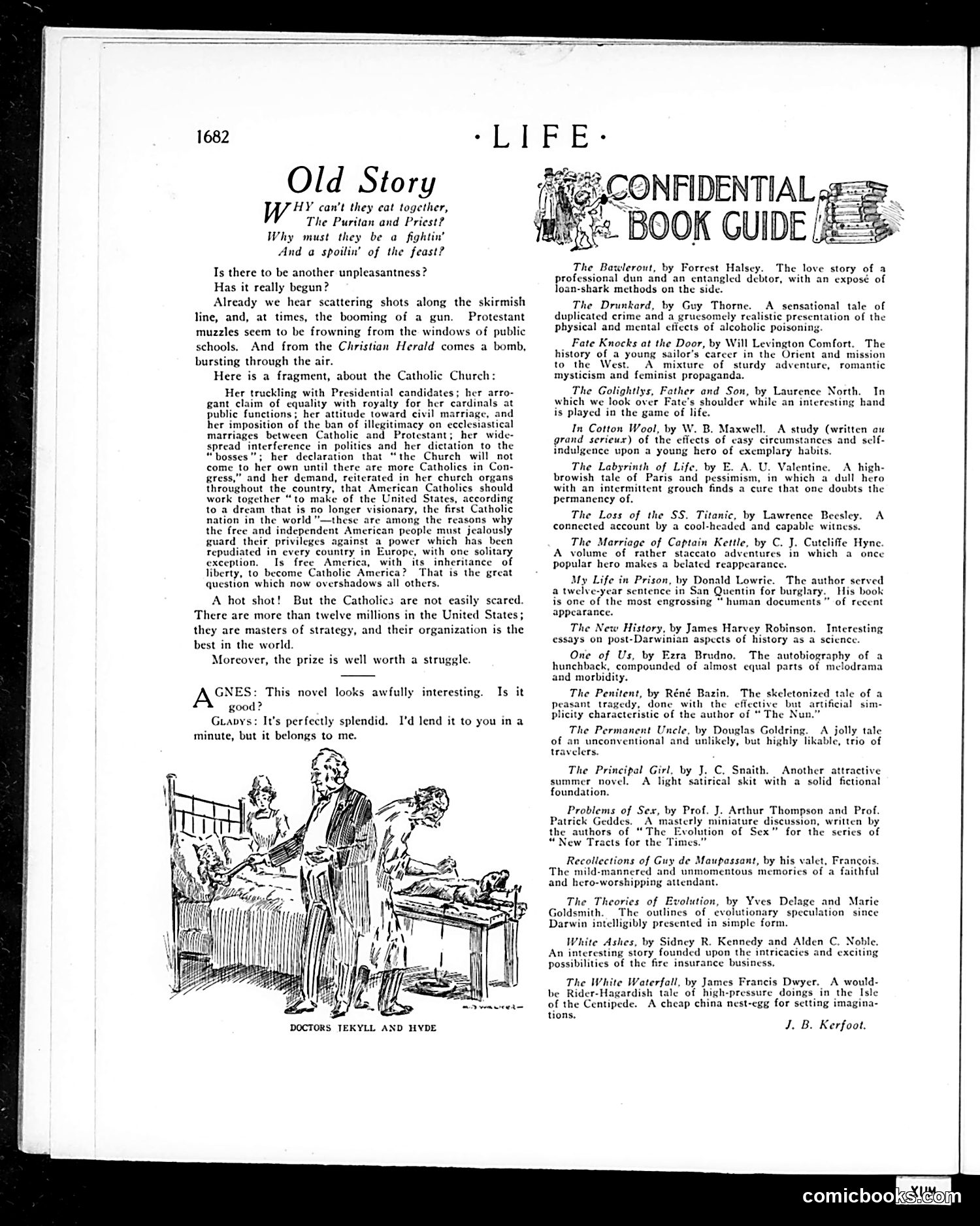
This 1682 Life magazine page contains two distinct elements: **The "Old Story" Essay**: A Protestant polemic warning against Catholic political and social power in America. The author expresses alarm that Catholics (numbering over 12 million in the U.S.) are allegedly: - Influencing presidential elections - Demanding political offices and social equality - Interfering in civil marriage laws - Controlling "bosses" and seeking to make America "the first Catholic nation in the world" The piece frames this as a threat to American Protestant liberty and independence. **The Cartoon "Doctors Jekyll and Hyde"**: Shows a medical scene where a doctor presents two contrasting personality types—likely satirizing the dual nature of human behavior or hypocrisy (referencing Stevenson's famous novella about a respectable doctor with a hidden evil alter ego). **Context**: This reflects genuine Protestant-Catholic tensions of the early 20th century, when Catholic immigration and organizational strength generated nativist anxieties about religious and political control.
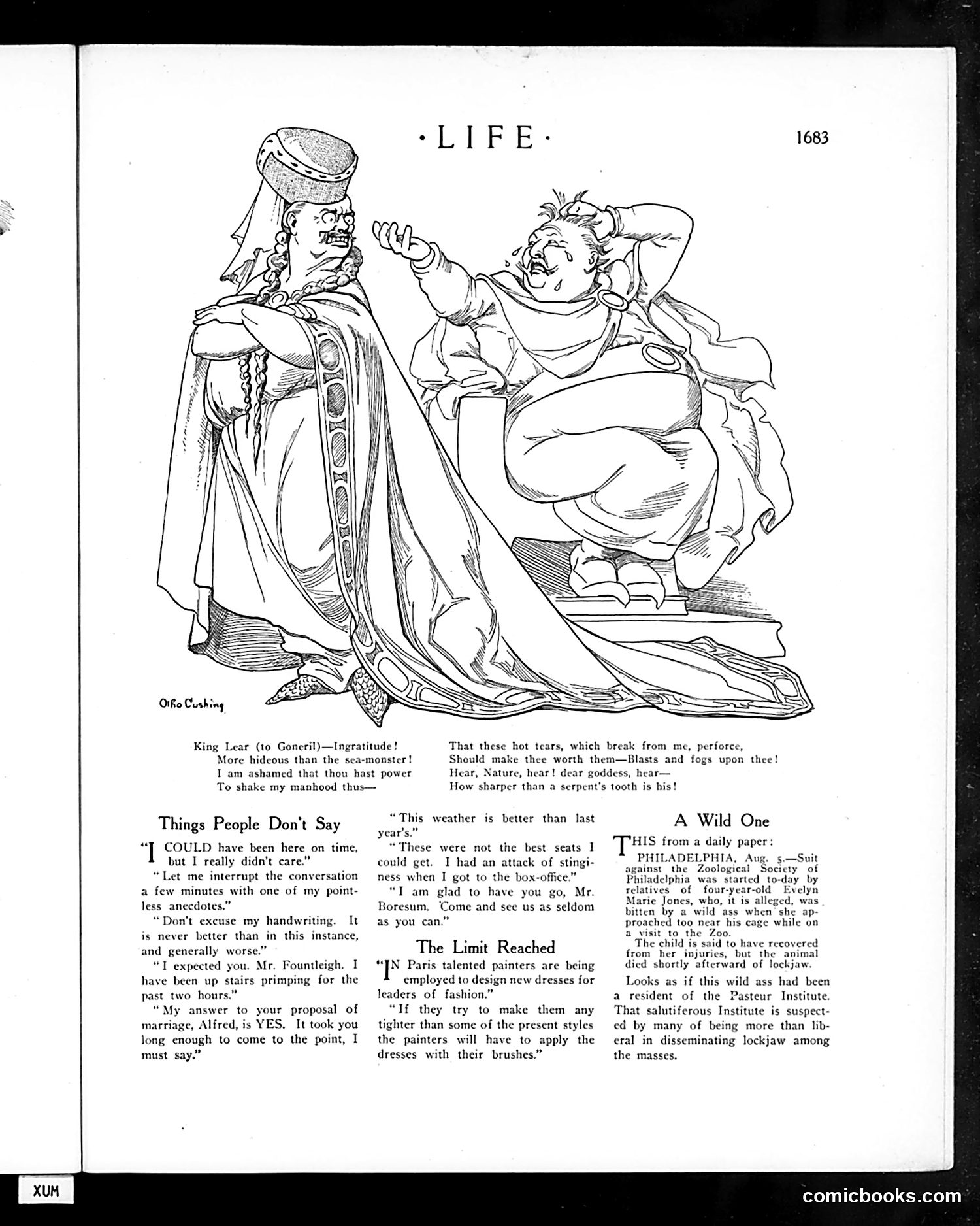
This page contains three distinct satirical pieces from Life magazine: **Main Cartoon**: An adaptation of Shakespeare's *King Lear*, showing the title character confronting Goneril (depicted as an elaborately dressed woman). The artist (Oto Cushing) illustrates Lear's famous rage at filial ingratitude, with quoted lines from the play displayed. **"Things People Don't Say"**: A humor column listing social courtesies people never actually voice—admitting they didn't care about punctuality, interrupting with boring stories, or confessing they stalled buying theater tickets due to frugality. The satire targets polite social conventions by revealing the hypocrisies behind everyday interactions. **"A Wild One"**: A brief satirical news item mocking a Philadelphia newspaper report about a girl bitten by a zoo ass that subsequently died of lockjaw. The satire suggests the Pasteur Institute (rabies treatment center) is suspiciously liberal in "disseminating lockjaw among the masses"—implying cynical distrust of health institutions or their competence. Overall, the page blends literary, social, and institutional satire typical of Life's approach.
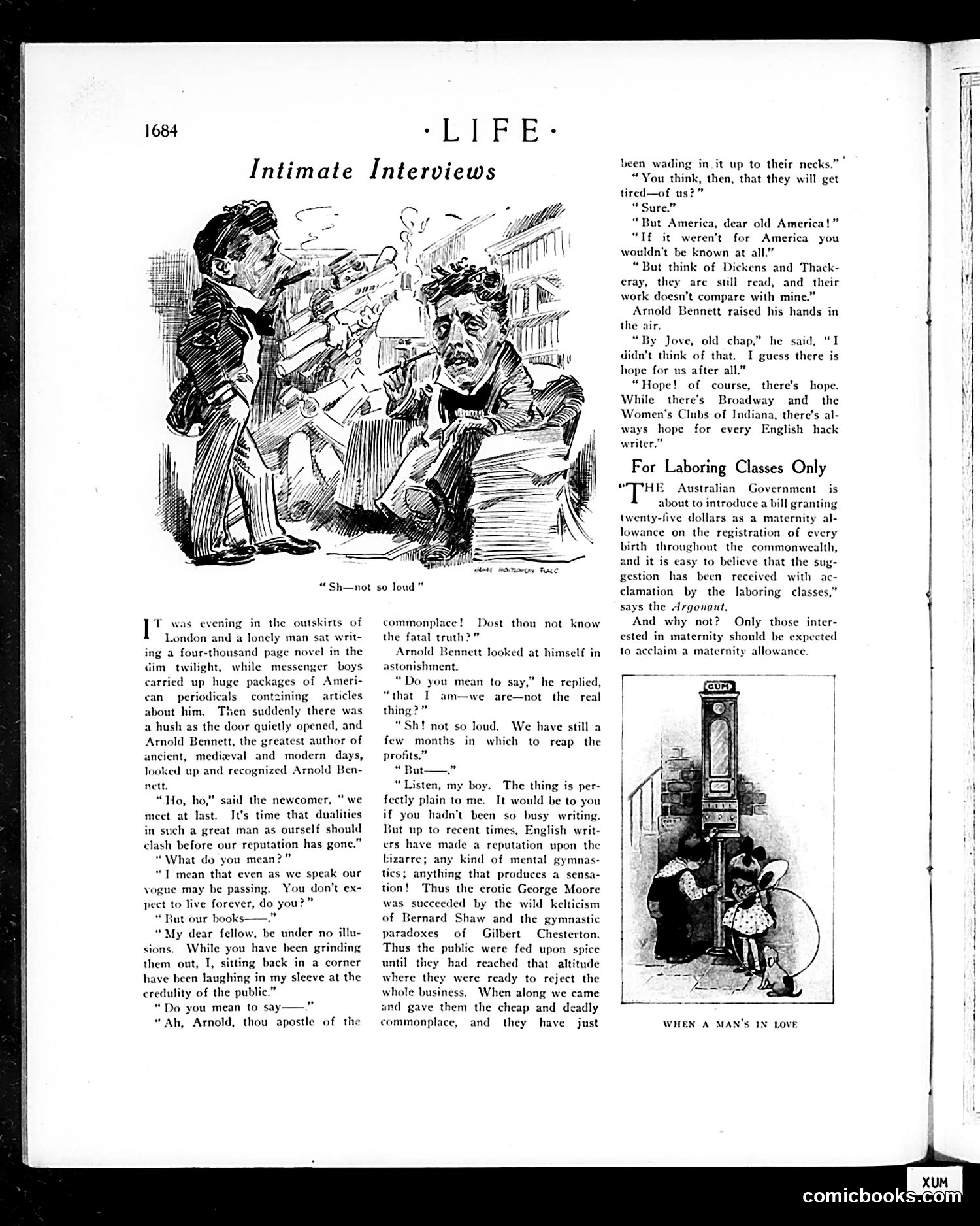
This page satirizes author **Arnold Bennett**, a famous early 20th-century British novelist known for realistic, "commonplace" fiction. The cartoon depicts Bennett meeting himself—a surreal device showing his internal conflict about his own fame and relevance. The satire's target: Bennett and other contemporary English writers (George Moore, Bernard Shaw, Gilbert Chesterton are named) had built reputations on either sensationalism or intellectual gymnastics. Bennett's strategy was the opposite—writing accessible, ordinary fiction. The joke suggests this "cheap and deadly commonplace" approach is actually cynical commercial calculation: writers deliberately feed the public what they've been conditioned to accept, while secretly mocking them. The darker implication: Success depends entirely on American audiences (Broadway, "Women's Clubs of Indiana")—English readers alone won't sustain "hack writers." The phrase "we have still a few months in which to reap the profits" reveals their work as temporarily fashionable rather than lasting literature. The cartoon ridicules both Bennett's pretensions to greatness and the publishing industry's commercial cynicism.
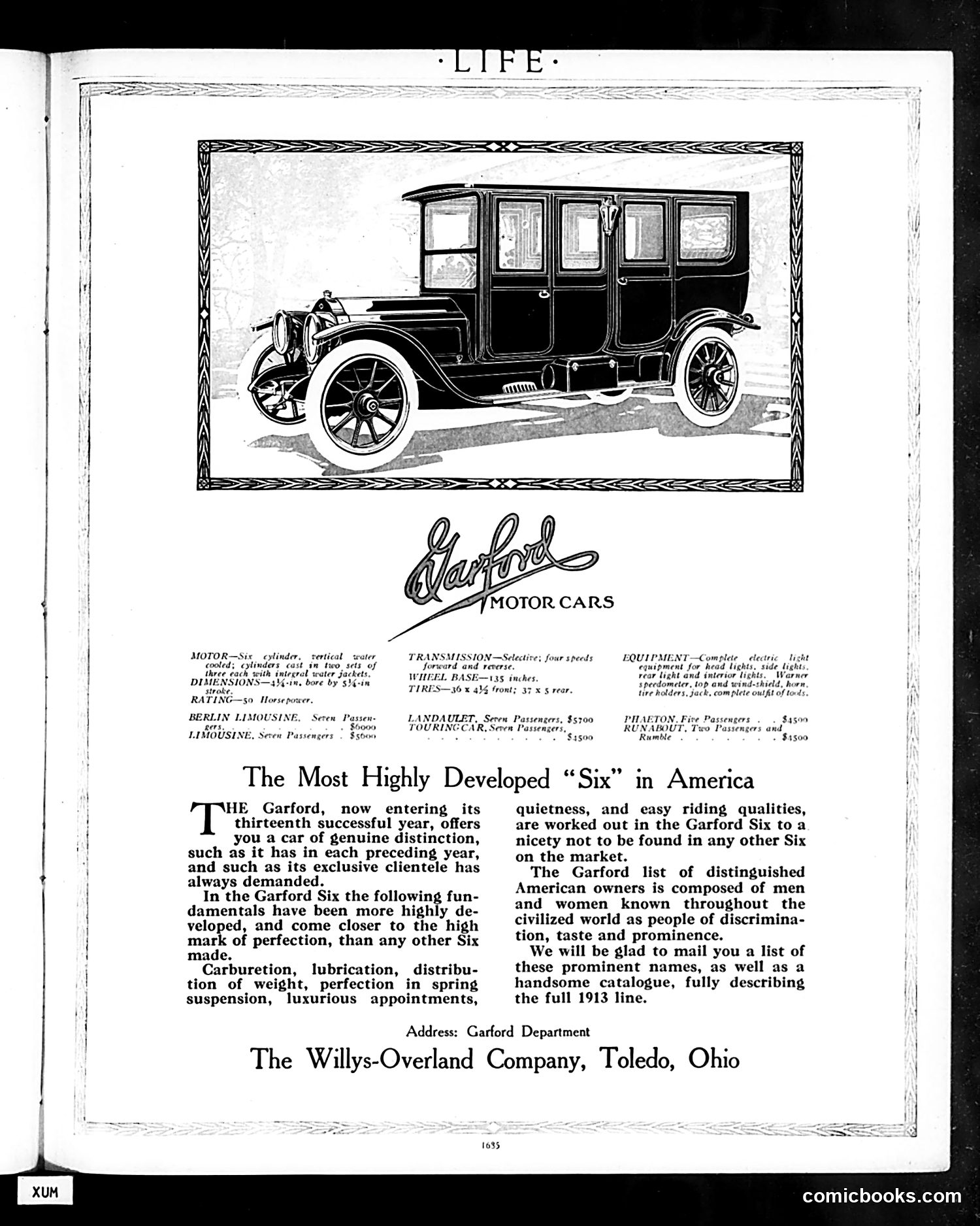
This is **not a cartoon or satire** — it's a straightforward automobile advertisement. The page features a detailed technical drawing of a Garford motor car (a luxury vehicle made by the Willys-Overland Company) alongside advertising copy promoting it as "the most highly developed 'Six' in America." The ad emphasizes the car's engineering refinements, mechanical features, and—importantly—its *social prestige*. It boasts that the Garford's owners are "men and women known throughout the civilized world as people of discrimination, taste and prominence," offering to mail prospective buyers a list of these distinguished owners. This appeals to aspirational consumers who associate the vehicle with wealth and status. The 1913 pricing (ranging from $1,500 to $6,000) indicates this was a high-end luxury model. The advertisement represents early-20th-century marketing strategy targeting the affluent class through exclusivity and social validation rather than pure functionality.
This is a letters-to-the-editor page from *Life* magazine, not a political cartoon. It features readers' responses to recent articles and editorial content. Key items include: 1. **"Greyfriars Bobby" praise**: A reader compliments Arthur Guiterman's rhymed review of the famous Scottish dog story, noting his usually sharp wit was "tender" in this case. 2. **"Money Makers" defense**: A reader criticizes *Life*'s August 1 cartoon "The Merry Go Round" as anti-capitalist, arguing it wrongly encourages "hatred of success in money making" and contradicts the magazine's own editorials. 3. **Montana dog story**: A heartwarming anecdote about a collie ("the quitter") who heroically herded lost sheep during a snowstorm, apparently countering anti-animal-experimentation sentiment. 4. **Catholic citizenship debate**: Readers argue about Catholic church-state separation, referencing President Taft and questioning whether the church hierarchy is "un-American." The page reflects *Life*'s satirical role in 1912 American public discourse.
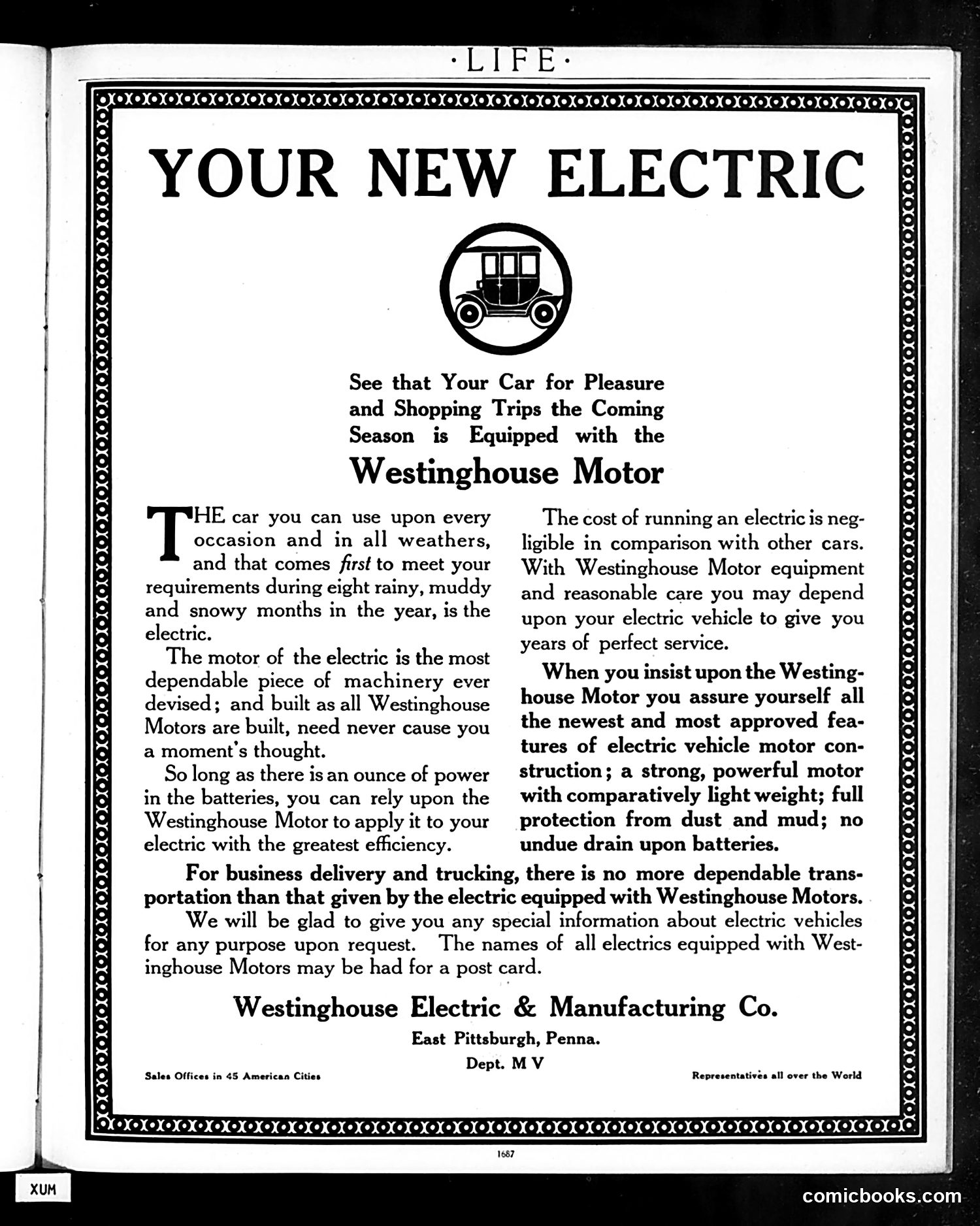
This is **not satire or a cartoon**—it's a straightforward advertisement placed in *Life* magazine. The page promotes Westinghouse Motors for electric vehicles, positioning them as reliable, economical alternatives for personal and commercial transportation. The ad targets early-20th-century consumers by emphasizing the electric car's advantages: all-weather usability, dependable motors, low operating costs, and suitability for both pleasure drives and business delivery. The rhetoric ("most dependable piece of machinery ever devised") reflects period marketing conventions. The historical irony—invisible to contemporary readers—is that electric vehicles were then a viable competitor to gasoline cars. This advertisement predates the eventual dominance of internal combustion engines, making it a curious artifact of alternative automotive history that modern readers might find surprising rather than satirical.
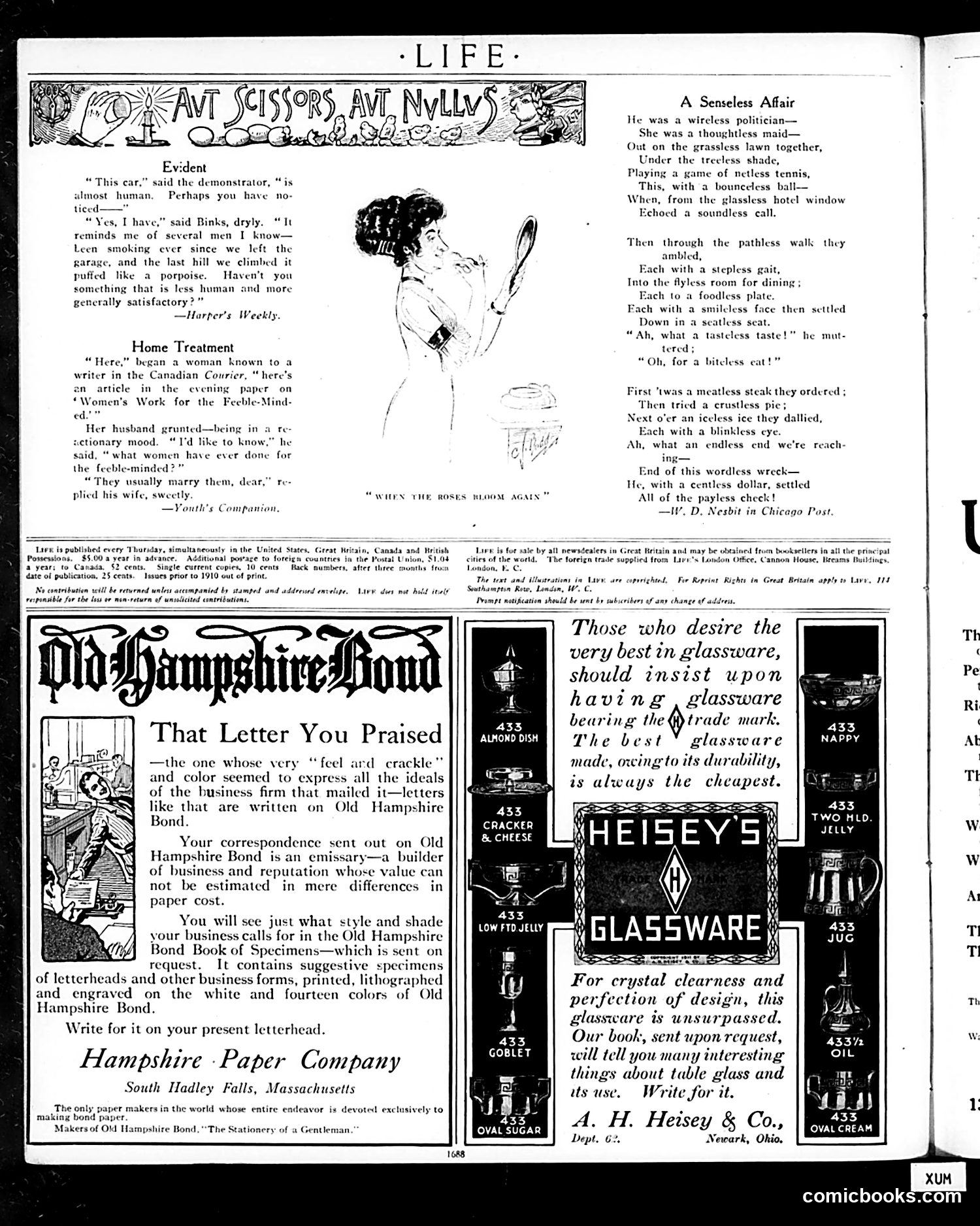
This page contains three satirical pieces and advertisements: **"Evident"** (Harper's Weekly): A brief joke where a car demonstrator claims his automobile is "almost human." A man named Binks agrees, noting it "reminds me of several men I know" who smoke constantly and puff going uphill—comparing the car's mechanical behavior to human flaws. **"Home Treatment"** (Youth's Companion): A domestic humor piece where a husband asks what women have done for "the feeble-minded." His wife replies they "usually marry them"—a jab at male intelligence. **"A Senseless Affair"** (W.D. Nesbit, Chicago Post): A poem satirizing modern artificiality through repetitive wordplay: a "wireless politician" and "thoughtless maid" encounter endless "less" things (grassless lawn, netless tennis, bounceless ball, soundless call, etc.), culminating in a "payless cheek." The remainder consists of business advertisements for Hampshire Bond paper and Heisey glassware, emphasizing quality and durability as cost-effective choices.
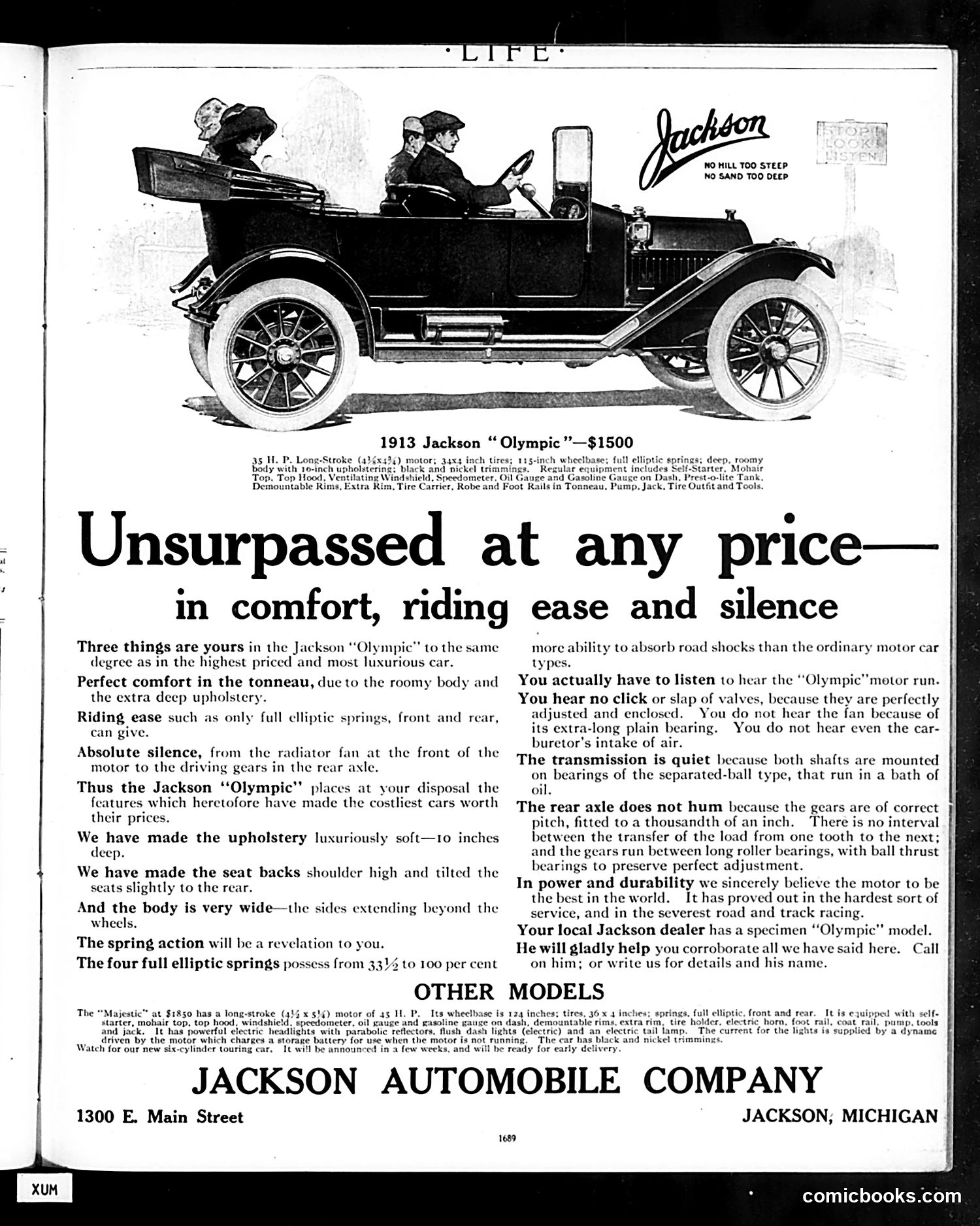
This is **not a cartoon or satire**, but rather a **straightforward automobile advertisement** from Life magazine circa 1913. The page promotes the Jackson "Olympic" automobile ($1,500), manufactured by the Jackson Automobile Company in Jackson, Michigan. The illustration shows a touring car with passengers, and the tagline "NO HILL TOO STEEP / NO SAND TOO DEEP" emphasizes the vehicle's capability. The ad's appeal targets middle-to-upper-class buyers by emphasizing luxury features uncommon at this price point: deep upholstery (10 inches), full elliptic springs, and notably, **quietness**—a selling point suggesting mechanical refinement. The text repeatedly highlights the absence of noise ("absolute silence," "you have to listen to hear it run"), suggesting this was a competitive advantage in early automotive manufacturing. A competing model, the "Majestic" at $1,850, is also advertised. The copy reflects the era's fascination with mechanical precision and engineering superiority as markers of quality.
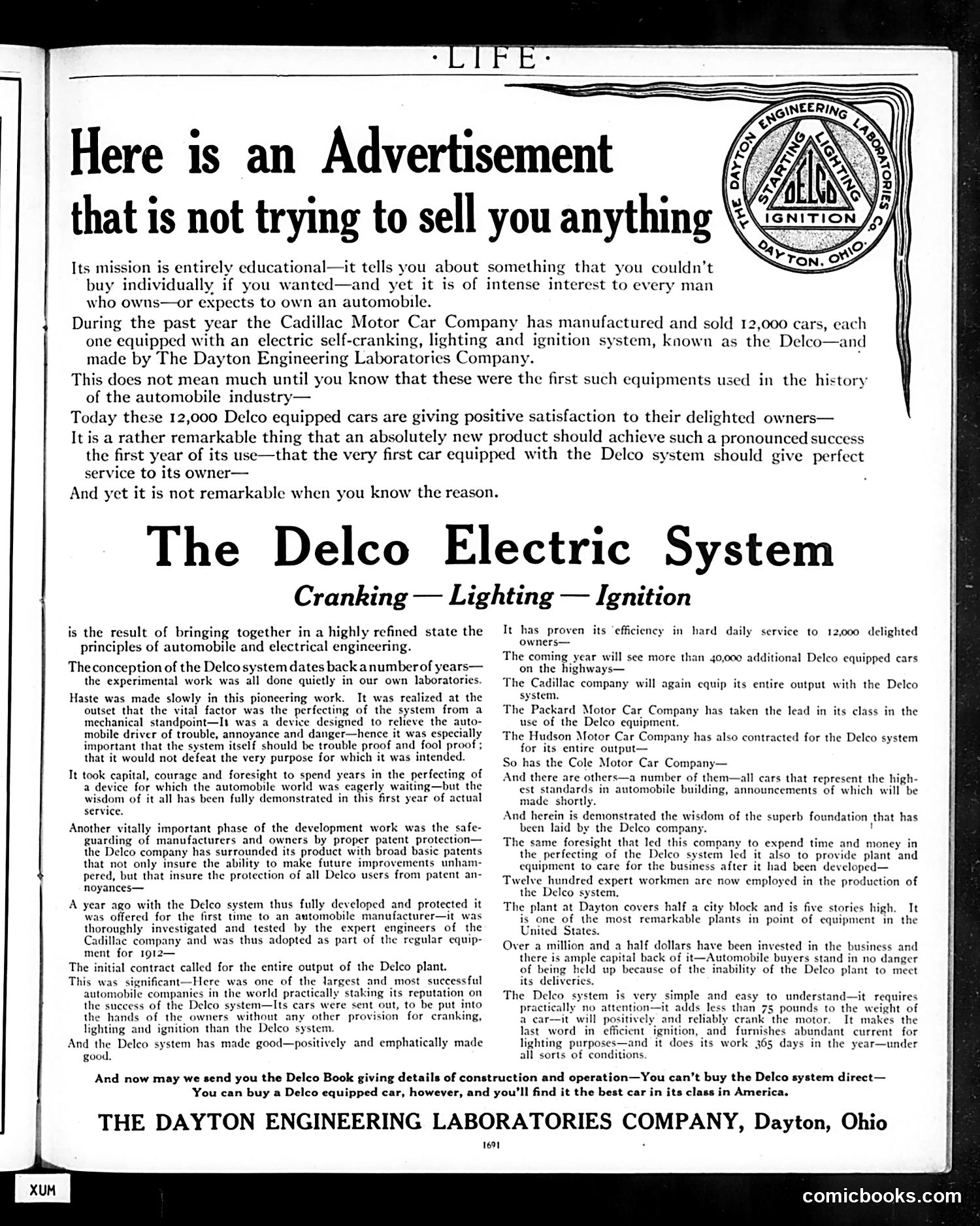
This is a **Delco (Dayton Engineering Laboratories Company) advertisement** disguised as educational content. The headline claims it's "not trying to sell you anything," but it's actually promoting the Delco electric self-cranking and ignition system by touting its adoption in 12,000 Cadillac automobiles. The satire is subtle: Life magazine's presentation frames this as public-interest education while the ad boasts about Delco's innovations and market dominance. The joke is the contradiction between the claim of being "educational" and the transparent self-promotion—naming Cadillac, Packard, Hudson, and Cole motor companies as Delco customers. For modern readers: this exemplifies early 1910s "soft advertising," where manufacturers disguised promotional copy as objective journalism. The page pokes gentle fun at corporate PR tactics while simultaneously running the ad itself.
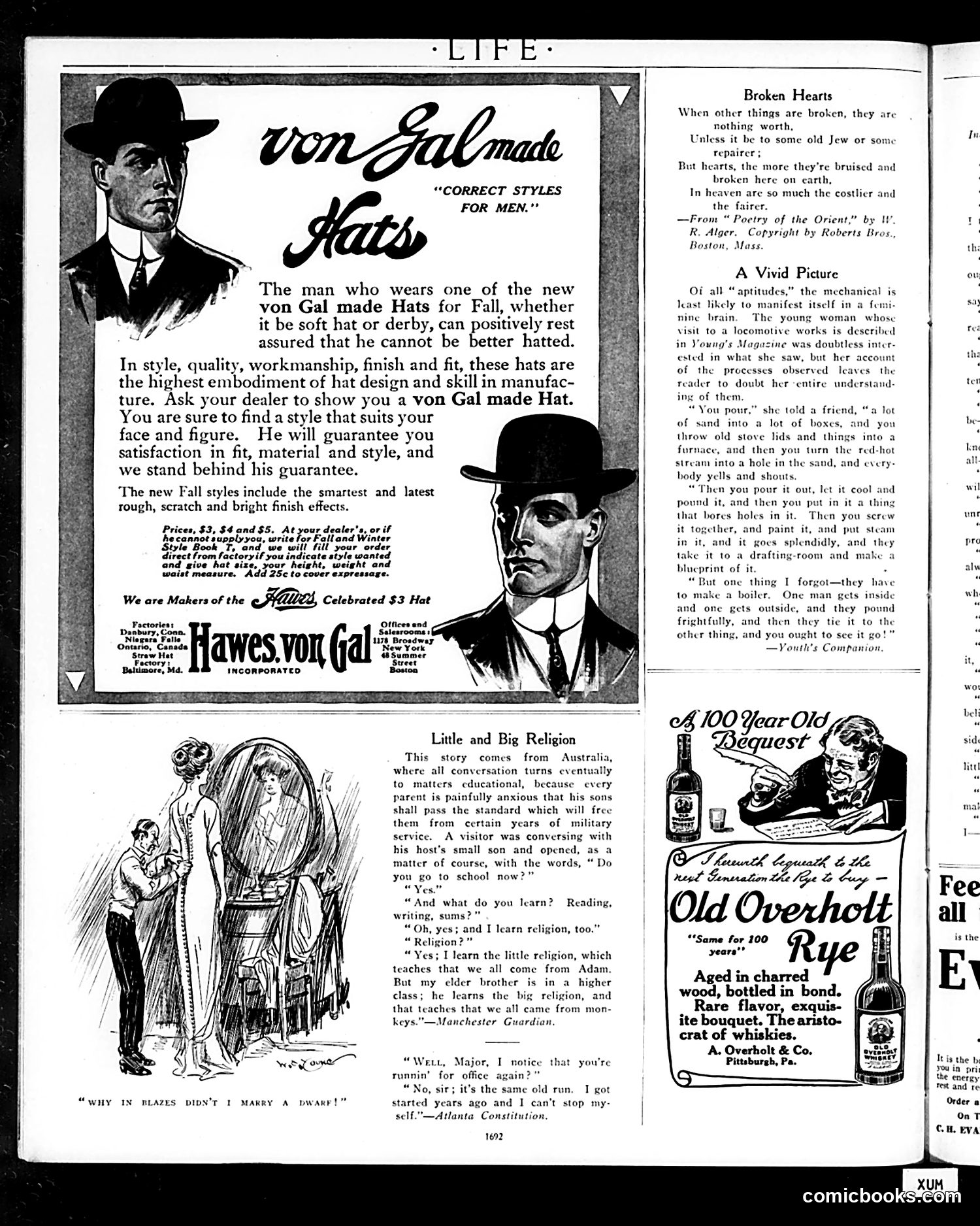
This page contains three distinct pieces of content: **Von Galmade Hats Advertisement** (top): A straightforward commercial ad featuring illustrated male faces modeling fall hat styles, emphasizing quality and fit. **"A Vivid Picture" Article** (right): Satirizes women's mechanical incomprehension. It mocks a young woman who visited a locomotive factory but understood nothing—she reduces complex industrial processes to absurd observations about "sand in boxes" and "stove lids," completely missing the engineering involved. The satire reflects early 20th-century gender stereotypes about women lacking aptitude for technical matters. **"Little and Big Religion" Cartoon** (bottom left): A humorous Australian anecdote contrasting children's religious education. A boy explains he learns "little religion" (Adam and Eve) while his older brother learns "big religion" (evolutionary descent from monkeys). The joke plays on contemporary debates over Darwinism versus religious orthodoxy—treating evolution as the "advanced" or "bigger" religion, satirizing both religious education and scientific theory. The advertisements (Old Overholt Rye whiskey, etc.) are period-standard magazine filler.
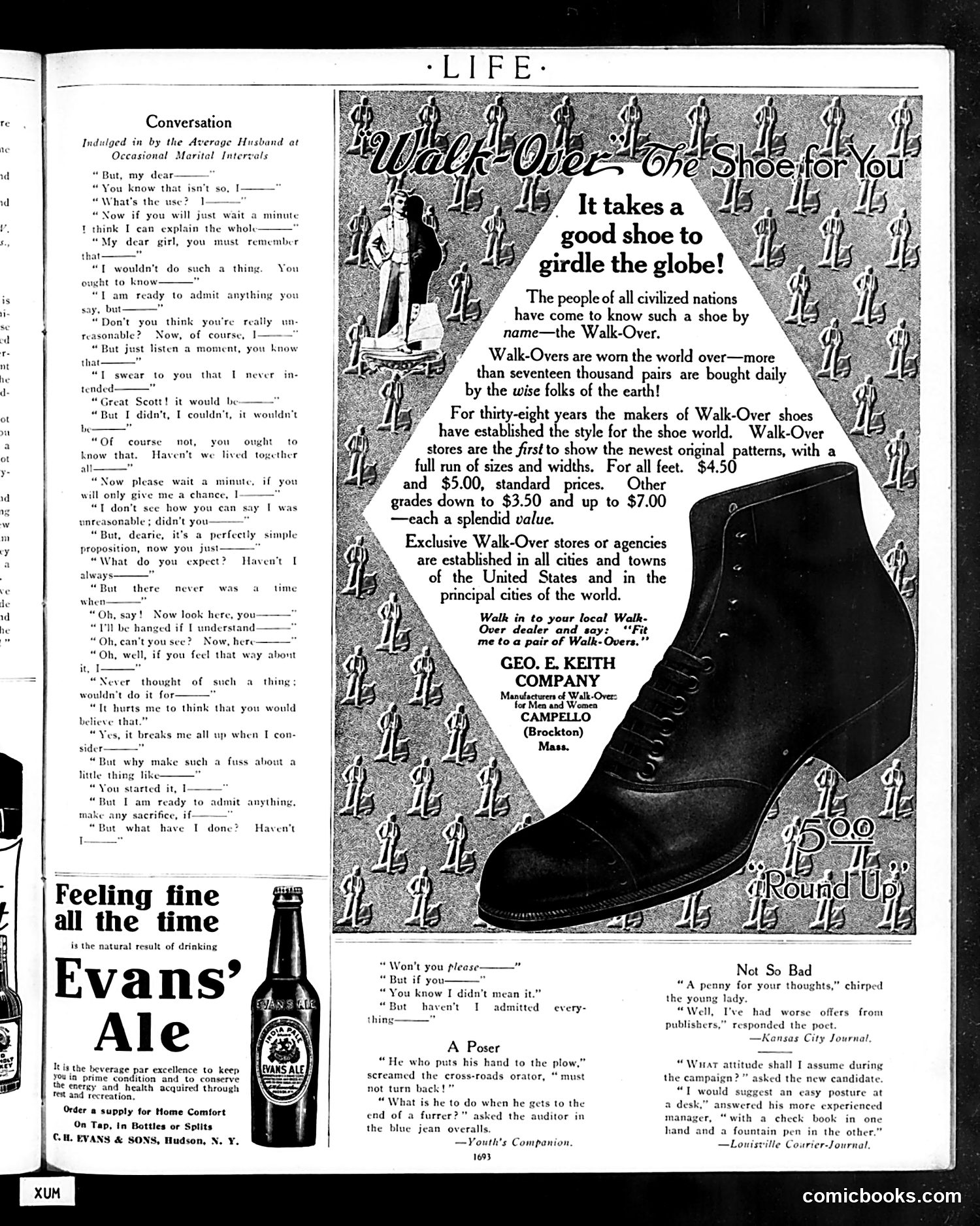
This page contains three distinct elements: **Left column ("Conversation"):** A satirical dialogue depicting a typical marital argument where the husband repeatedly attempts to explain or defend himself, but the wife continuously interrupts. The humor lies in the husband's futile attempts at reasoning—each explanation is cut off before completion. This reflects early 20th-century domestic comedy stereotypes about marriage communication. **Main advertisement:** A full-page ad for Walk-Over shoes, emphasizing their global popularity (17,000 pairs sold daily) and established reputation (38 years). This is straightforward product marketing with no satirical content. **Bottom section:** Three short humorous pieces mocking various figures—a political speaker whose logic fails, a poet dismissing publisher offers, and a political candidate advised to carry money and persuasion tools. These are light satirical jabs at politicians, speakers, and the publishing industry rather than commentary on specific individuals. The page is primarily advertising-driven with satirical editorial content as filler—typical of Life's format during this era.
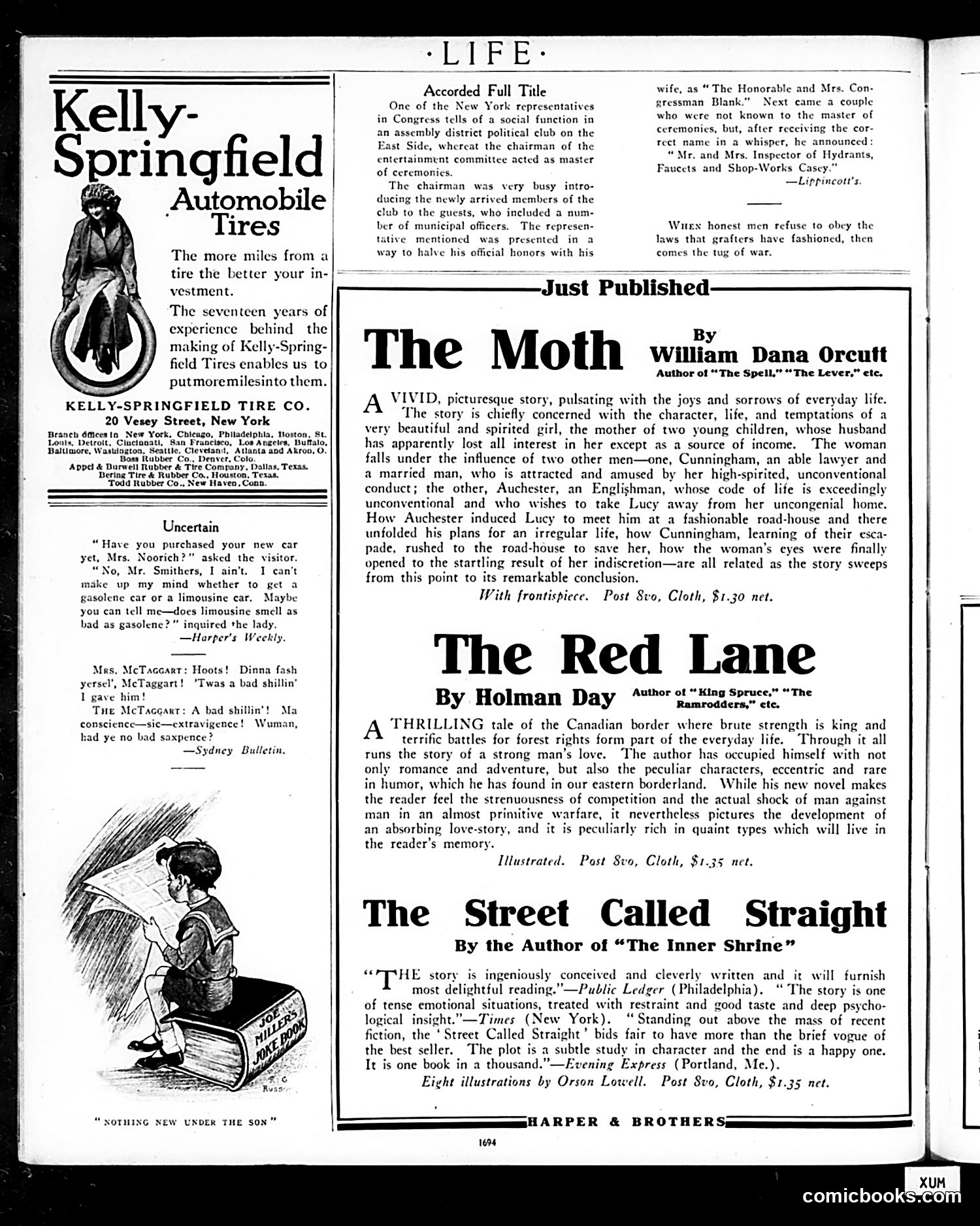
This page mixes advertising with book reviews and satirical humor typical of early 20th-century *Life* magazine. **Left side**: A Kelly-Springfield Tire advertisement uses a woman on a tire as its image—standard commercial messaging about durability. **Main satire**: The "Accorded Full Title" piece mocks New York political patronage. A congressman's representative describes a social event where the master of ceremonies inflates minor municipal officials' titles absurdly—introducing someone as "Mr. and Mrs. Inspector of Hydrants, Faucets and Shop-Works Casey." The joke targets bureaucratic pomposity and the practice of dressing up ordinary government jobs with grandiose titles, reflecting Gilded Age corruption and political machine culture. **Below**: Two brief humor snippets mock gender stereotypes (a wealthy woman confused about cars) and ethnic caricature (Scottish dialect). **Right side**: Book advertisements for three novels—typical commercial content of the era. The page satirizes early 1900s urban political culture and its pretensions.
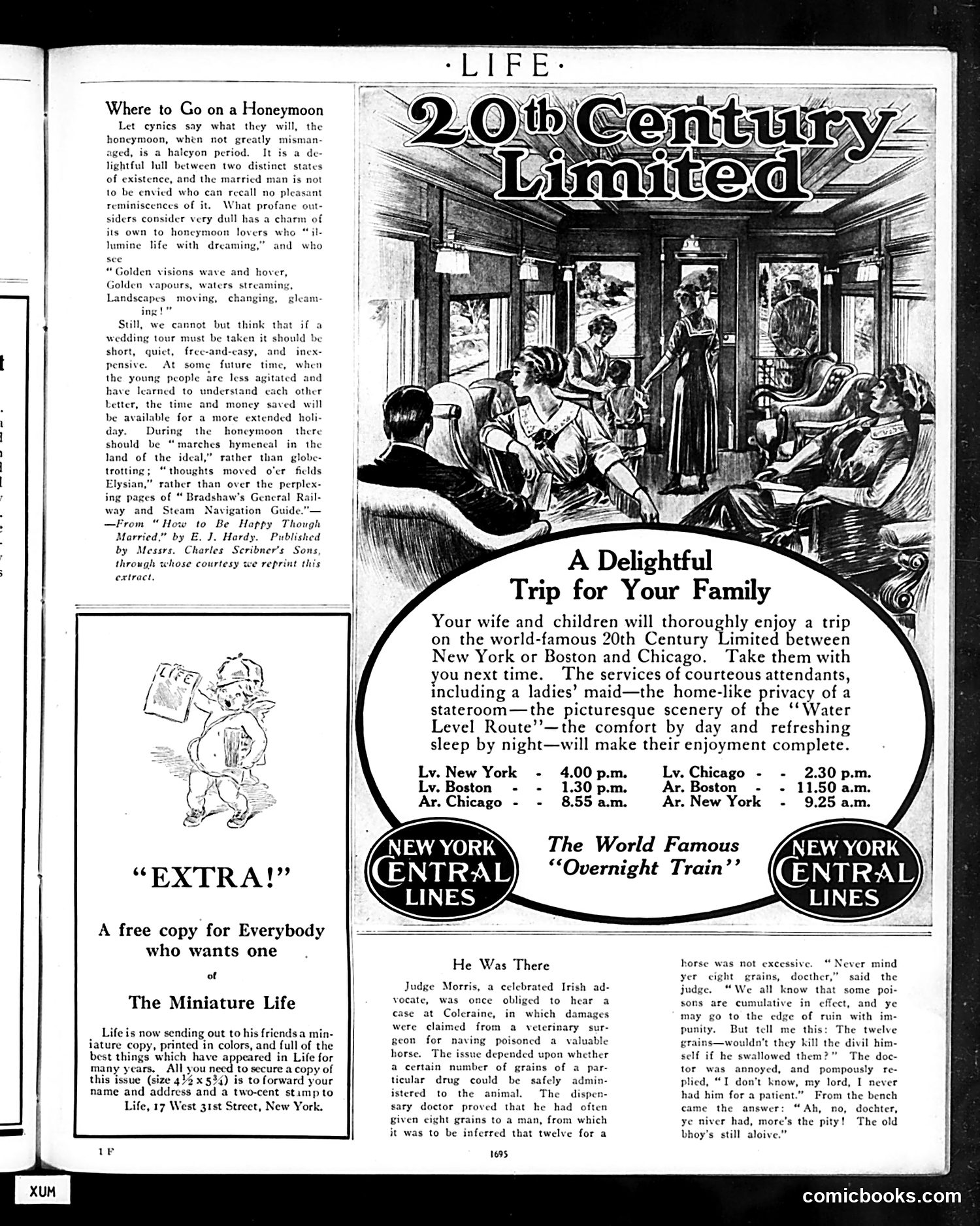
This page combines honeymoon travel advice with advertisements and a humorous anecdote. **Main Content:** The left column offers practical honeymoon guidance, advocating for short, inexpensive trips rather than elaborate globe-trotting—advice sourced from E.J. Hardy's "How to Be Happy Though Married." **Advertisements:** The dominant feature is a New York Central Lines ad promoting the "20th Century Limited" train between New York/Boston and Chicago, emphasizing family comfort with attendants, private staterooms, and scenic "Water Level Route" views. **Humor:** The bottom story, "He Was There," recounts an Irish judge (Judge Morris) cross-examining a veterinary surgeon about poisoning a horse. The joke hinges on the judge's withering retort—when the doctor admits never treating the devil as a patient, the judge quips the devil "still aloive," implying the doctor's medical incompetence. The "EXTRA!" section advertises a miniature colored copy of Life magazine itself. Overall, this is primarily an advertising-heavy page with light editorial content and Irish wit.
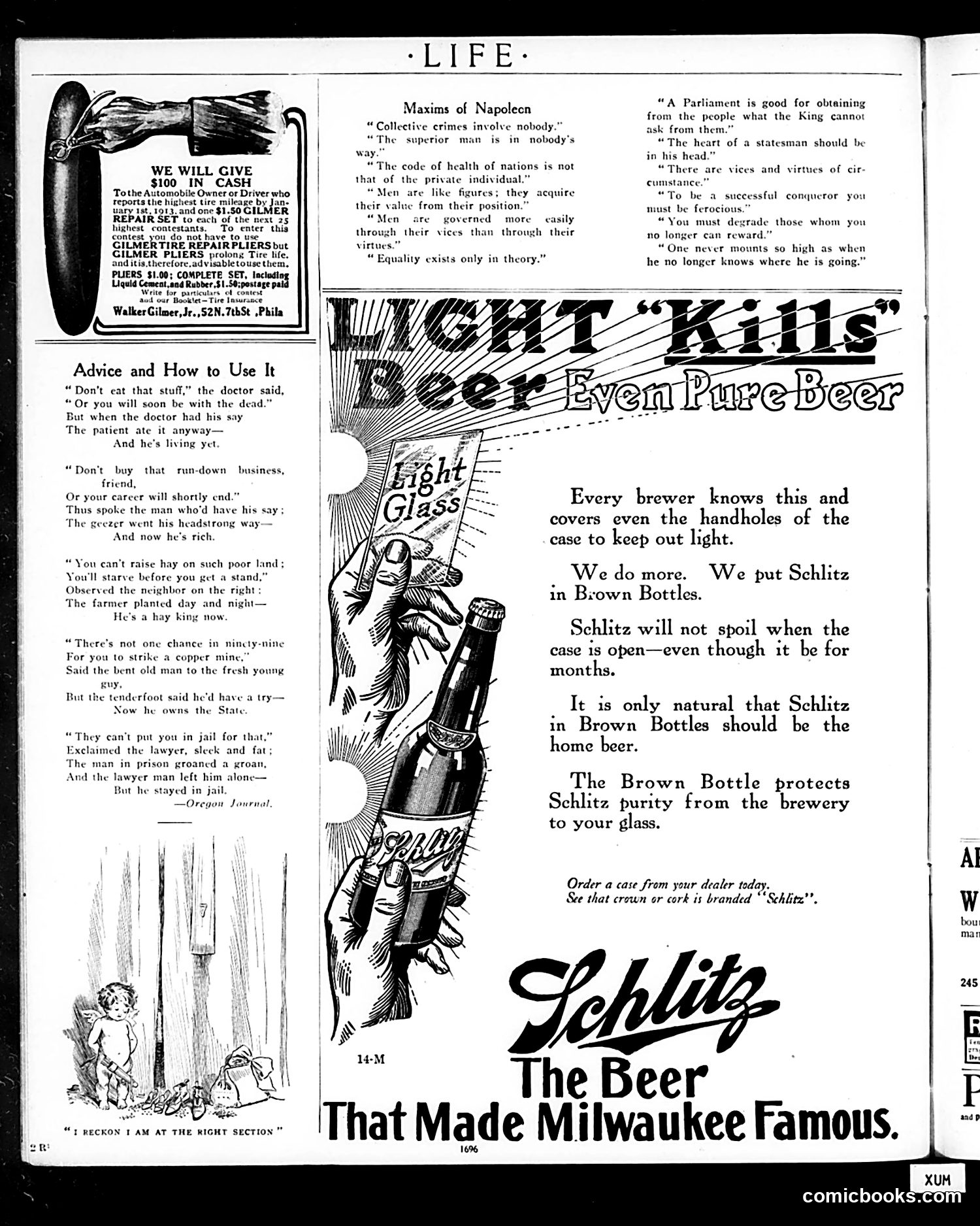
This page contains **two distinct elements**: a satirical article with accompanying cartoons, and a beer advertisement. ## Left Side: Napoleon Satire & Advice Cartoons The page opens with cynical "Maxims of Napoleon" mocking authoritarian governance—quotes emphasizing that rulers exploit citizens through vice rather than virtue, that equality is theoretical only, and that successful conquest requires degradation of the populace. This appears to critique autocratic power and dishonest governance. Below are three cartoon vignettes illustrating "Advice and How to Use It"—each showing someone ignoring conventional wisdom (a doctor's dietary warning, advice against a risky business, warnings about poor farmland) and succeeding anyway. The satire targets sanctimonious advice-givers and validates unconventional risk-taking. The small cartoon at bottom ("I reckon I am at the right section") appears unrelated to the main narrative. ## Right Side: Schlitz Beer Advertisement A straightforward commercial promoting Schlitz beer's use of brown bottles to protect against light spoilage—a genuine brewing advantage of that era. The tagline claims it's "The Beer That Made Milwaukee Famous."
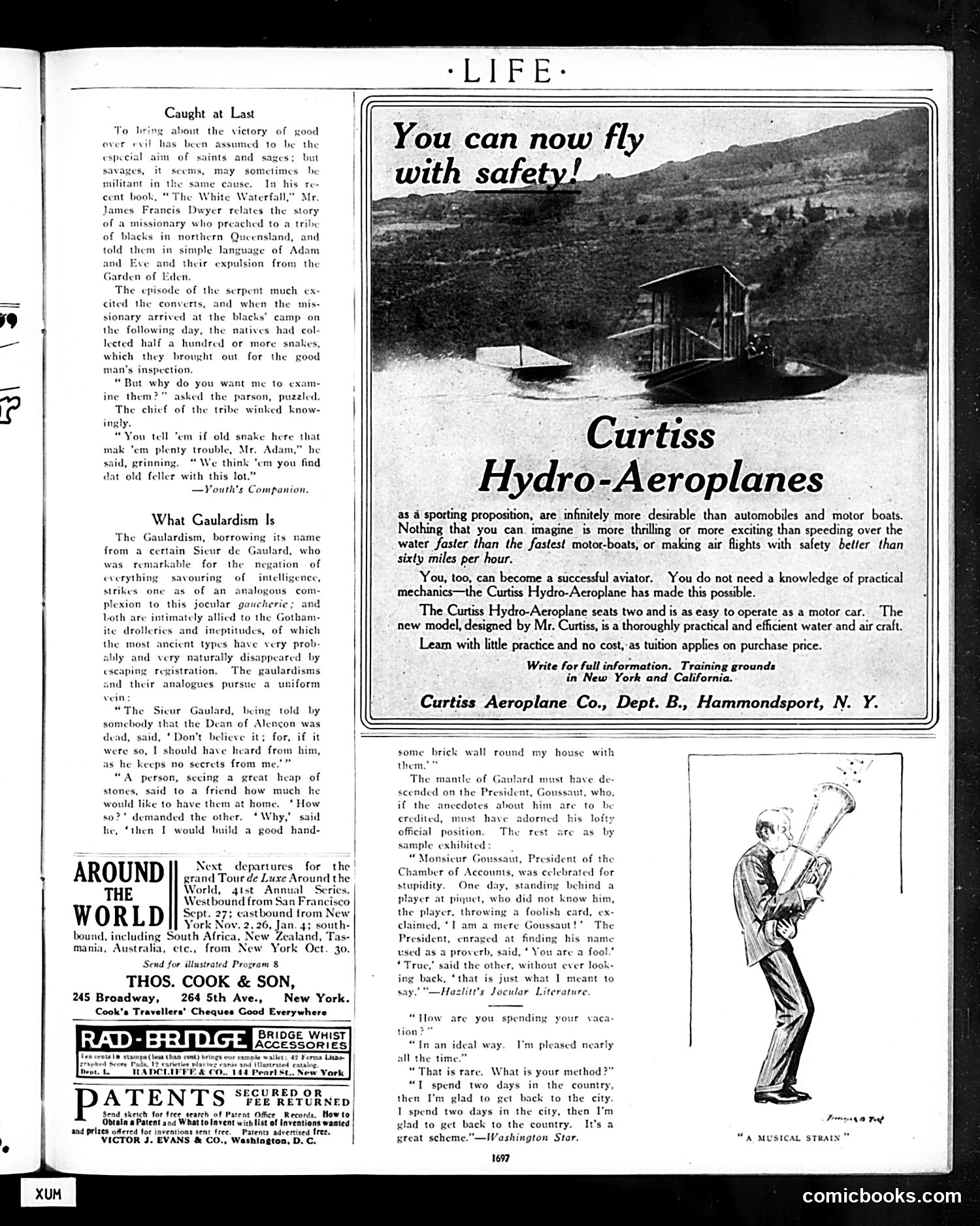
This page combines humor columns with early aviation advertising. **The humor pieces** ("Caught at Last" and "What Gaulardism Is") are absurdist jokes in the tradition of *Life* magazine's satirical humor—the first depicts a missionary misunderstanding when Australian Aboriginal converts collect snakes to test whether he can identify the serpent from Eden; the second defines "Gaulardism" as foolish non sequiturs, using examples of illogical reasoning. **The dominant content** is a Curtiss Hydro-Aeroplanes advertisement claiming flying is now safe and accessible to ordinary people—you need no mechanical knowledge, it's as easy as operating a car, and training costs nothing with purchase. This reflects early-1910s enthusiasm about aviation as an emerging consumer technology, positioning it alongside automobiles and motorboats as recreational activities for the affluent. The page also advertises Thomas Cook's around-the-world tours and various other services. The tone throughout is lighthearted modernism celebrating new technologies and travel.
This is primarily a **subscription advertisement** for Vogue magazine's Autumn Millinery Number, not a political cartoon. The page promotes Vogue's fashion magazine by appealing to wealthy women planning expensive fall wardrobes. The sales pitch uses a psychological angle: invest just $2 in the Millinery Number to avoid costly mistakes when purchasing $200+ worth of hats and gowns. The copy notes that "the really expensive hat is the hat you wear only because you cannot return it"—implying that expert fashion guidance prevents wasteful purchases. The page lists famous Parisian hat designers (Carlier, Paul Poiret, Suzanne Talbot, Georgette, Alphonsine) to establish authority and prestige. It also shows Vogue's upcoming special issues (Forecast of Autumn Fashions, Christmas Gifts, Motor Fashions, etc.) to encourage long-term subscriptions. The tone reflects early 1910s luxury consumer culture targeting affluent women who could afford haute couture from Paris.
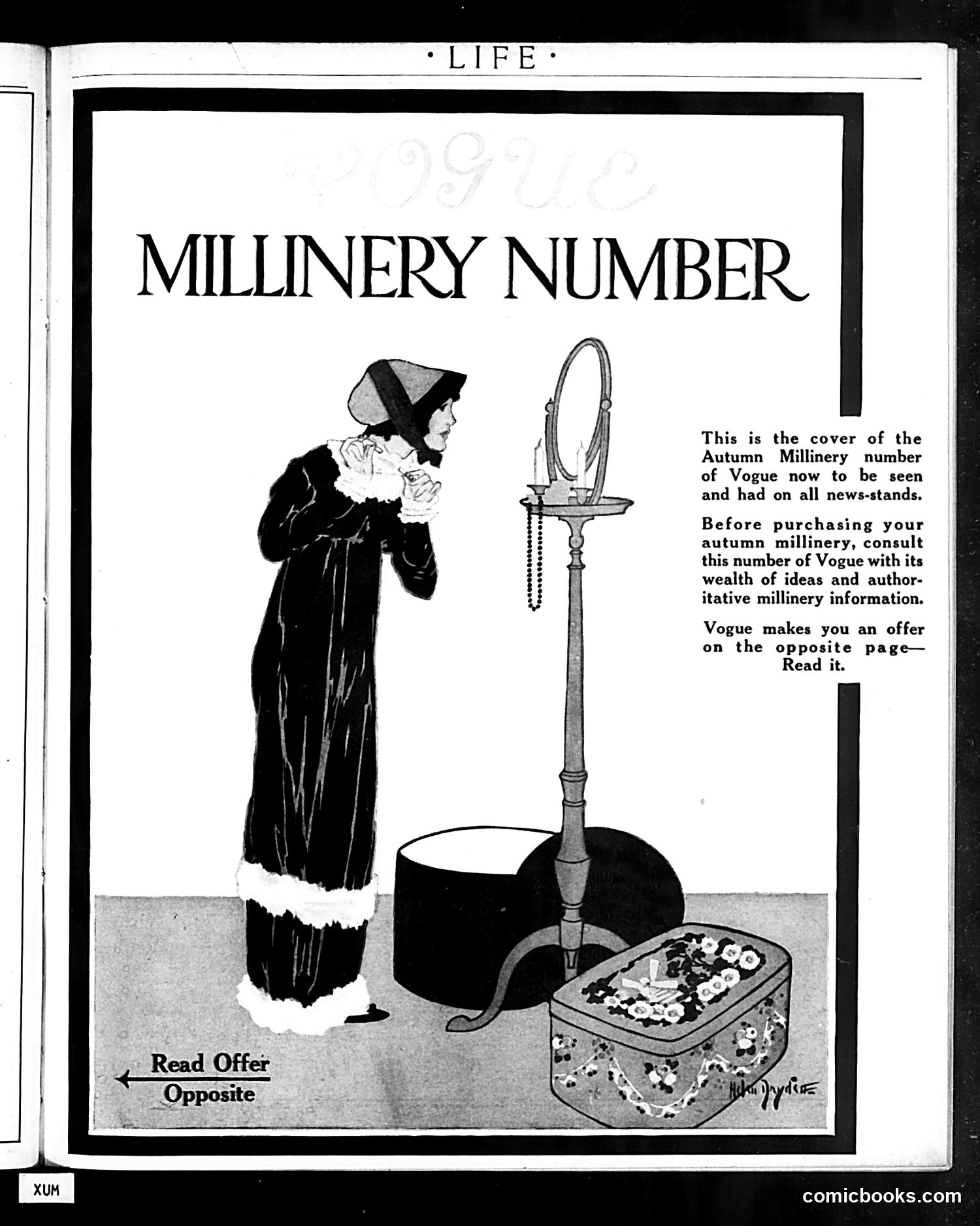
This is primarily a **promotional advertisement** for Life magazine's "Millinery Number," not a political cartoon. The page advertises Vogue's autumn fashion issue, encouraging readers to consult it before buying fall hats. The illustration shows a stylishly dressed woman in a long dark coat and distinctive hat, admiring herself in a standing mirror. Decorative items—a box and hat—sit nearby, emphasizing the fashion focus. The satire is **mild and commercial**: Life is essentially cross-promoting Vogue's millinery guidance to readers, positioning fashion consultation as essential before purchasing hats. The woman's self-admiring pose gently mocks fashion consciousness itself—the implication being that proper millinery advice (from Vogue) is necessary for the fashion-conscious consumer. This reflects early 20th-century magazine advertising practices, where publications promoted competitor content to shared audiences.
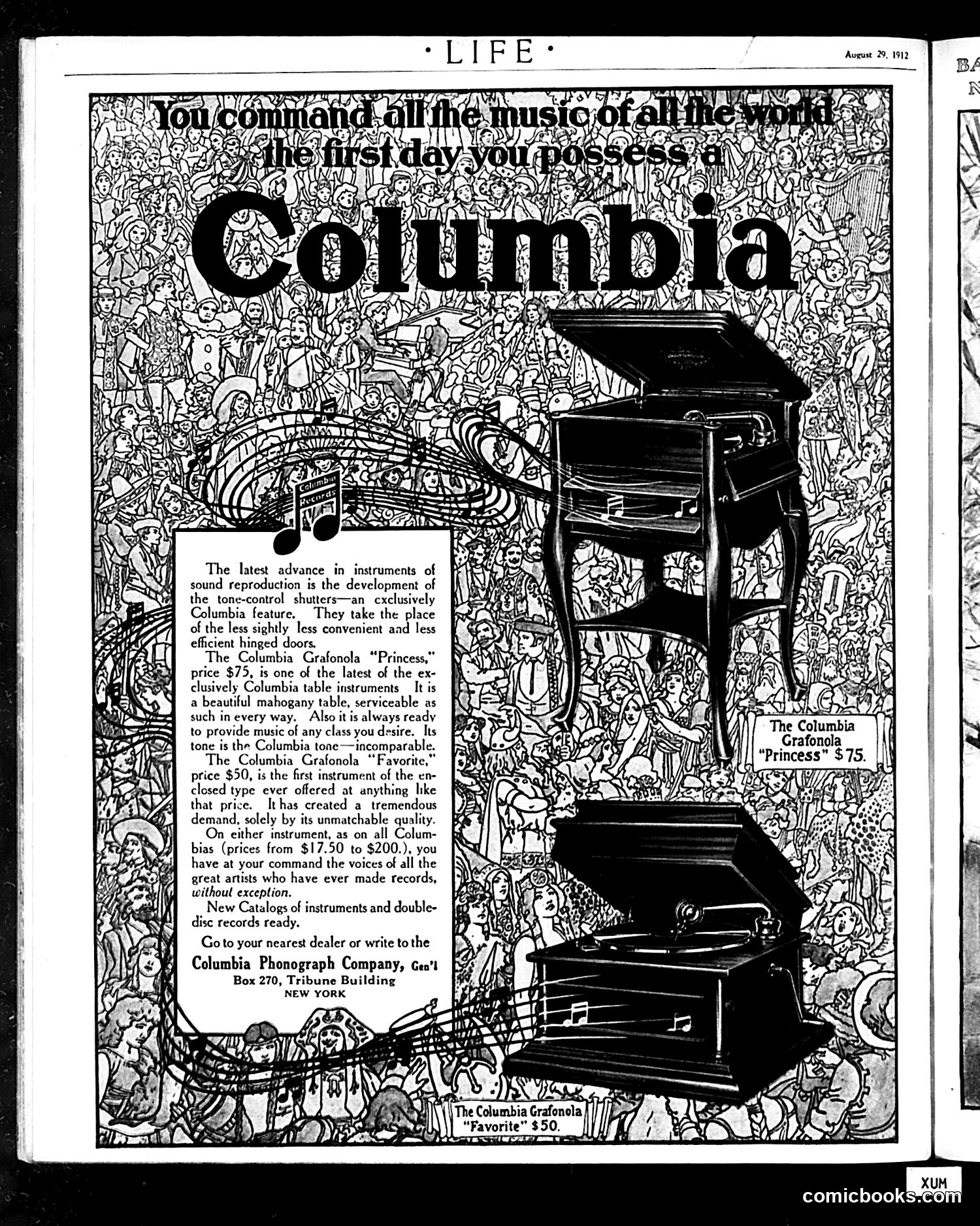
This is a **product advertisement**, not political satire. It promotes Columbia phonograph gramophones published in *Life* magazine on August 29, 1912. The ad highlights two gramophone models: - The "Princess" ($75): a mahogany table model with tone-control shutters (a new feature Columbia emphasizes as superior to hinged doors) - The "Favorite" ($50): a closed-type model marketed as affordable yet high-quality The key sales pitch claims that owning either model gives listeners access to recordings by "all the great artists who have ever made records, **without exception**"—a competitive claim suggesting Columbia had exclusive or superior artist catalogs. The ornate decorative border and musical motifs reinforce the aspirational, cultured positioning of these expensive consumer goods for early 20th-century middle-to-upper-class households.