
Life, 1912-08-29 · page 10 of 42
Life — August 29, 1912 — page 10: what you’re looking at
What you’re looking at
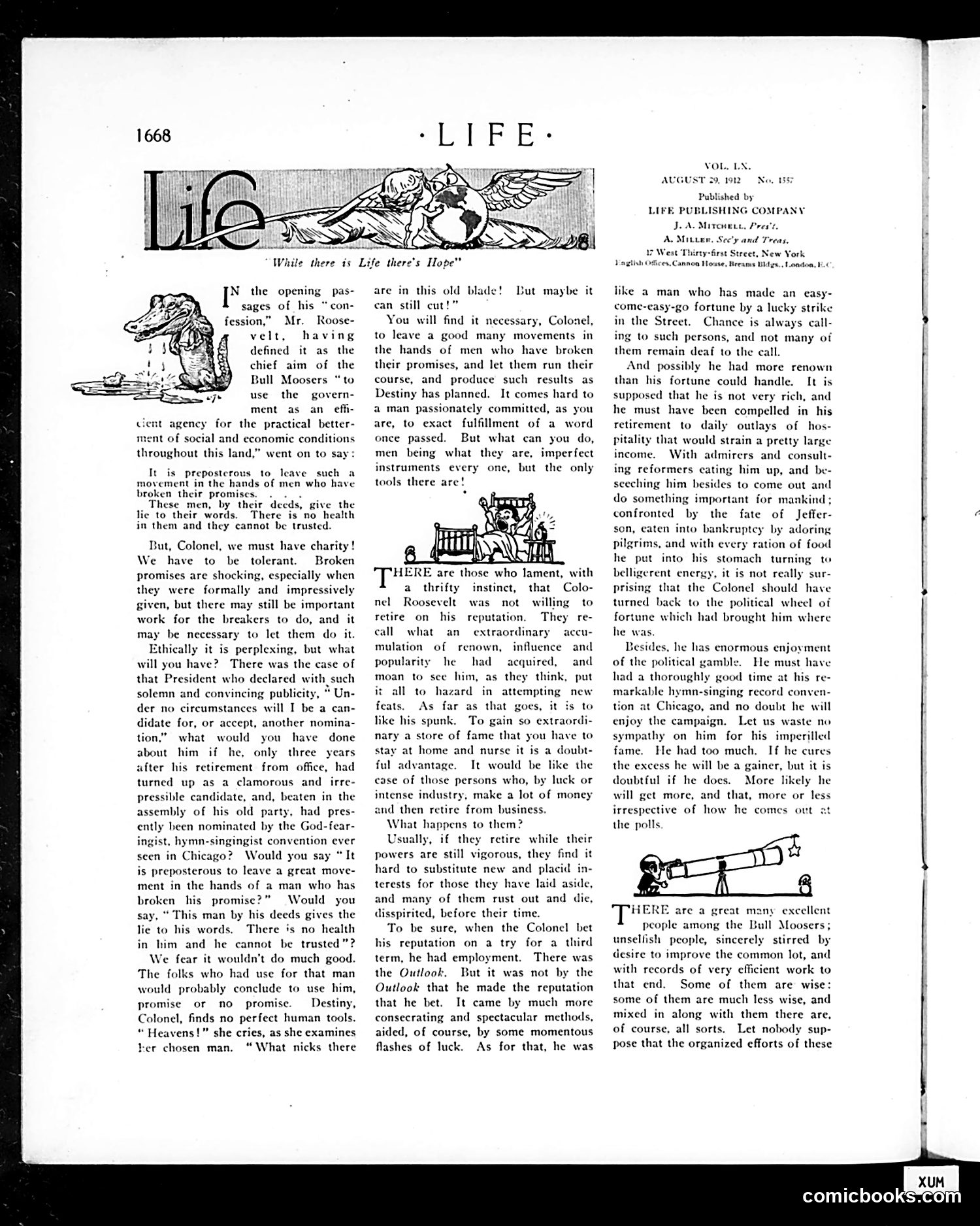
This is a political commentary piece from *Life* magazine (August 29, 1912) discussing Colonel Theodore Roosevelt and his political ambitions. The text critiques Roosevelt's reputation and his apparent desire to remain influential in politics despite having left office. The main argument: Roosevelt is being urged by admirers to re-enter politics, but the article warns this would be unwise. It compares his situation to wealthy businessmen who retire then attempt dangerous new ventures—suggesting his return would damage his legacy. The piece acknowledges Roosevelt's genuine accomplishments and popularity ("extraordinary store of fame"), but argues his best course is dignified retirement rather than pursuing further office. The tone is cautionary rather than harshly satirical, suggesting internal *Life* debate about Roosevelt's continued political relevance in the 1912 election period. The illustrations appear decorative rather than carrying specific satirical content.
📄 Transcribed text from this page (OCR, searchable)
Machine-transcribed from the original scan — historical spelling and the odd misread are preserved.
“While the | ee the opening pas- sages of his “con- fession,” Mr. Roo: velt, having defined it as the chief aim of the Bull Mooser: to use the govern- ment as an effi- ient agency for the practical better- ment of social and economic conditions throughout this land,” went on to say: It is preposterous to leave such a movement in the hands of men who have broken their promises... . These men, by their deeds, give the lic to their words. There is no health in them and they cannot be trusted But, Colonel, we must have charity! We have to be tolerant. Broken promises are shocking, especially when they were formally and impressively given, but there may still be important work for the breakers to do, and it may be necessary to let them do it. Ethically it is perplexing, but what will you have? There was the case of that President who declared with such solemn and convincing publicity, * Un- der no circumstances will I be a can- didate for, or accept, another nomina- tion,” what would have done about him if he, only three years after his retirement from office, had turned up as a clamorous and irre- pressible candidate, and, beaten in the assembly of his old party, had pres- ently been nominated by the God-fear- ingist, hymn-singingist convention ever seen in Chicago? Would you say “It is preposterous to leave a great move- ment in the hands of a man who has broken his promise?” Would you say, “ This man by his deeds gives the lie to his words. There is no health in him and he cannot be trusted"? We fear it wouldn't do much good. The folks who had use for that man would probably conclude to use him, promise or no promise. Destiny, Colonel, finds no perfect human tools. Heavens!” she cries, as she examines her chosen man. “ What nicks there you is Life there's Hope” are in this old blade! can still cut!” You will find it necessary, Colonel, to leave a good many movements in the hands of men who have broken their promises, and let them run their course, and produce such results as Destiny has planned. It comes hard to a man passionately committed, as you are, to exact fulfillment of a word once passed. But what can you do, men being what they are, imperfect instruments every one, but the only tools there are! But maybe it HERE are those who lament, with a thrifty instinct, that Colo- nel Roosevelt’ was not willing to retire on his reputation. They re- call, what) an extraordinary accu- mulation of renown, influence and popularity he had acquired, and moan to sce him, as they think, put it all to hazard in attempting new feats. As far as that goes, it is to like his spunk. To gain so extraordi nary a store of fame that you have to stay at home and nurse it is a doubt- ful advantage. It would be like the case of those persons who, by luck or intense industry, make a lot of mone and then retire from business. What happens to them? Usually, if they retire while their powers are still vigorous, they find it hard to substitute new and placid in- terests for those they have laid aside, and many of them rust out and die, disspirited, before their time. To be sure, when the Colonel bet his reputation on a try for a third term, he had employment. There was the Outlook. But it was not by the Outlook that he made the reputation that he bet. It came by much more consecrating and spectacular methods, aided, of course, by some momentous flashes of luck. As for that, he was VOL. LX. 29, 192 Published by LIFE PUBLISHING COMPANY J. A. Maremene, Pres’ A. Mitten, See'y and Treas. A Weat Thirty-first Street, New Vork 3.Cannoa House, Heeams Lldgs., London, 1. AUGUS' Vagthh like a man who has made an easy come-easy-go fortune by a lucky strike in the Street. Chance is always call- ing to such persons, and not many of them remain deaf to the call. And possibly he had more renown than his fortune could handle. It is supposed that he is not very rich, and he must have been compelled in his retirement to daily outlays of hos- pitality that would strain a pretty large income. With admirers and consult- ing reformers cating him up, and be- sceching him besides to come out and do something important for mankind; confronted by the fate of Jeffer- son, eaten into bankruptey by adoring pilgrims, and with every ration of food he put into his stomach turning to belligerent energy, it is not really sur- prising that the Colonel should have turned back to the political wheel of fortune which had brought him where he was. Besides, he has enormous enjoyment of the political gamble. He must have had a thoroughly good time at his re- markable hymn-singing record conven- tion at Chicago, and no doubt he will enjoy the campaign. Let us waste no sympathy on him for his imperilled fame. He had too much. If he cures the excess he will be a gainer, but it is doubtful if he does. More likely he will get more, and that, more or less irrespective of how he comes ovt at the polls. T iERE are a great many excellent people among the Bull Moosers ; unselfish people, sincerely stirred by desire to improve the common lot, and with records of very efficient work to that end. Some of them are wise: some of them are much less wise, and mixed in along with them there are, of course, all sorts. Let nobody sup- pose that the organized efforts of these comicbooks-com