
Life, 1912-08-29 · page 28 of 42
Life — August 29, 1912 — page 28: what you’re looking at
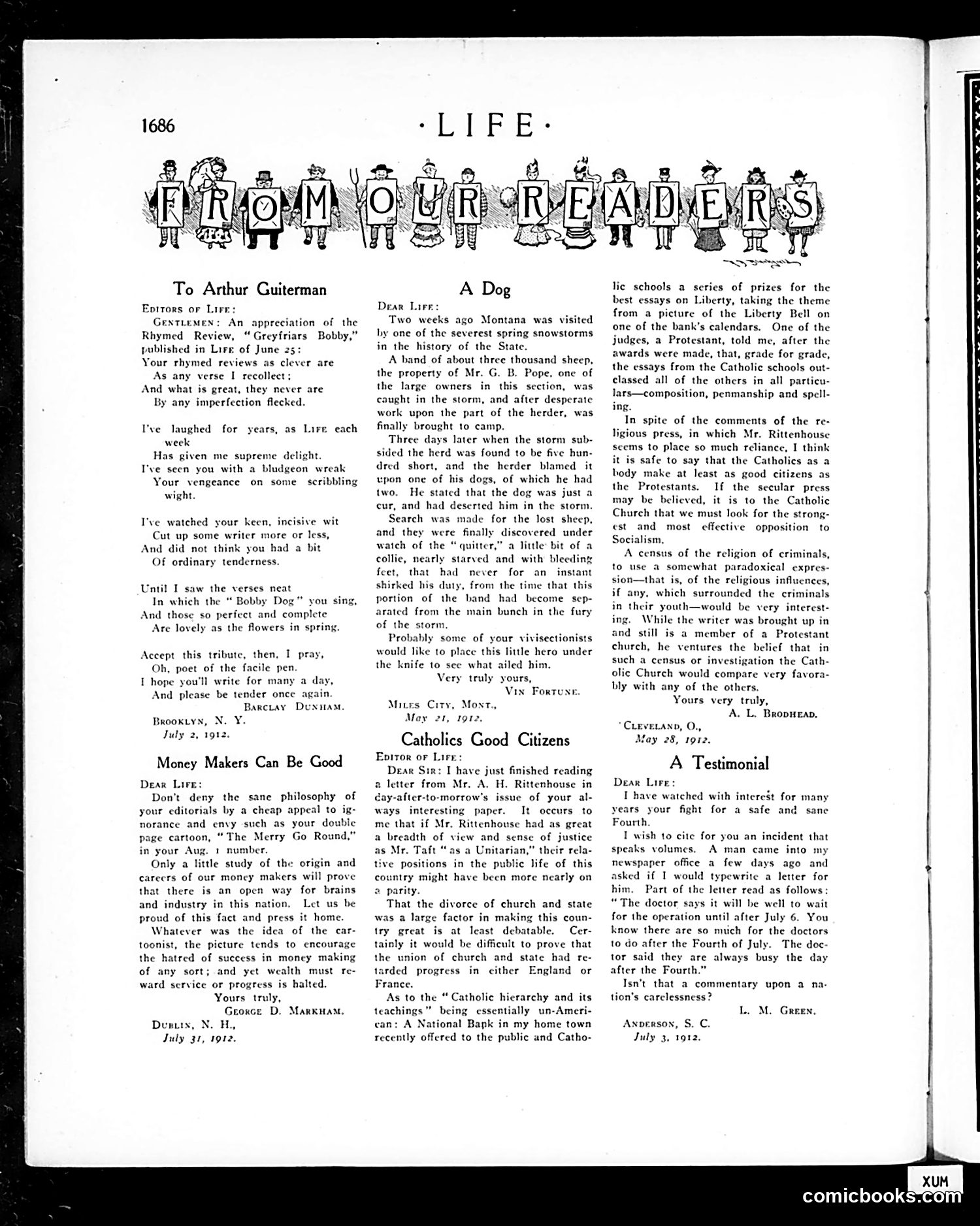
What you’re looking at
This is a letters-to-the-editor page from *Life* magazine, not a political cartoon. It features readers' responses to recent articles and editorial content. Key items include: 1. **"Greyfriars Bobby" praise**: A reader compliments Arthur Guiterman's rhymed review of the famous Scottish dog story, noting his usually sharp wit was "tender" in this case. 2. **"Money Makers" defense**: A reader criticizes *Life*'s August 1 cartoon "The Merry Go Round" as anti-capitalist, arguing it wrongly encourages "hatred of success in money making" and contradicts the magazine's own editorials. 3. **Montana dog story**: A heartwarming anecdote about a collie ("the quitter") who heroically herded lost sheep during a snowstorm, apparently countering anti-animal-experimentation sentiment. 4. **Catholic citizenship debate**: Readers argue about Catholic church-state separation, referencing President Taft and questioning whether the church hierarchy is "un-American." The page reflects *Life*'s satirical role in 1912 American public discourse.
📄 Transcribed text from this page (OCR, searchable)
Machine-transcribed from the original scan — historical spelling and the odd misread are preserved.
To Arthur Guiterman Epitors oF Live: Gextiemen: An appreciation of the Rhymed Review, “Greyfriars Bobby,” published in Lire of June 25: Your rhymed reviews as clever are As any verse I recollect ; And what is great, they never are By any imperfection flecked. I've laughed for years, as Lire each week Has given me supreme delight. I've seen you with a bludgeon wreak Your vengeance on some scribbling wight. I've watched your keen, incisive wit Cut up some writer more or less, And did not think you had a bit Of ordinary tenderness. Until I saw the verses neat In which the “ Bobby Dog” you sing, And those so perfect and complete ‘Are lovely as the flowers in spring. Accept this tribute, then, I pray, Oh, poet of the facile pen. I hope you'll write for many a day, And please be tender once again Barctay Duxiaat. Brooxtyx, N. Y. July 2, 1912. Money Makers Can Be Good Dear Lire: Don't deny the sane philosophy of your editorials by a cheap appeal to ig- norance and envy such as your dow page cartoon, “The Merry Go Round,” in your Aug. 1 number. Only a little study of the origin and carecrs of our money makers will prove that there is an open way for brains and industry in this nation, Let us be of this fact and press it home. Whatever was the idea of the car- toonist, the picture tends to encourage the hatred of success in money making of any sort; and yet wealth must re- ward service or progress is halted. Yours truly, Geoxce D. Markuan. Dusty, N. H., July 31, 1912. Dear Lire: Two weeks ago Montana was visited hy one of the severest spring snowstorms in the history of the State. A band of about three thousand sheep, the property of Mr. G. B. Pope, one of the large owners in this section, was caught in the storm, and after desperate work upon the part of the herder, was finally brought to camp. Three days later when the storm sub- sided the herd was found to be five hun- dred short, and the herder blamed it upon one of his dogs, of which he had two. He stated that the dog was just a cur, and had deserted him in the storm. Search was made for the lost sheep, and they were finally discovered under watch of the “quitter,” a little bit of a collie, nearly starved and with bleeding feet, that had never for an instant shirked his duty, from the time that this portion of the band had become sep- arated from the main bunch in the fury of the storm. Probably some of your vivisectionist: would like to place this little hero under the knife to see what ailed him. Very truly yours, Vin Fortune. Mites City, Most, May 21, 1912, Catholics Good Citizens Eprror oF Lire: Dear Sir: I have just finished reading a letter from Mr. A. H. Rittenhouse in cay-after-to-morrow’s issue of your al- ways interesting paper. It occurs to me that if Mr, Rittenhouse had as great a breadth of view and sense of justice as Mr. Taft “as a Unitarian,” their rela- tive positions in the public life of this country might have been more nearly on 2 parity. That the divorce of church and state was a large factor in making this coun- try great is at least debatable. Cer- tainly it would be difficult to prove that the union of church and state had re- tarded progress in cither England or France. As to the “Catholic hierarchy and its teachings” being essentially un-Ameri- can: A National Bapk in my home town recently offered to the public and Catho- ASS lic schools a series of prizes for the best essays on Liberty, taking the theme from a picture of the Liberty Bell on one of the bank’s calendars. One of the judges, a Protestant, told me, after the awards were made, that, grade for grade, the essays from the Catholic schools out- classed all of the others in all particu- lars—composition, penmanship and spell- ing. In spite of the comments of the re- ligious press, in which Mr. Rittenhouse seems to place so much reliance, I think it is safe to say that the Catholics as a body make at least as good citizens as the Protestants. If the secular press may be believed, it is to the Catholic Church that we must look for the strong- est and most effective opposition to Socialism, A census of the religion of criminals, to use a somewhat paradoxical expres- sion—that is, of the religious influences, if any, which surrounded the criminals in their youth—would be very interest- ing. While the writer was brought up in and still is a member of a Protestant church, he ventures the belief that in such a census or investigation the Cath- olic Church would compare very favora- bly with any of the others, Yours very truly, A. L. Bropitean. “CLEVELAND, O,, May 28, 1912 A Testimonial Dear Lire: I have watched with interest for many years your fight for a safe and sane Fourth I wish to cite for you an incident that speaks volumes. A man came into my newspaper office a few days ago and asked if I would typewrite a letter for him. Part of the letter read as follows: “The doctor says it will be well to wait for the operation until after July 6. You know there are so mich for the doctors to do after the Fourth of July. The doc- tor said they are always busy the day after the Fourth.” Isn't that a commentary upon a na- tion's carclessness? L. M. Green. Anpersox, S. C. July 3, 1912. comicbook $.CO