
Life, 1912-08-29 · page 11 of 42
Life — August 29, 1912 — page 11: what you’re looking at
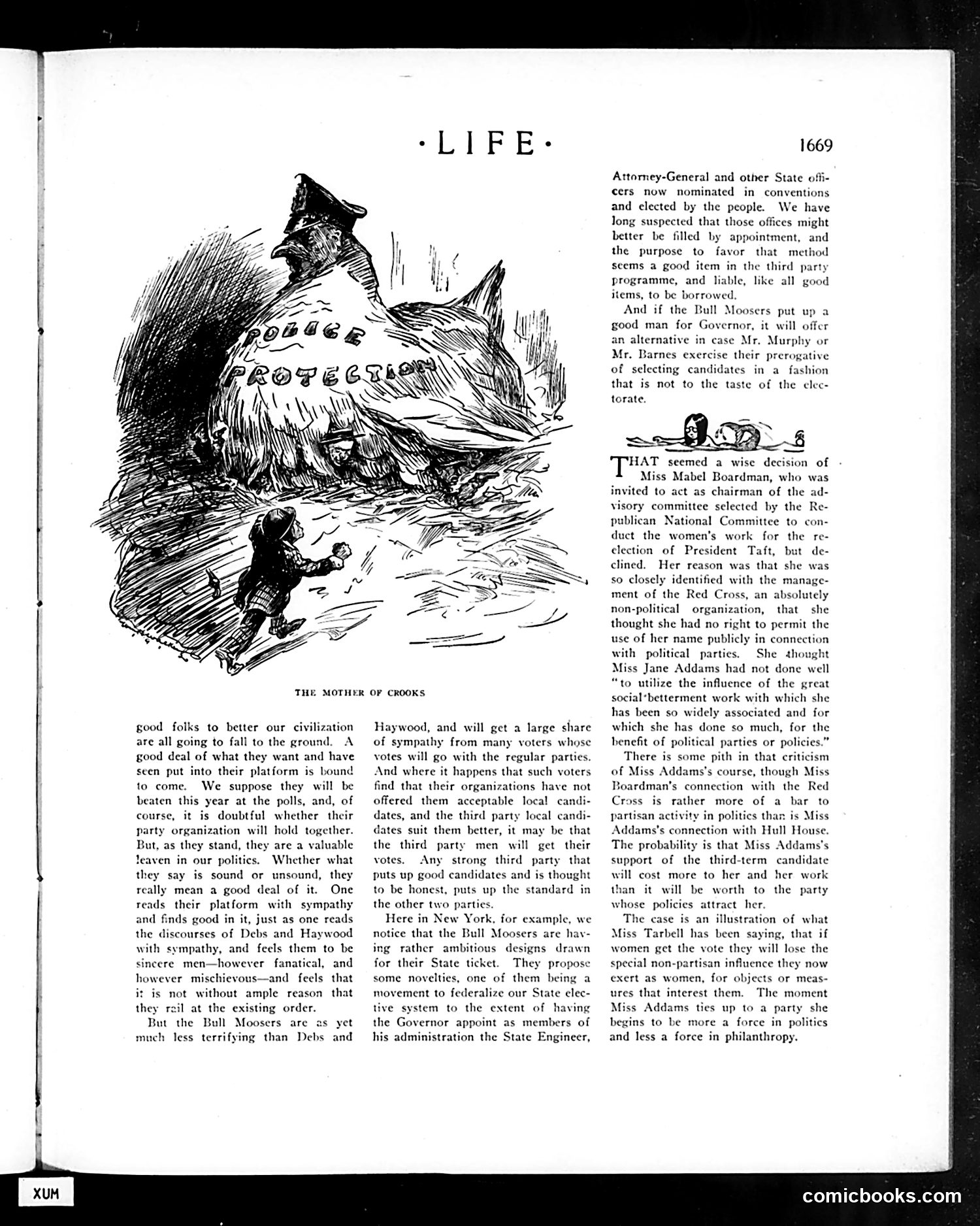
What you’re looking at
The cartoon depicts a large hen labeled "DODGE PROTECTION" brooding over chicks, with a small figure (likely representing a politician or voter) approaching below. The satire critiques the "Bull Moosers"—supporters of Theodore Roosevelt's Progressive Party (symbolized by the protective hen). The text argues that while the Bull Moosers present themselves as offering honest alternatives to corrupt establishment parties, they actually function as a breeding ground for political corruption and poor governance. The "mother of crooks" metaphor suggests that the Progressive Party, despite reform rhetoric, merely incubates the same corrupt politicians and practices they claim to oppose. The cartoon mocks their third-party candidacies as ineffectual and potentially dangerous to the existing political order.
📄 Transcribed text from this page (OCR, searchable)
Machine-transcribed from the original scan — historical spelling and the odd misread are preserved.
-LIFE- THE MOTHER OF CROOKS good folks to better our civilization are all going to fall to the ground. A good deal of what they want and have seen put into their platform is bound to come. We suppose they will be beaten this year at the polls, and, of course, it is doubtful whether their party organization will hold together. But, as they stand, they are a valuable nin our politics. Whether what they say is sound or unsound, they really mean a good deal of it. One reads their platform with sympathy and finds good in it, just as one reads the discourses of Debs and Haywood with sympathy, and feels them to be sincere men—however fanatical, and however mischievous—and feels that it is not without ample reason that they rail at the existing order. But the Bull Moosers are as yet much less terrifying than Debs and Haywood, and will get a large share of sympathy from many voters whose votes will go with the regular parties. And where it happens that such voters. find that their organizations have not offered them acceptable local candi- dates, and the third party local candi- dates suit them better, it may be that the third party men will get their votes. Any strong third party that puts up good candidates and is thought to be honest, puts up the standard in the other two parties. Here in New York, for example, notice that the Bull Moosers are hay- ing rather ambitious designs drawn for their State ticket. They propose some novelties, one of them being a movement to federalize our State elec- tive system to the extent of having the Governor appoint as members of his administration the State Engineer, we 1669 Attormey-General and other State offi- cers now nominated in conventions and elected by the people. We have long suspected that those offices might better be filled by appointment, and the purpose to favor that method scems a good item in the third party gramme, and liable, like all good items, to be borrowed, And if the Bull Moosers put up a good man for Governor, it will offer an alternative in case Mr. Murphy or Mr. Barnes exercise their prerogative of selecting candidates in a fashion that is not to the taste of the elec- torate. —— TH seemed a wise decision of Miss Mabel Boardman, who was invited to act as chairman of the visory committee selected by the Re- publican National Committee to con- duct the women’s work for the re- election of President Taft, but de- clined. Her reason was that she was so closely identified with the manage- ment of the Red Cross, an absolutely non-political organization, that she thought she had no right to permit the use of her name publicly in connection with political parti She tho Miss Jane Addams had not done well “to utilize the influence of the great social’betterment work with which she has been so widely associated and for which she has done so much, for the benefit of political parties or policies.” There is some pith in that criticism of Miss Addams’s course, though Miss 3oardman’s connection with the Red Cross is rather more of bar to partisan activity in politics t is Miss Addams’s connection with Hull House. The probability is that Miss Addams's support of the third-term candidate will cost more to her and her work than it will be worth to the party whose policies attract her. The case is an illustration of what Miss Tarbell has been saying, that if women get the vote they will lose the special non-partisan influence they now exert as women, for objects or meas- ures that interest them. The moment Miss Addams ties up to a party she begins to be more a force in politics and less a force in philanthropy. comicbooks.com