
Life, 1912-08-29 · page 26 of 42
Life — August 29, 1912 — page 26: what you’re looking at
What you’re looking at
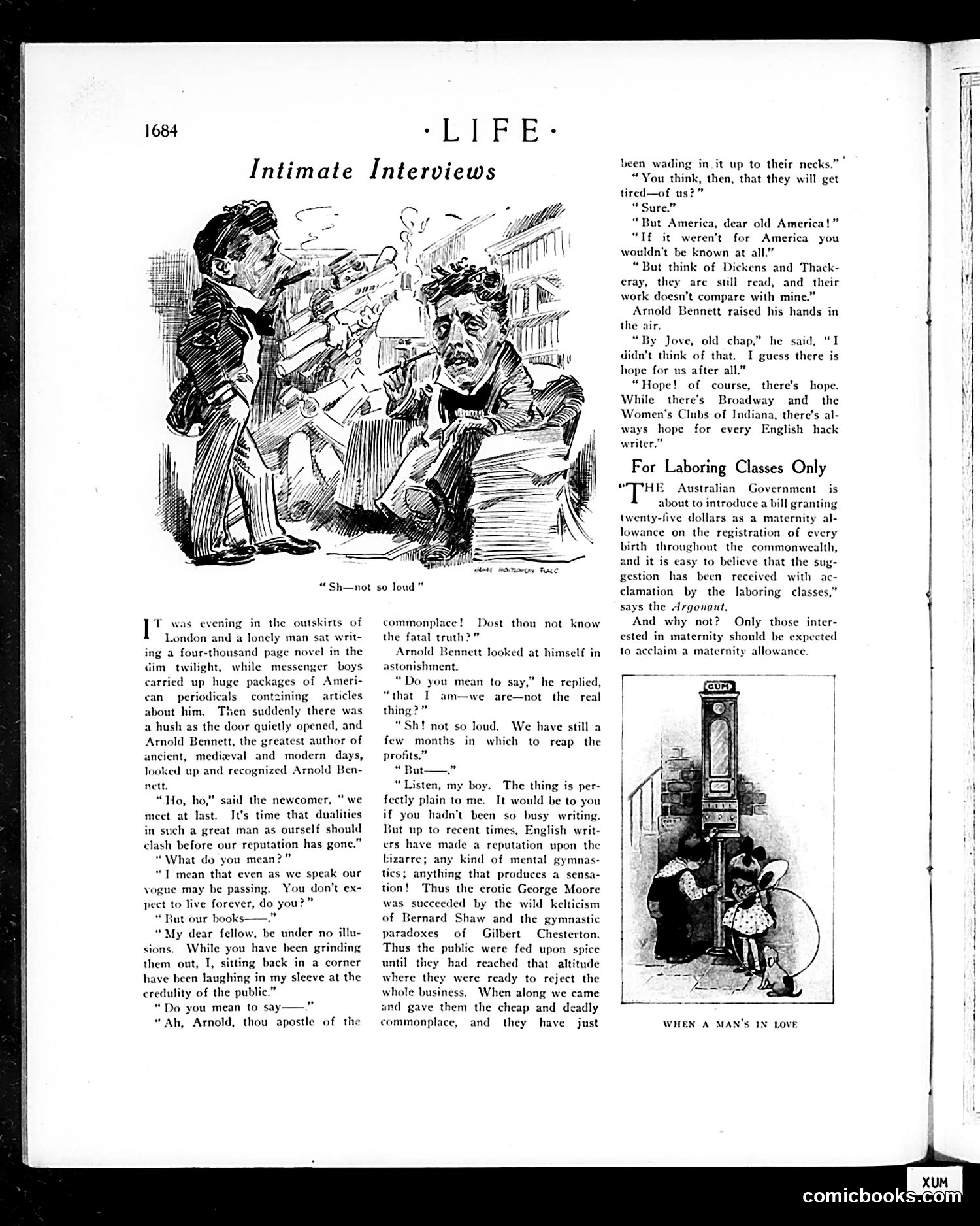
This page satirizes author **Arnold Bennett**, a famous early 20th-century British novelist known for realistic, "commonplace" fiction. The cartoon depicts Bennett meeting himself—a surreal device showing his internal conflict about his own fame and relevance. The satire's target: Bennett and other contemporary English writers (George Moore, Bernard Shaw, Gilbert Chesterton are named) had built reputations on either sensationalism or intellectual gymnastics. Bennett's strategy was the opposite—writing accessible, ordinary fiction. The joke suggests this "cheap and deadly commonplace" approach is actually cynical commercial calculation: writers deliberately feed the public what they've been conditioned to accept, while secretly mocking them. The darker implication: Success depends entirely on American audiences (Broadway, "Women's Clubs of Indiana")—English readers alone won't sustain "hack writers." The phrase "we have still a few months in which to reap the profits" reveals their work as temporarily fashionable rather than lasting literature. The cartoon ridicules both Bennett's pretensions to greatness and the publishing industry's commercial cynicism.
📄 Transcribed text from this page (OCR, searchable)
Machine-transcribed from the original scan — historical spelling and the odd misread are preserved.
“ELF E « Intimate Interviews “Sh—not so loud” I y was evening in the outskirts of London and a lonely man sat writ- ing a four-thousand page novel in the dim twilight, while messenger boys carried up huge packages of Ameri- can periodicals contzining articles about him. Then suddenly there was a hush as the door quietly opened, and Arnold Bennett, the greatest author of ancient, medieval and modern days, looked up and recognized Arnold Ben- nett, “Ho, ho,” said the newcomer, “we meet at last. It’s time that dualities in such a great man as ourself should clash before our reputation has gone.” “What do you mean?” I mean that even as we speak our vogue may be passing. You don’t ex- pect to live forever, do you?” “But our hooks—.” “My dear fellow, be under no illu- sions. While you have been grinding them out, I, sitting back in a corner have been laughing in my sleeve at the credulity of the public.” “Do you mean to say —-’ “Ah, Arnold, thou apostle of the commonplace! Dost thou not know the fatal truth?” Arnold Bennett looked at himself in astonishment. “Do you mean to say,” he replied, “that I am—we are—not the real thing?” “Sh! not so loud. We have still a few months in which to reap the profits.” “ But—.” “Listen, my boy. The thing is per- feetly plain to me. It would be to you if you hadn't been so busy writing. But up to recent times, English writ- ers have made a reputation upon the Lizarre; any kind of mental gymnas- tics; anything that produces a sensa- tior Thus the erotic George Moore was succeeded by the wild kelticism of Bernard Shaw and the gymnastic paradoxes of Gilbert Chesterton. Thus the public were fed upon spice until they had reached that altitude where they were ready to reject the whole business. When along we came and gave them the cheap and deadly commonplace, and they have just been wading in it up to their neck: “You think, then, that they will get tired—of us ur But America, dear old America!” “Tf it weren't for America you wouldn't be known at all.” “But think of Dickens and Thack- eray, they are still read, and their work doesn’t compare with mine.” Arnold Bennett raised his hands in the air. “By Jove, old chap,” he said, “I didn’t think of that. I guess there is hope for us after all.” “Hope! of course, there’s hope. While there's Broadway and the Women’s Clubs of Indiana, there's al- ways hope for every English hack writer.” For Laboring Classes Only “THE Australian Government is about to introduce a bill granting twenty-five dollars as a maternity lowance on the registration of every birth throughout the commonwealth, and it is easy to believe that the sug- gestion has been received with ac- clamation by the laboring classes says the Argonaut. And why not? Only those inter- ested in maternity should be expected to acclaim a maternity allowance. = WHEN A MAN’ IN LOVE re |