
Life, 1912-08-29 · page 17 of 42
Life — August 29, 1912 — page 17: what you’re looking at
What you’re looking at
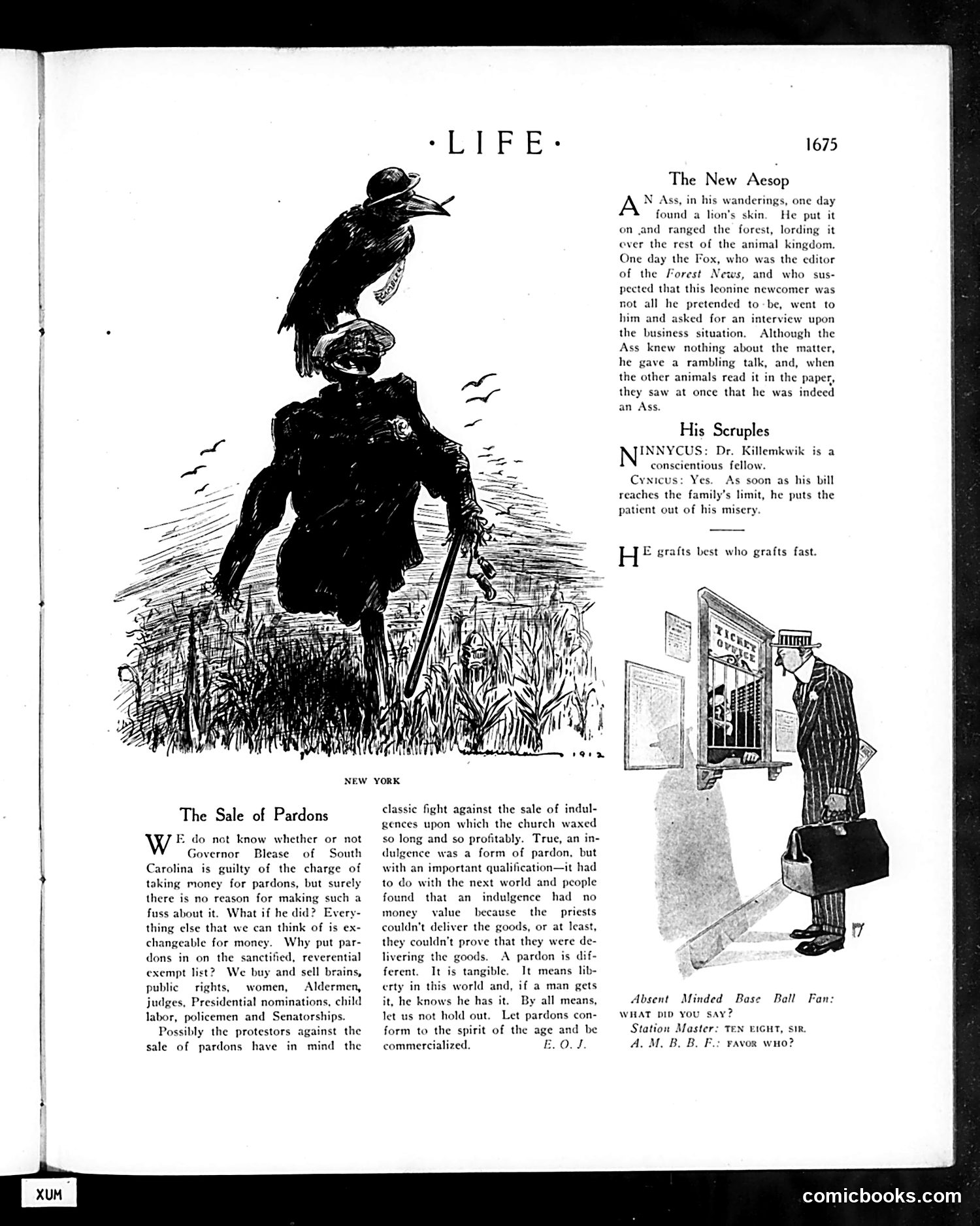
This page contains three satirical pieces attacking corruption and hypocrisy in 1920s America: **"The Sale of Pardons"** mocks Governor Blease of South Carolina (apparently accused of accepting bribes for pardons). The satirist argues cynically that since everything else—brains, judges, political nominations—is already "for sale," why exempt pardons? The piece sarcastically compares selling pardons to the historical Church selling indulgences, noting the key difference: pardons actually deliver tangible freedom in this world, making them genuinely valuable and thus commercializable. **"The New Aesop"** uses a fable format: an Ass wears a lion's skin to fool the forest, but when interviewed by the Fox (a newspaper editor), his rambling ignorance exposes him as a fraud. This appears to mock politicians or public figures who hide behind appearances but reveal their incompetence when questioned. **"His Scruples"** presents a dark joke about Dr. Killemkwik, supposedly conscientious—but only because once a patient's bill reaches the family limit, he "puts the patient out of his misery" (kills them). This satirizes medical profiteering. Together, these pieces attack corruption across government, media, and medicine.
📄 Transcribed text from this page (OCR, searchable)
Machine-transcribed from the original scan — historical spelling and the odd misread are preserved.
NEW YORK The Sale of Pardons W do not know whether or not Governor Blease of South Carolina is guilty of the charge of taking money for pardons, but surely there is no reason for making such a fuss about it. What if he did? Every- thing else that we can think of is ex- changeable for money. Why put par- dons in on the sanctified, reverential exempt list?) We buy and sell brains, public rights, women, Aldermen, judges, Presidential nominations, child labor, policemen and Senatorships. Possibly the protestors against the sale of pardons have in mind the classic fight against the sale of indul- gences upon which the church waxed so long and so profitably. True, an in- dulgence was a form of pardon, but with an important qualification—it had to do with the next world and people found that an indulgence had no money value because the priests couldn't deliver the goods, or at least, they couldn't prove that they were d A pardon is dif- It means li livering the goods. ferent. It is tangible. erty in this world and, if a man gets it, he knows he has it. By all means, let us not hold out. Let pardons con- form to the spirit of the age and be commercialized. E.0O.J. 1675 The New Aesop N Ass, in his wanderings, one day found a lion's skin. He put it on and ranged the forest, lording it over the rest of the animal kingdom. One day the Fox, who was the editor of the Forest News, and who sus- pected that this leonine newcomer was not all he pretended to-be, went to him and asked for an interview upon the ness situation, Although the Ass knew nothing about the matter, he gave a rambling talk, and, when the other animals read it in the paper, they saw at once that he was indeed an Ass. His Scruples INNYCUS: Dr. Killemkwik is a conscientious fellow. Cyxicus: Yes. As soon as his bill reaches the family's limit, he puts the patient out of his misery. E grafts best who grafts fast. Absent Minded Base Ball WHAT pID you say? Station Master: Ti A.M. B. B. Fan: N EIGHT, SIR. comicbooks.com