
A complete issue · 44 pages · 1912
Life — July 4, 1912
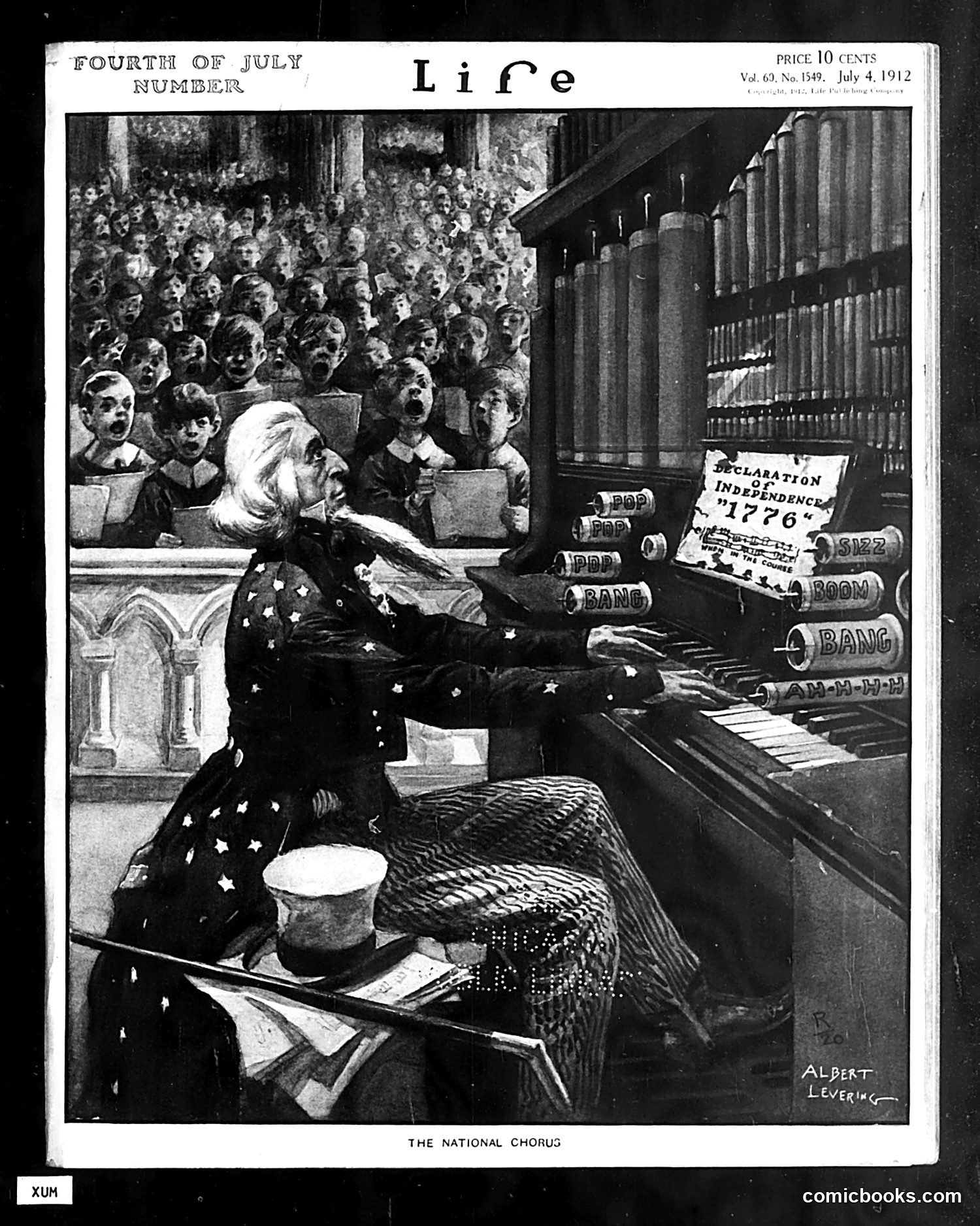
This satirical cartoon depicts an elderly Uncle Sam figure conducting an orchestra of explosives labeled "BANG," "BOOM," and "BOOM-BOOM," with sheet music reading "Declaration of Independence 1776." A massive crowd watches from above. The satire critiques America's Fourth of July celebrations—specifically the widespread use of fireworks and firecrackers during Independence Day festivities. The "national chorus" metaphorically transforms celebratory explosions into a chaotic "performance," with Uncle Sam as conductor orchestrating the noise. The cartoon appears to mock both the excessive, deafening nature of fireworks displays and perhaps broader concerns about public safety during holiday celebrations. The phrase "national chorus" sardonically suggests these explosions represent American patriotic expression.
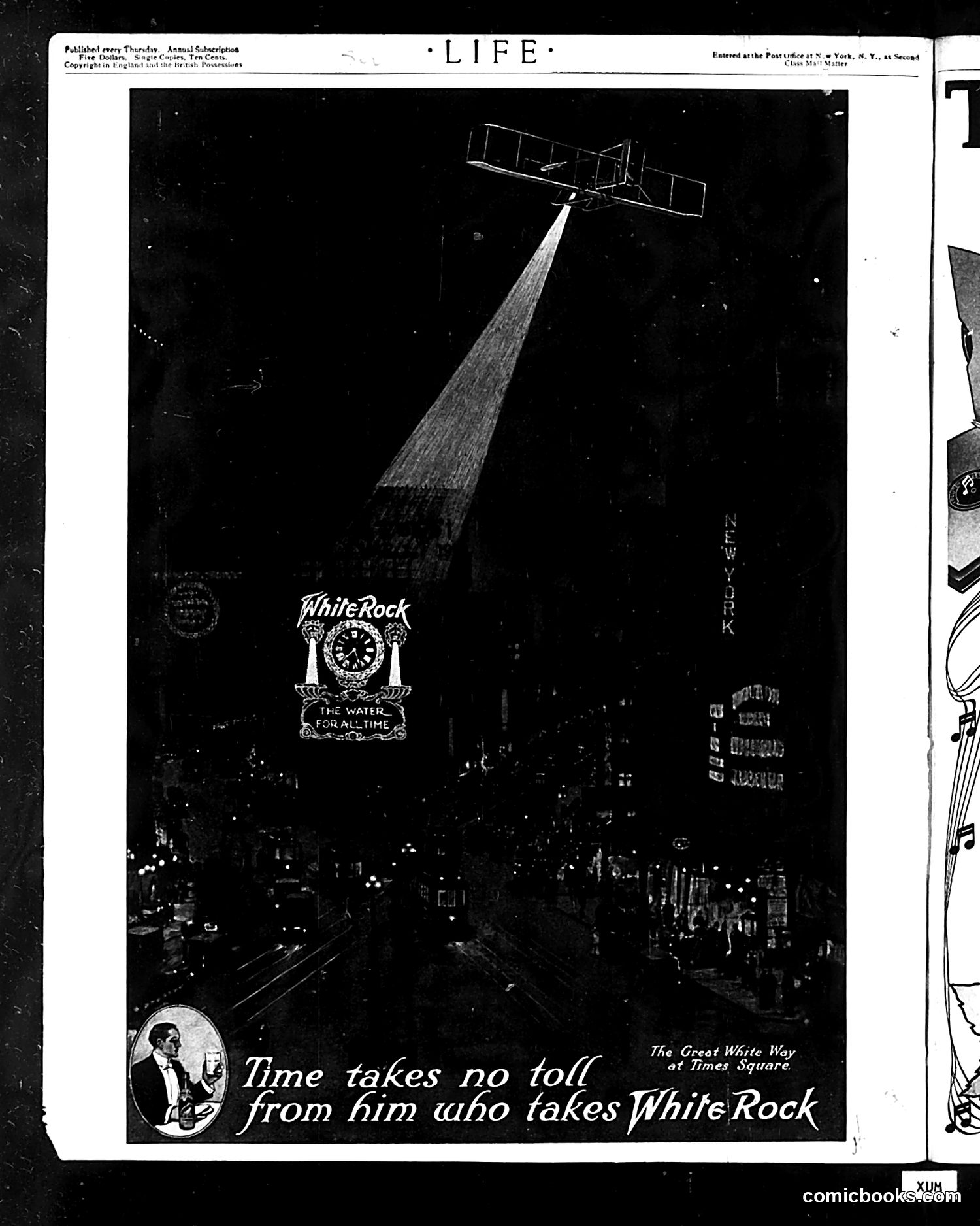
This is a **commercial advertisement**, not political satire. The full-page ad promotes White Rock beverages and appears in *Life* magazine. The image shows a futuristic searchlight beam from an aircraft illuminating Times Square at night, with the White Rock logo and clock prominently displayed among city buildings. The tagline reads: "Time takes no toll from him who takes White Rock." The ad's message conflates the product with modernity and vitality—the cutting-edge aircraft technology symbolizes progress, while the slogan suggests that White Rock consumers maintain their vigor and youthfulness. "The Great White Way of Times Square" references the famous Broadway area's electric lights, associating the brand with glamour and urban sophistication. This represents early 20th-century advertising's emphasis on science and progress to sell consumer goods.
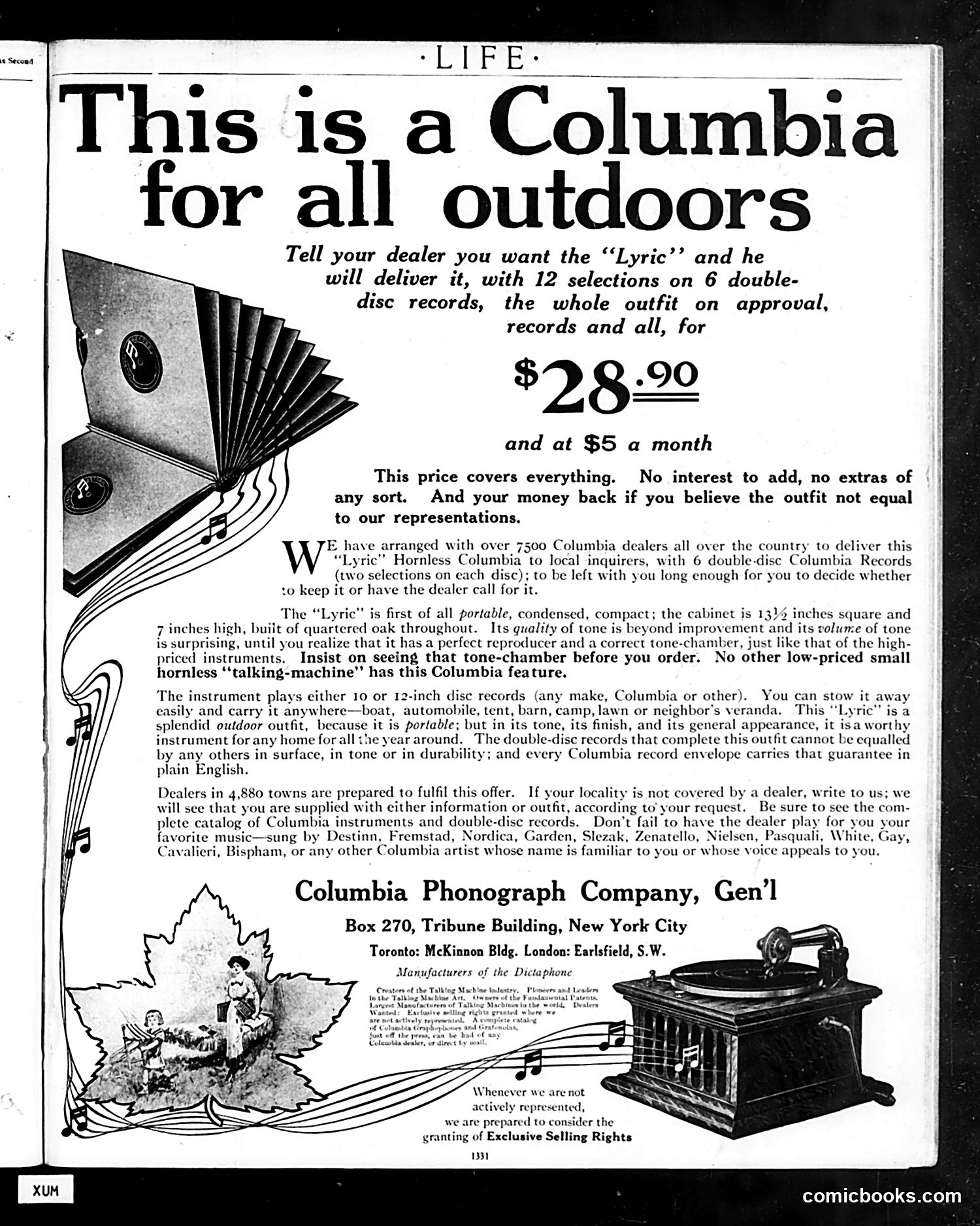
This page is primarily a **product advertisement**, not satire or political commentary. It advertises the Columbia "Lyric" phonograph—a portable record player priced at $28.90 plus $5 monthly installments. The marketing emphasizes portability ("boat, automobile, tent, barn, camp, lawn or neighbor's veranda") and affordability with a money-back guarantee. The decorative elements—musical notes, a leaf-framed scene of people outdoors—illustrate the product's intended use in outdoor settings. The heading "This is a Columbia for all outdoors" is straightforward advertising copy, not satire. The illustrated phonograph and musical imagery simply support the sales pitch. This appears to be from the early 20th century, when phonographs were still relatively new consumer technologies.
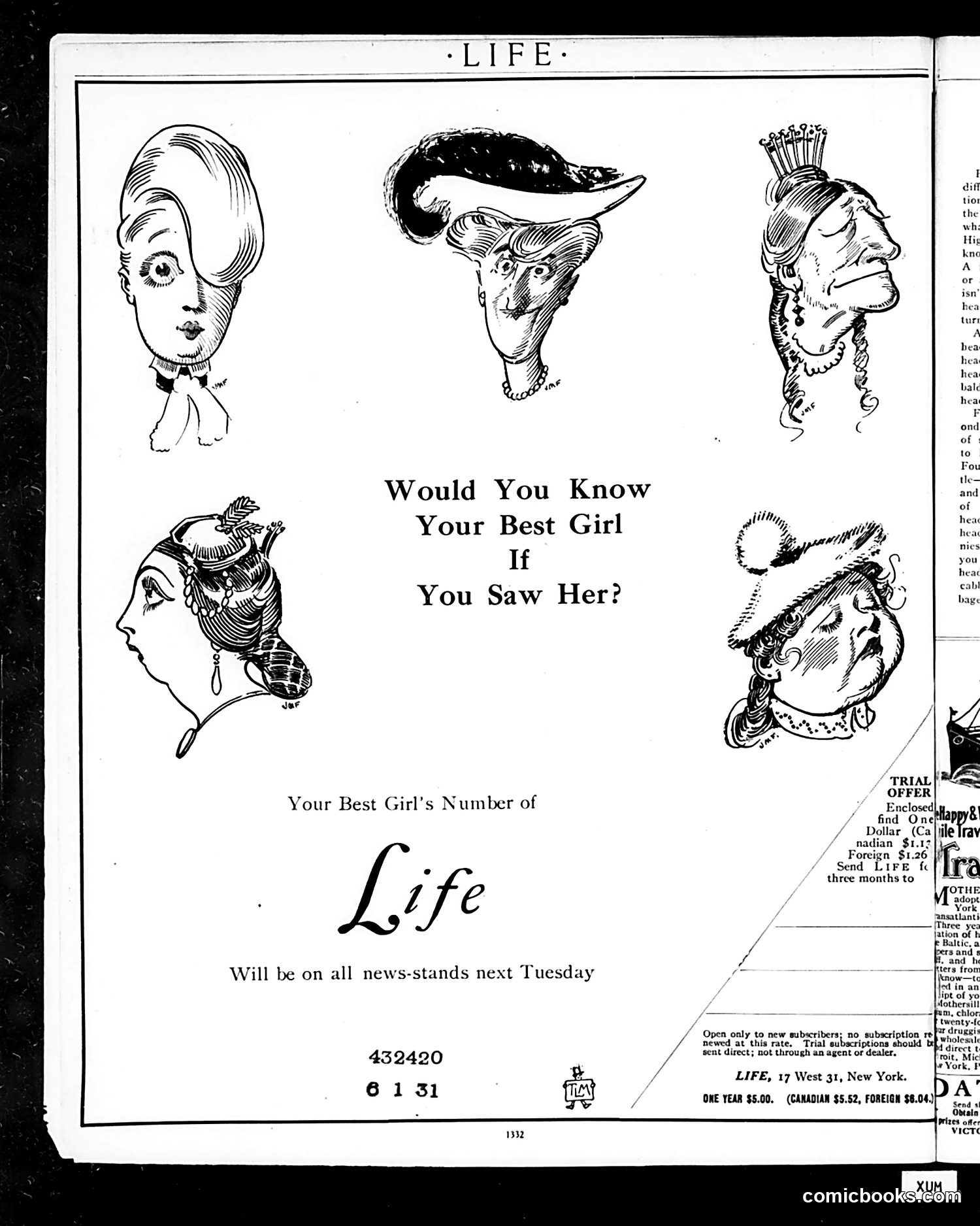
This is primarily an **advertisement for Life magazine**, not political satire. The page asks "Would You Know Your Best Girl If You saw Her?" and displays five exaggerated caricatured female heads in different styles—representing various fashionable hairstyles and headwear of the era. The implicit joke is that women's appearance changes so dramatically with different hairstyles, makeup, and fashions that they might become unrecognizable. This plays on contemporary anxieties about rapidly changing women's fashion and beauty standards. The ad promotes Life's upcoming issue (next Tuesday) and encourages subscription, suggesting the magazine regularly featured commentary on women's fashion and social trends. The price is listed as one dollar Canadian ($1.15 foreign).
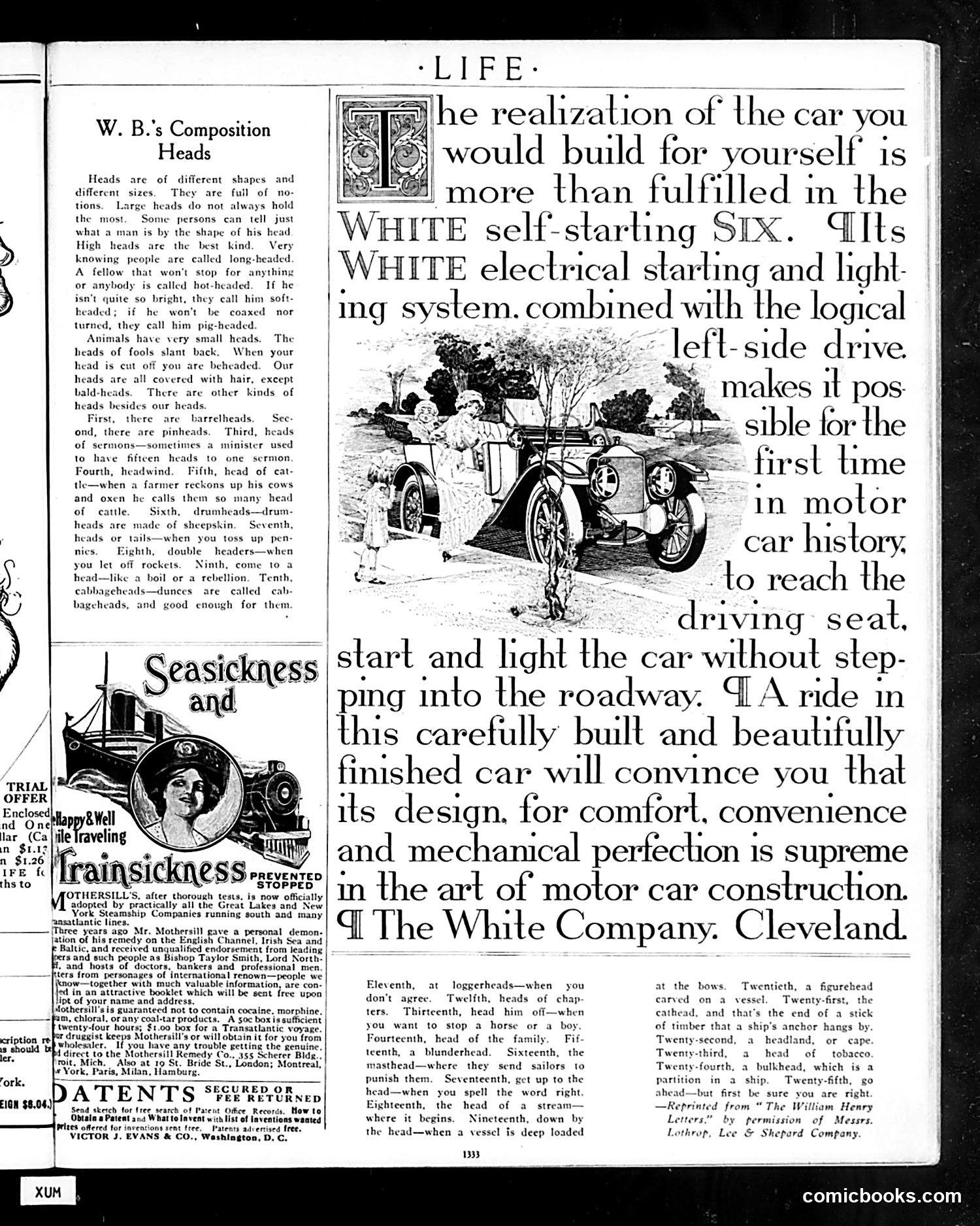
This page is primarily **advertising**, not satire or political commentary. The main content is a White automobile company advertisement promoting the "White self-starting Six," highlighting its electric starting system and left-side drive as revolutionary conveniences. The ad claims these features make it possible "for the first time in motor car history" to reach the driving seat without stepping into the roadway. The left column contains educational content about head shapes ("W.B.'s Composition Heads") and a brief piece on seasickness prevention—typical filler for Life magazine. A small patent notice appears at the bottom. There is no political cartoon or satire visible on this page; it's a straightforward early automotive advertisement from an era when self-starting cars were still novel innovations.
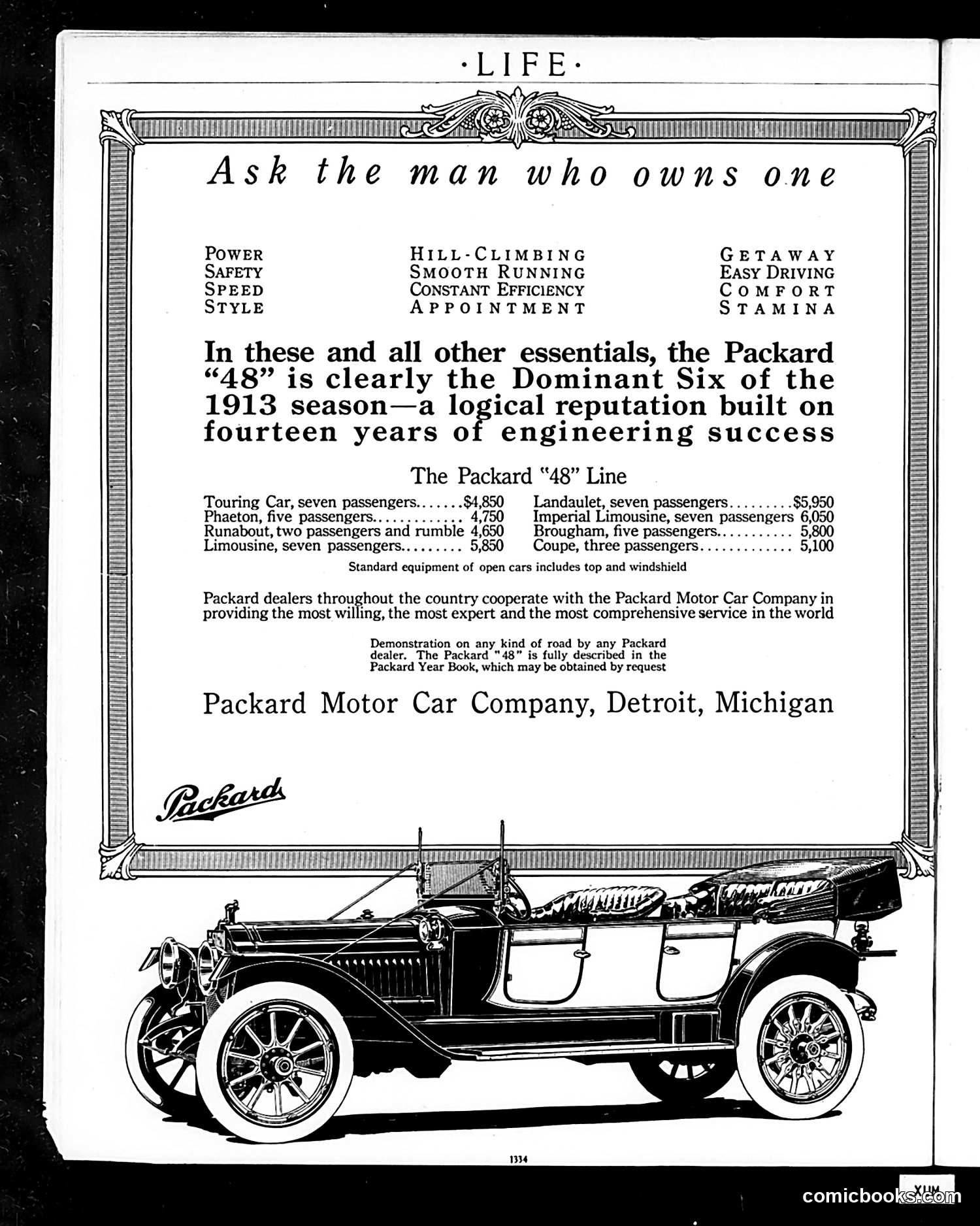
This is **not a satirical cartoon** but rather a **straightforward automobile advertisement** from Life magazine (1913). The page advertises the Packard "48" automobile, highlighting its engineering credentials developed over fourteen years. The content lists the vehicle's key features (Power, Safety, Speed, Style, Hill-Climbing, Smooth Running, etc.) and provides pricing for various models ranging from $4,850 to $8,050. The illustration shows a seven-passenger touring car—the primary model being promoted. The ad emphasizes Packard's reputation and dealer network, concluding with the company's Detroit headquarters address. There is **no political or social satire** on this page; it is purely commercial advertising typical of early automotive marketing.
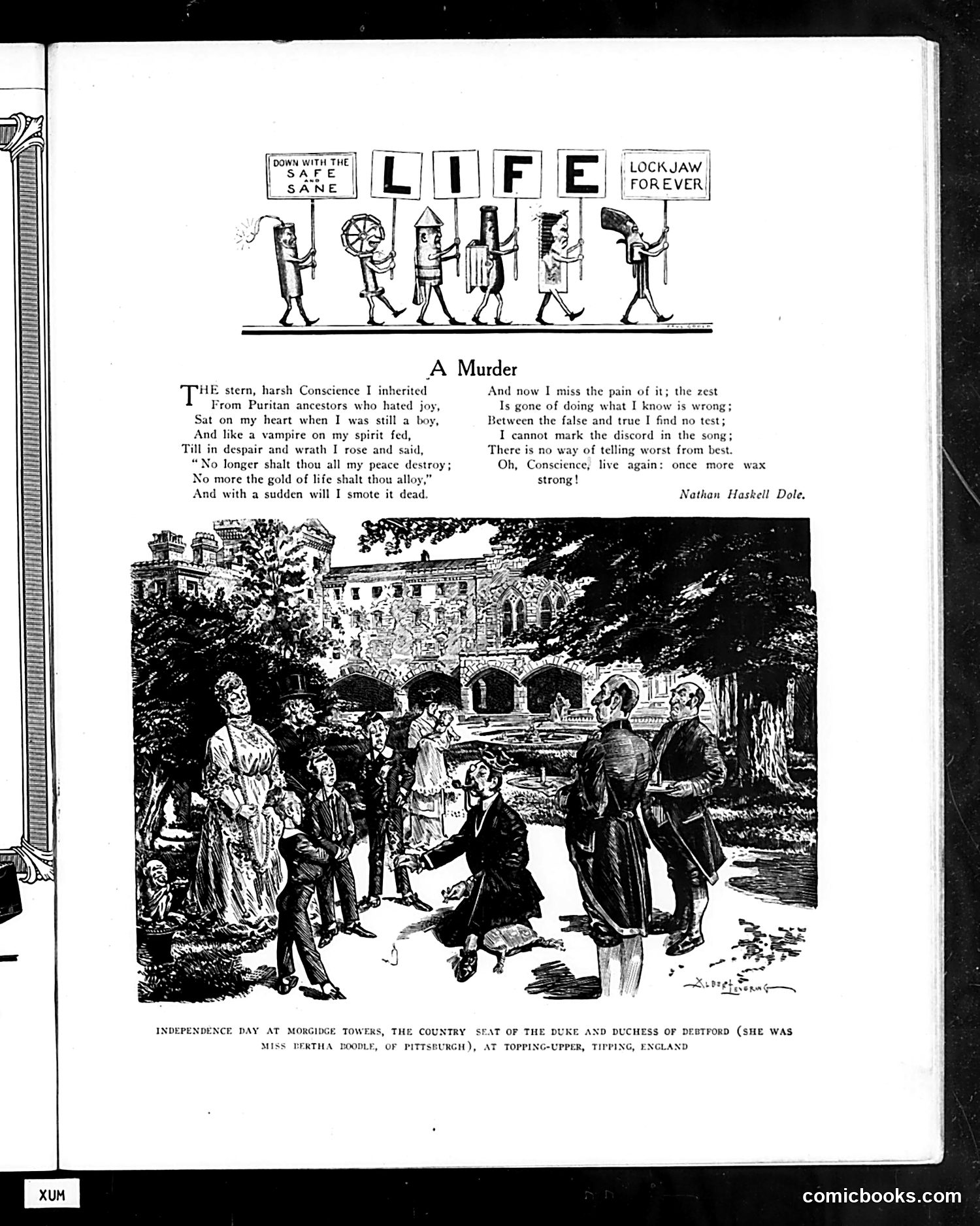
This page presents a poem titled "A Murder" by Nathan Haskell Dole, accompanied by an illustration depicting a formal garden scene at Morganidge Towers (identified as the country estate of the Duke and Duchess of Dertford, formerly Miss Bertha Doodle of Pittsburgh). The poem's title and melancholic tone suggest the "murder" is metaphorical—likely the death of conscience or moral principles. The text references Puritan ancestry, inherited sternness, and the speaker's renunciation of life's joys in favor of righteousness. The illustration shows well-dressed figures in a stately setting, apparently depicting the social world the poem critiques. The satire appears to target American society's adoption of rigid British aristocratic values and the spiritual cost of such conformity.
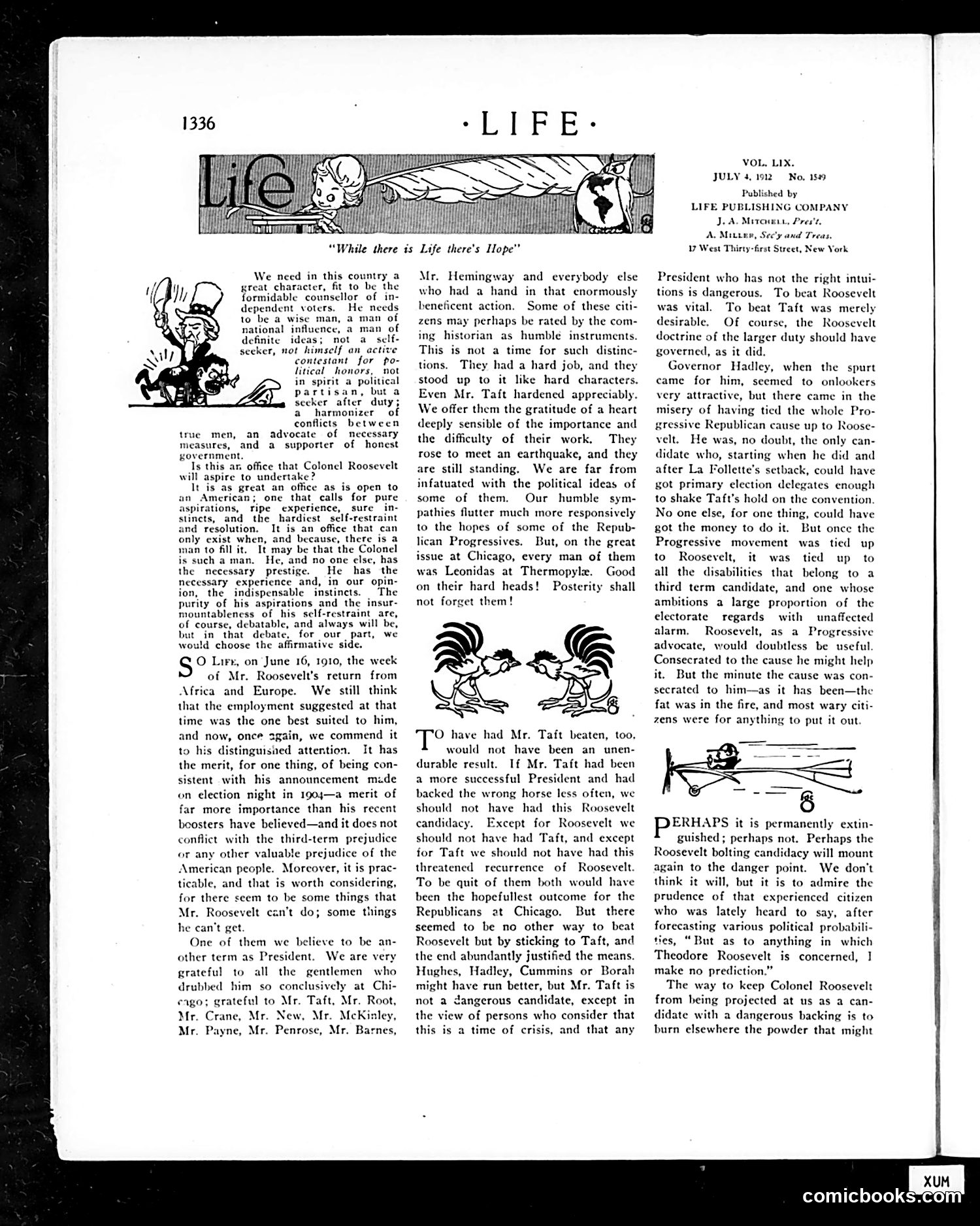
This editorial page discusses the 1912 Presidential election aftermath. The text debates whether Theodore Roosevelt's third-term candidacy was justified, suggesting that while Roosevelt had merit, supporting him created conflict with Republican party loyalty. The two cartoon illustrations show **roosters fighting** — likely representing the Republican party split. In 1912, Roosevelt's Progressive "Bull Moose" party candidacy divided the GOP, allowing Democrat Woodrow Wilson to win. The rooster imagery suggests fratricidal conflict within the Republican ranks. The text acknowledges Roosevelt's leadership qualities but criticizes his third-term ambitions as dangerous precedent, arguing the party should have stuck with Taft to maintain unity rather than fracturing over personality-driven politics.
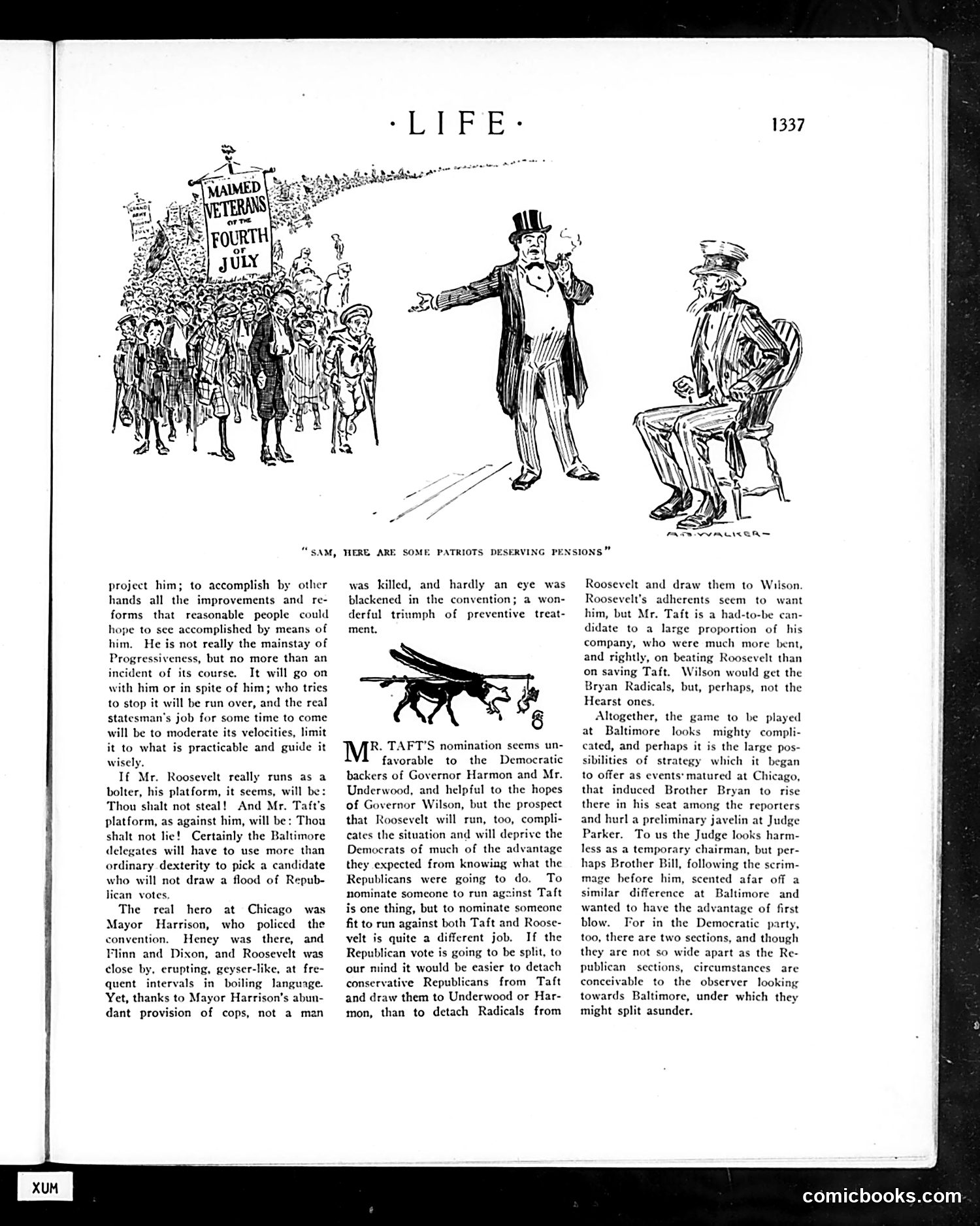
This Life magazine page satirizes the 1912 U.S. presidential election. The main cartoon shows Uncle Sam gesturing to a crowd of war veterans bearing a "Maimed Veterans of the Fourth of July" banner, while speaking to a seated military figure. The accompanying text discusses Taft's nomination prospects and Democratic strategy, mentioning Roosevelt, Wilson, Bryan, and the Republican Party split. The satire targets the tension between incumbent President Taft and Theodore Roosevelt's progressive faction within the Republican Party, which threatens to fracture Republican votes. The "maimed veterans" reference appears to mock the political "wounds" inflicted by party infighting, using Fourth of July imagery to suggest patriotic concerns are being damaged by partisan conflict.
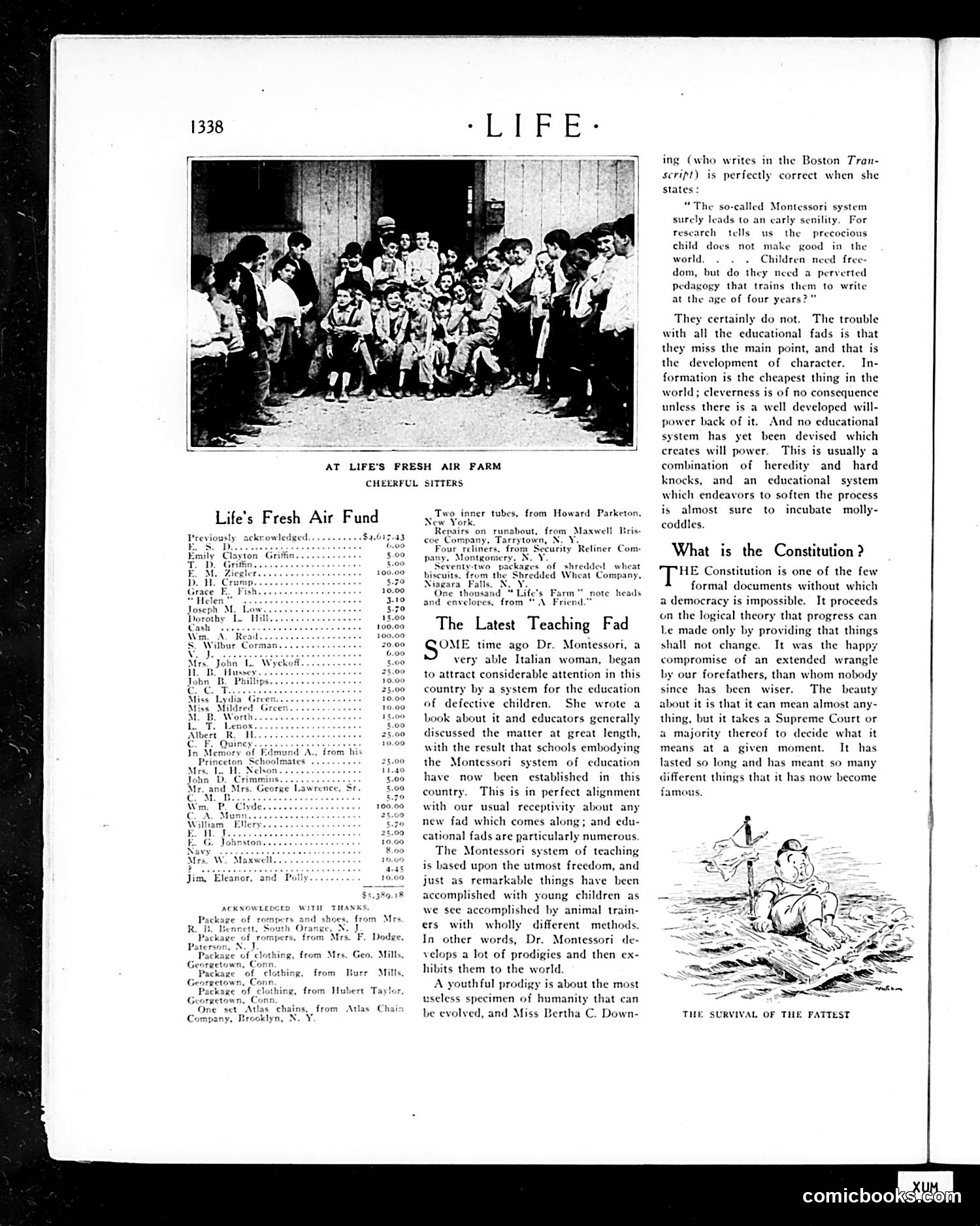
This LIFE magazine page (1338) contains two distinct sections: **Top Section:** A photograph labeled "At Life's Fresh Air Farm: Cheerful Sitters" shows children and adults at what appears to be a charitable facility. Below it is a fundraising list for "Life's Fresh Air Fund," documenting donations for presumably underprivileged children's care. **Bottom Section:** An article titled "The Latest Teaching Fad" criticizes the Montessori educational method, which had recently gained popularity in America. The text dismisses Montessori's progressive approach as overly focused on "freedom" while neglecting character development. The author argues that information alone is worthless without "well-developed willpower." A small cartoon illustration shows a child, likely depicting the satirical point about educational philosophy. This reflects early 20th-century American skepticism toward progressive pedagogy.
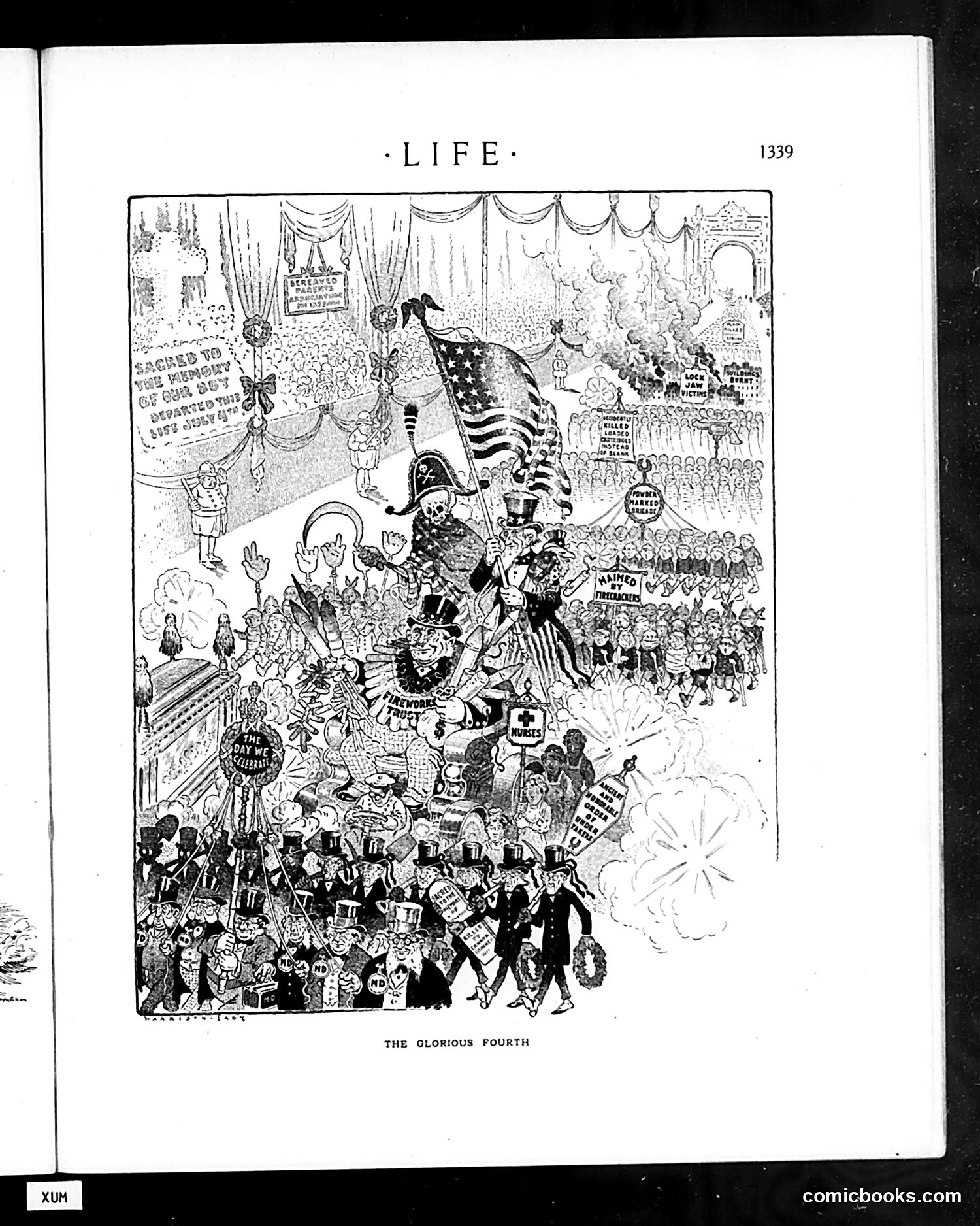
This satirical cartoon depicts a chaotic Fourth of July celebration, showing the holiday as overwrought and commercialized excess. The central figure appears to be Uncle Sam (identifiable by the star-spangled outfit and top hat), surrounded by massive crowds, elaborate decorations, and multiple American flags. The satire critiques how Independence Day celebrations had become spectacles of commercialism and noise rather than meaningful patriotic observance. Visible signs reference various commercial interests and entertainments competing for attention. The composition—with its layered masses of people, ornamental excess, and carnival-like atmosphere—suggests the cartoonist viewed the "glorious" Fourth as having devolved into frivolous pageantry disconnected from the holiday's actual significance. The work exemplifies *Life* magazine's tradition of lampooning American consumer culture and civic excess.
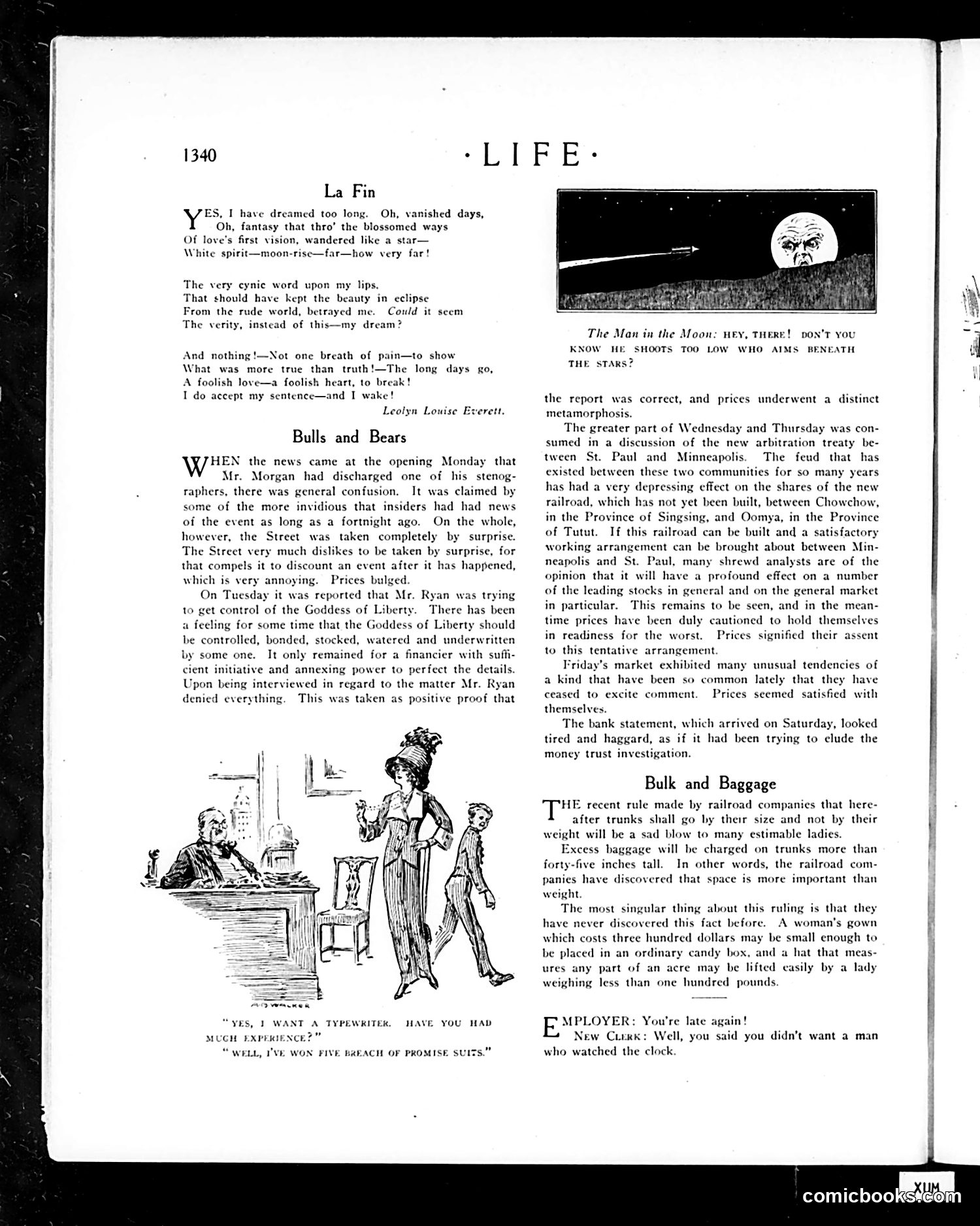
This page contains two distinct satirical pieces: **"La Fin"** - A poem lamenting lost romantic ideals, expressing disillusionment with harsh reality replacing youthful dreams. **"Bulls and Bears"** - A financial commentary about stock market volatility and railroad investments. The text discusses Mr. Ryan attempting to control the "Goddess of Liberty" (likely J.P. Morgan or similar financial figure), suggesting wealthy financiers manipulated markets. References to railroad construction between Minneapolis and St. Paul indicate speculation in railroad stocks. **The cartoon** depicts a woman (representing Liberty or the market) being pursued by businessmen, illustrating how financial interests competed for market control. **"Bulk and Baggage"** - A brief satirical piece about railroad companies' new rules charging by trunk size rather than weight, exposing absurd logistics while mocking corporate rule-making. The final joke about the typewriter reflects workplace humor about job applicants and experience.
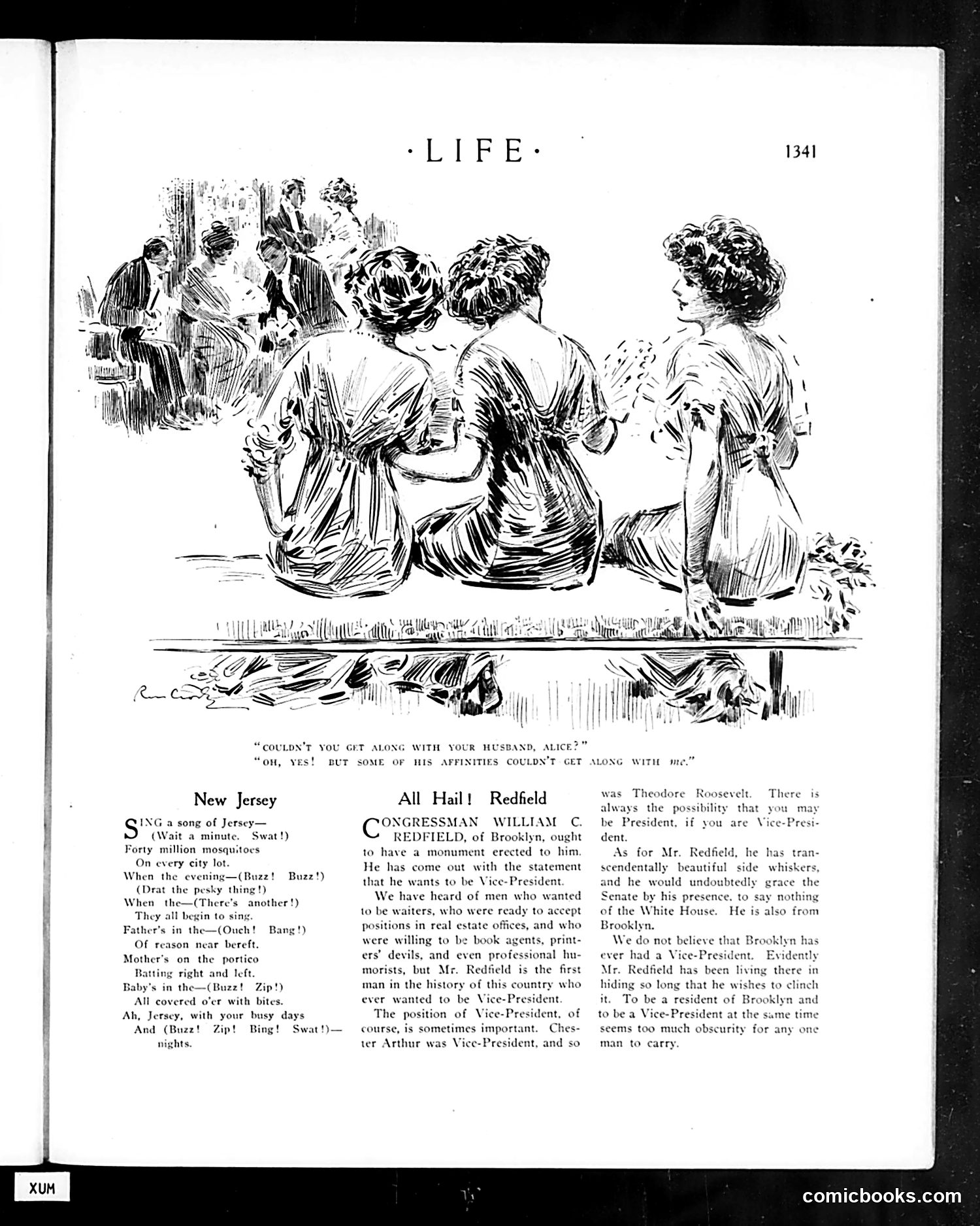
**The Main Cartoon** (top of page) depicts three women from behind, observing a social gathering. The caption reveals marital discord: one woman says her husband won't "get along" with her, and another responds that some of his "affinities couldn't get along" with her either—a veiled reference to infidelity or incompatible interests/associates. **The "All Hail! Redfield" Section** (below) satirizes Congressman William C. Redfield of Brooklyn's stated desire to be Vice President. The text mocks this ambition as absurdly obscure, noting that Brooklyn has never produced a Vice President and suggesting the position's obscurity makes it unsuitable for someone of Redfield's prominence. The page combines social satire with political commentary on an obscure political figure's unlikely ambitions.
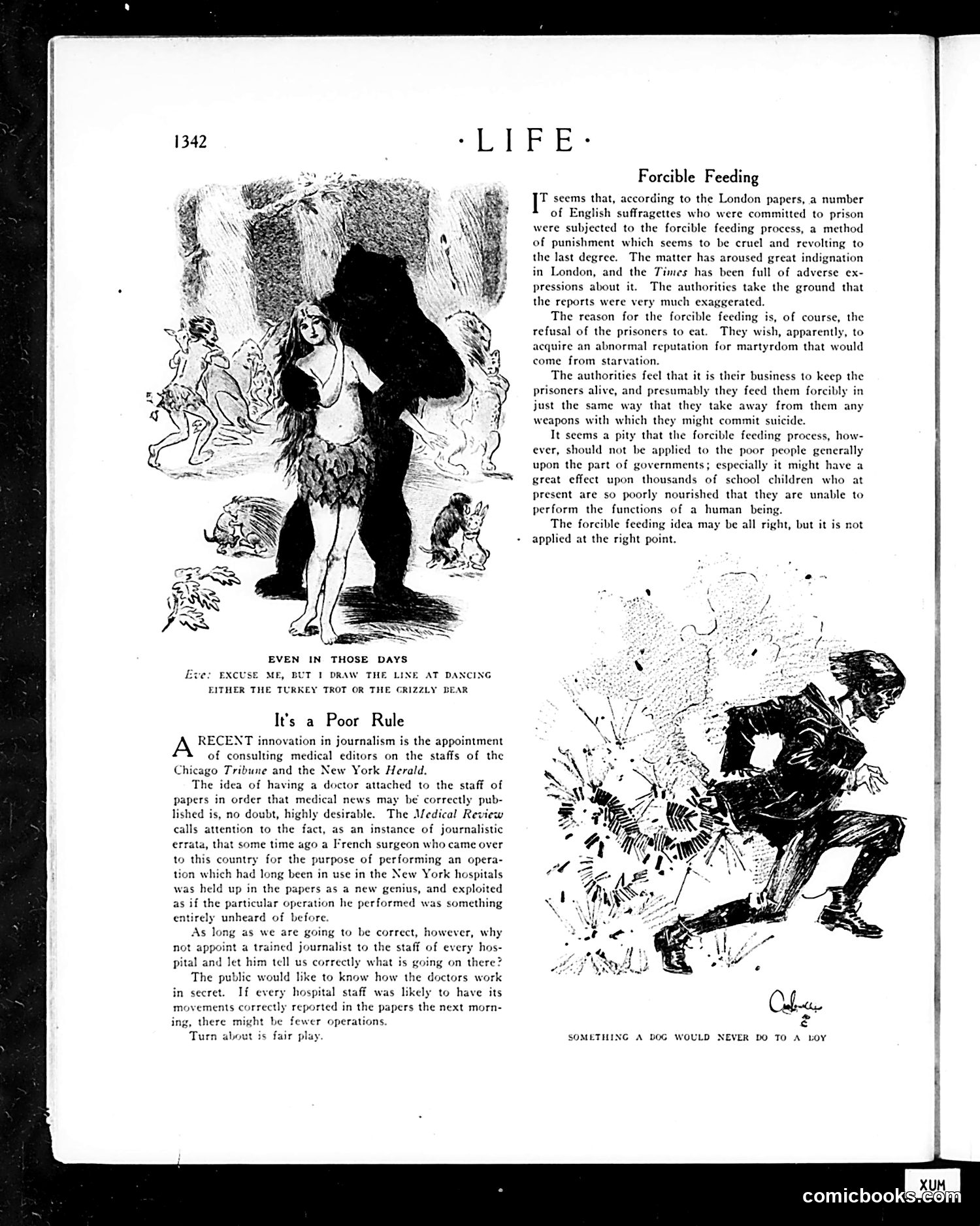
**"Forcible Feeding" Article:** This article critiques the force-feeding of imprisoned British suffragettes who refused to eat. The accompanying illustration shows a dark silhouette of a figure being forcibly fed while surrounded by cherubs and smaller figures. The text argues authorities justified this as keeping prisoners alive, but notes the practice was cruel and counterproductive—it gave martyrdom appeal to the suffragettes' cause. The article questions whether such harsh treatment should apply to any prisoners, particularly noting it seems especially wrong applied to underfed children generally. **"It's a Poor Rule" Section:** This discusses the appointment of consulting medical editors at major newspapers. It humorously critiques the idea, asking why hospitals shouldn't similarly have journalists to accurately report their operations to the public. The right illustration, "Something a Dog Would Never Do to a Lov[ed one]," appears unrelated social commentary.
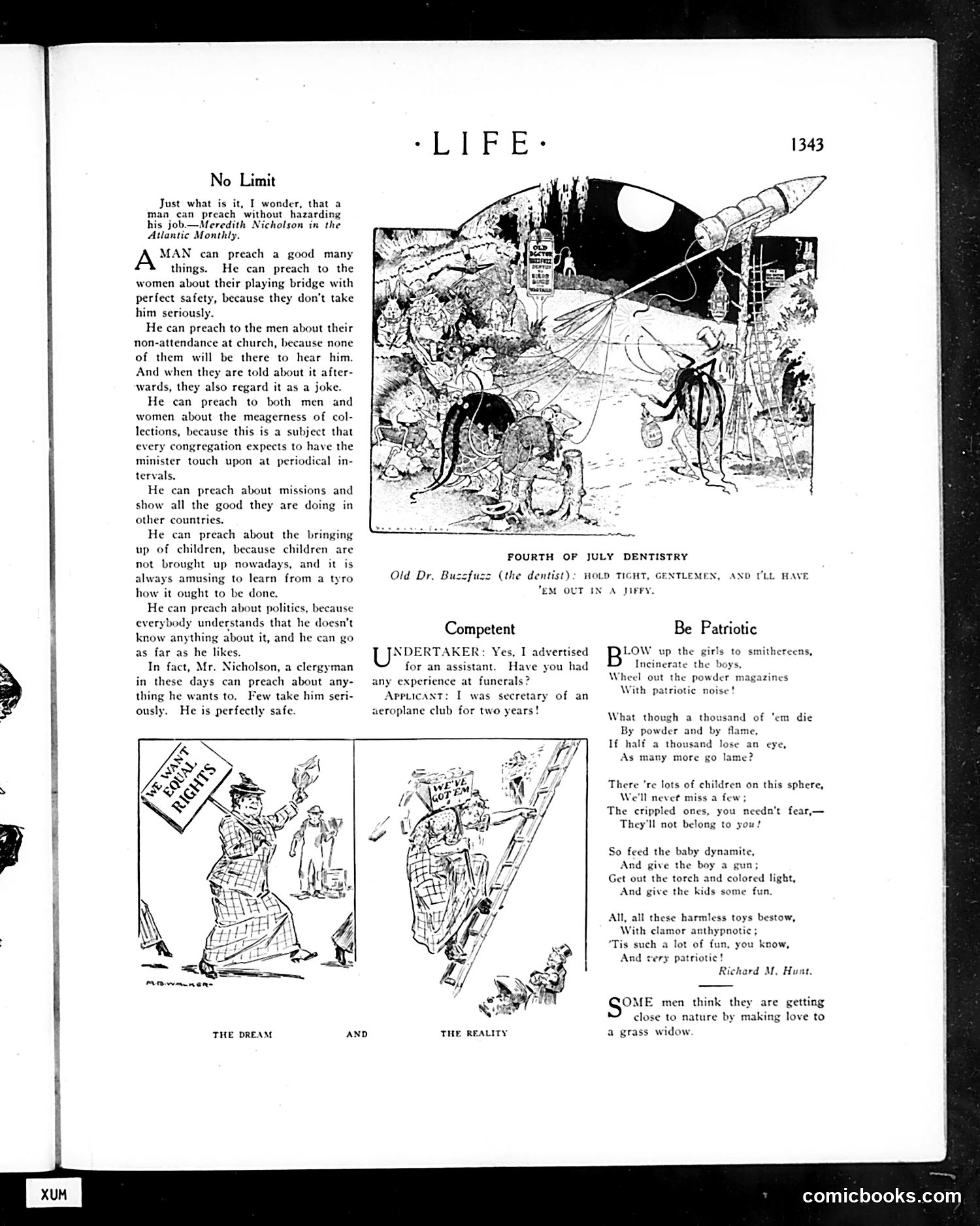
This page contains satirical commentary on early 20th-century American life: **"No Limit"** mocks clergy who preach safely on trivial topics (bridge-playing women, absent churchgoers, thin collections) while avoiding anything controversial. The joke: ministers are so ineffectual that congregants dismiss them entirely—they can preach about politics since "everybody understands that he doesn't know anything about it." **"Fourth of July Dentistry"** contrasts a dentist's confident promise ("I'll have 'em out in a jiffy") with reality—suggesting incompetence or rough treatment. **"The Dream and The Reality"** (cartoon pair) shows a woman's fantasy of proper women's rights activism versus actual reality of limited, frivolous activity. **"Be Patriotic"** is darkly satirical, sarcastically celebrating giving children explosives and firearms as "patriotic" Fourth of July fun, mocking dangerous holiday traditions that maimed children. The closing line about "grass widows" (separated women) references class anxiety about morality. The page reflects Progressive-era skepticism toward institutions and critique of unsafe practices affecting children.
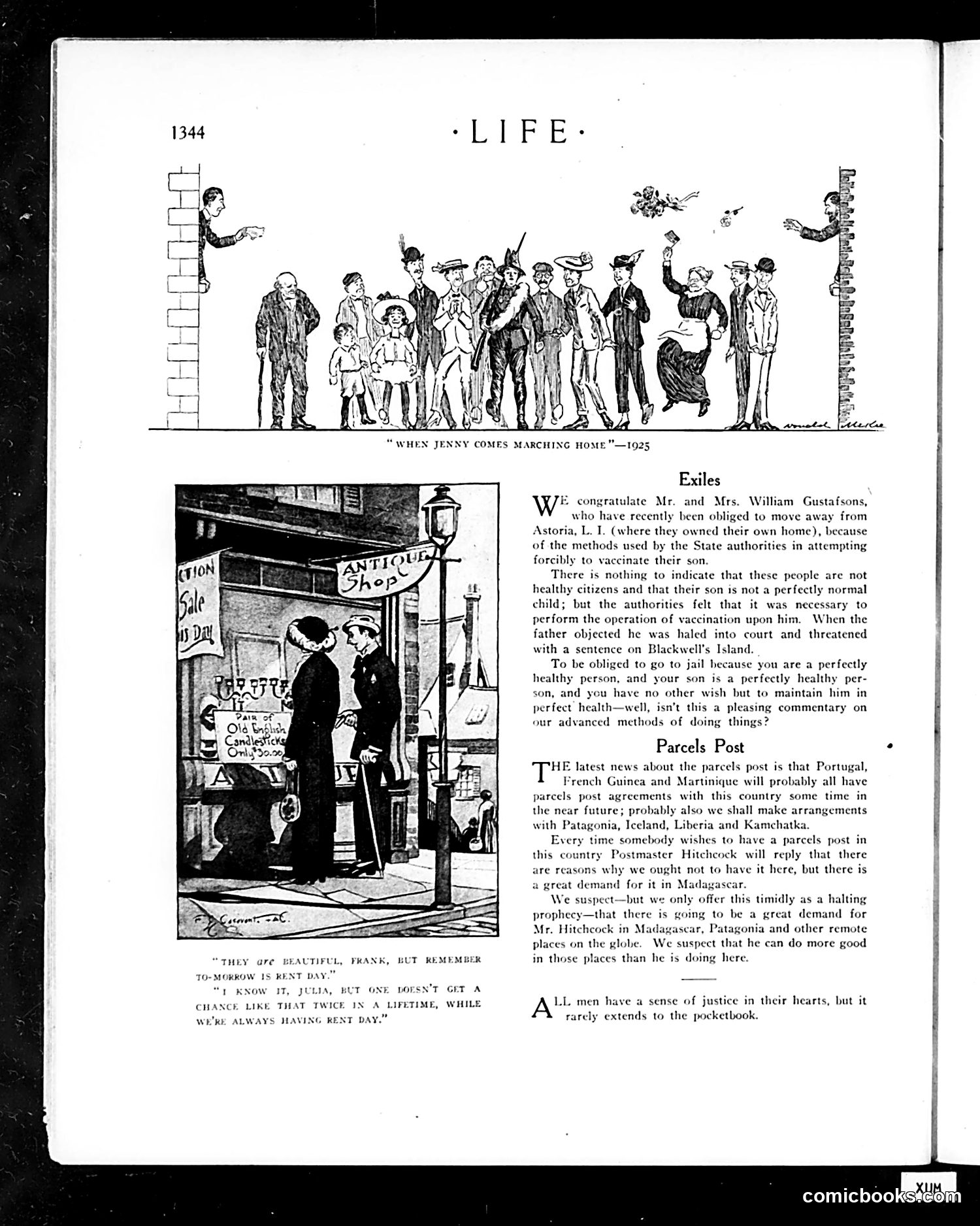
**Top Cartoon:** "When Jenny Comes Marching Home" depicts a parade of figures climbing ladders and walls—a visual metaphor for social mobility or aspiration. The exact reference is unclear without additional context. **"Exiles" Article:** Satirizes mandatory vaccination laws by describing the Gustafsons' forced exile from their home in Astoria, Long Island. State authorities threatened to jail the father for refusing to vaccinate his son. Life's satire targets the state's coercive power: forcing healthy citizens to submit to medical procedures against their conscience or face imprisonment. The piece questions whether such authoritarian methods represent "advanced" civilization. **"Parcels Post":** Mocks Postmaster Hitchcock's repeated objections to expanding parcel delivery service to remote countries. Life suggests he'd be better suited working in distant colonies (Madagascar, Patagonia) than obstructing domestic progress. **Final Aphorism:** Cynically notes people lack moral courage regarding money. The page reflects 1920s American tensions over individual liberty versus state authority and bureaucratic obstruction of public services.
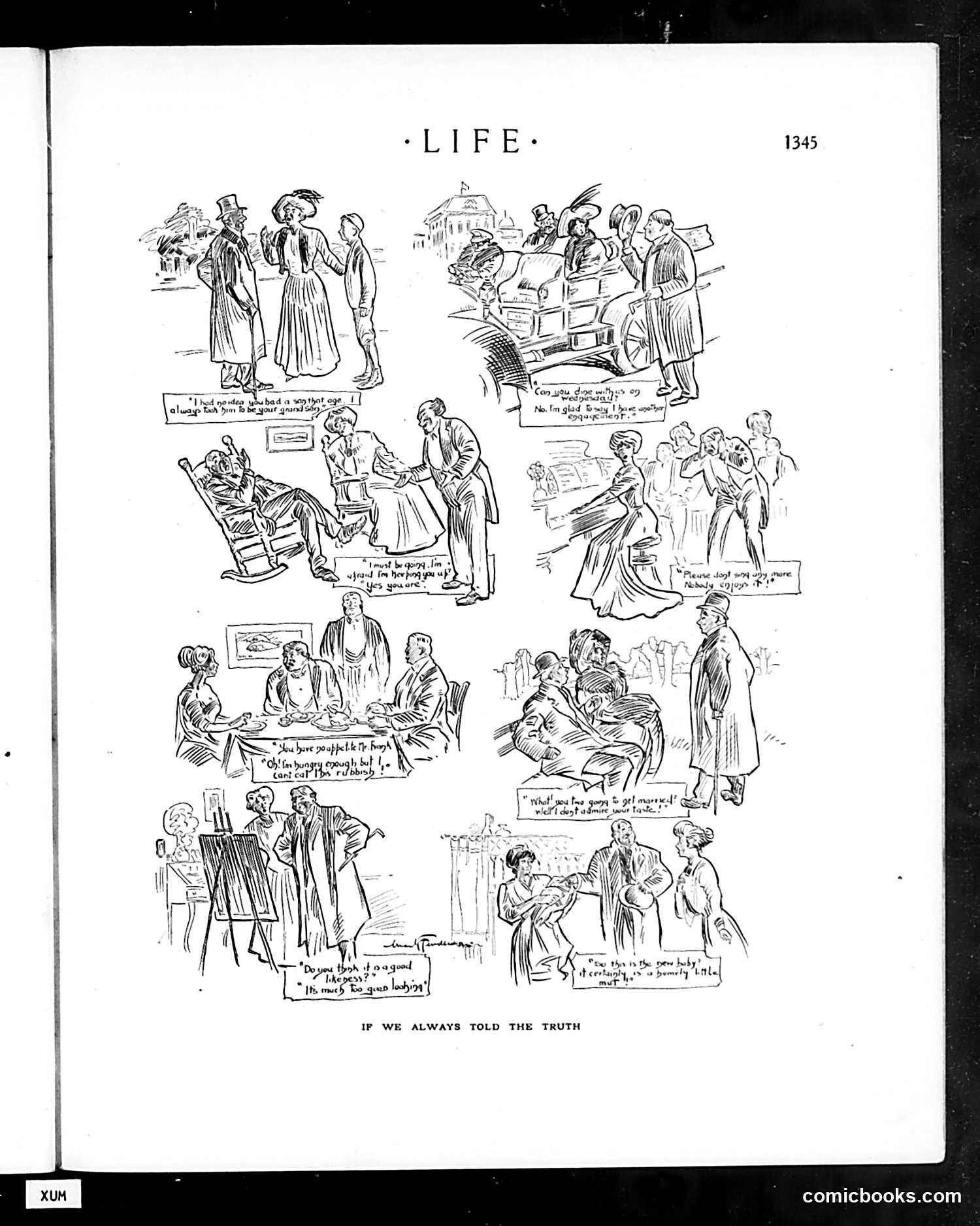
This satirical comic strip imagines what would happen if people always spoke honestly instead of politely lying. Each panel shows a common social scenario where someone tells an uncomfortable truth: - A woman admits she finds her suitor boring - Someone confesses they're glad to leave a tedious dinner party - A guest reveals they don't like their host's cooking - A woman admits she's pretending to enjoy socializing The humor derives from contrasting these blunt admissions with the social facades people typically maintain. The satire targets early 20th-century social conventions—particularly among the middle and upper classes—where politeness required concealing genuine feelings. By literalizing honest speech, the cartoonist ridicules how artificial and performative social interaction had become. The title encapsulates the joke: society functions through acceptable deception.
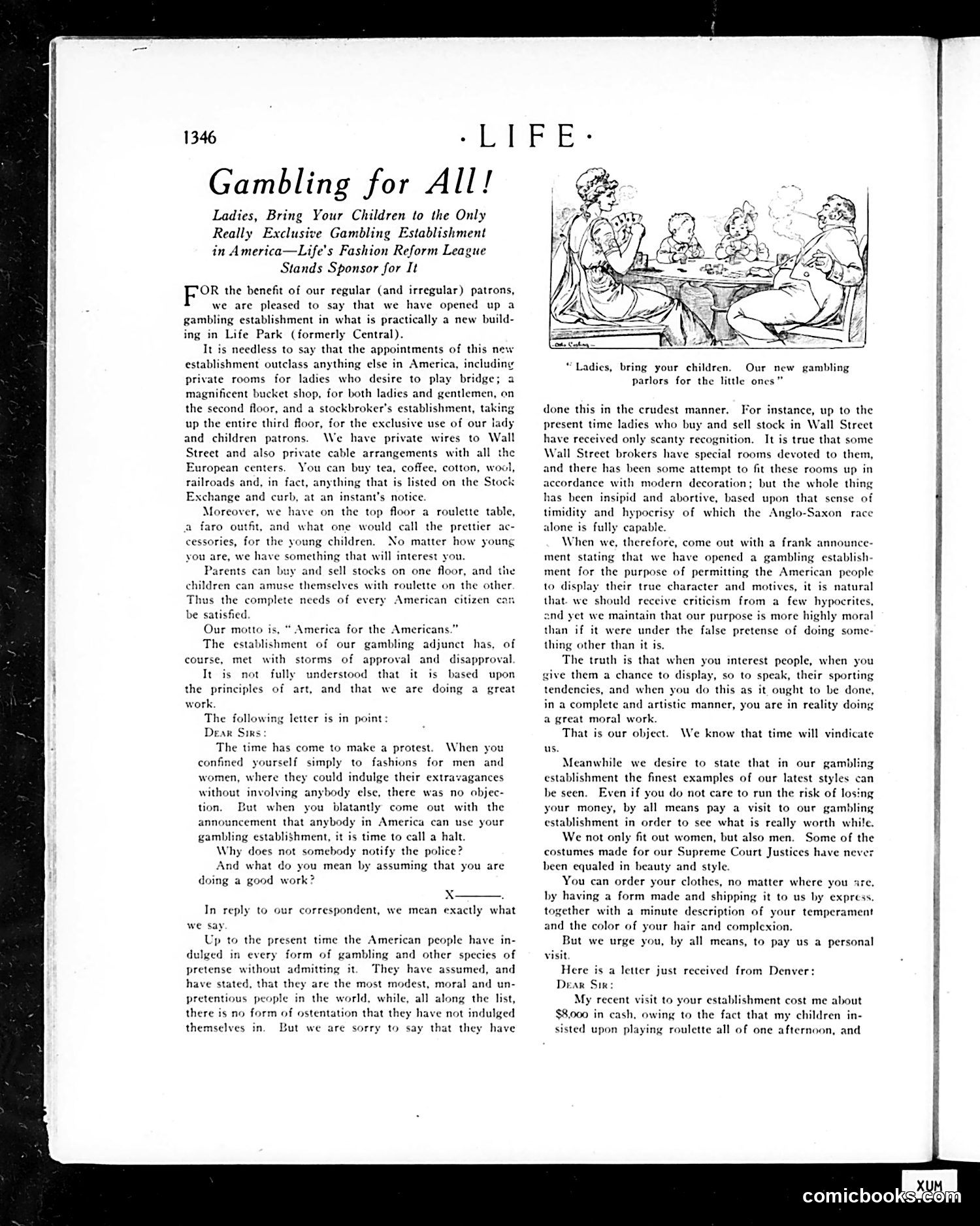
This is **satirical social criticism** disguised as a tongue-in-cheek business announcement. Life's editors are mocking American hypocrisy about gambling and financial speculation. The satire works by proposing an absurdly honest "gambling establishment" that openly admits what Americans already do secretly: gamble on stocks, play bridge for money, and engage in speculation. The genius of the joke is treating stock-trading and roulette as morally equivalent—both forms of gambling that respectable society pretends are different things. The accompanying cartoon shows women gambling at roulette with children present, literally illustrating Life's claim that they're simply being transparent about existing behavior. The "Fashion Reform League" sponsorship is ironic—Life sarcastically positions itself as a moral reformer while promoting vice, highlighting how Americans hide behind false respectability. The closing argument states the real point: Americans indulge in every vice but do so "in the crudest manner," lacking honest acknowledgment of their true "character and motives." This attacks American hypocrisy and the Anglo-Saxon cultural tendency toward self-deception.
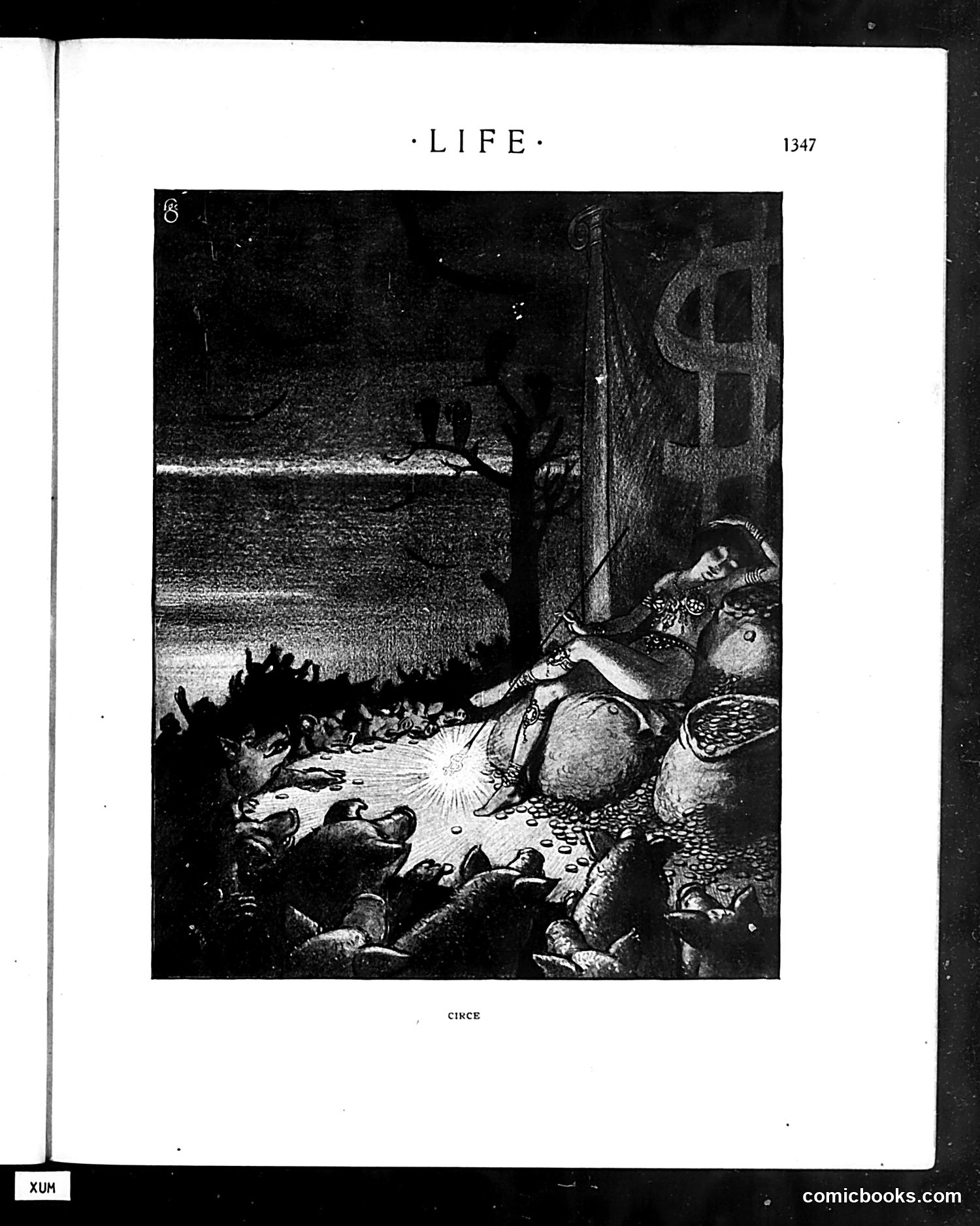
This appears to be a classical mythology illustration rather than political satire. The image depicts the enchantress Circe from Homer's *Odyssey*, shown reclining luxuriously in her palace surrounded by what appear to be transformed men (likely the pig-like creatures from the myth). The scene captures the moment when Circe uses her magical powers to enchant and transform Odysseus's crew. The illustration uses dramatic black-and-white contrast typical of early-to-mid 20th century magazine artwork. The caption simply identifies the subject as "Circe," suggesting this is either an artistic feature or accompanies a literary discussion rather than contemporary political commentary. The mythological subject matter would have been recognizable to Life's educated readership as a classical reference.
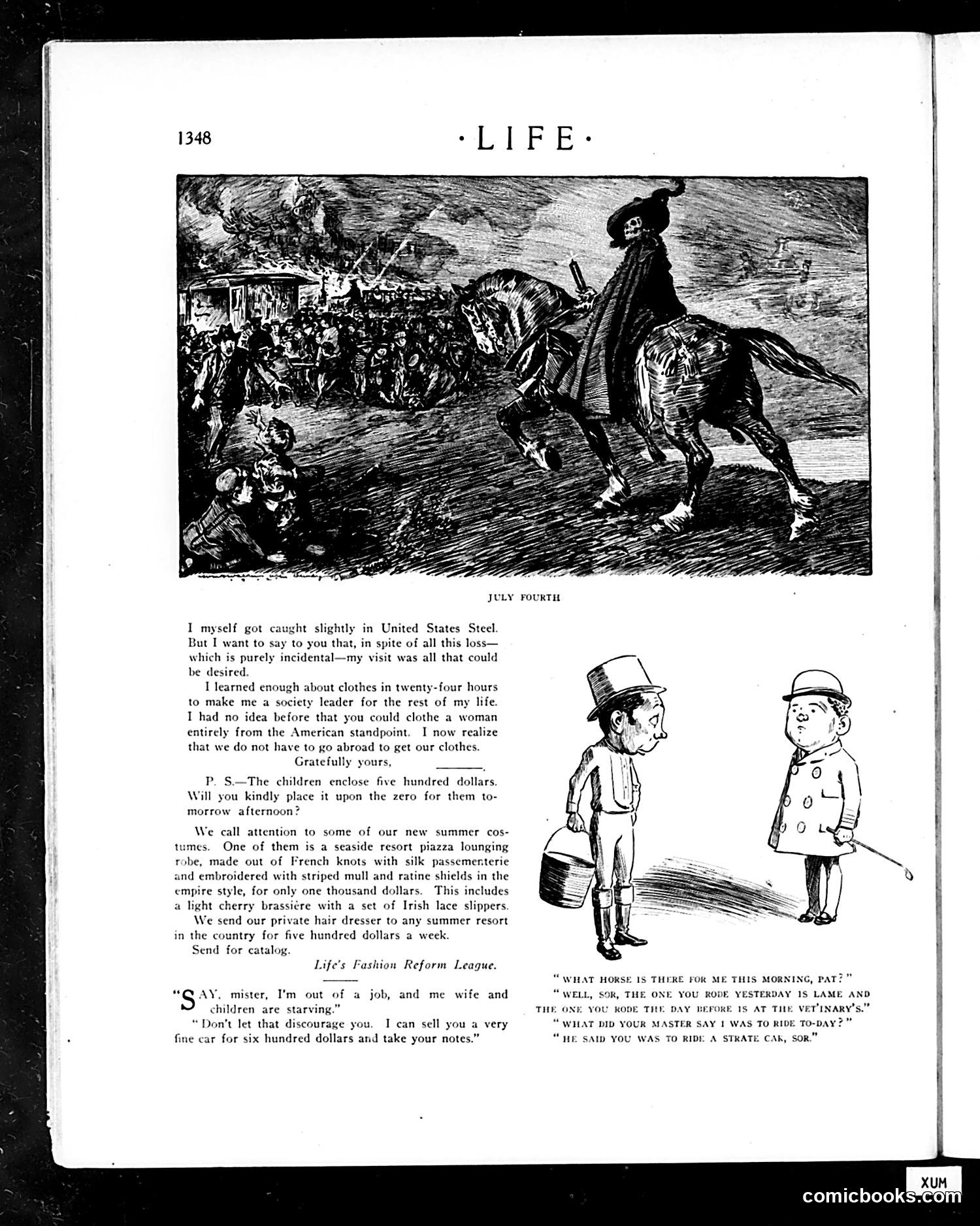
This page satirizes American wealth inequality and materialism during the Jazz Age. The top section mocks wealthy society through a letter from someone who lost money in United States Steel (a major stock), yet claims their visit was worthwhile because they learned about expensive fashion. The absurd prices—$1,000 for a bathing robe, $500/week for a private hairdresser—ridicule extravagant consumption by the rich. The bottom cartoons expose economic desperation. One shows a jobless man with starving children being sold an expensive car on credit by an unscrupulous businessman. The other depicts an Irish stable worker told to ride a "strate car" (streetcar) instead of a horse—a pun suggesting even working-class employment has vanished. The juxtaposition is pointed: while the wealthy flaunt frivolous purchases, working people cannot feed their families. This reflects pre-Depression economic tensions and class conflict in early 20th-century America.
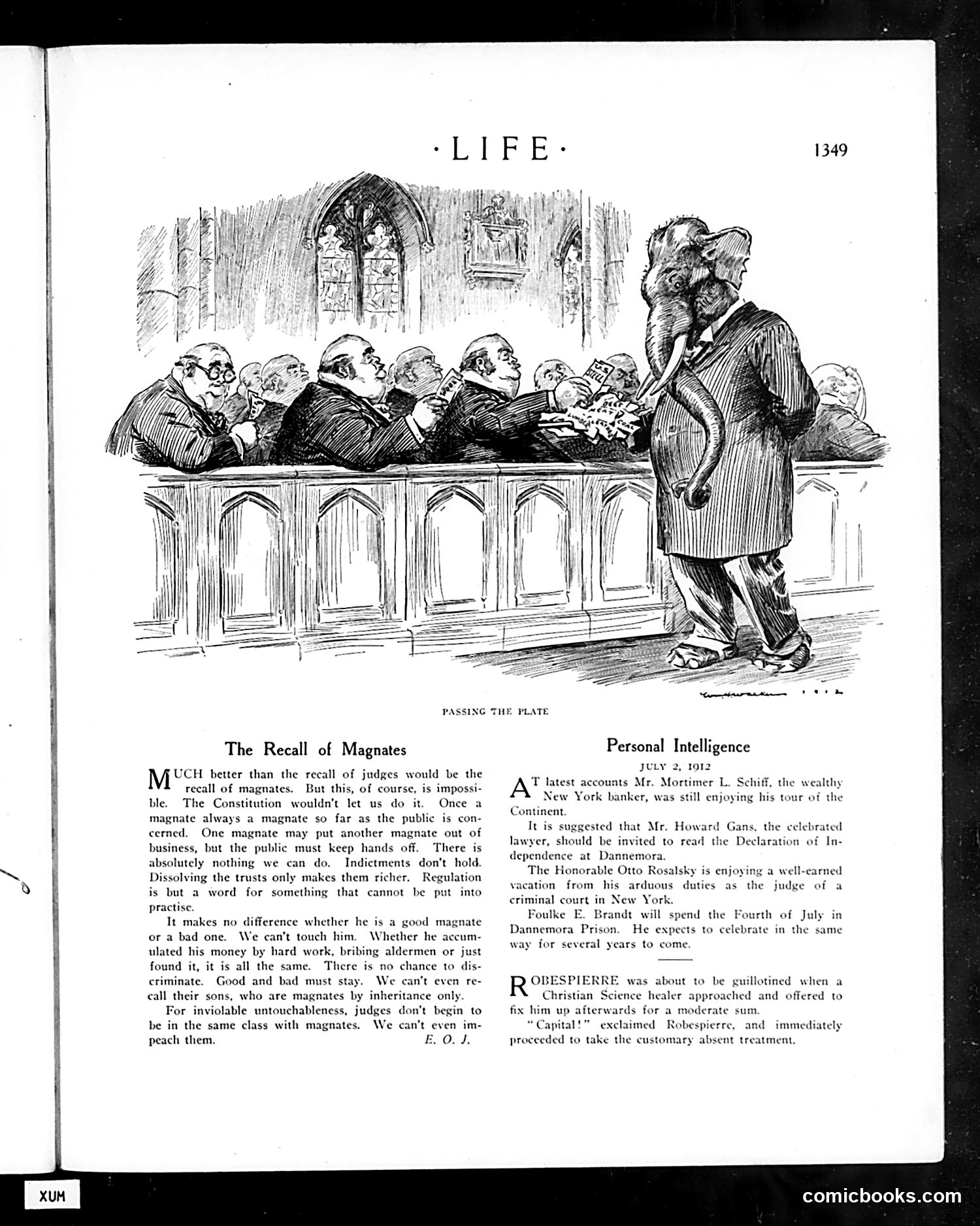
The cartoon depicts wealthy industrialists ("magnates") seated at what appears to be a judge's bench, while a caricatured figure on the right—appearing to be a working man or laborer—stands before them "passing the plate" (collecting money). **The satire:** The article argues that unlike judges, magnates cannot be "recalled" or removed by the public, despite their harmful behavior. They're untouchable by law whether corrupt or honest. The cartoon visualizes this irony: the wealthy sit in positions of power/judgment while ordinary citizens must contribute to them. **Context:** This reflects early 1900s Progressive Era frustration with corporate monopolies and wealthy industrialists who seemed immune to regulation or accountability. The "recall" movement sought to remove corrupt officials; the article sarcastically notes this remedy doesn't apply to business titans who wield equal or greater power. The cartoon suggests an inverted justice system where the powerful judge the powerless, rather than vice versa.
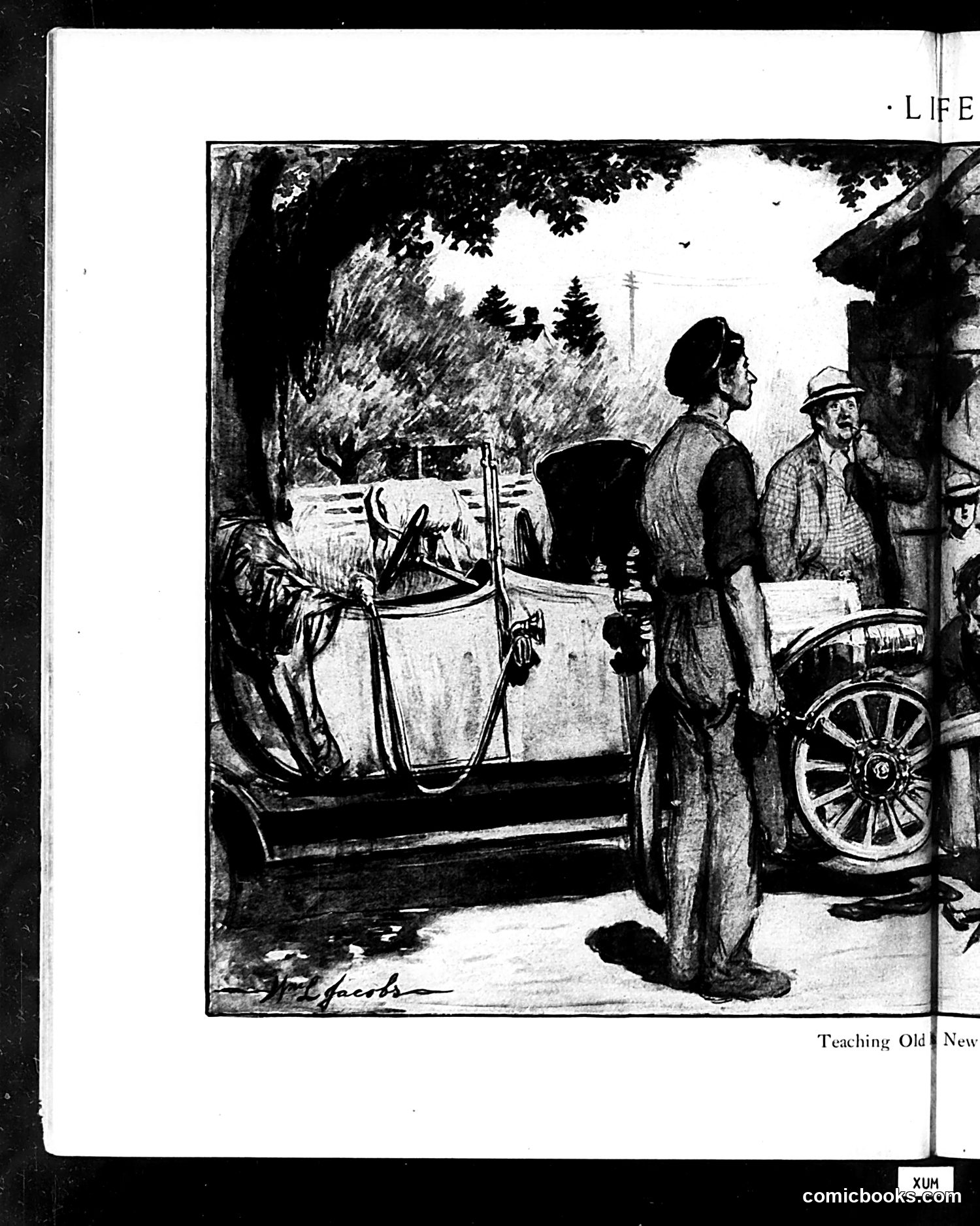
This satirical cartoon depicts the contrast between traditional horse-drawn transportation and early automobiles. Two men in period clothing stand near what appears to be an early motorcar on the right, while a horse-drawn cart is visible on the left. The caption "Teaching Old New" suggests the humor lies in the generational clash—the older methods of transportation (the horse cart) being instructed or displaced by newer technology (the automobile). The satire targets the rapid technological shifts of the early automotive era, when horseless carriages were revolutionizing transportation and making traditional methods obsolete. The composition emphasizes how quickly society was being forced to adapt to mechanical innovation, with the "old" literally being taught by the "new."
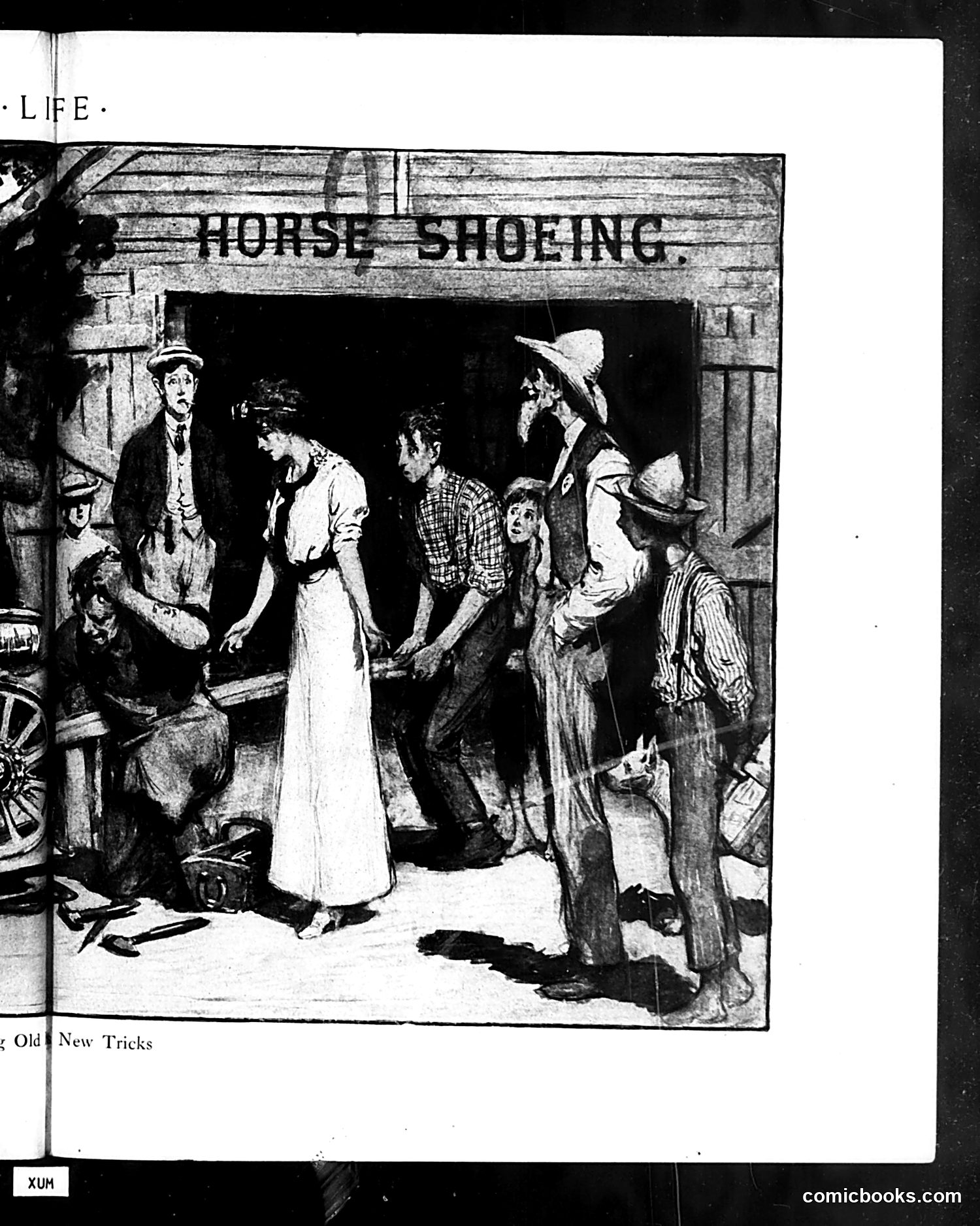
This appears to be a satirical cartoon depicting a horse shoeing shop scene. A well-dressed woman in white (likely representing an upper-class or refined figure) stands among working-class men in hats and work clothes, appearing surprised or startled by the rustic setting. The satire likely plays on class contrast and social pretension—the woman's formal appearance and demeanor clash sharply with the rough, utilitarian blacksmith/farrier shop environment. The title "Old New Tricks" suggests the joke involves someone attempting something unfamiliar or outside their social sphere, or perhaps mocking fashionable people encountering ordinary working-life situations. The specific social commentary remains unclear without additional context about when this was published or who the woman might represent.
This 1912 *Life* magazine piece satirizes literary conventions and feminist politics through book criticism. The author argues that readers find naive young heroines ("Jessica") romantically appealing in fiction, but would find an equally ignorant young hero ("Jim") comic—revealing a double standard in how innocence is valued. The satire's target: feminists fighting for voting rights are "on the wrong tack." The author provocatively suggests they should instead change cultural attitudes that romanticize female ignorance, which would actually undermine the conditions enabling women's subordination. The piece reviews three novels, including Reginald Wright Kauffman's work, which "frankly faces" innocence's "bi-sexual implications"—suggesting innocence isn't inherent but achievable regardless of gender. The illustration shows figures "scourging the sea," though its specific connection to the text is unclear. The critique uses literary analysis as vehicle for social commentary on gender expectations and feminist strategy.
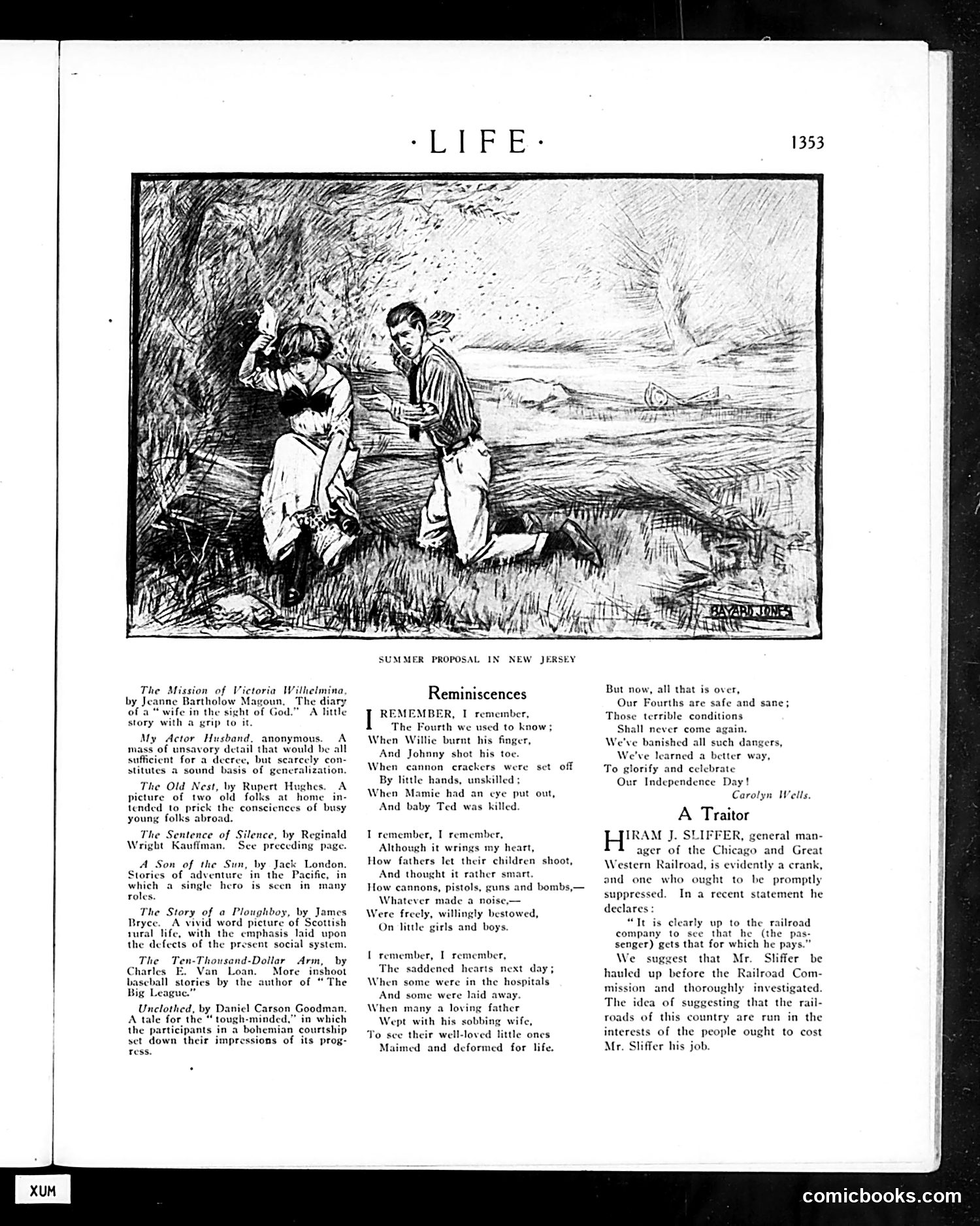
**The Cartoon:** "Summer Proposal in New Jersey" depicts a young couple by a riverside—a romantic scene rendered in sketch style. **The Satire:** The page juxtaposes this innocent romantic image with the accompanying poem "Reminiscences" by Carolyn Wells, which provides bitter social commentary. The poem nostalgically recalls 19th-century Fourth of July celebrations where parents recklessly gave children fireworks and explosives ("cannons, pistols, and bombs"), resulting in injuries and deaths—children burned, blinded, and killed. **The Point:** The poem contrasts this tragic past with modern "safe and sane" celebrations, celebrating reform. However, the pairing with the romantic cartoon creates irony: while the poem celebrates progress in child safety, the juxtaposition suggests sentimentality about dangerous practices. The contrast between the innocent lovers and the dark recollection underscores how recent and hard-won these safety reforms were. **Secondary Content:** The page also attacks railroad executive H.J. Sliffer for suggesting railroads should prioritize passenger safety—Life's editors sarcastically condemn him as dangerous for advocating consumer protection.
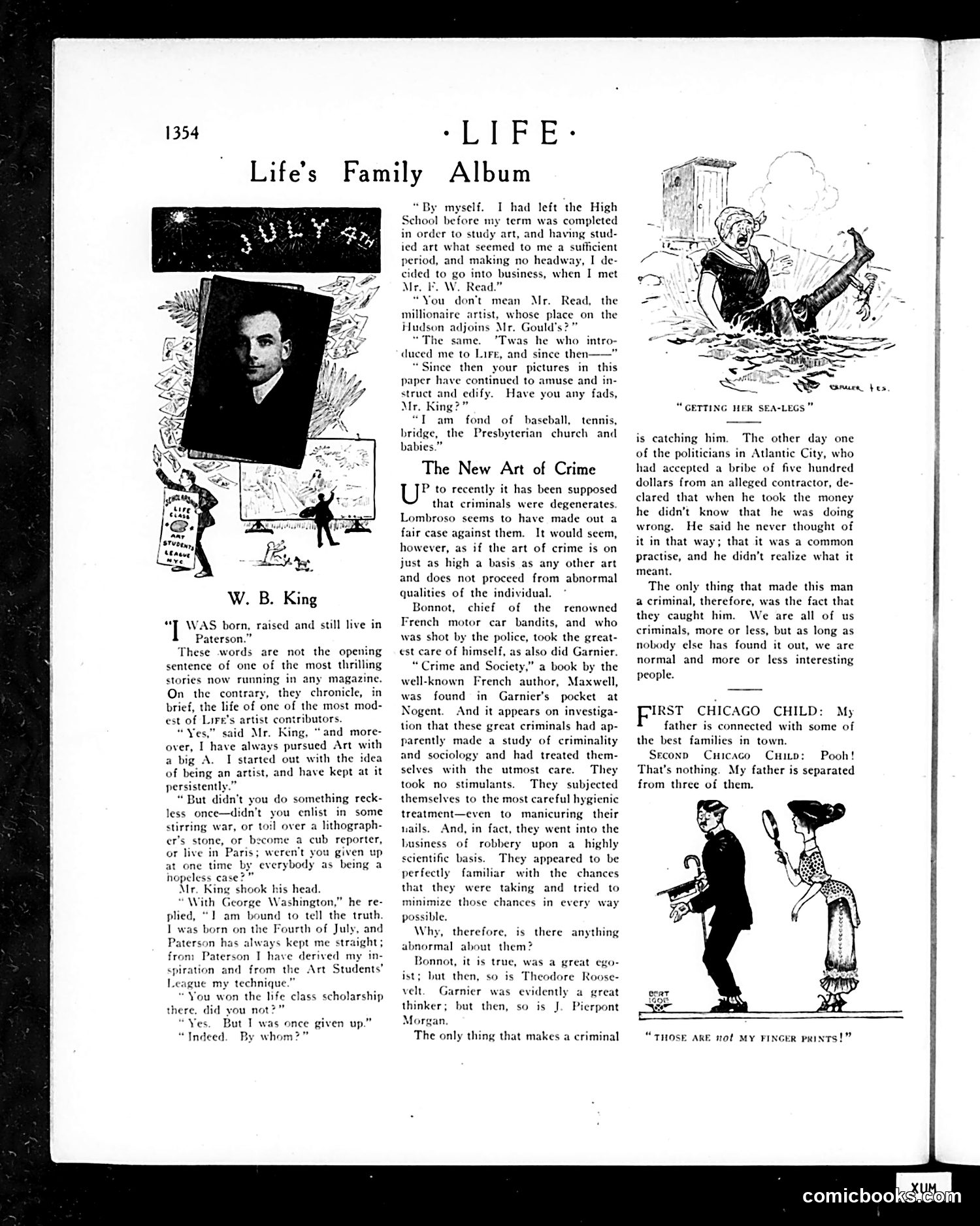
This page features W.B. King, a Life magazine cartoonist and artist, in a biographical profile titled "Life's Family Album." King recounts his modest career path: born in Paterson, New Jersey, he briefly abandoned art for business before being introduced to Life magazine by millionaire artist F.W. Read. He's presented as steady and unambitious—fond of baseball, tennis, and church. The article "The New Art of Crime" presents a satirical argument referencing real French criminals (Bonnot and Garnier) who studied criminology scientifically and maintained rigorous hygiene. The piece ironically compares their intellectual rigor to figures like Theodore Roosevelt and J.P. Morgan, suggesting criminality is merely "not getting caught"—a pointed social commentary equating respectable business practices with criminal behavior. The cartoons illustrate humorous domestic scenes, typical of Life's satirical humor of the era.
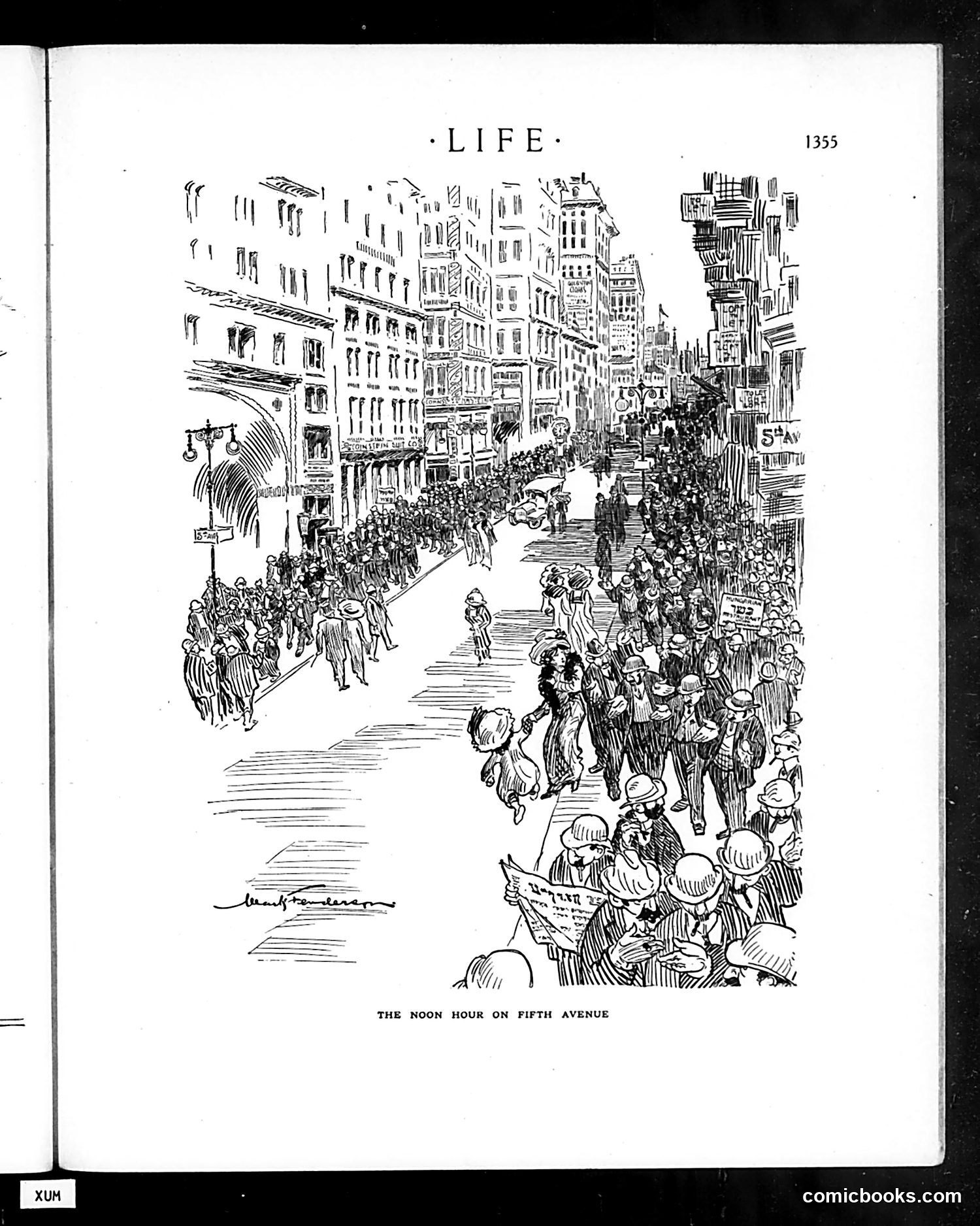
This sketch depicts a crowded urban street scene on Manhattan's Fifth Avenue at midday. The illustration captures the bustling pedestrian traffic and density of the city during lunch hour, with masses of people filling the sidewalk and street. The tall buildings lining both sides create an urban canyon effect. The satire likely comments on the overwhelming congestion and anonymity of modern city life—a common theme in early 20th-century American humor about urbanization. The packed crowds suggest both the vitality and the overwhelming, dehumanizing aspects of metropolitan existence. The specific focus on the "noon hour" emphasizes how predictably and densely the city fills during business lunch periods, reflecting contemporary anxieties about industrial-era urban growth and the mechanization of daily life.
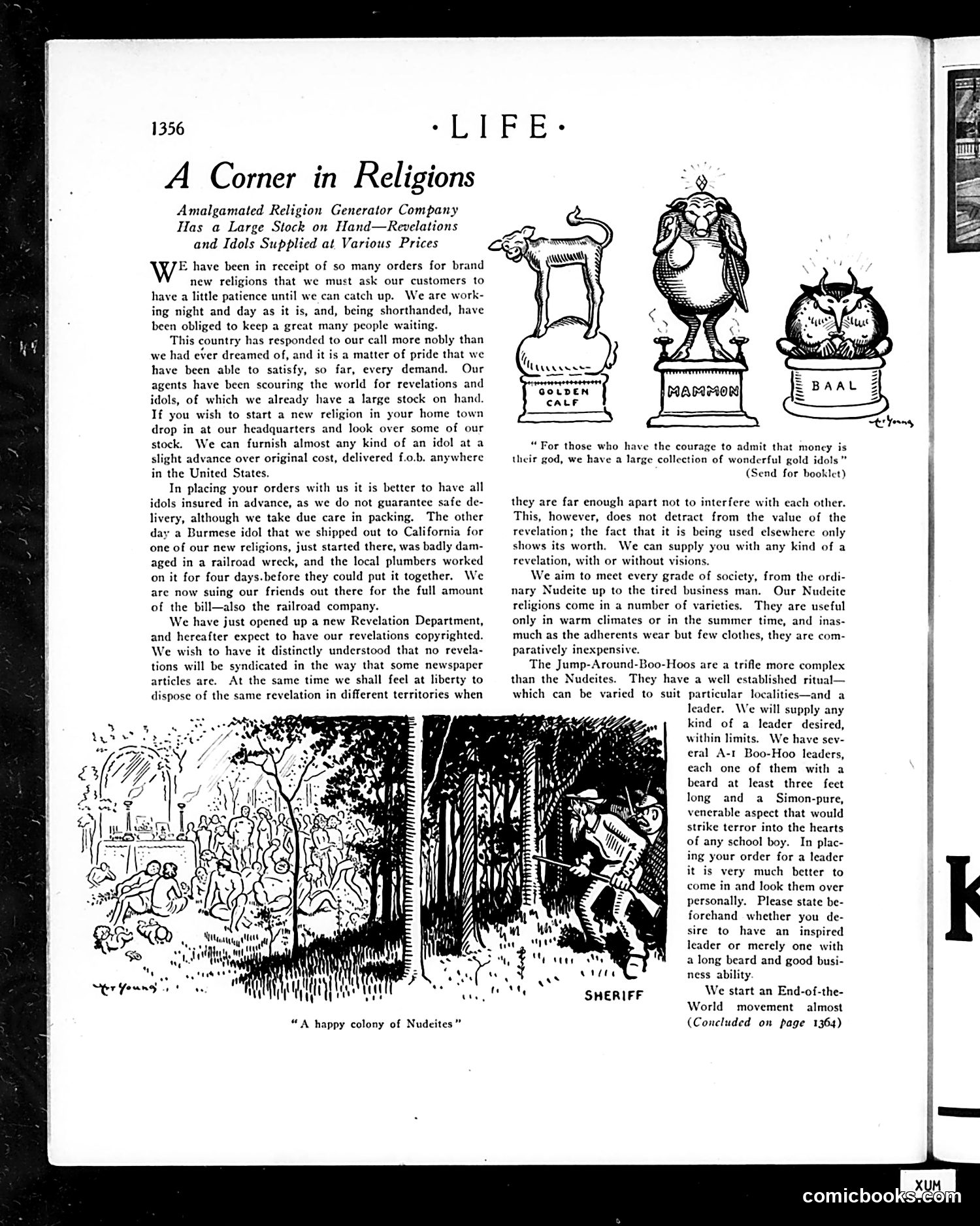
This is a satirical advertisement for a fictional "Amalgamated Religion Generator Company" that manufactures religions like commodities. The piece mocks early 20th-century American religious proliferation and commercialism. The satire targets several things: **The main joke**: Religion is presented as a mass-produced product with standardized "idols" and "revelations" sold at various prices—reducing spirituality to consumer goods. **Specific religious mockery**: Named religions include "Nudeites" (minimalist faiths for warm climates), "Jump-Around-Boo-Hoos" (with elaborate rituals), and others. These appear to parody actual American new religious movements and cults of the era. **The caption's dig**: "For those who have the courage to admit that money is their god, we have a large collection of wonderful gold idols"—directly equating wealth-worship with organized religion. **Visual elements**: The illustrations show a "happy colony of Nudeites" and a "Sheriff," suggesting both utopian community pretense and the need for social control within such groups. The piece expresses skepticism toward America's proliferating denominations and new faiths as superficial, commercialized, and potentially absurd.
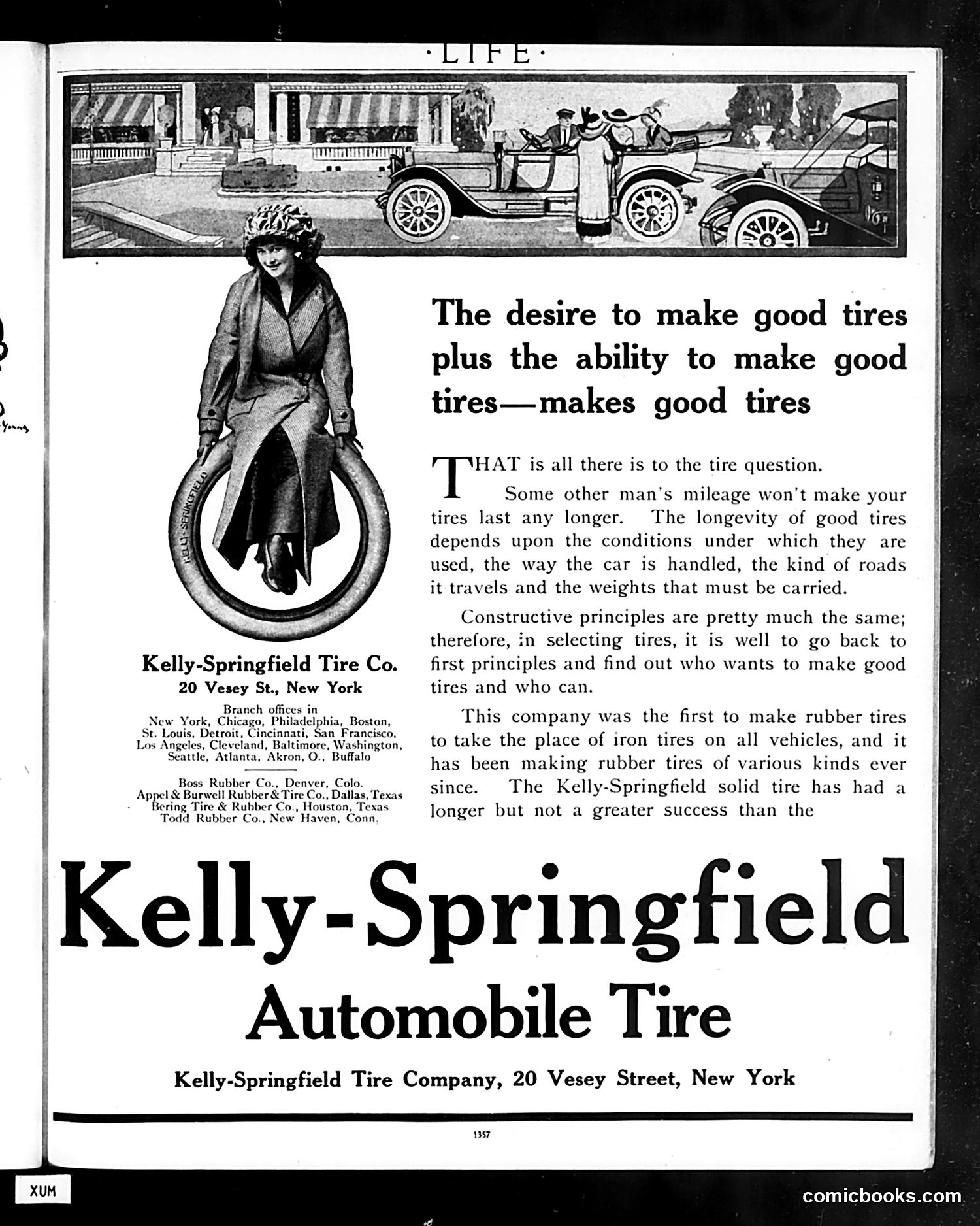
This is a **tire company advertisement**, not satire or political commentary. The page promotes Kelly-Springfield Automobile Tires through a full-page ad in *Life* magazine. The imagery shows a fashionably dressed woman seated on a large tire, with vintage automobiles illustrated above. The visual metaphor—a woman literally supported by the tire—emphasizes product reliability and quality. The text's argumentative approach is notable: rather than simply praising their tires, Kelly-Springfield makes a philosophical claim that "the desire to make good tires plus the ability to make good tires—makes good tires." They argue tire longevity depends on usage conditions, not brand alone, then position themselves as the company with both desire *and* ability, claiming to be the first to replace iron tires with rubber ones. This represents early automotive advertising's emphasis on technical legitimacy and manufacturing heritage to build consumer confidence in a relatively new product category.
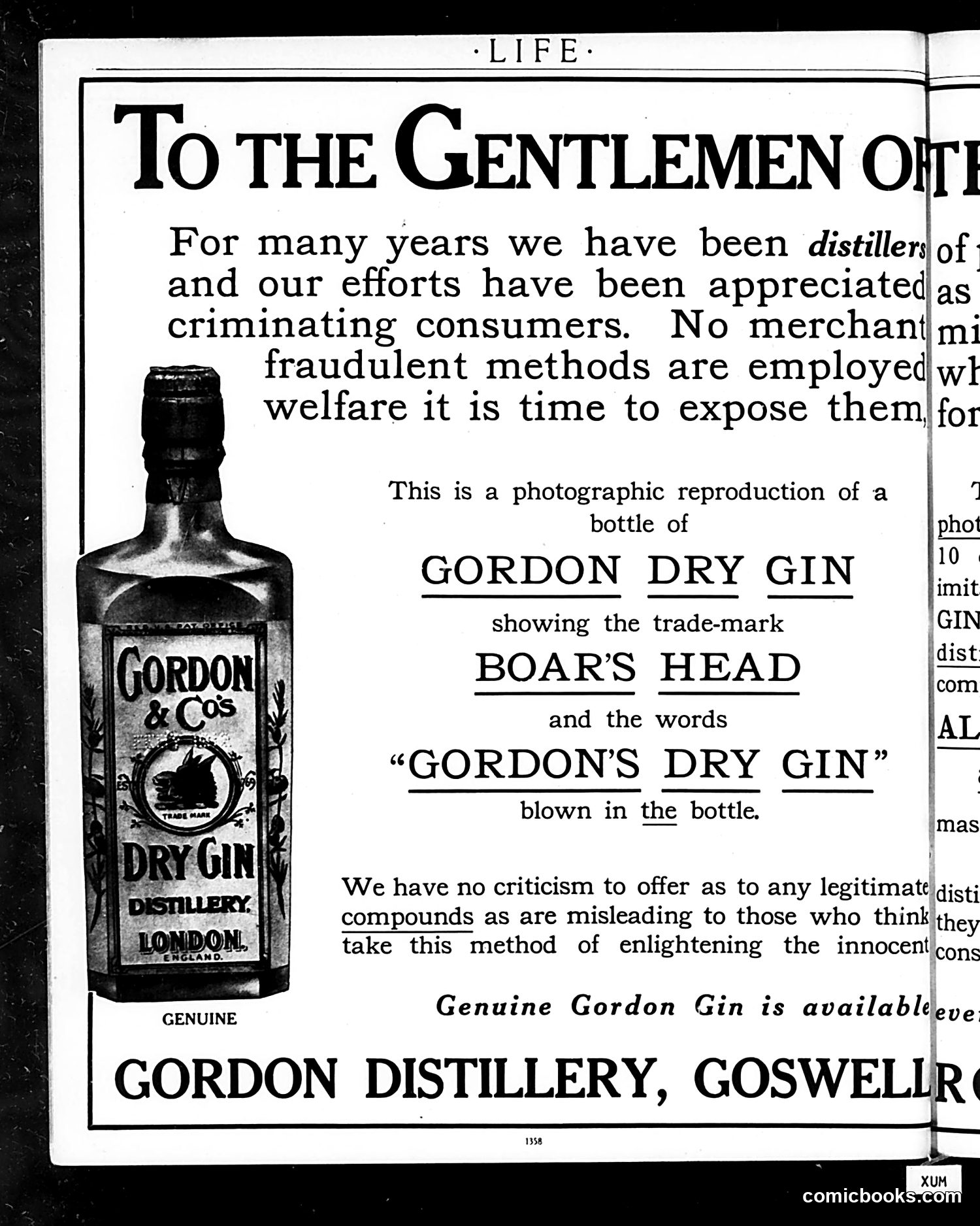
This is **not a cartoon or satire**, but rather a **straightforward advertisement** disguised as an editorial statement. Gordon Distillery uses the framing of "To the Gentlemen" to address accusations of fraud in the gin industry. The ad acknowledges that counterfeit or mislabeled gin compounds circulate in the market, misleading consumers. Gordon positions itself as ethical by highlighting its genuine product features: the trademarked boar's head and the words "Gordon's Dry Gin" blown directly into the bottle glass—anti-counterfeiting measures that prove authenticity. The rhetorical strategy is defensive: Gordon doesn't directly name competitors but implies others use "fraudulent methods." By claiming to "enlighten the innocent," the distillery turns a potential scandal (fake gins flooding the market) into a selling point for their legitimacy. This reflects early 20th-century consumer protection concerns before modern regulation, when product counterfeiting was widespread and consumers had limited recourse.
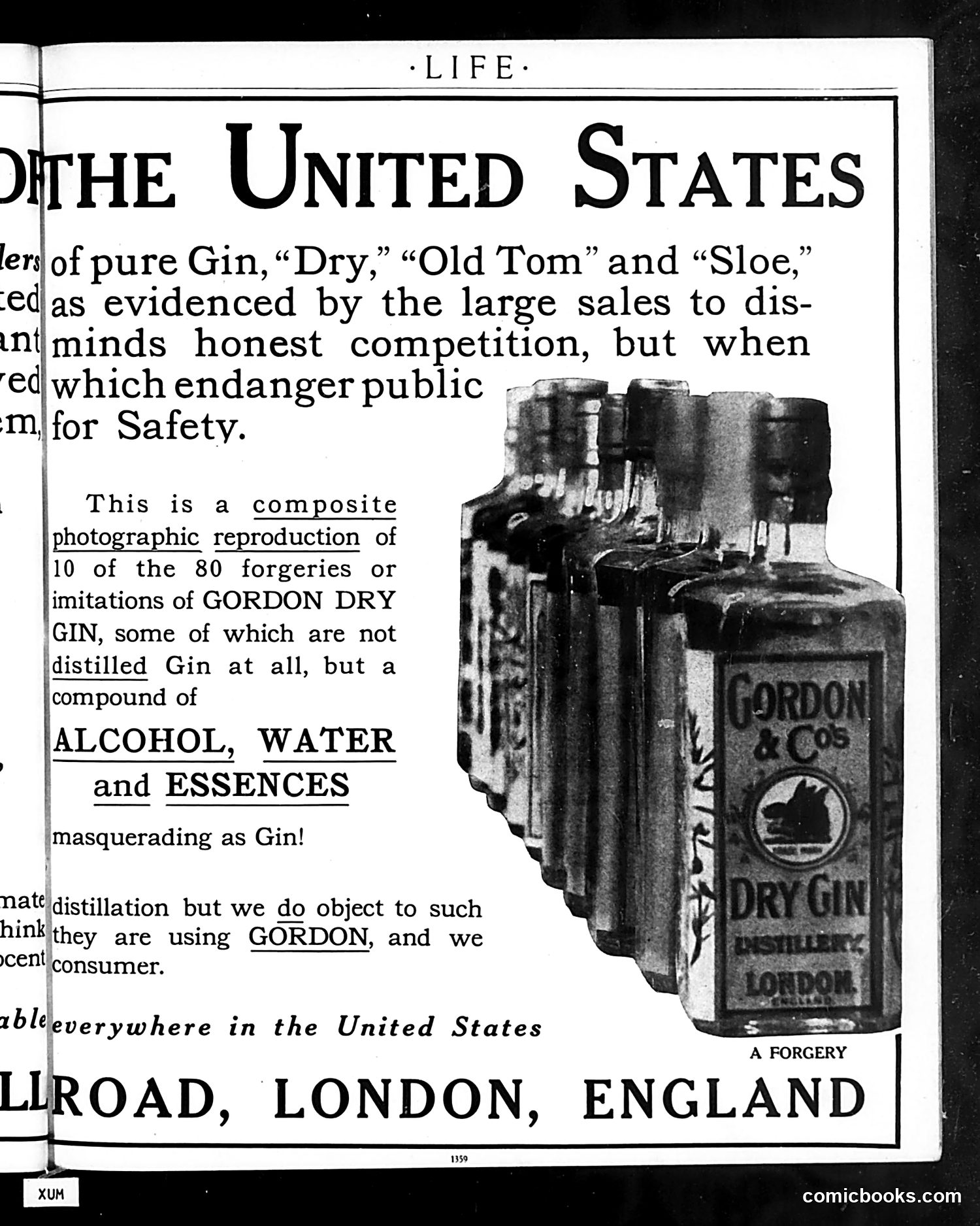
This is a **public service advertisement** (not satire) warning Americans about **counterfeit Gordon's Dry Gin** flooding the U.S. market. The image shows fake bottles masquerading as the genuine London product. The ad claims 80 different forgeries exist—fraudulent bottles containing only "alcohol, water and essences" rather than legitimately distilled gin. The composite photograph displays 10 examples of these counterfeits. The purpose is consumer protection: while the ad acknowledges honest competition among gin producers, it specifically objects to counterfeiters misusing the "GORDON" brand name, deceiving consumers who believe they're purchasing authentic London gin. This reflects early 20th-century concerns about product counterfeiting and brand protection before modern regulations existed.
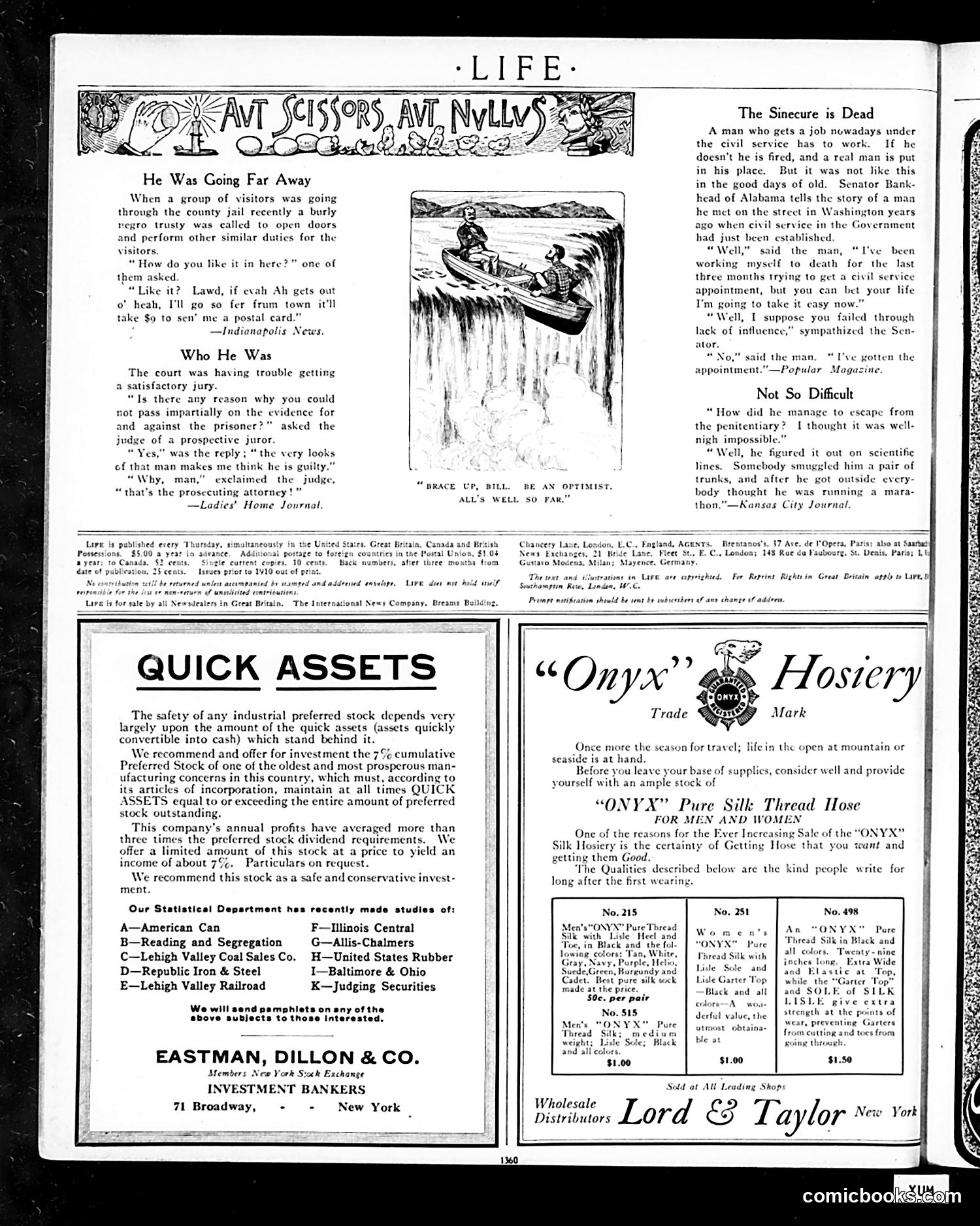
This page contains three unrelated humor pieces typical of early-20th-century Life magazine's satirical style: **"He Was Going Far Away"**: A brief anecdote about a Black jail trusty expressing his desire to escape far from town—playing on period stereotypes and the casual racism of the era. **"Who He Was"**: A courtroom joke where a judge mistakes a prospective juror's prejudicial appearance assessment as referring to the defendant, when the juror was actually describing the prosecuting attorney. **"The Sinecure is Dead"**: A commentary on civil service reform, featuring Alabama Senator Bankhead recounting a man's disappointment that government jobs now require actual work rather than serving as cushy, do-nothing positions. This references Progressive Era efforts to eliminate patronage and nepotism from federal employment. The page is primarily filled with advertisements (Quick Assets stock offering, Onyx Hosiery) and publication information. The humor reflects early-1900s attitudes and concerns about government efficiency and labor.
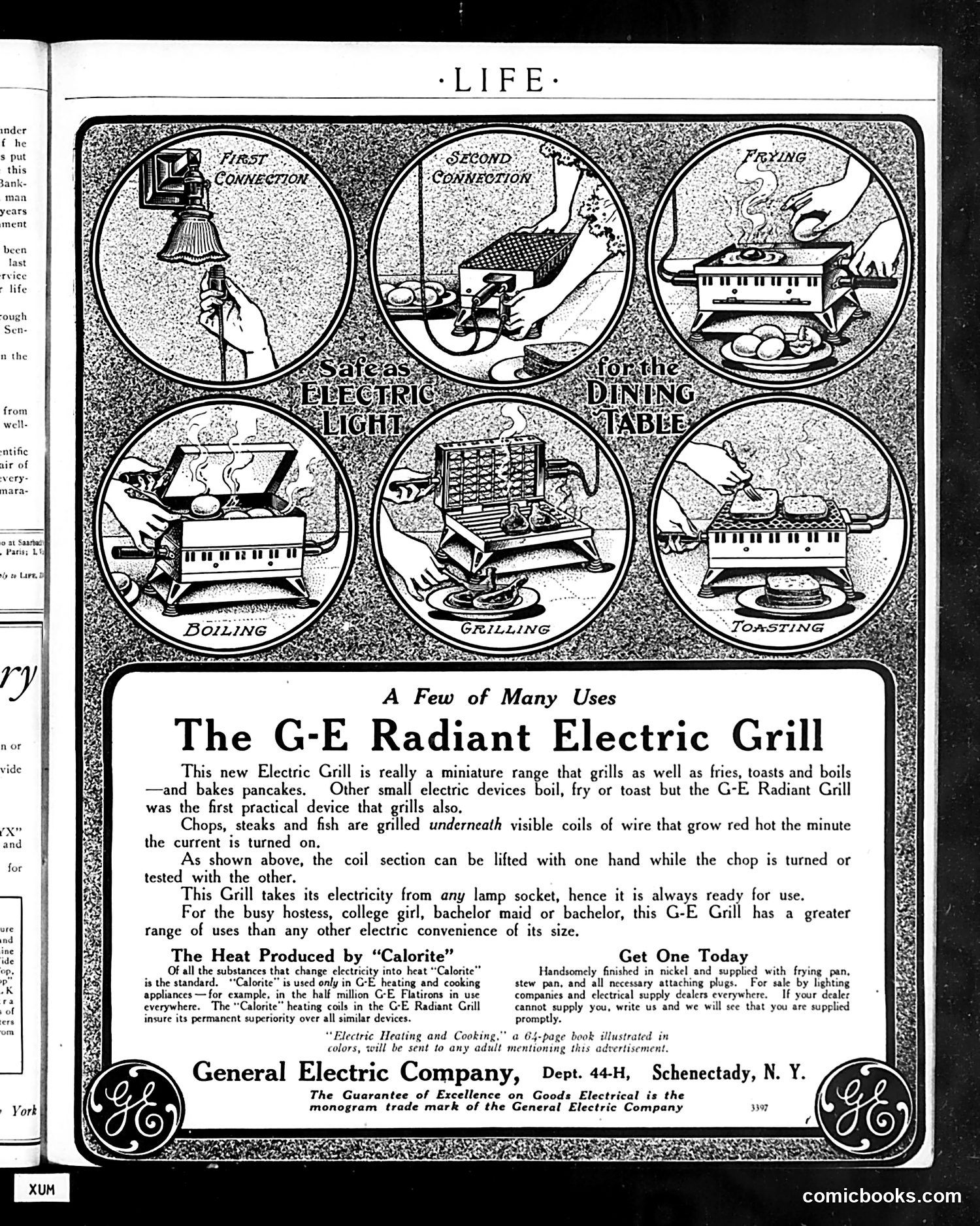
This is **not a cartoon or satire**—it's a **full-page advertisement** for General Electric's Radiant Electric Grill, published in *Life* magazine. The six circular illustrations at the top demonstrate the appliance's versatility: First Connection (electrical setup), Second Connection (usage), and Frying, Boiling, Grilling, and Toasting. These are instructional diagrams, not satirical commentary. The text emphasizes the grill's practicality for "busy hostess, college girl, bachelor maid or bachelor"—targeting 1920s-era consumers seeking modern kitchen convenience. The advertisement highlights that it plugs into any lamp socket and uses "Calorite" heating coils, positioning GE's proprietary technology as superior. This represents early-20th-century consumer culture marketing: selling electrical appliances as labor-saving devices that modernized domestic life. The *Life* magazine context suggests this ad appeared alongside satirical content, but this page itself is straightforward commercial promotion.
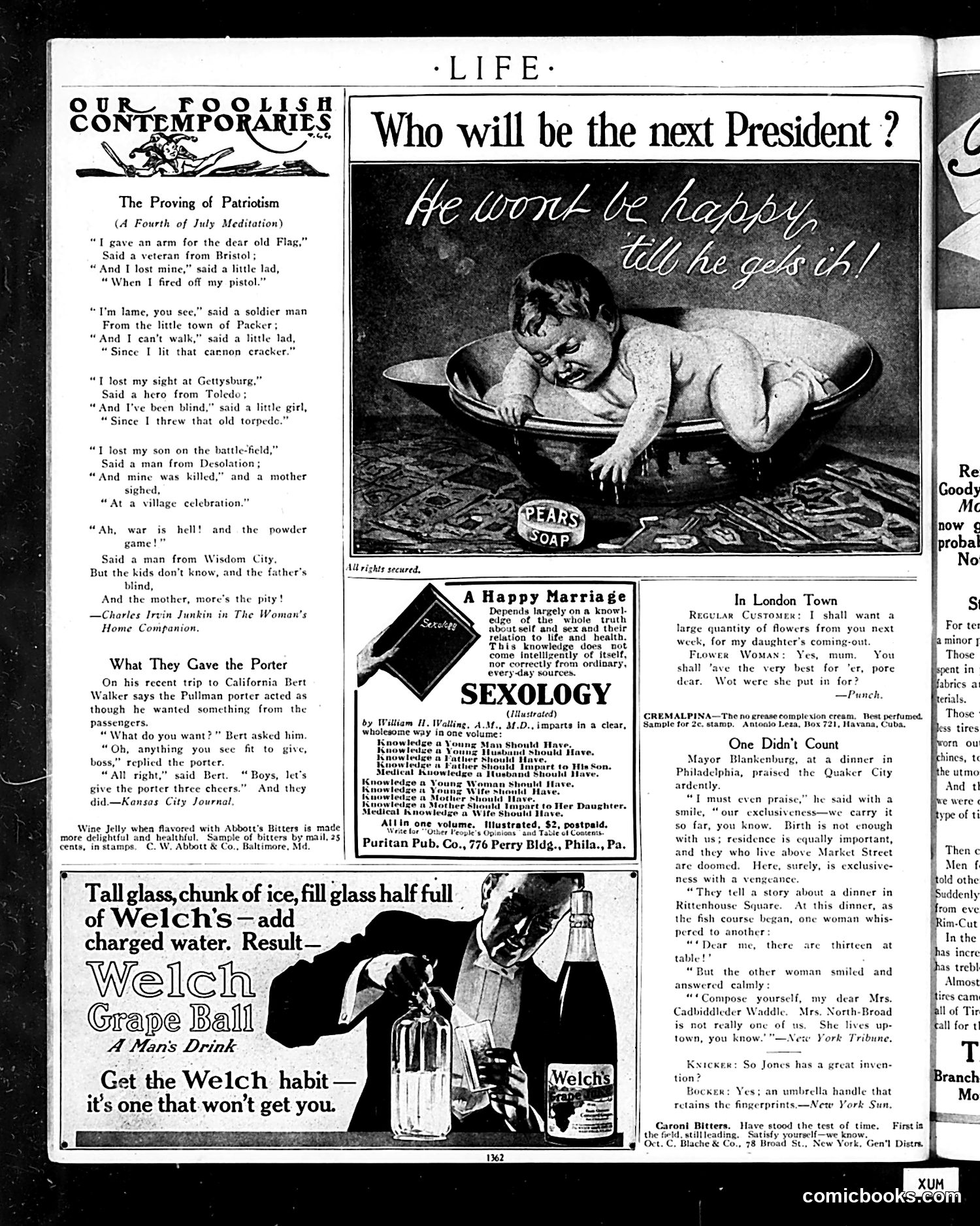
This page contains multiple satirical pieces typical of early 20th-century Life magazine: **"The Proving of Patriotism"** is a poem mocking hollow patriotism. It contrasts Civil War veterans who sacrificed limbs and eyesight in actual battle with children injured by fireworks during Fourth of July celebrations—yet treated as equivalently "patriotic." The satire suggests parents are negligently allowing children to be maimed while claiming patriotic fervor, exposing the hypocrisy of celebrating national holidays through dangerous practices. **"What They Gave the Porter"** is a light anecdote about a Pullman porter's cheeky request for "anything you see fit," which a passenger interprets literally by giving him cheers instead of money—a joke about class relations and misunderstanding. The page also contains typical period advertisements (Welch's Grape juice, Abbott's Bitters, and a "Sexology" book), along with brief humor columns about Philadelphia society and London customs. The overall tone is satirical commentary on American social conventions and pretenses.
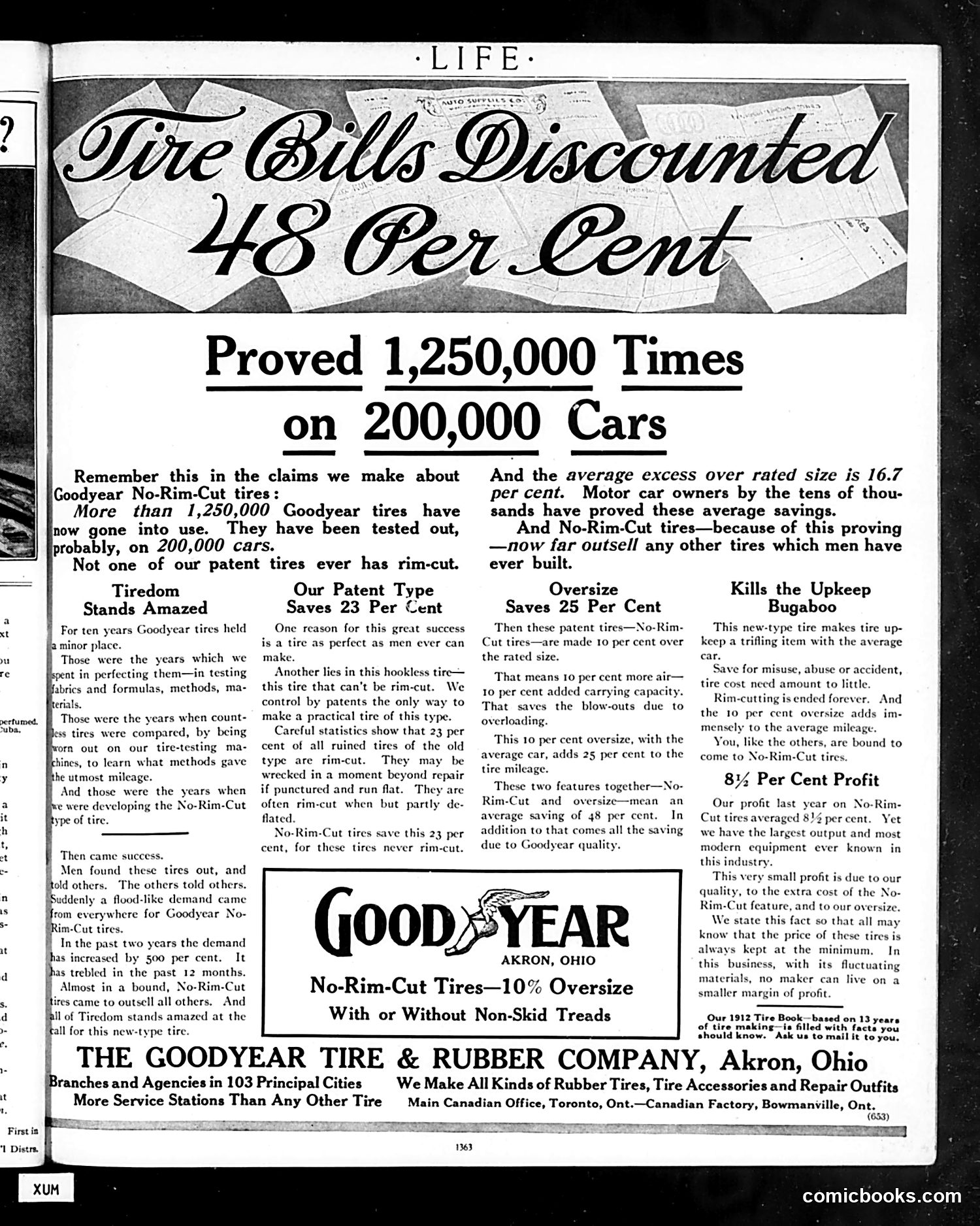
This is **not a cartoon or satire**—it's a full-page **advertisement for Goodyear tires** from *Life* magazine (appears to be circa 1912, based on references to "1912 Tire Book"). The ad makes marketing claims about Goodyear's "No-Rim-Cut" tire technology, emphasizing: - **Patent protection**: The hookless tire design prevents rim-cutting (a common failure mode), saving 23% of tire loss - **Oversize advantage**: Tires made 10% larger than rated size, adding carrying capacity and extending mileage by 25% - **Proof through volume**: Claims 1,250,000+ test instances across 200,000 cars The ad uses typical early-1900s advertising rhetoric—"amazing" success, "flood-like demand," increased sales—to build consumer confidence. It even includes a profit disclosure ("8½ per cent") to appear transparent and trustworthy. For modern readers, the key context: this represents early automotive-era marketing, when tire failure was a genuine concern and manufacturers competed heavily on mechanical innovation and durability.
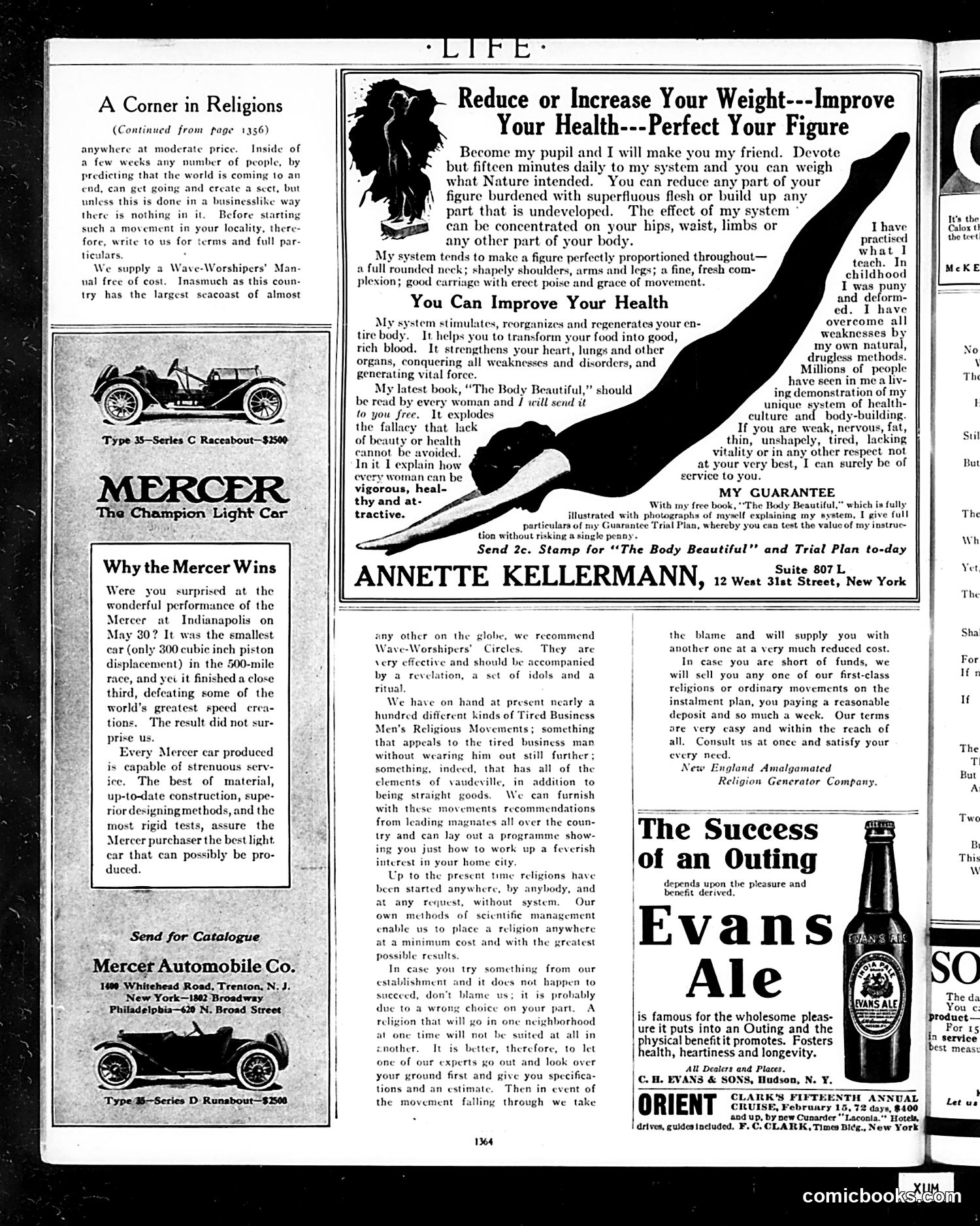
This page satirizes the commercialization of religion and fitness in early 20th-century America. **"A Corner in Religions" (left column):** Life mocks the ease of starting religious movements as a business venture. The satirical advice to entrepreneurs suggests that predicting the world's end is profitable if done "in a businesslike way." The joke: religion has become industrialized, with standardized "products" like "Wave-Worshipers' Manual" and "Tired Business Men's Religious Movements" sold at discount prices—treating spiritual faith as interchangeable consumer goods. **Annette Kellermann advertisement (center/right):** This features a famous swimmer-actress promoting her "Body Beautiful" system, claiming fifteen daily minutes can reshape the figure and cure ailments. The satire lies in the grandiose health claims and pseudo-scientific language ("reorganizes and regenerates your entire body") packaged to exploit consumer insecurity about appearance. **Mercer automobile ad (left):** Standard car advertising, not satirical. Both satirical sections target the American tendency to commodify and "package" intangible goods—spirituality and physical improvement—into purchasable systems, exploiting widespread anxieties through aggressive marketing.
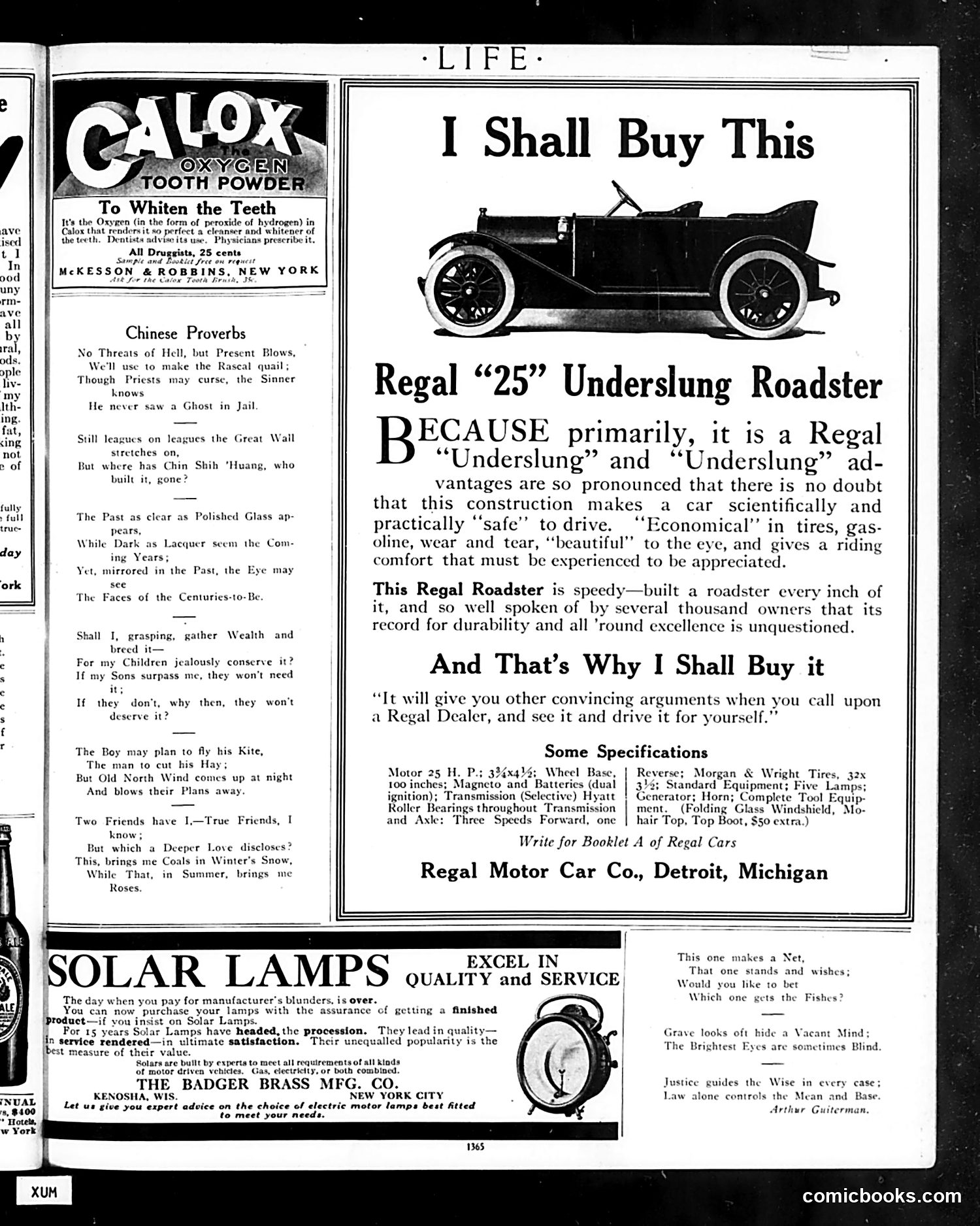
This page is primarily **advertising**, not political satire. It contains four major advertisements interspersed with poetry. The main content includes: 1. **Calox Tooth Powder ad** - promoting whitening via hydrogen peroxide, endorsed by dentists and physicians 2. **Regal "25" Underslung Roadster ad** - the dominant advertisement featuring an early automobile, emphasizing safety, economy, and comfort. The "underslung" design was a technical innovation of the era. 3. **Solar Lamps ad** - for motor vehicle electrical lighting 4. **Chinese Proverbs section** - a poetic filler piece about fate, wealth, and friendship with no satirical intent The page reflects early 1900s consumer culture, showcasing technological innovations (automobiles, electric lights) and promoting personal care products. There is **no political cartoon or meaningful satire** present—this appears to be a standard advertising-heavy magazine page from the era, with poetry used as padding between advertisements.
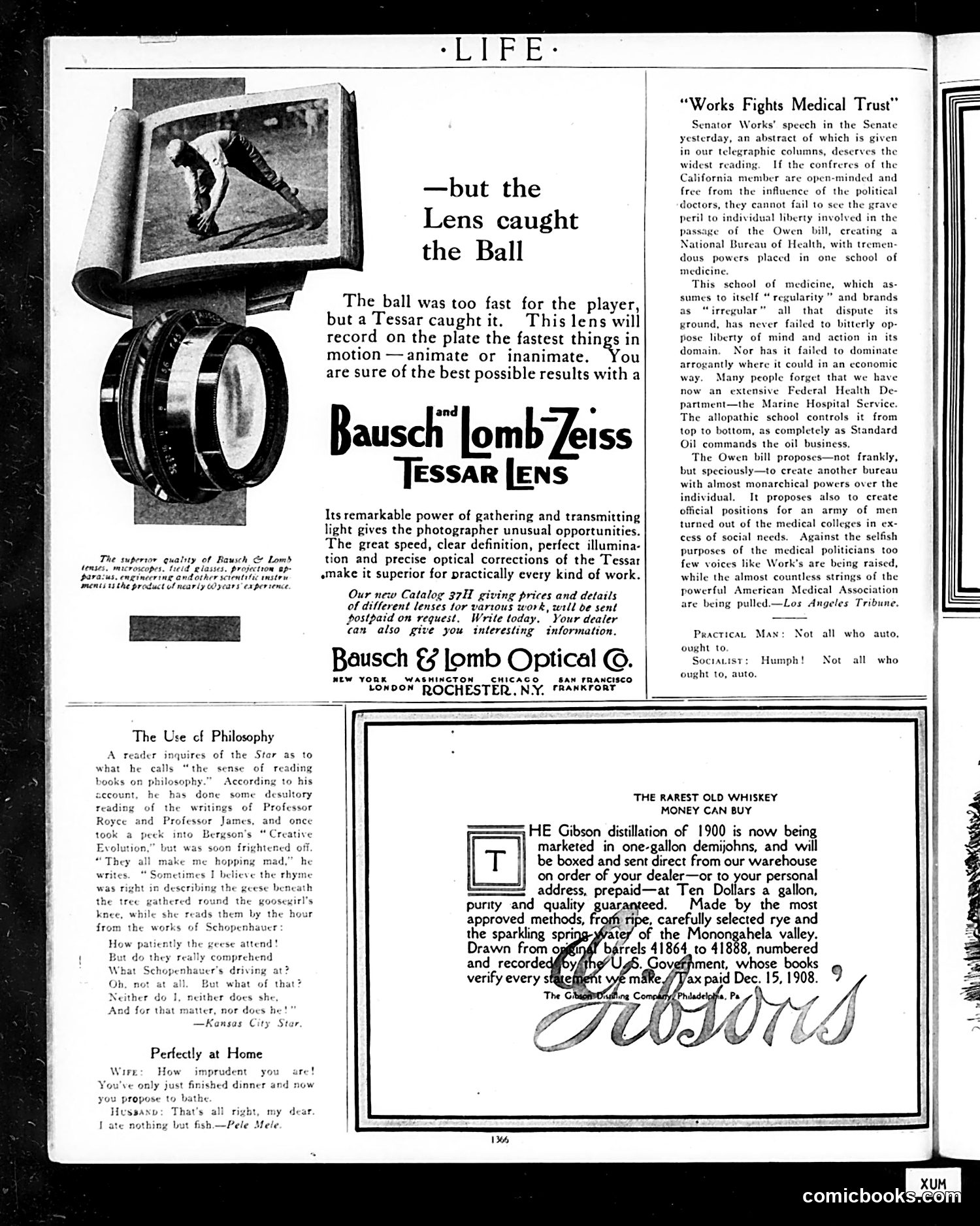
This page's main editorial content attacks the "Owen Bill," proposed federal health legislation. Senator Works of California is praised for opposing it as a threat to individual liberty. The article argues the bill would create a monopolistic "National Bureau of Health" controlled by allopathic (conventional) doctors—compared to Standard Oil's dominance of the oil industry. The critique claims this medical school unfairly brands competing practitioners as "irregular" and would wastefully create unnecessary positions for excess medical graduates. The piece presents this as a battle between individual freedom and institutional power, with the powerful American Medical Association portrayed as pulling strings behind the legislation. The Bausch & Lomb camera lens advertisement below is unrelated to the political content—it uses a sports photo to showcase the lens's ability to capture fast motion. The page reflects Progressive Era skepticism of concentrated institutional power and medical monopolies, particularly tensions between "regular" and alternative medicine practitioners.
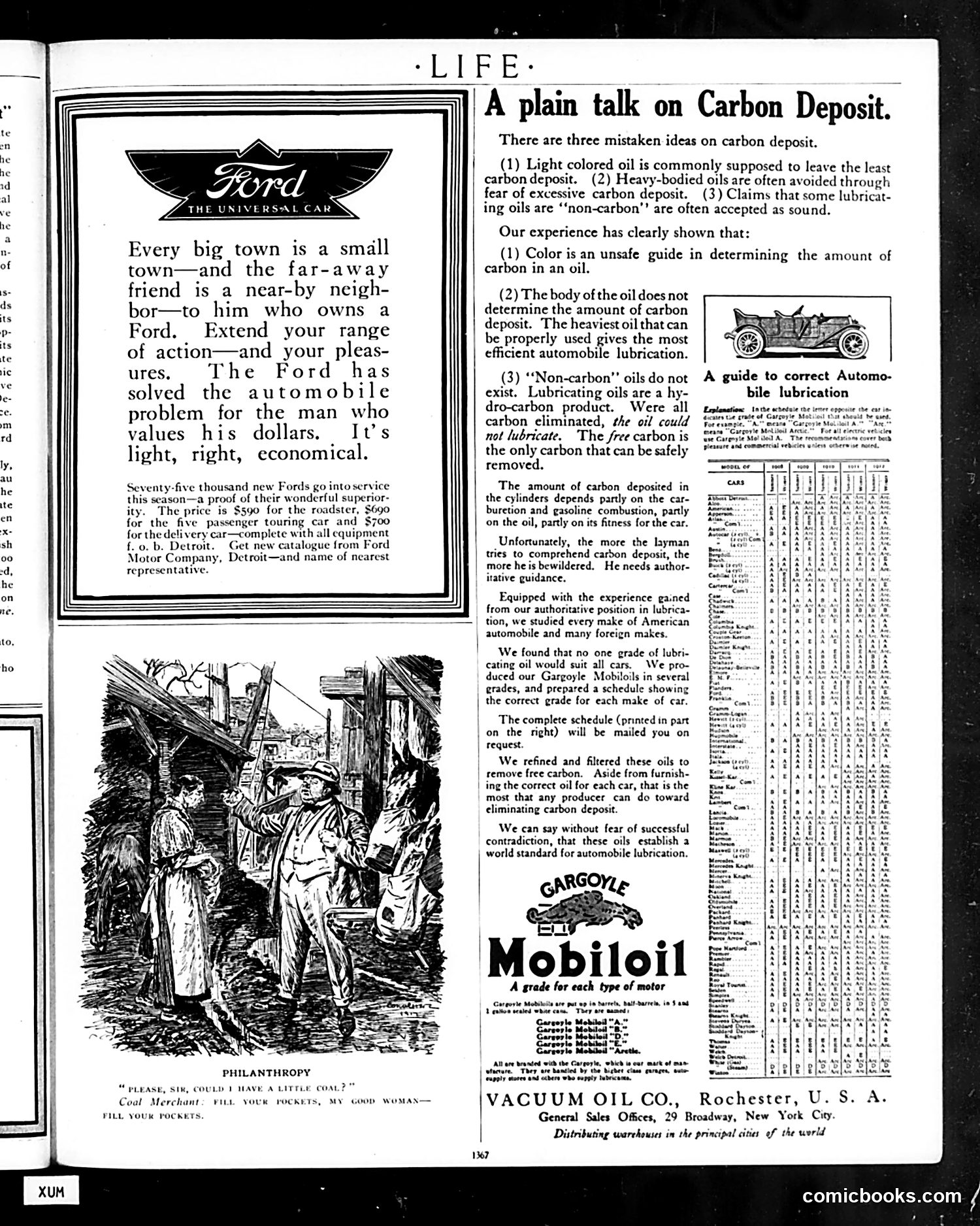
This page contains **two distinct pieces**: advertising and political satire. The **Ford advertisement** (top left) promotes automobiles as democratizing technology, claiming the Ford makes car ownership accessible to ordinary working men by solving "the automobile problem for the man who values his dollars." The **political cartoon** (bottom left, titled "Philanthropy") satirizes wealthy industrialists' hypocrisy. A well-dressed "Coal Merchant" refuses a poor person's request for coal with the callous phrase "Fill your pockets, my good woman—fill your pockets." The satire is obvious: the merchant suggests the destitute person simply fill their pockets with money to buy coal, completely ignoring their actual poverty and need. This reflects early 20th-century class tensions and criticism of the wealthy's indifference to working-class suffering, particularly regarding basic necessities like fuel during harsh winters. The remaining content is **motor oil advertising** (Gargoyle Mobiloil) presenting technical claims about carbon deposits.
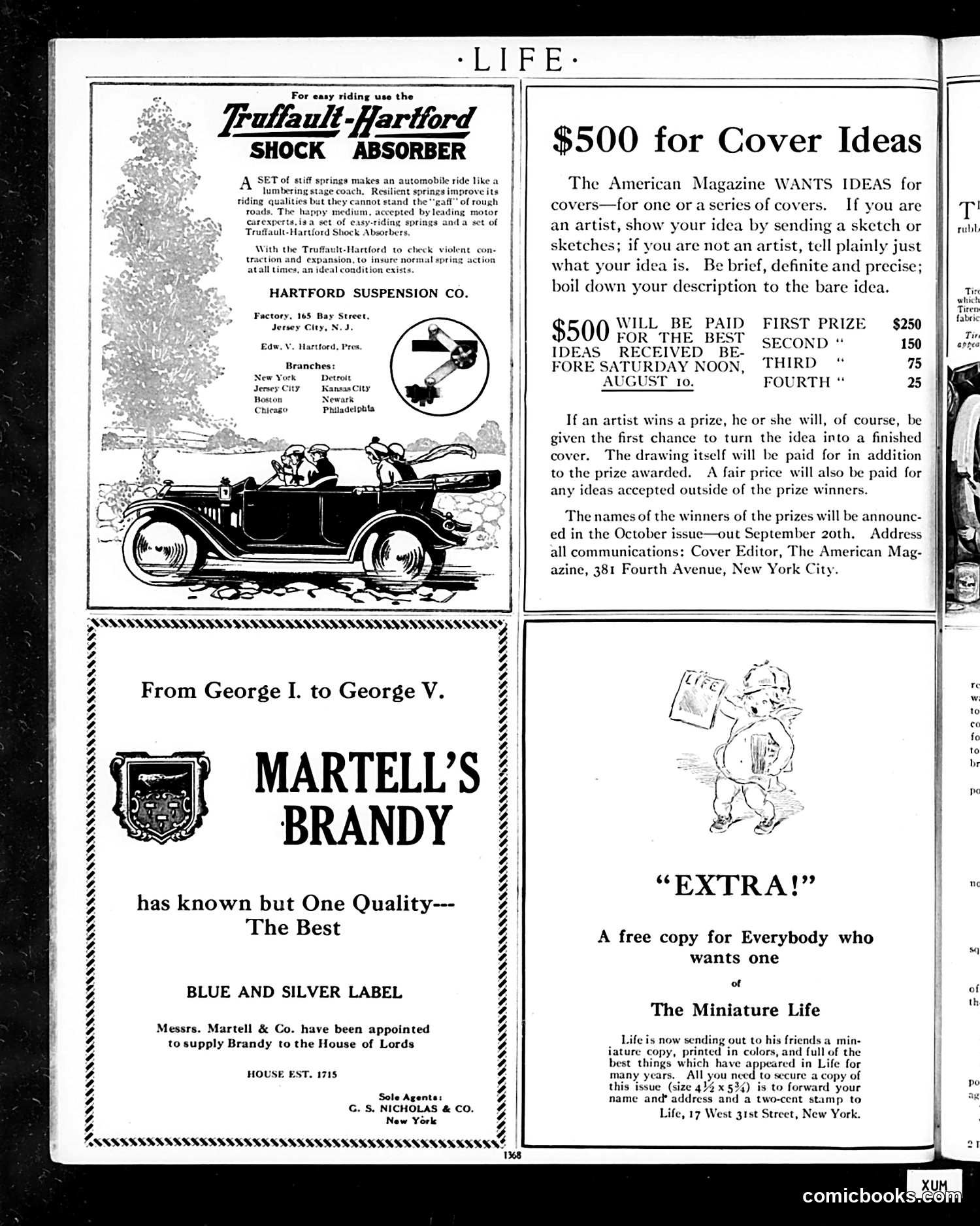
This page consists primarily of **advertisements** rather than editorial satire or political cartoons. The main ads are: 1. **Truffault-Hartford Shock Absorber** (top left): Promotes automobile suspension technology, featuring an illustration of an early 1900s car. The pitch emphasizes comfort on rough roads—a practical selling point when cars were new and roads poor. 2. **Martell's Brandy** (bottom left): A prestige liquor ad claiming centuries of quality ("From George I to George George V"), boasting royal appointment to the House of Lords. This appeals to tradition and social status. 3. **American Magazine Cover Contest** (top right): A call for artists to submit cover ideas for $500 prize money, with tiered awards. This represents the magazine soliciting reader participation. 4. **Life Magazine's Miniature Edition** (bottom right): Promotes a free miniature version of Life itself, requiring only name, address, and a two-cent stamp. **No political satire or caricature is present.** This is a straightforward advertising page from what appears to be an early 20th-century issue.
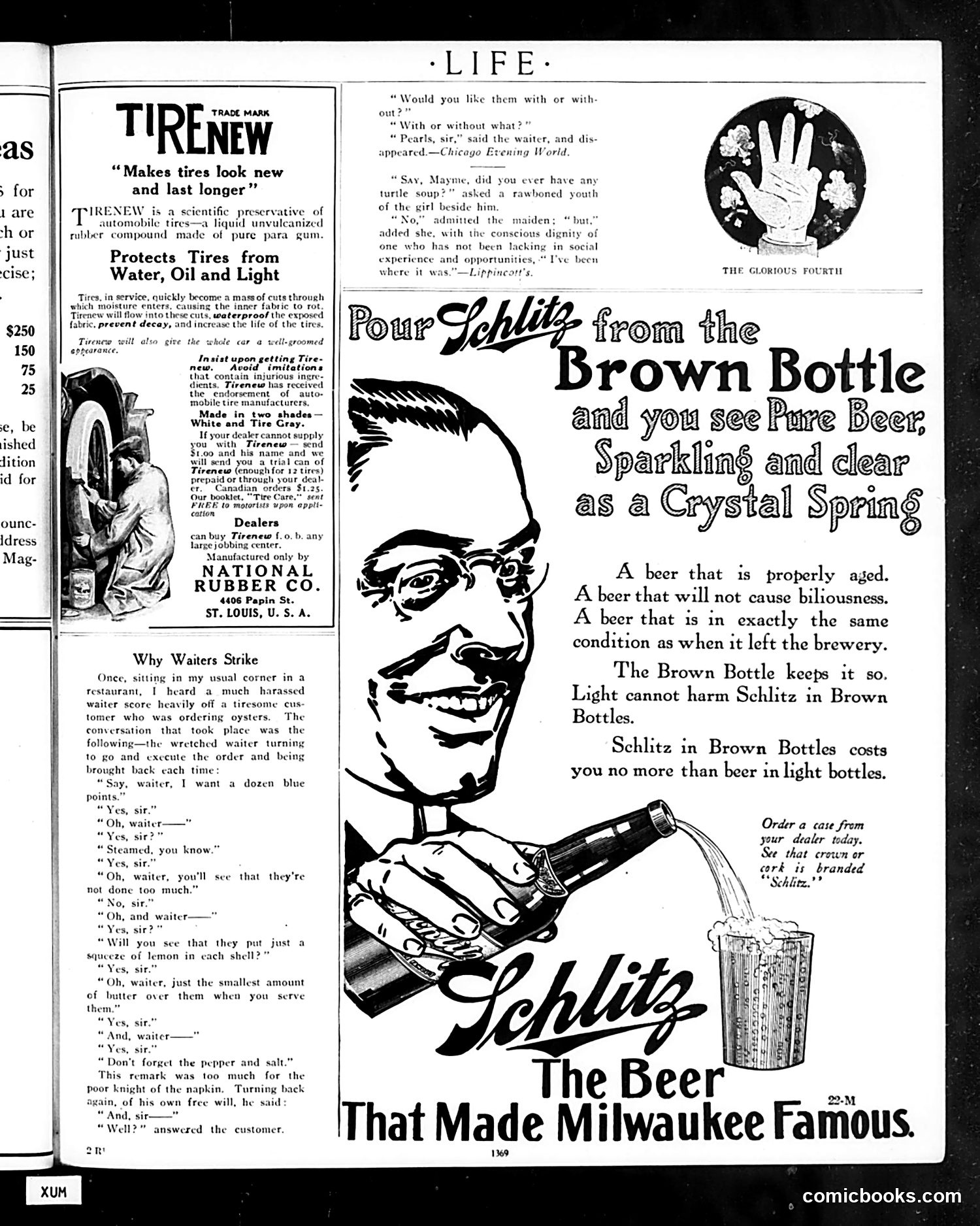
This page contains **three distinct pieces of content**: 1. **TIRENEW Advertisement** (left): A product ad for tire preservative, emphasizing protection from water, oil, and light damage. 2. **"Why Waiters Strike" (bottom left)**: A humorous anecdote about restaurant service. A demanding customer bombards a waiter with specific instructions for oyster preparation (steaming, lemon, butter, seasoning). Exasperated, the waiter sarcastically suggests the customer add "pearls"—implying the customer is being ridiculously fussy over minor details. The joke satirizes pretentious diners and explains worker frustration with unreasonable demands. 3. **Schlitz Beer Advertisement** (right): A large ad featuring a caricatured man pouring beer, promoting Schlitz in brown bottles. The copy emphasizes the beer is "properly aged," won't cause indigestion, and costs no more than light-bottled beer. The brown bottle allegedly protects beer from light damage. The page is **primarily advertising** with one brief satirical anecdote about working-class frustrations with customer service.
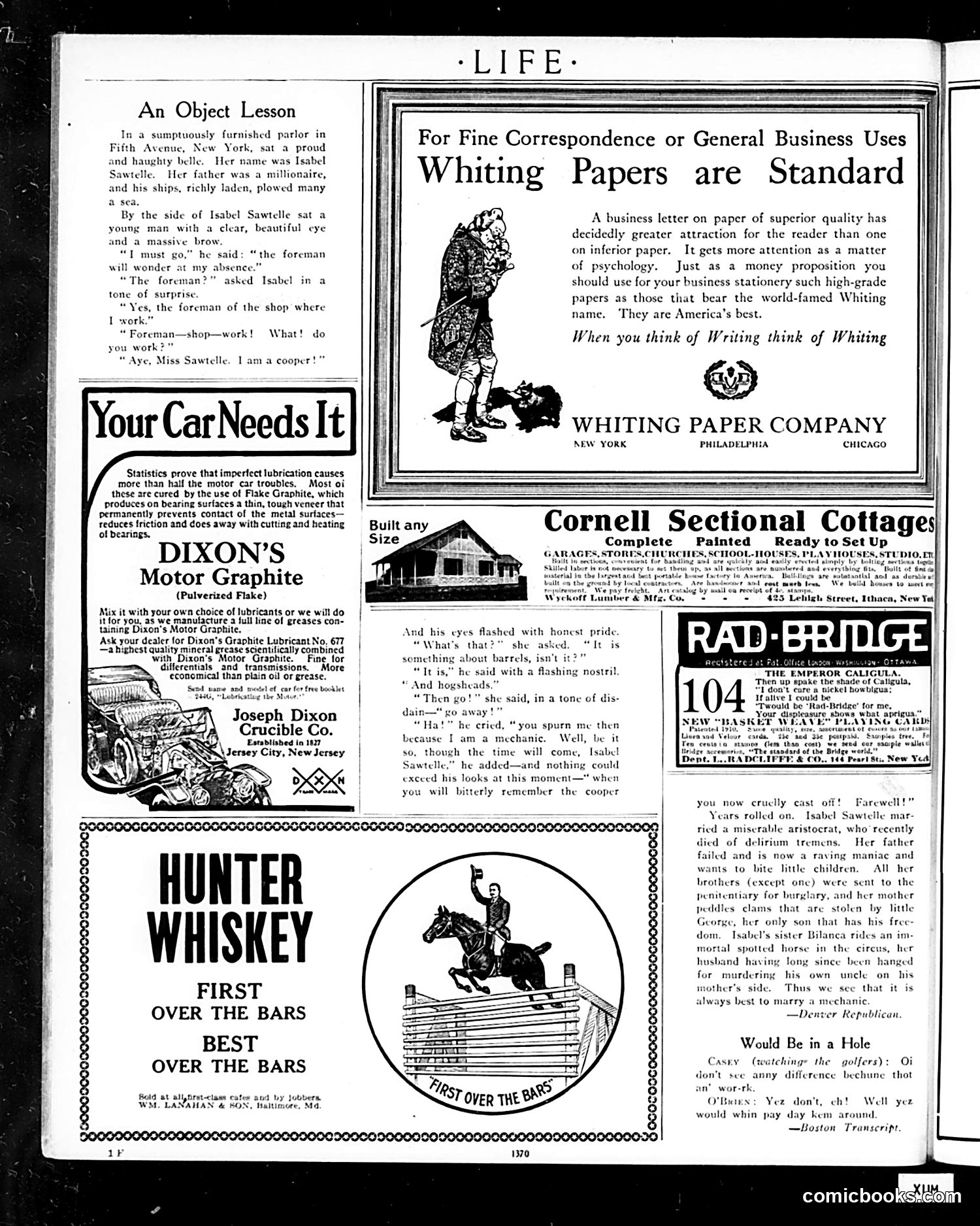
This page combines satirical fiction with period advertisements (typical for Life magazine). **"An Object Lesson" Story:** The narrative mocks class pretension. A wealthy Fifth Avenue belle, Isabel Sawtelle, dismisses a young cooper (barrel-maker) suitor because of his working-class status. The satire escalates absurdly: after she rejects him to marry an aristocrat, years of catastrophic family disasters follow—her husband dies of delirium tremens, her father goes mad, her brothers go to prison, her mother steals clams, her sister rides horses in the circus. The moral, credited to the *Denver Republican*, sarcastically concludes: "it is always best to marry a mechanic." **The Satire:** This attacks snobbish materialism and class prejudice, suggesting that marrying "down" to an honest working man would have been preferable to the chaos of aristocratic life. It's a morality tale dressed as dark comedy. **Advertisements:** The page includes typical early-1900s ads for motor graphite, writing paper, and whiskey—unrelated to the story but reflecting magazine revenue.
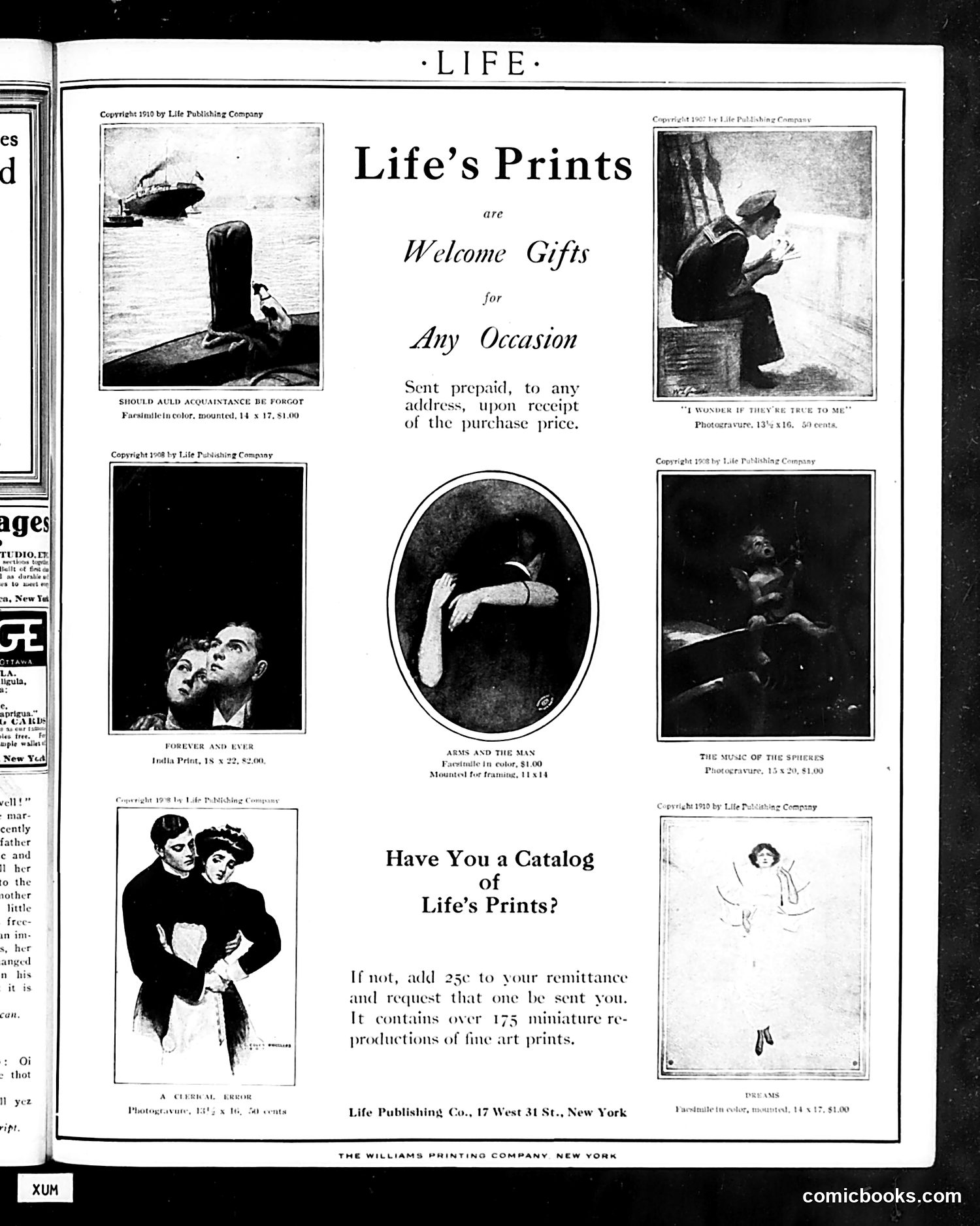
This is primarily a **Life magazine advertisement page** (circa 1910) promoting art prints rather than political satire. The page showcases sample prints available for purchase—romantic and sentimental scenes typical of early 20th-century popular art. The visible titles suggest conventional subject matter: "Should Auld Acquaintance Be Forgot" (nostalgic), "Forever and Ever" (romantic), "A Clerical Error" (likely humorous), and "Arms and the Man" (classical reference). One print shows figures in intimate embrace; another depicts what appears to be dreams or reverie. The satirical *Life* magazine itself was known for social commentary, but this particular page functions as a sales pitch, inviting readers to purchase art reproductions by mail for home decoration. The modest prices ($1–$2) and the catalog offer (175 miniature reproductions for 25¢ postage) reflect early mass-market art distribution. No specific political figures or dated references are evident; this reflects general commercial and aesthetic trends of the era rather than particular satire.
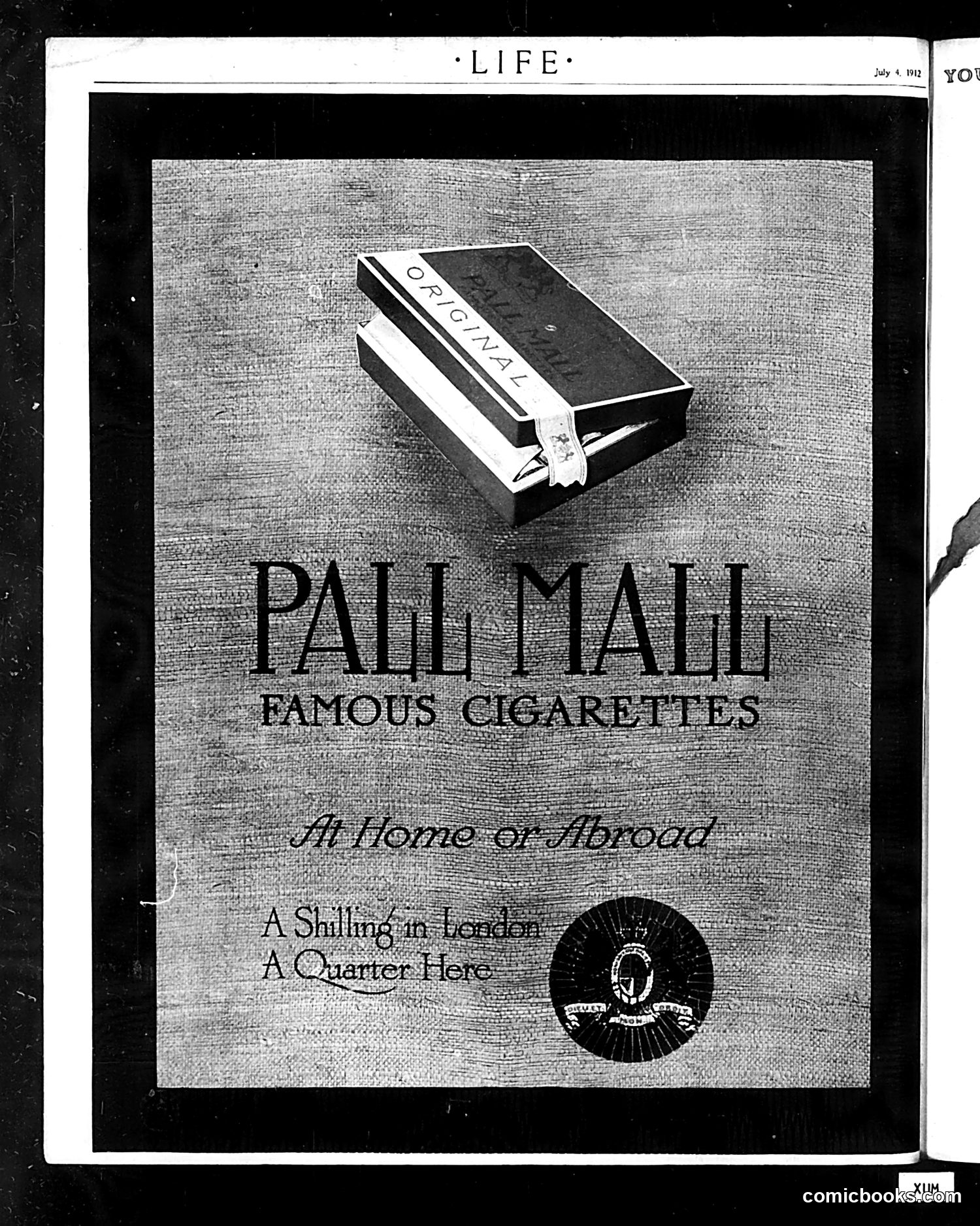
This is a Pall Mall cigarette advertisement from Life magazine, dated July 4, 1912. It's not a political cartoon but rather a commercial page promoting "Pall Mall Famous Cigarettes" with the tagline "At Home or Abroad." The ad emphasizes affordability ("A Shilling in London / A Quarter Here"), suggesting Pall Malls were competitively priced compared to British cigarettes. The imagery shows an elegant cigarette package with a ribbon, appealing to upscale consumers. This reflects early 20th-century advertising's focus on luxury goods and international commerce. The reference to London pricing indicates these were marketed as imported or premium products, even while being affordable to American consumers—a common marketing strategy of that era.