
Life, 1912-07-04 · page 26 of 44
Life — July 4, 1912 — page 26: what you’re looking at
What you’re looking at
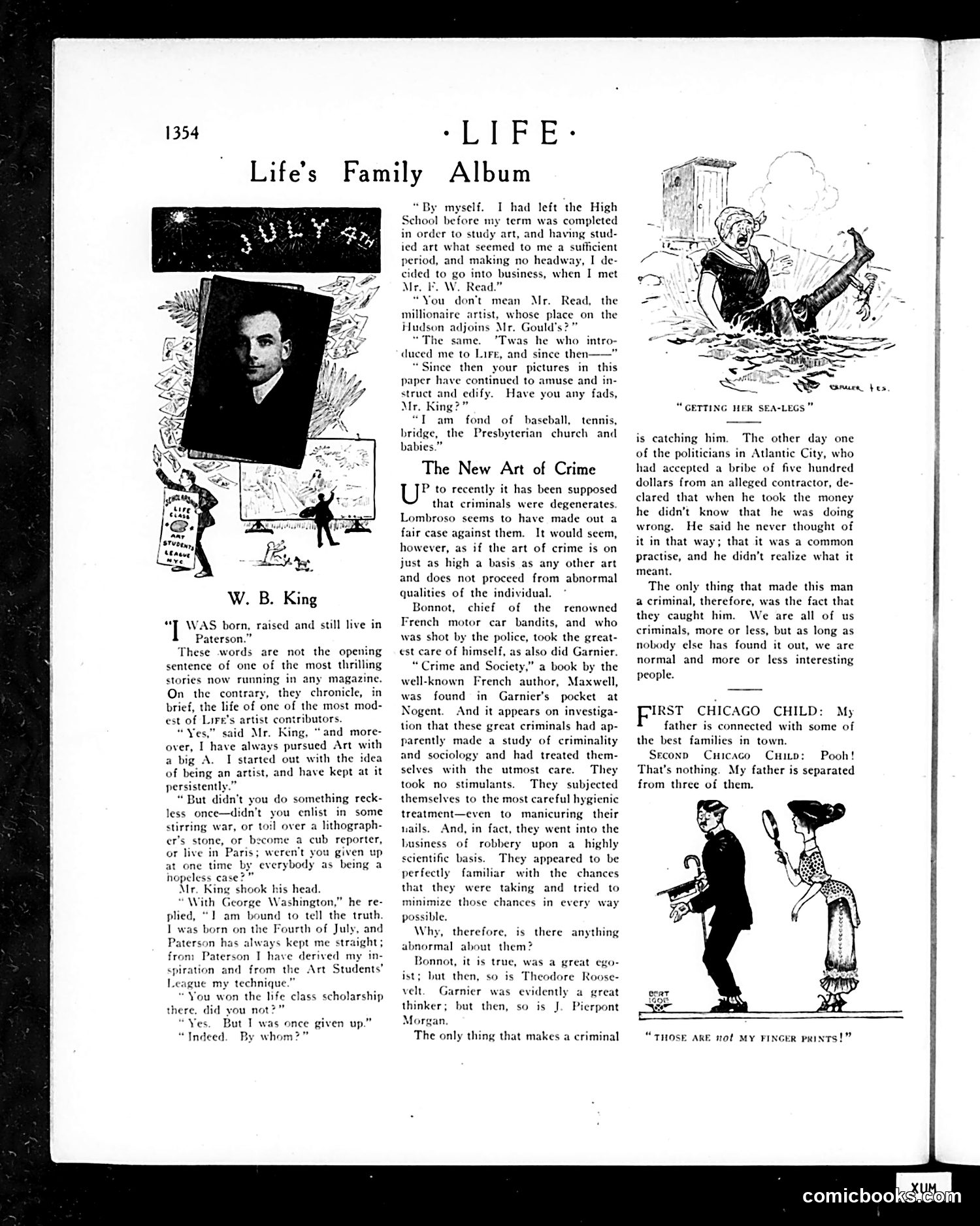
This page features W.B. King, a Life magazine cartoonist and artist, in a biographical profile titled "Life's Family Album." King recounts his modest career path: born in Paterson, New Jersey, he briefly abandoned art for business before being introduced to Life magazine by millionaire artist F.W. Read. He's presented as steady and unambitious—fond of baseball, tennis, and church. The article "The New Art of Crime" presents a satirical argument referencing real French criminals (Bonnot and Garnier) who studied criminology scientifically and maintained rigorous hygiene. The piece ironically compares their intellectual rigor to figures like Theodore Roosevelt and J.P. Morgan, suggesting criminality is merely "not getting caught"—a pointed social commentary equating respectable business practices with criminal behavior. The cartoons illustrate humorous domestic scenes, typical of Life's satirical humor of the era.
📄 Transcribed text from this page (OCR, searchable)
Machine-transcribed from the original scan — historical spelling and the odd misread are preserved.
Life’s W. B. King WAS born, raised and still live in Paterson.” These words are not the opening sentence of one of the most thrilling stories now running in any magazine. On the contrary, they chronicle, in brief, the life of one of the most mod- est of Lire’s artist contributors. “Yes,” said Mr. King, “and more- over, I have always pursued Art with a big A. I started out with the idea of being an artist, and have kept at it persistently.” But didn't you do something reck- less once—didn’t you enlist in some stirring war, or toil over a lithograph- cr’s stone, or become a cub reporter, or live in Paris; weren't you given up at one time by everybody as being a hopeless case? Mr. King shook his head. “With George Washington,” he re- plied, “1 am bound to tell the truth I was born on the Fourth of July, and Paterson has always kept me straight; from Paterson I have derived my in- spiration and from the Art Students’ League my technique. “You won the life class scholarship there. did you not “Yes, But I was once given up.” “Indeed. By who : Family ~LIFE- Album “By myself. I had left the High hool before my term was completed in order to study art, and having stud- ied art what seemed to me a sufficient period, and making no headway, I de- cided to go into business, when I met Mr. FW. Read.” “You don't mean Mr. Read, the millionaire artist, whose place on the Hudson adjoins Mr. Gould's?” “The same. 'Twas he who intro- duced me to Lire, and since then——” “Since then your pictures in this paper have continued to amuse and in- struct and edify. Have you any fads, Mr. King?” “Tam fond of baseball, tennis, bridge, the Presbyterian church and babies. The New Art of Crime P to recently it has been supposed that criminals were degenerates. Lombroso seems to have made out a fair case against them. It would seem, however, as if the art of crime is on just as high a basis as any other art and does not proceed from abnormal qualities of the individual, Bonnot, chief of the renowned French motor car bandits, and who was shot by the police, took the great- est care of himself, as also did Garnier. “Crime and Society,” a book by the well-known French author, Maxwell, was found in Garnier’s pocket at Nogent. And it appears on investiga- tion that these great criminals had ap- parently made a study of criminality and sociology and had treated them- selves with the utmost care. They took no stimulants. They subjected themselves to the most careful hygienic treatment—even to manicuring their nails. And, in fact, they went into the Lusiness of robbery upon a highly scientific basis. They appeared to be perfectly familiar with the chances that they were taking and tried to minimize those chances in every way possible. Why, therefore, is there anything abnormal about them? Zonnot, it is true, was a great ego- ist; but then, so is Theodore Roose velt. Garnier was evidently a great thinker; but then, so is J. Pierpont Morgan. The only thing that makes a criminal “GETTING HER SEA-LEGS is catching him. The other day one of the politicians in Atlantic City, who had accepted a bribe of five hundred dollars from an alleged contractor, de- clared that when he took the money he didn’t know that he was doing wrong. He said he never thought of it in that way; that it was a common practise, and he didn’t realize what it meant. The only thing that made this man a criminal, therefore, was the fact that they caught him. We are all of us criminals, more or less, but as long as nobody else has found it out, we are normal and more or less interesting people. IRST CHICAGO CHILD: My father is connected with some of the best families in town. Seconp Cuicaco Cuitp: Pooh! That's nothing. My father is separated from three of them. “THOSE ARE not MY FINGER paints!”