
Life, 1912-07-04 · page 21 of 44
Life — July 4, 1912 — page 21: what you’re looking at
What you’re looking at
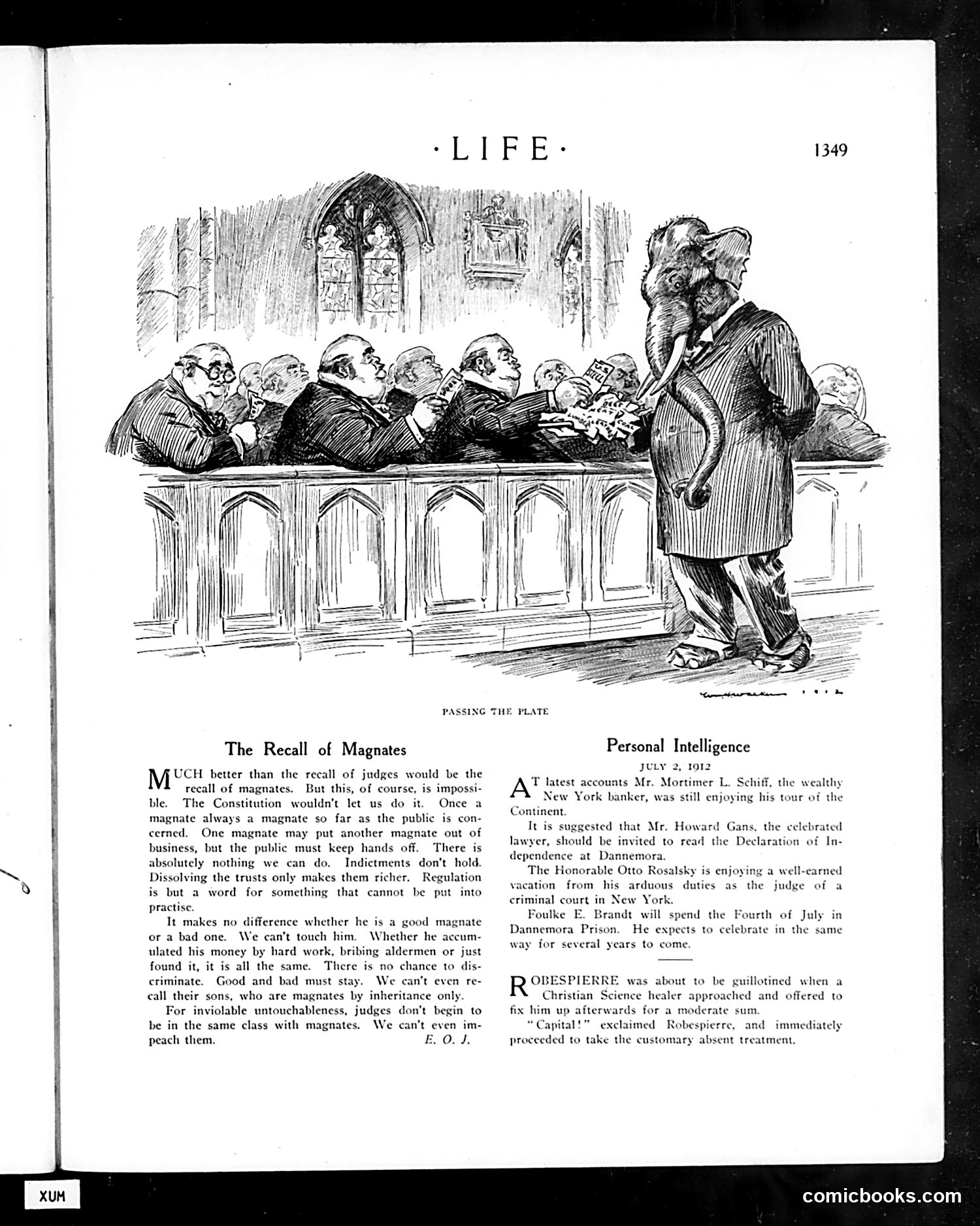
The cartoon depicts wealthy industrialists ("magnates") seated at what appears to be a judge's bench, while a caricatured figure on the right—appearing to be a working man or laborer—stands before them "passing the plate" (collecting money). **The satire:** The article argues that unlike judges, magnates cannot be "recalled" or removed by the public, despite their harmful behavior. They're untouchable by law whether corrupt or honest. The cartoon visualizes this irony: the wealthy sit in positions of power/judgment while ordinary citizens must contribute to them. **Context:** This reflects early 1900s Progressive Era frustration with corporate monopolies and wealthy industrialists who seemed immune to regulation or accountability. The "recall" movement sought to remove corrupt officials; the article sarcastically notes this remedy doesn't apply to business titans who wield equal or greater power. The cartoon suggests an inverted justice system where the powerful judge the powerless, rather than vice versa.
📄 Transcribed text from this page (OCR, searchable)
Machine-transcribed from the original scan — historical spelling and the odd misread are preserved.
PASSING THE PLATE The Recall of Magnates UCH better than the recall of judges would be the recall of magnates. But this, of course, is impossi- ble. The Constitution wouldn't let us do it. Once a magnate always a magnate so far as the public is con- cerned. One magnate may put another magnate out of business, but the public must keep hands off. There is absolutely nothing we can do. Indictments don't hold. Dissolving the trusts only makes them richer. Regulation is but a word for something that cannot be put into practise. It makes no difference whether he is a good magnate or a bad one. We can’t touch him. Whether he accum- ulated his money by hard work, bribing aldermen or just found it, it is all the same. There is no chance to dis- criminate. Good and bad must stay. We can’t even re- call their sons, who are magnates by inheritance only For inviolable untouchableness, judges don’t begin to be in the same class with magnates. We can’t even im- peach them. E.10.. J Personal Intelligence JULY 2, 1912 T latest accounts Mr. Mortimer L. Schiff, the wealthy New York banker, was still enjoying his tour of the Continent It is suggested that Mr. Howard Gans, the celebrated lawyer, should be invited to read the Declaration of In- dependence at Dannemora. The Honorable Otto Rosalsky is enjoying a well-earned vacation from his arduous duties as the judge of a criminal court in New York. Foulke E. Brandt will spend the Fourth of July in Dannemora Prison. He expects to celebrate in the same way for several years to come. OBESPIERRE was about to be guillotined when a Christian Science healer approached and offered to fix him up afterwards for a moderate sum, “Capital!” exclaimed Robespierre, and immediately proceeded to take the customary absent treatment, comicbooks.com