
Life, 1912-07-04 · page 24 of 44
Life — July 4, 1912 — page 24: what you’re looking at
What you’re looking at
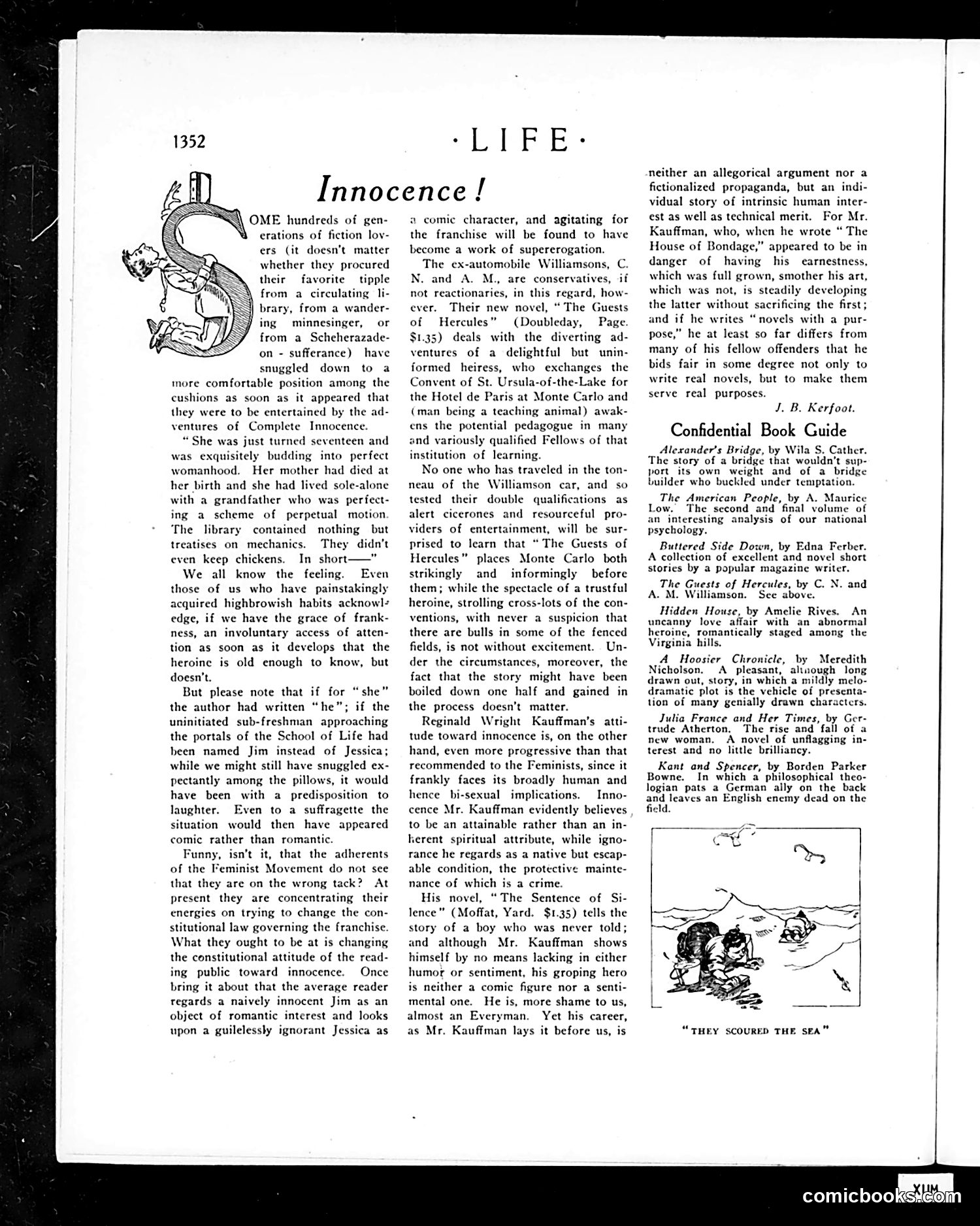
This 1912 *Life* magazine piece satirizes literary conventions and feminist politics through book criticism. The author argues that readers find naive young heroines ("Jessica") romantically appealing in fiction, but would find an equally ignorant young hero ("Jim") comic—revealing a double standard in how innocence is valued. The satire's target: feminists fighting for voting rights are "on the wrong tack." The author provocatively suggests they should instead change cultural attitudes that romanticize female ignorance, which would actually undermine the conditions enabling women's subordination. The piece reviews three novels, including Reginald Wright Kauffman's work, which "frankly faces" innocence's "bi-sexual implications"—suggesting innocence isn't inherent but achievable regardless of gender. The illustration shows figures "scourging the sea," though its specific connection to the text is unclear. The critique uses literary analysis as vehicle for social commentary on gender expectations and feminist strategy.
📄 Transcribed text from this page (OCR, searchable)
Machine-transcribed from the original scan — historical spelling and the odd misread are preserved.
\\ OME hundreds of gen- 4 erations of fiction lov- ers (it doesn’t matter whether they procured their favorite tipple from a circulating li- brary, from a wander- ing minnesinger, or from a Scheherazade- on - sufferance) have snuggled down to a more comfortable position among the cushions as soon as it appeared that they were to be entertained by the ad- ventures of Complete Innocence. “She was just turned seventeen and was exquisitely budding into perfect womanhood. Her mother had died at her birth and she had lived sole-alone with a grandfather who was perfect- ing a scheme of perpetual motion The library contained nothing but treatises on mechanics. They didn’t even keep chickens. In short——” We all know the feeling. Even those of us who have painstakingly acquired highbrowish habits acknowl- edge, if we have the grace of frank- ness, an involuntary access of atten- tion as soon as it develops that the heroine is old enough to know, but doesn’t. But please note that if for “she” the author had written “he”; if the uninitiated sub-freshman approaching the portals of the School of Life had been named Jim instead of Jessica; while we might still have snuggled ex- pectantly among the pillows, it would have been with a predisposition to laughter. Even to a suffragette the situation would then have appeared comic rather than romantic. Funny, isn’t it, that the adherents of the Feminist Movement do not see that they are on the wrong tack? At present they are concentrating their energies on trying to change the con- stitutional law governing the franchise. What they ought to be at is changing the constitutional attitude of the read- ing public toward innocence. Once bring it about that the average reader regards a naively innocent Jim as an object of romantic interest and looks upon a guilelessly ignorant Jessica as *LIFE: Innocence! 2 comic character, and agitating for the franchise will be found to have become a work of supererogation. The ex-automobile Williamsons, C. N. and A. M., are conservatives, i not reactionaries, in this regard, how- ever. Their new novel, “ The Guests of Hercules” (Doubleday, Page. $1.35) deals with the diverting ad- ventures of a delightful but unin- formed heiress, who exchanges the Convent of St. Ursula-of-the-Lake for the Hotel de Paris at Monte Carlo and (man being a teaching animal) awak- ens the potential pedagogue in many and variously qualified Fellows of that institution of learning. No one who has traveled in the ton- neau of the Williamson car, and so tested their double qualifications as alert cicerones and resourceful pro- viders of entertainment, will be sur- prised to learn that “The Guests of Hercules” places Monte Carlo both strikingly and informingly before them; while the spectacle of a trustful heroine, strolling cross-lots of the con- ventions, with never a suspicion that there are bulls in some of the fenced fields, is not without excitement. Un- der the circumstances, moreover, the fact that the story might have been boiled down one half and gained in the process doesn’t matter. Reginald Wright Kauffman’s atti- tude toward innocence is, on the other hand, even more progressive than that recommended to the Feminists, since it frankly faces its broadly human and hence bi-sexual implications. Inno- cence Mr. Kauffman evidently believes to be an attainable rather than an in- herent spiritual attribute, while igno- rance he regards as a native but escap- able condition, the protective mainte- nance of which is a crime. His novel, “The Sentence of Si- lence” (Moffat, Yard. $1.35) tells the story of a boy who was never told; and although Mr. Kauffman shows himself by no means lacking in cither humor or sentiment, his groping hero is neither a comic figure nor a senti- mental one. He is, more shame to us, almost an Everyman. Yet his career, as Mr. Kauffman lays it before us, is neither an allegorical argument nor a fictionalized propaganda, but an indi- vidual story of intrinsic human inter- est as well as technical merit. For Mr. Kauffman, who, when he wrote “ The House of Bondage,” appeared to be in danger of having his earnestness, which was full grown, smother his art, which was not, is steadily developing the latter without sacrificing the first; and if he writes “novels with a pur- pose,” he at least so far differs from many of his fellow offenders that he bids fair in some degree not only to write real novels, but to make them serve real purposes. J.B. Kerfoot. Confidential Book Guide Alexander's Bridge, by Wila S. Cather. The story of a bridge that wouldn't sup- port its own weight and of a bridge builder who buckled under temptation. The American People, by A. Maurice Low. The second and ‘final volume of an interesting analysis of our national psychology. Buttered Side Down, by Edna Ferber. A collection of excellent and novel short stories by a popular magazine writer. The Guests of Hercules, by C. N. and A. M. Williamson. See above. Hidden House, by Amelie Rives. An uncanny love affair with an abnormal heroine, romantically staged among the Virginia hills. A Hoosier Chronicle, by Meredith Nicholson. A pleasant,’ altnough long drawn out, story, in which a mildly melo- dramatic plot is the vehicle of presenta- tion of many genially drawn characters. Julia France and Her Times, by Ger- trude Atherton, The rise and ‘fall of a new woman. A novel of unflagging in- terest and no little brilliancy. Kant and Spencer, by Borden Parker Bowne. In which a’ philosophical theo- logian pats a German ally on the back and leaves an English enemy dead on the icld. comicbookt be 7